

Paper Menu >>
Journal Menu >>
 Psychology 2012. Vol.3, No.2, 208-212 Published Online February 2012 in SciRes (http://www.SciRP.org/journal/psych) http://dx.doi.org/10.4236/psych.2012.32029 Copyright © 2012 SciRes. 208 Psychology Students’ Beliefs about Integrating Complementary and Alternative Therapy (CAT) into Their Future Psychology Practice Lee-Ann M. Wilson1, Kyra Hamilton2, Katherine M. White2 1School of Public Health, Queensland University o f Technology, Brisbane, Australia 2School of Psychology and Counselling, Queensland University of Technology, Brisbane, Australia Email: [email protected] Received November 22nd, 2011; revised December 23rd, 2011; accepted January 27th, 2012 We investigated whether belief-based differences exist between students who have strong and weak in- tentions to integrate complementary and alternative therapy (CAT) into future psychology practice by recommending CAT or specific CAT practitioners to clients. A cross-sectional methodology was used. Psychology undergraduate students (N = 106) participated in a paper-based questionnaire design to ex- plore their underlying beliefs related to CAT integration. The study was undertaken at a major university in Queensland, Australia. The theory of planned behaviour belief-based framework guided the study. Multivariate analyses of variance examined the influence of behavioural, normative, and control beliefs on the strong and weak intention groups. A multiple regression analysis investigated the relative impor- tance of these belief sets for predicting intentions. We found that clear differences emerged between strong and weak intenders on behavioural and normative beliefs, but not control beliefs. Strong intenders perceived the positive outcomes of integrating CAT, such as being able to offer clients a more holistic practice and having confidence in the practitioners/practices, as more likely to occur than weak intenders, and perceived the negative outcome of compromising my professional practice as less likely. Strong in- tenders were more likely than weak intenders to perceive that a range of important referents (e.g., clients) would think they should integrate CAT. Results of the regression analysis revealed the same pattern of results in that behavioural and normative beliefs, but not control beliefs, significantly predicted intentions. The findings from this study can be used to inform policy and educational initiatives that aim to encour- age CAT use in psychology practice. Keywords: Integrating Complementary Therapy; Psychology Practice; Psychology Student; Theory of Planned Behaviour; Beliefs Introduction Recent research sugge sts that many individuals with mental health disorders seek the advice of naturopaths, or combine yoga, meditation, or herbal therapies with their traditional psychotherapy (Page, Jones, & Wilson, 2004; Australian Bu- reau of Statistics, 2004-2005). While significant research has been conducted exploring medical practitioners’ attitudes and perceptions toward complementary and alternative therapies (CAT) (Halcon, Chlan, Kreitzer, & Leonard, 2003; Hyland, Lewith, & Westoby, 2003; Lewith, Hyland, & Shaw, 2002), there is an absence of similar investigati ons within the field of psychology. Although some previous research has attempted to explore differences between medical and social science students’ (predominately psychology students) attitudes to- ward complementary medical practitioners and medical treatment preferences (Yardley, Fahmy, Jamie, & Furnham, 1999), no previous study has tried to demonstrate the key perceptions underlying psychology students’ decisions re- garding integrating CAT into their future professional prac- tice. Current research suggests that psychologists are integrating CAT into psychological practice via recommending CAT to clients, offering clients referrals to CAT practitioners, or ac- cessing training in CAT therapies to integrate these therapies into practice (Bassman & Uellendahl, 2003). Previous research, although somewhat limited, has found that psychologists are recommending CAT generally at relatively high rates and at significantly higher rates than they are offering specific refer- rals to CAT practitioners (Bassman & Uellendahl, 2003). However, little is known about how psychology students, who are the next cohort of health professionals and who will be in a position to direct future initiatives in the field, perceive inte- grating CAT into psychology practice. A qualitative pilot study examining psychology students’ and practicing psychologists’ attitudes and beliefs about CAT integration revealed that stu- dents are generally positive about CAT integration but indi- cated that they were largely unaware of the professional impli- cations of the various integration choices, and their responses did not vary much between the different integration scenarios (i.e., they saw much the same implications between training themselves in CAT, recommending CAT to clients, and refer- ring clients to CAT practitioners) (Wilson & White, 2011). Students focused on the potential benefits to clients, such as being able to offer a broader range of treatment options. Given that previous research has found examining attitudes and beliefs useful in understanding CAT practices in general (Chua & Furnham, 2008), having an understanding of the ways in which  LEE-A. M. WILSON ET AL. underlying beliefs guide psychology students’ decisions about whether to integrate CAT into future practice might also be useful to inform both clinical practice policy and educational initiatives. The Theory of Planned Behaviour (TPB; Ajzen, 1991) is a well validated decision-making model that allows for an ex- amination of people’s underlying beliefs and has much support in the social and health domains (see Armitage & Christian, 2003). According to the TPB, intention to perform a given be- haviour and the individual’s actual control over performing the behaviour predict behavioural performance. Intention, in turn, is influenced by the degree to which a person is in favour of performing a particular behaviour (attitude), the degree to which a person feels social pressure to perform a behaviour (subjective norms), and the degree to which a person feels they have control over performing the behaviour (perceived behav- ioural control) (Ajzen, 1991). Underlying the TPB is the as- sumption that the antecedents of attitude, subjective norms, and perceived behavioural control are corresponding behavioural (costs and benefits), normative (pressure to comply with im- portant others’ approval/disapproval), and control beliefs (mo- tivating or inhibiting factors), respectively, that reflect an indi- vidual’s intention and subsequent behaviour (Ajzen, 1991). Assessing the belief-based determinants of attitude, subjective norms, and perceived behavioural control allows researchers to establish the beliefs that differentiate those who perform a given behaviour from those who do not. A number of studies have explored these underlying beliefs in order to increase un- derstanding of health behaviours, including CAT practices (O’Conner & White, 2009; Pawlak et al., 2008; Wilson & White, 2008). Using the TPB as a theoretical framework, this study aims to investigate the beliefs that differentiate those psychology stu- dents who have strong and weak intentions to integrate CAT into future psychology practice by either recommending CAT to clients or referring clients to specific CAT practitioners. Specifically, the study assessed psychology students’ beliefs relating to the costs and benefits associated with recommending or referring CAT to clients (behavioural beliefs), beliefs about which important referents would approve or disapprove of their recommending or referring CAT (normative beliefs), and be- liefs about inhibiting factors (control beliefs) for recommending or referring CAT to clients. Method Participants Participants (N = 106) were psychology undergraduate stu- dents from a major Australian university. The majority of the students was enrolled in first year psychology units (89%) and indicated a preference of clinical (42%) or counseling (32%) psychology as their future area of professional interest. The study comprised of 77 females and 29 males and the mean age of participants was 24.55 years (SD = 10.46 years). Measures The target behaviour assessed students’ beliefs about inte- grating CAT into future psychology practice by either rec- ommending CAT to clients or referring clients to specific CAT practitioners. The two behaviours, recommending and referring, were combined as pilot research utilising semi- structured interviews indicated that students did not differen- tiate between the professional implications or clients out- comes associated with these two practices (Wilson & White, 2011). CAT was operationalised as: “A group of diverse medical and health care systems, practices, and products that are not presently considered to be part of conventional medi- cine”. This definition is consistent with the National Centre for Complementary and Alternative Medicines (2006). The pilot study which involved both practicing psychologists and psychology students was conducted (N = 12; 6 psychologists and 6 students) to elicit the salient behavioural, normative, and control beliefs (8) as recommended by Fishbein and Ajzen (1975). Using content analysis, the most commonly reported advantages (e.g., being able to offer clients a more holistic practice) and disadvantages (e.g., not being able to follow up client progress with CAT), referents approving or disapproving (e.g., employers), and factors preventing inte- grating CAT into future psychology practice by recommend- ing or referring CAT (e.g., lack of knowledge about relevant CATs) reported by students were used to assess the behav- ioural, normative, and control belief-based measures, respec- tively, in the present study. All belief-based items we re scored on 7-point Likert scale s, scored extremely unlikely (1) to extremely likely (7). To assess behavioural beliefs, participants were asked to rate how likely two costs and two benefits would result if they integrated CAT into a future psychology practice by recommending CAT or specific CAT practitioners to clients. For normative beliefs, participants were asked to rate how likely four refer- ents would think they should integrate CAT into a future psychology practice by recommending CAT or specific CAT practitioners to clients. Participants indicating how likely internal and external factors would prevent them from inte- grating CAT into a future psychology practice by recom- mending CAT or specific CAT practitioners to clients as- sessed control beliefs. It should be noted that internal consis- tency is not a necessary feature of belief composites as no assumption is made that the salient beliefs are internally con- sistent (Ajzen, 1991); thus, alpha coefficients were not com- puted for the behavioural , normative, a nd control bel ief-based measures. For a full listing of the belief-based items, see Ta- ble 1. The outcome measure of intention was measured on a single item scale. Students were asked to respond to the ques- tion: “I intend (1), do not intend (7) to integrate CAT into a future p sychology practice by recomme nding CAT or specifi c CAT practitioners to clients?” For analyses, intention scores were recoded such that higher scores were associated with stronger intentions. Furthermore, for belief-based analyses, responses were recoded to indicate those who had weak (scores 1.0 to 4.0) and strong intentions (scores 4.0 to 7.0) to perform the target behaviour. Procedure Prior to any data collection, the university human research ethics committee approved the study. Students were informed about the opportunity to participate in the study during one of their regularly scheduled classes. At the end of the class, stu- dents who were willing to participate were able to complete and return their survey before leaving. The student participants were offered a small number of credit points towards a research participation mark in their psychology class as a thank you for Copyright © 2012 SciRes. 209 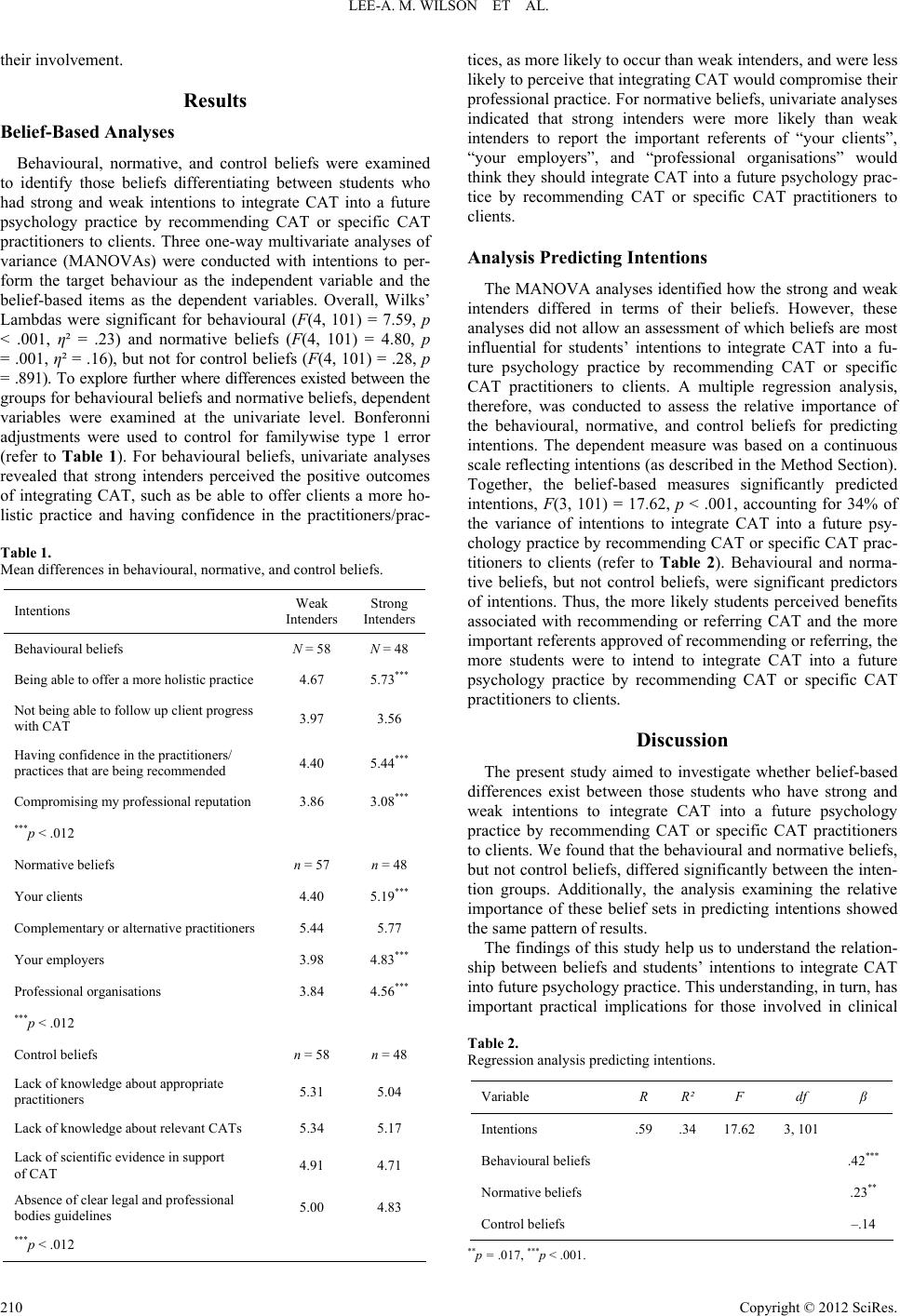 LEE-A. M. WILSON ET AL. their involvement. Results Belief-B ased Analyses Behavioural, normative, and control beliefs were examined to identify those beliefs differentiating between students who had strong and weak intentions to integrate CAT into a future psychology practice by recommending CAT or specific CAT practitioners to clients. Three one-way multivariate analyses of variance (MANOVAs) were conducted with intentions to per- form the target behaviour as the independent variable and the belief-based items as the dependent variables. Overall, Wilks’ Lambdas were significant for behavioural (F(4, 101) = 7.59, p < .001, η² = .23) and normative beliefs (F(4, 101) = 4.80, p = .001, η² = .16), but not for control beliefs (F(4, 101) = .28, p = .891). To explore further where differences existed between the groups for behavioural beliefs and normative beliefs, dependent variables were examined at the univariate level. Bonferonni adjustments were used to control for familywise type 1 error (refer to Table 1). For behavioural beliefs, univariate analyses revealed that strong intenders perceived the positive outcomes of integrating CAT, such as be able to offer clients a more ho- listic practice and having confidence in the practitioners/prac- Table 1. Mean differences in behavioural, norm ative, and control beliefs. Intentions Weak Intenders Strong Intenders Behavioural be liefs N = 58 N = 48 Being able t o o ffer a more holistic practice 4.67 5.73*** Not being able to follow up client p rogress with CAT 3.97 3.56 Having confidence in the practitioners/ practices that are being recommended 4.40 5.44*** Compromising my professional re putation 3.86 3.08*** ***p < .012 Normative bel iefs n = 57 n = 48 Your clients 4.40 5.19*** Complementary or alternative p ractitioners 5.44 5.77 Your employers 3.98 4.83*** Professional organisations 3.84 4.56*** ***p < .012 Control beliefs n = 58 n = 48 Lack of knowledge about appropri ate practitioners 5.31 5.04 Lack of knowledge about relevant CATs 5.34 5.17 Lack of scienti fi c evidence i n support of CAT 4.91 4.71 Absence of clear legal and professional bodies guidelines 5.00 4.83 ***p < .012 tices, as more likely to occur than weak intenders, and were less likely to perceive that integrating CAT would compromise their professional practice. For normative beliefs, univa riate analy ses indicated that strong intenders were more likely than weak intenders to report the important referents of “your clients”, “your employers”, and “professional organisations” would think they should integrate CAT into a future psychology prac- tice by recommending CAT or specific CAT practitioners to clients. Analysis Predicting Intentions The MANOVA analyses identified how the strong and weak intenders differed in terms of their beliefs. However, these analyses did not allow an assessment of which beliefs are most influential for students’ intentions to integrate CAT into a fu- ture psychology practice by recommending CAT or specific CAT practitioners to clients. A multiple regression analysis, therefore, was conducted to assess the relative importance of the behavioural, normative, and control beliefs for predicting intentions. The dependent measure was based on a continuous scale reflecting intentions (as described in the Method Section). Together, the belief-based measures significantly predicted intentions, F(3, 101) = 17.62, p < .001, accounting for 34% of the variance of intentions to integrate CAT into a future psy- chology practice by recommending CAT or specific CAT prac- titioners to clients (refer to Table 2). Behavioural and norma- tive beliefs, but not control beliefs, were significant predictors of intentions. Thus, the more likely students perceived benefits associated with recommending or referring CAT and the more important referents approved of recommending or referring, the more students were to intend to integrate CAT into a future psychology practice by recommending CAT or specific CAT practitioners to clients. Discussion The present study aimed to investigate whether belief-based differences exist between those students who have strong and weak intentions to integrate CAT into a future psychology practice by recommending CAT or specific CAT practitioners to clients. We found that the behavioural and normative beliefs, but not control beliefs, differed significantly betwee n the inten- tion groups. Additionally, the analysis examining the relative importance of these belief sets in predicting intentions showed the same pattern of results. The findings of this study help us to understand the relation- ship between beliefs and students’ intentions to integrate CAT into future psychology practice. This understanding, in turn, has important practical implications for those involved in clinical Table 2. Regression analysis pr ed i c ti n g i n te n t io n s . Variable R R² F df β Intentions .59.34 17.62 3, 101 Behavioural be liefs .42*** Normative beliefs .23** Control belief s –.14 **p = .017, ***p < .001. Copyright © 2012 SciRes. 210 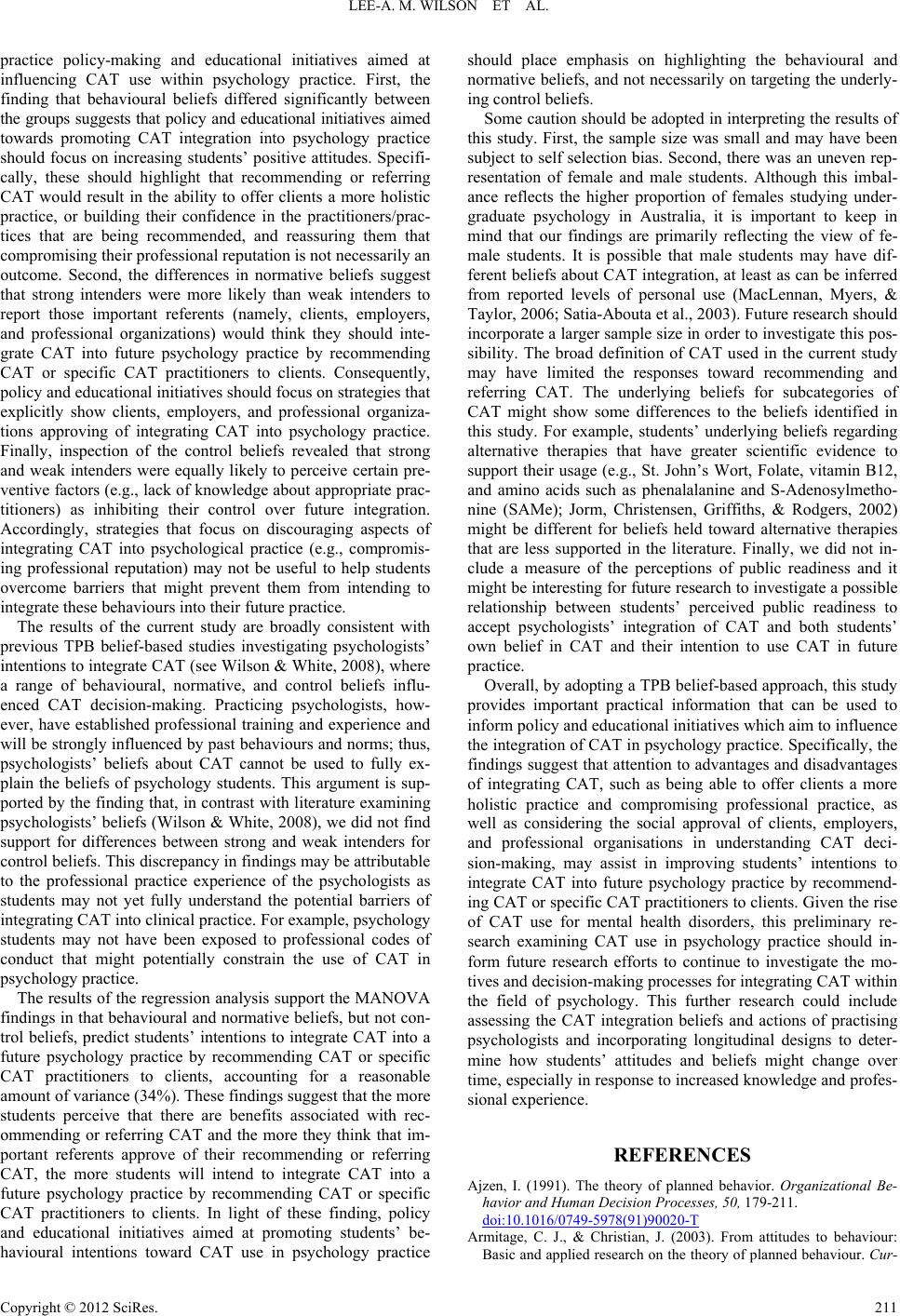 LEE-A. M. WILSON ET AL. practice policy-making and educational initiatives aimed at influencing CAT use within psychology practice. First, the finding that behavioural beliefs differed significantly between the groups suggests that policy and educational initiatives aimed towards promoting CAT integration into psychology practice should focus on increasing students’ positive attitudes. Specifi- cally, these should highlight that recommending or referring CAT would result in the ability to offer clients a more holistic practice, or building their confidence in the practitioners/prac- tices that are being recommended, and reassuring them that compromising their professional reputation is not necessarily an outcome. Second, the differences in normative beliefs suggest that strong intenders were more likely than weak intenders to report those important referents (namely, clients, employers, and professional organizations) would think they should inte- grate CAT into future psychology practice by recommending CAT or specific CAT practitioners to clients. Consequently, policy and educational initiatives should focus on strategies that explicitly show clients, employers, and professional organiza- tions approving of integrating CAT into psychology practice. Finally, inspection of the control beliefs revealed that strong and weak intenders were equally likely to perceive certain pre- ventive factors (e.g., lack of knowledge about appropriate prac- titioners) as inhibiting their control over future integration. Accordingly, strategies that focus on discouraging aspects of integrating CAT into psychological practice (e.g., compromis- ing professional reputation) may not be useful to help students overcome barriers that might prevent them from intending to integrate these behaviours into their future practice. The results of the current study are broadly consistent with previous TPB belief-based studies investigating psychologists’ intentions to integrate CAT (see Wilson & White, 2008), where a range of behavioural, normative, and control beliefs influ- enced CAT decision-making. Practicing psychologists, how- ever, have established professional training and experience and will be strongly influenced by past behaviours and norms; thus, psychologists’ beliefs about CAT cannot be used to fully ex- plain the beliefs of psychology students. This argument is sup- ported by the finding that, in contrast with literature examining psychologists’ beliefs (Wilson & White, 2008), we did not find support for differences between strong and weak intenders for control beliefs. This discrepancy in findings may be attributable to the professional practice experience of the psychologists as students may not yet fully understand the potential barriers of integrating CAT into clinical practice. For example, psychology students may not have been exposed to professional codes of conduct that might potentially constrain the use of CAT in psychology practice. The results of the regression analysis support the MANOVA findings in that behavioural and normative beliefs, but not con- trol beliefs, predict students’ intentions to integrate CAT into a future psychology practice by recommending CAT or specific CAT practitioners to clients, accounting for a reasonable amount of variance (34%). These findings suggest that the more students perceive that there are benefits associated with rec- ommending or referring CAT and the more they think that im- portant referents approve of their recommending or referring CAT, the more students will intend to integrate CAT into a future psychology practice by recommending CAT or specific CAT practitioners to clients. In light of these finding, policy and educational initiatives aimed at promoting students’ be- havioural intentions toward CAT use in psychology practice should place emphasis on highlighting the behavioural and normative beliefs, and not necessarily on targeting the underly- ing co ntrol beliefs. Some caution should be adopted in interpreting the results of this study. First, the sample size was small and may have been subject to self selection bias. Second, there was an uneven rep- resentation of female and male students. Although this imbal- ance reflects the higher proportion of females studying under- graduate psychology in Australia, it is important to keep in mind that our findings are primarily reflecting the view of fe- male students. It is possible that male students may have dif- ferent beliefs about CAT integration, at least as can be inferred from reported levels of personal use (MacLennan, Myers, & Taylor, 2006; Satia-Abouta et al., 2003). Future research should incorporate a larger sample size in order to investigate this pos- sibility. The broad definition of CAT used in the current study may have limited the responses toward recommending and referring CAT. The underlying beliefs for subcategories of CAT might show some differences to the beliefs identified in this study. For example, students’ underlying beliefs regarding alternative therapies that have greater scientific evidence to support their usage (e.g., St. John’s Wort, Folate, vitamin B12, and amino acids such as phenalalanine and S-Adenosylmetho- nine (SAMe); Jorm, Christensen, Griffiths, & Rodgers, 2002) might be different for beliefs held toward alternative therapies that are less supported in the literature. Finally, we did not in- clude a measure of the perceptions of public readiness and it might be interesting for future research to investigate a possible relationship between students’ perceived public readiness to accept psychologists’ integration of CAT and both students’ own belief in CAT and their intention to use CAT in future practice. Overall, by adopting a TPB belief-based approach, this study provides important practical information that can be used to inform policy and educational initiatives which aim to influence the integration of CAT in psychology practice. Specifically, the findings suggest that attention to advantages and disadvantages of integrating CAT, such as being able to offer clients a more holistic practice and compromising professional practice, as well as considering the social approval of clients, employers, and professional organisations in understanding CAT deci- sion-making, may assist in improving students’ intentions to integrate CAT into future psychology practice by recommend- ing CAT or specific CAT practitioners to clients. Given the rise of CAT use for mental health disorders, this preliminary re- search examining CAT use in psychology practice should in- form future research efforts to continue to investigate the mo- tives and decision-making processes for integrating CAT within the field of psychology. This further research could include assessing the CAT integration beliefs and actions of practising psychologists and incorporating longitudinal designs to deter- mine how students’ attitudes and beliefs might change over time, especially in response to increased knowledge and profes- sional experience. REFERENCES Ajzen, I. (1991). The theory of planned behavior. Organizational Be- havior and Human Decision Processes, 50, 179-211. doi:10.1016/0749-5978(91)90020-T Armitage, C. J., & Christian, J. (2003). From attitudes to behaviour: Basic and applied research on the theory of planned behaviour. Cur- Copyright © 2012 SciRes. 211  LEE-A. M. WILSON ET AL. Copyright © 2012 SciRes. 212 rent Psychology, 22, 187-195. doi:10.1007/s12144-003-1015-5 Australian Bureau of Statistics (2004-2005). 4364.0 National Health Survey: Summary. URL (las t ch e ck ed 1 Oc to b er 2006). http://www.abs.gov.au/AUSSTATS/[email protected]/DetailsPage/4364.020 04-05?OpenDocument Bassman, L. E., & Uellendahl, G. (2003). Complementary/alternative medicine: Ethical, professional, and practical challenges for psy- chologists. Professional Psychology: Research and Practice, 34, 264-270. doi:10.1037/0735-7028.34.3.264 Chua, S. A., & Furnham, A. (2008). Attitudes and beliefs towards com- plementary and alternative medicine (CAM): A cross-cultural ap- proach comparing Singapore and the United Kingdom. Complemen- tary Therapies in Medicine, 16, 247-253. doi:10.1016/j.ctim.2008.02.009 Fishbein, M., & Ajzen, I. (1975). Belief, attitude, intention, and behav- ior: An introduction to theory and research. Reading, MA: Addi- son-Wesley. Halcon, L. L., Chlan, L. L., Kreitzer, M. J., & Leonard, B. J. (2003). Complementary therapies and healing practices: Faculty/student be- liefs and attitudes and the implications for nursing education. Journal of Professional Nursing, 19, 387-397. doi:10.1016/S8755-7223(03)00133-9 Hyland, M. E., Lewith, G. T., & Westoby, C. (2003). Developing a measure of attitudes: The holistic complementary and alternative medicine questionnaire. Complementary Therapies in Medicine, 11, 33-38. doi:10.1016/S0965-2299(02)00113-9 Jorm, A. F., Christensen, H., Griffiths, K. M., & Rodgers, B. (2002). Effectiveness of complementary and self-help treatments for depres- sion. Medical Journal of Australia, 176, S84- S95. Lewith, G. T., Hyland, M. E., & Shaw, S. (2002). Do attitudes toward and beliefs about complementary medicine affect treatment outcomes? American Journal of Public Health, 92, 1064-1067. doi:10.2105/AJPH.92.10.1604 MacLennan, A. H., Myers, S. P., & Taylor, A. W. (2006). The continu- ing use of complementary and alternative medicine in South Austra- lia: costs and beliefs in 2004. Medical Journal of Australia, 184, 27-32. National Centre for Complementary and Alternative Medicine (2006). What is complementary and alternative medicine (CAM)? URL (last checked 15 October 2008). http://nccam.nih.gov/health/whatiscam/index.htm O’Connor, E. L., & White, K. M. (2009). Intentions and willingness to use complementary and alternative medicines: What potential pa- tients believe about CAMs. Complementary Therapy in Clinical Practice, 15, 136-140. doi:10.1016/j.ctcp.2009.03.003 Page, A. C., Jones, R., & Wilson, F. (2004). Survey of West Australian anxiety support group participants views on treatment processes and outcomes. Australian Psychologist, 39, 208-211. doi:10.1080/00050060412331295090 Pawlak, R., Brown, D., Meyer, M., Connell, C., Yadrick, K., Johnson, J. et al. (2008). Theory of planned behavior and multivitamin supple- ment use in caucasian college females. The Journal of Primary Pre- vention, 29, 57-71. doi:10.1007/s10935-008-0127-y Satia-Abouta, J., Kristal, A. R., Patterson, R. E., Littman, A. J., Stratton, K. L., & White, E. (2003). Dietary supplement use and medical con- ditions: The VITAL study. American Journal of Preventive Medicine, 24, 43-51. doi:10.1016/S0749-3797(02)00571-8 Wilson, L. M., & White, K. M. (2011). Integrating complementary and alternative therapies into psychological practice: A qualitative analy- sis. Australian Journal of Psychology, 63, 232-242. doi:10.1111/j.1742-9536.2011.00022.x Wilson, L. M., & White, K. M. (2008). Identifying the attitudinal, nor- mative, and control beliefs underlying psychologists’ willingness to integrate complementary and alternative therapies into psychological practice. In J. Summers (Ed.), Psychology leading change 2008: Proceedings of the 43rd APS annual conference, Hobart. Yardley, L., Fahmy, S., Jamie, A., & Furnham, A. (1999). Health be- liefs and preferences for medical treatment: A comparison between medical and social science students. Complementary Therapies in Medicine, 7, 101-109. doi:10.1016/S0965-2299(99)80088-0 |