

Paper Menu >>
Journal Menu >>
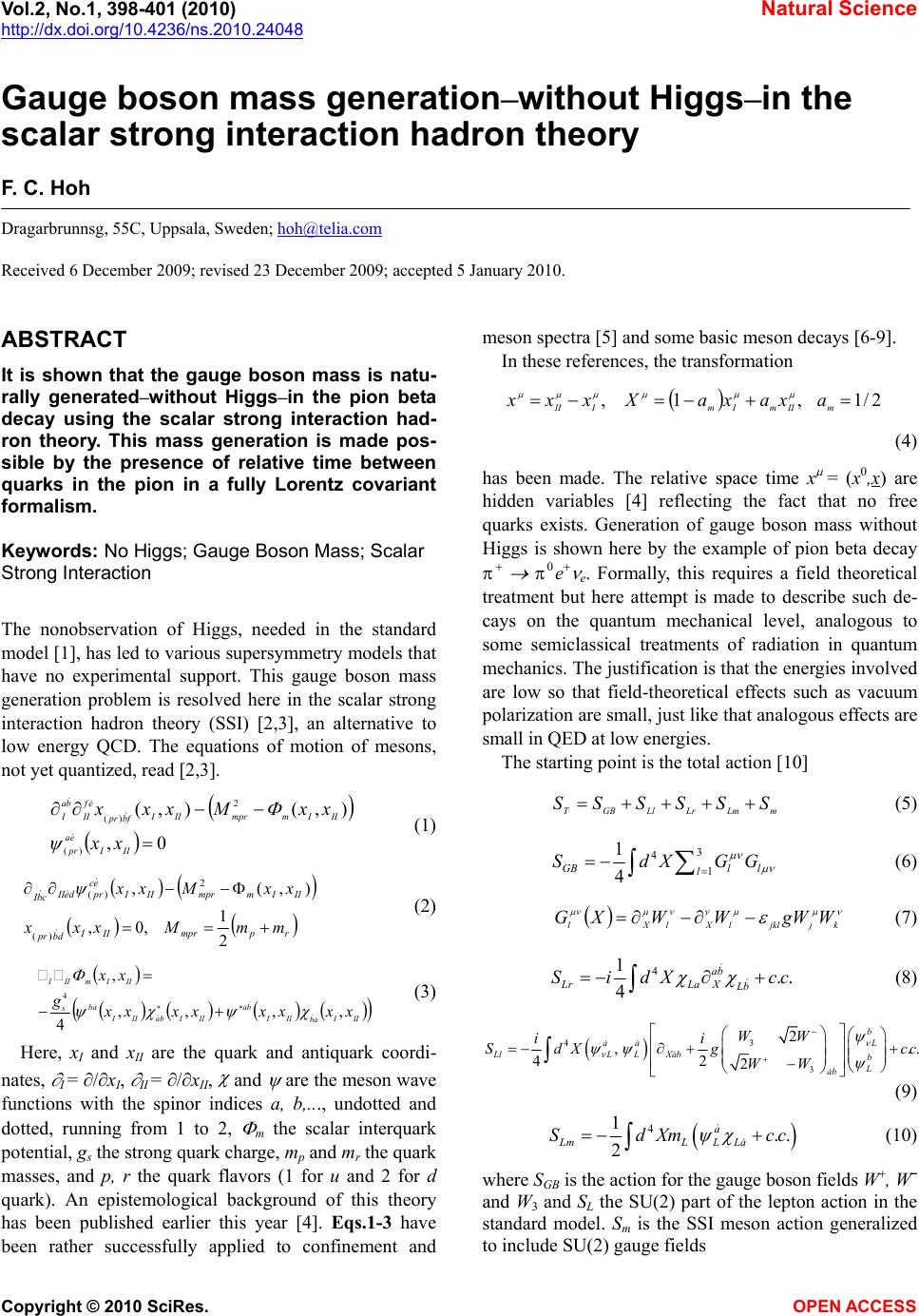 Vol.2, No.1, 398-401 (2010) Natural Science http://dx.doi.org/10.4236/ns.2010.24048 Copyright © 2010 SciRes. OPEN ACCESS Gauge boson mass generation–without Higgs–in the scalar strong interaction hadron theory F. C. Hoh Dragarbrunnsg, 55C, Uppsala, Sweden; [email protected] Received 6 December 2009; revised 23 December 2009; accepted 5 January 2010. ABSTRACT It is shown that the gauge boson mass is natu- rally generated–without Higgs–in the pion beta decay using the scalar strong interaction had- ron theory. This mass generation is made pos- sible by the presence of relative time between quarks in the pion in a fully Lorentz covariant formalism. Keywords: No Higgs; Gauge Boson Mass; Scalar Strong Interaction The nonobservation of Higgs, needed in the standard model [1], has led to various supersymmetry models that have no experimental support. This gauge boson mass generation problem is resolved here in the scalar strong interaction hadron theory (SSI) [2,3], an alternative to low energy QCD. The equations of motion of mesons, not yet quantized, read [2,3]. 0, ),(),( )( 2 )( III ea pr IIImmprIII fbpr ef II ba I xx xxMxxx (1) rpmprIII dbpr IIImmprIII ec prdeII cbI mmMxxx xxMxx 2 1 ,0, ),(, )( 2 )( (2) III ab III ba IIIbaIII ab s IIImIII xxxxxxxx g xx ,,,, 4 , 4 (3) Here, xI and xII are the quark and antiquark coordi- nates, I = /xI, II = /xII, and are the meson wave functions with the spinor indices a, b,..., undotted and dotted, running from 1 to 2, m the scalar interquark potential, gs the strong quark charge, mp and mr the quark masses, and p, r the quark flavors (1 for u and 2 for d quark). An epistemological background of this theory has been published earlier this year [4]. Eqs.1-3 have been rather successfully applied to confinement and meson spectra [5] and some basic meson decays [6-9]. In these references, the transformation 2/1,1, mIImImIII axaxaXxxx (4) has been made. The relative space time x = (x0,x) are hidden variables [4] reflecting the fact that no free quarks exists. Generation of gauge boson mass without Higgs is shown here by the example of pion beta decay 0e e. Formally, this requires a field theoretical treatment but here attempt is made to describe such de- cays on the quantum mechanical level, analogous to some semiclassical treatments of radiation in quantum mechanics. The justification is that the energies involved are low so that field-theoretical effects such as vacuum polarization are small, just like that analogous effects are small in QED at low energies. The starting point is the total action [10] mLmLrLlGBT SSSSSS (5) 3 4 1 1 4 GBl l l SdXGG (6) kjjkllXlXl WgWWWXG (7) 4 1.. 4 ab LrLa XLb SidX cc (8) 3 4 3 2 ,.. 42 2 b L aa LlL LXabb L ab WW ii SdX gcc WW (9) 4 1.. 2 a LmLL La SdXm cc (10) where SGB is the action for the gauge boson fields W, W¯ and W3 and SL the SU(2) part of the lepton action in the standard model. Sm is the SSI meson action generalized to include SU(2) gauge fields 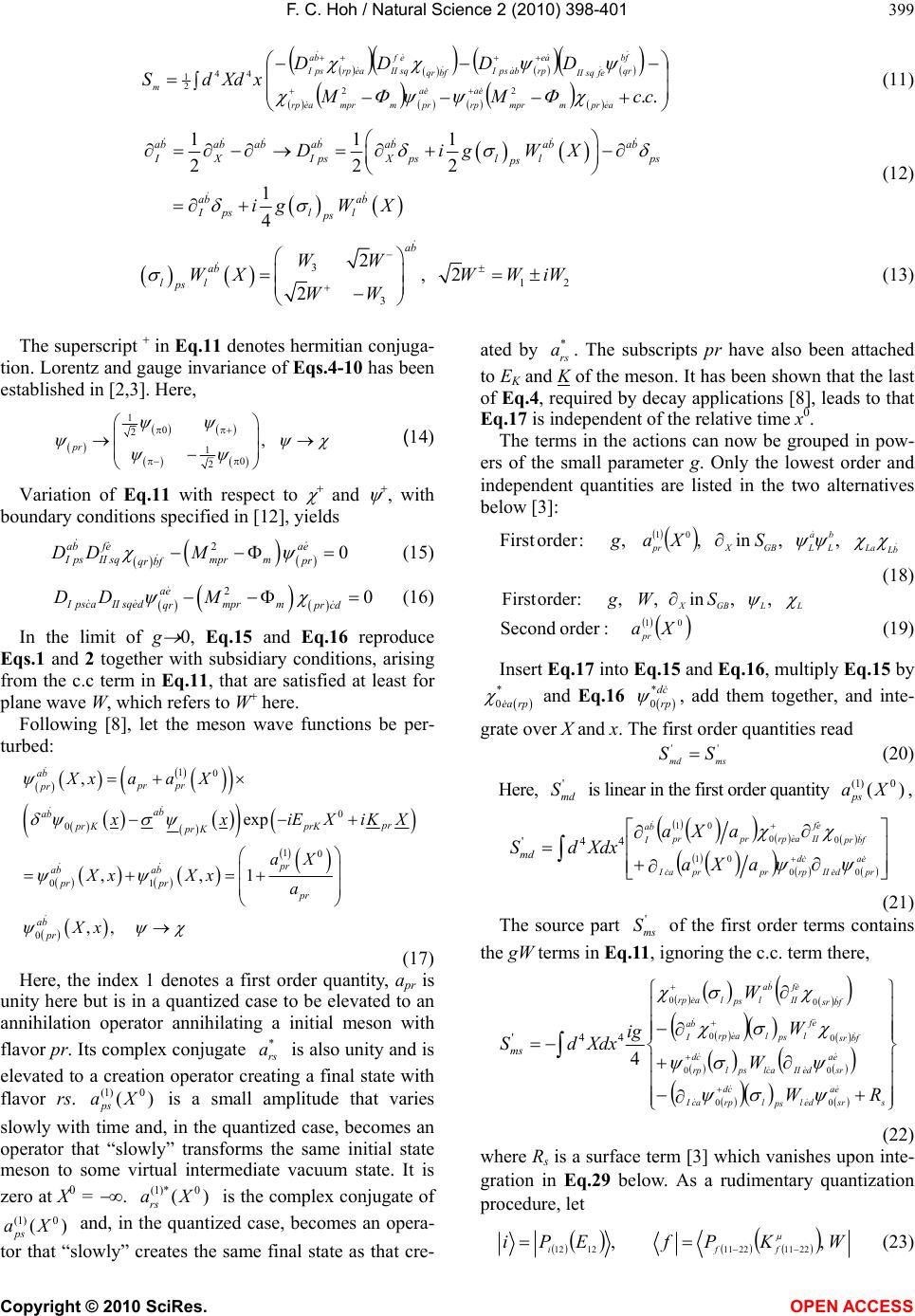 F. C. Hoh / Natural Science 2 (2010) 398-401 Copyright © 2010 SciRes. OPEN ACCESS 399 .. 22 44 2 1 ccMM DDDD xXddS aeprmmpr ea rp ea prmmpraerp fb qr efsqII ae rpbapsI fbqr ef sqIIaerp ba psI m (11) 111 222 1 4 abab ababababab I XIpsXpsll ps ps ab ab Ipsl l ps DigWX igW X (12) 3 12 3 2,2 2 ab ab ll ps WW WX WWiW WW (13) The superscript in Eq.11 denotes hermitian conjuga- tion. Lorentz and gauge invariance of Eqs.4-10 has been established in [2,3]. Here, 1 0 2 1 0 2 , pr (14) Variation of Eq.11 with respect to and , with boundary conditions specified in [12], yields 20 ab feae Ips IIsqmprmpr qr bf DD M (15) 20 ae IpscaII sqedmprm qrpr cd DD M (16) In the limit of g 0, Eq.15 and Eq.16 reproduce Eqs.1 and 2 together with subsidiary conditions, arising from the c.c term in Eq.11, that are satisfied at least for plane wave W, which refers to W here. Following [8], let the meson wave functions be per- turbed: 10 0 0 10 01 0 , exp ,,1 ,, ab pr pr pr ab ab pr prK pr Kpr K pr ab ab pr pr pr ab pr Xxaa X x xiEXiKX aX Xx Xxa Xx (17) Here, the index 1 denotes a first order quantity, apr is unity here but is in a quantized case to be elevated to an annihilation operator annihilating a initial meson with flavor pr. Its complex conjugate * rs a is also unity and is elevated to a creation operator creating a final state with flavor rs. (1) 0 () ps aX is a small amplitude that varies slowly with time and, in the quantized case, becomes an operator that “slowly” transforms the same initial state meson to some virtual intermediate vacuum state. It is zero at X0 = . (1)* 0 () rs aX is the complex conjugate of (1) 0 () ps aX and, in the quantized case, becomes an opera- tor that “slowly” creates the same final state as that cre- ated by * rs a. The subscripts pr have also been attached to EK and K of the meson. It has been shown that the last of Eq.4, required by decay applications [8], leads to that Eq.17 is independent of the relative time x0. The terms in the actions can now be grouped in pow- ers of the small parameter g. Only the lowest order and independent quantities are listed in the two alternatives below [3]: bL La b L a LGBXpr SXag ,,in , , :orderFirst 01 (18) LLGBX SWg ,,in , , :orderFirst 01 :order SecondXapr (19) Insert Eq.17 into Eq.15 and Eq.16, multiply Eq.15 by * 0ea rp and Eq.16 * 0 dc rp , add them together, and inte- grate over X and x. The first order quantities read '' msmdSS (20) Here, ' md S is linear in the first order quantity (1)0 () ps aX, '44 md SdXdx ea prdeII cd rpprpracI fbpr ef IIaerpprpr ba I aXa aXa 00 01 0 0 01 (21) The source part ' ms S of the first order terms contains the gW terms in Eq.11, ignoring the c.c. term there, '44 ms SdXdx s ea srdel ps l cd rpacI ea srdeIIacl ps l cd rp fbsr ef l ps laerp ba I fbsr ef II ba l ps laerp RW W W W ig 00 00 0 0 0 0 4 (22) where Rs is a surface term [3] which vanishes upon inte- gration in Eq.29 below. As a rudimentary quantization procedure, let WKPfEPi ffi ,, 221122111212 (23) 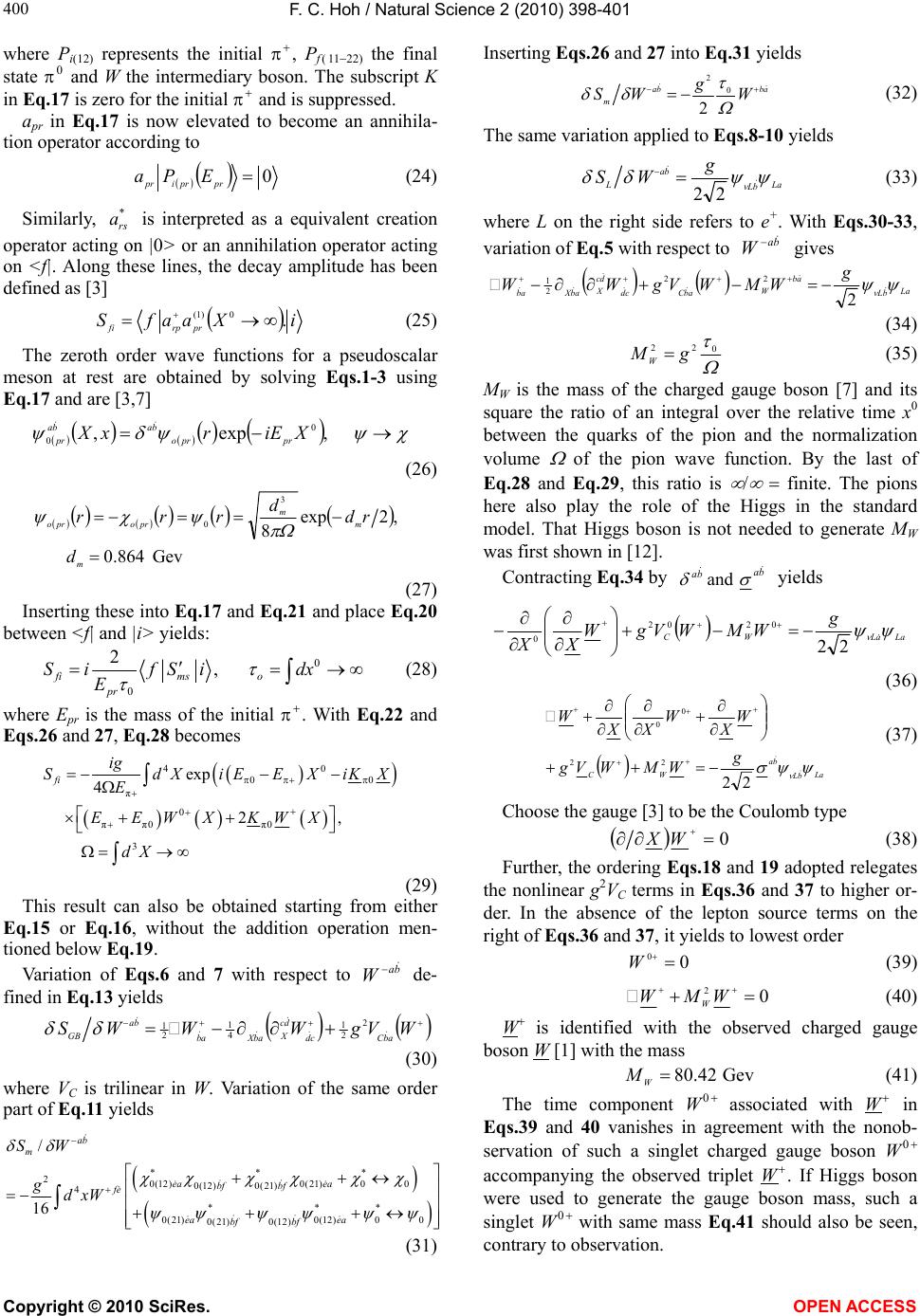 F. C. Hoh / Natural Science 2 (2010) 398-401 Copyright © 2010 SciRes. OPEN ACCESS 400 where Pi(12) represents the initial , Pf(1122) the final state 0 and W the intermediary boson. The subscript K in Eq.17 is zero for the initial and is suppressed. apr in Eq.17 is now elevated to become an annihila- tion operator according to 0 prpripr EPa (24) Similarly, * rs a is interpreted as a equivalent creation operator acting on |0> or an annihilation operator acting on <f|. Along these lines, the decay amplitude has been defined as [3] iXaafS prrpfi. 0)1( (25) The zeroth order wave functions for a pseudoscalar meson at rest are obtained by solving Eqs.1-3 using Eq.17 and are [3,7] ,exp, 0 0XiErxX prpro baba pr (26) Gev864.0 ,2exp 8 3 0 m m m propro d rd d rrr (27) Inserting these into Eq.17 and Eq.2 1 and place Eq.20 between <f| and |i> yields: 0 0 2, fims o pr Si fSidx E (28) where Epr is the mass of the initial . With Eq.22 and Eqs.26 and 27, Eq.28 becomes 40 0 0 π 0 π0 ππ0 3 exp 4 2, fi ig SdXiEEXiKX E EEWX KWX dX (29) This result can also be obtained starting from either Eq.15 or Eq.16, without the addition operation men- tioned below Eq.19. Variation of Eqs.6 and 7 with respect to ba W de- fined in Eq.13 yields WVgWWWS abCcd dc X abXab ba GB 2 2 1 4 1 2 1 (30) where VC is trilinear in W. Variation of the same order part of Eq.11 yields *** 20(12)0(21) 00 0(12) 0(21) 4 *** 0(21)0(12) 00 0(21) 0(12) / 16 ab m ea ea bf bf fe ea ea bf bf SW gdxW (31) Inserting Eqs.26 and 27 into Eq.31 yields abba mW g WS 0 2 2 (32) The same variation applied to Eqs.8-10 yields La bL ba L g WS 22 (33) where L on the right side refers to e+. With Eqs.30-33, variation of Eq.5 with respect to ba W gives La bL ab W abCcd dc X abXab g WMWVgWW 2 22 2 1 (34) 0 22 gMW (35) MW is the mass of the charged gauge boson [7] and its square the ratio of an integral over the relative time x0 between the quarks of the pion and the normalization volume of the pion wave function. By the last of Eq.28 and Eq.29, this ratio is finite. The pions here also play the role of the Higgs in the standard model. That Higgs boson is not needed to generate MW was first shown in [12]. Contracting Eq.34 by ba ba and yields LaaLWC g WMWVgW XX 22 0202 0 (36) La bL ba W C g WMWVg W X W XX W 22 22 0 0 (37) Choose the gauge [3] to be the Coulomb type 0 WX (38) Further, the ordering Eqs.18 and 19 adopted relegates the nonlinear g2VC terms in Eqs.36 and 37 to higher or- der. In the absence of the lepton source terms on the right of Eqs.36 and 37, it yields to lowest order 0 0 W (39) 0 2 WMW W (40) W is identified with the observed charged gauge boson W [1] with the mass Gev42.80 W M (41) The time component W associated with W in Eqs.39 and 40 vanishes in agreement with the nonob- servation of such a singlet charged gauge boson W accompanying the observed triplet W. If Higgs boson were used to generate the gauge boson mass, such a singlet W with same mass Eq.41 should also be seen, contrary to observation. 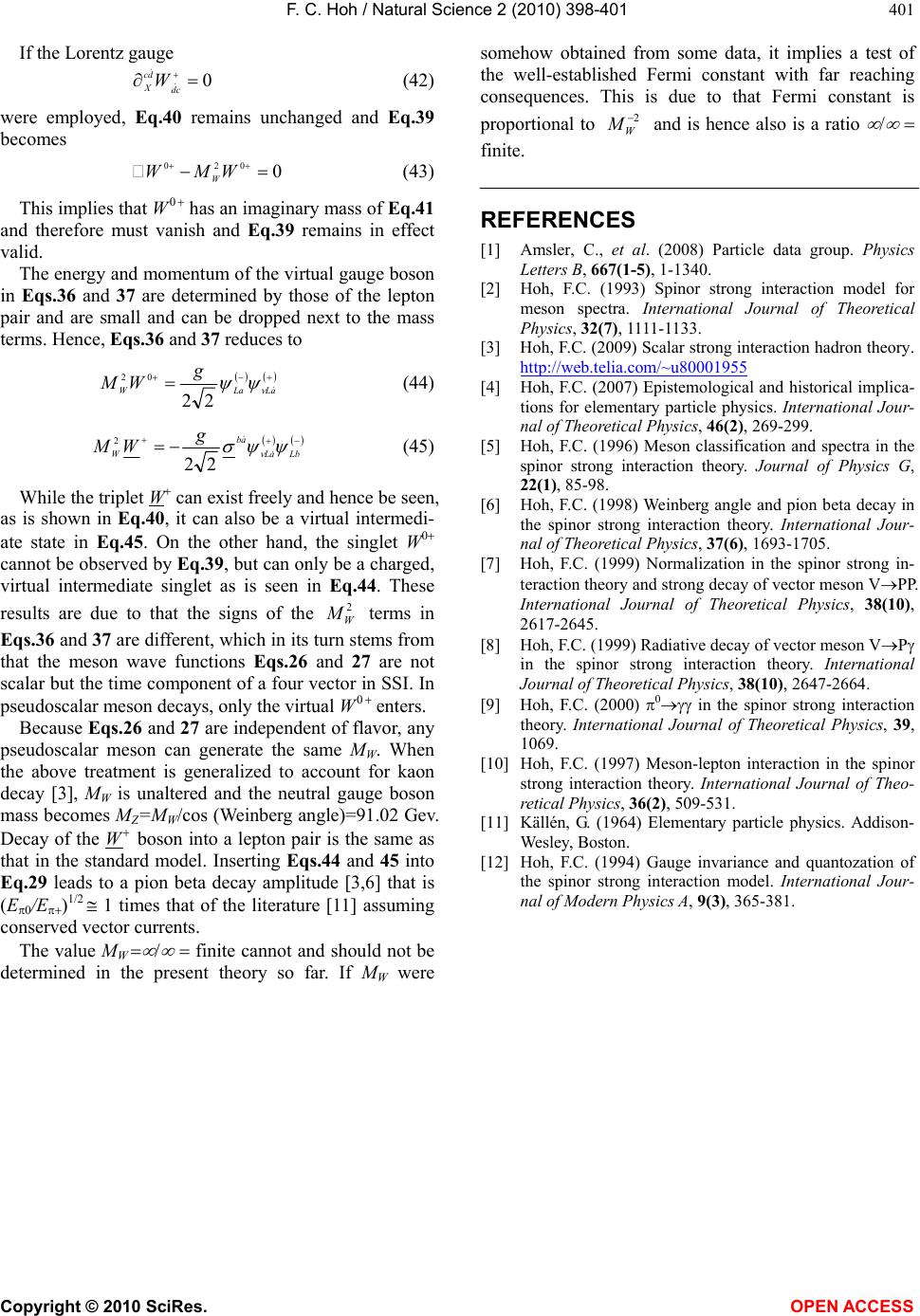 F. C. Hoh / Natural Science 2 (2010) 398-401 Copyright © 2010 SciRes. OPEN ACCESS 401 If the Lorentz gauge 0 cd dc XW (42) were employed, Eq.40 remains unchanged and Eq.39 becomes 0 020 WMW W (43) This implies that W has an imaginary mass of Eq.41 and therefore must vanish and Eq.39 remains in effect valid. The energy and momentum of the virtual gauge boson in Eqs.36 and 37 are determined by those of the lepton pair and are small and can be dropped next to the mass terms. Hence, Eqs.36 and 37 reduces to aLLaW g WM 22 02 (44) LbaL ab W g WM 22 2 (45) While the triplet W can exist freely and hence be seen, as is shown in Eq.40, it can also be a virtual intermedi- ate state in Eq.45 . On the other hand, the singlet W cannot be observed by Eq.39, but can only be a charged, virtual intermediate singlet as is seen in Eq.44 . These results are due to that the signs of the 2 W M terms in Eqs.36 and 37 are different, which in its turn stems from that the meson wave functions Eqs.26 and 27 are not scalar but the time component of a four vector in SSI. In pseudoscalar meson decays, only the virtual W enters. Because Eqs.26 and 27 are independent of flavor, any pseudoscalar meson can generate the same MW. When the above treatment is generalized to account for kaon decay [3], MW is unaltered and the neutral gauge boson mass becomes MZ=MW/cos (Weinberg angle)=91.02 Gev. Decay of the W boson into a lepton pair is the same as that in the standard model. Inserting Eqs.44 and 45 into Eq.29 leads to a pion beta decay amplitude [3,6] that is (E0/E)1/2 1 times that of the literature [11] assuming conserved vector currents. The value MW finite cannot and should not be determined in the present theory so far. If MW were somehow obtained from some data, it implies a test of the well-established Fermi constant with far reaching consequences. This is due to that Fermi constant is proportional to 2 W M and is hence also is a ratio finite. REFERENCES [1] Amsler, C., et al. (2008) Particle data group. Physics Letters B, 667(1-5), 1-1340. [2] Hoh, F.C. (1993) Spinor strong interaction model for meson spectra. International Journal of Theoretical Physics, 32(7), 1111-1133. [3] Hoh, F.C. (2009) Scalar strong interaction hadron theory. http://web.telia.com/~u80001955 [4] Hoh, F.C. (2007) Epistemological and historical implica- tions for elementary particle physics. International Jour- nal of Theoretical Physics, 46(2), 269-299. [5] Hoh, F.C. (1996) Meson classification and spectra in the spinor strong interaction theory. Journal of Physics G, 22(1), 85-98. [6] Hoh, F.C. (1998) Weinberg angle and pion beta decay in the spinor strong interaction theory. International Jour- nal of Theoretical Physics, 37(6), 1693-1705. [7] Hoh, F.C. (1999) Normalization in the spinor strong in- teraction theory and strong decay of vector meson VPP. International Journal of Theoretical Physics, 38(10), 2617-2645. [8] Hoh, F.C. (1999) Radiative decay of vector meson VP in the spinor strong interaction theory. International Journal of Theoretical Physics, 38(10), 2647-2664. [9] Hoh, F.C. (2000) 0 in the spinor strong interaction theory. International Journal of Theoretical Physics, 39, 1069. [10] Hoh, F.C. (1997) Meson-lepton interaction in the spinor strong interaction theory. International Journal of Theo- retical Physics, 36(2), 509-531. [11] Källén, G. (1964) Elementary particle physics. Addison- Wesley, Boston. [12] Hoh, F.C. (1994) Gauge invariance and quantozation of the spinor strong interaction model. International Jour- nal of Modern Physics A, 9(3), 365-381. |