

Paper Menu >>
Journal Menu >>
 Creative Education 2012. Vol.3, No.1, 120-125 Published Online February 2012 in SciRes (http://www.SciRP.org/journal/ce) http://dx.doi.org/10.4236/ce.2012.31020 Copyright © 2012 SciR e s . 120 Authentic Situations Motivate Medical Students for Dealing with Medical Insurance Issues ——A Study of Learning Styles and E-Learning Susanne Nielsen1, Kaety Plos2, Carina Furåker2, Annika Ja k obsson3 1Department of Emergency an d C a r d i ov a s c u l a r Medicine, The Sahlgrenska Academy, University of Gothenburg, Gothenburg, Sweden 2Institute of Health and Care Sciences, The Sahlgrenska Academy, University of Gothenburg, Gothenburg, Sweden 3Department of Public Health and Community Medicine, The Sahlgrenska Academy, University of Gothenburg, Gothenburg, Sweden Email: [email protected] Received December 15th, 2011; revised January 17th, 2012; accepted January 28th, 2012 In this study, e-learning based on authentic situations was used as a pedagogic method to stimulate medi- cal students to reflect over their own learning styles and to prepare them for dealing with medical insur- ance issues in their future profession. The aim was to explore the learning styles used by the students in a Social medicine course when e-learning, based on authentic situations was used as a pedagogical ap- proach. A learning style questionnaire by Kember, Biggs and Leung, and a course evaluation question- naire designed by the authors were used. Seventy-seven students answered the questionnaires and the questionnaires were analysed by Mann-Whitney U-test, and Fisher’s test was used as a pair comparison. One hundred forty comments made by the students were analysed using content analysis. The results showed that: 69% of the students regarded e-learning as a very good/good pedagogical method to study medical insurance. Men had a significantly higher rate of surface learning than women. A majority of the students thought that it was positive to take part of peer students’ assignments but they highlighted the risk of plagiarism and cheating. The students made use of the flexibility in this type of learning which suited their lifestyle. Keywords: Learning Styles; Medical Students; Attitudes to E-Learning; Medical Insurance Issues Introduction An evaluation of the Swedish medical education showed that there were some shortcomings concerning teaching practices that promote students’ deep approaches to learning (Swedish National Agency for Higher education, 2007:23 R). The curric- ula for the medical educations in Sweden have mainly a struc- ture of traditional lectures. Accor ding to Marton & Booth (1997 ) varied forms of teaching are crucial and should be offered to students to meet their different learning styles. In this study, e-learning, based on authentic situations was used as a peda- gogical approach to stimulate students to reflect over their own learning styles and also to prepare them for dealing with medi- cal insurance issues in their future profession. The new sick- leave process in Sweden requires that medical doctors can as- sess an individual’s work ability. The complexity of the sick leave process requires medical competence including medical insurance proficiency and therefore the purpose of this study is to explore how medical students in a Social medicine course learn about medical insu rance issues. Learning Styles Individual differences in the learning process have been known for a long time. Identification and understanding of different learning styles can help teachers to structure their teaching. Briefly, Biggs (1976), Marton & Säljö (1976) and Entwistle (1977) found that students had two main approaches towards learning; surface and deep learning. The concepts of surface and deep approaches to learning are, according to Biggs & Tang (2007) very useful when conceiving ways of improving the teaching. When using the surface approach, the students focus is on the words used, and facts and items are treated in- dependently of each other. The surface approach stated by Marton & Booth (1997), may hinder the students from seeing the meaning and structure of what is taught. The deep approach to learning is when the students feel that they need to know more, and try to focus on underlying ideas (Biggs & Tang, 2007). The students are interested, learning is a pleasure and they will understand “the big picture”. Surface and deep ap- proaches to learning are not merely personality qualities, but it is also thoughts of and reactions to the teaching context. The teacher’s role is to get the students engaged in learning before they choose the surface learning strateg y (Biggs & Tang, 2007). Decreased economic recourses and new educational reforms have influenced teachers to stimulate students to take more responsibility for their learning (Biggs, 2003). Independent learning is a dimension of self-directed learning (Bedford, 2006). Self directed learners are those who are willing to take on more responsibility for their own learning process which is suitable for e-learning. However there have been some prob- lems connected to self directed learning associated to adult learning. Teachers using traditional lectures do little to promote  S. NIELSEN ET AL. students to be independent and therefore the students show a preference to traditional teaching. Students become teacher- dependent rather than self-directed and motivated (Akerlind & Trevitt, 1999). Teachers must therefore prepare students for independent t hinking, like e-learning. Teaching Theories Teachers operate, according to Ramsden (2007), within dif- ferent teaching theories and these theories have changed over time. One theory describes teaching as telling of content and focus lay on the teacher’s actions rather than the students. A second theory describes teaching as how to classify student activities to guarantee their learning. A third theory describes a focus on the students and their capability of understanding. The current study is focused on students and their learning styles related to e-l ea r ning. The Context of Learning Approaches to learning are intimately connected to the con- text, like perceptions of assessment requirements, of workload, the amount of controls, and the commitments of teachers. Me- dical students have criticised the form of examinations as they too often call for memorising instead of understanding and ap- plying the knowledge (Lindblom-Ylänne & Lonka , 2001). With- out clarifying the topic and learning outcome there is a risk of using “a hidden curriculum” (Ramsden, 2007). A challenge in medical education is to apply relevant teaching methods so that the students learn how to use them, for example authentic internet too l s which they la t e r will use as medical doctors. A literature review about e-learning shows that using authen- tic case situations is a good way to learn. Realistic patient cases were useful tools when learning for both nurses and doctors (Carroll & Appelton, 2009). Kim et al. (2007) argue that the use of case studies intended to support students’ ability to develop critical thinking and decision-making capabilities. However relatively few studies show how case studies can be developed to be interactive for the students. That there are both strengths and weaknesses in e-learning is well kno wn (Cook, 2009). More research needs to be done about students experiences of e- learning and what learning styles they make use of in higher education. Aim The aim was to explore the learning styles used by medical students in a Social medicine course when e-learning based on authentic situation was used as a pedagogical approach. Research questions: Do the students use surface or deep approaches to learn medical insurance issues via a learning platform? Does sex or age affect students learning style? Hypothesis: Students with a deep approach to learning are more positive towards e-learning than students with a surface approach. Method This is a study of 119 medical students studying a medical program in which medical insurance was taught during a Social Medicine course. The course is given towards the end of the medical education. This course is normally delivered via tradi- tional lectures covering approximately 6 - 8 hours, along with a visit at the Swedish Social Insurance Agency where the stu- dents meet medical doctors and social insurance experts. Course Structure The course material was made available through an Internet- based learning platform. The students could read each other’s assignments from the open forum on the platform, a so called learning transparency. The content consisted of real case stud- ies and guiding documents made available via internet links. The students were supposed to gain enough knowledge to per- form three assignments that would give them the competence to formulate the medical insurance evidence needed. The course also included two seminars and a visit at the Swedish Social Insurance Agency to give the students opportunities to discuss and ask experts about the content. Sample and Data Collection Two questionnaires were used. One questionnaire was de- veloped by Kember, Biggs & Leung (2004), (R-SPQ-2F) which examines deep and surface approach to learning. The question- naire consists of 20 questions and the respondents could choose their answers from a five-level Likert scale, the options were; this is never or rarely true for me, this is sometimes true for me, this is true for me half of the time, this is often true for me, this is always or almost always true for me. The answers were com- piled and provided a measure of deep respective surface ap- proach to learning and gave us a possibility to compare group answers to the questionnaire. The questionnaire has been vali- dated and has good reliability (Kember et al., 2004). Questionnaire number two (course evaluation) consisted of four questions about the students experience from studying via a learning platform, designed by the authors of this manuscript, for example; how useful is e-learning when studying medical insurance? The answer options were; very good, good, less good and bad. Each question had room for comments. One hundred nineteen students from three different courses participated. One of the researchers made a personal visit at a seminar in the end of each of the three courses, from 2009- 2010. Seventy-seven students (65%) of whom 52 (68%) were women and 25 (32%) were men, answered a questionnaire. The average age was 28 years and ranged between 22 and 44 years, 48 students (66%) were 27 years or younger, 25 (34%) were over 27 years. Analysis The questionnaires were analyzed using SPSS (Statistical Package for Social Sciences version 19.0). Non-parametric test, Mann-Whitney U-test, was used to analyze differences between groups and Fisher’s test was used for a pair comparison. Both tests were performed with median values. The five-point scale on the questionnaire (R-SPQ-2F) was later converted into a three-point scale and the four point scale covering attitudes to- wards e -learning was converted into a two point scale. The li- mit for significance was set to p < .05. The statistics was ad- justed according to gender. One hundred forty-two comments were made by the students on questionnaire number two. These com- ments were first organized according to pros and cons to e-learn- ing and after that we used content analysis, according to Gra- neheim & Lundman (2004). We analysed the comments to get Copyright © 2012 SciRe s . 121 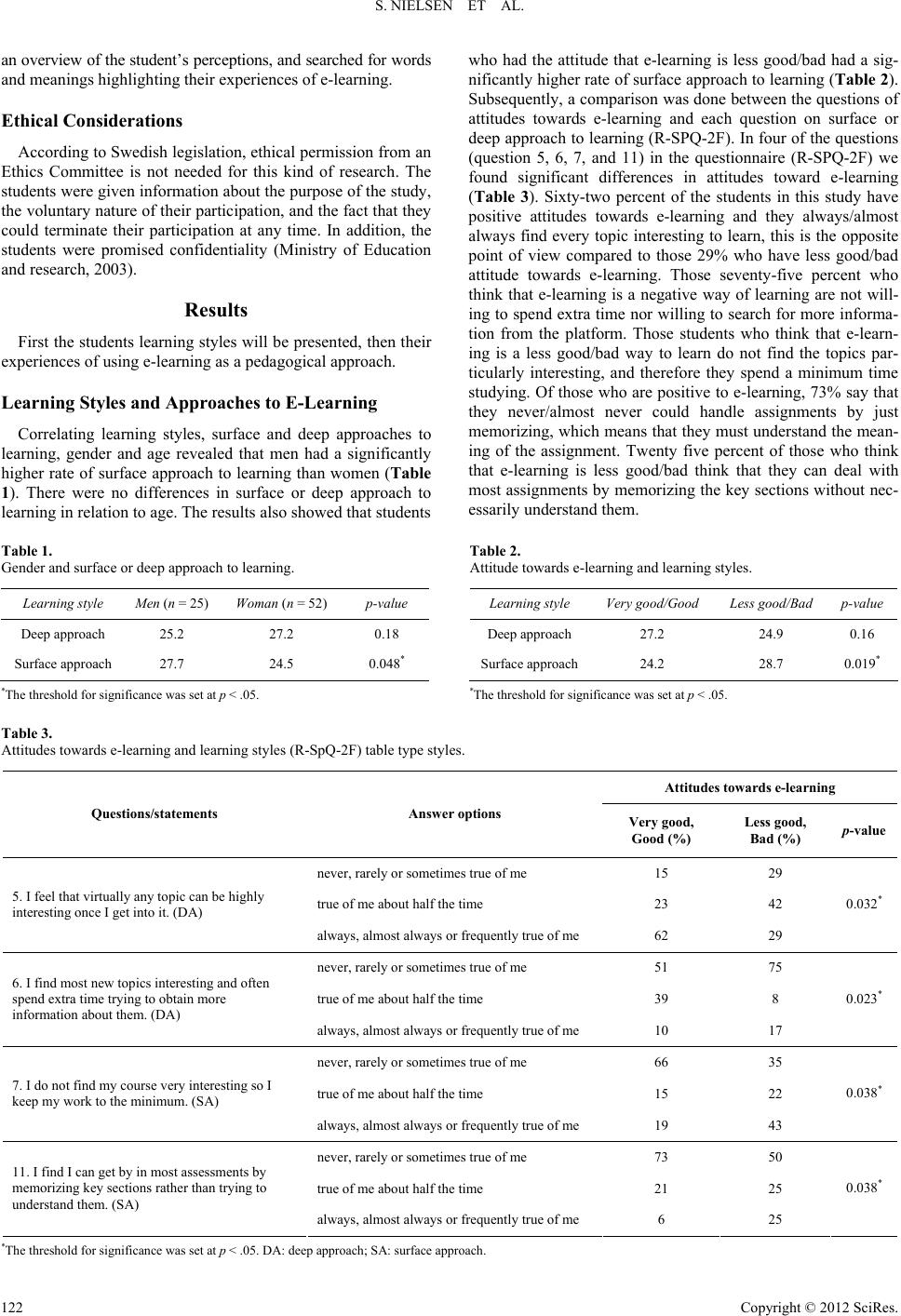 S. NIELSEN ET AL. Copyright © 2012 SciRe s . 122 an overview of the student’ s perceptions, and searched for words and meanings highlighting their experiences of e-learning. Ethical Considerations According to Swedish legislation, ethical permission from an Ethics Committee is not needed for this kind of research. The students were given information about the purpose of the study, the voluntary nature of their participation, and the fact that they could terminate their participation at any time. In addition, the students were promised confidentiality (Ministry of Education and research, 2003). Results First the students learning styles will be presented, then their experiences of using e-learning as a pedagogical approach. Learning Styles and Approaches to E-Learning Correlating learning styles, surface and deep approaches to learning, gender and age revealed that men had a significantly higher rate of surface approach to learning than women (Table 1). There were no differences in surface or deep approach to learning in relation to age. The results also showed that students who had the attitude that e-learning is less good/bad had a sig- nificantly higher rate of surface approach to learning (Table 2). Subsequently, a comparison was done between the questions of attitudes towards e-learning and each question on surface or deep approach to learning (R-SPQ-2F). In four of the questions (question 5, 6, 7, and 11) in the questionnaire (R-SPQ-2F) we found significant differences in attitudes toward e-learning (Table 3). Sixty-two percent of the students in this study have positive attitudes towards e-learning and they always/almost always find every topic interesting to learn, this is the opposite point of view compared to those 29% who have less good/bad attitude towards e-learning. Those seventy-five percent who think that e-learning is a negative way of learning are not will- ing to spend extra time nor willing to search for more informa- tion from the platform. Those students who think that e-learn- ing is a less good/bad way to learn do not find the topics par- ticularly interesting, and therefore they spend a minimum time studying. Of those who are positive to e-learning, 73% say that they never/almost never could handle assignments by just memorizing, which means that they must understand the mean- ing of the assignment. Twenty five percent of those who think that e-learning is less good/bad think that they can deal with most assignments by memorizing the key sections without nec- essarily understand them. Table 1. Gender and surface or deep approach to learning. Learning style Men (n = 25) Woman (n = 52) p-value Deep approach 25.2 27.2 0.18 Surface approach 27.7 24.5 0.048* *The threshold for significance was set at p < .05. Table 2. Attitude towards e-learning and learning styles. Learning style Very good/Good Less good/Bad p-value Deep approach 27.2 24.9 0.16 Surface approach24.2 28.7 0.019* *The threshold for significance was set at p < .05. Table 3. Attitudes towards e-learning and learning styles (R-SpQ-2F) table type styles. Attitudes towards e-learning Questions/statements Answer options Very good, Good (%) Less good, Bad (%) p-value never, rar ely or sometimes true of me 15 29 true of me about half the time 23 42 5. I feel that virtuall y any topic can be highly interesting once I get i nto it. (DA) always, almost always or frequently true of me 62 29 0.032* never, rar ely or sometimes true of me 51 75 true of me about half the time 39 8 6. I find most new topics interesting and often spend extra time trying to obtain more information about them. (DA) always, almost always or frequently true of me 10 17 0.023* never, rar ely or sometimes true of me 66 35 true of me about half the time 15 22 7. I do not find my course ver y interesting so I keep my work to the minimum. (SA) always, almost always or frequently true of me 19 43 0.038* never, rar ely or sometimes true of me 73 50 true of me about half the time 21 25 11. I find I can get by in most a ssessments by memorizing key sections rather than trying to understand them. (SA) always, almost always or frequently true of me 6 25 0.038* *The threshold for significance was set at p < .05. DA: deep ap p roach; SA: surface approach. 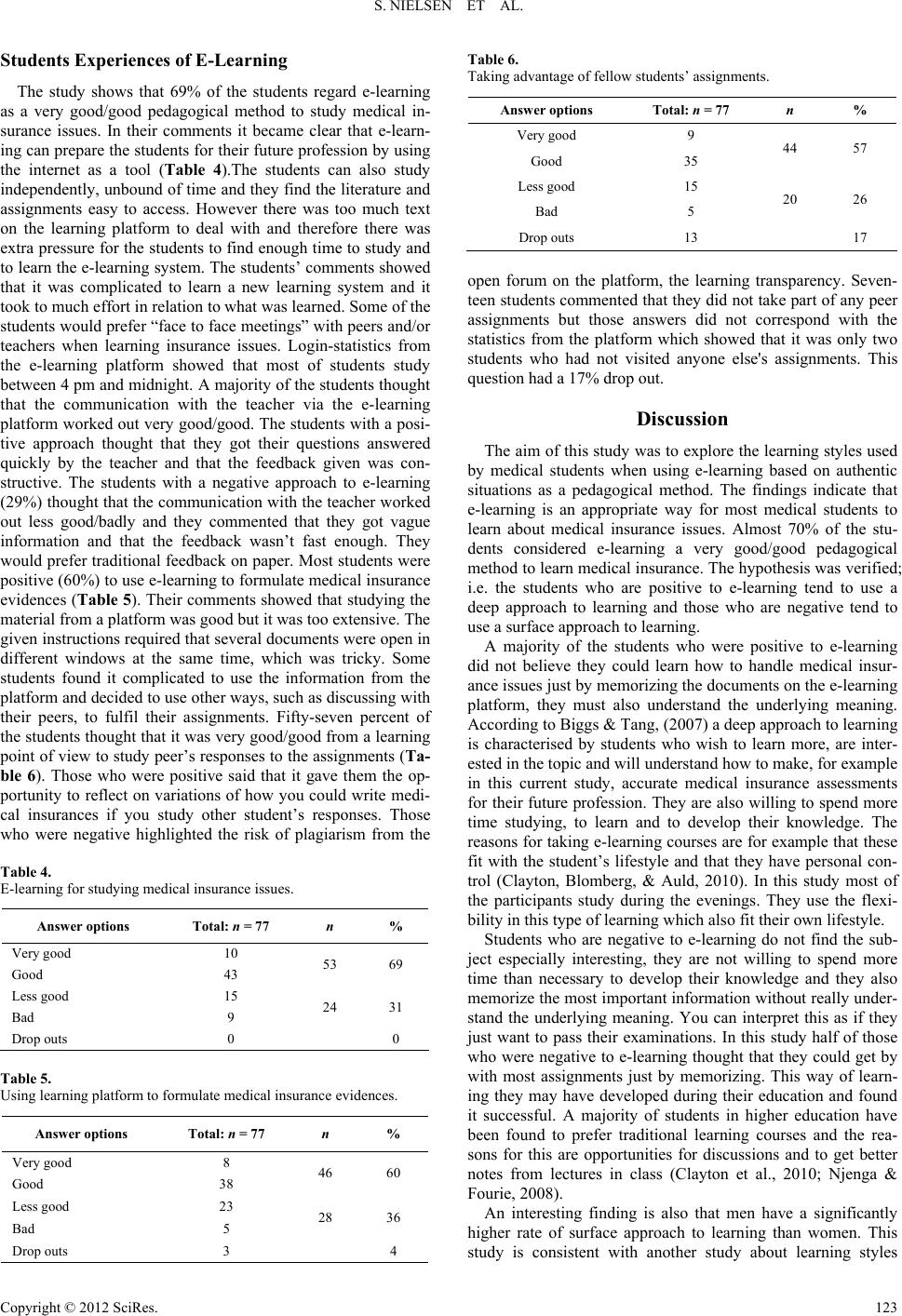 S. NIELSEN ET AL. Students Experiences of E-Learning The study shows that 69% of the students regard e-learning as a very good/good pedagogical method to study medical in- surance issues. In their comments it became clear that e-learn- ing can prepare the students for their future profession by using the internet as a tool (Table 4).The students can also study independently, unbound of time and they find the literature and assignments easy to access. However there was too much text on the learning platform to deal with and therefore there was extra pressure for the students to find enough time to study and to learn the e-learning system. The students’ comments showed that it was complicated to learn a new learning system and it took to much effort in relation to what was learned. Some of the students would prefer “face to face meetings” with peers and/or teachers when learning insurance issues. Login-statistics from the e-learning platform showed that most of students study between 4 pm and midnight. A majority of the students thought that the communication with the teacher via the e-learning platform worked out very good/good. The students with a posi- tive approach thought that they got their questions answered quickly by the teacher and that the feedback given was con- structive. The students with a negative approach to e-learning (29%) thought that the communication with the teacher worked out less good/badly and they commented that they got vague information and that the feedback wasn’t fast enough. They would prefer traditional feedback on paper. Most students were positive (60%) to use e-learning to formulate medical insurance evidences (Table 5). Their comments showed that studying the material from a platform was good but it was too extensive. The given instructions required that several documents were open in different windows at the same time, which was tricky. Some students found it complicated to use the information from the platform and decided to use other ways, such as discussing with their peers, to fulfil their assignments. Fifty-seven percent of the students thought that it was very good/good from a learning point of view to study peer’s responses to the assignments (Ta- ble 6). Those who were positive said that it gave them the op- portunity to reflect on variations of how you could write medi- cal insurances if you study other student’s responses. Those who were negative highlighted the risk of plagiarism from the Table 4. E-learning for studying medical insurance issues. Answer options Total: n = 77 n % Very good 10 Good 43 53 69 Less good 15 Bad 9 24 31 Drop outs 0 0 Table 5. Using learning platform to formulate medical insurance evidences. Answer options Total: n = 77 n % Very good 8 Good 38 46 60 Less good 23 Bad 5 28 36 Drop outs 3 4 Table 6. Taking advantage of fellow s tudents’ assignments. Answer options Total: n = 77 n % Very good 9 Good 35 44 57 Less good 15 Bad 5 20 26 Drop outs 13 17 open forum on the platform, the learning transparency. Seven- teen students commented that they did not take part of any peer assignments but those answers did not correspond with the statistics from the platform which showed that it was only two students who had not visited anyone else's assignments. This question had a 17% drop out. Discussion The aim of this study was to explore the learning styles used by medical students when using e-learning based on authentic situations as a pedagogical method. The findings indicate that e-learning is an appropriate way for most medical students to learn about medical insurance issues. Almost 70% of the stu- dents considered e-learning a very good/good pedagogical method to learn medical insurance. The hypothesis was verified; i.e. the students who are positive to e-learning tend to use a deep approach to learning and those who are negative tend to use a surface approach to learning. A majority of the students who were positive to e-learning did not believe they could learn how to handle medical insur- ance issues just by memorizing the documents on the e-learning platform, they must also understand the underlying meaning. According to Biggs & Tang, (2007) a deep approach to learning is characterised by students who wish to learn more, are inter- ested in the topic and will understand how to make, for example in this current study, accurate medical insurance assessments for their future profession. They are also willing to spend more time studying, to learn and to develop their knowledge. The reasons for taking e-learning courses are for example that these fit with the student’s lifestyle and that they have personal con- trol (Clayton, Blomberg, & Auld, 2010). In this study most of the participants study during the evenings. They use the flexi- bility in this type of learning which also fit their own lifestyle. Students who are negative to e-learning do not find the sub- ject especially interesting, they are not willing to spend more time than necessary to develop their knowledge and they also memorize the most important information without really under- stand the underlying meaning. You can interpret this as if they just want to pass their examinations. In this study half of those who were negative to e-learning thought that they could get by with most assignments just by memorizing. This way of learn- ing they may have developed during their education and found it successful. A majority of students in higher education have been found to prefer traditional learning courses and the rea- sons for this are opportunities for discussions and to get better notes from lectures in class (Clayton et al., 2010; Njenga & Fourie, 2008). An interesting finding is also that men have a significantly higher rate of surface approach to learning than women. This study is consistent with another study about learning styles Copyright © 2012 SciRe s . 123  S. NIELSEN ET AL. (Kjellgren et al., 2008) where male students were found to have a significantly higher rate of a surface approach to learn. An explanation may be that men and women have different study habits which influence their learning approach. Men may think that e-learning takes too much effort, they are more goal ori- ented and prefer traditional lectures. By using e-learning as a pedagogical method women may think they will get opportuni- ties to be flexible in their choice of study time which is not possible in traditional lectures. In the study by Kjellgren et al. (2008) there is also an indication that a deep approach to learn- ing among students was more characteristic of older students. But in this study there is no difference in relation to age be- tween surface and deep approaches to learning. As stated by Kim (2007), using realistic authentic cases in higher education is a good way to learn and also to increase students’ ability to develop critical thinking. In this study we do not have access to how the students solve the assignments based on authentic cases in relation to their learning styles. Therefore we cannot make any conclusions about the students understanding of the authentic cases and if it made any differ- ences for handling medical insurance issues. Further studies are needed to make conclusions about using authentic cases to solve medical insurance issues. On the other hand students who use surface approach to learn maybe prevent themselves from understanding the meaning of the authentic cases (Marton & Booth, 1997), which is important in this medical course. Well motivated students have positive effects on learning (Biggs, 2003; Clayton et al., 2010). Many students wish for engaging learning environments that support them in interact- tions with teachers and other students (Clayton et al., 2010). Most students in this study thought that communication with the teachers via the learning platform worked out very well. The majority also thought that they got their questions an- swered quickly and that the feedback given was constructive, whereas others thought that they did not get feedback fast enough and that they lacked interactions with the teachers. The different opinions may not only depend on learning styles but also, motivation, family situations, tradition, lack of time and work load. If deep or surface approaches to learning have any conse- quences on their future professional role is not easy to express. It is well known that there is a strong relationship between mo- tivation, the topics and the use of learning styles (Bengtsson & Ohlsson, 2010; Clayton et al., 2010). Medical students are used to traditional lectures and not used to e-learning and of authen- tic cases. This current course of medical education is placed at the end of their whole education, which may influence their motivation. To be able to handle the sick leave process requires motivation, medical competence, medical insurance knowledge, competence to work online and knowledge about the society. Understanding the underlying meanings of the insurance sys- tem in our society is thus crucial. A majority of students think that it is positive to take part of other peer students’ assign- ments, which was considered to be a useful way to learn. But they also highlighted the risk of plagiarism and cheating. This learning transparency was also a new way of learning. Why the students are worried about plagiarism can have several expla- nations like; they are not used to take part of other students’ assignments and they may not see the value to learn from each other. On the other hand they might be worried that somebody else copies their assignments or about revealing their knowl- edge gaps for the other participants. According to Bengtsson & Ohlsson (2010) many medical students are aware of their great responsibility as fully fledged doctors and they are afraid of not having acquired enough knowledge. In a study by Lindblom-Ylänne & Lonka (2001), medical students often criticise the form of assignments and examina- tions as these guide them towards a surface approach to learn- ing. These findings highlight the shortcomings in a traditional medical curriculum concerning assignments and examinations. What type of knowledge is actually asked for in the examina- tions? The type of knowledge asked for must of course be suit- able for their future profession and the documents and authentic cases presented on the platform must be appropriate and inter- esting to study. The content of the assignments on the platform must be consistent with the curriculum and learning outcomes. To be able to answer these questions more research must be done on the content of the medical curriculum. E-learning is based on that you study alone and use your own learning style, while studying in a group is about solving prob- lems together. Medical doctors have to make decisions on their own and therefore e-learning can be a suitable method to prac- tice independently and take responsibility to prepare for their coming profession. Stated by Säljö (2000) studying in a group can help students to maximize their own and others learning, you learn by listening to others. Still there is no indication that studying in a group results in higher motivation to learn than studying alone (Schunk et al., 2008). That the curriculum and the study program in medical educa- tion are based on scientific theories is rather obvious, but should not also the teaching methods be based on scientific studies? Method Discussion The strengths of this study are that the participants are re- cruited from three different groups, who allowed a variation in the data and that the response rate was satisfactory. One of the questionnaires has been validated and has good reliability and the other included many comments from students which gave us adequate explanations to their answers. The majority of those who responded to the questionnaires were women, which can be seen as a weakness, but the analysis was adjusted to gender, so the conclusion of the study is not affected by the gender imbalance. Conclusion A majority of the medical students found e-learning an ap- propriate pedagogical method to learn about medical insurance issues. The students who had positive attitudes about e-learning had a significantly higher rate of deep approach learning which is beneficial in an area of knowledge that is so demanding and changing as medicine. To promote students’ deep approach learning, the medical education curriculum could contain more student-activating teaching methods such as e-learning based on authentic situations. To stimulate students to reflect on various learning styles and find their own preferences is an important issue for developing lifelong learning. Recommendations A comprehensive introduction is fundamental to be confi- dent to e-learning E-learning fits the students modern lifestyle. Copyright © 2012 SciRe s . 124  S. NIELSEN ET AL. Copyright © 2012 SciRe s . 125 The often difficult topic of medical insurance lends itself to online flexible learning. E-learning is suitable for their coming profession. Authentic situations is an appropriate method to handle the sick leave process. Acknowledgements Thanks to Insurance Fund in Sweden and the Pedagogical Development and Interactive Learning (PIL) at the University of Gothenburg for financial contributions to the study. REFERENCES Akerlind, G. S., & Trevitt, C. (1999). Enhancing self-directed learning through educational technology: When students resist the change. In- novations in Education an d Tr ai ni ng International, 36, 96-105. doi:10.1080/1355800990360202 Bedford, T. A. (2006). Learning styles. A review of English-language literature. In R. R. Sims & S. J. Sims (Eds.), Learning styles and learning. A key to Meeting the accountability demands in Education. New York: Nova Science Publ. Inc. Bengtsson, M., & Olsson, B. (2010). The nursing and medical students motivation to attain knowledge. Nurse Education Today, 30, 150-156. doi:10.1016/j.nedt.2009.07.005 PMid:19692152 Biggs, J. (2003). Teaching for quality learning at university. London: Open University Press. Biggs, J. (1976). Dimensions of studying behaviour. Another look at ATI. British journal of Educati onal Psychology, 46, 68-80. doi:10.1111/j.2044-8279.1976.tb02987.x Biggs, J., & Tang, C. (2007). Teaching for quality learning at univer- sity. New York: Open University Press. Carroll, J., Appleton, J. (2009). Plagiarism: A Good practice guide. Ox- ford: JISC. Brookes University . URL (lasted checked 3 January 2012). www.plagiarismadvice.org/documents/brookes.pdf Clayton, K., Blomberg, F., & Auld, D. P. (2001). The relationship be- tween motivation, learning strategies and choice of environment whether traditional or including an online component. British Jour- nal of Educational Technology, 4, 349-364. Cook, D. A. (2009). The failure of e-learning research to inform educa- tional practice, and what we can do about it. Medical Teacher, 31, 158-162. doi:10.1080/01421590802691393 PMid:19330674 Entwistle, N. J. (1977). Strategies of learning and studying: Regent re- search findings. British Journal of Educational Studies, 25, 225-238. doi:10.2307/3120694 doi:10.1080/00071005.1977.9973497 Graneheim, U. H., & Lundman, B. (2004). Qualitative content analysis in nursing research: Concepts, procedures and measures to achieve trustworthiness. Nurse Education Today, 24, 105-112. doi:10.1016/j.nedt.2003.10.001 PMid:14769454 Kember, D., Biggs, J., & Leung, D. Y. (2001). The revised two-factor study process questionnaire R-SPQ-2F. British Journal of Educatio- nal Psychology, 63, 133-149. Kim, S., Phillips, W. R., Huntington, J., Astion, M. L., Keerbs, A., Pin- sky, L., Dresden, G., Sharma, U., & Shearer, D. W. (2007). Medical case teaching on the web. Teaching and Learning in Medicine, 19, 106-114. doi:10.1080/10401330701332169 Kjellgren, K., Hend ry, G. D., Hultberg, J., Plos, K., Ryd mark, M., To- bin, G., & Säljö, R. (2008). Learning to learn and learning to teach— Introduction to studies in higher education. Medical Teacher, 30, 239-245. doi:10.1080/01421590802258896 PMid:18946811 Lindblom-Ylänne, S., & Lonka, K. (2001). Students’ perceptions of assessments practice in a traditional medical curriculum. Advances in Health Sciences Education, 6 , 121-140. doi:10.1023/A:1011422517238 Marton, F., & Booth, S. A. (1997). Learning and awareness. Hillsdale, NJ: Lawrence Erlbaum. Marton, F., & Säljö, R. (1976). On qualitative differences in learning I—Outcome and process. British Journal of Educational Psychology, 46, 4-11. doi:10.1111/j.2044-8279.1976.tb02980.x Ministry of Education and Research. (2003). The act of ethical trail of research concern ing humans (in Swedish). The Swedish Statute Book. Stockholm: Ministry of Education and Research. Njenga, J. K., & Fourie, C. H. (2010). The myths about e-learning in higher education. British Journal of Educational Technology, 41, 199-212. doi:10.1111/j.1467-8535.2008.00910.x Ramsden, P. (2007). Learning to teach in higher education. Cornwall: TJ International Ltd. Säljö, R. (2000). Lea r n i n g in p ractice (in Swedish). Stockholm: Prisma. Schunk, D. K., Pintrich, P. R., & Meece, J. L. (2008). Motivation in education. Theory research and applications. New Jersey: Pearson Education Inc. Swedish National Agency for Higher Education. (2007). Evaluation of undergraduate training in medicine and care at Swedish universities (in Swedish). Stockholm: Swedish National Agency for Higher Edu- cation. |