

Paper Menu >>
Journal Menu >>
 Creative Education 2012. Vol.3, No.1, 96-100 Published Online February 2012 in SciRes (http://www.SciRP.org/journal/ce) http://dx.doi.org/10.4236/ce.2012.31016 Copyright © 2012 SciRes. 96 Digital Renaissance: The Creative Potential of Narrative Technology in Education Tony Hall School of Education, National University of Ireland, Galway , I reland Email: [email protected] Received November 12th, 2011; revised December 10th, 2011; accepted December 26th, 2011 This paper outlines research which explores the potential of narrative technology: the synergy of storytel- ling and computing to enhance creativity and creative education. The paper outlines the theoretical basis of the research: nöogenic narrative, which is informed by contemporary debates and themes in the educa- tional sciences. These include narrativity and storytelling in education; and positive and humanistic psy- chology. Furthermore, from an empirical/practical perspective, a number of examples of narrative tech- nology are presented and discussed. These exemplify the principal ways in which narrative technology has been deployed in the research-enhanced teaching outlined in this paper: as both a pedagogical, and as a reflective methodology. The paper concludes with insights regarding the deployment of narrative tech- nology to enhance creativity and creative education; and how the synergy of storytelling and computing is potentially affording new possibilities for a digital renaissance in education and educational technology. Keywords: Creativity; Education; Narrative; Storytelling; Educational Technology Introduction Narrative: The Big Story in Education? In Against Narrativity (2004), Strawson critiques and refutes what he defines as the two key aspects of the prevailing narra- tological view in education. Firstly, he argues against the “psy- chological Narra tivity thesis”: the view that narrative is the prin- cipal means by which people live in, and make sense of their world. Secondly, he problematises and refutes the ‘ethical Nar- rativity thesis’, the normative position that narrative is essential to leading an ethical and productive existence: the “good life”. Although such important critical insig hts are emerging from con- tradistinct positions in relation to narratology in education, po- inting to potential limitations of narrative and storytelling in hu- man experience and ontogenetic development, narrative is con- sidered a foundational and powerful mediating tool in the deve- lopment of human understanding, culture and society. Bruner (2007) would go as far as to contend: “There is no culture in the world without stories.” Schank (1990: p. 16) defines human in- telligence by its relation to narrative: “All we have are experi- ences—but all we can effectively tell others are stories. Know- ledge is experiences and stories, and intelligence is the apt use of experience and the creation and telling of stories”. Fo r Brune r, narrative and storytelling are so innately a part of human ex- perience that we are born to structure the world narratological- ly—in story-form; to the extent that it formatively and intrinsic- cally shapes our nascent literacy: “one of the most ubiquitous and powerful discourse forms in human communication is nar- rative. Narrative structure is even inherent in the praxis of so- cial interaction before it achieves linguistic expression; it is a ‘push’ to construct narrative that determines the order of prior- ity in which grammatical forms are ma stered by the young child ” (1990: p. 77). As will be presently outlined, in recent years, technology has emerged that potentially creates new possibili- ties for narrativity, creativity and creative education. The re- search reported in this paper aims to explore innovative possi- bilities for education by combining potentially powerful human story-telling processes and new and emerging ICTs (informa- tion and communications technologies). How might the syn- ergy of storytelling and computing—what we define as narra- tive technology—create new potential for creative education? The research reported in this paper endeavours to address this question; informed and inspired by a conception of education predicated on meaning, narrative and positive orientation. Nöogenic Narrative Accomplishment, Affect and Attitude The conceptual approach that has emerged in our research into creative education, narrative and technology over the last five years is what we call the concept of nöogenic narrative, or the meaningful life story. According to Bruner (2007), life itself is autobiographical—we are each the protagonist, the main cha- racter in our own, ontogenetic narrative. If we construe or see life as a story or narrative—with differ- ent characters, themes, dramatic tensions, dénouements, emplot- ments and so forth—then what is the meaning of that story? In- formed by key debates and themes in educational philosophy and psychology, nöogenic narrative endeavours to address this fundamental educational question. The concept of nöogenic nar- ra tive is in spired by po sitive psycho logy, princ ipally Fr ankl (19 46/ 2006) and Seligman (2011). According to the positive psycho- logical approach, positivity or positive orientation (particularly in the face of life’s unavoidable challenges and problems) is a crucial, determining factor in leading a meaningful, purposefu l life. In the seminal Man’s Search for Meaning (1946/2006), Frankl outlines three ways in which we can find meaning and purpose in life: 1) through accomplishment/achievement—by complet- ing a task or doing a deed; 2) through recognising another per- son’s or ot her people’s unique po tential and helping them to rea- 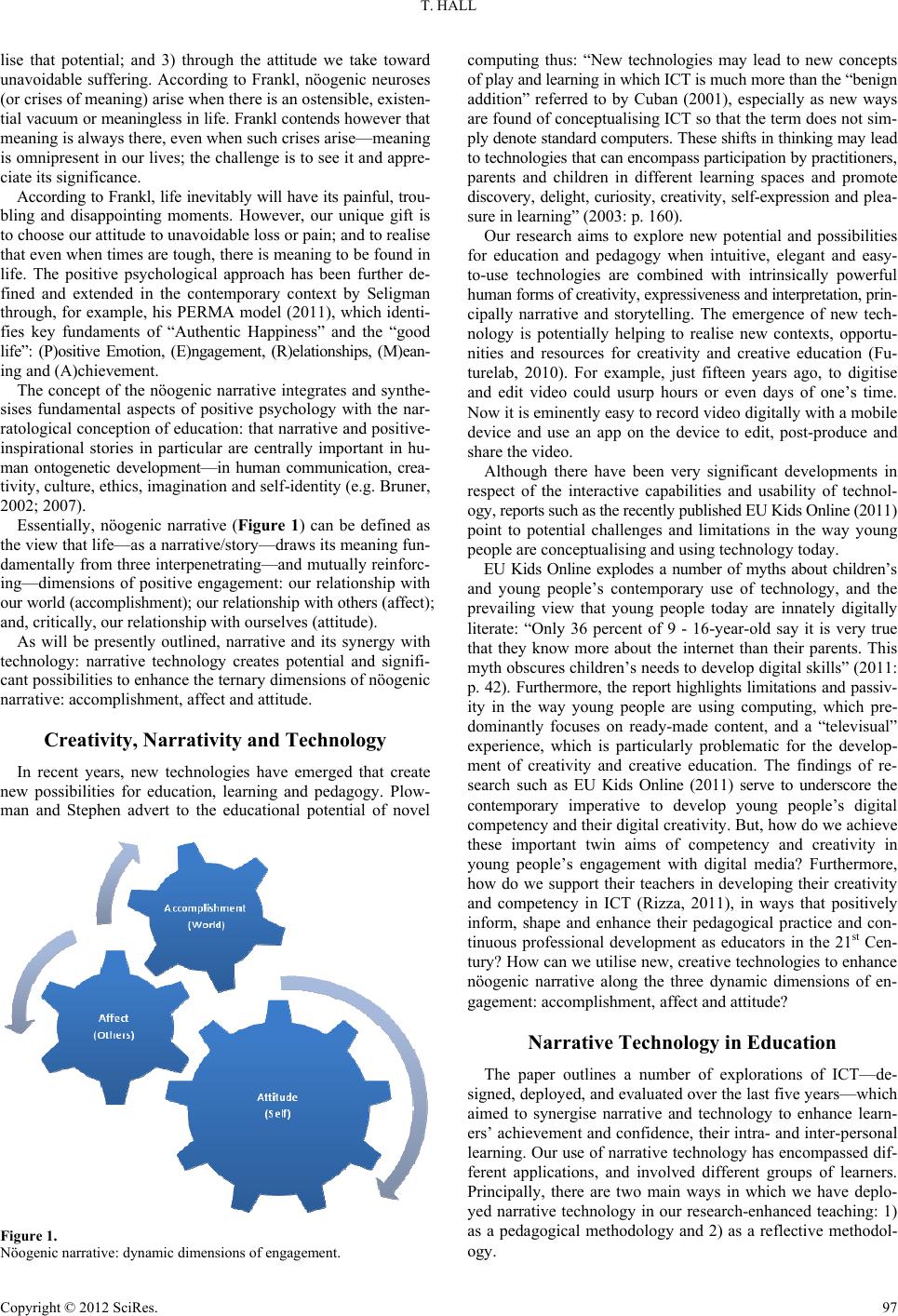 T. HALL lise that potential; and 3) through the attitude we take toward unavoidable suffering. According to Frankl, nöogenic neuroses (or crises of meaning) arise when there is an ostensible, existen- ti al vacuum or meaningless in life. Frankl contends however that meaning is always there, even when such crises arise—meaning is omnipresent in our lives; the challenge is to see it and appre- ciate its significance. According to Frankl, life inevita bly will have its painful, trou- bling and disappointing moments. However, our unique gift is to choose our attitude to unavoidable loss or pain; and to realise that even when times are tough, there is meaning to be found in life. The positive psychological approach has been further de- fined and extended in the contemporary context by Seligman through, for example, his PERMA model (2011), which identi- fies key fundaments of “Authentic Happiness” and the “good life”: (P)ositive Emotion, (E)ngagement, (R)elationships, (M)ean- ing and (A)chievement. The concept of the nöogenic narrative integrates and synthe- sises fundamental aspects of positive psychology with the nar- ratological conception of education: that narrative and positive- inspirational stories in particular are centrally important in hu- man ontogenetic development—in human communication, crea- tivity, culture, ethics, imagination and self-identity (e.g. Bruner, 2002; 2007). Essentially, nöogenic narrative (Figure 1) can be defined as the view that life—as a narrative/story—draws its meaning fun- damentally from three interpenetrating—and mutually reinforc- ing—dimensions of positive engagement: our relationship with our world (accomplishment); our relationship wit h others (affect) ; and, critically, our relationship with ourselves (attitude). As will be presently outlined, narrative and its synergy with technology: narrative technology creates potential and signifi- cant possibilities to enhance the ternary dimensions of nöogenic narrative: accomplishment, affect and attitude. Creativity, Narrativity and Technology In recent years, new technologies have emerged that create new possibilities for education, learning and pedagogy. Plow- man and Stephen advert to the educational potential of novel Figure 1. Nöogenic narrative: dynamic dimensions of en gag ement. computing thus: “New technologies may lead to new concepts of play and learning in which ICT is much more than the “benign addition” referred to by Cuban (2001), especially as new ways are found of conceptualising ICT so that the term does not sim- ply denote standard co mputers. These shifts in thi nking may lead to technologies that can enco mpass participation by practitioners, parents and children in different learning spaces and promote discovery, delight, curiosity , creativity, self-expression and pl ea- sure in learning” (2003: p. 160). Our research aims to explore new potential and possibilities for education and pedagogy when intuitive, elegant and easy- to-use technologies are combined with intrinsically powerful human f orms of creativity, expressiveness and interpre tation, prin- cipally narrative and storytelling. The emergence of new tech- nology is potentially helping to realise new contexts, opportu- nities and resources for creativity and creative education (Fu- turelab, 2010). For example, just fifteen years ago, to digitise and edit video could usurp hours or even days of one’s time. Now it is eminently easy to record video digitally with a mobile device and use an app on the device to edit, post-produce and share the video. Although there have been very significant developments in respect of the interactive capabilities and usability of technol- ogy, reports such as the recently published EU Kids Online (2011) point to potential challenges and limitations in the way young people are conceptualising and using technology today. EU Kids Online explodes a number of myths about children’s and young people’s contemporary use of technology, and the prevailing view that young people today are innately digitally literate: “Only 36 percent of 9 - 16-year-old say it is very true that they know more about the internet than their parents. This myth obscures children’s needs to develop digital skills” (2011: p. 42). Furthermore, the report highlights limitations and passiv- ity in the way young people are using computing, which pre- dominantly focuses on ready-made content, and a “televisual” experience, which is particularly problematic for the develop- ment of creativity and creative education. The findings of re- search such as EU Kids Online (2011) serve to underscore the contemporary imperative to develop young people’s digital competency and their digital creativity. But, how do we achieve these important twin aims of competency and creativity in young people’s engagement with digital media? Furthermore, how do we support their teachers in developing their creativity and competency in ICT (Rizza, 2011), in ways that positively inform, shape and enhance their pedagogical practice and con- tinuous professional development as educators in the 21st Cen- tury? How can we utilise new, creative technologies to enhance nöogenic narrative along the three dynamic dimensions of en- gagement: accomplishment, affect and attitude? Narrative Technology in Education The paper outlines a number of explorations of ICT—de- signed, deployed, and evaluated over the last five years—which aimed to synergise narrative and technology to enhance learn- ers’ achievement and confidence, their intra- and inter-personal learning. Our use of narrative technology has encompassed dif- ferent applications, and involved different groups of learners. Principally, there are two main ways in which we have deplo- yed narrative technology in our research-enhanced teaching: 1) as a pedagogical methodology and 2) as a reflective methodol- ogy. Copyright © 2012 SciRes. 97 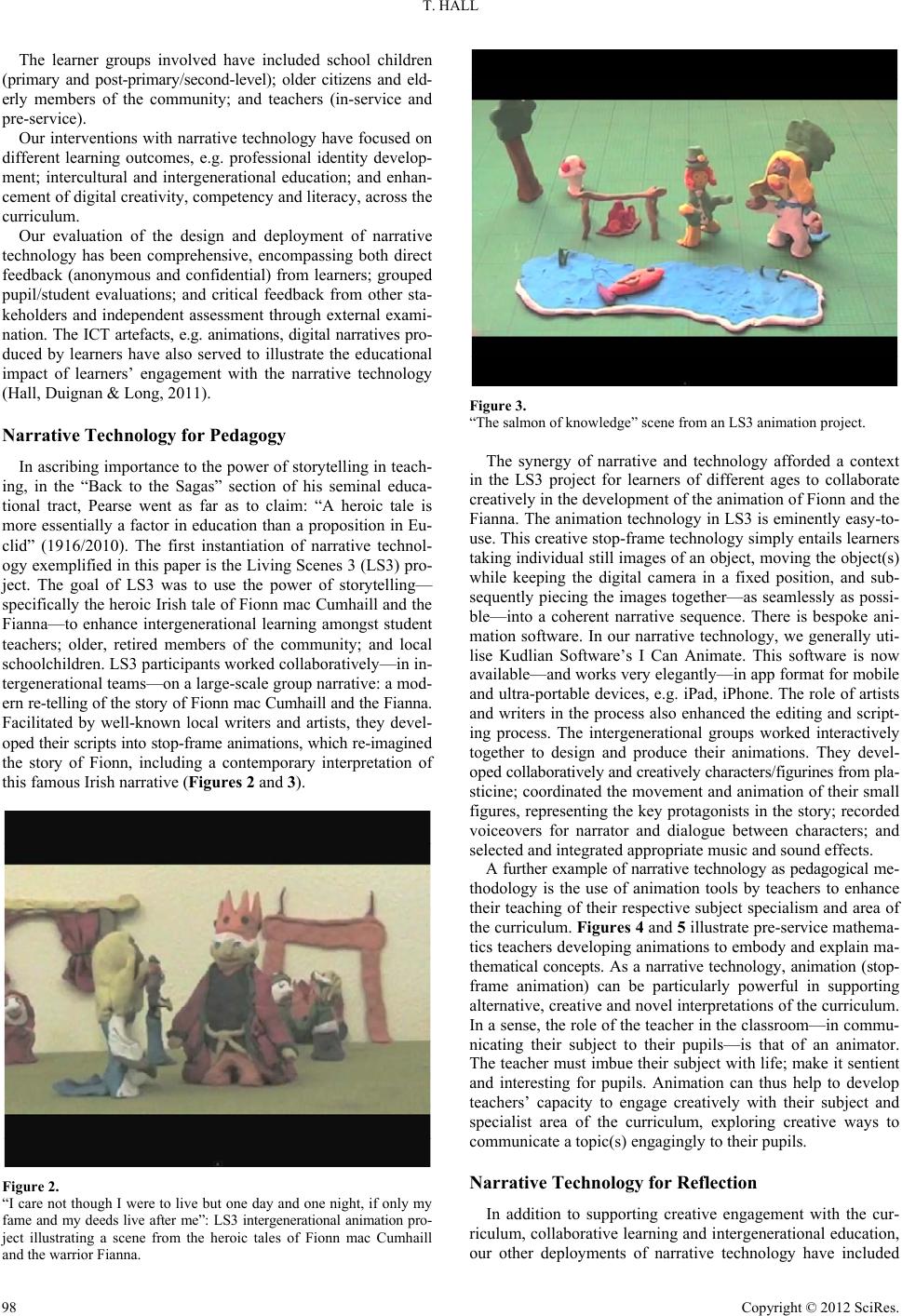 T. HALL The learner groups involved have included school children (primary and post-primary/second-level); older citizens and eld- erly members of the community; and teachers (in-service and pre-service). Our interventions with narrative technology have focused on different learning outcomes, e.g. professional identity develop- ment; intercultural and intergenerational education; and enhan- cement of digital creativity, competency and literacy, across the curriculum. Our evaluation of the design and deployment of narrative technology has been comprehensive, encompassing both direct feedback (anonymous and confidential) from learners; grouped pupil/student evaluations; and critical feedback from other sta- keholders and independent assessment through external exami- nation. The ICT artefacts, e.g. animations, digital narratives pro- duced by learners have also served to illustrate the educational impact of learners’ engagement with the narrative technology (Hall, Duignan & Long, 2011). Narrative Techno logy for Pedagogy In ascribing importance to the power of storytelling in teach- ing, in the “Back to the Sagas” section of his seminal educa- tional tract, Pearse went as far as to claim: “A heroic tale is more essentially a factor in education than a proposition in Eu- clid” (1916/2010). The first instantiation of narrative technol- ogy exemplified in this paper is the Living Scenes 3 (LS3) pro- ject. The goal of LS3 was to use the power of storytelling— specifically the heroic Irish tale of Fionn mac Cumhaill and the Fianna—to enhance intergenerational learning amongst student teachers; older, retired members of the community; and local schoolchildren. LS3 participants worked collaboratively—in in- tergenerational teams—on a large-scale group narrative: a mod- ern re-telling of the story of Fionn mac Cumhaill and the Fianna. Facilitated by well-known local writers and artists, they devel- oped their scripts into stop-frame animations, which re-imagin ed the story of Fionn, including a contemporary interpretation of this famous Irish narrative (Figures 2 and 3). Figure 2. “I care not though I were to live but one day and one night, if only my fame and my deeds live after me”: LS3 intergenerational animation pro- ject illustrating a scene from the heroic tales of Fionn mac Cumhaill Figure 3. om an LS3 animation project. The synergy of narrative and technology afforded a context in e- th Narrative Technology for Reflection ement with the cur- ri “The salmon of knowledge” s cene fr the LS3 project for learners of different ages to collaborate creatively in the development of the animation of Fionn and the Fianna. The animation technology in LS3 is eminently easy-to- use. This creative stop-frame technology simply entails learners taking individual still images of an object, moving the object(s) while keeping the digital camera in a fixed position, and sub- sequently piecing the images together—as seamlessly as possi- ble—into a coherent narrative sequence. There is bespoke ani- mation software. In our narrative technology, we generally uti- lise Kudlian Software’s I Can Animate. This software is now available—and works very elegantly—in app format for mobile and ultra-portable devices, e.g. iPad, iPhone. The role of artists and writers in the process also enhanced the editing and script- ing process. The intergenerational groups worked interactively together to design and produce their animations. They devel- oped collaborati vely and creatively characters/figurines from pla- sticine; coordinated the movement and animation of their small figures, representing the key protagonists in the story; recorded voiceovers for narrator and dialogue between characters; and selected and integrated appropriate music and sound effects. A further example of narrative technology as pedagogical m odology is the use of animation tools by teachers to enhance their teaching of their respective subject specialism and area of the curriculum. Figures 4 and 5 illustrate pre-service mathema- tics teachers developing animations to embody and explain ma- the matical concepts. As a narrative technology, animation (stop- frame animation) can be particularly powerful in supporting alternative, creative and novel interpretations of the curriculum. In a sense, the role of the teacher in the classroom—i n commu- nicating their subject to their pupils—is that of an animator. The teacher must imbue their subject with life; make it sentient and interesting for pupils. Animation can thus help to develop teachers’ capacity to engage creatively with their subject and specialist area of the curriculum, exploring creative ways to communicate a topic(s) engagingly to their pupils. In addition to supporting creative engag culum, collaborative learning and intergenerational education, our other deployments of narrative technology have included and the warrior Fianna. Copyright © 2012 SciRes. 98 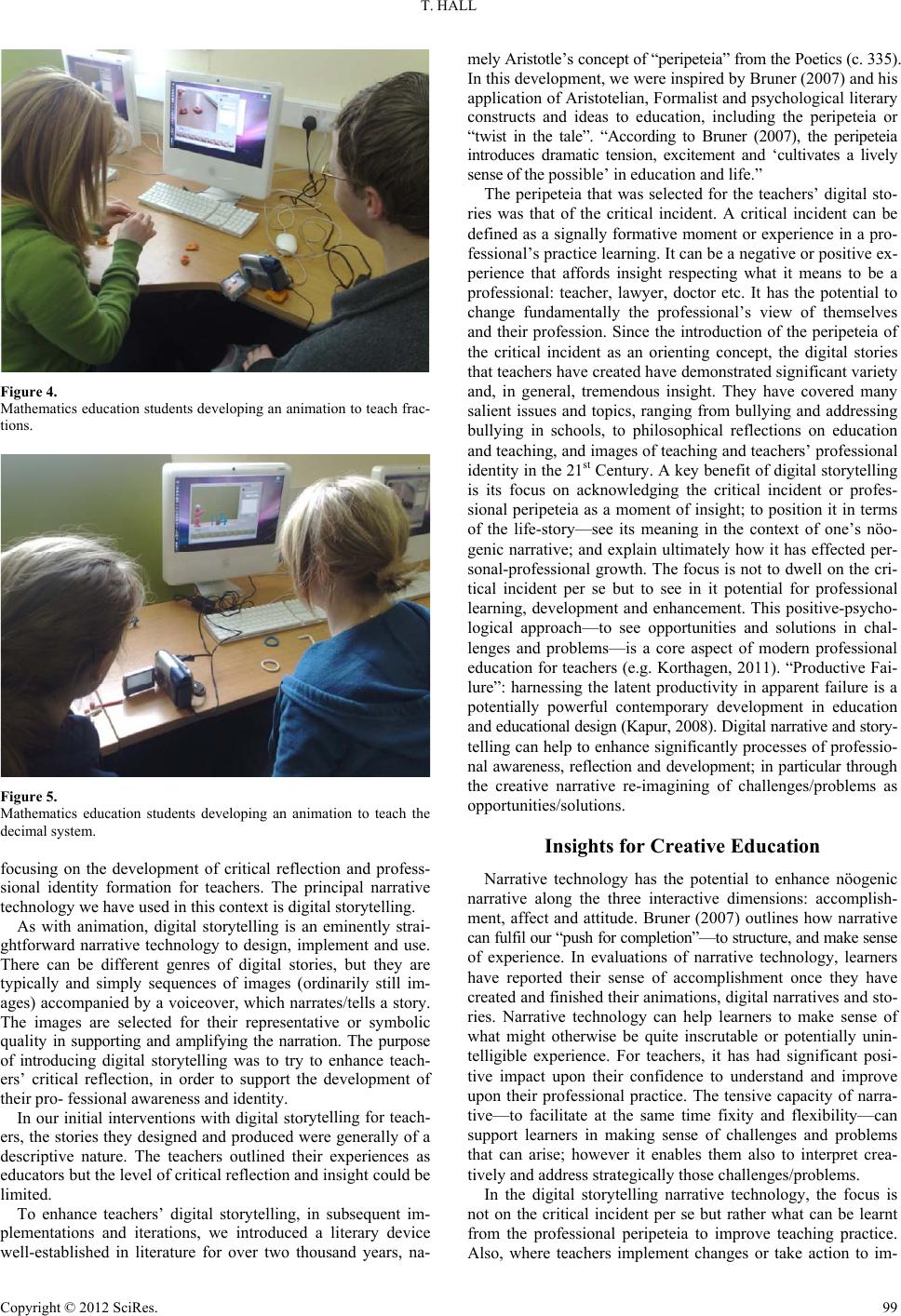 T. HALL Figure 4. cs education students developing an animation to teach frac-Mathemati tions. Figure 5. cs education students developing an animation to teach the cusing on the development of critical reflection and profess- - gh rytelling for teach- er nce teachers’ digital storytelling, in subsequent im- pl achers’ digital sto- ri Narrativ nöogenic na s is no Mathemati decimal system. fo sional identity formation for teachers. The principal narrative technology we have used in this context is digital storytelling. As with animation, digital storytelling is an eminently strai tforward narrative technology to design, implement and use. There can be different genres of digital stories, but they are typically and simply sequences of images (ordinarily still im- ages) accompanied by a voiceover, which narrates/tells a story. The images are selected for their representative or symbolic quality in supporting and amplifying the narration. The purpose of introducing digital storytelling was to try to enhance teach- ers’ critical reflection, in order to support the development of their pro- fessional awareness and identity. In our initial interventions with digital sto s, the stories they designed and produced were generally of a descriptive nature. The teachers outlined their experiences as educators but the level of critical reflection and insight could be limited. To enha ementations and iterations, we introduced a literary device well-established in literature for over two thousand years, na- mely Aristotle’s concept of “peripeteia” from the Poetics (c. 335). In this development, we were inspired by Bruner (2007) and his application of Aristotelian, Formalist and psychological literary constructs and ideas to education, including the peripeteia or “twist in the tale”. “According to Bruner (2007), the peripeteia introduces dramatic tension, excitement and ‘cultivates a lively sense of the possible’ in education and life.” The peripeteia that was selected for the te es was that of the critical incident. A critical incident can be defined as a signally formative moment or experience in a pro- fessional’s practice learning. It can be a negative or positive ex- perience that affords insight respecting what it means to be a professional: teacher, lawyer, doctor etc. It has the potential to change fundamentally the professional’s view of themselves and their profession. Since the introduction of the peripeteia of the critical incident as an orienting concept, the digital stories that teachers have created have demonstrated significant variety and, in general, tremendous insight. They have covered many salient issues and topics, ranging from bullying and addressing bullying in schools, to philosophical reflections on education and teaching, and images of teaching and teachers’ professional identity in the 21st Century. A key benefit of digital storytelling is its focus on acknowledging the critical incident or profes- sional peripeteia as a moment of insight; to position it in terms of the life-story—see its meaning in the context of one’s nöo- genic narrative; and explain ultimately how it has effected per- sonal-professional growth. The focus is not to dwell on the cri- tical incident per se but to see in it potential for professional learning, development and enhancement. This positive-psycho- logical approach—to see opportunities and solutions in chal- lenges and problems—is a core aspect of modern professional education for teachers (e.g. Korthagen, 2011). “Productive Fai- lure”: harnessing the latent productivity in apparent failure is a potentially powerful contemporary development in education an d educational design (Kapur, 2 008). Digita l narrative and st ory- telling can help to enhance significantly processes of professio- nal awareness, reflection and development; in particular through the creative narrative re-imagining of challenges/problems as opportunities/solutions. Insights for Creative Education e technology has the potential to enhance rrative along the three interactive dimensions: accomplish- ment, affect and attitude. Bruner (2007) outlines how narrative can fulfi l our “push for co mpletion” —to st ructure , and mak e sense of experience. In evaluations of narrative technology, learners have reported their sense of accomplishment once they have created and finished their animations, digital narratives and sto- ries. Narrative technology can help learners to make sense of what might otherwise be quite inscrutable or potentially unin- telligible experience. For teachers, it has had significant posi- tive impact upon their confidence to understand and improve upon their professional practice. The tensive capacity of narra- tive—to facilitate at the same time fixity and flexibility—can support learners in making sense of challenges and problems that can arise; however it enables them also to interpret crea- tively and address strategically those challenges/problems. In the digital storytelling narrative technology, the focu t on the critical incident per se but rather what can be learnt from the professional peripeteia to improve teaching practice. Also, where teachers implement changes or take action to im- Copyright © 2012 SciRes. 99  T. HALL Copyright © 2012 SciRes. 100 erational project the synergy of narrative and te Conclusion The synergy of storyputing—what we term na Acknowledgements Firstly, the authes and students of th prove practice, digital storytelling can continue to provide a te- chnology-enhanced, meaningful context for critical reflection on, and creative interpretation of experience. The working posi- tively towards a resolution or dénouement through narrative te- chnology can help to effect attitudinal change in terms of de- veloping teachers’ confidence to be able to understand challen- ges and problems—and to be able to solve those problems crea- tively and productively. Narrative technology can significantly enhance accomplishment, affect and attitude by providing me- dia rich, technology-enhanced contexts for creativity and crea- tive education. In the intergen chnology supported collaborative creativity amongst learners of very different ages. The intergenerational teams worked to- gether to interpret creatively heroic sagas and stories, which helped to break down age barriers and foster collaboration and meaningful interaction. The simplicity of the technology also ensured that all learners were involved in the development of the animated stories. A further, significant technical aspect of na rrative technology is t he high usability of the tools used, whic h helps to ensure the focus remains principally on learning and that all learners feel included/involved. telling and com rrative technology—is creating possibilities for a digital ren- aissance in education. The ease-of-use of new and emerging storytelling technologies, synergised with the imaginative, po- tentially transformative human power of narrative is opening up new possibilities to enhance creativity and creative education. It is potentially enabling more learners to be creative with digital media—irrespective of their creativity or “lack” of creativity heretofore. It is potentially enhancing learners’ engagement with technology—irrespective of possible limitations in their historical or prior use of ICT. Narrative technology is creating potential for a renaissance in education and educational tech- nology—across the dynamic, interactive dimensions of nöo- genic narrative—with significant positive impacts for learner accomplishment, affect and attitude. or wishes to thank colleagu e School of Education, National University of Ireland, Gal- way, and in particular: Prof. Chris Curtin, Bonnie Long, Jim Lenaghan, and Dr. Dolores Stewart. The author would further- more like to thank the Dean and the College of Arts, Social Sciences and Celtic Studies, NUI Galway; Apple Education; and Galmac for their support of the research reported in this paper—through the School of Education’s Apple iPedagogy Learning Environment (AiPLE), Apple Regional Training Cen- tre. The author also wishes to thank colleagues in the BEAM Consortium, Building European Identity through Spirit, Sense and Meaning, and Hewlett Packard (Innovation in Education Award 2009) for their support of the research reported here. REFERENCES Aristotle. (c.335 BC/2007) Poetics. US: Forgotten Books. Bruner, J. (1990). Acts of meaning. Cambridge, MA: Harvard Univer- sity Press. Bruner, J. (2002). Making stories: Law, literature, life. New York: Farrar Straus & Giroux. Bruner, J. (2007). Cultivating the possible. URL (last checked 16 No- vember 2011). http://www.education.ox.ac.uk/about-us/video-archive/ Cuban, L. (2001). Oversold and underused: Computers in the class- room. Cambridge, MA: Harvard University Press. EU Kids Online. (2011). EU kids online final report. URL (last checked 28 September 2011). http://www2.lse.ac.uk/media@lse/research/EUKidsOnline/Home.aspx Frankl, V. E. (1946/2006). Man’s search for meaning. UK: Beacon Press. Futurelab. (2010). Digital Literacy Professional Development Resource. URL (last checked 26 September 2011). http://www.futurelab.org.uk/sites/default/files/Digital_Literacy_Reso urce.pdf Futurelab. (2010). Digital literacy across the curriculum. URL (last checked 26 September 201 1 ). http://www.futurelab.org.uk/sites/default/files/Digital_Literacy_hand book_0.pdf Hall, T., Duignan, S., & Long, B. T. (2011). Quality through synergy: Technology-enhanced learning (animation, virtualisation and multi- user virtual environments (MUVEs) in higher education. In T. Hou- rigan, L. Murray, & E. Riordan, (Eds.), Quality issues in ICT inte- gration: Third level disciplines and learning contexts (pp. 28-46). Newcastle upon Tyne: Cambridge Scholars Publishing . Kapur, M. (2008). Productive failure. Cognition and Instruction, 26, 379-424. doi:10.1080/07370000802212669 Korthagen, F. (2011). Moving from the inside out: Connecting practice, theory, and person. International Association of Physical Education in Higher Education 2011 Conference, Limerick, 22-25 June 2011. Pearse, P. H. (1916/2010). The murder machine. URL (last checked 6 November 2011). http://www.ucc.ie/celt/published/E900007-001/index.html Plowman, L., & Stephen, C. (2003). A “benign addition”? A review of research on ICT and pre-school children. Journal of Computer-As- sisted Learning, 19, 149-164. doi:10.1046/j.0266-4909.2003.00016.x Rizza, C. (2011). ICT and initial teacher education: National policies. OECD Education Working Pap e rs , 61, 55. doi:10.1787/5kg57kjj5hs8-en Schank, R. (1990). Tell me a story: Narrative and intelligence. Evans- ton: Northwestern University Press. Seligman, M. E. P. (2011). Flourish: A visionary new understanding of happiness and well-being. New York: Free Press. Strawson, G. (2004 ). Against narrativity. Ratio, 17, 428-452. doi:10.1111/j.1467-9329.2004.00264.x |