

Paper Menu >>
Journal Menu >>
 Creative Education 2012. Vol.3, No.1, 92-95 Published Online February 2012 in SciRes (http://www.SciRP.org/journal/ce) http://dx.doi.org/10.4236/ce.2012.31015 Copyright © 2012 SciRes. 92 Gender and Anxiety: A Comparison of Student Anxiety Levels in Face-to-Face and Video Conferencing Courses Jodi McKnight1, Mark A. McKnight2 1Psychology, M idcontinent University, Mayfield, USA 2Business Communication, University of Southern Indiana, Evansville, USA Email: jmcknight @midcontinent.edu, [email protected] Received October 11th, 2011; revised November 14th, 2011; accepted November 28th, 2011 This research focuses on the role of gender in face-to-face instruction and video conferencing instruction on students’ levels of anxiety. This is due, in part, to the fact that gender and anxiety levels of students enrolled in remote video conferencing learning environments has received little attention in either psy- chological or educational research. A difference in gender as it relates to education is an important focus of research. This is due to the increasing learning opportunities for female students (online in particular). Explored later, further research should investigate various demographics and delivery options for courses. Keywords: Video Conferencing; Student Anxiety; Gender Introduction Current research has shown that affective responses in alter- native learning environments are lacking (McKnight, 2010). Hove and Corcoran (2008) found that there is a limit to the investigation of students’ affective responses in virtual learning environments, one of which is video conferencing. Video con- ferencing in educational settings is a method of instruction in which instructors and students interact, both visually and with audio in “real time”, with the instructor and students at the originating campus and other remote campuses, allowing simu- lation of the face-to-face interaction of traditional education (Fillion et al., 1999). Yukselturk and Bulut, (2009) report that within the literature, gender based differences in education are an important focus for research, and have been for a while. Research was conducted to explore the comparative impact of a students’ form of instruction (either face-to-face or video con- ferenced) on their levels of anxiety as it relates to t heir gender, one reason being that gender, as a demographic variable, has great practical importance (Schleicher, Van Iddenkinge, Mor- geson, & Campion, 2010). The present research attempts to provide an exploratory study on the impacts of demographics as determining factors for anxiety levels in educational settings. More specifically, initial study undertaken here investigates the demographic of gender in a live video-based course. Further research, which is fully explored later, could explore various demographics and delivery options for courses. Review of the Literature Recent studies have found that attending a college or univer- sity can be anxiety-producing during the first year (Bouteyre, Maurel, & Bernand, 2007; Mundia, 2010). This can be the re- sult of numerous factors including poor time management, repeated failure, or public speaking (Head & Lindsey, 1983). Yukselturk and Bulut (2009) report that distance education has been a good option for female students, primarily because they can balance more of the familial and educational, as well as vocational, areas of their lives. Since distance education is one of the more popular forums for educational advancement, Yuk- selturk and Bulut (2009) found that the male and female may be different in several ways due to the variety of life responsibili- ties they have. Bekker and van Mens-Verhulst (2007) define gender as con- sisting of “the socio-cultural aspects of defining people’s iden- tity in relation to sex” (p. S179). These characteristics can be very different between same sex members, but can also be similar between those individuals of opposite sexes (Bekker & van Mens-Verhulst, 2007). Judge and Livingston (2008) state that gender is fundamental and has been explored within a plethora of disciplinary perspectives. In fact, gender is often one of the first variables considered when conducting a meta-analysis of a topic. Gender and anxiety research have been explored in a variety of areas, one being distance learning (Yukselturk, and Bulut, 2009). Martin (2010) recommends that to gain better representation on gender and discipline, study one specific dis- cipline and explore gender within it. Abdel-Khalek and Alansari (2004) state that “anxiety is one of the most fundamental of all constructs in psychology” (p. 649). Disorders within the anxiety-spectrum are the most per- vasive class of mental disorders (Stein & Stein, 2008), with over 29% of the United States population having one or more diagnosable anxiety disorder at some point in their lives (Mi- neka & Zinbarg, 2006.) Both physiological and psychological manifestations have also been explored, but it is limited in a video conferenced en- vironment (McKnight, 2010). Anxiety research in education has been limited to computer-assisted teaching methods (DeBord, Arugente, & Muhlig, 2004), learning and computer anxiety (Barbeite and Weiss, 2003), emotions and achievement (Pekrun et al., 2006), academic anxiety (Levine, 2008) and the compa- risons between online learning and face-to-face learning (Soli- meno et al., 2007). As for gender prevalence, Bekker and van Mens-Verhulst  J. MCKNIGHT ET AL. (2007) report that anxiety is substantially higher in women than in men. Mundia (2010) indicates that there is an increase in the prevalence of anxiety in college students. In addition, anxiety was more prevalent in female students than male students. Procedures The sample was drawn from a larger population of students enrolled in a community college. Upon registration, students had the opportunity to enroll in a variety of courses, one being called “Interactive Video Course”. As more face-to-face courses were available than distance learning courses, there was un- equal groups. This, however, is neither uncommon nor atypical, according to Halsne and Gotta’s (2002) study of traditional versus online instruction. Their sample for study consisted of twice as many traditional students than online students. The educational institution’s distance education option was called an “interactive video course.” The courses offered in this format and the traditional face-to-face format included Intro- duction to Psychology, Speech, English, History and Sociology. This “class subject” was included in the analyses as an inde- pendent variable to see if it had any impact on anxiety experi- enced. The demographics of the participants were as follows: ages 18-50, men and women, of all socioeconomic backgrounds. The exclusion criteria included those not enrolled in the video conferencing course for the above courses during a single 15- week term. Additional exclusion criteria included students who did not speak the English language fluently. There were no disability exclusion criteria for this research. Distance education courses at this college had a maximum of 20 enrollees per 15-week term in each class, but had to have at least 10 students enrolled in order for the course to be held. Students could have enrolled at the main campus or at the re- mote campus. Using five courses provided the researcher with approximately 100 students to which the instruments were ad- ministered. Students who choose to enroll in Introduction to Psychology, Speech, English, History and Sociology video conferencing courses decided upon registration which campus they preferred to receive instruction from, the main campus (face-to-face) or the remote campus. Factors that influenced the students’ choices of location in the past included convenience, the length of travel time it took to and from the college loca- tions, financial issues due to travel, residential addresses of students. Therefore, the researcher did not assign participants to groups; the students themselves (along with assistance from their academic advisor) decided the location from which to take the class. Method A quasi-experimental design was used due the fact that stu- dents were not randomly assigned and there were unequal groups. Data was collected through two quantitative measures, at one time. The first measure was through the state scale of the State-Trait Anxiety Inventory, created by Spielberger (1983). The STAI measures the psychological manifestations of anxiety. Andor et al. (2008) reports that one psychological manifestation of anxiety is a difficulty in controlling worry, while Spielberger (1983) believes manifestations can also include a feelings of fear, tension and apprehension. The second measure was the Beck Anxiety Inventory, cre- ated by Beck et al. (1988). The BAI measures the physical manifestations of anxiety. These can include an increase in heart rate, sweating, shortness of breath and trembling (Larson et al., 2007). The class subject being taught, age and gender was also be recorded, to be analyzed as an independent variable, as it may have had some impact on anxiety levels. Students were administered the BAI and the STAI during a class period toward the end of the 15-week term. Data The data that was analyzed included the numerical compo- nents provided by the STAI and the BAI, as well as the class subject being taught. For the scores on the STAI-S (or state scale), there is an increase in response to physical danger and psychological stress and decrease as a result of some relaxation techniques (Spielberger, 1983). The STAI consists of separate self-report scales that measure state and trait anxiety. The STAI items contain twenty statements of how people generally feel. Spielberger (1983) reports that the state anxiety scale can vary from a minimum of 20 to a maximum of 80, with those report- ing higher scores exhibiting more self-reported symptoms of anxiety. Participants are asked to read the statements, and then circle the number to the right of the statement to indicate how they feel at the current moment. Choices included 1 = not at all; 2 = somewhat; 3 = moderately so; and 4 = very much so. This instrument consists of twenty statements that evaluate those feelings. The BAI, according to Beck et al. (1988) reports that the items are summed to obtain the total score ranging from 0-63. Wetherell and Arean (1997) report that scores of 16 or higher suggest moderate to severe levels of anxiety, which means that the higher the score on the BAI, the greater number of symp- toms of anxiety experienced by the person. This is a self-report measure that examines the physical sensations associated with anxiety, such as abdominal discomfort, numbness, difficulty breathing, and sweating. The BAI consists of 21 anxiety symp- toms, with participants being asked to indicate the extent to which they were bothered by each item during the past week, and including the current day (Creamer, et al., 1995). Partici- pants rate their severity of anxious symptoms over the past week on a 4-point scale ranging from 0 (not at all) to 3 (se- verely-I could barely stand it). Beck et al. (1988) reports that the items are summed to obtain the total score ranging from 0-63. The researcher in the main campus classroom collected data while the proctor collected the data in the remote campus loca- tion. Participants were assigned a number before the admini- stration of the instruments and the participant number was the only identifying information on the instruments. Once instru- ments were collected, the researcher and the proctor placed the instruments in a large manila envelope and sealed it. The re- searcher then drove to the remote campus and collected the video conferencing participants’ data after the completion of the BAI and STAI. Results The demographics of the participants included 41% (n = 54) males and 59% (n = 78) females, for a total of 132 participants. Participants ranged in ages from 18 years old to 66 years old. There were 10 participants who did not report their age. Twenty- seven percent (27%) of those reporting age were 18 years old, Copyright © 2012 SciRes. 93 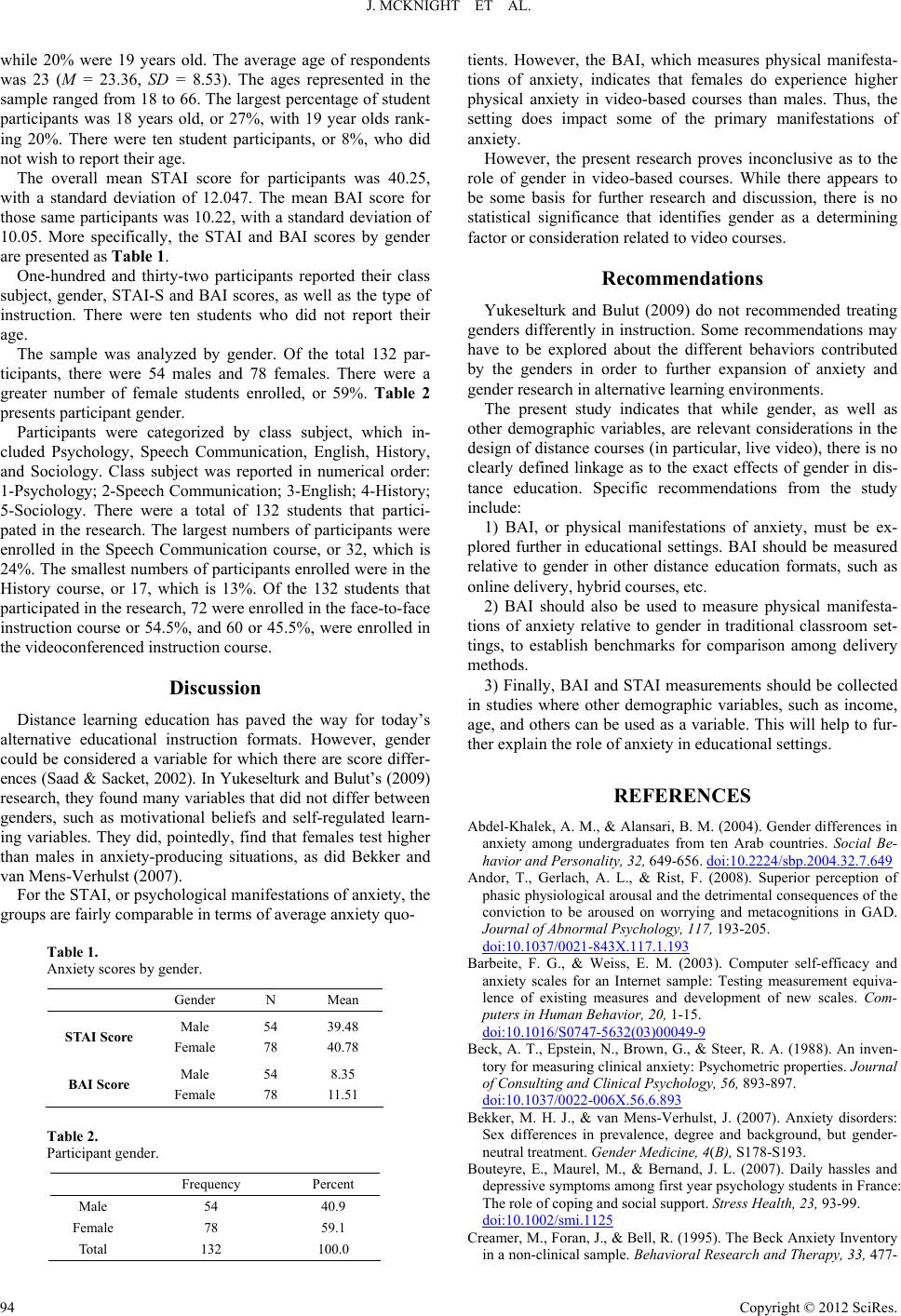 J. MCKNIGHT ET AL. while 20% were 19 years old. The average age of respondents was 23 (M = 23.36, SD = 8.53). The ages represented in the sample ranged from 18 to 66. The largest percentage of student participants was 18 years old, or 27%, with 19 year olds rank- ing 20%. There were ten student participants, or 8%, who did not wish to report their age. The overall mean STAI score for participants was 40.25, with a standard deviation of 12.047. The mean BAI score for those same participants was 10.22, with a standard deviation of 10.05. More specifically, the STAI and BAI scores by gender are presented as Table 1. One-hundred and thirty-two participants reported their class subject, gender, STAI-S and BAI scores, as well as the type of instruction. There were ten students who did not report their age. The sample was analyzed by gender. Of the total 132 par- ticipants, there were 54 males and 78 females. There were a greater number of female students enrolled, or 59%. Table 2 presents participant gender. Participants were categorized by class subject, which in- cluded Psychology, Speech Communication, English, History, and Sociology. Class subject was reported in numerical order: 1-Psychology; 2-Speech Communication; 3-English; 4-History; 5-Sociology. There were a total of 132 students that partici- pated in the research. The largest numbers of participants were enrolled in the Speech Communication course, or 32, which is 24%. The smallest numbers of participants enrolled were in the History course, or 17, which is 13%. Of the 132 students that participated in the research, 72 were enrolled in the face-to-face instruction course or 54.5%, and 60 or 45.5%, were enrolled in the videoconferenced instruction course. Discussion Distance learning education has paved the way for today’s alternative educational instruction formats. However, gender could be considered a variable for which there are score differ- ences (Saad & Sacket, 2002). In Yuke selturk and Bulut’s (2009) research, they found many variables that did not differ between genders, such as motivational beliefs and self-regulated learn- ing variables. They did, pointedly, find that females test higher than males in anxiety-producing situations, as did Bekker and van Mens-Verhulst (2007). For the STAI, or psychological manifestations of anxiety, the groups are fairly comparable in terms of average anxiety quo- Table 1. Anxiety scores by gender. Gender N Mean STAI Score Male Female 54 78 39.48 40.78 BAI Score Male Female 54 78 8.35 11.51 Table 2. Participant gender. Frequency Percent Male 54 40.9 Female 78 59.1 Total 132 100.0 tients. However, the BAI, which measures physical manifesta- tions of anxiety, indicates that females do experience higher physical anxiety in video-based courses than males. Thus, the setting does impact some of the primary manifestations of anxiety. However, the present research proves inconclusive as to the role of gender in video-based courses. While there appears to be some basis for further research and discussion, there is no statistical significance that identifies gender as a determining factor or consideration related to vid eo cou rses. Recommendations Yukeselturk and Bulut (2009) do not recommended treating genders differently in instruction. Some recommendations may have to be explored about the different behaviors contributed by the genders in order to further expansion of anxiety and gender research in alternative learning environments. The present study indicates that while gender, as well as other demographic variables, are relevant considerations in the design of distance courses (in particular, live video), there is no clearly defined linkage as to the exact effects of gender in dis- tance education. Specific recommendations from the study include: 1) BAI, or physical manifestations of anxiety, must be ex- plored further in educational settings. BAI should be measured relative to gender in other distance education formats, such as online delivery, hybrid courses, etc. 2) BAI should also be used to measure physical manifesta- tions of anxiety relative to gender in traditional classroom set- tings, to establish benchmarks for comparison among delivery methods. 3) Finally, BAI and STAI measurements should be collected in studies where other demographic variables, such as income, age, and others can be used as a variable. This will help to fur- ther explain the role of anxiety in educational set tings. REFERENCES Abdel-Khalek, A. M., & Alansari, B. M. (2004). Gender differences in anxiety among undergraduates from ten Arab countries. Social Be- havior and Personality, 32, 649-656. doi:10.2224/sbp.2004.32.7.649 Andor, T., Gerlach, A. L., & Rist, F. (2008). Superior perception of phasic physiological arousal and the detrimental consequences of the conviction to be aroused on worrying and metacognitions in GAD. Journal of Abnormal Psycholo gy , 117, 193-205. doi:10.1037/0021-843X.117.1.193 Barbeite, F. G., & Weiss, E. M. (2003). Computer self-efficacy and anxiety scales for an Internet sample: Testing measurement equiva- lence of existing measures and development of new scales. Com- puters in Human Behavior, 20, 1-15. doi:10.1016/S0747-5632(03)00049-9 Beck, A. T., Epstein, N., Brown, G., & Steer, R. A. (1988). An inven- tory for measuring clinical anxiety: Psychometric properties. Journal of Consulting and Clinical Psychology , 56, 893-897. doi:10.1037/0022-006X.56.6.893 Bekker, M. H. J., & van Mens-Verhulst, J. (2007). Anxiety disorders: Sex differences in prevalence, degree and background, but gender- neutral treatment. Gender Medicine, 4(B), S178-S193. Bouteyre, E., Maurel, M., & Bernand, J. L. (2007). Daily hassles and depressive symptoms among first year psychology students in France: The role of coping and social suppo rt. Stress H e a lth, 23, 93-99. doi:10.1002/smi.1125 Creamer, M., Foran, J., & Bell, R. (1995). The Beck Anxiety Inventory in a non-clinical sample. Behavioral Research and Therapy, 33, 477- Copyright © 2012 SciRes. 94  J. MCKNIGHT ET AL. Copyright © 2012 SciRes. 95 485. doi:10.1016/0005-7967(94)00082-U DeBord, K. A., Aruguete, M. S., & Muhlig, J. (2004). Are computer- assisted teaching methods effective? Teaching of Psychology, 31, 65- 68. doi:10.1207/s15328023top3101_13 Fillion, G., Limayem, M., & Bouchard, L. (1999). Videoconferencing in distance education: A study of student perceptions in the lecture context. Innovations in Education and Training International, 36, 302-319. doi:10.1080/1355800990360406 Halsne, A., & Gotta, L. (2002). Online versus traditionally-delivered instruction: A descriptive study of learner characteristics in a com- munity college setting. Online Journal of Distance Learning Admini- stration, 5. URL. http://www.westga.edu/%7Edistance/ojdla/spring51/halsne51.html Head, L.G., & Lindsey, J. D. (1983). Anxiety and the university student: A brief review of the professional literature. College Studies Journal, 17, 176-182. Judge, T. A., & Livingston, B. A. (2008). Is the gap more than gender? A longitudinal analysis of gender, gender role orientation, and earn- ings. Journal of App li e d Psychology, 93, 994-1012. doi:10.1037/0021-9010.93.5.994 Levine, G. (2008). A Foucaultian approach to academic anxiety. Edu- cational Studies, 44, 62-76. Martin, A. J. (2010). Should students have a gap year? Motivation and performance factors relevant to time out after completing school. Journal of Educational Ps ych olo gy, 102, 561-576. doi:10.1037/a0019321 McKnight, J. L. (2010). The comparative impact of face-to-face in- struction and video conferencing instruction on students’ anxiety lev- els. Minneapolis, MN: Capella University. Mineka, S., & Zinbarg, R. (2006). A contemporary learning theory perspective on etiology of anxiety disorders. American Psychologist, 61, 10-26. doi:10.1037/0003-066X.61.1.10 Pekrun, R., Elliot, A. J., & Maier, M. A. (2006). Achievement goals and discrete achievement emotions: A theoretical model and pro- spective test. Journal of Educational Psychology, 98, 583-597. doi:10.1037/0022-0663.98.3.583 Mundia, L. (2010). The prevalence of depression, anxiety and stress in Brunei preservice student teachers. The Internet Journal of Mental Health, 6. Saad, S., & Sackett, P. R. (2002). Examining differential prediction by gender in employment-oriented personality measures. Journal of Ap- plied Psychology, 87, 667-674. doi:10.1037/0021-9010.87.4.667 Schleicher, D. J., Van Iddekinge, C. H., Morgeson, F. P., & Campion, M. A. (2010). If at first you don’t succeed, try, try again: Under- standing race, age, and gender differences in retesting score im- provement. Journal of Applied Psychology, 95, 603-617. doi:10.1037/a0018920 Solimeno, A., Mebane, M. E., Tomai, M., & Francescato, D. (2007). The influence of students and teachers characteristics on the efficacy of face-to-face and computer supported collaborative learning. Com- puters and Education, 51, 109-128. doi:10.1016/j.compedu.2007.04.003 Spielberger, C. D., Gorsuch, R. L., & Lushene. R. E. (1970). Test man- ual for the State-Trait Anxiety Inventory. Palo Alto, CA: Consulting Psychologists. Spielberger, C. D. (1983). Manual for the State-Trait Anxiety Inventory. Palo Alto, CA: Mind Garden. Stein, M. B., & Stein, D. J. (2008). Social anxiety disorder. The Lancet, 371, 1115-1125. doi:10.1016/S0140-6736(08)60488-2 Wetherell, J. L., & Arean, P. A. (1997). Psychometric evaluation of the Beck Anxiety Inventory with older medical patients. Psychological Assessments, 9, 136-144. doi:10.1037/1040-3590.9.2.136 Yukselturk, E., & Bulut, S. (2009). Gender differences in self-regulated online learning environment. Educational Technology & Society, 12, 12-22. |