

Paper Menu >>
Journal Menu >>
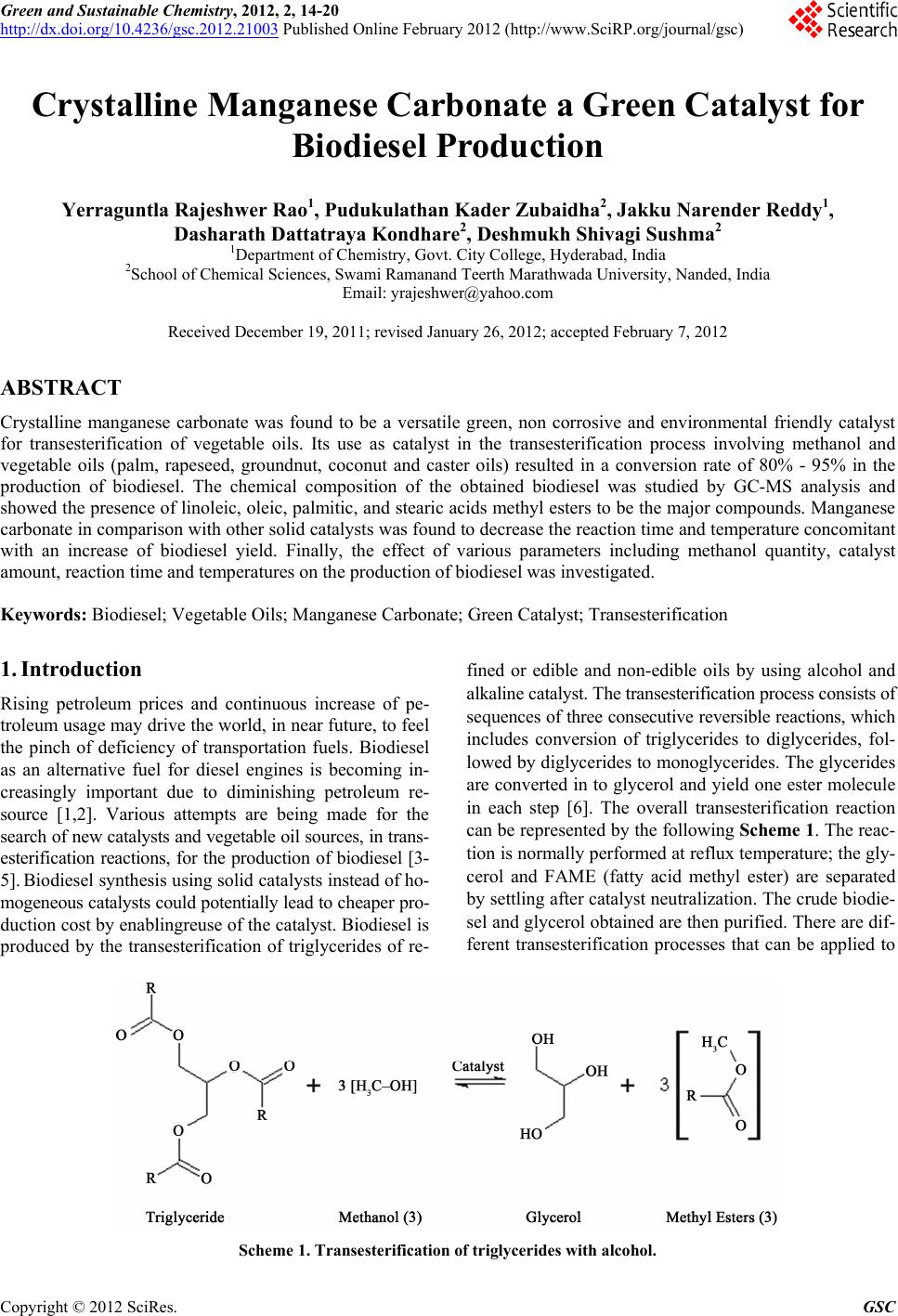 Green and Sustainable Chemistry, 2012, 2, 14-20 http://dx.doi.org/10.4236/gsc.2012.21003 Published Online February 2012 (http://www.SciRP.org/journal/gsc) Crystalline Manganese Carbonate a Green Catalyst for Biodiesel Production Yerraguntla Rajeshwer Rao1, Pudukulathan Kader Zubaidha2, Jakku Narender Reddy1, Dasharath Dattatraya Kondhare2, Deshmukh Shivagi Sushma2 1Department of Chemis try, Govt. City College , Hyderabad, Indi a 2School of Chemical Sciences, Swami Ramanand Teerth Marathwada University, Nanded, India Email: [email protected] Received December 19, 2011; revised January 26, 2012; accepted February 7, 2012 ABSTRACT Crystalline manganese carbonate was found to be a versatile green, non corrosive and environmental friendly catalyst for transesterification of vegetable oils. Its use as catalyst in the transesterification process involving methanol and vegetable oils (palm, rapeseed, groundnut, coconut and caster oils) resulted in a conversion rate of 80% - 95% in the production of biodiesel. The chemical composition of the obtained biodiesel was studied by GC-MS analysis and showed the presence of linoleic, oleic, palmitic, and stearic acids methyl esters to be the major compounds. Manganese carbonate in comparison with other solid catalysts was found to decrease the reaction time and temperature concomitant with an increase of biodiesel yield. Finally, the effect of various parameters including methanol quantity, catalyst amount, reaction time and temperatures on the production of biodiesel was investigated. Keywords: Biodiesel; Vegetable Oils; Manganese Carbonate; Green Catalyst; Transesterification 1. Introduction Rising petroleum prices and continuous increase of pe- troleum usage may drive the world, in near future, to feel the pinch of deficiency of transportation fuels. Biodiesel as an alternative fuel for diesel engines is becoming in- creasingly important due to diminishing petroleum re- source [1,2]. Various attempts are being made for the search of new catalysts and vegetable oil sour ces, in trans- esterification reactions, for the production of biodiesel [3- 5]. Biodiesel synthesis using solid catalysts instead of ho- mogeneous catalysts could potentially lead to cheaper pro- duction cost by enablingreu se of the catalyst. Biodiesel is produced by the transesterification of triglycerides of re- fined or edible and non-edible oils by using alcohol and alkaline catalyst. The transest eri fi cati on process consists of seq uences of three consecutive reversible reactions, which includes conversion of triglycerides to diglycerides, fol- lowed by diglycerides to monoglycerides. The glycerides are converted in to glycerol and yield one ester molecule in each step [6]. The overall transesterification reaction can be represented by the following Scheme 1. The reac- tion is normally performed at reflux temperature; the gly- cerol and FAME (fatty acid methyl ester) are separated by settling after catalyst neutralization. The crude biodie- sel and glycerol obtained are then purified. There are dif- ferent transesterification processes that can be applied to Scheme 1. Transesterification of triglycerides with alcohol. C opyright © 2012 SciRes. GSC  Y. RAJESHWER RAO ET AL. 15 synthesize biodiesel like base catalyzed transesterifica- tion, acid catalyzed transesterification and enzyme cata- lyzed transesterification [4]. Biodiesel is currently syn- thesized using homogeneous acid catalysts, the rate of reaction much slower than the base catalyzed reaction. There are several comprehensive studies of base catalyzed transesterification. The most common basic catalysts are potassium hydroxide (KOH) and sodium hydroxide (NaOH) [7,8]. Even though homogeneous catalyzed bio- diesel production process are relatively fast and show high conversion with minimal side reactions, they are still no t very cost effective with petrodiesel. The transesterifica- tion reaction can also be catalyzed by Bronsted acids pre- ferably sulphonic and sulphuric acids, but the reaction rates are very low and require relatively high temperatur e to get the high product yield [9]. According to an acid ca- talyzed mechanism for esterification, carboxylic acid can be readily formed by hydrolysis of the carbocation inter- mediate formed upon protonation of the ester. This sug- gests that acid catalyzed transesterification should be car- ried out in the absence of the water to avoid the compete- tive formation of carboxylic acids and concomitant re- duction in the yields of alkyl ester [10]. The most com- mon acid catalysts used are H2SO4 and HCl. The scientist Freedman et al showed that the methanolysis of soybean oil, in the presence of 1 mol% of H2SO4 with an alco- hol/oil molar ratio of 30:1 at 65˚C, takes 50 hrs to reach complete conversion of the vegetable oil [11]. The trans- esterification of oils is also carried out by solid super acids such as tungustated zirconia-alumina (WZA), sul- phated tin oxide (STA) and sulphated zirconia-alumina (SZA), of which the WZA catalyst was the most effect- tive achieving conversion >90% at temperature above 250˚C after 20 h [12]. Current industrial catalysts for bio- diesel are based on the basic catalyst mentioned above require pretreatment of the feedstock to remove impuri- ties, water and the free fatty acids (which precludes the use of low quality feedstocks such as waste oils) [13,14]. They also lead to saponification (i.e. soap formation) of vegetable oil, which occur as an undesired side reaction and necessities lengthy after process separation proce- dures. These productio n steps negate the low price of the catalyst and are energy intensive. It is therefore necessary to develop new environmentally benign, inexpensive and effective catalysts which avoid the costly saponification reaction. A wide range of alternatives have been propo- sed but to date none are ideal. In this work, manganese carbonate (MnCO3) was found to be a versatile catalyst in transesterifiction reaction to produce monoalkyl ester (biodiesel). In this communication manganese carbonate was found to be a versatile catalyst with 80% - 95% con- version rate in the production of biodiesel involving, ve- getable oils like palm oil, rapeseed oil, groundnut o il, co- conut oil and castor oil. Although palm oil and rapeseed oil are extensively used for biodiesel production the other oils mentioned are studied for comparison purposes. 2. Experimental Details 2.1. Materials All chemicals used in the experiments such as methanol (99.5%), chloroform, petroleum ether, sodium sulphate, sulphuric acid were of analytical regent grade and silica gel G LR for TLC were purchased from Sarabhai Divi- sion Fine Chemicals (Mumbai, India). Refined palm, sun- flower, groundnut, coconut, rapeseed and castor oils were purchased from local food store. Pure, ash colored, crys- talline manganese carbonate was purchased fro m Chemi- cal Corporation (Mumbai, India). 2.2. Transesterification Transesterification process was performed in 25 ml round bottom flask with reflux condenser and a magnetic stirrer. Stirring was set at constant speed throughout the experi- ment. The manganese carbonate in methanol ( 0.5% - 3% w/v) was used for the conversion of oil to fatty acid me- thyl ester (FAME), other oil to methanol ratio varied from 5:1 to 12:1 v/v. A known amount of catalyst was added in the required amount of methanol and was hea- ted separately at desired temperature. This methanolic ca- talyst was added to the preheated oil and the reaction was kept under reflux condition. Formation of methyl ester from vegetable oil was monitored by thin layer chroma- tography. After reaction completion, the formed methyl esters mixture was extracted with chloroform dried over sodium sulphate. Chloroform was evaporated using a ro- tary evaporator and the obtained methyl esters mixture was then subjected to GC-MS analysis. 2.3. Analysis of Fatty Acid Methyl Esters Gas chromatography has been to date the most widely used method for the analysis of biodiesel due to its hi- gher accuracy in unifying minor components [15]. The sample was analyzed with shimadzu GC-2010 gas chro- matograph equipped with splitless injection system. He- lium was used as carrier gas. The cond ition of instrument were: column oven temperature 75˚C, injection tempera- ture set at 280˚C, the detection was made with a flame ionization detector (FID) at 310˚C, flow control mode in linear velocity with 26.0 cm/sec, total flow 14.0 ml/min, column flow 1.0 ml/min, purge flow 3.0 ml/min, pressu r e 131.6 Kpa where as the split ratio 10.0. Samples were prepared for analysis by adding approximately 0.05 gm of oil phase to 5 ml of n-hexane. About 1 ml of this mix- ture was put in to GC auto sampler vials. Two micro li- ters of the sample were injected in to the column. Copyright © 2012 SciRes. GSC 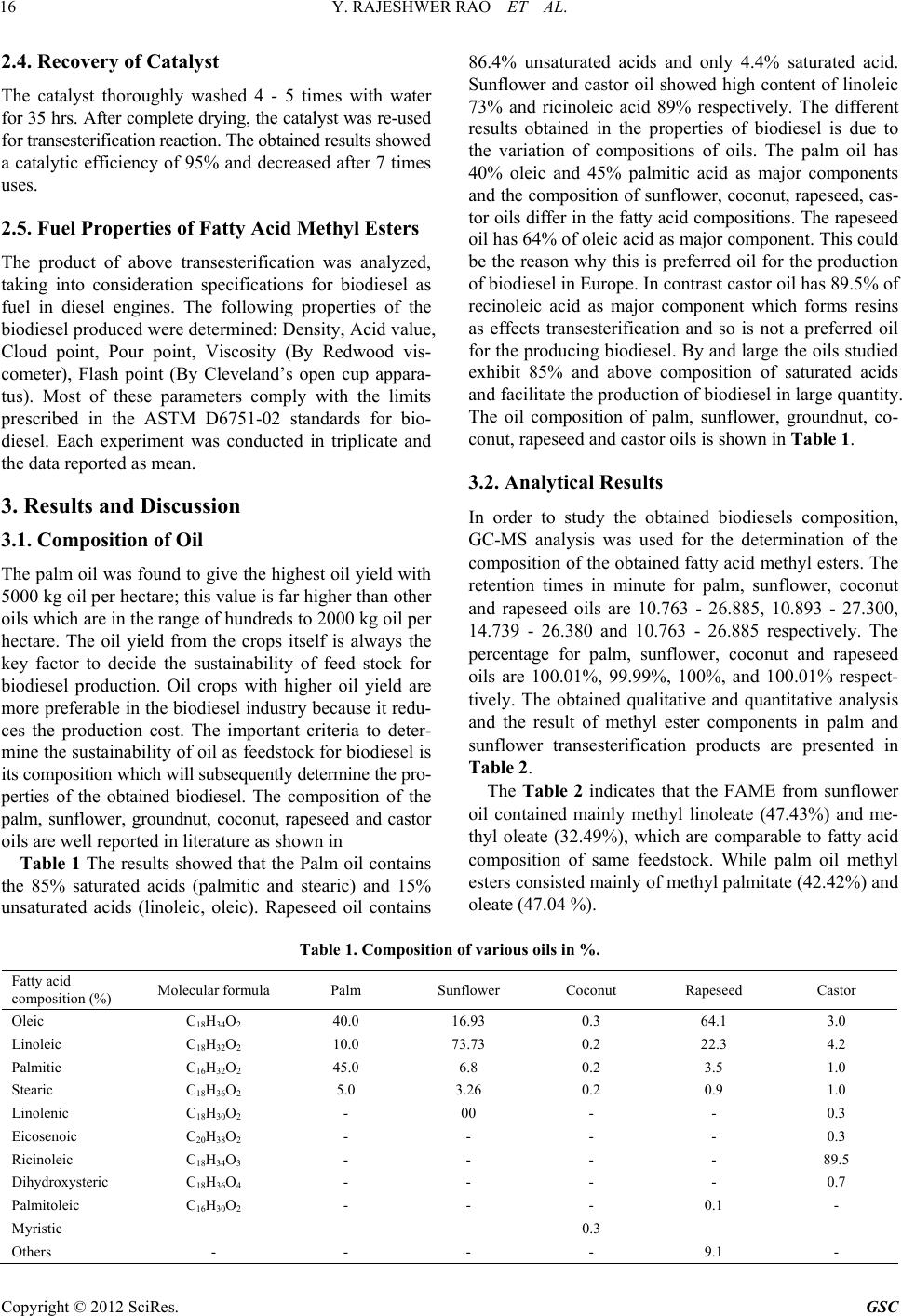 Y. RAJESHWER RAO ET AL. 16 2.4. Recovery of Catalyst The catalyst thoroughly washed 4 - 5 times with water for 35 hrs. After complete drying, the catalyst was re-used for transesterification reaction. The obtained results showed a catalytic efficiency of 95% and decreased after 7 times uses. 2.5. Fuel Properties of Fatty Acid Methyl Esters The product of above transesterification was analyzed, taking into consideration specifications for biodiesel as fuel in diesel engines. The following properties of the biodiesel produced were determined: Density, Acid value, Cloud point, Pour point, Viscosity (By Redwood vis- cometer), Flash point (By Cleveland’s open cup appara- tus). Most of these parameters comply with the limits prescribed in the ASTM D6751-02 standards for bio- diesel. Each experiment was conducted in triplicate and the data reported as mean. 3. Results and Discussion 3.1. Composition of Oil The palm oil was found to give the highest oil yield with 5000 kg oil per hectare; this value is far higher than other oils which are in th e range of hund reds to 200 0 kg oil p er hectare. The oil yield from the crops itself is always the key factor to decide the sustainability of feed stock for biodiesel production. Oil crops with higher oil yield are more preferable in the biodiesel indu stry because it redu- ces the production cost. The important criteria to deter- mine the sustainability o f oil as feedstock for biodiesel is its composition which will subsequently determine the pro- perties of the obtained biodiesel. The composition of the palm, sunflower, groundnut, coconut, rapeseed and castor oils are well reported in literature as shown in Table 1 The results showed that the Palm oil contains the 85% saturated acids (palmitic and stearic) and 15% unsaturated acids (linoleic, oleic). Rapeseed oil contains 86.4% unsaturated acids and only 4.4% saturated acid. Sunflower and castor oil showed high content of linoleic 73% and ricinoleic acid 89% respectively. The different results obtained in the properties of biodiesel is due to the variation of compositions of oils. The palm oil has 40% oleic and 45% palmitic acid as major components and the composition of sunflower, coconut, rapeseed, cas- tor oils differ in th e fatty acid compositions. The rapeseed oil has 64% of oleic acid as major component. This could be the reason why this is preferred oil for the production of biodiesel in Europe. In contrast castor oil has 89.5% of recinoleic acid as major component which forms resins as effects transesterification and so is not a preferred oil for the producing biodiesel. By an d large the oils studied exhibit 85% and above composition of saturated acids and facilitate the pro duction of biod iesel in large q u antity. The oil composition of palm, sunflower, groundnut, co- conut, rapeseed and castor oils is shown in Table 1. 3.2. Analytical Results In order to study the obtained biodiesels composition, GC-MS analysis was used for the determination of the composition of the ob tained fatty acid methyl esters. The retention times in minute for palm, sunflower, coconut and rapeseed oils are 10.763 - 26.885, 10.893 - 27.300, 14.739 - 26.380 and 10.763 - 26.885 respectively. The percentage for palm, sunflower, coconut and rapeseed oils are 100.01%, 99.99%, 100%, and 100.01% respect- tively. The obtained qualitative and quantitative analysis and the result of methyl ester components in palm and sunflower transesterification products are presented in Table 2. The Table 2 indicates that the FAME from sunflower oil contained mainly methyl linoleate (47.43%) and me- thyl oleate (32.49%), which are comparable to fatty acid composition of same feedstock. While palm oil methyl esters consisted mainly of methyl p almitate (42.42 %) an d oleate (47.04 %). Table 1. Composition of various oils in %. Fatty acid composition (%) Molecular formula Palm Sunflower Coconut Rapeseed Castor Oleic C18H34O2 40.0 16.93 0.3 64.1 3.0 Linoleic C18H32O2 10.0 73.73 0.2 22.3 4.2 Palmitic C16H32O2 45.0 6.8 0.2 3.5 1.0 Stearic C18H36O2 5.0 3.26 0.2 0.9 1.0 Linolenic C18H30O2 - 00 - - 0.3 Eicosenoic C20H38O2 - - - - 0.3 Ricinoleic C18H34O3 - - - - 89.5 Dihydroxysteric C18H36O4 - - - - 0.7 Palmitoleic C16H30O2 - - - 0.1 - Myristic 0.3 Others - - - - 9.1 - Copyright © 2012 SciRes. GSC 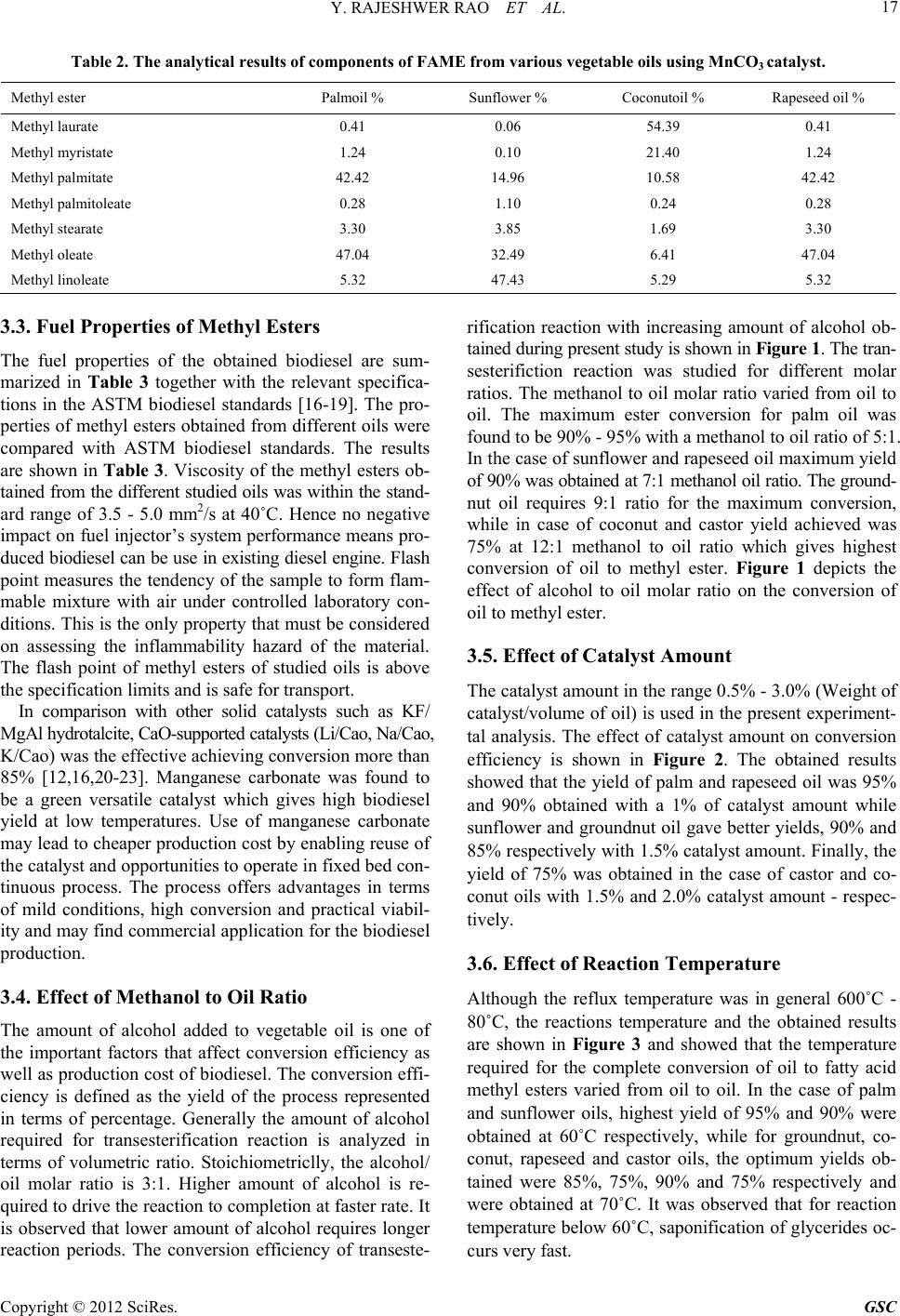 Y. RAJESHWER RAO ET AL. 17 Table 2. The analytical results of components of FAME from various vegetable oils using MnCO3 catalyst. Methyl ester Palmoil % Sunflower % Coconutoil % Rapeseed oil % Methyl laurate 0.41 0.06 54.39 0.41 Methyl myristate 1.24 0.10 21.40 1.24 Methyl palmitate 42.42 14.96 10.58 42.42 Methyl palmitoleate 0.28 1.10 0.24 0.28 Methyl stearate 3.30 3.85 1.69 3.30 Methyl oleate 47.04 32.49 6.41 47.04 Methyl linoleate 5.32 47.43 5.29 5.32 3.3. Fuel Properties of Methyl Esters The fuel properties of the obtained biodiesel are sum- marized in Table 3 together with the relevant specifica- tions in the ASTM biodiesel standards [16-19]. The pro- perties of methyl esters obtained from different oils were compared with ASTM biodiesel standards. The results are shown in Table 3. Viscosity of the methyl esters ob- ta ined from the different stud ied oils was wit hin the stand- ard range of 3.5 - 5.0 mm2/s at 40˚C. Hence no negative impact on fuel injector’s system performance means pro- duced biodiesel can be use in existing diesel engine. Flash point measures the tendency of the sample to form flam- mable mixture with air under controlled laboratory con- ditions. This is the only p roperty that must be considered on assessing the inflammability hazard of the material. The flash point of methyl esters of studied oils is above the specification limits and is safe for transpor t. In comparison with other solid catalysts such as KF/ MgAl hydrotalcite, CaO-supported catalysts (Li/Cao, Na/Cao, K/Cao) was the effective achieving conversion more than 85% [12,16,20-23]. Manganese carbonate was found to be a green versatile catalyst which gives high biodiesel yield at low temperatures. Use of manganese carbonate may lead to cheaper production cost by enabling reuse of the catalyst and opportun ities to op erate in fixed bed con - tinuous process. The process offers advantages in terms of mild conditions, high conversion and practical viabil- ity and may find commercial application for the biodiesel production. 3.4. Effect of Methanol to Oil Ratio The amount of alcohol added to vegetable oil is one of the important factors that affect conversion efficiency as well as production cost of biodiesel. The conversion effi- ciency is defined as the yield of the process represented in terms of percentage. Generally the amount of alcohol required for transesterification reaction is analyzed in terms of volumetric ratio. Stoichiometriclly, the alcohol/ oil molar ratio is 3:1. Higher amount of alcohol is re- quired to drive the reaction to completion at faster rate. It is observed that lower amount of alcohol requires longer reaction periods. The conversion efficiency of transeste- rification reaction with increasing amount of alcohol ob- tained during present study is shown in Figure 1. The tran- sesterifiction reaction was studied for different molar ratios. The methanol to oil molar ratio varied from oil to oil. The maximum ester conversion for palm oil was found to be 90% - 95% with a methanol to oil ratio of 5:1. In the case of sunflower and rap eseed oil maximum yield of 90% was obtained at 7:1 methanol oil ratio. The ground- nut oil requires 9:1 ratio for the maximum conversion, while in case of coconut and castor yield achieved was 75% at 12:1 methanol to oil ratio which gives highest conversion of oil to methyl ester. Figure 1 depicts the effect of alcohol to oil molar ratio on the conversion of oil to methyl ester. 3.5. Effect of Catalyst Amount The catalyst amount in the range 0.5% - 3.0% (Weight of catalyst/volume of oil) is used in the present experiment- tal analysis. The effect of catalyst amount on conversion efficiency is shown in Figure 2. The obtained results showed that the yield of palm and rapeseed oil was 95% and 90% obtained with a 1% of catalyst amount while sunflower and groundnut oil gave better yields, 90% and 85% respectively with 1.5% catalyst amount. Finally, th e yield of 75% was obtained in the case of castor and co- conut oils with 1.5% and 2.0% catalyst amount - respec- tively. 3.6. Effect of Reaction Temperature Although the reflux temperature was in general 600˚C - 80˚C, the reactions temperature and the obtained results are shown in Figure 3 and showed that the temperature required for the complete conversion of oil to fatty acid methyl esters varied from oil to oil. In the case of palm and sunflower oils, highest yield of 95% and 90% were obtained at 60˚C respectively, while for groundnut, co- conut, rapeseed and castor oils, the optimum yields ob- tained were 85%, 75%, 90% and 75% respectively and were obtained at 70˚C. It was observed that for reaction temperature below 60˚C, saponification of glycerides oc- curs very fast. Copyright © 2012 SciRes. GSC  Y. RAJESHWER RAO ET AL. 18 Table 3. Fuel properties of produced fatty acid methyl esters. Properties Palm oil Sunflower Coconut Rapeseed Castor ASTM biodiesel standard Viscosity mm2/s at 40˚C 4.42 3.26 3.9 3.51 5.0 3.5 - 5.0 flash point (˚C) 162 180 171 150 190 130 min Cloud point (˚C) 5 4 6 –4 –3 –3 - 12 Pour point (˚C) 10 9 9 –12 –8 –15 - 10 Density Kg/m3 0.92 0.92 0.91 0.91 0.96 0.87- 0.90 Acid value mg KOH/g 0.1 0.15 0.3 0.89 2.0 0.5 Figure 1. Effect of methanol/oil molar ratio. Figure 2. Effect of amount of catalyst. Figure 3. Effect of reaction temperature. Figure 4. Effect of reaction time. 3.7. Effect of Reaction Time In order to study the effect of reaction of reaction time, experiments were carried out between 30 to 210 min for the studied oils and the obtained results are depicted in Figure 4. The obtained results showed that palm and sun- flower oils achieved highest yield of 95% and 90% re- spectively at 60 min under reflux conditions. Groundnut and rapeseed oil gives 85% and 90% yield at 120 and 150 min respectively; while the transesterifiction yield of 75% was obtained in case of coconut and castor oils maximum time of 180 minutes was sufficient for the completion of reaction with highest yield of biodiesel . 3.8. Recovery and Reuse of Catalyst Recovery of catalyst from the reaction mixture is an im- portant operational parameter. From a financial economic point of view, the use of heterogeneous catalyst in bio- diesel production could reduce its price becoming com- petitive with diesel. The used catalyst was recovered and reused for further transesterification reactions. Th e obtai- ned results showed the recovered catalyst was still effici- ent even after seven successive uses. This suggests that the use of manganese carbonate could be a fruitful ap- proach for biod iesel production. Copyright © 2012 SciRes. GSC  Y. RAJESHWER RAO ET AL. 19 4. Conclusion In this paper, we have evaluated the catalytic activity of crystalline MnCO3 as green catalyst since MnCO3 is non corrosive, easy to handle and environmentally friendly and an alternative low cost catalyst. MnCO3 efficiently promote the transesterification in methanol solutions and in the presence of vegetable oils. The high yields achiev- able under mild reaction conditions are comparable to those obtained with a common acid catalyst such as acid and base. Therefore it is demonstrated that, MnCO3 is a potential catalyst for the produ ction of biodiesel which is a low-cost raw materials. The advantage of this protocol is the use of an available low-cost catalyst, which is easy to manipulate and potentially less corrosive. The results of this work suggest MnCO3 as a promising alternative catalyst for the produ ction of biodiesel. As a final remark , we believe that the application of MnCO3 potentially promote a reduction of the costs related to biodiesel pro- duction. 5. Acknowledgements The financial support provided by University Grants Com- mission, New Delhi, F.No.34-316/2008 (SR) is gratefully acknowledged. The authors also thank the Principal, Dr. C.S.N.Sharma, Govt. City College, Hyderabad-500002 for kind cooperation and encouragement. REFERENCES [1] G. Antoline, F. Tinaut, Y. Briceno, V. Castano, C. Perez and A. Ramirez, “Optimition of Biodiesel Production by Sunflower Oil Trnsesterifiction,” Bioresource Technology, Vol. 83, No. 2, 2002, pp. 111-114. doi:10.1016/S0960-8524(01)00200-0 [2] G. Vicente, M. Mrtine and J. Arcil, “Integrted Biodiesel Production: A Comparison of Different Homogeneous Systems,” Bioresource Technology, Vol. 92, No. 3, 2004, pp. 297-305. doi:10.1016/j.biortech.2003.08.014 [3] U. Schuchardt, R. Serchelia and R. M. Vargas, “Trans- esterification of Vegetble Oils: A Review,” Journal of Bra- zilian Chemical Society, Vol. 9, No. 3, 1997, pp. 199-210. [4] Y. C. Dennis, X. Wu and M. K. H. Leung, “A Review on Biodiesel Production Using Catalyzed Transesterifiction,” Applied Energy, Vol. 87, No. 4, 2010, pp. 1083-1095. doi:10.1016/j.apenergy.2009.10.006 [5] L. F. Razon, “Alternative Crops for Biodiesel Feedstock,” CAB Reviews: Perspectives in Agriculture, Veterinary Science, Nutrition and Natural Resources, Vol. 4, No. 56, 2009, pp. 1-15. doi:10.1079/PAVSNNR20094056 [6] M. Canakci, “The Potential of Restaurant Waste Lipids Biodiesel Feedstock,” Bioresource Technology, Vol. 98, No. 1, 2007, pp. 183-190. doi:10.1016/j.biortech.2005.11.022 [7] B. Freedman, E. H. Pryde and W. F. Kwolek, “Thi n Layer Chromatography/FID Analysis of Transesterified Vege- table Oils,” Journal of American Oil Chemists’ Society, Vol. 61, No. 7, 1984, pp. 1638-1643. doi:10.1007/BF02541649 [8] D. Darnoko and M. Cheryan, “Kinetics o f Palm Oil Trans- esterification in a Batch Reactor,” Journal of American Oil Chemists’ Society, Vol. 77, No. 12, 2000, pp. 1263- 1267. doi:10.1007/s11746-000-0198-y [9] K. J. Harrington and C. D. Arcy-Evans, “Transesterifica- tion in Situ of Sunflower Oil,” Industrial and Engineering Chemistry Product Research and Development, Vol. 24, No. 2, 1985, 314-318. doi:10.1021/i300018a027 [10] W. Stoffel, F. Chu and E. H. Ahrens, “Analysis of Long Chain Fatty Acids by Acids by Gas-Iquid Chromatogra- phy,” Journal of Analytical Chemistry, Vol. 31, No. 2, 1959, pp. 307-308. doi:10.1021/ac60146a047 [11] B. Freedman, R. O. Butterfield and E. H. Pryde, “Trans- esterification Kinetics of Soybean Oil,” Journal of Ame- rican Oil Chemists’ Society, Vol. 63, No. 10, 1986, pp. 1375-1380. doi:10.1007/BF02679606 [12] S. Furuta, H. Matsuhshi and K. Arata, “Biodiesel Fuel Production with Solid Superacid Catalysis in Fixed Bed Reactor under Atmospheric Pressure,” Catalysis Commu- nication, Vol. 5, No. 12, 2004, pp. 721-723. doi:10.1016/j.catcom.2004.09.001 [13] K. Narsimharao, A. Lee and K. J. Wilson, “Catalyst in Production of Biodiesel: A Review,” Biobased Materials and Bioenergy, Vol. 1, No. 1, 2007, pp. 19-30. [14] M. M. Gui, K. T. Lee and S. Bhatia, “Flexibility of Edible Oil vs. Non-Edible Oil vs. Waste Oil as Biodiesel Feed- stock,” Energy, Vol. 33, No. 11, 2008, pp. 1646-1653. doi:10.1016/j.energy.2008.06.002 [15] R. C. Schneider, V. Z. Baldissrelli, F. Trombetta, M. Mar- tinelli and E. B. Caramao, “Optimization of Gas Chroma- tographic-Mass Spectrometric Analysis for Fatty Acids in Hydrogenated Castor Oil Obtained by Catalytic Transfer Hydrogenation,” Analytica Chimica Acta, Vol. 505, No. 2, 2004, pp. 223-226. doi:10.1029/2004JD005394 [16] H. Fukuda, A. Kondo and H. J. Noda, “Biodiesel Fuel Pro- duction by Transesterification of Oil,” Bioscience Bio- energy, Vol. 92, No. 5, 2001, pp. 405-416. doi:10.1263/jbb.92.405 [17] P. Bondioli, “The Properties of Fatty Acid Esters by Means of Catalytic Reactions,” Topics in Cataly sis, Vol. 27, No. 1-4, 2004, pp. 77-81. doi:10.1023/B:TOCA.0000013542.58801.49 [18] A. Murugesan, C. Umarani, T. R. Chinnusamy, M. Krish- nan, R. Subramanian and N. Neduzchezhain, “Production and Analysis of Biodiesel from Non-Edible Oils—A Re- view,” Renewable and Sustainable Energy Reviews, Vol. 13, No. 4, 2009, pp. 825-834. doi:10.1016/j.rser.2008.02.003 [19] S. P. Singh and D. Singh, “Biodiesel Production through the Use of Different Sources and Characterization of Oils and Their Esters as the Substitute of Diesels: A Review,” Renewable and Sustainable Energy Reviews, Vol. 14, No. 1, 2010, pp. 200-216. doi:10.1016/j.rser.2009.07.017 [20] K. F. Peter, R. Ganswindt, H. P. Neuner and E. Weidner, “Alcoholysis of Triglycerols by Heterogeneous Cataly- Copyright © 2012 SciRes. GSC  Y. RAJESHWER RAO ET AL. Copyright © 2012 SciRes. GSC 20 sis,” European Journal of Lipid Science Technology, Vol. 104, No. 6, 2002 pp. 324-330. doi:10.1002/1438-9312(200206)104:6<324::AID-EJLT32 4>3.0.CO;2-D [21] G. J. Suppes, S. Bockwinkel, S. Lucas, J. B. Botts, M. H. Mason and A. J. Heppert, “Calcium Carbonate Catalyzed Alcoholysis of Fats and Oils,” Journal of American Oil Chemical Society, Vol. 78, No. 2, 2001, pp. 139-145. doi:10.1007/s11746-001-0234-y [22] E. Leclereq, A. Finiels and C. Moreau, “Transesterifica- tion of Rapeseed Oil in the Presence of Basic Zeolites and Related Solid Catalyst,” Journal of American Oil Chem- ist’s Society, Vol. 78, No. 11, 2001, pp. 1161-1165. doi:10.1007/s11746-001-0406-9 [23] D. W. Lee, Y. M. Park and K. Y. Lee, “Heterogeneous Base Catalysts for Transesterification in Biodiesel Syn- thesis,” Catalysis Surveys from Asia, Vol. 13, No. 2, 2009, pp. 63-77. |