

Paper Menu >>
Journal Menu >>
 Advances in Physical Education 2012. Vol.2, No.1, 32-37 Published Online February 2012 in SciRes (http://www.SciRP.org/journal/ape) http://dx.doi.org/10.4236/ape.2012.21006 Copyright © 2012 SciRes. 32 Gender as a Factor in the Prediction of Performance in Botswana General Certificate of Secondary Education Physical Education Examinations by Coursework and Forecast Grades among Senior Secondary School Students Mogomotsi Ramatlala1, Johnson Nenty2 1Department of Curriculum & Instruction, Central Ch in a No rmal University, Wuhan, China 2Department of Educational Foundations, Uni ver sity of Botswana, Gaborone, Botswana Email: [email protected], [email protected] Received December 6th, 2011; revised January 10th, 2012; accepted January 20th, 2012 Selection bias is an educational and a social malady which is of concern to every educator especially educational administrator when allocating educational opportunities to learners based on previous per- formance. Bias in predicting who passes or who fails and hence in selection exists if the same prediction equation is used for different groups, for example, for both gender when in fact such prediction, given the tests involved, is different for male and female learners. As a check for this, there is always the need to perform differential prediction for the sexes. The purpose for this descriptive study is to investigate gen- der as a factor in the prediction of performance in BGCSE physical examination by coursework and fore- cast grades among secondary school students in Botswana. The sample composed of 2292 (1432 males and 860 females) students who, based on Botswana Examination Council (BEC) records, obtained grades in coursework, forecast and BGCSE physical education grades for 2005 through 2008. The Pearson cor- relation and regression analyses done using SPSS revealed that though coursework and forecast grades significantly predict the BGCSE grades in physical education among senior secondary school students in Botswana, based on each year’s data, gender does not influence such prediction significantly, but for cu- mulative data across all the years it does. Keywords: Differential Prediction; Gender Bias in Selection; BGCSE Physical Education Examination; Coursework Grades; Forecast Grades; Botswana Introduction and Background Education is the single most expensive enterprise globally and especial ly so in Bo tswa na whe re go ver nment spen ds ab out 26 % of her annual budget on this enterprise. It is common practice to de- termine academic readiness and hence perform selection of learners for the next level of education based on the results of their per- formance in previous related examinations. Conducting examina- tions within and at the end of ea ch and every school year is a part of the school curriculum and in Botswana, like in other countries; learners take public examinations to determine their academic standing at each level of education. Coursework grades from con- tinuous assessment and Mock examination or forecast grades are often used to predict students’ readiness to take the final school public examination. Public examination grades are commonly used as a measure of acade mic achievement for a given level of e duca- tion. Achievement at a given level of education is often used to determine or predict the probable level of achievement i n the next level of education or at the workplace. In Botswana at the end of basic education, and at the end of secondary education, students are expected to sit for public ex- aminations such as the Junior Certificate in Education (JCE) and Botswana General Certificate of Secondary Education (BGCSE) examinations respectively. BGCSE examination started in 1993 in partnership with the University of Cambridge Local Examina- tion Syndicate (UCLES). Later when it was realized that the country was in sufficient control of the education standards and could develop and administer examinations across all levels, localization of marking examinations took place as a recommen- dation by the Report of the National Commission on Education (RNPE) of 1993. BGCSE physical education examinations were first administere d in 2005 taking the form of pract ical and theory based examinations. Theoretical Foundation The mean of scores on several measures of the same ability is likely to give a more valid indication of that ability than the result of a one-shot measure of the ability. It is on this premise that continuous assessment is advocated in schools as it pro- vides for opportunity for improvement based on occasional feedback. But if the instruments used in the repeated measure- ments are differentially invalid for the different groups involved, then the sum of the scores would not provide an unbiased measure of the ability under consideration. The case of con- tinuous assessment of students contributing to their final grade in the graduating examination is a well argued one (Little, 1992). Teachers are in stronger position to assess the attainment of their students than the external examiner who has only the evidence of a few hours work to draw from. Little highlighted that the rationale for coursework in GCSE has been that it can explore aspects of physical education knowledge and practice  M. RAMATLALA ET AL. which short time written examinations questions cannot reach and do not provide enough time to investigate in any depth. In any setup, academic achievement is generally assumed to be an indication of the student ability to succeed in the educa- tional program. The first difficulty with any consideration of these purposes is that the functions and values of public ex- aminations and coursework are not constant. Both are deter- mined by the wider purpose of education and the changing needs of the society involved (Robbins, 1997). Assuming the purpose of coursework, given that it is properly administered and weighted, is determined by the overt function of the ex- amination which might not perfectly reflect the needs of the society. In that case, the realization of these purposes is unlike- ly to be achieved (Ramatlala, 2009). In other words to what extent could one count on what the student has done in school, as reflected by his/her performance, in admitting him/ her to the next level of education, or in employing him/her in an area that requires the same or rela t ed skills? Iramaneerat (2007) stated that different countries use differ- ent measures to evaluate academic readiness of students. Bot- swana’s Ministry of Education in collaboration with Botswana Examination Council recommended class or theory based ses- sions in addition to practice-based sessions for performance of coursework in physical education. According to Ramatlala (2009) teachers assess the students in practical activities and grade them for assessment of learning purpose. The assessment is carried at each and every teaching and practical activity. The marks from physical activities are combined with theory based assessment at the end of two years of high school to determine the learning outcome. According to Robbins (1997), examination is a process of measuring, scrutinizing and investigating the knowledge, un- derstanding and capability of the candidate. Coursework is any sort of performance or work produced to meet the purpose of the curriculum. Forecasting, on the other hand, is to estimate or calculate in advance, the likely performance level of the learn- ers, and could be determined through analysis of relevant data. The expectation is that students getting good grades in course- work and forecast test should be in a position to attain good grades during final examinations. Coursework and forecast grades represent academic achievement over a period of time and given that they are based on the same content with BGCSE, they can be appropriately used as predictors of BGCSE final examination grades. Studies on coursework have revealed a significant predictive strength of coursework in final examination (Masole & Utl- wang, 2005; Thobega & Masole, 2008). Daniels and Schouten as cited by Adeyemi (2010) argued that a prediction of a future examination result could be made with reasonable success on the basis of the result of an earlier examination and that grades may serve as prediction measures and as criterion measures. This boils down to finding the validity of the measures used to determine the likely achievement of the learners in the crite- rion measure. According to Young (2001), validity is not the inherent characteristics of a test but it must be determined for each use of a test and for the population of interest. Mock and forecast grades are used in Botswana to predict who would earn what level of pass during Botswana General Certificate of Sec- ondary Education Examination (BGCSE) (Masole & Utlwang, 2005; Thobega & Masole, 2008). Depending on the predictor and criterion variables involved, sometimes the results from such analysis are often used to select students for advancement to the next level of education. But some extraneous variables especially gender, school location, type of school, etc. may pose extraneous influences that bring about invalidity in such exercise. It might lead to differential prediction which results in bias in the selection purpose. This depends on the predictive validity of the variables used in such exercise. Bias in Testing and in the Use of Test Results Bias in testing exists when the influences of extraneous sour ce s in a testing situation result in members of one group performing significantly higher or lower than members with the same abi- lity but from other groups taking the same test. In other words, when examinees with different group membership have been determined to have the same ability in what the test was de- signed to measure, are matched up, members from one group systematically influenced by the extraneous variable show sig- nificantly different performance in the test items. So, extrane- ous sources that influence performance on a test can make the test biased against one group or the other because the test items, influenced by extraneous sources, function differentially across members of groups taking the test. In other words, scores that results from a biased test have different meaning for different groups who took the same test (Nenty, 1979). The use of test results can also be biased if they differentially over-predict a criterion of interest for one group while under- predicting it for another group of examinees. That is, if the same test (or te sts) has si gnifican tly diffe rent pre dictive val idity for the different groups involved in the testing. Therefore, pre- dictive bias has to do with differential validity which leads to differential prediction. This study is concerned with the second meaning of bias. Selection bias is an educational and a social malady which is of concern to every educator especially educa- tional administrator when allocating educational opportunities to learners based on previous performance. According to Kyei- Blankson (2005), questions about differential prediction, there- fore, are questions related to whether the prediction models obtained for the different groups of examinees are different. Such questions are generally approached by comparing regres- sion systems for equality of regression slopes and equality of regression intercepts in the respective prediction equations across groups of interest (p. 48). Statement of the Problem Every examination results serve the fundamental purpose of pre- dicting the readiness of the learner for the next level of education or suitability for employment. Some examination might lack predic- tive validity and hence predict such suitability falsely and some- times differently for different groups of students, for example males and females. T he predictive validity of certain examinati ons has been a matter of concern to many researchers (Adeyemi, 2008). Prediction bias is a source of and might lead to social injustice which a selection process might unknowingly commit. Studies have shown that certain examinations such as Scholastic Aptitude Test (SAT) validly predicts university grades, while certain low- quality examinations could not effectively predict performance at higher level examinations (Kobrin et al., 2008; Young, 2001). This is more so for teacher made classroom tests and some public ex- aminations in Africa. Using grades from school coursework ex- aminations and forecast grades from mock examinations to predict who passe s or who f ails and he nce for sel ection is l ikely to lea d to biased decision-making especially if the same prediction equation Copyright © 2012 SciRes. 33 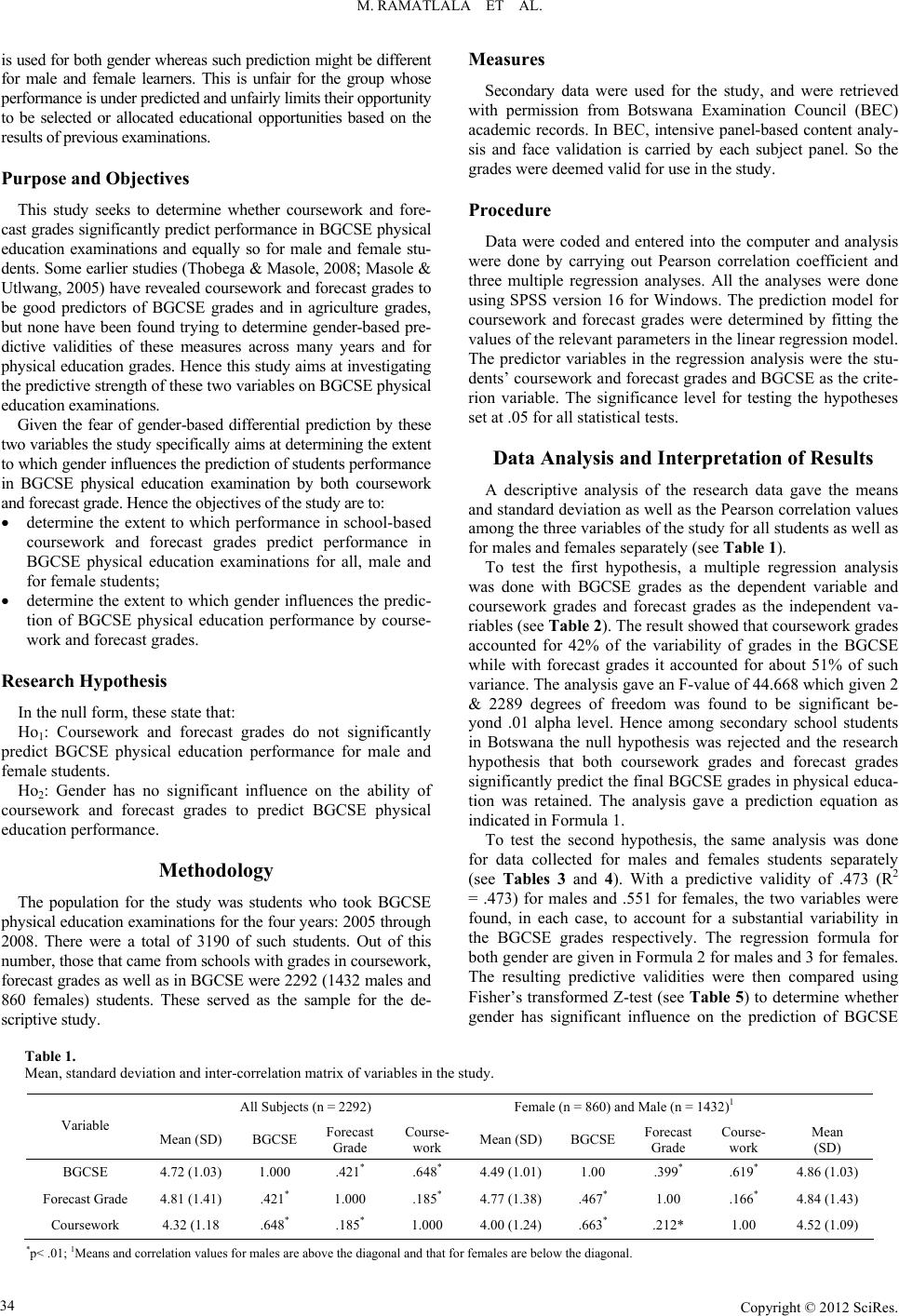 M. RAMATLALA ET AL. Copyright © 2012 SciRes. 34 is used for both gender whereas such prediction might be different for male and female learners. This is unfair for the group whose performance is under pred icted an d unfairly limits their opportunity to be selected or allocated educational opportunities based on the results of p rev ious exam ina tions . Purpose and Objectives This study seeks to determine whether coursework and fore- cast grades significantly predict performance in BGCSE phy sical education examinations and equally so for male and female stu- dents. Some earlier studies (Thobe ga & Masole, 2008; Masole & Utlwang, 2005) have revealed course work and forecast grades to be good predictors of BGCSE grades and in agriculture grades, but none have been found trying to determine gender-based pre- dictive validities of these measures across many years and for physical education grades. Hence this stu dy aims at investigating the predictive strength of these t w o variables on BGCSE phy sical education examinations. Given the fear of gender-based differential prediction by these two variables the st udy spec ificall y aims at determining the extent to which gender influence s the pre diction o f students pe rforma nce in BGCSE physical education examination by both coursework and forecast grade. H ence the objectives of the study ar e to: determine the extent to which performance in school-based coursework and forecast grades predict performance in BGCSE physical education examinations for all, male and for female students; determine the extent to which gender influences the predic- tion of BGCSE physical education performance by course- work and forecast grades. Research Hypothesis In the null form, these state that: Ho1: Coursework and forecast grades do not significantly predict BGCSE physical education performance for male and female students. Ho2: Gender has no significant influence on the ability of coursework and forecast grades to predict BGCSE physical education performance. Methodology The population for the study was students who took BGCSE physical education examinations f or the four years: 2005 throu gh 2008. There were a total of 3190 of such students. Out of this number, those that came from schools with grades in coursework, forecast grades as well a s in BGCSE were 2292 (1432 males a nd 860 females) students. These served as the sample for the de- scriptive study. Measures Secondary data were used for the study, and were retrieved with permission from Botswana Examination Council (BEC) academic records. In BEC, intensive panel-based content analy- sis and face validation is carried by each subject panel. So the grades were deemed valid for use in the study. Procedure Data were coded and entered into the computer and analysis were done by carrying out Pearson correlation coefficient and three multiple regression analyses. All the analyses were done using SPSS version 16 for Windows. The prediction model for coursework and forecast grades were determined by fitting the values of the relevant parameters in the linear regression model. The predictor variables in the regression analysis were the stu- dents’ coursework and forecast grades and BGCSE as the crite- rion variable. The significance level for testing the hypotheses set at .05 for all statistical tests. Data Analysis and Interpretation of Results A descriptive analysis of the research data gave the means and standard deviation as well as the Pearson correlation values among the three variables of the study for all students as well as for males and females separately (se e Table 1). To test the first hypothesis, a multiple regression analysis was done with BGCSE grades as the dependent variable and coursework grades and forecast grades as the independent va- riables (see Table 2). The result showed that coursework grades accounted for 42% of the variability of grades in the BGCSE while with forecast grades it accounted for about 51% of such variance. The analysis gave an F-value of 44.668 which given 2 & 2289 degrees of freedom was found to be significant be- yond .01 alpha level. Hence among secondary school students in Botswana the null hypothesis was rejected and the research hypothesis that both coursework grades and forecast grades significantly predict the final BGCSE grades in physical educa- tion was retained. The analysis gave a prediction equation as indicated in Formula 1. To test the second hypothesis, the same analysis was done for data collected for males and females students separately (see Tables 3 and 4). With a predictive validity of .473 (R2 = .473) for males and .551 for females, the two variables were found, in each case, to account for a substantial variability in the BGCSE grades respectively. The regression formula for both gender are given in Formula 2 for males and 3 for females. The resulting predictive validities were then compared using Fisher’s transformed Z-test (see Table 5) to determine whether ender has significant influence on the prediction of BGCSE g Table 1. Mean, standard deviati o n and inter-correlation matrix of variables in the study. All Subjec t s (n = 2292) Female (n = 860) and Male ( n = 1432)1 Variable Mean (SD) BGCSE Forecast Grade Course- work Mean (SD)BGCSE Forecast Grade Course- work Mean (SD) BGCSE 4.72 (1.03) 1.000 .421* .648* 4.49 (1.01)1.00 .399* .619* 4.86 (1.03) Forecast Grade 4.81 (1.41) .421* 1.000 .185* 4.77 (1.38).467* 1.00 .166* 4.84 (1.43) Coursework 4.32 (1.18 .648* .185* 1.000 4.00 (1.24).663* .212* 1.00 4.52 (1.09) *p< .01; 1Mea ns and correl ation values for males a re above the diagonal a nd that for females are bel ow the diagonal. 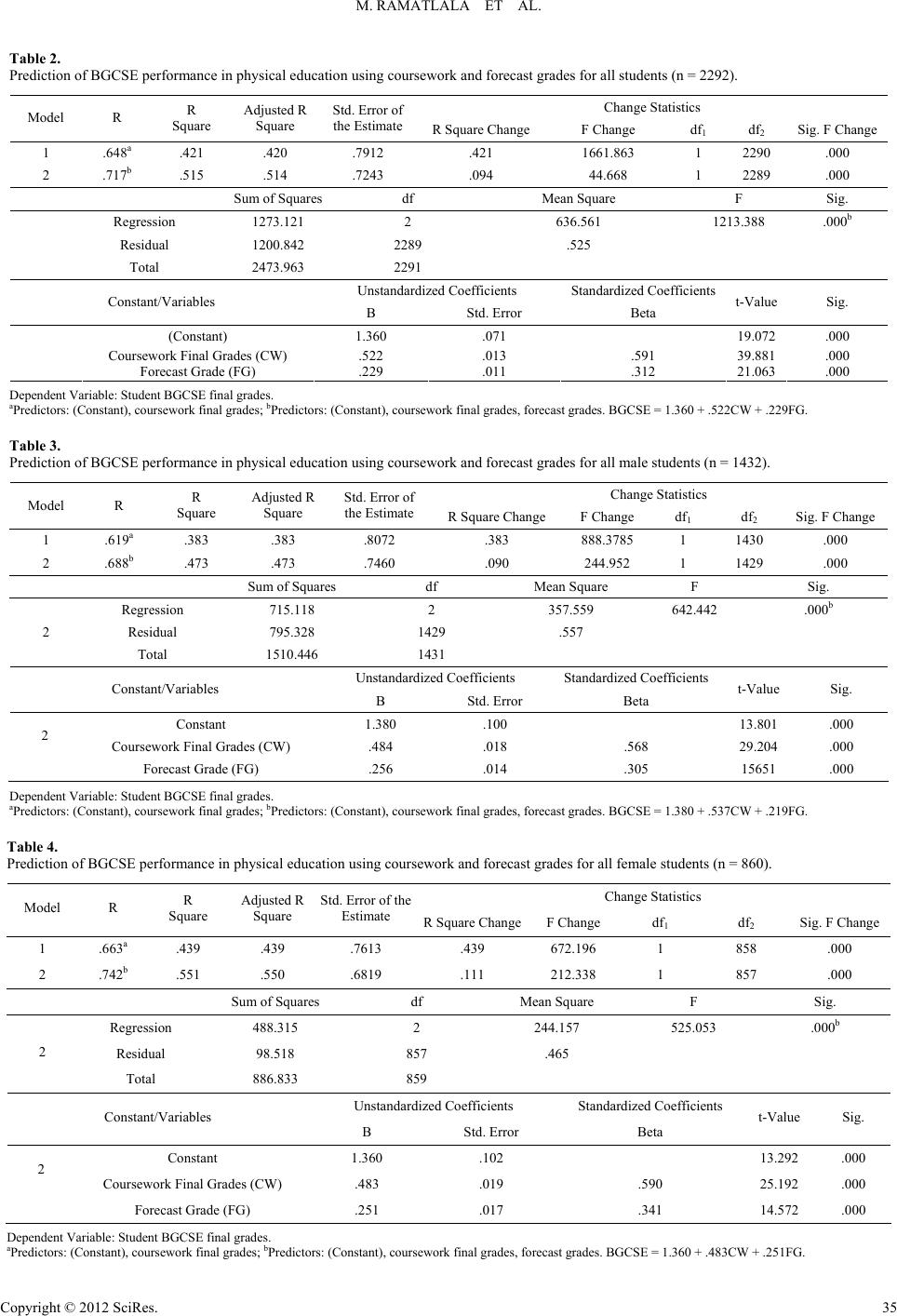 M. RAMATLALA ET AL. Table 2. Prediction of BGCSE performance in physical education using coursework and forecast grades for all students (n = 2292). Change Statistics Model R R Square Adjusted R Square Std. Error of the EstimateR Square Change F Change df1 df2 Sig. F Change 1 .648a .421 .420 .7912 .421 1661.863 1 2290 .000 2 .717b .515 .514 .7243 .094 44.668 1 2289 .000 Sum of Squares df Mean Square F Sig. Regression 1273.121 2 636.561 1213.388 .000b Residual 1200.842 2289 .525 Total 2473.963 2291 Unstandardized Coefficients Standardized Coefficients Constant/Variables B Std. Error Beta t-Value Sig. (Constant) 1.360 .071 19.072 .000 Coursework F i nal Grades (CW) Forecast Grade (FG) .522 .229 .013 .011 .591 .312 39.881 21.063 .000 .000 Depende nt Variable: Student BG C S E final grades. aPredictors: (Constant), coursework final grades; bPredictors: (C onstant), coursework final grades, forecast grade s. BGCSE = 1.360 + .522 CW + .229FG. Table 3. Prediction of BGCSE performance in physical education using coursework and forecast grades for all male students (n = 1432). Change Sta t i s tics Model R R Square Adjusted R Square Std. Error of the Estimate R Square Change F Change df1 df2 Sig. F Change 1 .619a .383 .383 .8072 .383 888.3785 1 1430 .000 2 .688b .473 .473 .7460 .090 244.952 1 1429 .000 Sum of Squares df Mean Square F Sig. Regression 715.118 2 357.559 642.442 .000b Residual 795.328 1429 .557 2 Total 1510.446 1431 Unstandardized Coefficients Standardized Coefficients Constant/Variables B Std. Error Beta t-Value Sig. Constant 1.380 .100 13.801 .000 2 Coursework Final Grades (CW) .484 .018 .568 29.204 .000 Forecast Grade (FG) .256 .014 .305 15651 .000 Depende nt Variable: Student BG C S E final grades. aPredictors: (Constant), coursework final grades; bPredictors: (C onstant), coursework final grades, forecast grade s. BGCSE = 1.380 + .537 CW + .219FG. Table 4. Prediction of BGCSE performance in physical education using coursework and forecast grades for all female students (n = 860). Change Statistics Model R R Square Adjusted R Square Std. E rror of the Estimate R Square ChangeF Change df1 df2 Sig. F Change 1 .663a .439 .439 .7613 .439 672.196 1 858 .000 2 .742b .551 .550 .6819 .111 212.338 1 857 .000 Sum of Squares df Mean Square F Sig. Regression 488.315 2 244.157 525.053 .000b Residual 98.518 857 .465 2 Total 886.833 859 Unstandardized Coefficients Standardized Coefficients Constant/Variables B Std. Error Beta t-Value Sig. Constant 1.360 .102 13.292 .000 2 Coursework Final Grades (CW) .483 .019 .590 25.192 .000 Forecast Grade (FG) .251 .017 .341 14.572 .000 Dependent Variable: Student BGCS E final grades. aPredictors: (Constant), coursework final grades; bPredictors: (C onstant), coursework final grades, forecast grade s. BGCSE = 1.360 + .483 CW + .251FG. Copyright © 2012 SciRes. 35  M. RAMATLALA ET AL. Copyright © 2012 SciRes. 36 Table 5. Validity of coursework and forecast grades in predicting BGCSE in physical education from 2005 to 2008. From Simple Regression From Multiple RegressionUnique Contribution of Forecast Grades Coursework Grade Forecast Grade Year Gender N 2 1 R Z-Value 2 2 R Z-Value Coursework & Forecast GradesZ-Value 2 1 R - 2 2 RZ-Value Male 366 .407 .190 .472 .068 –1.18 2005 Female 272 .442 –1.04 .271 –1.37 .528 –1.00 .086 –.97 Total 638 .457 .209 .521 .064 –1.61 Male 317 .512 .357 .555 .043 –.78 2006 Female 213 .544 –.50 .354 .03 .592 –.66 .048 –.78 Total 530 .562 .368 .601 .039 –1.01 Male 403 .453 .277 .560 .107 –2.18* 2007 Female 205 .454 –.02 .245 .05 .583 –.41 .129 –1.89* Total 608 .459 .266 .574 .115 –2.89* Male 346 .566 .170 .659 .093 –2.00* 2008 Female 170 .627 –1.03 .230 –.09 .745 –1.82 .118 –1.89 Total 516 .591 .192 .691 .100 –2.89* Male 1432 .383 .159 .473 .090 –3.11* Total Female 860 .439 –1.71 .218 –1.91 .551 –2.53* .112 –3.25* Total2 2292 .421 .177 .515 .094 –4.39* *p < .05; Critical Z = 1.96. grades using coursework grades and forecast grades. This gave a Z-value of –2.53 (p = .005) which, in absolute value, is higher than the critical Z-value of 1.96 (α = .05). Hence the second null hypothesis was rejected for the combined data, meaning that the prediction lines for BGCSE from coursework and forecast grades for males and females have significantly different slopes. A similar comparison for each of the four years separately did not result in any significantly different predictive validity for male and female students (see Table 5). Therefore, for the combined data for all the four years, a significant gender-based differential prediction was observed, but for each of the years, gender was not found to have a significant influence on the prediction of BGCSE grades using coursework grades and forecast grades among secondary school students in Botswana. A closer study of the related regression equations shows that based on data for the four years combined coursework grades and forecast grades significantly under-predict the BGCSE grades in physical education for males and over-predict for females students. Such significant trend was not found when the parameters for regression equations for each of the four years were examined (see Table 5 ). In summary therefore coursework and forecast grades sig- nificantly predict the BGCSE grades in physical education among secondary school students in Botswana and gender is found to influence such prediction significantly across the years but not for each of the years. A summary of the effect sizes and prediction differential prediction indicators are presented in Table 5. For each of, and for all the years 2005 to 2008, both course- work grades and forecast grades individually are significant predictors of BGCSE grades in physical education (see Table 5). But coursework grades are always significantly superior to forecast grades in predicting BGCSE grades in this subject. Generally such prediction is always significantly improved if both independent variables are used together. For physical edu- cation, whether coursework grades or forecast grades are used singly or combinely to predict BGCSE grades for each of the years, gender does not constitute a significant biasing factor in such prediction, but predictive validity for females is always higher than that for males (see Table 5). A significant sign of such effect appears when the prediction is based on a combined four years’ data, but it is rare to use more than one year’s data for such exercise. Discussion of Findings and Recommendations Fair selection has a lot of implications for social justice, access and for equality in the identification and development of potential through education. Selection based on incorrect prediction may deprive some learners of the oppo rtunity to continue their educa- tion or channel them into areas to which they are not naturally endowed. This may result in inefficient utilization of manpower as well as of resources. Invalid prediction often results in un- der-predicting the criterion variable for one group of students while over-predicting it for the other(s). This often leads to bias in selection, which is of very high social and educational concern. Given the cumulative data for the four years under considera- tion, in this study the two measures used coursework and fore- cast grades—significantly predict performance at BGCSE grades in physical education and based on data cumulated over four years, such prediction differs between male and female secondary school students in Botswana. This confirms the dif- ferential prediction often found in similar studies (Young, 2001). The very high percentage (about 40%) of criterion variance accounted for by continuous assessment grades for each of the three (male, female, & total) predictions is indicative of the pre- dictive validity of this class exercises given BGCSE in physical education. This tells a lot about the quality of continuous as- sessment in physical education in Botswana schools. The nature of this assessment is its strength. It takes into consideration all 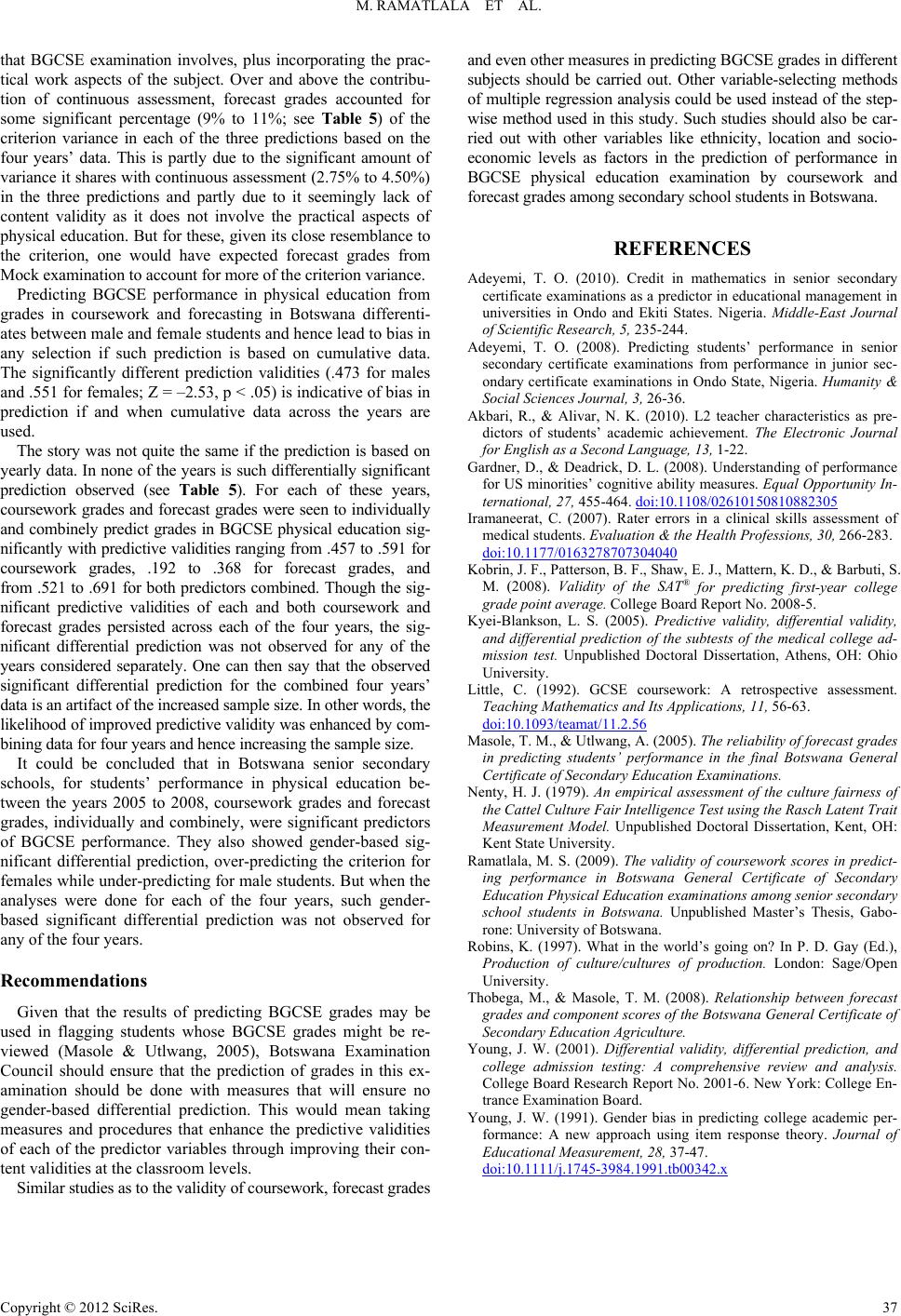 M. RAMATLALA ET AL. that BGCSE examination involves, plus incorporating the prac- tical work aspects of the subject. Over and above the contribu- tion of continuous assessment, forecast grades accounted for some significant percentage (9% to 11%; see Table 5) of the criterion variance in each of the three predictions based on the four years’ data. This is partly due to the significant amount of variance it shares with continuous assessment (2.75% to 4.50%) in the three predictions and partly due to it seemingly lack of content validity as it does not involve the practical aspects of physical education. But for these, given its close resemblance to the criterion, one would have expected forecast grades from Mock examination to account for more of the criterion variance. Predicting BGCSE performance in physical education from grades in coursework and forecasting in Botswana differenti- ates between male and female students and hence lead to bias in any selection if such prediction is based on cumulative data. The significantly different prediction validities (.473 for males and .551 for females; Z = –2.53, p < .05) is indicative of bias in prediction if and when cumulative data across the years are used. The story was not quite the same if the prediction is based on yearly data. In none of the y ears is such differentially significant prediction observed (see Table 5). For each of these years, coursework grades and forecast grades were seen to individually and combinely predict grades in BGCSE physical education sig- nificantly with predictive validities ran ging from .457 to .591 fo r coursework grades, .192 to .368 for forecast grades, and from .521 to .691 for both predic tors combined. Though the sig- nificant predictive validities of each and both coursework and forecast grades persisted across each of the four years, the sig- nificant differential prediction was not observed for any of the years considered separately. One can then say that the observed significant differential prediction for the combined four years’ data is an artifact of the increased sample size. In other words, the likelihood of improved predictive validity was enhanced by com- bining data for four years and hence increasing the sample size. It could be concluded that in Botswana senior secondary schools, for students’ performance in physical education be- tween the years 2005 to 2008, coursework grades and forecast grades, individually and combinely, were significant predictors of BGCSE performance. They also showed gender-based sig- nificant differential prediction, over-predicting the criterion for females while under-predicting for male students. But when the analyses were done for each of the four years, such gender- based significant differential prediction was not observed for any of the four years. Recommendations Given that the results of predicting BGCSE grades may be used in flagging students whose BGCSE grades might be re- viewed (Masole & Utlwang, 2005), Botswana Examination Council should ensure that the prediction of grades in this ex- amination should be done with measures that will ensure no gender-based differential prediction. This would mean taking measures and procedures that enhance the predictive validities of each of the predictor variables through improving their con- tent validities at the classroom levels. Similar studies as to the validity of coursework, forecast grades and even other measures in predicting BGCSE grad es in different subjects should be carried out. Other variable-selecting methods of multiple regression analy sis could be used instead of the step- wise method used in this st udy. Such studies should also be car- ried out with other variables like ethnicity, location and socio- economic levels as factors in the prediction of performance in BGCSE physical education examination by coursework and forecast grades among secondary school students in Botswana. REFERENCES Adeyemi, T. O. (2010). Credit in mathematics in senior secondary certificate examinations as a predictor in educational management in universities in Ondo and Ekiti States. Nigeria. Middle-East Journal of Scientific Research, 5, 235-244. Adeyemi, T. O. (2008). Predicting students’ performance in senior secondary certificate examinations from performance in junior sec- ondary certificate examinations in Ondo State, Nigeria. Humanity & Social Sciences Journal, 3, 26-36. Akbari, R., & Alivar, N. K. (2010). L2 teacher characteristics as pre- dictors of students’ academic achievement. The Electronic Journal for English as a Second Language, 13, 1-22. Gardner, D., & Deadrick, D. L. (2008). Understanding of performance for US minorities’ cognitive ability measures. Equal Opportunity In- ternational, 27, 455-464. doi:10.1108/02610150810882305 Iramaneerat, C. (2007). Rater errors in a clinical skills assessment of medical students. Evaluation & the Health Professions, 30, 266-283. doi:10.1177/0163278707304040 Kobrin, J. F., Patterso n, B. F ., Shaw, E. J ., Mattern, K. D., & Barb uti, S. M. (2008). Validity of the SAT® for predicting first-year college grade point average. College Board Report No. 2008-5. Kyei-Blankson, L. S. (2005). Predictive validity, differential validity, and differential prediction of the subtests of the medical college ad- mission test. Unpublished Doctoral Dissertation, Athens, OH: Ohio University. Little, C. (1992). GCSE coursework: A retrospective assessment. Teaching Mathematics and Its Applications, 11, 56-63. doi:10.1093/teamat/11.2.56 Masole, T. M., & Utlwang, A. (2005). The reliability of forecast grades in predicting students’ performance in the final Botswana General Certificate of Secondary Education Examinations. Nenty, H. J. (1979). An empirical assessment of the culture fairness of the Cattel Culture Fair Intelligence Test using the Rasch Latent Trait Measurement Model. Unpublished Doctoral Dissertation, Kent, OH: Kent State University. Ramatlala, M. S. (2009). The validity of coursework scores in predict- ing performance in Botswana General Certificate of Secondary Education Physical Education examinations among senior secondary school students in Botswana. Unpublished Master’s Thesis, Gabo- rone: University of Botswana. Robins, K. (1997). What in the world’s going on? In P. D. Gay (Ed.), Production of culture/cultures of production. London: Sage/Open University. Thobega, M., & Masole, T. M. (2008). Relationship between forecast grades and component scores of the Botswana General Certificate of Secondary Education Agriculture. Young, J. W. (2001). Differential validity, differential prediction, and college admission testing: A comprehensive review and analysis. College Board Research Report No. 2001-6. New York: College En- trance Examination Board. Young, J. W. (1991). Gender bias in predicting college academic per- formance: A new approach using item response theory. Journal of Educational Measurement, 28, 37-47. doi:10.1111/j.1745-3984.1991.tb00342.x Copyright © 2012 SciRes. 37 |