

Paper Menu >>
Journal Menu >>
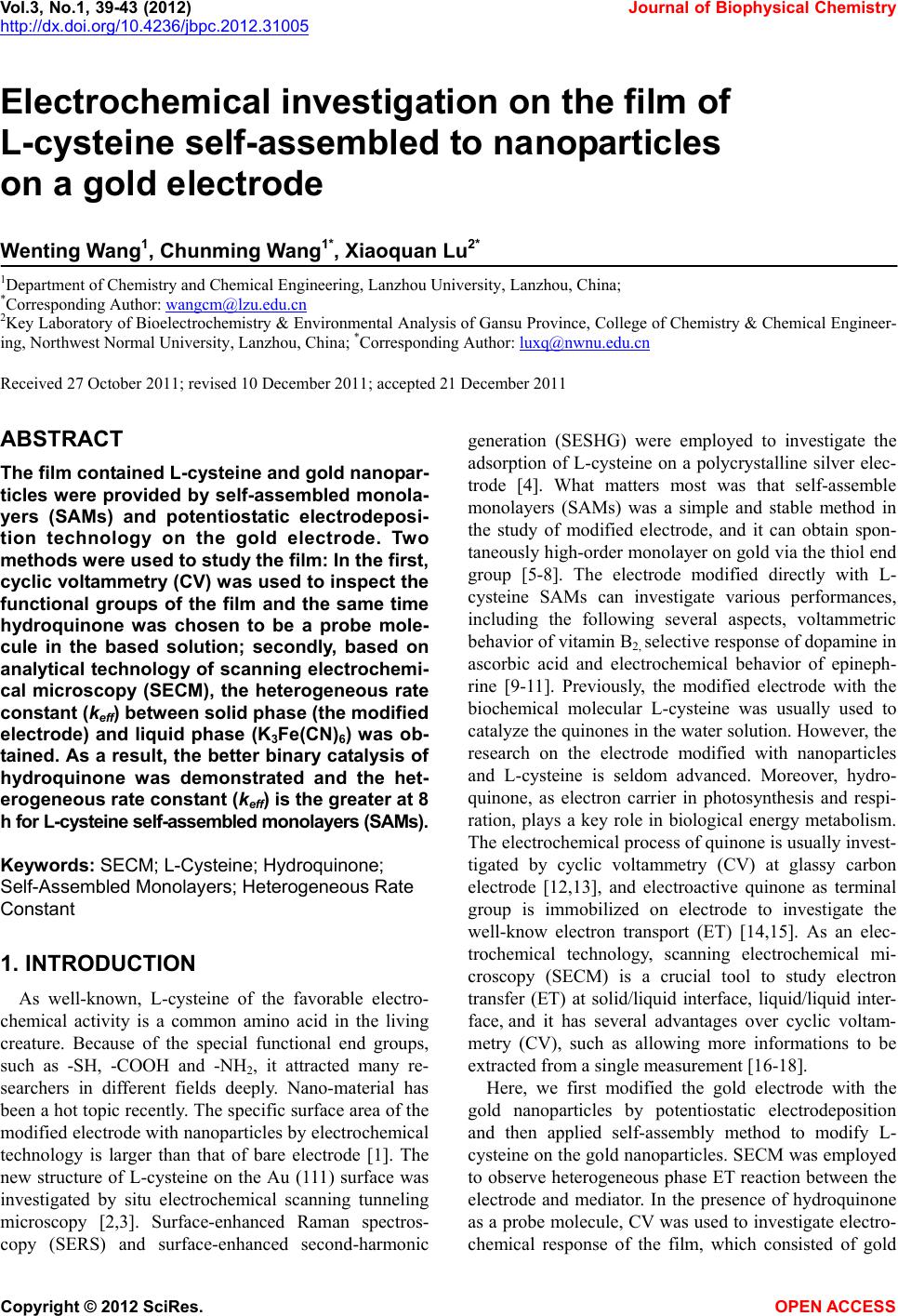 Vol.3, No.1, 39-43 (2012) Journ al of Biophysical Chemistry http://dx.doi.org/10.4236/jbpc.2012.31005 Electrochemical investigation on the film of L-cysteine self-assembled to nanoparticles on a gold electrode Wenting Wang1, Chunming Wang1*, Xiaoquan Lu2* 1Department of Chemistry and Chemical Engineering, Lanzhou University, Lanzhou, China; *Corresponding Author: [email protected] 2Key Laboratory of Bioelectrochemistry & Environmental Analysis of Gansu Province, College of Chemistry & Chemical Engineer- ing, Northwest Normal University, Lanzhou, China; *Corresponding Author: [email protected] Received 27 October 2011; revised 10 December 2011; accepted 21 December 2011 ABSTRACT The film contained L-cysteine and gold nanopar- ticles were provided by self-assembled monola- yers (SAMs) and potentiostatic electrodeposi- tion technology on the gold electrode. Two methods were used to study the film: In the first, cyclic voltammetr y (CV) was used to inspect the functional groups of the film and the same time hydroquinone was chosen to be a probe mole- cule in the based solution; secondly, based on analytical technology of scanning electrochemi- cal microscopy (SECM), the heterogeneous rate constant (keff) bet ween solid phase (the modified electrode) and liquid phase (K3Fe(CN)6) was ob- tained. As a result, the better binary catalysis of hydroquinone was demonstrated and the het- erogeneous rate constant (keff) is the greater at 8 h for L-cysteine self-assembled monolayers (SAMs). Keywords: S E CM; L-Cysteine; Hydroquinone; Self-Assembled Monolayers; Heterogeneous Rate Constant 1. INTRODUCTION As well-known, L-cysteine of the favorable electro- chemical activity is a common amino acid in the living creature. Because of the special functional end groups, such as -SH, -COOH and -NH2, it attracted many re- searchers in different fields deeply. Nano-material has been a hot topic recently. The specific surface area of the modified electrode with nanoparticles by electrochemical technology is larger than that of bare electrode [1]. The new structure of L-cysteine on the Au (111) surface was investigated by situ electrochemical scanning tunneling microscopy [2,3]. Surface-enhanced Raman spectros- copy (SERS) and surface-enhanced second-harmonic generation (SESHG) were employed to investigate the adsorption of L-cysteine on a polycrystalline silver elec- trode [4]. What matters most was that self-assemble monolayers (SAMs) was a simple and stable method in the study of modified electrode, and it can obtain spon- taneously high-order monolayer on gold via the thiol end group [5-8]. The electrode modified directly with L- cysteine SAMs can investigate various performances, including the following several aspects, voltammetric behavior of vitamin B2, selective response of dopamine in ascorbic acid and electrochemical behavior of epineph- rine [9-11]. Previously, the modified electrode with the biochemical molecular L-cysteine was usually used to catalyze the quinones in the water solution. However, the research on the electrode modified with nanoparticles and L-cysteine is seldom advanced. Moreover, hydro- quinone, as electron carrier in photosynthesis and respi- ration, plays a key role in biological energy metabolism. The electrochemical process of quinone is usually invest- tigated by cyclic voltammetry (CV) at glassy carbon electrode [12,13], and electroactive quinone as terminal group is immobilized on electrode to investigate the well-know electron transport (ET) [14,15]. As an elec- trochemical technology, scanning electrochemical mi- croscopy (SECM) is a crucial tool to study electron transfer (ET) at solid/liquid interface, liquid/liquid inter- face, and it has several advantages over cyclic voltam- metry (CV), such as allowing more informations to be extracted from a single measurement [16-18]. Here, we first modified the gold electrode with the gold nanoparticles by potentiostatic electrodeposition and then applied self-assembly method to modify L- cysteine on the gold nanoparticles. SECM was employed to observe heterogeneous phase ET reaction between the electrode and mediator. In the presence of hydroquinone as a probe molecule, CV was used to investigate electro- chemical response of the film, which consisted of gold Copyright © 2012 SciRes. OPEN ACCESS 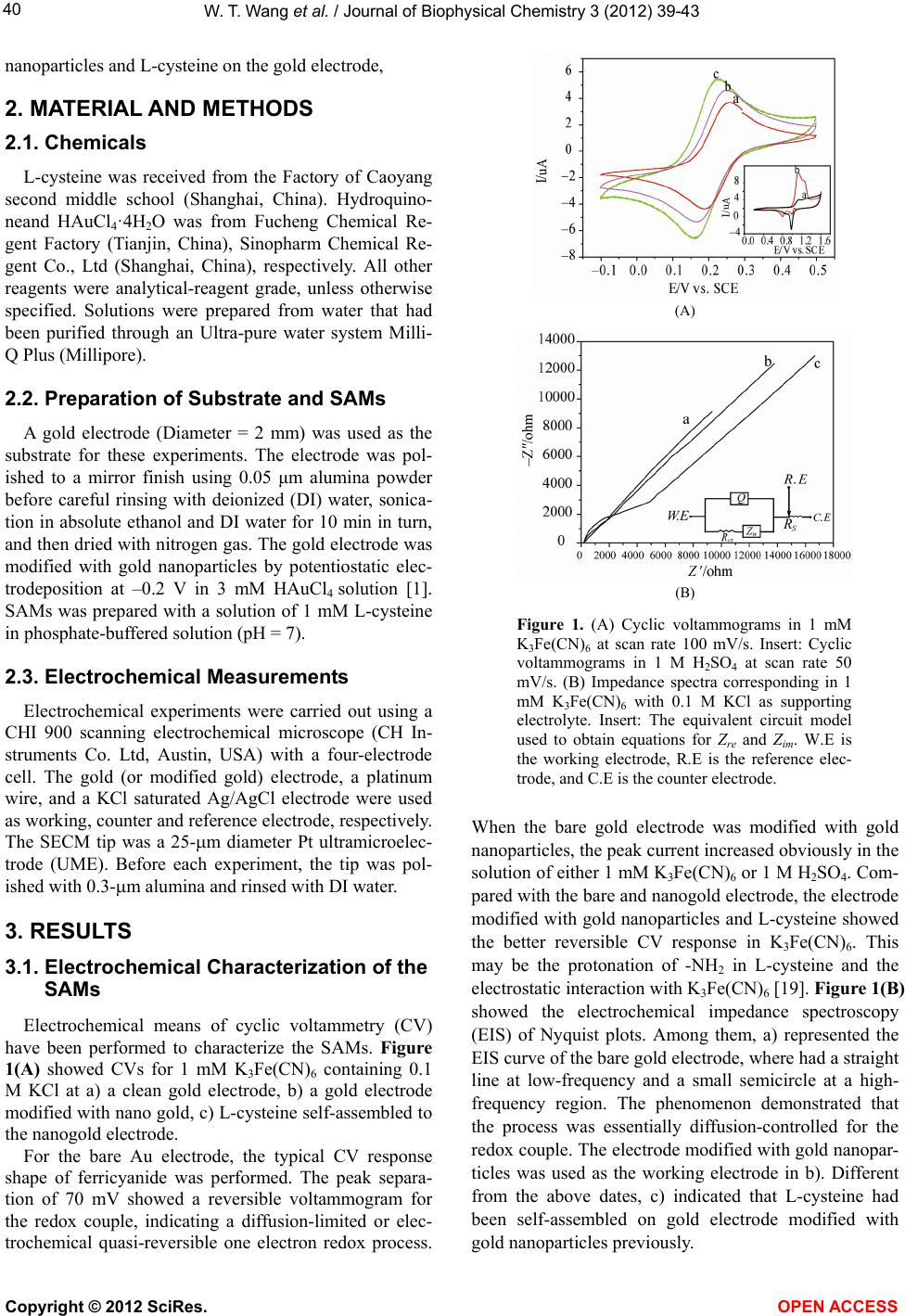 W . T. Wang et al. / Journal of Biophysical Chemistry 3 (2012) 39-43 40 nanoparticles and L-cysteine on the gold electrode, 2. MATERIAL AND METHODS 2.1. Chemicals L-cysteine was received from the Factory of Caoyang second middle school (Shanghai, China). Hydroquino- neand HAuCl4·4H2O was from Fucheng Chemical Re- gent Factory (Tianjin, China), Sinopharm Chemical Re- gent Co., Ltd (Shanghai, China), respectively. All other reagents were analytical-reagent grade, unless otherwise specified. Solutions were prepared from water that had been purified through an Ultra-pure water system Milli- Q Plus (Millipore). 2.2. Preparation of Substrate and SAMs A gold electrode (Diameter = 2 mm) was used as the substrate for these experiments. The electrode was pol- ished to a mirror finish using 0.05 μm alumina powder before careful rinsing with deionized (DI) water, sonica- tion in absolute ethanol and DI water for 10 min in turn, and then dried with nitrogen gas. The gold electrode was modified with gold nanoparticles by potentiostatic elec- trodeposition at –0.2 V in 3 mM HAuCl4 solution [1]. SAMs was prepared with a solution of 1 mM L-cysteine in phosphate-buffered solution (pH = 7). 2.3. Electrochemical Measurements Electrochemical experiments were carried out using a CHI 900 scanning electrochemical microscope (CH In- struments Co. Ltd, Austin, USA) with a four-electrode cell. The gold (or modified gold) electrode, a platinum wire, and a KCl saturated Ag/AgCl electrode were used as working, counter and reference electrode, respectively. The SECM tip was a 25-m diameter Pt ultramicroelec- trode (UME). Before each experiment, the tip was pol- ished with 0.3-m alumina and rinsed with DI water. 3. RESULTS 3.1. Electrochemical Characterization of the SAMs Electrochemical means of cyclic voltammetry (CV) have been performed to characterize the SAMs. Figure 1(A) showed CVs for 1 mM K3Fe(CN)6 containing 0.1 M KCl at a) a clean gold electrode, b) a gold electrode modified with nano gold, c) L-cysteine self-assembled to the nanogold electrode. For the bare Au electrode, the typical CV response shape of ferricyanide was performed. The peak separa- tion of 70 mV showed a reversible voltammogram for the redox couple, indicating a diffusion-limited or elec- trochemical quasi-reversible one electron redox process. (A) (B) Figure 1. (A) Cyclic voltammograms in 1 mM K3Fe(CN)6 at scan rate 100 mV/s. Insert: Cyclic voltammograms in 1 M H2SO4 at scan rate 50 mV/s. (B) Impedance spectra corresponding in 1 mM K3Fe(CN)6 with 0.1 M KCl as supporting electrolyte. Insert: The equivalent circuit model used to obtain equations for Zre and Zim. W.E is the working electrode, R.E is the reference elec- trode, and C.E is the counter electrode. When the bare gold electrode was modified with gold nanoparticles, the peak current increased obviously in the solution of either 1 mM K3Fe(CN)6 or 1 M H2SO4. Com- pared with the bare and nanogold electrode, the electrode modified with gold nanoparticles and L-cysteine showed the better reversible CV response in K3Fe(CN) 6. This may be the protonation of -NH2 in L-cysteine and the electrostatic interaction with K3Fe(CN)6 [19]. Figure 1(B) showed the electrochemical impedance spectroscopy (EIS) of Nyquist plots. Among them, a) represented the EIS curve of the bare gold electrode, where had a straight line at low-frequency and a small semicircle at a high- frequency region. The phenomenon demonstrated that the process was essentially diffusion-controlled for the redox couple. The electrode modified with gold nanopar- ticles was used as the working electrode in b). Different from the above dates, c) indicated that L-cysteine had been self-assembled on gold electrode modified with gold nanoparticles previously. Copyright © 2012 SciRes. OPEN ACCESS 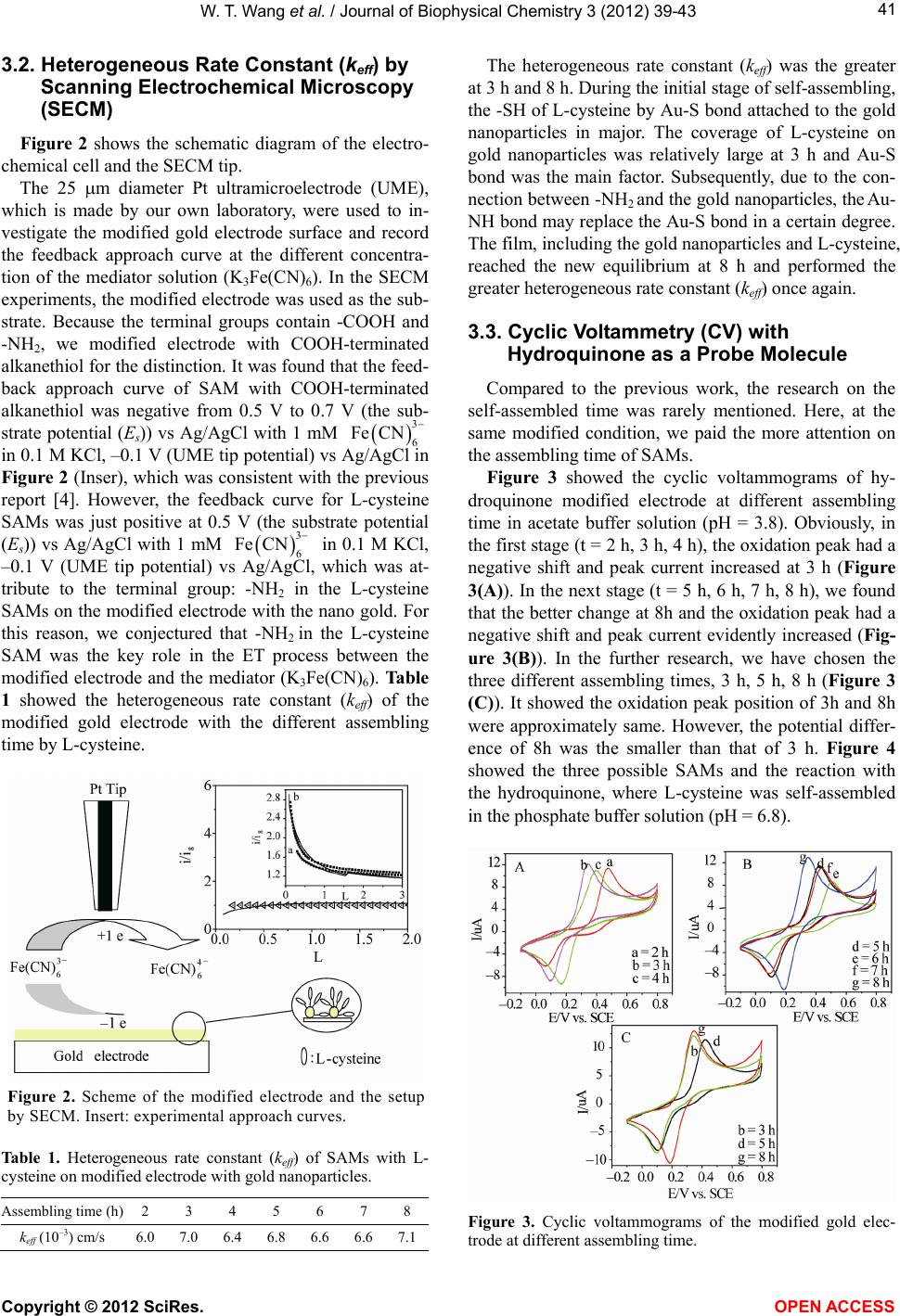 W . T. Wang et al. / Journal of Biophysical Chemistry 3 (2012) 39-43 41 3.2. Heterogeneous Rate Constant (keff) by Scanning Electrochemical Microscopy (SECM) Figure 2 shows the schematic diagram of the electro- chemical cell and the SECM tip. The 25 m diameter Pt ultramicroelectrode (UME), which is made by our own laboratory, were used to in- vestigate the modified gold electrode surface and record the feedback approach curve at the different concentra- tion of the mediator solution (K3Fe(CN)6). In the SECM experiments, the modified electrode was used as the sub- strate. Because the terminal groups contain -COOH and -NH2, we modified electrode with COOH-terminated alkanethiol for the distinction. It was found that the feed- back approach curve of SAM with COOH-terminated alkanethiol was negative from 0.5 V to 0.7 V (the sub- strate potential (Es)) vs Ag/AgCl with 1 mM 6 3 Fe CN in 0.1 M KCl, –0.1 V (UME tip potential) vs Ag/AgCl in Figure 2 (Inser), which was consistent with the previous report [4]. However, the feedback curve for L-cysteine SAMs was just positive at 0.5 V (the substrate potential (Es)) vs Ag/AgCl with 1 mM 6 in 0.1 M KCl, –0.1 V (UME tip potential) vs Ag/AgCl, which was at- tribute to the terminal group: -NH2 in the L-cysteine SAMs on the modified electrode with the nano gold. For this reason, we conjectured that -NH2 in the L-cysteine SAM was the key role in the ET process between the modified electrode and the mediator (K3Fe(CN)6). Table 1 showed the heterogeneous rate constant (keff) of the modified gold electrode with the different assembling time by L-cysteine. 3 Fe CN Figure 2. Scheme of the modified electrode and the setup by SECM. Insert: experimental approach curves. Table 1. Heterogeneous rate constant (keff) of SAMs with L- cysteine on modified electrode with gold nanoparticles. Assembling time (h) 2 3 4 5 6 7 8 keff (10–3) cm/s 6.0 7.0 6.4 6.8 6.6 6.6 7.1 The heterogeneous rate constant (keff) was the greater at 3 h and 8 h. During the initial stage of self-assembling, the -SH of L-cysteine by Au-S bond attached to the gold nanoparticles in major. The coverage of L-cysteine on gold nanoparticles was relatively large at 3 h and Au-S bond was the main factor. Subsequently, due to the con- nection between -NH2 and the gold nanoparticles, the Au- NH bond may replace the Au-S bond in a certain degree. The film, including the gold nanoparticles and L-cysteine, reached the new equilibrium at 8 h and performed the greater heterogeneous rate constant (keff) once again. 3.3. Cyclic Voltammetry (CV) with Hydroquinone as a Probe Molecule Compared to the previous work, the research on the self-assembled time was rarely mentioned. Here, at the same modified condition, we paid the more attention on the assembling time of SAMs. Figure 3 showed the cyclic voltammograms of hy- droquinone modified electrode at different assembling time in acetate buffer solution (pH = 3.8). Obviously, in the first stage (t = 2 h, 3 h, 4 h), the oxidation peak had a negative shift and peak current increased at 3 h (Figure 3(A)). In the next stage (t = 5 h, 6 h, 7 h, 8 h), we found that the better change at 8h and the oxidation peak had a negative shift and peak current evidently increased (Fig- ure 3(B)). In the further research, we have chosen the three different assembling times, 3 h, 5 h, 8 h (Figure 3 (C)). It showed the oxidation peak position of 3h and 8h were approximately same. However, the potential differ- ence of 8h was the smaller than that of 3 h. Figure 4 showed the three possible SAMs and the reaction with the hydroquinone, where L-cysteine was self-assembled in the phosphate buffer solution (pH = 6.8). Figure 3. Cyclic voltammograms of the modified gold elec- rode at different assembling time. t Copyright © 2012 SciRes. OPEN ACCESS 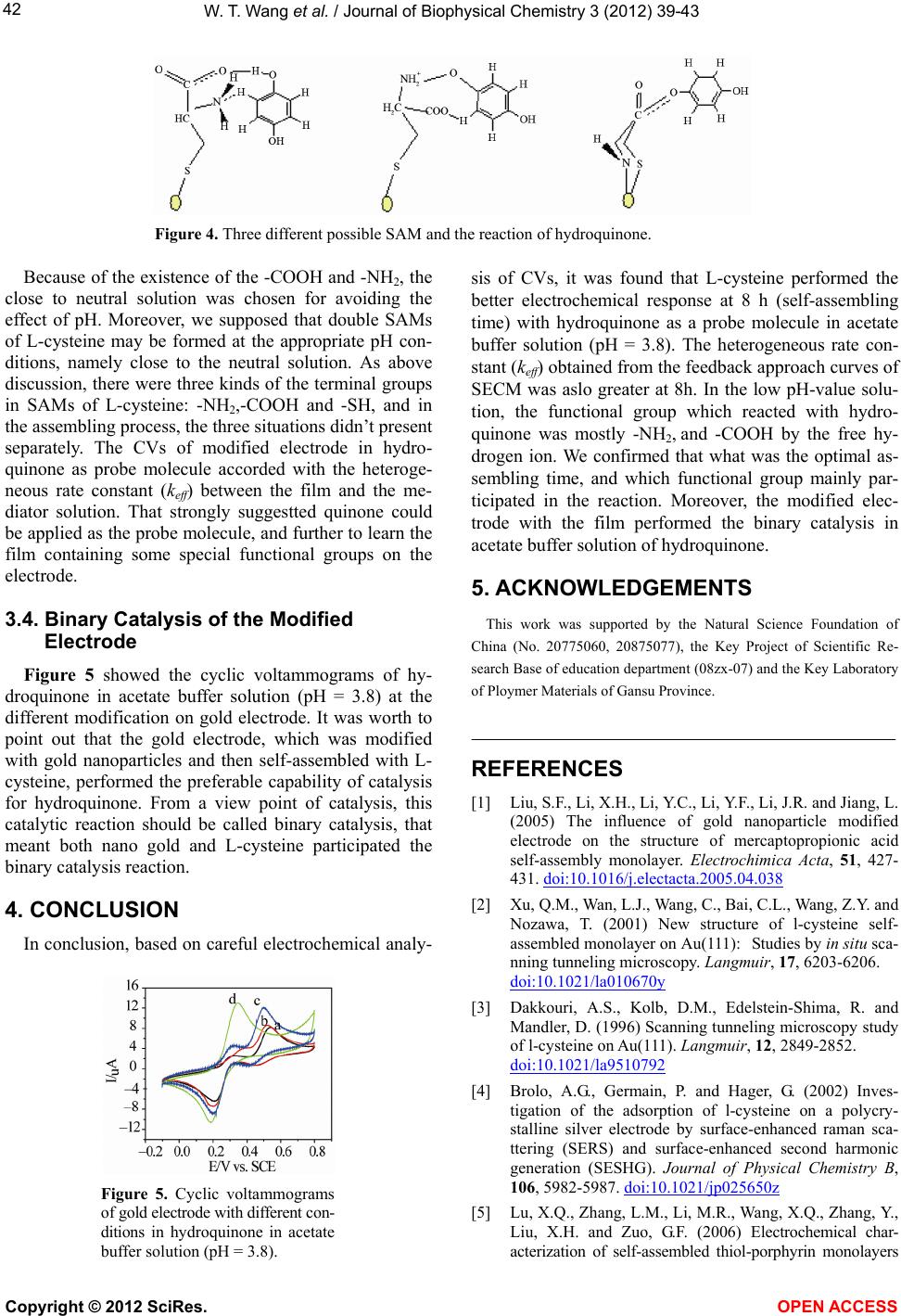 W . T. Wang et al. / Journal of Biophysical Chemistry 3 (2012) 39-43 Copyright © 2012 SciRes. 42 Figure 4. Three different possible SAM and the reaction of hydroquinone. Because of the existence of the -COOH and -NH2, the close to neutral solution was chosen for avoiding the effect of pH. Moreover, we supposed that double SAMs of L-cysteine may be formed at the appropriate pH con- ditions, namely close to the neutral solution. As above discussion, there were three kinds of the terminal groups in SAMs of L-cysteine: -NH2,-COOH and -SH, and in the assembling process, the three situations didn’t present separately. The CVs of modified electrode in hydro- quinone as probe molecule accorded with the heteroge- neous rate constant (keff) between the film and the me- diator solution. That strongly suggestted quinone could be applied as the probe molecule, and further to learn the film containing some special functional groups on the electrode. sis of CVs, it was found that L-cysteine performed the better electrochemical response at 8 h (self-assembling time) with hydroquinone as a probe molecule in acetate buffer solution (pH = 3.8). The heterogeneous rate con- stant (keff) obtained from the feedback approach curves of SECM was aslo greater at 8h. In the low pH-value solu- tion, the functional group which reacted with hydro- quinone was mostly -NH2, and -COOH by the free hy- drogen ion. We confirmed that what was the optimal as- sembling time, and which functional group mainly par- ticipated in the reaction. Moreover, the modified elec- trode with the film performed the binary catalysis in acetate buffer solution of hydroquinone. 5. ACKNOWLEDGEMENTS 3.4. Binary Catalysis of the Modified Electrode This work was supported by the Natural Science Foundation of China (No. 20775060, 20875077), the Key Project of Scientific Re- search Base of education department (08zx-07) and the Key Laboratory of Ploymer Materials of Gansu Province. Figure 5 showed the cyclic voltammograms of hy- droquinone in acetate buffer solution (pH = 3.8) at the different modification on gold electrode. It was worth to point out that the gold electrode, which was modified with gold nanoparticles and then self-assembled with L- cysteine, performed the preferable capability of catalysis for hydroquinone. From a view point of catalysis, this catalytic reaction should be called binary catalysis, that meant both nano gold and L-cysteine participated the binary catalysis reaction. REFERENCES [1] Liu, S.F., Li, X.H., Li, Y.C., Li, Y.F., Li, J.R. and Jiang, L. (2005) The influence of gold nanoparticle modified electrode on the structure of mercaptopropionic acid self-assembly monolayer. Electrochimica Acta, 51, 427- 431. doi:10.1016/j.electacta.2005.04.038 [2] Xu, Q.M., Wan, L.J., Wang, C., Bai, C.L., Wang, Z.Y. and Nozawa, T. (2001) New structure of l-cysteine self- assembled monolayer on Au(111): Studies by in situ sca- nning tunneling microscopy. Langmuir, 17, 6203-6206. doi:10.1021/la010670y 4. CONCLUSION In conclusion, based on careful electrochemical analy- [3] Dakkouri, A.S., Kolb, D.M., Edelstein-Shima, R. and Mandler, D. (1996) Scanning tunneling microscopy study of l-cysteine on Au(111). Langmuir, 12, 2849-2852. doi:10.1021/la9510792 [4] Brolo, A.G., Germain, P. and Hager, G. (2002) Inves- tigation of the adsorption of l-cysteine on a polycry- stalline silver electrode by surface-enhanced raman sca- ttering (SERS) and surface-enhanced second harmonic generation (SESHG). Journal of Physical Chemistry B, 106, 5982-5987. doi:10.1021/jp025650z Figure 5. Cyclic voltammograms of gold electrode with different con- ditions in hydroquinone in acetate buffer solution (pH = 3.8). [5] Lu, X.Q., Zhang, L.M., Li, M.R., Wang, X.Q., Zhang, Y., Liu, X.H. and Zuo, G.F. (2006) Electrochemical char- acterization of self-assembled thiol-porphyrin monolayers OPEN ACCESS  W . T. W ang et al. / Journal of Bioph ysical Ch emistry 3 (2012) 39-43 43 on gold electrodes by SECM. ChemPhysChem, 7, 854-862. doi:10.1002/cphc.200500492 [6] Zhang, S. and Echegoyen, L. (2005) Selective response of dopamine in the presence of ascorbic acid on l-cysteine self-assembled gold electrode. Journal of the American Chemical Society, 127, 2006-2011. doi:10.1021/ja044411h [7] Holt, K.B. (2006) Using scanning electrochemical micr- oscopy (SECM) to measure the electron-transfer kinetics of cytochrome c Immobilized on a COOH-terminated alkanethiol monolayer on a gold electrode. Langmuir , 22, 4298-4304. doi:10.1021/la0529916 [8] Wang, W.T., Li, X.J., Wang, X.Y., Shang, H., Liu, X.H. and Lu, X.Q. (2010) Comparative electrochemical be- haviors of a series of SH-terminated-functionalized por- phyrins assembled on a gold electrode by scanning elec- trochemical microscopy (SECM). Journal of Physical Chemistry B, 114, 10436-10441. doi:10.1021/jp1026064 [9] Wan, Q.J. Yang, N.J., Zhang, H.L., Zou, X.P. and Xu, B. (2001) Voltammetric behavior of vitamin B2 on the gold electrode modified with a self-assembled monolayer of L-cysteine and its application for the determination of vi- tamin B2 using linear sweep stripping voltammetry. Ta- lanta, 55, 459-467. doi:10.1016/S0039-9140(01)00437-4 [10] Hu, G.Z., Liu, Y.C., Zhao, J., Cui, S.Q., Yang, Z.S. and Zhang, Y.Z. (2006) Selective response of dopamine in the presence of ascorbic acid on l-cysteine self-assembled gold electrode. Bioelectrochem, 69, 254-257. doi:10.1016/j.bioelechem.2006.03.005 [11] Wang, S.F., Du, D. and Zou, Q.C. (2002) Electrochemical behavior of epinephrine at L-cysteine self-assembled mo- nolayers modified gold electrode. Talanta, 57, 687-692. doi:10.1016/S0039-9140(02)00072-3 [12] Ji, X.B., Banks, C.E., Silvester, D.S., Wain, A.J. and Compton, R.G. (2007) Electrode kinetic studies of the hydroquinone-benzoquinone system and the reaction bet- ween hydroquinone and ammonia in propylene carbonate: Application to the indirect electroanalytical sensing of ammonia. Journal of Physical Chemistry C, 111 , 1496- 1504. doi:10.1021/jp066704y [13] Quan, M., Sanchez, D., Wasylkiw, M.F. and Smith, D.K. (2007) Voltammetry of quinones in unbuffered aqueous solution: Reassessing the roles of proton transfer and hydrogen bonding in the aqueous electrochemistry of quinones. Journal of the American Chemical Society, 129. 12847-12856. doi:10.1021/ja0743083 [14] Tamaki, T., Ito, T. and Yamaguchi, T. (2007) Immobiliza- tion of hydroquinone through a spacer to polymer grafted on carbon black for a high-surface-area biofuel cell elec- trode. Journal of Physical Chemistry B, 111, 10312- 10319.doi:10.1021/jp074334n [15] Larsen, A.G. and Gothelf, K.V. (2005) Electrochemical properties of mixed self-assembled monolayers on gold electrodes containing mercaptooctylhydroquinone and alkylthiols. Langmuir, 21, 1015-1021. doi:10.1021/la048221w [16] Liu, B., Bard, A.J., Mirkin, M.V. and Creager, S.E. (2004) Electron transfer at self-assembled monolayers measured by scanning electrochemical microscopy. Journal of the American Chemical Society, 126, 1485-1492. doi:10.1021/ja038611p [17] Lu, X.Q., Nan, M.N., Zhang, H.R., Liu, X.H., Yuan, H.Q. and Yang, J.D. (2007) Investigation of the antioxidant property of ascorbic acid. Journal of Physical Chemistry C, 111, 14998-15002. doi:10.1021/jp072551i [18] Bollo, S., Yanez, C., Sturm, J., Nunez-Vergara, L. and Squella, J.A. (2003) Cyclic voltammetric and scanning electrochemical microscopic study of thiolated β-cyclo- dextrin adsorbed on a gold electrode. Langmuir, 19, 3365-3370. doi:10.1021/la0267995 [19] Hu, X.Y., Xiao, Y. and Chen, H.Y. (1999) Adsorption characteristics of Fe3(CN)6 3−/4− on Au colloids as mono- layer films on cysteamine-modified gold electrode. Jour- nal of Electroanalytical Chemistry, 466, 26-30. doi:10.1016/S0022-0728(99)00113-8 Copyright © 2012 SciRes. OPEN ACCESS |