

Paper Menu >>
Journal Menu >>
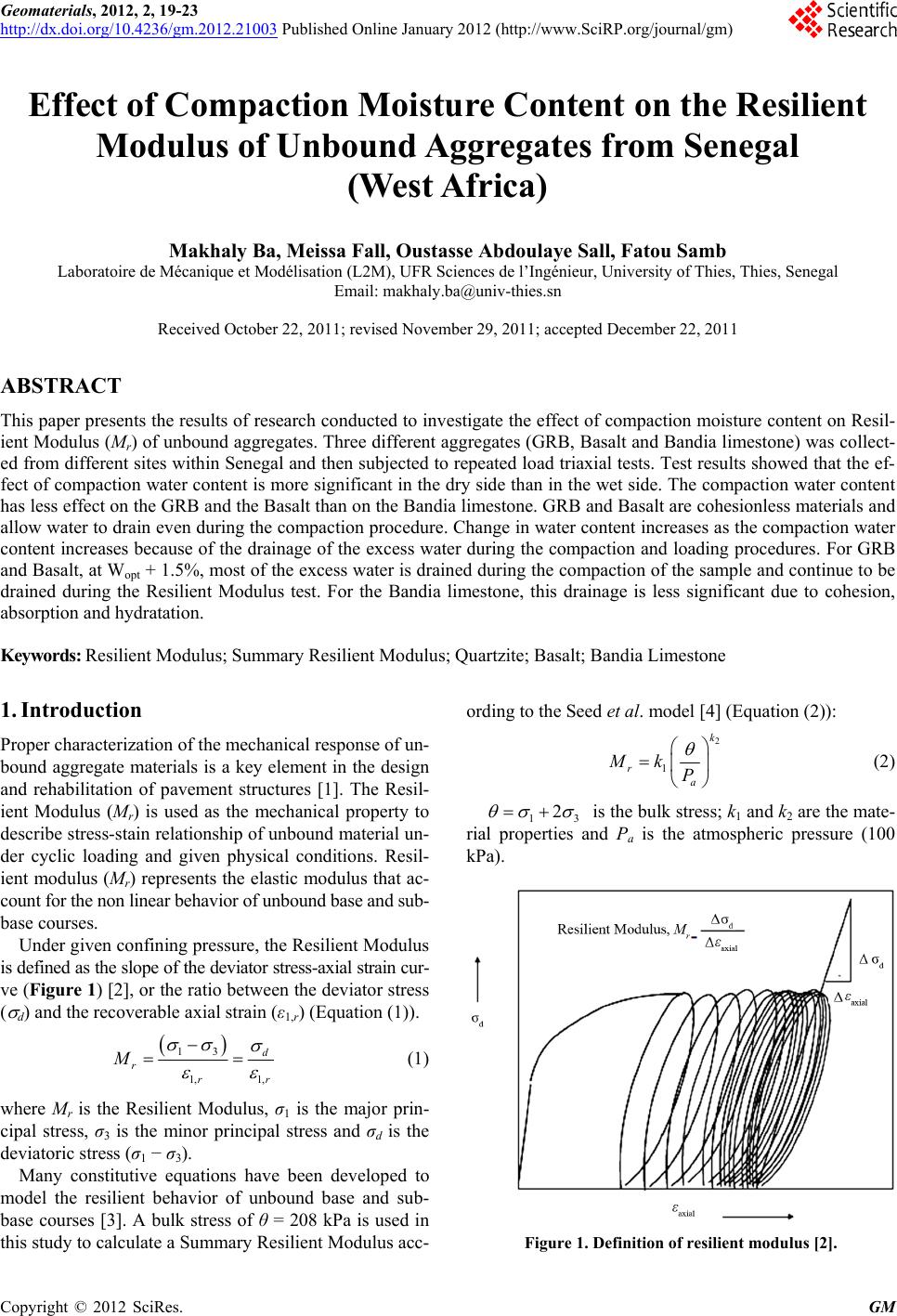 Geomaterials, 2012, 2, 19-23 http://dx.doi.org/10.4236/gm.2012.21003 Published Online January 2012 (http://www.SciRP.org/journal/gm) 19 Effect of Compaction Moisture Content on the Resilient Modulus of Unbound Aggregates from Senegal (West Africa) Makhaly Ba, Meissa Fall, Oustasse Abdoulaye Sall, Fatou Samb Laboratoire de Mécanique et Modélisation (L2M), UFR Sciences de l’Ingénieur, University of Thies, Thies, Senegal Email: [email protected] Received October 22, 2011; revised November 29, 2011; accepted December 22, 2011 ABSTRACT This paper presents the results of research conducted to investigate the effect of compaction moisture content on Resil- ient Modulus (Mr) of unbound aggregates. Three different aggregates (GRB, Basalt and Bandia limestone) was collect- ed from different sites within Senegal and then subjected to repeated load triaxial tests. Test results showed that the ef- fect of compaction water content is more significant in the dry side than in the wet side. The compaction water content has less effect on the GRB and the Basalt than on the Bandia limestone. GRB and Basalt are cohesionless materials and allow water to drain even during the compaction procedure. Change in water content increases as the compaction water content increases because of the drainage of the excess water during the compaction and loading procedures. For GRB and Basalt, at Wopt + 1.5%, most of the excess water is drained during the compaction of the sample and continue to be drained during the Resilient Modulus test. For the Bandia limestone, this drainage is less significant due to cohesion, absorption and hydratation. Keywords: Resilient Modulus; Summary Resilient Modulus; Quartzite; Basalt; Bandia Limestone 1. Introduction Proper characterization of the mechanical response of un- bound aggregate materials is a key element in the design and rehabilitation of pavement structures [1]. The Resil- ient Modulus (Mr) is used as the mechanical property to describe stress-stain relationship of unbound material un- der cyclic loading and given physical conditions. Resil- ient modulus (Mr) represents the elastic modulus that ac- count for the non linear behavior of unbound base and sub- base courses. Under given confining pressure, the Resilient Modulus is defined as the slope of the deviator stress-axial strain cur- ve (Figure 1) [2], or the ratio between the deviator stress ( d) and the recoverable axial strain (ε1,r) (Equation (1)). 13 1, 1, d r rr M (1) where Mr is the Resilient Modulus, σ1 is the major prin- cipal stress, σ3 is the minor principal stress and σd is the deviatoric stress (σ1 − σ3). Many constitutive equations have been developed to model the resilient behavior of unbound base and sub- base courses [3]. A bulk stress of θ = 208 kPa is used in this study to calculate a Summary Resilient Modulus acc- ording to the Seed et al. model [4] (Equation (2)): 2 1 k r a Mk P (2) 13 2 is the bulk stress; k1 and k2 are the mate- rial properties and Pa is the atmospheric pressure (100 kPa). Figure 1. Definition of resilient modulus [2]. C opyright © 2012 SciRes. GM 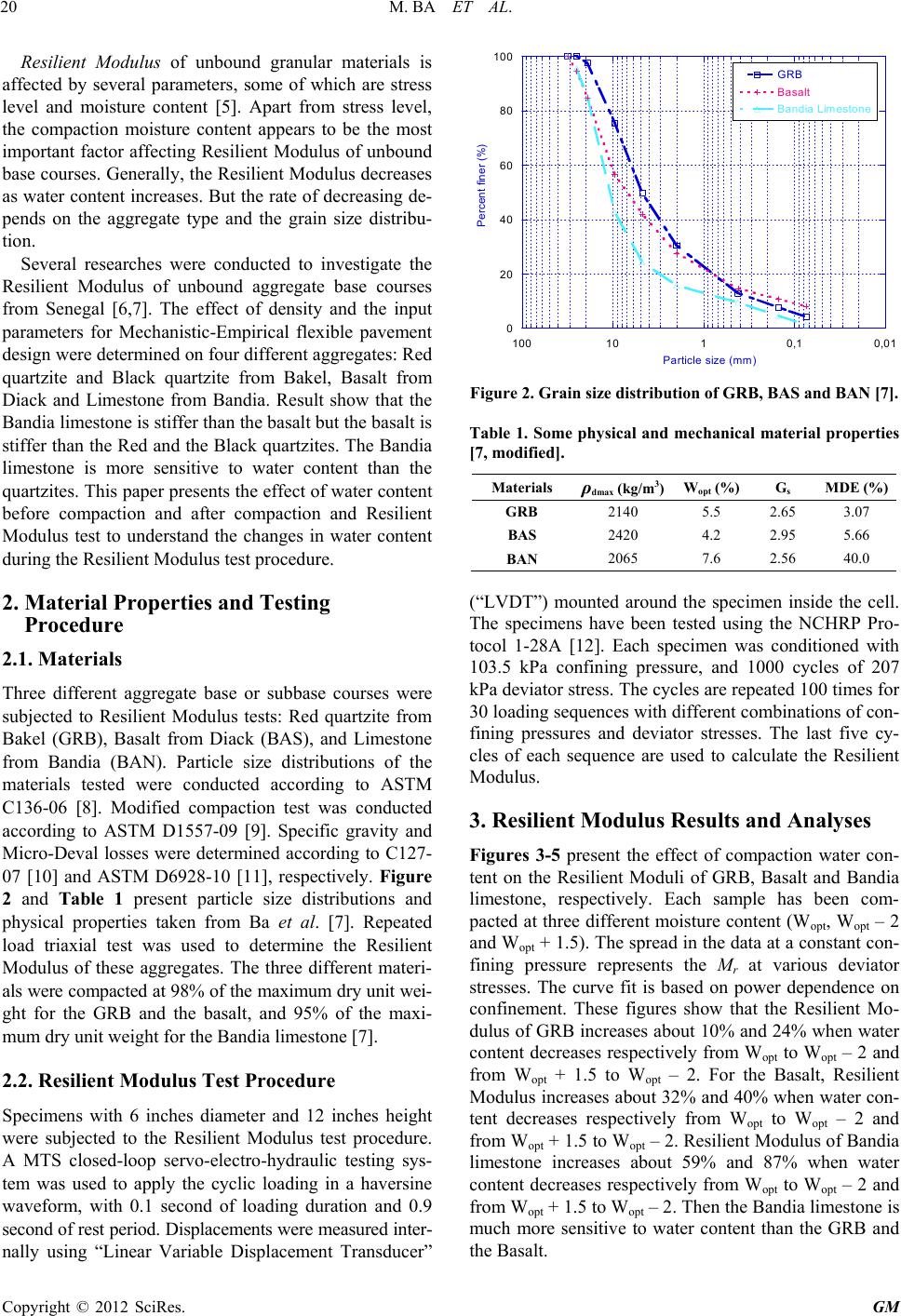 M. BA ET AL. 20 Resilient Modulus of unbound granular materials is affected by several parameters, some of which are stress level and moisture content [5]. Apart from stress level, the compaction moisture content appears to be the most important factor affecting Resilient Modulus of unbound base courses. Generally, the Resilient Modulus decreases as water content increases. But the rate of decreasing de- pends on the aggregate type and the grain size distribu- tion. Several researches were conducted to investigate the Resilient Modulus of unbound aggregate base courses from Senegal [6,7]. The effect of density and the input parameters for Mechanistic-Empirical flexible pavement design were determined on four different aggregates: Red quartzite and Black quartzite from Bakel, Basalt from Diack and Limestone from Bandia. Result show that the Bandia limestone is stiffer than the basalt but the basalt is stiffer than the Red and the Black quartzites. The Bandia limestone is more sensitive to water content than the quartzites. This paper presents the effect of water content before compaction and after compaction and Resilient Modulus test to understand the changes in water content during the Resilient Modulus test procedure. 2. Material Properties and Testing Procedure 2.1. Materials Three different aggregate base or subbase courses were subjected to Resilient Modulus tests: Red quartzite from Bakel (GRB), Basalt from Diack (BAS), and Limestone from Bandia (BAN). Particle size distributions of the materials tested were conducted according to ASTM C136-06 [8]. Modified compaction test was conducted according to ASTM D1557-09 [9]. Specific gravity and Micro-Deval losses were determined according to C127- 07 [10] and ASTM D6928-10 [11], respectively. Figure 2 and Table 1 present particle size distributions and physical properties taken from Ba et al. [7]. Repeated load triaxial test was used to determine the Resilient Modulus of these aggregates. The three different materi- als were compacted at 98% of the maximum dry unit wei- ght for the GRB and the basalt, and 95% of the maxi- mum dry unit weight for the Bandia limestone [7]. 2.2. Resilient Modulus Test Procedure Specimens with 6 inches diameter and 12 inches height were subjected to the Resilient Modulus test procedure. A MTS closed-loop servo-electro-hydraulic testing sys- tem was used to apply the cyclic loading in a haversine waveform, with 0.1 second of loading duration and 0.9 second of rest period. Displacements were measured inter- nally using “Linear Variable Displacement Transducer” 0 20 40 60 80 100 0,010,1110100 GRB Basalt Bandia Limestone Percent finer (%) Particle size (mm) Figure 2. Grain size distribution of GRB, BAS and BAN [7]. Table 1. Some physical and mechanical material properties [7, modified]. Materials ρdmax (kg/m3)Wopt (%) Gs MDE (%) GRB 2140 5.5 2.65 3.07 BAS 2420 4.2 2.95 5.66 BAN 2065 7.6 2.56 40.0 (“LVDT”) mounted around the specimen inside the cell. The specimens have been tested using the NCHRP Pro- tocol 1-28A [12]. Each specimen was conditioned with 103.5 kPa confining pressure, and 1000 cycles of 207 kPa deviator stress. The cycles are repeated 100 times for 30 loading sequences with different combinations of con- fining pressures and deviator stresses. The last five cy- cles of each sequence are used to calculate the Resilient Modulus. 3. Resilient Modulus Results and Analyses Figures 3-5 present the effect of compaction water con- tent on the Resilient Moduli of GRB, Basalt and Bandia limestone, respectively. Each sample has been com- pacted at three different moisture content (Wopt, Wopt – 2 and Wopt + 1.5). The spread in the data at a constant con- fining pressure represents the Mr at various deviator stresses. The curve fit is based on power dependence on confinement. These figures show that the Resilient Mo- dulus of GRB increases about 10% and 24% when water content decreases respectively from Wopt to Wopt – 2 and from Wopt + 1.5 to Wopt – 2. For the Basalt, Resilient Modulus increases about 32% and 40% when water con- tent decreases respectively from Wopt to Wopt – 2 and from Wopt + 1.5 to Wopt – 2. Resilient Modulus of Bandia limestone increases about 59% and 87% when water content decreases respectively from Wopt to Wopt – 2 and from Wopt + 1.5 to Wopt – 2. Then the Bandia limestone is much more sensitive to water content than the GRB and the Basalt. Copyright © 2012 SciRes. GM 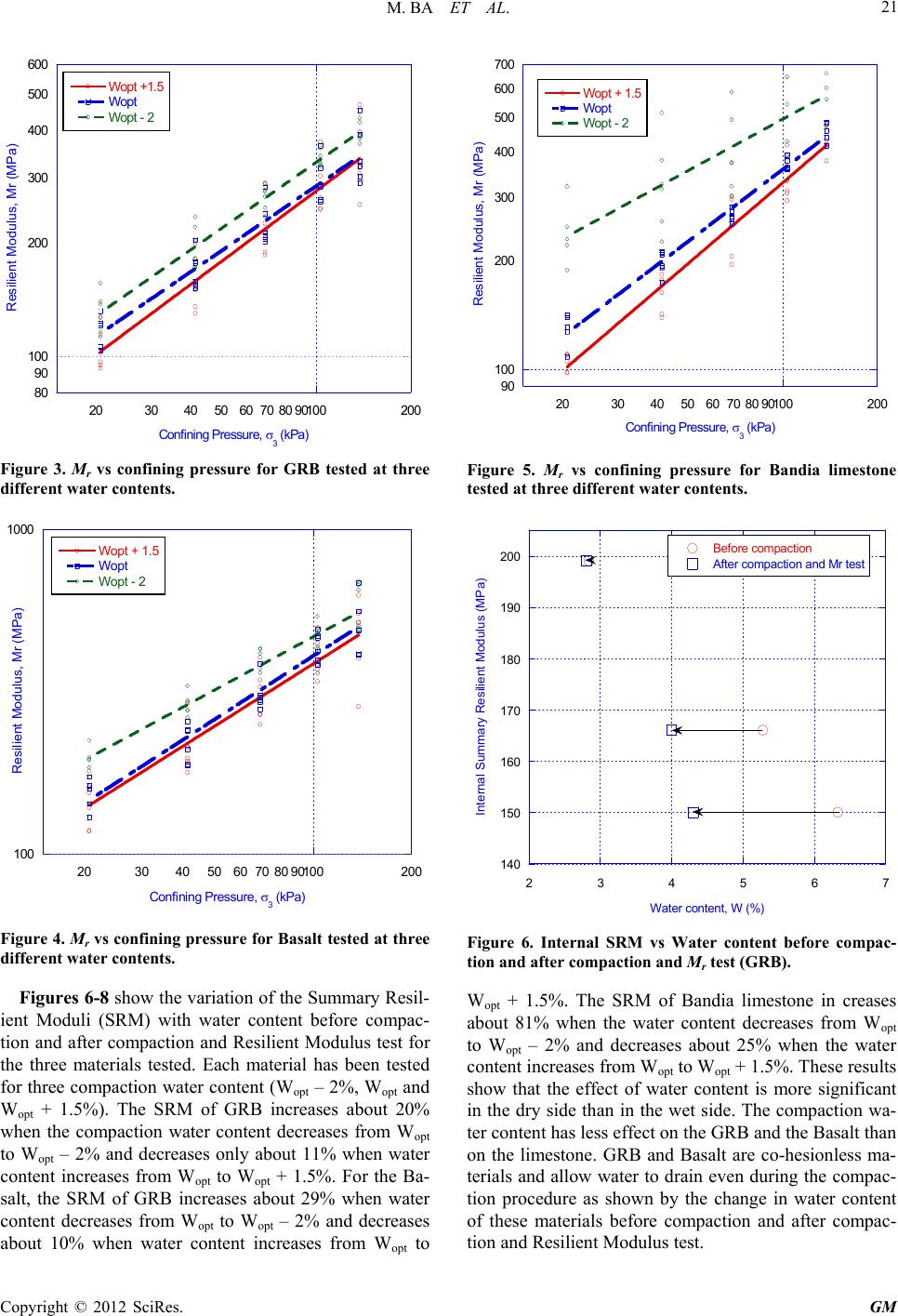 M. BA ET AL. 21 80 90 100 200 300 400 500 600 20304050607080 90100200 Wopt +1.5 Wopt Wopt - 2 Resilient Modulus, Mr (MPa) Confining Pressure, 3 (kPa) Figure 3. Mr vs confining pressure for GRB tested at three different water contents. 100 1000 20304050607080 90100200 Wopt + 1.5 Wopt Wopt - 2 Resilient Modulus, Mr (MPa) Confining Pressure, 3 (kPa) Figure 4. Mr vs confining pressure for Basalt tested at three different water contents. Figures 6-8 show the variation of the Summary Resil- ient Moduli (SRM) with water content before compac- tion and after compaction and Resilient Modulus test for the three materials tested. Each material has been tested for three compaction water content (Wopt – 2%, Wopt and Wopt + 1.5%). The SRM of GRB increases about 20% when the compaction water content decreases from Wopt to Wopt – 2% and decreases only about 11% when water content increases from Wopt to Wopt + 1.5%. For the Ba- salt, the SRM of GRB increases about 29% when water content decreases from Wopt to Wopt – 2% and decreases about 10% when water content increases from Wopt to 90 100 200 300 400 500 600 700 20304050607080 90100200 Wopt + 1.5 Wop t Wopt - 2 Resilient Modulus, Mr (MPa) Confining Pressure, 3 (kPa) Figure 5. Mr vs confining pressure for Bandia limestone tested at three different water contents. 140 150 160 170 180 190 200 234567 Before compaction After compaction and Mr test Internal Summary Resilient Modulus (MPa) Water content, W (%) Figure 6. Internal SRM vs Water content before compac- tion and after compaction and Mr test (GRB). Wopt + 1.5%. The SRM of Bandia limestone in creases about 81% when the water content decreases from Wopt to Wopt – 2% and decreases about 25% when the water content increases from Wopt to Wopt + 1.5%. These results show that the effect of water content is more significant in the dry side than in the wet side. The compaction wa- ter content has less effect on the GRB and the Basalt than on the limestone. GRB and Basalt are co-hesionless ma- terials and allow water to drain even during the compac- tion procedure as shown by the change in water content of these materials before compaction and after compac- tion and Resilient Modulus test. Copyright © 2012 SciRes. GM 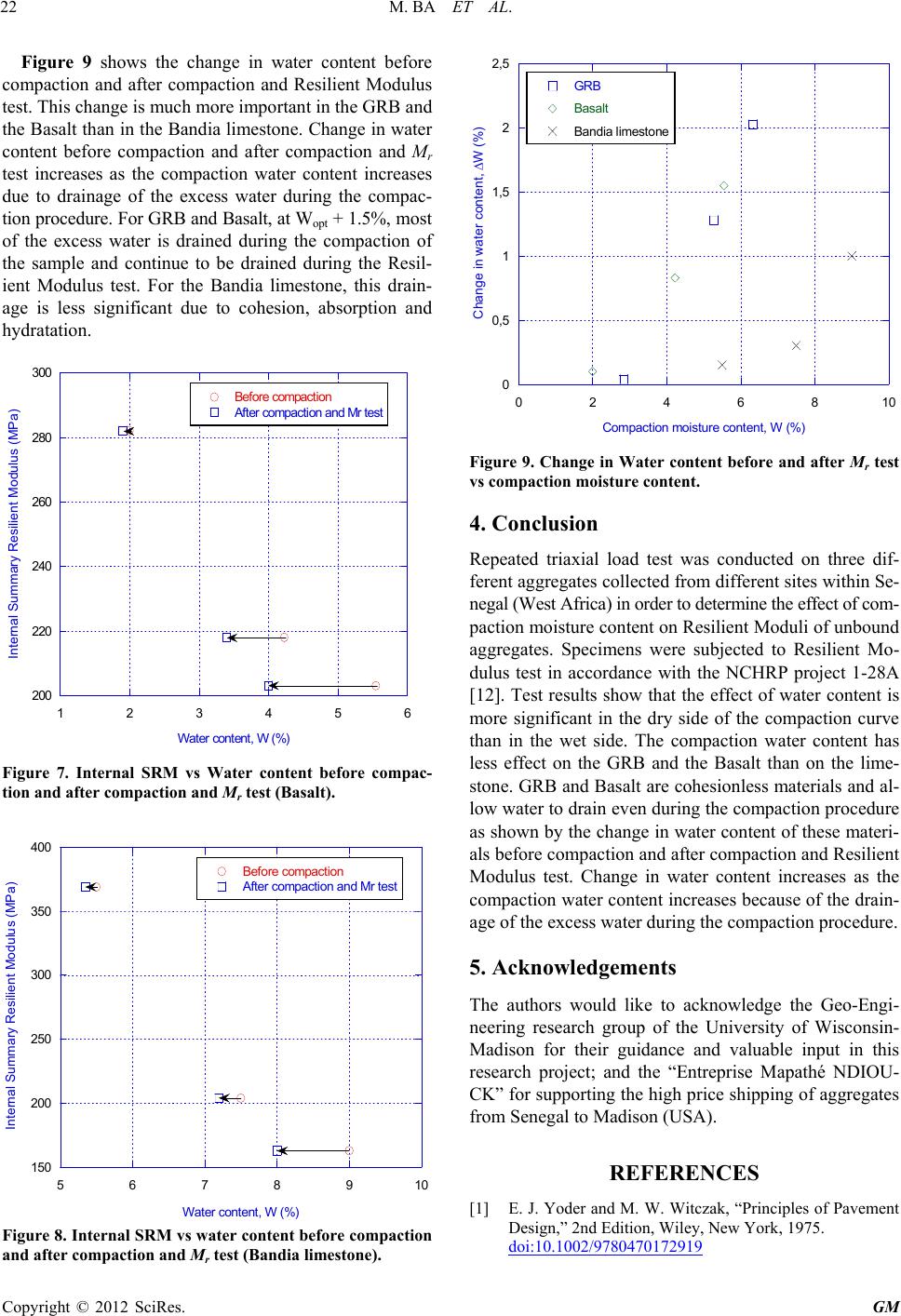 M. BA ET AL. 22 Figure 9 shows the change in water content before compaction and after compaction and Resilient Modulus test. This change is much more important in the GRB and the Basalt than in the Bandia limestone. Change in water content before compaction and after compaction and Mr test increases as the compaction water content increases due to drainage of the excess water during the compac- tion procedure. For GRB and Basalt, at Wopt + 1.5%, most of the excess water is drained during the compaction of the sample and continue to be drained during the Resil- ient Modulus test. For the Bandia limestone, this drain- age is less significant due to cohesion, absorption and hydratation. 200 220 240 260 280 300 123456 Before compaction After compaction and Mr test Internal Summary Resilient Modulus (MPa) Water content, W (%) Figure 7. Internal SRM vs Water content before compac- tion and after compaction and Mr test (Basalt). 150 200 250 300 350 400 56789 0 0,5 1 1,5 2 2,5 0246810 GRB Basalt Bandia limestone Change in water content, W (%) Compaction moisture content, W (%) Figure 9. Change in Water content before and after Mr test vs compaction moisture content. 4. Conclusion 10 Before compaction After compaction and Mr test Internal Summary Resilient Modulus (MPa) Water content, W (%) Figure 8. Internal SRM vs water content before compaction and after compaction and Mr test (Bandia limestone). Repeated triaxial load test was conducted on three dif- ferent aggregates collected from different sites within Se- negal (West Africa) in order to determine the effect of com- paction moisture content on Resilient Moduli of unbound aggregates. Specimens were subjected to Resilient Mo- dulus test in accordance with the NCHRP project 1-28A [12]. Test results show that the effect of water content is more significant in the dry side of the compaction curve than in the wet side. The compaction water content has less effect on the GRB and the Basalt than on the lime- stone. GRB and Basalt are cohesionless materials and al- low water to drain even during the compaction procedure as shown by the change in water content of these materi- als before compaction and after compaction and Resilient Modulus test. Change in water content increases as the compaction water content increases because of the drain- age of the excess water during the compaction procedure. 5. Acknowledgements The authors would like to acknowledge the Geo-Engi- neering research group of the University of Wisconsin- Madison for their guidance and valuable input in this research project; and the “Entreprise Mapathé NDIOU- CK” for supporting the high price shipping of aggregates from Senegal to Madison (USA). REFERENCES [1] E. J. Yoder and M. W. Witczak, “Principles of Pavement Design,” 2nd Edition, Wiley, New York, 1975. doi:10.1002/9780470172919 Copyright © 2012 SciRes. GM  M. BA ET AL. Copyright © 2012 SciRes. GM 23 [2] T. C. Hopkins, T. L. Beckham and C. Sun, “Resilient Modulus of Compacted Crushed Stone Aggregate Bases,” Research Report KTC-05-27/SPR-229-01-1F, Kentucky Transportation Center, College of Engineering, Univer- sity of Kentucky, Lexington, 2007, p. 89. [3] F. Lekarp, U. Isacsson and A. Dawson, “State of the Art. I: Resilient Response of Unbound Aggregates,” Journal of Transportation Engineering, Vol. 126, No. 1, 2000. [4] H. B. Seed, F. G. Mitry, C. L. Monismith and C. K. Chan, “Prediction of Flexible Pavement Deflections from Labo- ratory Repeated Load Tests,” NCHRP Rep. No. 35, Na- tional Cooperative Highway Research Program, 1967. [5] R. G. Hicks and C. L. Monismith, “Factors Influencing the Resilient Properties of Granular Materials,” Highway Research Record, Vol. 345, 1971, pp. 15-31. [6] M. Fall, A. Sawangsuriya, C. H. Benson, T. B. Edil and P. J. Bosscher, “On the Investigations of Resilient Modulus of Residual Tropical Gravel Lateritic Soils from Senegal (West Africa),” Geotechnical and Geological Engineer- ing Journal, Vol. 26, No. 1, 2008, pp. 109-111. [7] M. Ba, M. Fall, F. Samb, D. Sarr and M. Ndiaye, “Resil- ient Modulus of Unbound Aggregate Base Courses from Senegal (West Africa),” Open Journal of Civil Engineer- ing, Vol. 1, No. 1, 2011, pp. 1-6. doi:10.4236/ojce.2011.11001 [8] ASTM C136-06, “Standard Test Method for Sieve Analy- sis of Fine and Coarse Aggregates,” Annual Book of ASTM Standards, ASTM International, West Consho- hocken, 2006. [9] ASTM D1557-09, “Standard Test Methods for Labora- tory Compaction Characteristics of Soil Using Modified Effort (56,000 ft-lbf/ft3(2700 kN-m/m3)),” Annual Book of ASTM Standards, ASTM International, West Consho- hocken, 2009. [10] ASTM C127-07, “Standard Test Method for Density, Relative Density (Specific Gravity), and Absorption of Coarse Aggregate,” Annual Book of ASTM Standards, ASTM International, West Conshohocken, 2007. [11] ASTM D6928-10, “Standard Test Method for Resistance of Coarse Aggregate to Degradation by Abrasion in the Micro-Deval Apparatus,” Annual Book of ASTM Stan- dards, ASTM International, West Conshohocken, 2010. [12] NCHRP, “Laboratory Determination of Resilient Modu- lus for Flexible Pavement Design,” National Cooperative Highway Research Program (NCHRP) Project 1-28A, Transportation Research Board of National Academies, 2004. |