

Paper Menu >>
Journal Menu >>
 Psychology 2012. Vol.3, No.1, 24-29 Published Online January 2012 in SciRes (http://www.SciRP.org/journal/psych) http://dx.doi.org/10.4236/psych.2012.31004 Copyright © 2012 SciRes. 24 The Relationship between Self-Esteem and Paragraph Writing of Iranian EFL Learners Mansoor Fahim, Somaye Khojaste Rad Islamic Azad University Tehran Central Branch, Tehran, Iran Email: [email protected], [email protected] Received September 21st, 2011; revised October 31st, 2011; accepted November 30th, 2011 The present study is an attempt to understand the relationship between self-esteem and paragraph writing of Iranian EFL learners. The study was conducted on both Iranian male and female senior EFL learners studying at Tonekabon and Lahijan Azad Universities. To start the project, first of all, the researcher ran the TOEFL test among 80 students. Then, the Self-esteem Coopersmith inventory was given to the same subjects, after that the researcher asked them to write three different kinds of paragraphs in three forms namely; descriptive, comparison/contrast and cause/effect. However, the last two stages were adminis- tered in one session by one week interval. Needless to say, the researcher was available in the class in or- der to eliminate probable misunderstanding while the subjects were completing all three above-mentioned stages. Finally, in order to come up with the result, the correlation related to the four questions was mea- sured by Pearson-product moment formula, thus, the results of the calculation of correlation coefficient showed a correlation between variables of each question. Based on the above-mentioned results the null hypotheses of this study were all rejected. Meanwhile, the consistency of the raters was calculated by α- Chronbach index showing a high reliability among all raters. Keywords: Self-Esteem; Self-Concept; Paragraph Writing; Expository Writing Introduction Most of the writing problems are closely related to psycho- logical factors out of which self-esteem is an overwhelming is- sue that has determining effects on language learning. What this points to is that the importance of self-esteem as a crucial factor affecting motivation should not be underestimated. One approa- ch to reveal writing problem of the students is to make a conne- ction between self-esteem and writing skill. According to the study by Badran A. in (1999) among 50 randomly chosen uni- versity students about finding a positive correlation between se- lf-esteem and writing achievement, no significant relationship was reported in this research. Neither was any report associated with the low level of self-esteem and its relationship with low level of writing; besides, nor was any finding regards with a connection between high level of self-esteem and high level of writing ability. In another study by Grodnick reported in (2001) writing apprehension of university EFL students negatively co- rrelated with their self-esteem. And also based on another re- search which was investigated in Iran by Hayati (2006) the re- search is between listening comprehension and self-esteem that as the result showed there was a positive relationship between self-esteem and listening comprehension. Therefore, the last in- vestigation persuaded author to do another research to examine the relationship between self-esteem and paragraph writing in which she was expecting to discover new findings of the cur- rent research. Similarly, the current research, which has been done in line with the other approximately the same report, has illustrated a positive relationship between self-esteem and para- graph writing. The present research which was administered among 80 students was suggesting an appropriate correlation between students’ self-esteem and writing; therefore, better say, such results can be attributed to two main factors: on the one hand, the students’ academic writing knowledge which was up- graded depending on back-up parameters such as grammar, rea- ding, etc., and on the other hand their reasonable level of self- esteem which was boosted both at home and academic envi- ronment. Thus the research result not only was affected by writing skills of the participants but their self-esteem aspects also have been effective for establishing such relationship. The Concept of Self-Esteem According to Kobal & Musek (2002), self-concept as a theo- retical term has both numerous synonyms and definitions. In the literature, it is also identified as self representation, self-es- teem and self-evaluation. Self-concept is a psychological entity which includes our feelings, evaluations and attitudes, as well as descriptive categories of our selves. It is manifested outwa- rdly by your behavioral and personality traits and inwardly by how we feel about ourselves and the world around us. As a psy- chological whole, it has an effect on one’s particular self per- ceptions and on the perceptions of other people. It also regu- lates academic achievement attitudes to school, etc. (Burns, 1979, p.78). He also states that self-esteem is a positive or negative attitude of an individual towards himself. High Self-Concept and Low Self-Co n ce pt Burns (1979) argues that: “A person who has high self-es- teem is confident reveals that a person is in secure, lacking in confidence and self-critical. People who have low self-concept usually show signs of stress and unhappiness” (p.112) Accord- ing to Winter (1996), people with high self-esteem have more  M. FAHIM ET AL. realistic views of themselves and others i.e. they consider weak points and shortcomings more realistically, instead of criticiz- ing severely themselves. This group of people will not have any problem in adjusting to the environment. On the contrary, peo- ple with low level of self-concept are likely to become malad- justed, because of the negative attitudes they hold towards oth- ers and themselves. Essay and Composition The words “essay” and “composition” have sometimes been employed interchangeably. However, the two terms are not sy- nonymous. Heaton (1988) defines composition as a task which involves the student in manipulating words in grammatically correct sentences and in linking those sentences to form a piece of continuous writing which successfully communicates the writer’s thoughts and ideas on a certain topic. Moreover, he be- lieves that essay writing is a more demanding task which re- quires creativity and originally because it both informs and en- tertains the readers. Other scholars have not focused on the di- fferences between the two; rather, they have only defined com- position. According to Raimes (1985), composing means expre- ssing ideas, and conveying meaning. Composing means think- ing. She claims “thinking and writing should be inseparable when our students compose” (p. 261). Likewise, Slager (1972) defines composition as “writing beyond the sentence level” (p. 232). Addressing this issue, Finocchiaro (1967) believes: A co- mposition generally consists of several paragraphs on one the- me, each paragraph containing an idea, which is expanded or explained within that paragraph or in the succeeding ones. Ideas are generally linked by words, which indicate the transition between one paragraph to another. The arrangement of ideas is such that the reader can sense the author’s organization, which may be logical, chronological, or one showing cause and effect, for example, (p. 41) considering these definitions; one can real- ize how complex and demanding the task of composing is. That is why Crowhurst (1983) insists, “composing is a complex act which depends on many skills” (p. 14). Along the same line, Chimombo (1986) considers writing as “the toughest of all lan- guage skills to master” (p. 20). Moreover, Memering and O’Hare (1984) assert that “the skills of writing have always been difficult to teach, more difficult to learn” (p. v), and per- haps one can claim that if is still more difficult to est. according to Ross (1968): Acquiring skill in composition involves ac- quiring control over rhetorical devices, setting up a control idea, maintaining this idea throughout the composition, presenting the ma- terial in an orderly sequence, and so on. Basic to com- position skill is control of sentences structure and accuracy in mechanics so that the student writes correctly the first time and does not practice errors, (p. 253) Due to these complexities, most scholars including Croft (1972) believe that “writing skills ... are usually developed at advanced level of English instruction” (p. 209). Moreover, it seems quite reasonable that acquiring skill in composition is even more difficult for non-natives. According to Celce-Murica and Mcintosh (1979): The ability to express one’s ideas in the written form in a sec- ond language and to do so with reasonable accuracy and co- herence is no mean achie- vement since many native speakers of English never truly master this skill, (p. 187) In this regard, Raimes (1983) states that ESL student writers have all the wor- ries of the native speakers and many more besides, for all of them have to acquire to consciously learn the phonology, grammar, syntactic structure, vo- cabulary, rhetorical structure and idioms of a new language in addition to learning the me- chanics of prose (p. 259). Therefore, many authorities believe that for a non-native speaker, the goal in productive skills, in- cluding writing skill, is not native speech, but the ability to communicate with a native speaker (Chastain, 1971: p. 220). Expository Writing Expository writing is a mode of writing in which the purpose of the author is to inform, explain, describe, or define his or her subject to the reader. Expository text is meant to expose infor- mation and is the most frequently used type of writing by stu- dents in colleges and universities. A well-written exposition re- mains focused on its topic and provides facts in order to inform its reader. It should be unbiased, accurate, and use a scholarly third person tone. Examples of expository writing can be found in magazine and newspaper articles, non-fiction books, travel brochures, business reports, memorandums, professional jour- nal, oral presentations and encyclopedia articles and many other types of informative writing. One of the most familiar and basic forms of expository writing is the five-paragraph essay, which features an introduction with a clear thesis statement, three main body paragraphs and a conclusion. (Retrieved from inter- net, paper site, Wikipedia, the free encyclopedia.htm) Research Q uestions To fulfill the purpose of this study, the following research que- stions are addressed. 1) Is there any significant relationship between self esteem and paragraph writing of Iranian EFL learners? 2) Is there any significant relationship between English lan- guage proficiency and paragraph writing of Iranian EFL learn- ers? 3) Is there any significant relationship between English lan- guage proficiency and self-esteem of Iranian EFL learners? 4) Is there any significant relationship between English lan- guage proficiency, self-esteem, and paragraph writing of Iranian EFL learners? Research Hypotheses In order to investigate the above-mentioned research ques- tions empirically, the following null hypotheses are stated: H1: There is no significant relationship between self-esteem and paragraph writing of Iranian EFL learners. H2: There is no significant relationship between English lan- guage proficiency and paragraph writing of Iranian EFL learn- ers. H3: Here is no significant relationship between English lan- guage proficiency and self-esteem of Iranian EFL learners. H4: There is no significant relationship between English lan- guage proficiency, self-esteem, and paragraph writing of Iranian EFL learners. Method Participants The subjects who participated in this study were 80 students majoring at English translation at Tonekabon and Lahijan Azad Universities. Among 80 subjects half was male and the other Copyright © 2012 SciRes. 25  M. FAHIM ET AL. half was female who junior students were. The selection was performed based on their TOEFL test. In this research the writ- ing was rated by Writing Scoring Guide which is applicable for TOEFL/CBT/PBT TEST in which factors like being well-or- ganized, using appropriate details, demonstrating syntactic va- riety, and using appropriate word choice have been considered. All three paragraphs of the participants, descriptive, compari- son/contrast, and cause/effect were all rated by three raters who were a researcher and two academic professors in each time of rating-it is worth mentioning that the researcher and the other two raters are all teaching English in academic level and ex- perts in this field. It was a holistic writing evaluation. In order to find out the degree of agreement between judgments of the raters, the inter-rater reliability of the scores was estimated. The purpose behind evaluating the relationship between language proficiency and paragraph writing was to measure whether stu- dents with advancing level of language proficiency have more ability in paragraph writing, and how much this affects their writing, that ,of course, we found that this hypothesis was acce- pted; to prove this I should say a student who is proficient in both grammar and vocabulary could be a successful writer sin- ce the requirement to be a good writer is to practice and write a lot especially to be aware of the most fundamental factors of writing including vocabulary and grammar to build proper wri- ting schemata and regulate writing process and also have high self confidence that is only achievable through practice. The li- mitations of this research are as follows: The gender of the students is not controlled in terms of being male or female.The number of the students is limit and the study is not done on a large group. Instrumentation In the present study a TOEFL proficiency test, from TOEFL ACTUAL TEST (October 2003), Nashre Ebteda, was used. It consisted of 90 multiple-choice items in the two parts of struc- ture (section 1, 40 items) and reading comprehension (section 2, 50 items). The allotted time was 1 hour and 30 minutes. An- other measuring instrument which was used in this study was self-esteem questionnaire, which was selected in order to test subjects’ global selfesteem. The Coopersmith self-esteem in- ventory contains 58 items: eight of which are lie items, (6, 13, 20, 27, 34, 41, 48, 55); items number (2, 4, 5, 10, 14, 18, 19, 21, 23, 24, 28, 29, 30, 32, 36, 45, 47, 57) are given one mark if they are marked by “yes”, and they receive no mark if they are an- swered by “no”. The rest of the items are marked in a reverse order. The desirable score on this test range from 25 to 50. The students chose one of the choices of “like me” and “unlike me” that each was in the place of “yes” and “no” answer. Each of the 58 items was scored on 2 points, ranging from 0 to 1 point, which showed the most positive attitudes and the most negative attitudes. The maximum score for this questionnaire was 50 and the minimum was 0. The name of the students remained ano- nymous. The researcher asked the students not to mention their name to reduce the degree of anxiety producing from evalua- tion. The translated sample of this questionnaire is prepared in, but the students were just provided with the original copy of the questionnaire. In addition, the SPSS software along with the Pearson-product moment formula for the correlation coefficient was used in this research, and also α-Chronbach index was applied to examine the reliability among raters in this study. Procedure To pave the way for this study, several steps were succes- sively taken.A General Proficiency Test consisted of 90 multi- ple-choice items including 40 structure items and 50 reading comprehension items were administered for 150 students then the numbers of 80 students were selected. The allotted time was 1 hour and 30 minutes. In the present study a TOEFL profi- ciency test from TOEFL ACTUAL TEST (October 2003), Na- shre Ebteda, was provided for the students. In the second step, Coopersmith’s Self-Esteem Inventory was administered to the same 80 subjects. The result of the previous studies in Iran showed nearly high reliability of 87% which proved the ac- ceptability of the questionnaire in Iran. As participants answer- ing the items, it was found that some of the students had prob- lem with some of the items of self-esteem questionnaire. For example, they did not know how to answer the items which were negatively worded. Therefore, during the administration the testees were provided with an example. They were told that providing “yes” answer means that the item was corrected, no matter it has a negative or positive verb and vice versa. In other word a “yes” answer indicates that the item describes the tes- tee’s feeling. In the same way, a “no” answer indicates that the item does not describe the testee’s feeling. The Coopersmith self-esteem inventory contains 58 items: eight of which are lie items, (6, 13, 20, 27, 34, 41, 48, 55); items number (2, 4, 5, 10, 14, 18, 19, 21,23, 24, 28, 29, 30, 32, 36, 45, 47, 57) are given one mark if they are marked by “yes”, and they receive no mark if they are answered by “no”. The rest of the items are marked in a reverse order. The desirable score on this test range from 25 to 50. The students chose one of the choices of “like me” and “unlike me” that each was in the place of “yes” and “no” answer. Each of the 58 items was scored on 2 points, ranging from 0and1point, which showed the most posi- tive attitudes and the most negative attitudes. The maximum score for this questionnaire was 50 and the minimum was 0. In this step, the subjects were asked to write on three differ- ent topics, the researcher tried to choose specific topics related to psychology, so that they emerge their self. All three topics were related to expository writing: descriptive, comparison/con- trast, and cause/effect writing. It took 1 hour 20 minutes for each paragraph. Needless to say because 2 of those topics were established in two parts as it is shown, comparison/contrast, and cause/effect, while the students were writing, there was some misunderstanding on writing topics; therefore, they were clari- fied to the point. It needs to be mentioned that since these kinds of three different writings (descriptive, comparison/contrast, and cause/effect) are dealing with more than one paragraph ,so the researcher asked the students to write at least in two paragraphs in order to convey the format of these kinds of writings . After that, the researcher and the other raters who were all university English teachers rated the participants’ writing samples. The researcher and other raters evaluated the writing of the students using TOEFL rating score. Then, In order to find out the degree of agreement between the judgments of the raters, the in- ter-rater reliability of the scores was estimated. The results in- dicated that there was a high inter-rater correlation between the scores of the two raters. Data Analysis and Interpretations Analysis N o. 1 In order to answer this research question: is there any rela- Copyright © 2012 SciRes. 26  M. FAHIM ET AL. tionship between self-esteem and paragraph writing of Iranian EFL learners and to test the null hypothesis: there’s no rela- tionship between self-esteem and paragraph writing of Iranian EFL learners, the correlation coefficient between self-esteem and paragraph writing is calculated. Table 1 presents the correlation between self-esteem scores and paragraph writing scores. As Table 1 shows, the correla- tion between self-esteem and paragraph writing was .217, with degree of reliability, which was statistically significant (p < .05). So the higher the students’ self-esteem scores were the higher their paragraph writing scores were and vice versa. Analysis N o. 2 In order to answer this research question: is there any rela- tionship between English language proficiency scores and para- graph writing scores and to test the null hypothesis: there’s no relationship between English language proficiency scores and paragraph writing, the correlation coefficient between English language proficiency and paragraph writing is calculated. Table 2 presents the correlation between English langua- ge proficiency scores and paragraph writing. As Table 2 shows, there is a correlation of .339 between English language profi- ciency scores and paragraph writing scores, which was statisti- cally significant (p < .02). So the higher the students’ English language proficiency scores were the higher their paragraph writing scores were and vice versa. Analysis N o. 3 In order to answer this research question: is there any rela- tionship between English language proficiency scores and self- esteem scores and to test the null hypothesis: there’s no rela- tionship between English language proficiency scores and self- esteem, the correlation coefficient between English language proficiency scores and self-esteem is calculated. According to Table 3 there is also a correlation of .35 be- tween English language proficiency and self-esteem. The cor- relation between self-esteem and paragraph writing was .350, which was statistically significant (p < .05) Table 1. Correlation between self-esteem and paragraph writing. N Sig. (2-tailed) Pearson correlation 80 .53 .217 Self-esteem writing Table 2. Correlation between toefl and writing. N Sig. (2-tailed) Pearson correlation 80 .002 .339** TOEFL writing Table 3. Correlation between TOEFL and self-esteem. N Sig. (2-tailed) Pearson correlation 80 .001 .305** TOEFL Self-esteem Interpretation: There is a positive correlation between Eng- lish language proficiency scores and self-esteem. So the higher the students’ English language proficiency scores were the higher their self-esteem scores were and vice versa. Accord- ingly, the null hypotheses that there is no relationship between self-esteem and paragraph writing of EFL language learners and there is no relationship between English language profi- ciency and paragraph writing of EFL language learners and also there’s no relationship between English language proficiency and self-esteem of Iranian EFL learners are fully rejected. These correlations mean that there is a relationship between self-esteem and the paragraph writing of EFL language learners and there is a relationship between English language profi- ciency and paragraph writing and also there is a relationship between English language proficiency and self-esteem of EFL language learners. Analysis N o. 4 In order to answer this research question: is there any rela- tionship between English language proficiency, self-esteem, and paragraph writing and to test the null hypothesis: there’s no relationship between English language proficiency, self-esteem, and paragraph writing, As Table 4 shows, the correlation coef- ficient between English language proficiency, self-esteem, and paragraph writing are calculated. The correlation among these variables is 0.28 that means it has reliability and is statistically significant (p < .05) Interpretation: there was a correlation between English lan- guage proficiency, self-esteem, and paragraph writing. So the higher the students’ scores of the two independent variables na- mely, English language proficiency and self-esteem, were the higher the scores of their paragraph writing were. Analysis N o. 5 Inter-Rater Consistency In order to find the consistency among raters of writing scores, the researcher utilized the Pearson-product moment formula and came up with the following results: According to Table 5, there is a positive correlation among raters 1, 2, and 3 with the correlation of .457, degree of freedom: 77 which are significant at the level of (p < 0.05). Table 4. Correlation between TOEFL, self-esteem, and writing. df Sig. (2-tailed)correlation 77 .010 .288 Self-esteem TOEFL writing Table 5. Correlation among 3 raters. df Sig. (2-tailed) correlation 77 Rator 1 Rator 2 .000 .457 Rator 3 Copyright © 2012 SciRes. 27 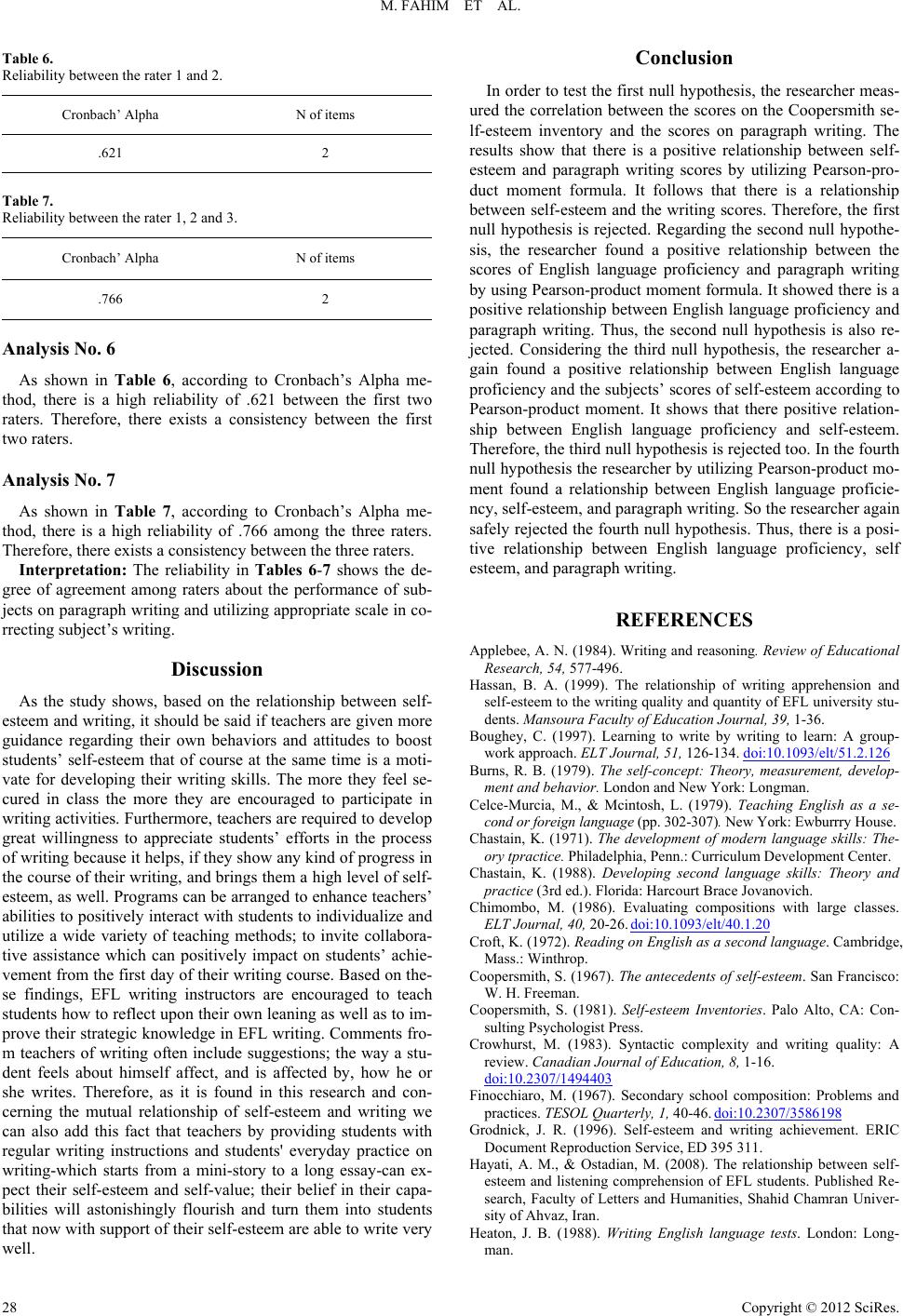 M. FAHIM ET AL. Table 6. Reliability between the rater 1 and 2. N of items Cronbach’ Alpha 2 .621 Table 7. Reliability between the rater 1, 2 and 3. N of items Cronbach’ Alpha 2 .766 Analysis N o. 6 As shown in Table 6, according to Cronbach’s Alpha me- thod, there is a high reliability of .621 between the first two raters. Therefore, there exists a consistency between the first two raters. Analysis N o. 7 As shown in Table 7, according to Cronbach’s Alpha me- thod, there is a high reliability of .766 among the three raters. Therefore, there exists a consistency between the three raters. Interpretation: The reliability in Tables 6-7 shows the de- gree of agreement among raters about the performance of sub- jects on paragraph writing and utilizing appropriate scale in co- rrecting subject’s writing. Discussion As the study shows, based on the relationship between self- esteem and writing, it should be said if teachers are given more guidance regarding their own behaviors and attitudes to boost students’ self-esteem that of course at the same time is a moti- vate for developing their writing skills. The more they feel se- cured in class the more they are encouraged to participate in writing activities. Furthermore, teachers are required to develop great willingness to appreciate students’ efforts in the process of writing because it helps, if they show any kind of progress in the course of their writing, and brings them a high level of self- esteem, as well. Programs can be arranged to enhance teachers’ abilities to positively interact with students to individualize and utilize a wide variety of teaching methods; to invite collabora- tive assistance which can positively impact on students’ achie- vement from the first day of their writing course. Based on the- se findings, EFL writing instructors are encouraged to teach students how to reflect upon their own leaning as well as to im- prove their strategic knowledge in EFL writing. Comments fro- m teachers of writing often include suggestions; the way a stu- dent feels about himself affect, and is affected by, how he or she writes. Therefore, as it is found in this research and con- cerning the mutual relationship of self-esteem and writing we can also add this fact that teachers by providing students with regular writing instructions and students' everyday practice on writing-which starts from a mini-story to a long essay-can ex- pect their self-esteem and self-value; their belief in their capa- bilities will astonishingly flourish and turn them into students that now with support of their self-esteem are able to write very well. Conclusion In order to test the first null hypothesis, the researcher meas- ured the correlation between the scores on the Coopersmith se- lf-esteem inventory and the scores on paragraph writing. The results show that there is a positive relationship between self- esteem and paragraph writing scores by utilizing Pearson-pro- duct moment formula. It follows that there is a relationship between self-esteem and the writing scores. Therefore, the first null hypothesis is rejected. Regarding the second null hypothe- sis, the researcher found a positive relationship between the scores of English language proficiency and paragraph writing by using Pearson-product moment formula. It showed there is a positive relationship between English language proficiency and paragraph writing. Thus, the second null hypothesis is also re- jected. Considering the third null hypothesis, the researcher a- gain found a positive relationship between English language proficiency and the subjects’ scores of self-esteem according to Pearson-product moment. It shows that there positive relation- ship between English language proficiency and self-esteem. Therefore, the third null hypothesis is rejected too. In the fourth null hypothesis the researcher by utilizing Pearson-product mo- ment found a relationship between English language proficie- ncy, self-esteem, and paragraph writing. So the researcher again safely rejected the fourth null hypothesis. Thus, there is a posi- tive relationship between English language proficiency, self esteem, and paragraph writing. REFERENCES Applebee, A. N. (1984). Writing and reasoning. Review of Educational Research, 54, 577-496. Hassan, B. A. (1999). The relationship of writing apprehension and self-esteem to the writing quality and quantity of EFL university stu- dents. Mansoura Faculty of Education Journal, 39, 1-36. Boughey, C. (1997). Learning to write by writing to learn: A group- work approach. ELT Journal, 51, 126-134. doi:10.1093/elt/51.2.126 Burns, R. B. (1979). The self-concept: Theory, measurement, develop- ment and behavior. London and New York: Longman. Celce-Murcia, M., & Mcintosh, L. (1979). Teaching English as a se- cond or foreign language (pp. 302-307). New York: Ewburrry House. Chastain, K. (1971). The development of modern language skills: The- ory tpractice. Philadelphia, Penn.: Curriculum Development Center. Chastain, K. (1988). Developing second language skills: Theory and practice (3rd ed.). Florida: Harcourt Brace Jovanovich. Chimombo, M. (1986). Evaluating compositions with large classes. ELT Journal, 40, 20-26. doi:10.1093/elt/40.1.20 Croft, K. (1972). Reading on English as a second language. Cambridge, Mass.: Winthrop. Coopersmith, S. (1967). The antecedents of self-esteem. San Francisco: W. H. Freeman. Coopersmith, S. (1981). Self-esteem Inventories. Palo Alto, CA: Con- sulting Psychologist Press. Crowhurst, M. (1983). Syntactic complexity and writing quality: A review. Canadian Journal of Education, 8, 1-16. doi:10.2307/1494403 Finocchiaro, M. (1967). Secondary school composition: Problems and practices. TESOL Quarterly, 1, 40-46. doi:10.2307/3586198 Grodnick, J. R. (1996). Self-esteem and writing achievement. ERIC Document Reproduction Service, ED 395 311. Hayati, A. M., & Ostadian, M. (2008). The relationship between self- esteem and listening comprehension of EFL students. Published Re- search, Faculty of Letters and Humanities, Shahid Chamran Univer- sity of Ahvaz, Iran. Heaton, J. B. (1988). Writing English language tests. London: Long- man. Copyright © 2012 SciRes. 28  M. FAHIM ET AL. Copyright © 2012 SciRes. 29 Howgate, L. (1982). Building self-esteem through the writing process. Writing teachers at work. Berkeley, CA: National Writing Project Publications Department. James, W. (1890). The principles of psychology. Cambridge, MA: Har- vard University Press. Kobal, D., & Musek, J. (2002). Self-concept and academic achievement: Slovina and France. Retrieved January 21, 2003 from http://www.elsvier.com/locat/paid Memering, D., & O’Hare, F. (1984). The writer’s work: Guide to effec- tive composition. New Jersey: Prentice Hall. Raimes, A. (1983a). Anguish as a Second Language? Remedies for Composition Teachers In En J. Pringle, I. Yalden, & Y. A. Freedman (Eds.), Learning to write: First language, second language (pp. 252-272), New York: Longman. Raimes, A. (1983b). Techniques in teaching writing. Teaching English as a second language. New York: Oxford University Press. Raimes, A. (1985). What unskilled writers do as they write: a class- room study of composing’. TESOL Quarterly, 19, 229a-258a. doi:10.2307/3586828 Silva, T. (1993). Toward an understanding of the distant nature of L2 writing: The ESL research and its implications. TESOL Quarterly, 27, 657-677. doi:10.2307/3587400 Slager, W. (1972). Classroom techniques for controlling composition. In Croft (Ed.). Reading on English as a second language (pp. 232- 234). Mass.: Winthrop Publishers. Winter, D. G. (1996). Personality analysis and interpretation of lives. Plenum: University of Michigan. |