

Paper Menu >>
Journal Menu >>
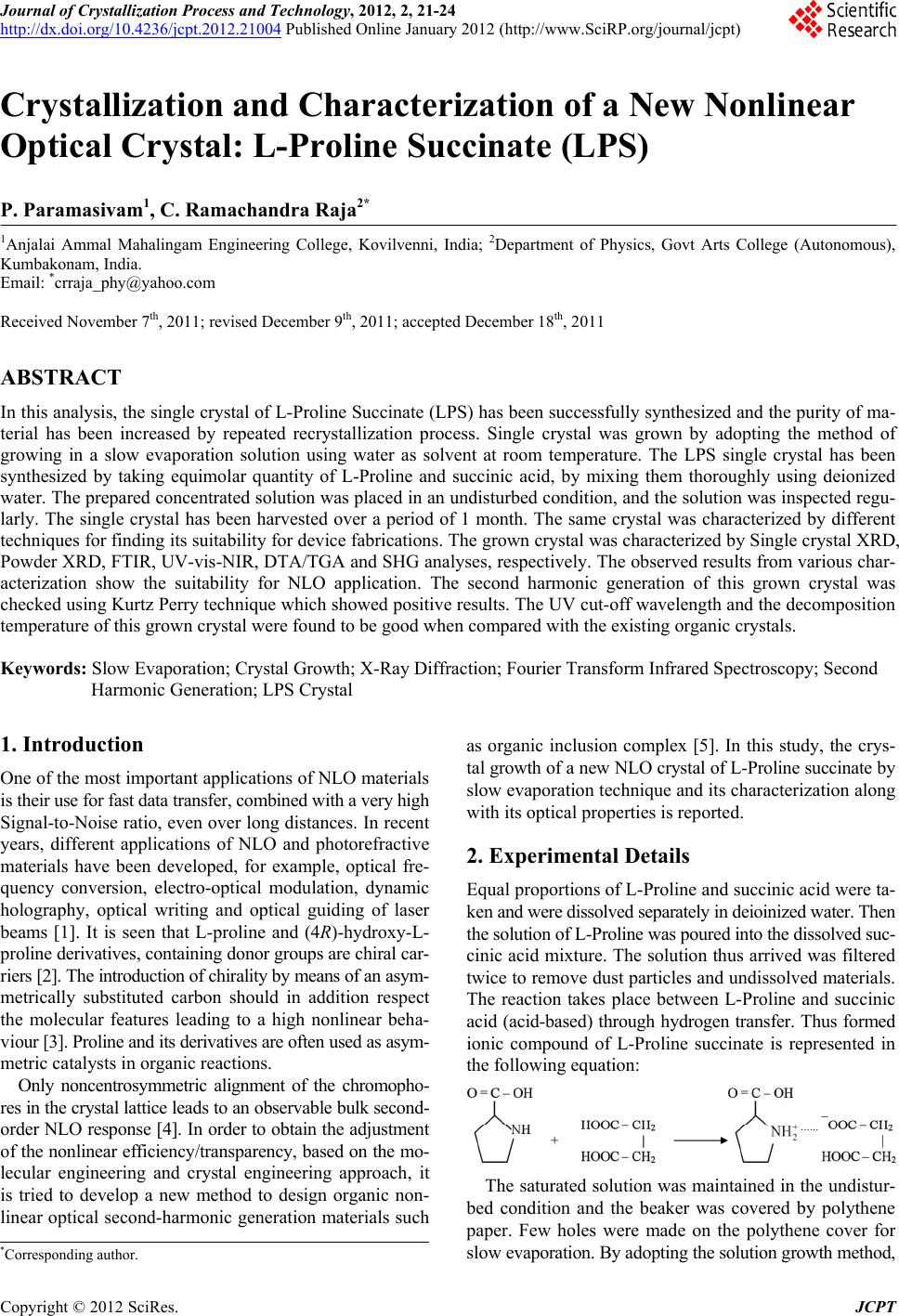 Journal of Crystallization Process and Technology, 2012, 2, 21-24 http://dx.doi.org/10.4236/jcpt.2012.21004 Published Online January 2012 (http://www.SciRP.org/journal/jcpt) 21 Crystallization and Characterization of a New Nonlinear Optical Crystal: L-Proline Succinate (LPS) P. Paramasivam1, C. Ramachandra Raja2* 1Anjalai Ammal Mahalingam Engineering College, Kovilvenni, India; 2Department of Physics, Govt Arts College (Autonomous), Kumbakonam, India. Email: *[email protected] Received November 7th, 2011; revised December 9th, 2011; accepted December 18th, 2011 ABSTRACT In this analysis, the single crystal of L-Proline Succinate (LPS) has been successfully synthesized and the purity of ma- terial has been increased by repeated recrystallization process. Single crystal was grown by adopting the method of growing in a slow evaporation solution using water as solvent at room temperature. The LPS single crystal has been synthesized by taking equimolar quantity of L-Proline and succinic acid, by mixing them thoroughly using deionized water. The prepared concentrated solution was placed in an undisturbed condition, and the solution was inspected regu- larly. The single crystal has been harvested over a period of 1 month. The same crystal was characterized by different techniques for finding its su itability fo r device fabrication s. Th e grown crystal was characterized by Single crystal XRD, Powder XRD, FTIR, UV-vis-NIR, DTA/TGA and SHG analyses, respectively. The observed results from various char- acterization show the suitability for NLO application. The second harmonic generation of this grown crystal was checked using Kurtz Perry technique which showed po sitive results. The UV cut-o ff wavelength and the decompositio n temperature of this grown crystal were found to be good when compared with the existing organ ic crystals. Keywords: Slow Evaporation; Crystal Growth; X-Ray Diffraction; Fourier Transform Infrared Spectroscopy; Second Harmonic Generat i on; LPS C rys t al 1. Introduction One of the most important applications of NLO materials is their use for fast data transfer, combined with a very high Signal-to-Noise ratio, even over long distances. In recent years, different applications of NLO and photorefractive materials have been developed, for example, optical fre- quency conversion, electro-optical modulation, dynamic holography, optical writing and optical guiding of laser beams [1]. It is seen that L-proline and (4R)-hydroxy-L- proline derivatives, containing donor groups are chiral car- ri ers [2]. The introduction of chirality by means of an asym- metrically substituted carbon should in addition respect the molecular features leading to a high nonlinear beha- v iour [3]. Proline and its derivatives are often used as asym- metric catalysts in organic reactions. Only noncentrosymmetric alignment of the chromopho- res in the crystal lattice leads to an observable bulk second- order NLO response [4]. In order to obtain the adjustment of the nonlinear efficiency/transparency, based on the mo- lecular engineering and crystal engineering approach, it is tried to develop a new method to design organic non- linear optical second-harmonic generation materials such as organic inclusion complex [5]. In this study, the crys- tal growth of a new NLO crystal of L-Proline succinate by slow evaporation technique and its characterization along with its optical properties is reported. 2. Experimental Details Equal proportions of L-Proline and succinic acid were ta- ken and were dissolved separately in deioinized water. Then the solution of L-Proline was poured into the dissolved suc- cinic acid mixture. The so lution thus arrived was filtered twice to remove dust particles and undissolved materials. The reaction takes place between L-Proline and succinic acid (acid-based) through hydrogen transfer. Thus formed ionic compound of L-Proline succinate is represented in the following equ ation: The saturated solution was maintained in the undistur- bed condition and the beaker was covered by polythene paper. Few holes were made on the polythene cover for slow evaporation. By adopting the solution growth method, *Corresponding a uthor. Copyright © 2012 SciRes. JCPT 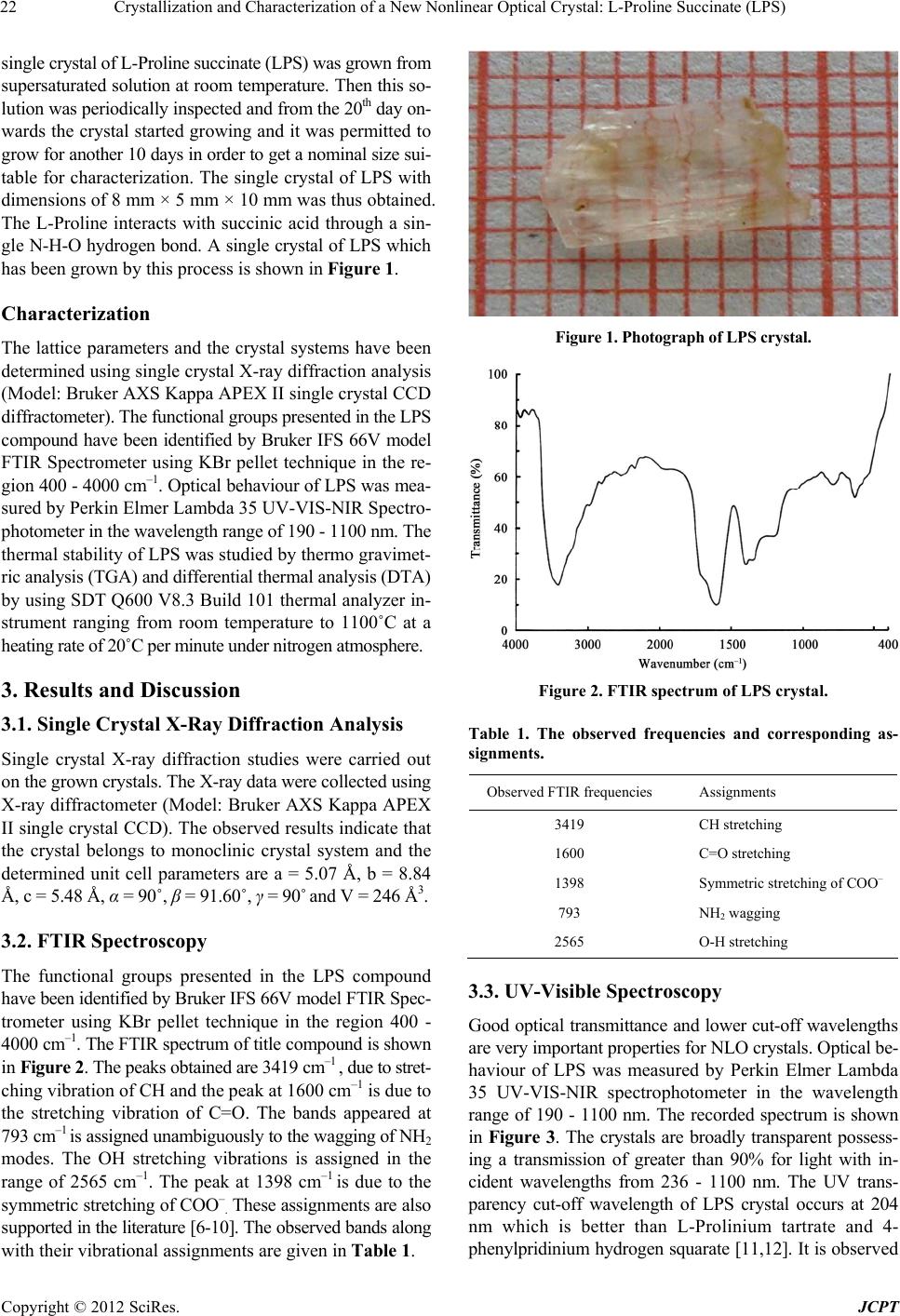 Crystallization and Characterization of a New Nonlinear Optical Crystal: L-Proline Succinate (LPS) 22 single crystal of L-Proline succinate (LPS) was grown from supersaturated solution at room temperature. Then this so- lution was periodically inspected and from the 20th day on- wards the crystal started growing and it was permitted to grow for another 10 days in order to get a nominal size sui- table for ch aracterization. The single crystal of LPS with dimensions of 8 mm × 5 mm × 10 mm was thus obtained. The L-Proline interacts with succinic acid through a sin- gle N-H-O hydrogen bond. A single crystal of LPS which has been grown by this process is show n in Figure 1. Characterization The lattice parameters and the crystal systems have been determined using single crystal X-ray diffraction analysis (Model: Bruker AXS Kapp a APEX II single cr ystal CCD diffractometer). The functional groups presented in the LPS compound have been identified by Bruker IFS 66V model FTIR Spectrometer using KBr pellet technique in the re- gion 400 - 4000 cm–1. Optical behaviour of LPS was mea- sured by Perkin Elmer Lambda 35 UV-VIS-NIR Spectro- photometer in the wavelength range of 190 - 1100 nm. The thermal stability of LPS was studied by thermo gravimet- ric analysis (TGA) and differential thermal analysis (DTA) by using SDT Q600 V8.3 Build 101 thermal analyzer in- strument ranging from room temperature to 1100˚C at a heatin g rate of 20˚C per minute under nitrogen atmosphere. 3. Results and Discussion 3.1. Single Crystal X-Ray Diffraction Analysis Single crystal X-ray diffraction studies were carried out on the grown crystals. The X-ray data were collected using X-ray diffractometer (Model: Bruker AXS Kappa APEX II single crystal CCD). The observed results indicate that the crystal belongs to monoclinic crystal system and the determined unit cell parameters are a = 5.07 Å, b = 8.84 Å, c = 5.48 Å, α = 90˚, β = 91.60˚, γ = 90˚ and V = 246 Å3. 3.2. FTIR Spectroscopy The functional groups presented in the LPS compound have been identified by Bruker IFS 66V model FTIR Spec- trometer using KBr pellet technique in the region 400 - 40 00 cm–1. The FTIR spectrum of title compound is shown in Figur e 2 . The peaks obtained are 3419 cm–1 , due to stret- ching vibration of CH and the peak at 1600 cm–1 is due to the stretching vibration of C=O. The bands appeared at 793 cm–1 is assigned unambiguously to the wagging of NH2 modes. The OH stretching vibrations is assigned in the range of 2565 cm–1. The peak at 1398 cm–1 is due to the symmetric stretching of COO–. These assignments are also supported in the literature [6 -10]. The ob serv ed b ands along with their vibrational assignments are given in Table 1. Figure 1. Photograph of LPS crystal. Figure 2. FTIR spectrum of LPS crystal. Table 1. The observed frequencies and corresponding as- signments. Observed FTIR frequencies Assignments 3419 CH stretching 1600 C=O stretching 1398 Symmetric stretching of COO– 793 NH2 wagging 2565 O-H stretching 3.3. UV-Visible Spectroscopy Good o ptical transmittance and lower cu t-off wavelengths are very important properties for NLO cryst a ls. Opt i c al be- haviour of LPS was measured by Perkin Elmer Lambda 35 UV-VIS-NIR spectrophotometer in the wavelength range of 190 - 1100 nm. The recorded spectrum is shown in Figure 3. The crystals are broadly transparent possess- ing a transmission of greater than 90% for light with in- cident wavelengths from 236 - 1100 nm. The UV trans- parency cut-off wavelength of LPS crystal occurs at 204 nm which is better than L-Prolinium tartrate and 4- phenylpridinium hydrogen squarate [11,12]. It is observ ed Copyright © 2012 SciRes. JCPT 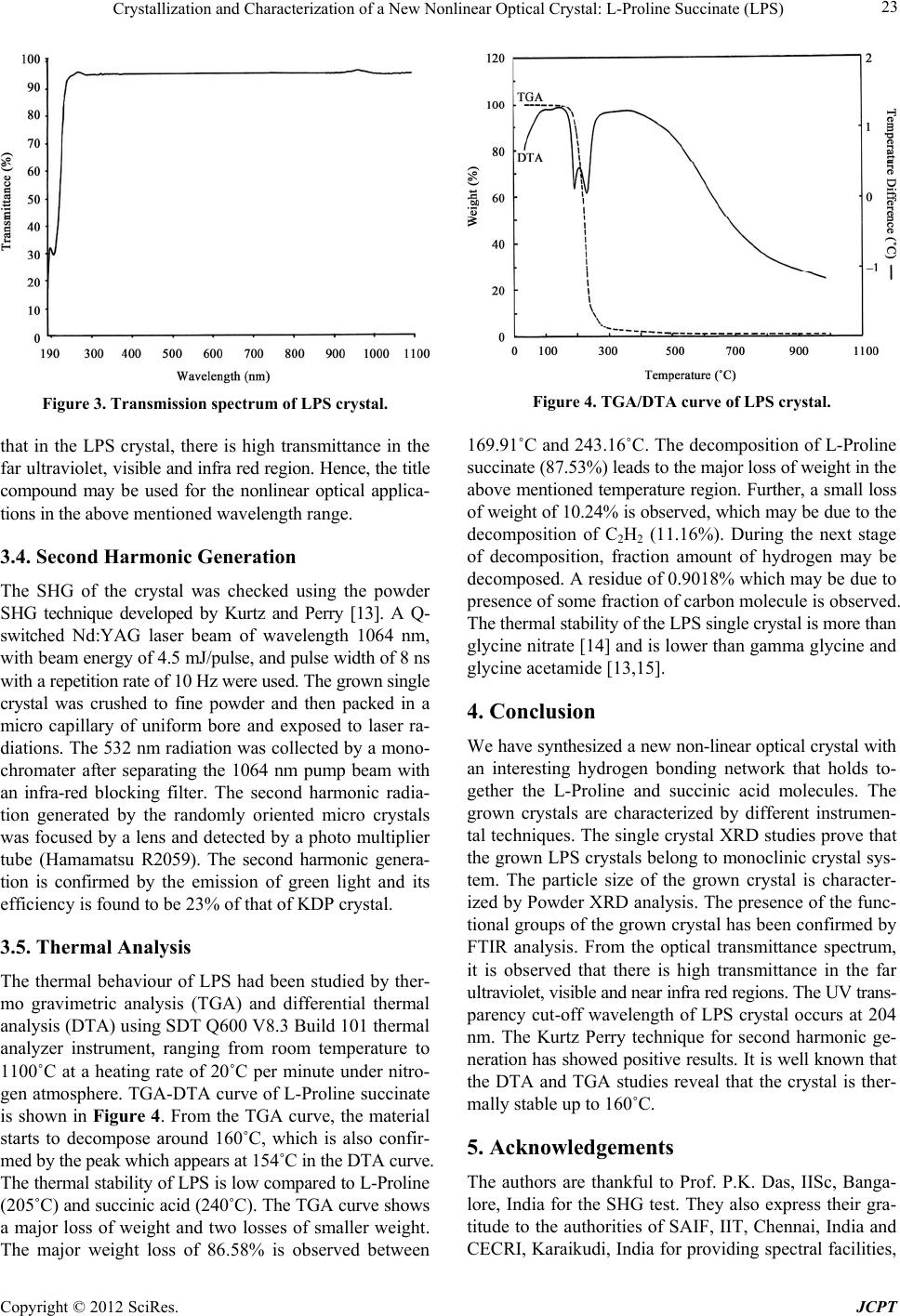 Crystallization and Characterization of a New Nonlinear Optical Crystal: L-Proline Succinate (LPS) 23 Figure 3. Transmission spectrum of LPS crystal. that in the LPS crystal, there is high transmittance in the fa r u lt r av io l et , v isible and infra red reg ion. Hence, the title compound may be used for the nonlinear optical applica- tions in the above mentioned wavelength range. 3.4. Second Harmonic Generation The SHG of the crystal was checked using the powder SHG technique developed by Kurtz and Perry [13]. A Q- switched Nd:YAG laser beam of wavelength 1064 nm, wit h b e am energy of 4.5 mJ/pulse, and pulse width of 8 ns with a repetition rate of 10 Hz were used. The grown single crystal was crushed to fine powder and then packed in a micro capillary of uniform bore and exposed to laser ra- diations. The 532 nm radiation was collected by a mono- chromater after separating the 1064 nm pump beam with an infra-red blocking filter. The second harmonic radia- tion generated by the randomly oriented micro crystals was focused by a lens and detected by a photo multiplier tube (Hamamatsu R2059). The second harmonic genera- tion is confirmed by the emission of green light and its efficiency is found t o be 23% of that of KDP crystal. 3.5. Thermal Analysis The thermal behaviour of LPS had been studied by ther- mo gravimetric analysis (TGA) and differential thermal analysis (DTA) using SDT Q6 00 V8.3 Build 101 ther mal analyzer instrument, ranging from room temperature to 1100˚C at a heating rate of 20˚C per minute under nitro- gen atmosphere. TGA-DTA curve of L-Proline succinate is shown in Figure 4. From the TGA curve, the material starts to decompose around 160˚C, which is also confir- med by the peak which appears at 154˚C in the DTA curve. The ther mal stabil ity of LPS i s low compar ed to L-Pro line (205˚C) and succinic acid (240˚C). The TGA curve shows a major loss of weight and two losses of smaller weight. The major weight loss of 86.58% is observed between Figure 4. TGA/DTA curve of LPS crystal. 169.91˚C and 243.16˚C. The decomposition of L-Proline su ccinate (87.53%) leads to th e major loss of weig ht in the above mentioned temperature region. Further, a small loss of weight of 10.24% is observed, which may be due to the decomposition of C2H2 (11.16%). During the next stage of decomposition, fraction amount of hydrogen may be decomposed. A residue of 0.9018% which may be due to presence of some fraction of carbon molecule is observed. The thermal stability of the LPS single crystal is more than glycine nitrate [14] and is lower than gamma glycine and glycine acetamide [13,15]. 4. Conclusion We have synthesized a new non-linear optical crystal with an interesting hydrogen bonding network that holds to- gether the L-Proline and succinic acid molecules. The grown crystals are characterized by different instrumen- tal techniques. The single crystal XRD studies prove that the grown LPS crystals belong to monoclinic crystal sys- tem. The particle size of the grown crystal is character- ized by Powder XRD ana lysis. The pr esence of th e func- tional groups of the grown crystal has been confirmed by FTIR analysis. From the optical transmittance spectrum, it is observed that there is high transmittance in the far u ltraviolet, vis ible and near infra red regions. The UV trans- parency cut-off wavelength of LPS crystal occurs at 204 nm. The Kurtz Perry technique for second harmonic ge- neration has showed positive r esults. It is well known that the DTA and TGA studies reveal that the crystal is ther- mally stable up to 160˚C. 5. Acknowledgements The authors are thankful to Prof. P.K. Das, IISc, Banga- lore, India for the SHG test. They also express their gra- titude to the authorities of SAIF, IIT, Chennai, India and CECRI, Karaikudi, India for providing spectral facilities, Copyright © 2012 SciRes. JCPT  Crystallization and Characterization of a New Nonlinear Optical Crystal: L-Proline Succinate (LPS) Copyright © 2012 SciRes. JCPT 24 to undertake this study. REFERENCES [1] T. M. Kolev, D. Y. Yancheva and S. I. Stoyanov, “Syn- thesis and Spectral Elucidation of Some Pyridinium Be- taines of Squaric Acid: Potential Materials for Nonlinear Optical Applications,” Advanced Functional Materials, Vol. 14, No. 8, 2004, pp. 799-805. [2] B. Gutierrez, N. Rubio and C. Minguillon, “Evaluation of L-Proline Derivatives as Chiral Carriers in the Separation of Enantiomers by Membrane Techniques,” Journal of Desalination, Vol. 200, No. 1-3, 2006, pp. 117-119. [3] R. Hierle, J. Badan and J. Zyss, “Growth and Characteri- zation of a New Material for Nonlinear Optics: Methy l-3-Nitro-4-Pyridine-1-Oxide (POM),” Journal of Crystal growth, Vol. 69, No. 2-3, 1984, pp. 545-554. doi:10.1016/0022-0248(84)90366-X [4] T. kolev, B. Stamboliyska and D. Yancheva, “Spectral and Structural Study of Two Acceptor-Substituted Pyri- dinium-Betaines of Squaric Acid: Promising Chromo- phores for Nonlinear Optical App lications,” Chemical Phy- sics, Vol. 324, No. 2-3, 2006, pp. 489-496. doi:10.1016/j.chemphys.2005.11.014 [5] F. Q. Meng, M. K. Lu, J. Chen, S. J. Zhang and H. Zeng, “Characterization of Linear and Nonlinear Optical Prop- erties of a New Single Crystal,” Solid State Communica- tions, Vol. 101, No. 12, 1997, pp. 925-928. doi:10.1016/S0038-1098(96)00702-8 [6] K. V. Krishna and M. Arivazhagan, “Vibrational and Nor- mal Coordinate Analysis of Xanthine and Hypoxanthine,” Indian Journal of Pure & Applied Physics, Vol. 42, No. 12, 2004, pp. 411-418. [7] G. Socrates, “Infrared and Raman Characteristic Group Frequencies,” 3rd Edition, Wiley, Chichester, 2001. [8] G. Varaasyi, “Assignments for Vibrational Spectra of Seven Hundred Benzene Derivatives,” Wiley, New York, 1974. [9] S. Gunasekaran and D. Uthra, “Fourier Transform Infra- red and Fourier Transform Raman Spectra and Normal Coordinate Analysis of Ethyleneimine,” Indian Journal of Pure & Applied Physics, Vol. 46, No. 2, 2008, pp. 100- 105. [10] S. Krishnan, C. J. Raj, R. Robert, A. Ramanand and S. J. Das, “Growth and Charac terization of Succinic Acid Sin- gle Crystals,” Crystal Research Technology, Vol. 42, No. 11, 2007, pp. 1087-1090. doi:10.1002/crat.200710981 [11] S. A. M. Britto Dhas and S. Natarajan, “Growth and Cha- racterization of L-Prolinium Tartrate—A New Organic NLO Material,” Crystal Research Technology, Vol. 42, No. 5, 2007, pp. 471-476. doi:10.1002/crat.200610850 [12] C. R. Raja, P. Paramasivam and N. Vijayan, “Synthesis, Growth and Characterization of a New Nonlinear Optical Material: 4-Phenylpyridinium Hydrogen Squarate (4PHS),” Spectrochimica Acta Part A, Vol. 69, No. 4, 2008, pp. 1146-1149. doi:10.1016/j.saa.2007.06.014 [13] V. Krishnakumar, L. G. Prasad, R. Nagalakshmi and P. Muthusamy, “Ph ysicochemical Properties of Organic Non - linear Optical Crystal for Frequency Doubling: Glycine Acetamide,” Materials Letters, Vol. 63, No. 15, 2009, pp. 1255-1257. doi:10.1016/j.matlet.2009.02.052 [14] S. A. M. Britto Dhas and S. Natarajan, “Growth and Characterization of a New Organic NLO Material: Gly- cine Nitrate,” Optics Communications, Vol. 278, No. 2, 2007, pp. 434-438. doi:10.1016/j.optcom.2007.06.052 [15] T. Balakrishnan, R. R. Babu and K. Ramamurthi, “Grow- th, Structural, Optical and Thermal Properties of γ-Gly- cine Crystal,” Spectrochimica Acta Part A, Vol. 69, No. 4, 2008, pp. 1114-1118. doi:10.1016/j.saa.2007.06.025 |