Intelligent Supply Chain Management407
component inventory to meet this need. If not, it submits
an RFQ for a fixed amount to the relevant supplier, re-
questing delivery on the date at which the predicted in-
ventory falls below the daily minimum need.
3.3.2 Near Future Procurement
The near future procurement strategy is more complex. It
consists of two elements, a daily demand predictor that
predicts the future demand of components, and a market
tracker that generates the RFQs to be sent to the suppliers,
both to order actual components required and to test the
market to discern the most profitable order lead time and
set appropriate reserve price
3.4 Demand Predictor
As described above, the agent buys components for the
near future based on a prediction of customer demand.
Now, according to the game specification, the number of
RFQs that each agent receives from the customers is de-
scribed by three independent random walks; one for each
market segment (finished products are classified into
three such segments: high, mid and low range). In more
detail, the number of RFQs that an agent receives, within
a single market segment, on day d is denoted by Nd, and
is drawn from a Poisson distribution whose expected
value is given by the parameter, Qd. Thus, for each mar-
ket segment, Nd = Poisson(Qd)
Having predicted the number of RFQs that will be re-
ceived, within each market segment, on each day within
the near future, the agent then calculates the expected
daily usage of each component type (Did).
3.5 Price Tracker
The price tracker acts to maintain an estimate of the cur-
rent market price of the components. Due to the behav-
iors of the competing agents, this market price depends
on the due date with which components are requested.
For example, if the competing agents are ordering com-
ponents with very short lead times, then the supplier will
have little spare capacity, and thus, the corresponding
offer prices that the agent receives will be greater than
those of orders wit h l ong l ead t im e s.
3.6 Factory Agent
One of the main challenges for the factory agent is
scheduling what to produce and when to produce it (i.e.,
how to allocate supply resources and factory time).
This strategy involves manufacturing commodities
according to customer orders and satisfying orders with
an earlier delivery date. Now, since the computers stored
in the factory will be charged storage cost, each order
will be delivered as soon as it is filled. The agent builds
the commodity according to the customers’ orders it has
obtained (which has the advantage of ensuring that the
factory always produces the needed computers on time).
However, if on any day, there are still free factory as-
sembling cycles available, and the numbers of finished
PCs in stock are below a certain thresho ld, then the agen t
produces additional PCs of each kind uniformly (subject
to the availability of components) in order to maximize
the factory utilization. It is critical that this threshold is
set appropriately; a high threshold will lead to excessive
finished PC inventory, which may be hard to sell if de-
mand is low.
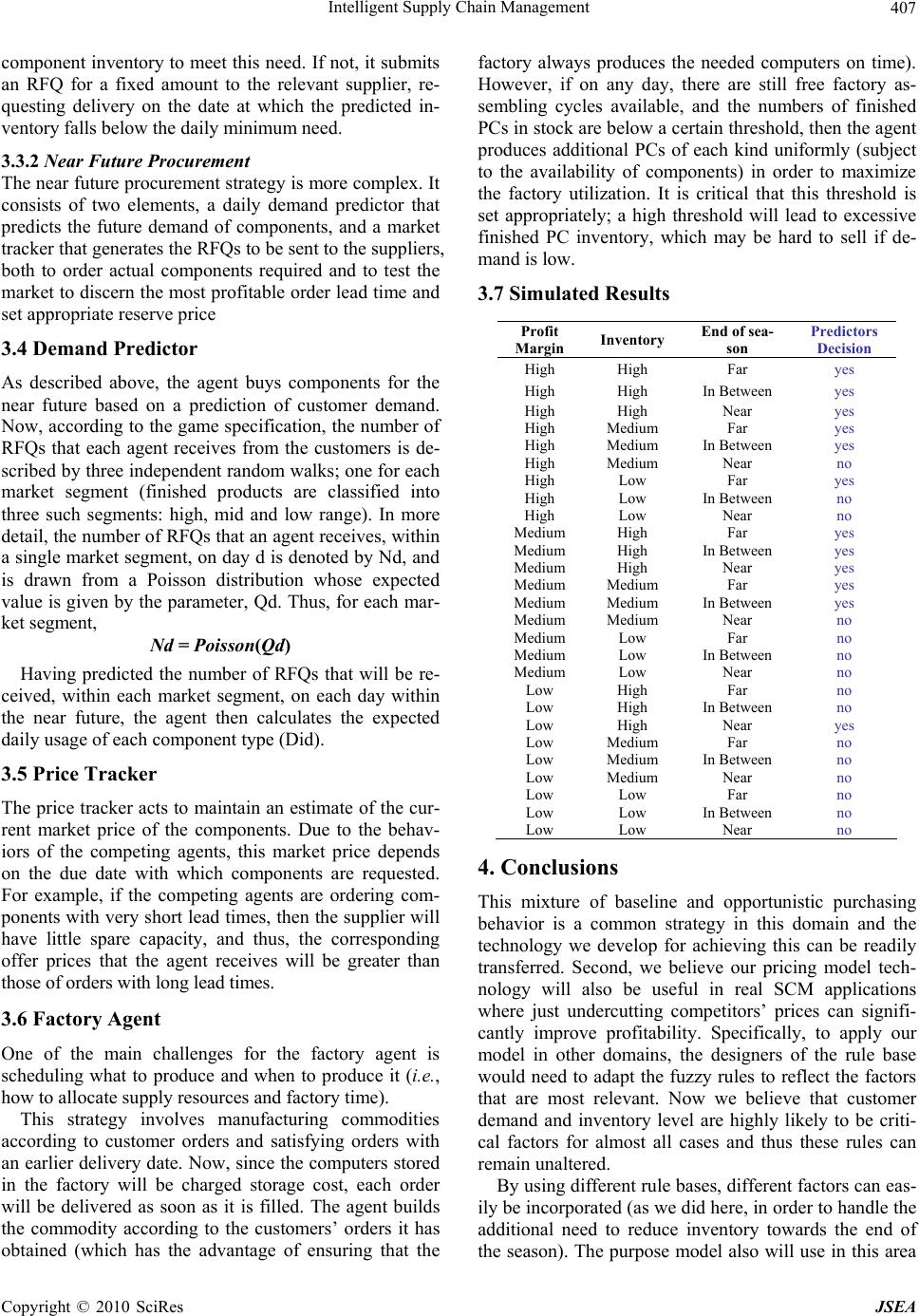
3.7 Simulated Results
Profit
Margin Inventory End of sea-
son Predictors
Decision
High High Far yes
High High In Between yes
High High Near yes
High Medium Far yes
High Medium In Between yes
High Medium Near no
High Low Far yes
High Low In Between no
High Low Near no
Medium High Far yes
Medium High In Between yes
Medium High Near yes
Medium Medium Far yes
Medium Medium In Between yes
Medium Medium Near no
Medium Low Far no
Medium Low In Between no
Medium Low Near no
Low High Far no
Low High In Between no
Low High Near yes
Low Medium Far no
Low Medium In Between no
Low Medium Near no
Low Low Far no
Low Low In Between no
Low Low Near no
4. Conclusions
This mixture of baseline and opportunistic purchasing
behavior is a common strategy in this domain and the
technology we develop for achieving this can be readily
transferred. Second, we believe our pricing model tech-
nology will also be useful in real SCM applications
where just undercutting competitors’ prices can signifi-
cantly improve profitability. Specifically, to apply our
model in other domains, the designers of the rule base
would need to adapt the fuzzy rules to reflect the factors
that are most relevant. Now we believe that customer
demand and inventory level are highly likely to be criti-
cal factors for almost all cases and thus these rules can
remain unaltered.
By using different rule bases, different factors can eas-
ily be incorporated (as we did here, in order to handle the
additional need to reduce inventory towards the end of
the season). The purpose model also will use in this area
Copyright © 2010 SciRes JSEA