

Paper Menu >>
Journal Menu >>
 Advances in Pure Mathematics, 2012, 2, 59-61 http://dx.doi.org/10.4236/apm.2012.21012 Published Online January 2012 (http://www.SciRP.org/journal/apm) On BCL+-Algebras Yonghong Liu School of Automation, Wuhan University of Technology, Wuhan, China Email: [email protected] Received October 11, 2011; revised November 24, 2011; accepted December 5, 2011 ABSTRACT This paper presents the BCL+-algebras, which is derived the fundamental properties. Results are generalized with ver- sion of BCL-algebras [5], using some unusual for a binary relation * and a constant 1 (one) in a non-empty set X, one may take different axiom systems for BCL+-algebras. Keywords: BCL-Algebra; BCL+-Algebra; Logic Algebra 1. Introduction The BCK/BCI/BCH-algebra (see [1-4]) has been a major issue, but BCL-algebra (see [5]) is a new algebra struc- ture—and we started to grasp the properties. This paper presents the BCL+-algebras, we show that under our formulation, the BCL+-algebra is a variant of a BCL- algebra. We can define by taking some axioms and im- portant properties in this way for the BCL+-algebras. A BCL-algebra may be defined as a non-empty set X with a binary relation * and a constant 0 (zero) satisfying the following axioms: Definition 1.1. [5] An algebra of type is said to be a BCL-algebra if and only if for any ;,0X 2, 0 ,, x yzX 0xy 0yx , the following conditions: 1) BCL-1: ; 0xx 2) BCL-2: and imply x y ; 3) BCL-3: 0xy zxzyzy x 0 . Such set X in Definition 1.1 is called the underlying set of a BCL-algebra , which needs the following theorem: ;,X Theorem 1.1. [5] Algebra ;,0X of type 2, 0 is a BCL-algebra if and only if it satisfies the following conditions: for all ,, x yz 0xx X 0yx , 1) BCL-1: ; 2) BCL-2: and 0xy imply x y ; 3) x yz xz y zyx X ;,1X ,, . 2. Main Result The BCL+ product, denoted by *. We call the binary op- eration * on X the * product on X, and the constant 1(one) of X the unit element of X. For brevity we often write X instead of . We begin with the following defini- tion: ;,1 Definition 2.1. An algebra is called a BCL+- algebra if it satisfies the following laws hold: for any x yz X , 1) BCL+-1: 1xx 1xy ; 2) BCL+-2: 1yx and imply x y ; 3) BCL+-3: x yzxzy zyx 0,1, 2,3X . Such definition, clearly, the BCL+-algebra is a gener- alization of the BCL-algebra, imply a BCL-algebra is a BCL+-algebra, however, the converse is not true. We illustrate with the next theorem. Theorem 2.1. A BCL+-algebra is existent. Proof. The proof of this Theorem 2.1 is not difficult and uses only example. Let . Define an operation * on X, which are given in Table 1. ;,1XThen is a proper BCL+-algebra. It is easy to verify that there are BCI-1: 23 2113 11 3 13 30; BCI-2: 223 3 21 3 13 30; BCH-3: 1) The left side of the equation is 231111; C opyright © 2012 SciRes. APM 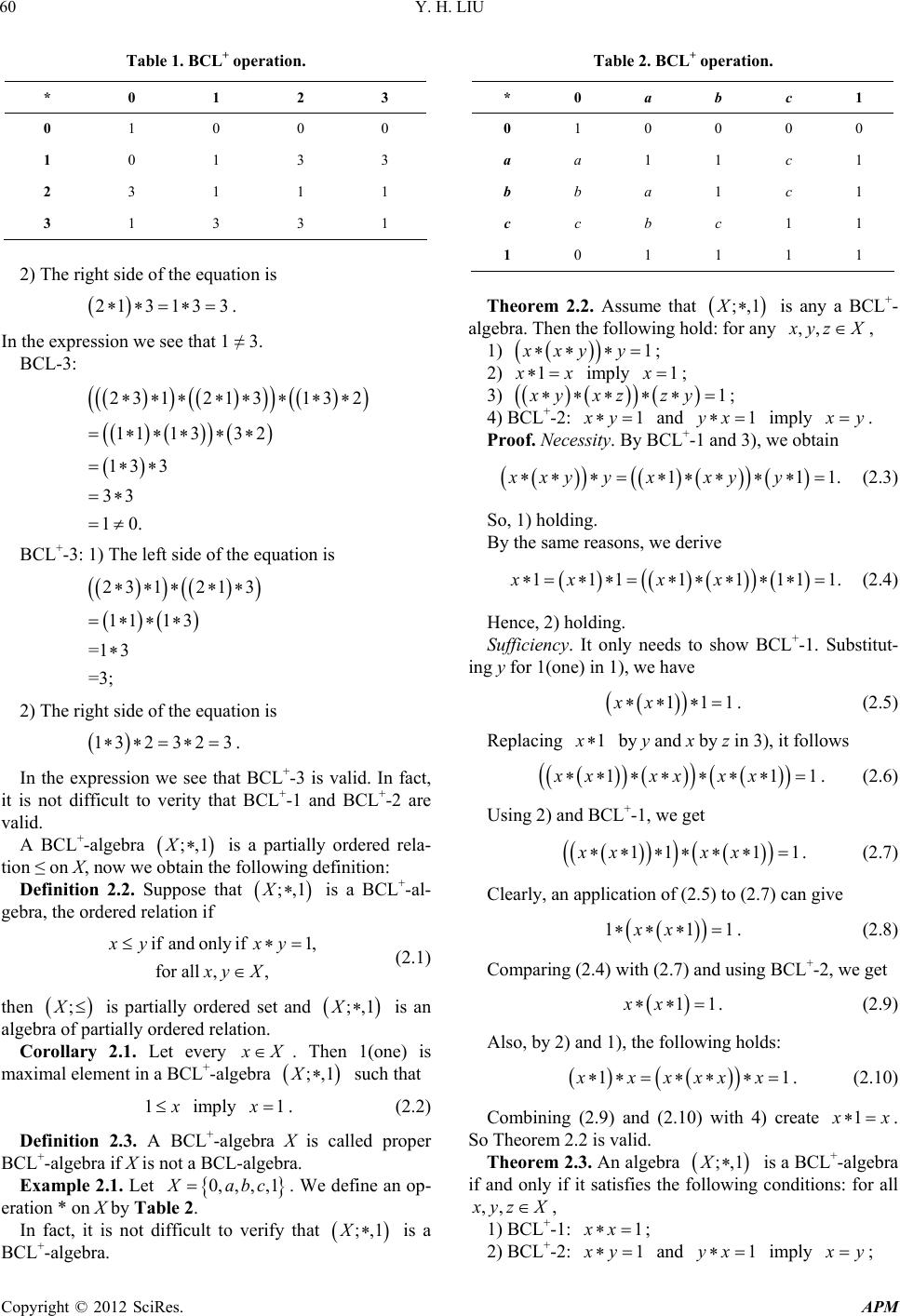 Y. H. LIU 60 Table 1. BCL+ operation. * 0 1 2 3 0 1 0 0 0 1 0 1 3 3 2 3 1 1 1 3 1 3 3 1 2) The right side of the equation is 213 133 13 2 21 3 13 2 32 3 ;,1X ;,1X y if 1, , xy xy X ;X ;,1X . In the expression we see that 1 ≠ 3. BCL-3: 23 121 3 11133 2 13 3 33 10. BCL+-3: 1) The left side of the equation is 23 1 11 =1 3 =3; 2) The right side of the equation is 13 . In the expression we see that BCL+-3 is valid. In fact, it is not difficult to verity that BCL+-1 and BCL+-2 are valid. A BCL+-algebra is a partially ordered rela- tion ≤ on X, now we obtain the following definition: Definition 2.2. Suppose that is a BCL+-al- gebra, the ordered relation if if and onl for all , xy (2.1) then is partially ordered set and is an algebra of partially ordered relation. Corollary 2.1. Let every x X ;,1X . Then 1(one) is maximal element in a BCL+-algebra such that 1 x imply . (2.2) 1x 0,,, ,1 Definition 2.3. A BCL+-algebra X is called proper BCL+-algebra if X is not a BCL-algebra. Example 2.1. Let X abc ;,1X . We define an op- eration * on X by Table 2. In fact, it is not difficult to verify that Table 2. BCL+ operation. * 0 a b c 1 0 1 0 0 0 0 a a 1 1 c 1 b b a 1 c 1 c c b c 1 1 1 0 1 1 1 1 Theorem 2.2. Assume that is any a BCL+- algebra. Then the following hold: for any ;,1X ,, x yz X , 1xxy y1) 1 ; x x1x imply 2) ; 1xy xzzy3) 1xy ; 4) BCL+-2: 1yx and imply x y . Proof. Necessity. By BCL+-1 and 3), we obtain 111.xxy yxxyy is a BCL+-algebra. (2.3) So, 1) holding. By the same reasons, we derive 111 11111.xx xx (2.4) Hence, 2) holding. Sufficiency. It only needs to show BCL+-1. Substitut- ing y for 1(one) in 1), we have 111xx 1 . (2.5) by y and x by z in 3), it follows x Replacing 111xxxxxx . (2.6) Using 2) and BCL+-1, we get 111 1xx xx . (2.7) Clearly, an application of (2.5) to (2.7) can give 111xx . (2.8) Comparing (2.4) with (2.7) and using BCL+-2, we get 11xx . (2.9) Also, by 2) and 1), the following holds: 11xxxxxx 1 . (2.10) x x Combining (2.9) and (2.10) with 4) create ;,1X ,, . So Theorem 2.2 is valid. Theorem 2.3. An algebra is a BCL+-algebra if and only if it satisfies the following conditions: for all x yz X , 1) BCL+-1: 1xx 1xy ; 2) BCL+-2: 1yx and imply x y ; Copyright © 2012 SciRes. APM 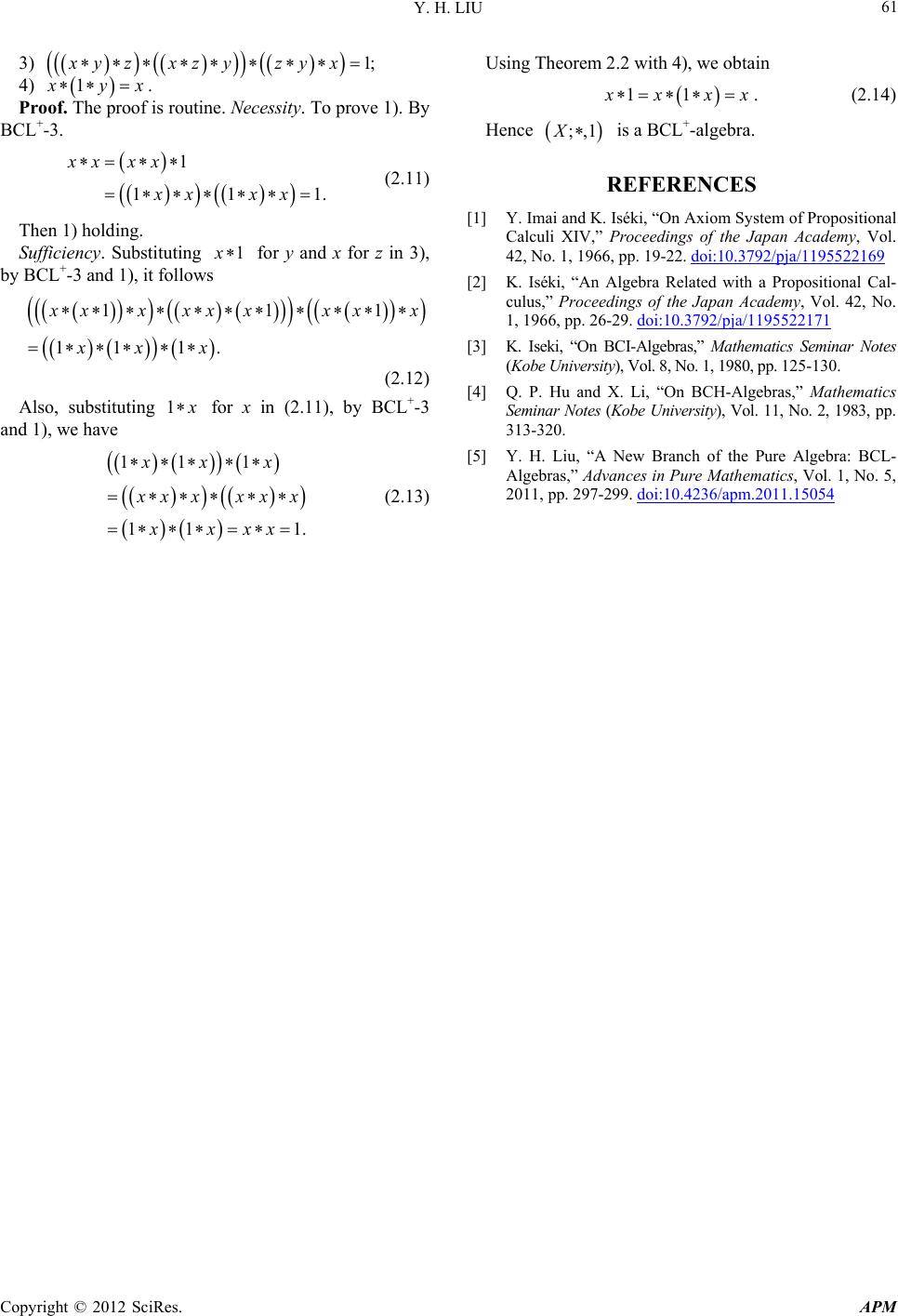 Y. H. LIU Copyright © 2012 SciRes. APM 61 1;zy x3) xy zxzy 1 Using Theorem 2.2 with 4), we obtain x yx . 4) 11 x xxx . (2.14) Proof. The proof is routine. Necessity. To prove 1). By BCL+-3. ;,1X is a BCL+-algebra. Hence 1 1 xx xx xx 1 1.xx 1 (2.11) REFERENCES [1] Y. Imai and K. Iséki, “On Axiom System of Propositional Calculi XIV,” Proceedings of the Japan Academy, Vol. 42, No. 1, 1966, pp. 19-22. doi:10.3792/pja/1195522169 Then 1) holding. Sufficiency. Substituting x for y and x for z in 3), by BCL+-3 and 1), it follows 11 11 1. 1 x xxxxx xx x xxx (2.12) [2] K. Iséki, “An Algebra Related with a Propositional Cal- culus,” Proceedings of the Japan Academy, Vol. 42, No. 1, 1966, pp. 26-29. doi:10.3792/pja/1195522171 [3] K. Iseki, “On BCI-Algebras,” Mathematics Seminar Notes (Kob e Uni versi ty), Vol. 8, No. 1, 1980, pp. 125-130. [4] Q. P. Hu and X. Li, “On BCH-Algebras,” Mathematics Seminar Notes (Kobe University), Vol. 11, No. 2, 1983, pp. 313-320. x Also, substituting 1 for x in (2.11), by BCL+-3 and 1), we have [5] Y. H. Liu, “A New Branch of the Pure Algebra: BCL- Algebras,” Advances in Pure Mathematics, Vol. 1, No. 5, 2011, pp. 297-299. doi:10.4236/apm.2011.15054 1 1. x 11 11 xx x xx xx xxx xx (2.13) |