

Paper Menu >>
Journal Menu >>
 Advances in Pure Mathematics, 2012, 2, 33-35 http://dx.doi.org/10.4236/apm.2012.21007 Published Online January 2012 (http://www.SciRP.org/journal/apm) A Simple Proof That the Curl Defined as Circulation Density Is a Vector-Valued Function, and an Alternative Approach to Proving Stoke’s Theorem David McKay California State University, Long Beach, USA Email: [email protected] Received September 24, 2011; revised November 16, 2011; accepted November 25, 2011 ABSTRACT This article offers a simple but rigorous proof that the curl defined as a limit of circulation density is a vector-valued function with the standard Cartesian expression. Keywords: Curl; Circulation Density 1. Introduction The standard mathematical presentation that the curl de- fined as a limit of circulation density is a vector-valued function with the standard Cartesian expression uses Stokes’ Theorem. Most physics books use the multidi- mensional version of Taylor’s Theorem to show this re- lationship works in the x, y plane by using linear ap- proximations of F, and simply assert that this special case extends to three dimensional space, [1, pp. 71-72]. This approach requires that F have continuity in the sec- ond partials, which is not necessary. Also, the assertion that the two dimensional case extends to three dimen- sions is not trivial. A more elementary proof is presented here, using only Green’s Theorem on a right triangle [2, p. 1102], and the Integral Mean Value Theorem [2, p. 1071]. 2. A Criticism of Existing Methods to Explain and Prove the Properties of the Curl 2.1. The Approach of Most Physicists In this approach, we suppose we have a vector field ,, =,,,, ,, x yz PxyzQxyzFiRxyzjk curl pF and we are at a point p in space. The is then “de- fined” to be the vector such that for all unit vectors n, the following equation is true: 0 d =limC aa Fr ()curlp Fn (1) where C is a tiny loop or contour about p in the plane containing p with normal n, and a is the area of the inte- rior of the loop, see [3, p. 81] and [4]. The limit on the right hand side of (1) is given the name “circulation den- sity of F at p in the direction of n”, or usually just “cir- culation density” it being understood that a unit normal vector n has been chosen. This definition has two fatal flaws. 2.1.1. Fl aw 1 We don’t even know if the limit on the right hand side of this equation exists. Indeed, it looks to be very dubious as to whether it exists. As a crude thought experiment, if the loop was a circle of radius r and if the tangential component of F is 1, then in (1) we would be looking at 2 00 2π2 lim= lim rr r r r which, of course, does not exist. This is not a counter- example, since the tangential component of F always being 1 excludes this F from being integrable in (1), but it points out that the limit does not obviously exist. Also, the area of the loop going to zero does not force the loop to collapse about point p. 2.1.2. Fl aw 2 Even if the limit on the right hand side of (1) exists, this definition asserts that the limit produces the existence of a fixed vector curl pF. The limit is just a scalar that depends on n. This produces an infinite number of equa- tions, one for each n. Unless you can show linearity of the limit with respect to n, you can not solve this system. You can’t just assert the existence of this property. Nobel Prize winning physicist, Edward Purcell, points out this second flaw in his Berkeley Series text book C opyright © 2012 SciRes. APM 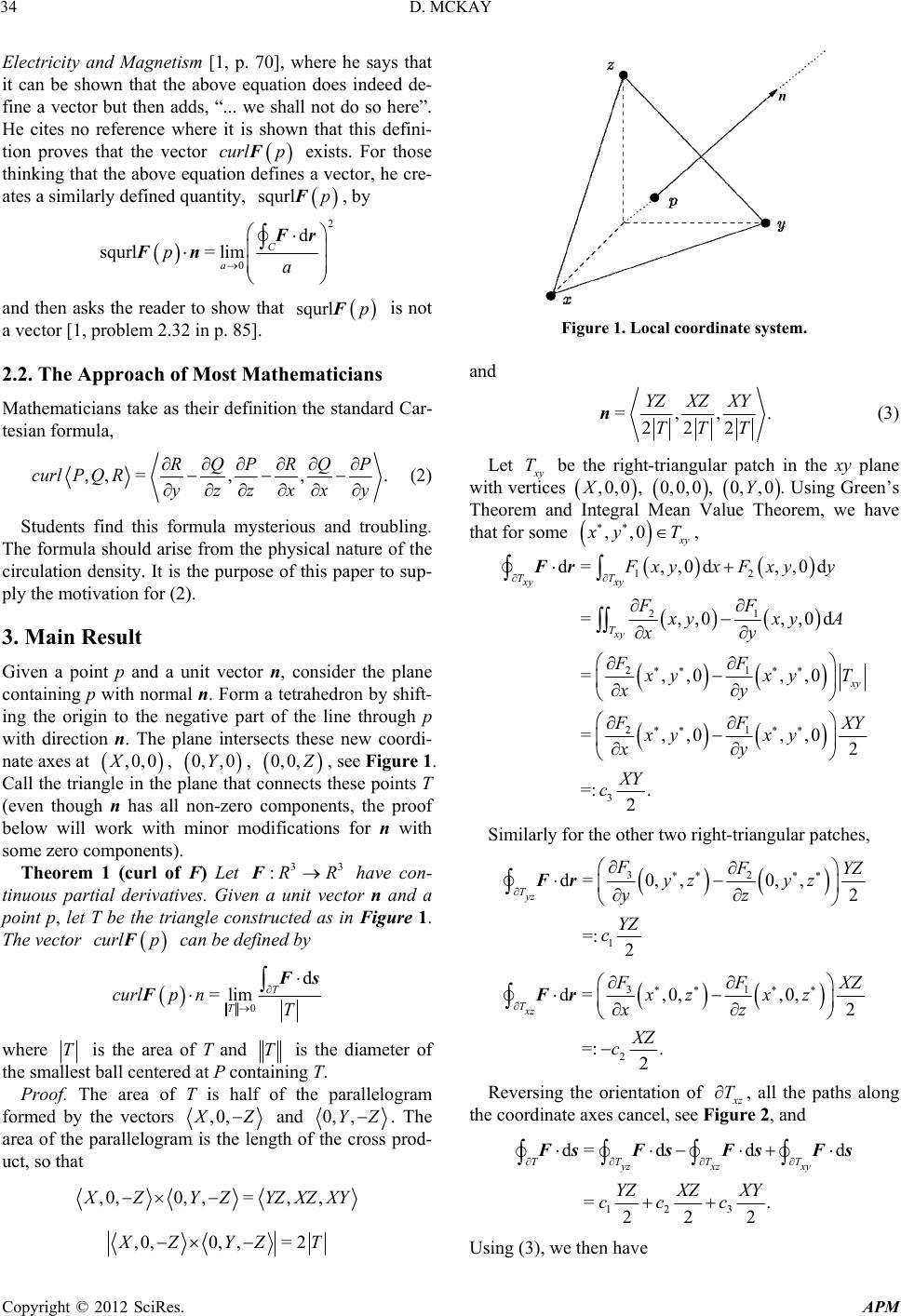 D. MCKAY 34 Electricity and Magnetism [1, p. 70], where he says that it can be shown that the above equation does indeed de- fine a vector but then adds, “... we shall not do so here”. He cites no reference where it is shown that this defini- tion proves that the vector exists. For those thinking that the above equation defines a vector, he cre- ates a similarly defined quantity, , by curl pF squrl pF 2 0 d mCa Fr squrl pF squrl = li a p Fn and then asks the reader to show that is not a vector [1, problem 2.32 in p. 85]. 2.2. The Approach of Most Mathematicians Mathematicians take as their definition the standard Car- tesian formula, ,, =, RQPR curlP QRyzz , . QP xxy 0, 0,0, (2) Students find this formula mysterious and troubling. The formula should arise from the physical nature of the circulation density. It is the purpose of this paper to sup- ply the motivation for (2). 3. Main Result Given a point p and a unit vector n, consider the plane containing p with normal n. Form a tetrahedron by shift- ing the origin to the negative part of the line through p with direction n. The plane intersects these new coordi- nate axes at ,0 , 0, ,Y,0X Z , 33 :RRF curlF see Figure 1. Call the triangle in the plane that connects these points T (even though n has all non-zero components, the proof below will work with minor modifications for n with some zero components). Theorem 1 (curl of F) Let have con- tinuous partial derivatives. Given a unit vector n and a point p, let T be the triangle constructed as in Figure 1. The vector can be defined by p 0 d im T TT Fs =lcurlp nF where T is the area of T and T is the diameter of the smallest ball centered at P containing T. Proof. The area of T is half of the parallelogram formed by the vectors ,0, X Z and 0, ,YZ . The area of the parallelogram is the length of the cross prod- uct, so that ,0,0, ,=,, X ZY Z YZXZXY ,0,0,,= 2 X ZY ZT n Figure 1. Local coordinate system. and =,,. 222 YZXZ XY TTT n (3) Let x y be the right-triangular patch in the xy plane with vertices T ,0,0X, 0,0,0 0, ,0Y, . Using Green’s Theorem and Integral Mean Value Theorem, we have that for some ,,0 x y yT , x 12 21 21 21 3 d=,,0d ,,0d =,,0,,0d =,,0 ,,0 =,,0 ,,0 2 =: . 2 TT xy xy Txy x y Fxyx Fxyy FF xyxy A xy FF x yxyT xy FF X Y xy xy xy XY c Fr Similarly for the other two right-triangular patches, 32 1 d=0, ,0, ,2 =: 2 Tyz FFYZ yz yz yz YZ c Fr 31 2 d=,0,,0, 2 =: . 2 Txz FF X Z xz xz xz XZ c Fr Reversing the orientation of x z, all the paths along the coordinate axes cancel, see Figure 2, and T 12 3 d= ddd =. 222 TT T T yz xz xy YZ XZ XY cc c F sFsFsFs Using (3), we then have Copyright © 2012 SciRes. APM 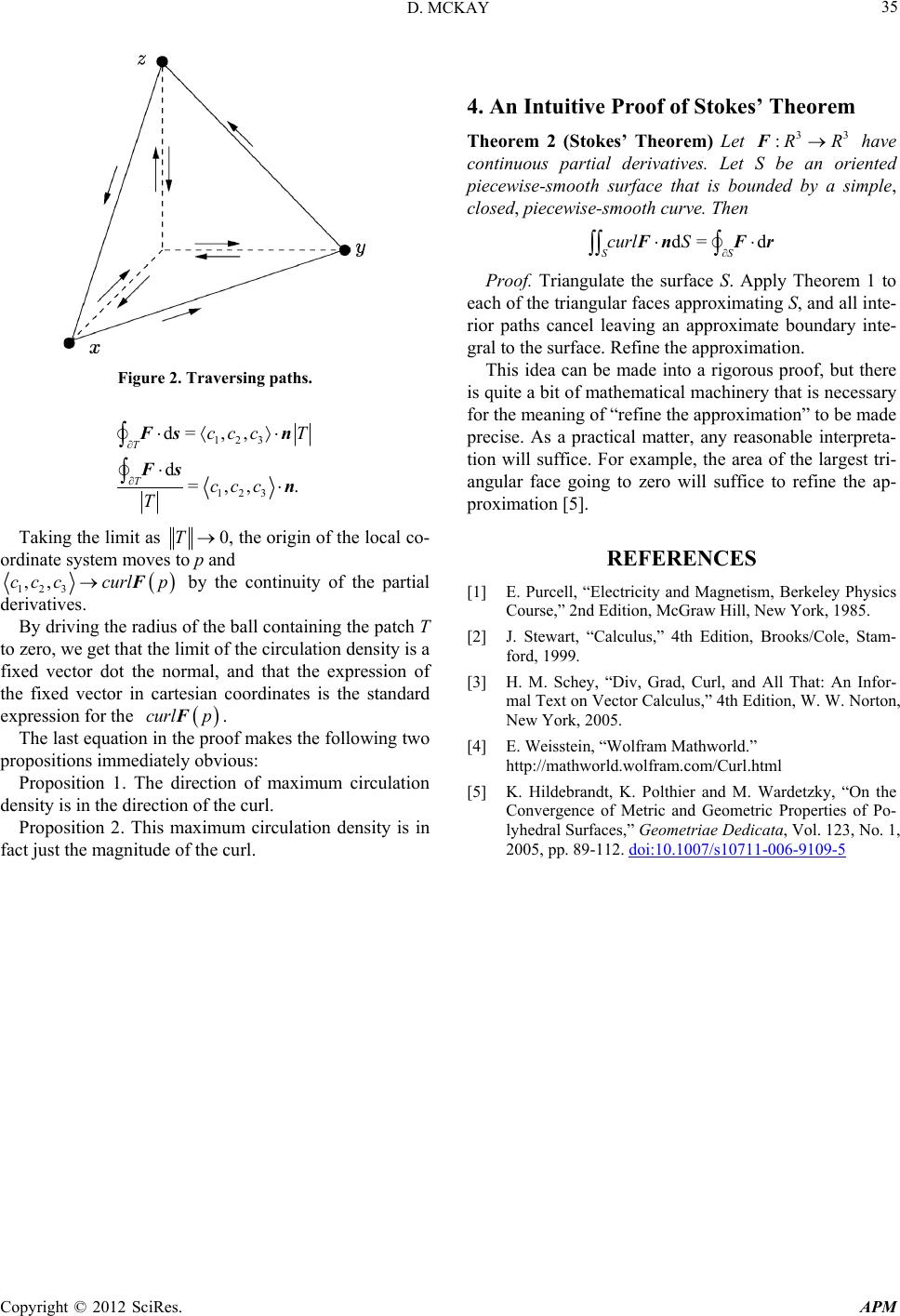 D. MCKAY Copyright © 2012 SciRes. APM 35 4. An Intuitive Proof of Stokes’ Theorem Figure 2. Traversing paths. 12 3 123 , , =,, . ccc T ccc n n d= d T TT Fs Fs Taking the limit as 0T, the origin of the local co- ordinate system moves to p and ,,ccccurl pF curl pF 33 :RRF d= d SS curlS 123 by the continuity of the partial derivatives. Theorem 2 (Stokes’ Theorem) Let have continuous partial derivatives. Let S be an oriented piecewise-smooth surface that is bounded by a simple, closed, piecewise-smooth curve. Then By driving the radius of the ball containing the patch T to zero, we get that the limit of the circulation density is a fixed vector dot the normal, and that the expression of the fixed vector in cartesian coordinates is the standard expression for the . The last equation in the proof makes the following two propositions immediately obvious: Proposition 1. The direction of maximum circulation density is in the direction of the curl. Proposition 2. This maximum circulation density is in fact just the magnitude of the curl. F nFr Proof. Triangulate the surface S. Apply Theorem 1 to each of the triangular faces approximating S, and all inte- rior paths cancel leaving an approximate boundary inte- gral to the surface. Refine the approximation. This idea can be made into a rigorous proof, but there is quite a bit of mathematical machinery that is necessary for the meaning of “refine the approximation” to be made precise. As a practical matter, any reasonable interpreta- tion will suffice. For example, the area of the largest tri- angular face going to zero will suffice to refine the ap- proximation [5]. REFERENCES [1] E. Purcell, “Electricity and Magnetism, Berkeley Physics Course,” 2nd Edition, McGraw Hill, New York, 1985. [2] J. Stewart, “Calculus,” 4th Edition, Brooks/Cole, Stam- ford, 1999. [3] H. M. Schey, “Div, Grad, Curl, and All That: An Infor- mal Text on Vector Calculus,” 4th Edition, W. W. Norton, New York, 2005. [4] E. Weisstein, “Wolfram Mathworld.” http://mathworld.wolfram.com/Curl.html [5] K. Hildebrandt, K. Polthier and M. Wardetzky, “On the Convergence of Metric and Geometric Properties of Po- lyhedral Surfaces,” Geometriae Dedicata, Vol. 123, No. 1, 2005, pp. 89-112. doi:10.1007/s10711-006-9109-5 |