

Paper Menu >>
Journal Menu >>
 Advances in Pure Mathematics, 2012, 2, 41-44 http://dx.doi.org/10.4236/apm.2012.21010 Published Online January 2012 (http://www.SciRP.org/journal/apm) L-Topological Spaces Based on Residuated Lattices Zhudeng Wang1, Xuejun Liu2 1Department of Mathematics, Yancheng Teachers University, Yancheng, China 2School of Computer and Information Technology, Zhejiang Wanli University, Ningbo, China Email: [email protected], [email protected] Received September 14, 2011; revised October 10, 2011; accepted October 20, 2011 ABSTRACT In this paper, we introduce the notion of L-topological spaces based on a complete bounded integral residuated lattice and discuss some properties of interior and left (right) closure operators. Keywords: Residuated Lattice; L-Topological Space; Interior Operator; Left (Right) Closure Operator 1. Introduction x yzy xz . Residuation is a fundamental concept of ordered struc- tures and the residuated lattices, obtained by adding a residuated monoid operation to lattices, have been applied in several branches of mathematics, including L-groups, ideal lattices of rings and multivalued logic. Commuta- tive residuated lattices have been studied by Krull, Dil- worth and Ward. These structures were generalized to the non-commutative situation by Blount and Tsinakis [1]. Definition 1.1. [1-4]. A residuated lattice is an algebra of type (2, 2, 2, 2, 2, 0, 0) sat- isfying the following conditions: ,,,, ,,0,1LL (L1) is a lattice, ,,L ,,1L(L2) is a monoid, i.e., is associative and 11 x xx for any x L, (L3) x yz if and only if x yz if and only if y xz,, for any x yz L. Generally speaking, 1 is not the top element of L. A residuated lattice with a constant 0 is called a pointed residuated lattice or full Lambek algebra (FL-algebra, for short). If 1 x for all x L, then L is called integral residuated lattice. An FL-algebra L which satisfies the condition 01 x for all x L is called FLw-algebra or bounded integral residuated lattice (see [2]). Clearly, if L is an FLw-algebra, then ,,,0,1L ab 11 is a bounded lattice. A bounded integral residuated lattice is called com- mutative (see [5]) if the operation is commutative. We adopt the usual convention of representing the monoid operation by juxtaposition, writing ab for . The following theorem collects some properties of bounded integral residuated lattices (see [1-4,6]. Theorem 1.1. Let L be a bounded integral residuated lattice. Then the following properties hold. 1) , 1xxxx x xx . 2) ,3) x xyxy , x yx x y , x yxy . y xxy , x yyz xz 4) y zxy xz ,. 5) If x y then x ,,zyzzxzy, x zy z , zyzz xzy .zxzy and x 6) x y if and only if if and only if 1xy 1xy . , x yzy xzxyzxyz . 7) , x yzxzyz 8) . x yzxzyz , x yzxyx z 9) x yzxyx z . If bounded integral residuated lattice L is complete, then , x zyLyxzxzyLxyz ,, , jj ababLjJ Thus, it follows from some results in [7] that Theorem 1.2. Let L be a complete bounded integral residuated lattice and . Then the following properties hold. 1) j JjjJ j ab ab , jJ jjJ j ab ab and i.e., the operation is infinitely -distributive. jJ jjJj ab ab and 2) . jJ jjJj ab ab 3) j Jj jJj ab ab and j Jj jJj ab ab , i.e., the two residuation operations and are all right infinitely -dis- tributive (see [8]). jJ jjJj ab ab and 4) jJ jjJj ab ab . C opyright © 2012 SciRes. APM 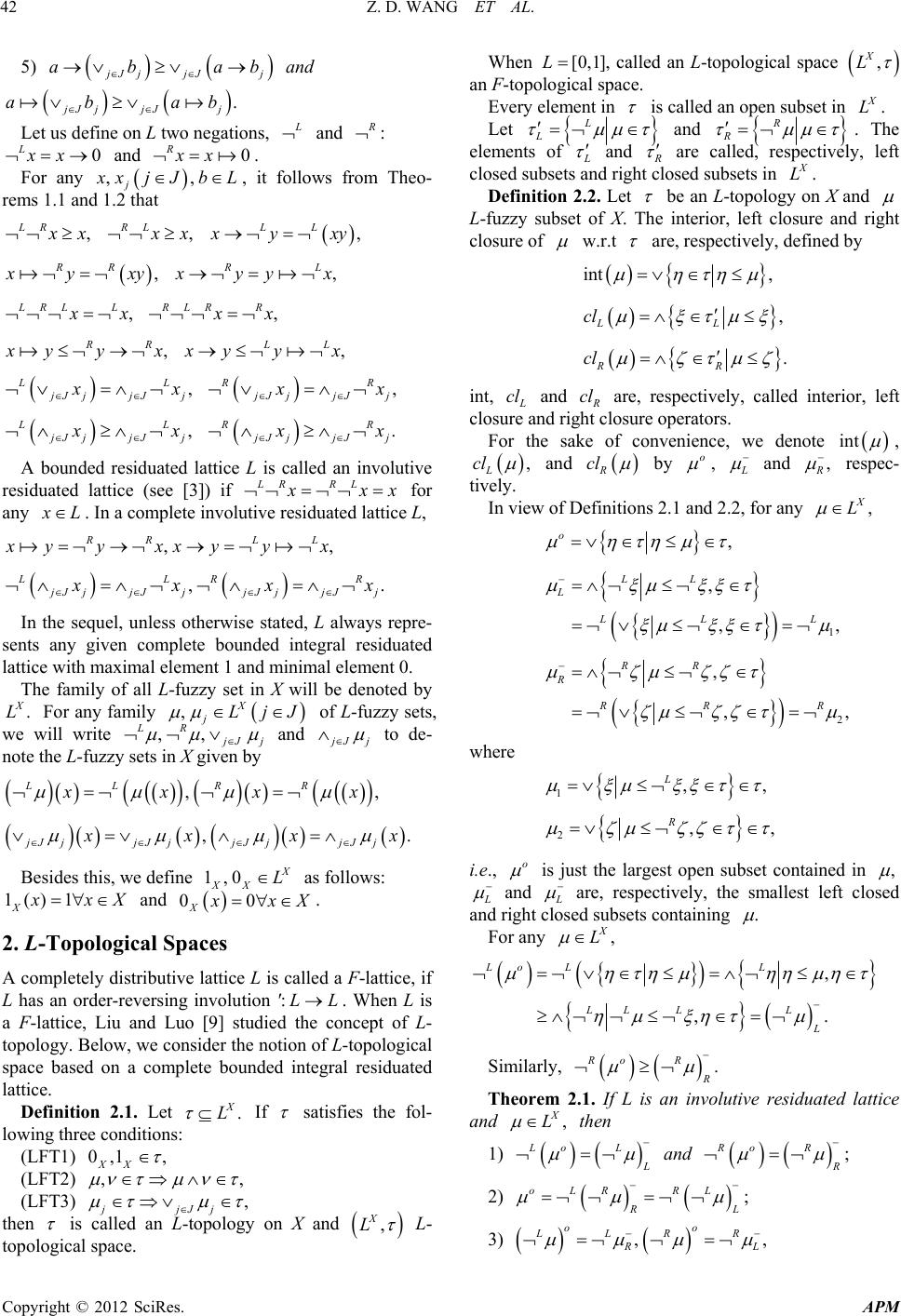 Z. D. WANG ET AL. 42 5) j Jj ab , X L jJ j ab . and j Jj ab jJj ab Let us define on L two negations, L and R : 0xx , L0xx , and . R For any j x xjJbL , it follows from Theo- rems 1.1 and 1.2 that , LR x x , RL x x , LL x yxy , RR x yxy , RL x yy x , LRL L x x , RLR R x x RR , x yy x , LL x yy x , LL j JjjJj x x , RR j JjjJj x x , LL j JjjJ j x x R. R j JjjJ j x x RL A bounded residuated lattice L is called an involutive residuated lattice (see [3]) if LR x xx for any x L ,, L . In a complete involutive residuated lattice L, RR L x yy x ,. RR xxyy LL j Jj jJjjJjjJj x xx x . X L ,X jLjJ LR In the sequel, unless otherwise stated, L always repre- sents any given complete bounded integral residuated lattice with maximal element 1 and minimal element 0. The family of all L-fuzzy set in X will be denoted by For any family of L-fuzzy sets, we will write ,, j Jj and j Jj ,, R to de- note the L-fuzzy sets in X given by LL R x xxx ,. jjJjjJjjJjjJ x xxx Besides this, we define as follows: 1,0 X XXL 1() 1 X x xX 00 X and x xX . 2. L-Topological Spaces A completely distributive lattice L is called a F-lattice, if L has an order-reversing involution ':. When L is a F-lattice, Liu and Luo [9] studied the concept of L- topology. Below, we consider the notion of L-topological space based on a complete bounded integral residuated lattice. LL . X L Definition 2.1. Let If satisfies the fol- lowing three conditions: (LFT1) 0,1 XX , (LFT2) ,, , (LFT3) jjJj then is called an L-topology on X and When ][0,1L , called an L-topological space an F-topological space. is called an open subset in . X L Every element in L , X L L- topological space. Let L R and R . The elements of L and R are called, respectively, left closed subsets and right closed subsets in . X L be an L-topology on X and Definition 2.2. Let L-fuzzy subset of X. The interior, left closure and right closure of w.r.t are, respectively, defined by int , , LL cl . RR cl int, L cl and R cl are, respectively, called interior, left closure and right closure operators. int , For the sake of convenience, we denote ,clL R cl o and by , L , and R respec- tively. In view of Definitions 2.1 and 2.2, for any , X L , o 1 , ,, LL L LL L 2 , ,, RR R RR R where 1,, L 2,, R o i.e., is just the largest open subset contained in , L and L are, respectively, the smallest left closed and right closed subsets containing . For any , X L , ,. Lo LL LL LL L . RoR Similarly, R , X L Lo L Theorem 2.1. If L is an involutive residuated lattice and then 1) L Ro R and R oLR RL ; 2) R L ,, oo LLRR ; 3) R L Copyright © 2012 SciRes. APM 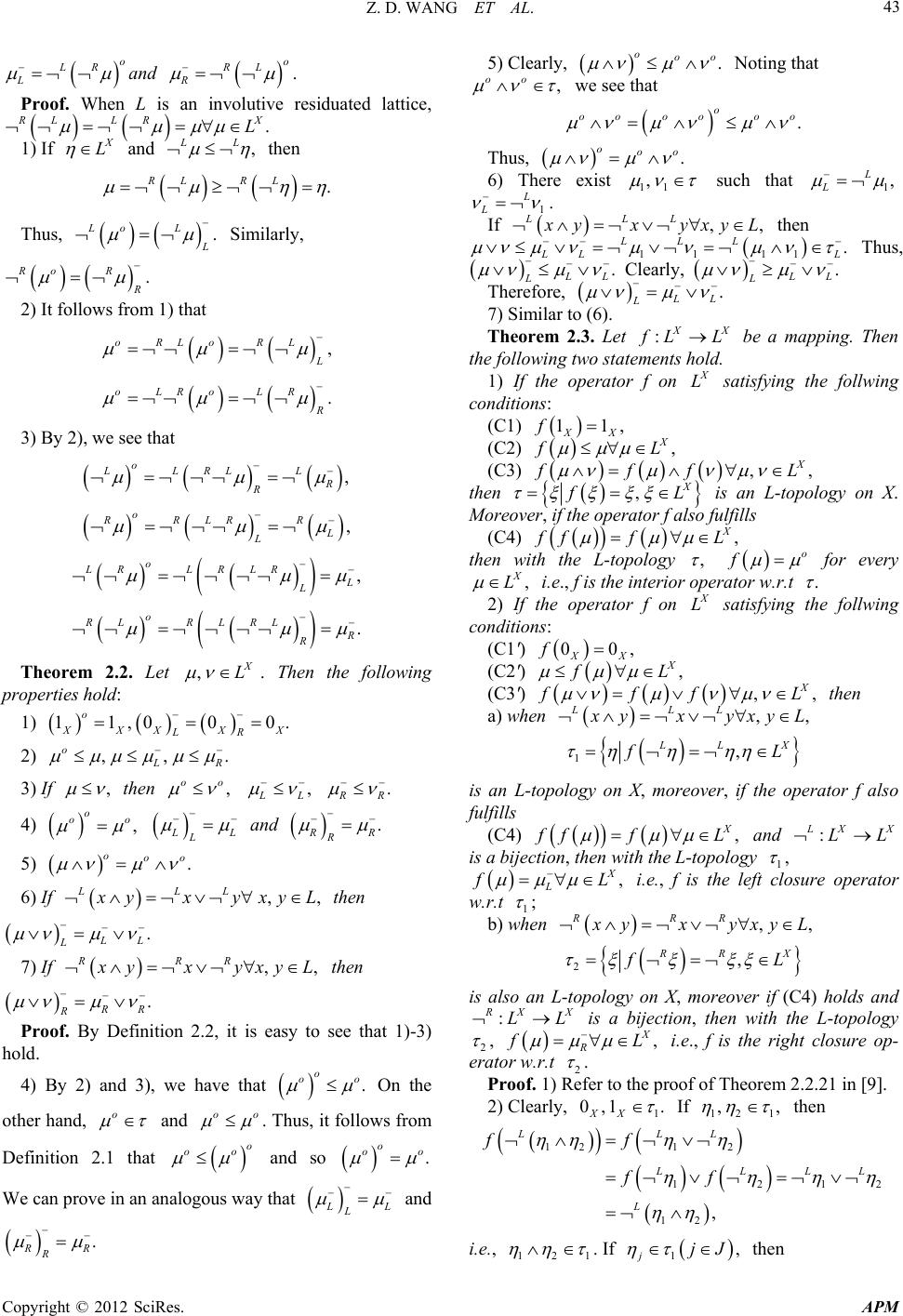 Z. D. WANG ET AL. 43 Copyright © 2012 SciRes. APM o LR L . o RL R and Proof. When L is an involutive residuated lattice, . R LLR X L X L , LL 1) If and . RL then RL Lo L . Thus, L R Similarly, Ro R oRL . 2) It follows from 1) that o , RL L oLR . LR o R o LL o RR o LR , L L R R , RR L L , LR 3) By 2), we see that R L LR L L . RL o RL RL R R 0 0. X X LR . , 11,0 o XXX ,, o X L Theorem 2.2. Let . Then the following properties hold: 1) 2) L R , 3) If then , oo , L L . R R 4) , o oo L L L and . R R R 5) . ooo LL 6) If ,, L x yx . yxyL then L L L RR 7) If ,, R x yx . yxyL then R R R Proof. By Definition 2.2, it is easy to see that 1)-3) hold. 4) By 2) and 3), we have that . o oo On the other hand, o and oo . Thus, it follows from Definition 2.1 that and so . o oo o oo We can prove in an analogous way that L L L and . R R R 5) Clearly, . ooo , oo Noting that . o oo oooo we see that . ooo Thus, 11 , 6) There exist such that 1, L L 1 L L . If ,, LLL x yxyxyL 11 . LLL then 11 L LL Thus, . L L L Clearly, . L L L Therefore, . L L L :XX 7) Similar to (6). Theorem 2.3. Let f LL X L be a mapping. Then the following two statements hold. 1) If the operator f on satisfying the follwing conditions: (C1) 11, XX f (C2) , X f L (C3) ,, X f ff L then ,X f L is an L-topology on X. Moreover, if the operator f also fulfills (C4) , X f ff L , then with the L-topology o f , X L . for every i.e., f is the interior operator w.r.t 2) If the operator f on satisfying the follwing conditions: X L (C1') 00, XX f (C2') , X f L (C3') ,, X f ff L then a) when ,, LLL x yxyxyL 1, L LX f L is an L-topology on X, moreover, if the operator f also fulfills (C4) , X f ff L : and L XX LL is a bijection, then with the L-topology 1 , , X L f L i.e. , f is the left closure operator w.r.t 1 ; b) when ,, RRR x yxyxyL 2, RR X f L : is also an L-topology on X, moreover if (C4) holds and R XX LL is a bijection, then with the L-topology 2 , , X R f L i.e., f is the right closure op- erator w.r.t 2 . Proof. 1) Refer to the proof of Theorem 2.2.2 1 in [9]. 2) Clearly, 1 0,1. XX If 12 1 ,, then 121 2 1212 12 , LLL LLLL L ff ff 121 i.e., 1, jjJ . If then 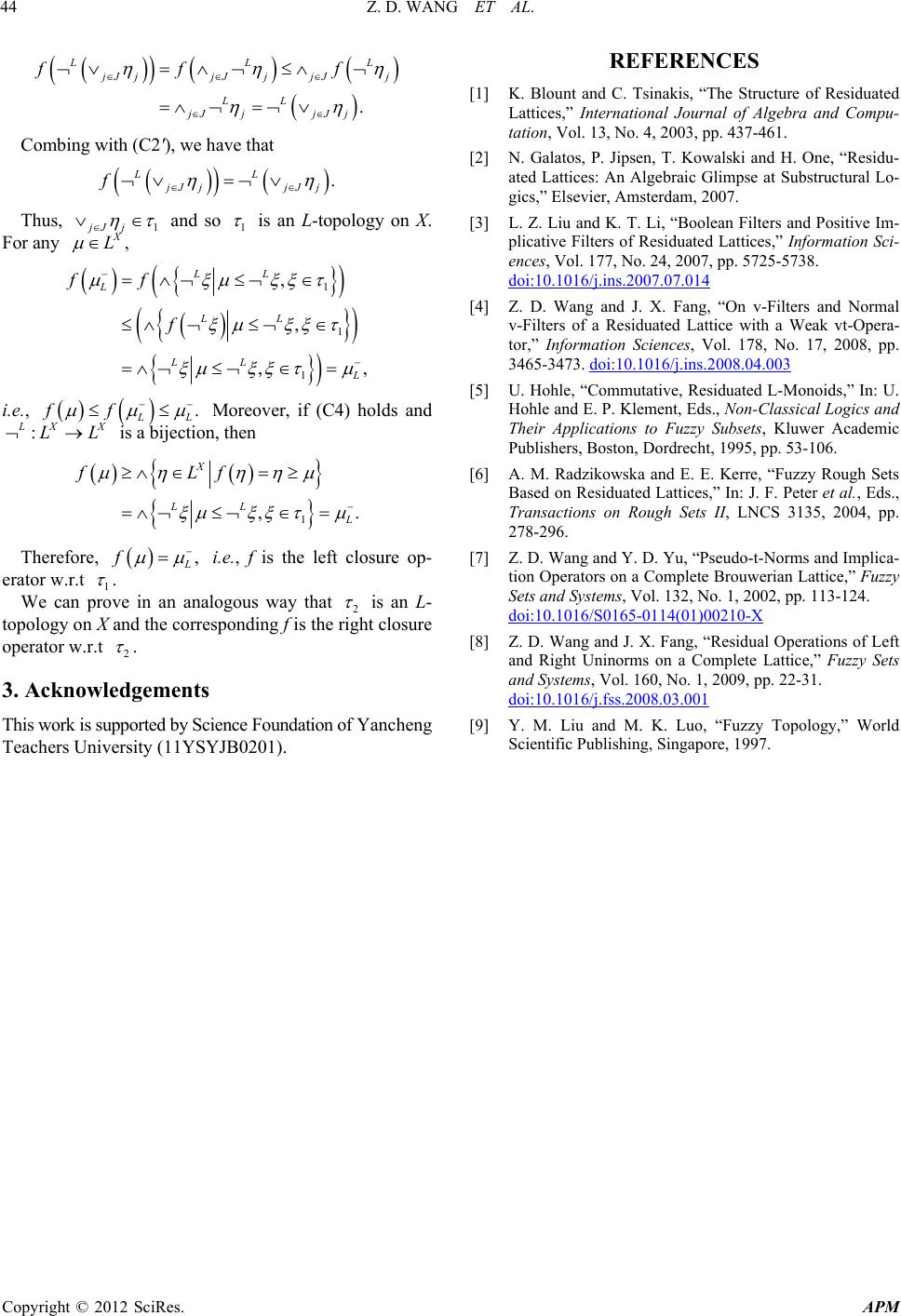 Z. D. WANG ET AL. Copyright © 2012 SciRes. APM 44 . LREFERENCES LL j JjjJ j LL jJj ff jJ j jJ j f . LL jJ j [1] K. Blount and C. Tsinakis, “The Structure of Residuated Lattices,” International Journal of Algebra and Compu- tation, Vol. 13, No. 4, 2003, pp. 437-461. Combing with (C2'), we have that [2] N. Galatos, P. Jipsen, T. Kowalski and H. One, “Residu- ated Lattices: An Algebraic Glimpse at Substructural Lo- gics,” Elsevier, Amsterdam, 2007. jJ j f 1jJ Thus, j 1 and so is an L-topology on X. For any , X L [3] L. Z. Liu and K. T. Li, “Boolean Filters and Positive Im- plicative Filters of Residuated Lattices,” Information Sci- ences, Vol. 177, No. 24, 2007, pp. 5725-5738. doi:10.1016/j.ins.2007.07.014 1 1 1 , , ,, LL LL L LL L ff f . [4] Z. D. Wang and J. X. Fang, “On v-Filters and Normal v-Filters of a Residuated Lattice with a Weak vt-Opera- tor,” Information Sciences, Vol. 178, No. 17, 2008, pp. 3465-3473. doi:10.1016/j.ins.2008.04.003 [5] U. Hohle, “Commutative, Residuated L-Monoids,” In: U. Hohle and E. P. Klement, Eds., Non-Classical Logics and Their Applications to Fuzzy Subsets, Kluwer Academic Publishers, Boston, Dordrecht, 1995, pp. 53-106. i.e., L L ff Moreover, if (C4) holds and : L X L X L is a bijection, then 1 ,. X LL L fL f , [6] A. M. Radzikowska and E. E. Kerre, “Fuzzy Rough Sets Based on Residuated Lattices,” In: J. F. Peter et al., Eds., Transactions on Rough Sets II, LNCS 3135, 2004, pp. 278-296. f Therefore, L i.e., f is the left closure op- erator w.r.t [7] Z. D. Wang and Y. D. Yu, “Pseudo-t-Norms and Implica- tion Operators on a Complete Brouwerian Lattice,” Fuzzy Sets and Systems, Vol. 132, No. 1, 2002, pp. 113-124. doi:10.1016/S0165-0114(01)00210-X 1 . We can prove in an analogous way that 2 is an L- topology on X and the correspond ing f is the right closure operator w.r.t [8] Z. D. Wang and J. X. Fang, “Residual Operations of Left and Right Uninorms on a Complete Lattice,” Fuzzy Sets and Systems, Vol. 160, No. 1, 2009, pp. 22-31. doi:10.1016/j.fss.2008.03.001 2 . 3. Acknowledgements This work is supported by Science Foundation of Yancheng Teachers University (11YSYJB0201). [9] Y. M. Liu and M. K. Luo, “Fuzzy Topology,” World Scientific Publishing, Singapore, 1997. |