

Paper Menu >>
Journal Menu >>
 Open Journal of Modern Hydrology, 2012, 2, 21-27 http://dx.doi.org/10.4236/ojmh.2012.21004 Published Online January 2012 (http://www.SciRP.org/journal/ojmh) 1 Uptake of Ag, Co and Ni by the Organs of Typha domingensis (Pers.) Poir. ex Steud. in Lake Burullus and Their Potential Use as Contamination Indicators Ebrahem M. Eid1*, Mohamed A. El-Sheikh2,3, Abdulrahman A. Alatar2 1Botany Department, Faculty of Science, Kafr El-Sheikh University, Kafr El-Sheikh, Egypt; 2Botany & Microbiology Department, College of Science, King Saud University, Riyadh, Saudi Arabia; 3Botany Department, Faculty of Science, Damanhour University, Damanhour, Egypt. Email: *[email protected] Received October 24th, 2011; revised November 27th, 2011; accepted December 29th, 2011. ABSTRACT The concentrations of Ag, Co and Ni in the sediments and the different organs of Typha domingensis from Lake Burul- lus, Egypt, were investigated monthly from February to September 2010 to evaluate the aquatic environment quality of the lake and to test the suitability of these organs for bio-indicating of sediment metals. The sediment heavy metals were found to decrease in the order of Ni > Co > Ag. The sediment contents of Ag were about 45 times above the worldwide range. On the other hand, Co concentrations were below the reference ranges of United States and Chinese soils. The heavy metals bioaccumulation decreased according to the order of rhizome > root > leaf for Ag; and root > rhizome > leaf for Co and Ni. It was found also that, T. domingensis had no significant differences in heavy metals concentrations over time. The transfer factors of Ag, Co and Ni from sediment to below-ground organs were smaller than one. Co had the maximum transport from below-ground to above-ground organs, while Ag had the minimum. There was a significant linear correlation between the concentration of Ag in root of T. domingensis and that in sedi- ment. This result suggested that T. domingensis can be regarded as bio-indicator for Ag pollution of Lake Burullus. Keywords: Bio-indicators; Cattails; Heavy metals; Lake Burullus; Macrophytes; Wetlands 1. Introduction Heavy metals are serious pollutants in natural environm- ents due to their toxicity, persistence and bioaccumulation problems. The accumulation of heavy metals in the enviro- nment has become a concern due to the health risks to humans and animals. The problem is not restricted to soils with high metal levels, such as mining areas, but also incl- udes those with moderate to low contamination of metals. These toxic elements are present at elevated levels mainly through human activities, as smelting, refining of non-fer- rous metals, electroplating, agricultural practices, and ind- ustrial and municipal waste disposal on land [1]. Recently, there has been an increasing interest in using biological indicators such as plants for monitoring soil, air and water pollution [2-6]. Perception the environmental pollution by using biological indicators is a cheap, reliable and simple alternative to the conventional sampling methods [7]. Aquatic macrophytes are widely distributed in various wet environments, from fresh to salt water [4] and they play an important role in heavy metals cycling in the wet- lands due to uptake, storage, and release processes. Spe- cifically, plants with potentially high annual primary pro- duction can extract large amounts of heavy metals from their environment and store these metals in biomass and litter [8]. Therefore, some aquatic plants such as Eichhor- nia crassipes (C. Mart.) Solms, Phragmites australis (Cav.) Trin. ex Steud., Potamogeton pectinatus L. and Typha domingensis (Pers.) Poir. ex Steud. have been used to in- dicate, monitor and purify water pollution [3,4,8-11]. Typha domingensis (Pers.) Poir. ex Steud. is a warm- temperate and tropical regions plant that occurs every- where in ditches and marshy places in Egypt [12,13]. It is one of the major components of vegetation stands along the shores of Lake Burullus close to the Deltaic Mediter- ranean coast [14]. T. domingensis is one of the emergent plants most commonly used in constructed wetlands for the enhancement of water quality in water treatment sys- tems [10,15] due to its high growth rate and great capac- ity for heavy metals accumulation in its tissues [16,17]. In the present study, Ag, Co and Ni concentrations in the plant and sediment samples were analyzed in order to evaluate the aquatic environment quality of Lake Burul- lus, and to investigate possible relationships between *Corresponding author. Copyright © 2012 SciRes. OJMH 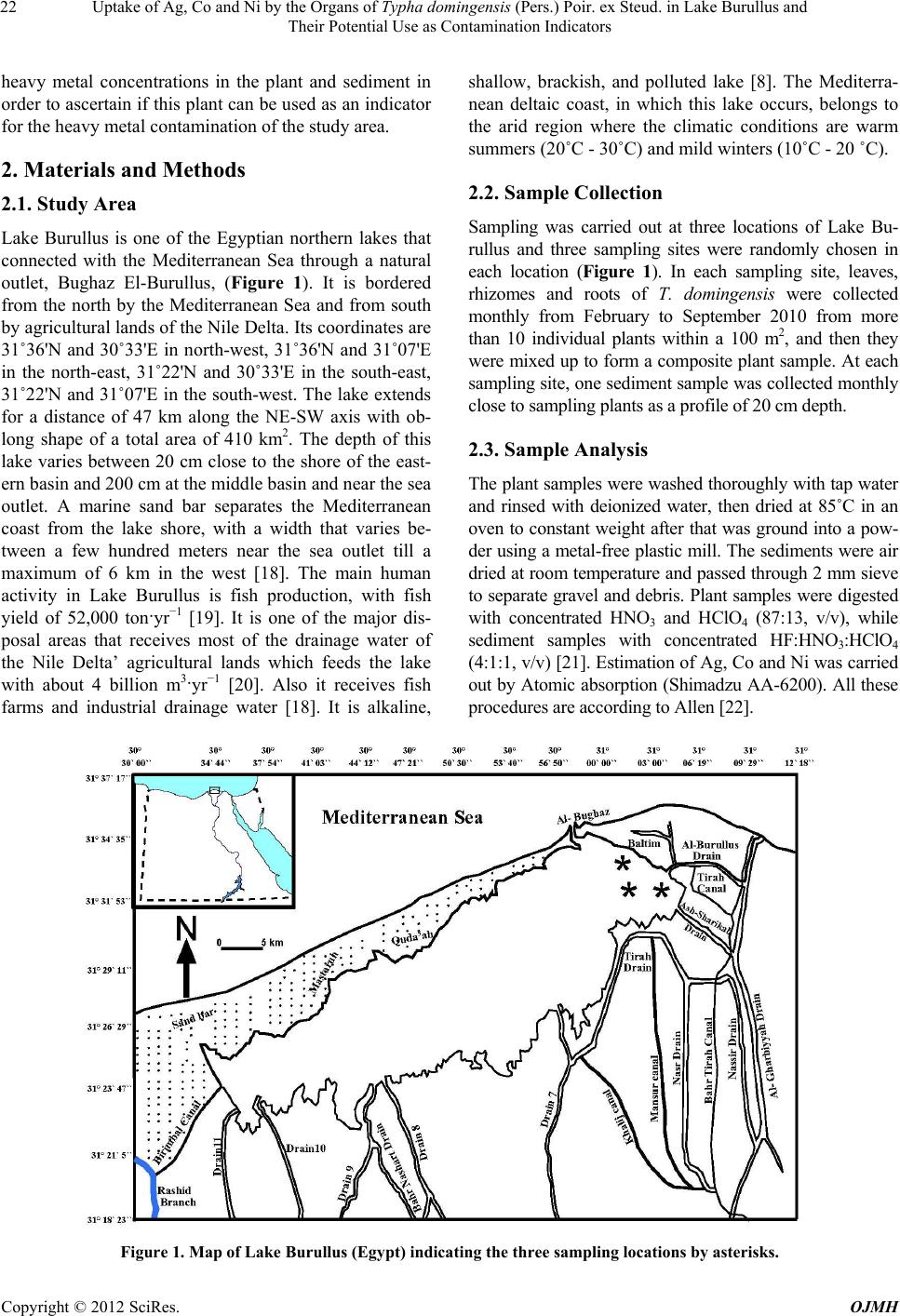 Uptake of Ag, Co and Ni by the Organs of Typha domingensis (Pers.) Poir. ex Steud. in Lake Burullus and Their Potential Use as Contamination Indicators 22 heavy metal concentrations in the plant and sediment in order to ascertain if this plant can be used as an indicator for the heavy metal contamination of the study area. 2. Materials and Methods 2.1. Study Area Lake Burullus is one of the Egyptian northern lakes that connected with the Mediterranean Sea through a natural outlet, Bughaz El-Burullus, (Figure 1). It is bordered from the north by the Mediterranean Sea and from south by agricultural lands of the Nile Delta. Its coordinates are 31˚36'N and 30˚33'E in north-west, 31˚36'N and 31˚07'E in the north-east, 31˚22'N and 30˚33'E in the south-east, 31˚22'N and 31˚07'E in the south-west. The lake extends for a distance of 47 km along the NE-SW axis with ob- long shape of a total area of 410 km2. The depth of this lake varies between 20 cm close to the shore of the east- ern basin and 200 cm at the middle basin and near the sea outlet. A marine sand bar separates the Mediterranean coast from the lake shore, with a width that varies be- tween a few hundred meters near the sea outlet till a maximum of 6 km in the west [18]. The main human activity in Lake Burullus is fish production, with fish yield of 52,000 ton·yr−1 [19]. It is one of the major dis- posal areas that receives most of the drainage water of the Nile Delta’ agricultural lands which feeds the lake with about 4 billion m3·yr−1 [20]. Also it receives fish farms and industrial drainage water [18]. It is alkaline, shallow, brackish, and polluted lake [8]. The Mediterra- nean deltaic coast, in which this lake occurs, belongs to the arid region where the climatic conditions are warm summers (20˚C - 30˚C) and mild winters (10˚C - 20 ˚C). 2.2. Sample Collection Sampling was carried out at three locations of Lake Bu- rullus and three sampling sites were randomly chosen in each location (Figure 1). In each sampling site, leaves, rhizomes and roots of T. domingensis were collected monthly from February to September 2010 from more than 10 individual plants within a 100 m2, and then they were mixed up to form a composite plant sample. At each sampling site, one sediment sample was collected monthly close to sampling plants as a profile of 20 cm depth. 2.3. Sample Analysis The plant samples were washed thoroughly with tap water and rinsed with deionized water, then dried at 85˚C in an oven to constant weight after that was ground into a pow- der using a metal-free plastic mill. The sediments were air dried at room temperature and passed through 2 mm sieve to separate gravel and debris. Plant samples were digested with concentrated HNO3 and HClO4 (87:13, v/v), while sediment samples with concentrated HF:HNO3:HClO4 (4:1:1, v/v) [21]. Estimation of Ag, Co and Ni was carried out by Atomic absorption (Shimadzu AA-6200). All these procedures are according to Allen [22]. Figure 1. Map of Lake Burullus (Egypt) indicating the three sampling locations by asterisks. Copyright © 2012 SciRes. OJMH  Uptake of Ag, Co and Ni by the Organs of Typha domingensis (Pers.) Poir. ex Steud. in Lake Burullus and Their Potential Use as Contamination Indicators 23 2.4. Statistical Analysis The significance of variation in heavy metal concentra- tions in sediment supporting the growth of T. domingen- sis was assessed using one-way ANOVA. The signify- cance of variation in heavy metals of T. domingensis organs in relation to plant organs over time were assessed using repeated measurement ANOVAs. We used the correlation procedures to evaluate statistical relationships between heavy metals of plant organs and sediment. All statistical analyses were carried out using software SPSS version 15.0 of Statistical Software Package [23]. The translocation of heavy metals from sediment to plant tissues was assessed following transfer factor (TF). It was calculated to determine the relative uptake of heavy metals by the plants with respect to sediment [24]: TF = Concentration of metals in plant body (mg·kg−1)/Concen- tration of metals in sediment (mg·kg−1) at that site. 3. Results In sediment, the heavy metals were found to decrease in the order of Ni > Co > Ag (Table 1). No significant dif- ferences in sediment heavy metals concentrations were found over time. The concentrations of Ag ranged from 5.28 mg·kg−1 in April to 6.33 mg·kg−1 in August with an- nual mean 5.86 mg·kg−1; Co ranged from 11.85 mg·kg−1 in July to 14.07 mg·kg−1 in May with annual mean 13.06 mg·kg−1; Ni ranged from 21.57 mg·kg−1 in April to 27.65 mg·kg−1 in March with annual mean 25.07 mg·kg−1. Heavy metals concentrations in the organs of T. dom- ingensis are shown in (Figure 2). The bioaccumulation decreased according to the order of rhizome > root > leaf for Ag; and root > rhizome > leaf for Co and Ni. The heavy metals of the plant organs were found to decrease in the same order of sediment (Ni > Co > Ag). It was found that T. domingensis had no significant differences in heavy metals concentrations over time. Ag, Co and Ni concentrations ranged between 1.24 - 3.09, 3.64 - 6.63 and 5.08 - 15.39 mg·kg·DW−1 in leaf; 1.12 - 3.87, 4.48 - 6.89 and 10.44 - 17.44 mg·kg·DW−1 in root; 1.23 - 6.89, 2.08 - 8.69 and 6.52 - 20.99 mg·kg·DW−1 in rhizome, respectively (Figure 2). Ag Concentration(mg·kg·DW –1 )Concentration (mg·kg·DW –1 )Concentration (mg·kg·DW –1 ) 0 2 4 6 8 10 12 14 Leaves Root Rhizome Co 0 2 4 6 8 10 12 14 Fmonth=1.06,P= 0.439 Forgan=0.56,P= 0.583 Fmonth*organ=3.81,P= 0.000 Ni Month FebMarAprMay JunJulAug Sep 0 3 6 9 12 15 18 21 24 27 30 Fmonth=1.39,P= 0.284 Forgan=3.12,P= 0.076 Fmonth*organ=1.69,P= 0.088 Fmonth=0.50,P= 0.816 Forgan=5.87,P= 0.014 Fmonth*organ=7.92,P= 0.000 Figure 2. Monthly mean and standard error (vertical bars) of Ag, Co and Ni concentrations of Typha domingensis or- gans in Lake Burullus. Table 1. Monthly mean (1st line) and standard error (2nd line) of Ag, Co and Ni concentrations in sediment supporting the growth of Typha domingensis in Lake Burullus. F-values represent the one way ANOVA. The minimum and maximum values are in the bold letters. Month Site Feb. Mar. Apr. May Jun. Jul. Aug. Sep. Annual mean F-value P Ag (mg·kg−1) 5.35 0.71 5.47 0.63 5.28 0.73 5.88 0.47 6.01 0.48 6.25 0.72 6.33 0.59 6.32 0.69 5.86 0.21 0.485 0.832 Co (mg·kg−1) 11.97 0.92 13.76 0.72 12.95 1.45 14.07 0.55 13.39 0.43 11.85 0.59 13.23 0.80 13.23 1.17 13.06 0.30 0.783 0.611 Ni (mg·kg−1) 24.29 0.80 27.65 1.69 21.57 1.48 23.41 1.28 25.19 5.59 25.73 1.86 26.63 3.48 26.07 4.75 25.07 0.99 0.390 0.895 Copyright © 2012 SciRes. OJMH  Uptake of Ag, Co and Ni by the Organs of Typha domingensis (Pers.) Poir. ex Steud. in Lake Burullus and Their Potential Use as Contamination Indicators 24 The transfer factors of Ag, Co and Ni from sediment to below-ground organs were smaller than one. Co had the maximum transport from below-ground to above-ground organs, while Ag had the minimum (Table 2). Ag accu- mulated in higher concentration in roots grown in sedi- ment containing greater amount of this element (r = 0.56, P < 0.01; Table 3). Significantly positive correlation was found between Co contents in roots and the level of Ni element in sediment (r = 0.41, P < 0.05). 4. Discussion Silver is very toxic to heterotrophic bacteria and thus is widely used as an aseptic substance [25]. However, some bacteria (e.g., Thiobacillus ferrooxidans) are capable of accumulating great amounts of Ag [26]. Ag compounds are known to precipitate bacterial proteins as well as to form insoluble complexes with ribonucleic acids [27]. The average Ag content for worldwide soils is estimated as 0.13 mg·kg−1, and range of its mean contents in soils of various countries is 0.05 and 0.13 mg·kg−1 [25]. In the present study, Ag concentrations of Lake Burullus sedi- ment were about 45 times above the worldwide range. Concentrations of Ag in plants were reported by Smith and Carson [28] to range from 0.03 to 0.5 mg·kg−1. Chapman [29] established the intermediate range of Ag in plant foodstuffs as 0.07 to 2.0 mg·kg−1. In the present study, the average concentrations of Ag were 2.01, 2.23 and 4.26 mg·kg−1 in leaves, roots and rhizomes of T. domingensis, respectively; and these detected values were not in the phytotoxic range (> 5.04 mg·kg−1) re- ported by Cunningham and Stroube [30]. Most of Co is used for special alloys utilized in several industries. It is also used in chemical catalysis and syn- thesis, as well as a plastic hardener. In pharmacy Co is used for medical and veterinarian drugs. The radionu- clide 60Co is applied for some medical treatments [25]. Cobalt is an essential micro-nutrient for animals, being part of the structure of vitamin B12, and is involved with certain enzymes. The essentiality of Co for both blue- green algae and microorganisms in fixing N2 is now well established [25]. Plants require only minute amounts mainly for catalytic functions and levels are often <5 mg·kg−1 dry weight [22]. The range of Co in reference soil samples of United States is from 5.5 to 29.9 mg·kg−1 and in Chinese soils, in the range of 5.5 - 97.0 mg·kg−1 [31]. In the present study, Co concentrations of sediment were below the reference ranges of the United States and Chinese soils. Different concentrations of Co in plant tissues have been reported to produce toxicity symptoms, as follows (in mg·kg−1): 43 - 142 in bush beans [32]; 19 - 32 in Sudan grass [33]; and 6 in barley seedlings [34]. However, commonly reported critical Co levels in plants range from 30 to 40 mg·kg−1 [35]. In the present study, Co concentrations of T. domingensis organs were below the phytotoxic range (30 - 40 mg·kg−1). Table 2. Mean and standard error (SE) of the transfer factor of Ag, Co and Ni from sediment to roots (RT/SE), sediment to rhizomes (RE/SE), below- to above-ground organs (AG/BG) in Typha domingensis in Lake Burullus. Transfer factor RT/SE RE/SE AG/BG Mean SE Mean SE Mean SE Ag 0.40 0.03 0.75 0.08 0.88 0.09 Co 0.46 0.03 0.41 0.05 1.18 0.13 Ni 0.55 0.06 0.51 0.06 0.89 0.12 Table 3. Pearson correlation coefficient (r-values) between Ag, Co and Ni concentrations of sediment and plant organs of Typha domingensis in Lake Burullus. The significant values are in the bold letters. *P < 0.05, **P < 0.01. LeafAg RootAg RhizomeAg SedimentAg LeafCo RootCo RhizomeCo SedimentCo LeafNi RootNi RhizomeNi RootAg −0.499* RhizomeAg 0.493* −0.542** SedimentAg −0.231 0.564** 0.038 LeafCo −0.257 0.087 −0.093 −0.003 RootCo −0.119 −0.270 0.233 −0.090 0.134 RhizomeCo 0.187 −0.415* 0.158 −0.306 0.018 0.073 SedimentCo 0.148 −0.118 0.180 −0.171 0.017 −0.383 −0.160 LeafNi 0.062 0.136 −0.078 0.220 0.249 0.002 −0.040 −0.119 RootNi 0.078 −0.026 0.122 0.170 −0.016 0.140 0.205 −0.040 0.323 RhizomeNi 0.298 −0.190 0.273 −0.008 −0.324 −0.307 0.528** −0.071 0.191 0.094 SedimentNi −0.336 0.077 −0.183 −0.023 0.140 0.411* −0.224 0.084 0.160 −0.097 −0.266 Copyright © 2012 SciRes. OJMH  Uptake of Ag, Co and Ni by the Organs of Typha domingensis (Pers.) Poir. ex Steud. in Lake Burullus and Their Potential Use as Contamination Indicators 25 Nickel is considered as a serious pollutant that is re- leased from metal processing plants and from the in- creased combustion of coal and oil. Also some sewage sludge and phosphate fertilizers may be importance sources of Ni in agricultural soils. There is no evidence of an essential role of Ni in plant metabolism [25]. Soils throughout the world contain Ni in the very broad range, however its mean concentrations, as reported for various countries are within the range 13 - 37 mg·kg−1 [25]. In the present study, Ni concentrations in sediment were in the world range. The phytotoxic Ni concentrations range widely among plant species and cultivars from 40 to 246 mg·kg−1 [33]. Davis et al. [34] found the toxic Ni content of barley seedlings to be as low as 26 mg·kg−1, whereas Khalid and Tinsley [36] found 50 mg·kg−1 Ni in ryegrass to cause slight chlorosis. The mean Ni values detected in T. domigensis organs were below the phytotoxic range (26 - 246 mg·kg−1). The transfer factor generally showed the movement of heavy metals from sediment to root and shoot, indicating the efficiency to uptake of the bio-available metals from the environment and gives an idea whether the plant is an accumulator, excluder or indicator [37]. Zu et al. [38] re- ported that TF > 1 were determined in metal accumulating plants, whereas TF was typically < 1 in metal excluding plants. In the present study, the mean TF for Ag, Co and Ni from sediment to below-ground organs were lower than one. That may be partly attributed to the fact that the TF was calculated based on the total metal concentrations in sediment instead of the bioavailable fractions, which are the dominant form for metal uptake by plant roots [39]. The mean TF for Ag and Ni from below- to above-ground tissues were lower than one, which means that T. domin- gensis is metal excluding plant and did not effectively transfer Ag and Ni from below-to above-ground tissues. On the other hand, the higher translocation ratio of Co in T. domingensis shoots make it suitable for Co phytoextrac- tion from sediment. The differences in TF values indicated that each metal has different phytotoxic effect on T. domingensis [40]. In addition, these results could be re- lated to differences in solubility and availability of each heavy metal ion [41]. Variability of within-plant distribu- tion of Ag, Co and Ni in T. domingensis may be also due to compartmentalization and translocation in the vascular system [41]. These mechanisms are poorly understood and need further study. There was a significant linear correlation between the concentration of Ag in root of T. domingensis and that in sediment. This result suggested that T. domingensis can be regarded as bio-indicator for Ag pollution of Lake Burullus, defined as organisms providing quantitative assessment of the environmental quality. However, no significant relationships were found between Co and Ni concentrations in T. domingensis organs and those in sediment. This may be partly attributed to the fact that the correlation was developed based on the total metal concentrations in sediment instead of the bioavailable fractions [39]. In conclusion, T. domingensis in Lake Burullus could be regarded as bio-indicator on the Ag pollution and a suitable green filter to reduce the pollution load reaching the lake, if the above-ground biomass is harvested at the maximum biomass. In Lake Burullus, the above-ground biomass reached the maximum value in July [6327 g·m−2; 11], as much as (in mg m−2) 11.64 Ag, 33.32 Co and 63.52 Ni could be theoretically removed annually from the lake by harvesting above-ground biomass of T. domingensis in July. Thus, we recommend removing the shoots immediately after cutting to avoid heavy metals leaching from shoots to sediment and water. However, over the long term, annual harvesting may lead to the deterioration of T. domingensis primary productivity. Thus for the sustainable use of T. domingensis stands, harvests should not be conducted annually; perhaps har- vest rotation could be used (similar to crop rotation in farming). 5. Acknowledgments This project was supported by the Center of Excellence in Biodiversity Research, King Saud University for en- couragement and support. REFERENCES [1] S. M. Ross, “Toxic Metal in Soil-Plant Systems,”. Wiley, Chichester, 1994. [2] F. B. Pyatt, “Comparison of Foliar and Stem Bioaccumu- lation of Heavy Metals by Corsican pines in the Mount Olympus Area of Cyprus,” Ecotoxicology and Environ- mental Safety, Vol. 42, No. 1, 1999, pp. 57-61. doi:10.1006/eesa.1998.1726 [3] K. Peng, C. Luo, L. Lou, X. Li and Z. Shen, “Bioac- cumulation of Heavy Metals by the Aquatic Plants Pota- mogeton pectinatus L. and Potamogeton malaianus Miq. and Their Potential Use for Contamination Indicators and in Wastewater Treatment,” Science of The Total Envi- ronment, Vol. 392, No. 1, 2008, pp. 22-29. doi:10.1016/j.scitotenv.2007.11.032 [4] G. Bonanno and R. L. Giudice, “Heavy Metal Bioac- cumulation by the Organs of Phragmites australis (com- mon reed) and Their Potential Use as Contamination In- dicators,” Ecological Indicators, Vol. 10, 2010, No. 3, pp. 639-645. [5] M. Ruiz and J. Velasco, “Nutrient Bioaccumulation in Phragmites australis: Management Tool for Reduction of Pollution in the Mar Menor,” Water, Air, & Soil Pollution, Vol. 205, No. 1-4, 2010, pp. 173-185. doi:10.1007/s11270-009-0064-2 Copyright © 2012 SciRes. OJMH  Uptake of Ag, Co and Ni by the Organs of Typha domingensis (Pers.) Poir. ex Steud. in Lake Burullus and Their Potential Use as Contamination Indicators 26 [6] M. N. Al-Yemni, H. Sher, M. A. El-Sheikh and E. M. Eid, “Bioaccumulation of Nutrient and Heavy Metals by Calotropis procera and Citrullus colocynthis and Their Potential Use as Contamination Indicators,” Scientific Research and Essays, Vol. 6, No. 4, 2011, pp. 966-976. [7] R. Zurayk, B. Sukkariah and R. Baalbaki, “Common Hydrophytes as Bioindicators of Nickel, Chromium and Cadmium Pollution,” Water, Air, & Soil Pollution, Vol. 127, No. 1-4, 2001, pp. 373-388. doi:10.1023/A:1005209823111 [8] E. M. Eid, K. H. Shaltout, Y. M. Al-Sodany, K. Soetaert and K. Jensen, “Modeling Growth, Carbon Allocation and Nutrient Budget of Phragmites australis in Lake Bu- rullus, Egypt,” Wetlands, Vol. 30, No. 2, 2010, pp. 240- 251. [9] B. C. Wolverton and R. C. McDonald, “Bioaccumulation and Detection of Trace Levels of Cadmium in Aquatic Systems by Eichhornia crassipes,” Environmental Health Perspectives, Vol. 27, No. 1, 1978, pp. 161-164. doi:10.1289/ehp.7827161 [10] N. T. Abdel-Ghani, A. K. Hegazy, G. A. El-Cheghaby and E. C. Lima, “Factorial Experimental Design for Bio- sorption of Iron and Zinc Using Typha domingensis Phy- tomass,” Desalination, Vol. 249, No. 1, 2009, pp. 343- 347. doi:10.1016/j.desal.2009.02.065 [11] E. M. Eid, K. H. Shaltout and T. Asaeda, “Modeling growth dynamics of Typha domingensis (Pers.) Poir. ex Steud. in Lake Burullus, Egypt,” Ecological Modelling, 2012. [12] L. Boulos, “Flora of Egypt, Monocotyledons (Altismata- ceae-Orchidaceae),” Al-Hadara Publishing, Cairo, 2005. [13] V. Täckholm, “Students’ Flora of Egypt,” Cairo Univer- sity Press, Cairo, 1974. [14] K. H. Shaltout and Y. M. Al-Sodany, “Vegetation Analy- sis of Burullus Wetland: a RAMSAR Site in Egypt,” Wet- lands Ecology and Management, Vol. 16, No. 5, 2008, pp. 421−439. doi:10.1007/s11273-008-9079-5 [15] M. A. El-Sheikh, H. I. Saleh, D. E. El-Quosy and A. A. Mahmoud, “Improving Water Quality in Polluted Drains With Free Water Surface Constructed Wetlands,” Eco- logical Engineering, Vol. 36, No. 10, 2010, pp. 1478-1484. doi:10.1016/j.ecoleng.2010.06.030 [16] B. Lorenzen, H. Brix, I. A. Mendelssohn, K. L. McKee and S. L. Miao,“Growth, Biomass Allocation and Nutri- ent Use Efficiency in Cladium jamaicense and Typha do- mingensis as Affected by Phosphorus and Oxygen Avail- ability,” Aquatic Botany, Vol. 70, No. 2, 2001, pp. 117- 133. doi:10.1016/S0304-3770(01)00155-3 [17] S. Newman, J. B. Grace and J. W. Koebel, “Effects of Nutrient and Hydroperiod on Typha, Cladium and Eleo- charis: Implications for Everglades Restoration,” Journal of Ap plied Ecology, Vol. 6, No. 3, 1996, pp. 774-783. doi:10.2307/2269482 [18] K. H. Shaltout and M. T. Khalil, “Lake Burullus: Burul- lus Protected Area,” Publication of National Biodiversity Unit, Cairo, 2005. [19] M. T. Khalil and F. A. El-Dawy, “Ecological Survey of Burullus Nature Protectorate: Fishes and Fisheries,” Med- WetCoast, Global Environmental Facility (GEF) and Egyptian Environmental Affairs Agency (EEAA), Cairo, 2002. [20] I. El-Shinnawy, “Al-Burullus Wetland’s Hydrological Study,” MedWetCoast, Global Environmental Facility (GEF) and Egyptian Environmental Affairs Agency (EEAA), Cairo, 2002. [21] F. J. Zhao, S. P. McGrath and A. R. Croslant, “Compari- son of Three Wet Digestion Methods for the Determina- tion of Plant Sulpher by Inductively Coupled Plasma Atomic Emission Spectrometry (ICP-AES),” Communi- cations in Soil Science and Plant Analysis, Vol. 25, No. 3-4, 1994, pp. 407-418. doi:10.1080/00103629409369047 [22] S. Allen, “Chemical Analysis of Ecological Materials,” Blackwell Scientific Publications, London, 1989. [23] SPSS, “SPSS Base 15.0 User’s Guide,” SPSS Inc., Chi- cago, 2006. [24] A. C. Chamberlin, “Fallout of Lead and Uptake by Crops,” Atmospheric Environment, Vol. 17, No. 4, 1983, pp. 693- 706. doi:10.1016/0004-6981(83)90416-X [25] A. Kabata-Pendias, “Trace Elements in Soils and Plants,” CRC Press, Boca Raton, 2011. [26] A. B. Mukherjee, “The Use and Release of Silver in Fin- land,” Finnish Enviro nmen t, Vol. 33, No. 1, 1997, pp. 1-49. [27] E. D. Weinberg, “Microorganisms and Minerals,” Marcel Dekker, New York, 1977. [28] I. C. Smith and B. L. Carson, “Trace Metals in the Envi- ronment,” Ann Arbor Scientific Publications, Ann Arbor, MI, 1977. [29] H. D. Chapman, “Diagnostic Criteria for Plants and Soils,” University of California, Riverside, 1972. [30] S. D. Cunningham and W. R. Stroube, “Application of an Instrumental Neutron Activation Analysis Procedure to Analysis of Food,” Science of the Total Environment, Vol. 63, No. 1, 1987, pp. 29-43. doi:10.1016/0048-9697(87)90034-9 [31] K. Govindaraju, “Compilation of Working Values and Sample Description for 383 Geostandards,” Geostan- dards Newsletter, Vol. 18, No. 1, 1994, pp. 1-158. [32] A. Wallace, G. V. Alexander and F. M. Chaudhry, “Phy- totoxicity of Cobalt, Vanadium, Titanium, Silver and Chromium,” Communications in Soil Science and Plant Analysis, Vol. 8, No. 9, 1977, pp. 751-756. doi:10.1080/00103627709366769 [33] L. P. Gough, H. T. Shacklette and A. A. Case, “Element Concentrations Toxic to Plants, Animals, and Man,” US Geological Survey Bulletin, Vol. 1466, No. 1, 1979, pp. 1-80. [34] R. D. Davis, P. H. T. Beckett and E. Wollan, “Critical Levels of Twenty Potentially Toxic Elements in Young Spring Barley,” Plant and Soil, Vol. 49, No. 2, 1978, pp. 395-408. doi:10.1007/BF02149747 [35] R. D. Macnicol and P. H. T. Beckett, “Critical Tissue Concentrations of Potentially Toxic Elements,” Plant and Soil, Vol. 85, No. 1, 1985, pp. 107-129. doi:10.1007/BF02197805 Copyright © 2012 SciRes. OJMH  Uptake of Ag, Co and Ni by the Organs of Typha domingensis (Pers.) Poir. ex Steud. in Lake Burullus and Their Potential Use as Contamination Indicators Copyright © 2012 SciRes. OJMH 27 [36] B. Y. Khalid and J. Tinsley, “Some Effects of Nickel Toxicity on Ryegrass,” Plant and Soil, Vol. 55, No. 1, 1980, pp. 139-145. doi:10.1007/BF02149717 [37] S. Bose, J. Vedamati, V. Rai and A. L. Ramanathan, “Metal Uptake and Transport by Typha angustata L. Grown on Metal Contaminated Waste Amended Soil: an Implication of Phytoremediation,” Geoderma, Vol. 145, No. 1-2, 2008, pp. 136-142. doi:10.1016/j.geoderma.2008.03.009 [38] Y. Q. Zu, Y. Li, J. J. Chen, H. Y. Chen, L. Qin and C. Schvartz, “Hyperaccumulation of Pb, Zn and Cd in Her- baceous Grown on Lead-Zinc Mining Area in Yunnan, China,” Environment International, Vol. 31, No. 5, 2005, pp. 755-762. doi:10.1016/j.envint.2005.02.004 [39] A. J. Cardwell, D. W. Hawker and M. Greenway, “Metal Accumulation in Aquatic Macrophytes from Southeast Queensland, Australia,” Chemosphere, Vol. 48, No. 7, 2002, pp. 653-663. doi:10.1016/S0045-6535(02)00164-9 [40] M. Ruiz and J. Velasco, “Nutrient Bioaccumulation in Phragmites australis: Management Tool for Reduction of Pollution in the Mar Menor,” Water, Air, & Soil Pollution, Vol. 205, No. 1-4, 2010, pp. 173-185. doi:10.1007/s11270-009-0064-2 [41] I. S. Kim, K. H. Kang, P. Johnson-Green and E. J. Lee, “Investigation of Heavy Metal Accumulation in Poly- gonum thunbergii for Phytoextraction,” Environmental Pollution, Vol. 126, No. 2, 2003, pp. 235-243. doi:10.1016/S0269-7491(03)00190-8 |