

Paper Menu >>
Journal Menu >>
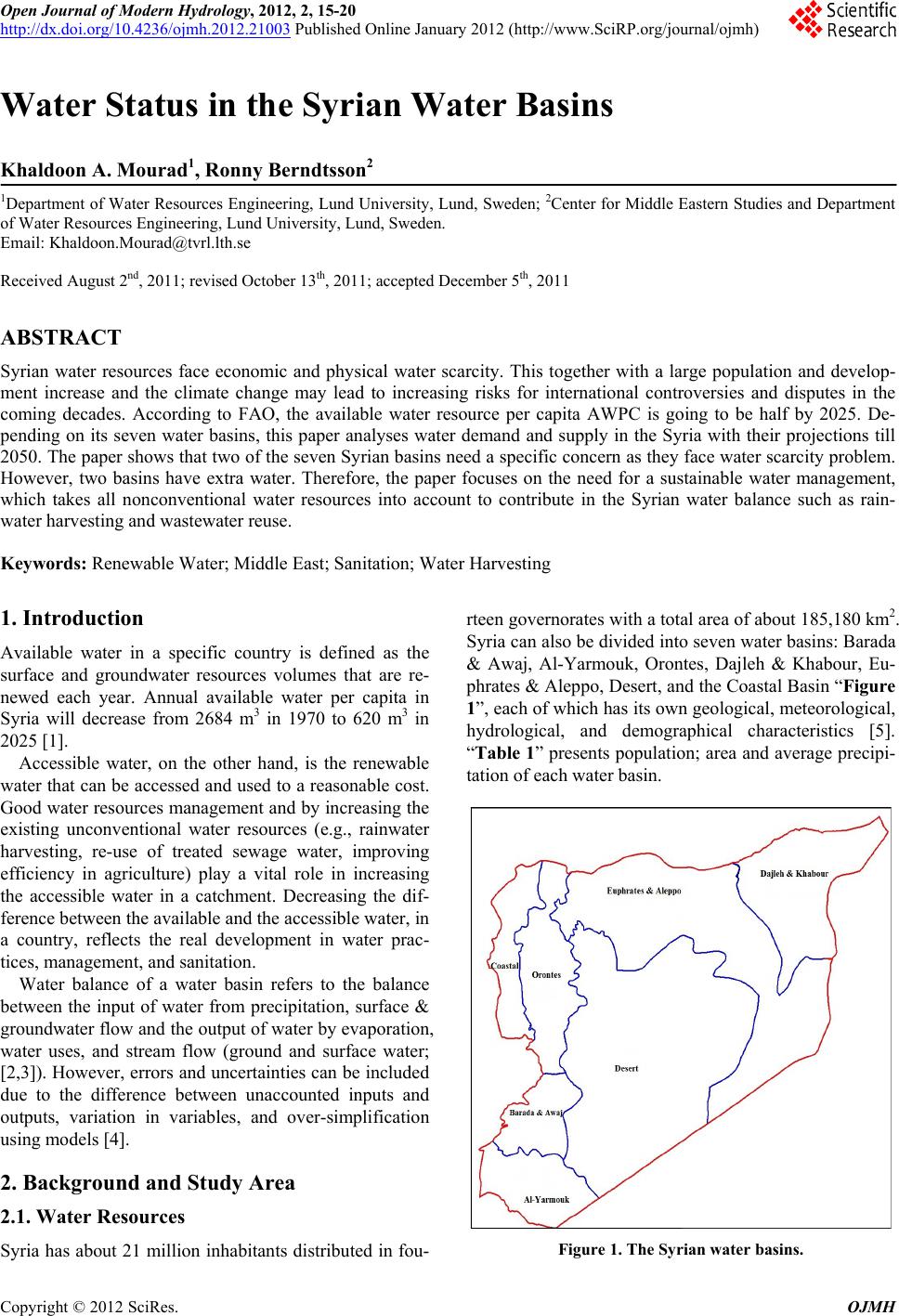 Open Journal of Modern Hydrology, 2012, 2, 15-20 http://dx.doi.org/10.4236/ojmh.2012.21003 Published Online January 2012 (http://www.SciRP.org/journal/ojmh) 1 Water Status in the Syrian Water Basins Khaldoon A. Mourad1, Ronny Berndtsson2 1Department of Water Resources Engineering, Lund University, Lund, Sweden; 2Center for Middle Eastern Studies and Department of Water Resources Engineering, Lund University, Lund, Sweden. Email: [email protected] Received August 2nd, 2011; revised October 13th, 2011; accepted December 5th, 2011 ABSTRACT Syrian water resources face economic and physical water scarcity. This together with a large population and develop- ment increase and the climate change may lead to increasing risks for international controversies and disputes in the coming decades. According to FAO, the available water resource per capita AWPC is going to be half by 2025. De- pending on its seven water basins, this paper analyses water demand and supply in the Syria with their projections till 2050. The paper shows that two of the seven Syrian basins need a specific concern as they face water scarcity problem. However, two basins have extra water. Therefore, the paper focuses on the need for a sustainable water management, which takes all nonconventional water resources into account to contribute in the Syrian water balance such as rain- water harvesting and wastewater reuse. Keywords: Renewable Water; Middle East; Sanitation; Water Harvesting 1. Introduction Available water in a specific country is defined as the surface and groundwater resources volumes that are re- newed each year. Annual available water per capita in Syria will decrease from 2684 m3 in 1970 to 620 m3 in 2025 [1]. Accessible water, on the other hand, is the renewable water that can be accessed and used to a reasonable cost. Good water resources management and by increasing the existing unconventional water resources (e.g., rainwater harvesting, re-use of treated sewage water, improving efficiency in agriculture) play a vital role in increasing the accessible water in a catchment. Decreasing the dif- ference between the available and the accessible water, in a country, reflects the real development in water prac- tices, management, and sanitation. Water balance of a water basin refers to the balance between the input of water from precipitation, surface & groundwater flow and the output of water by evaporation, water uses, and stream flow (ground and surface water; [2,3]). However, errors and uncertainties can be included due to the difference between unaccounted inputs and outputs, variation in variables, and over-simplification using models [4]. 2. Background and Study Area 2.1. Water Resources Syria has about 21 million inhabitants distributed in fou- rteen governorates with a total area of about 185,180 km2. Syria can also be divided into seven water basins: Barada & Awaj, Al-Yarmouk, Orontes, Dajleh & Khabour, Eu- phrates & Aleppo, Desert, and the Coastal Basin “Figure 1”, each of which has its own geological, meteorological, hydrological, and demographical characteristics [5]. “Table 1” presents population; area and average precipi- tation of each water basin. Figure 1. The Syrian water basins. Copyright © 2012 SciRes. OJMH 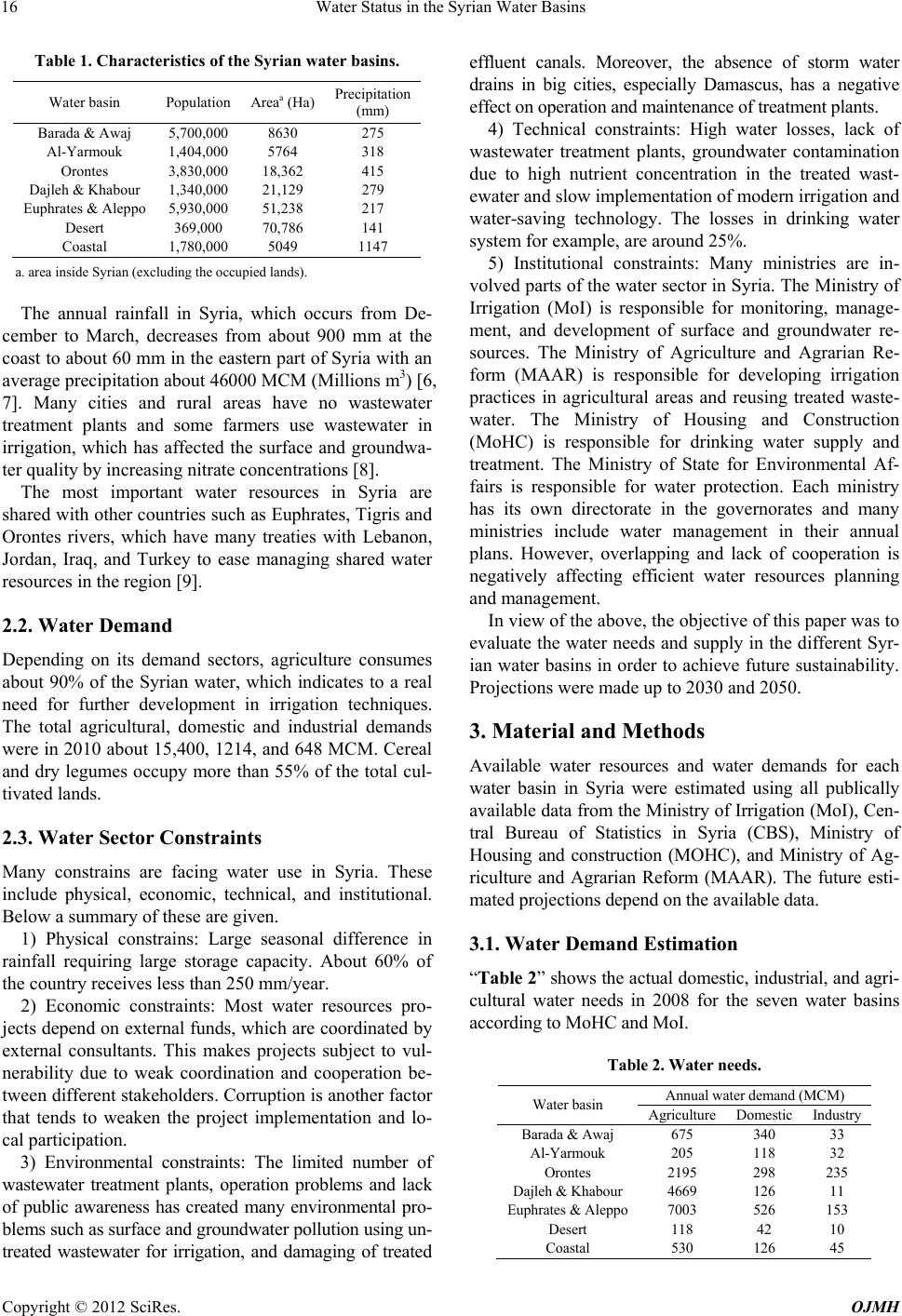 Water Status in the Sy ri an Water Basins 16 Table 1. Characteristics of the Syrian water basins. Water basin PopulationAreaa (Ha) Precipitation (mm) Barada & Awaj 5,700,0008630 275 Al-Yarmouk 1,404,0005764 318 Orontes 3,830,00018,362 415 Dajleh & Khabour 1,340,00021 ,129 279 Euphrates & Aleppo 5,930,00051,238 217 Desert 369,000 70,786 141 Coastal 1,780,0005049 1147 a. area inside Syrian (excluding the occupied lan ds). The annual rainfall in Syria, which occurs from De- cember to March, decreases from about 900 mm at the coast to about 60 mm in the eastern part of Syria with an average precipitation about 46000 MCM (Millions m3) [6, 7]. Many cities and rural areas have no wastewater treatment plants and some farmers use wastewater in irrigation, which has affected the surface and groundwa- ter quality by increasing nitrate concentrations [8]. The most important water resources in Syria are shared with other countries such as Euphrates, Tigris and Orontes rivers, which have many treaties with Lebanon, Jordan, Iraq, and Turkey to ease managing shared water resources in the region [9]. 2.2. Water Demand Depending on its demand sectors, agriculture consumes about 90% of the Syrian water, which indicates to a real need for further development in irrigation techniques. The total agricultural, domestic and industrial demands were in 2010 ab out 15,400, 1214, and 648 MCM. Cereal and dry legumes occupy more than 55% of the total cul- tivated lands. 2.3. Water Sector Constraints Many constrains are facing water use in Syria. These include physical, economic, technical, and institutional. Below a summary of these are given. 1) Physical constrains: Large seasonal difference in rainfall requiring large storage capacity. About 60% of the country receives less than 250 mm/year. 2) Economic constraints: Most water resources pro- jects depend on exter nal funds, which are coordinated by external consultants. This makes projects subject to vul- nerability due to weak coordination and cooperation be- tween different stakeholders. Corruption is another factor that tends to weaken the project implementation and lo- cal participation. 3) Environmental constraints: The limited number of wastewater treatment plants, operation problems and lack of public awareness has created many environmental pro- blems such as surface and groundwater pollution using un- treated wastewater for irrigation, and damaging of treated effluent canals. Moreover, the absence of storm water drains in big cities, especially Damascus, has a negative effect on operation and maintenance of treatment pl ants. 4) Technical constraints: High water losses, lack of wastewater treatment plants, groundwater contamination due to high nutrient concentration in the treated wast- ewater and slow implementation of modern irrigation and water-saving technology. The losses in drinking water system for example, are around 25%. 5) Institutional constraints: Many ministries are in- volved parts of the water sector in Syria. The Ministry of Irrigation (MoI) is responsible for monitoring, manage- ment, and development of surface and groundwater re- sources. The Ministry of Agriculture and Agrarian Re- form (MAAR) is responsible for developing irrigation practices in agricultural areas and reusing treated waste- water. The Ministry of Housing and Construction (MoHC) is responsible for drinking water supply and treatment. The Ministry of State for Environmental Af- fairs is responsible for water protection. Each ministry has its own directorate in the governorates and many ministries include water management in their annual plans. However, overlapping and lack of cooperation is negatively affecting efficient water resources planning and management. In view of the above, the objective of this paper was to evaluate the water needs and supply in the different Syr- ian water basins in order to achieve future sustainability. Projections were made up to 2030 and 2050. 3. Material and Methods Available water resources and water demands for each water basin in Syria were estimated using all publically available data from the Ministry of Irrigation (MoI), Cen- tral Bureau of Statistics in Syria (CBS), Ministry of Housing and construction (MOHC), and Ministry of Ag- riculture and Agrarian Reform (MAAR). The future esti- mated projections depend on the availabl e data. 3.1. Water Demand Estimation “Table 2” shows the actual domestic, industrial, and agri- cultural water needs in 2008 for the seven water basins according to MoHC and MoI. Table 2. Water needs. Annual water demand (MCM) Water basin Agriculture Domestic Industry Barada & Awaj 675 340 33 Al-Yarmouk 205 118 32 Orontes 2195 298 235 Dajleh & Khabour 4669 126 11 Euphrates & Aleppo7003 526 153 Desert 118 42 10 Coastal 530 126 45 Copyright © 2012 SciRes. OJMH  Water Status in the Sy ri a n Water Basins 17 3.1.1. Agricultural Demand: For agricultural demand we assumed that due to water shortage, cultivated land will be constant and the impl- ementation of modern irrigation practices will annually save about 0.5% of t he c onsumed water. 3.1.2. Industrial Demand : For the industrial sector , the number of industrial projects is increasing every year. According to CBS the annual increase between 1970-2010 was about 1.7%. Therefore we can assume that the annual industrial demand is to increase by 2%. 3.1.3. Domestic Demand: According to Tables 1 and 2, we can estimate the daily per capita domestic needs in “Figure 2”. Moreover, According to CBS, the average population increase, all over Syria, decreased from 3% for 19 60- 19 70 to 2.2% for 2000-2010. However the populations increase is different from basins to basin (“Figure 3”). For the future domestic demand projections, we assume, due to the expected improvement in the drinking water systems, that the domestic con sumptio n will b e redu ced b y 10 % by 2030 and anot her 5% by 2050. 3.2. Annual Renewable Water Resources The annual renewable water resources in a basin are the summation of the net surface water flow, the net ground- water flow, and the reclaimed water. The total surface water SW, groundwater GW and reclaimed water RW (agricultural, domestic, and industrial) for the Syrian wa- ter basins are presented in “Table 3”. According to MoI, the reclaimed water in 2008 was about 2306, 671, and 407 MCM in agriculture, domestic, and industrial sectors, respectively. This corresponds to about 15%, 55%, and 65% of the totally consumed water in agriculture, domestic, and industrial sector, respec- tively. In the national development plan, MoHC has an- nounced the construction of more than 20 wastewater treatment plants within the next 20 years. According to this, domestic and industrial wastewaters will be treated up to 85% by volume in 2040. This gives an average an- nual increase of treated domestic and industrial wastewa- ter of about 1% and 0.5%, respectively. 3.3. Climate Change Effect Climate change will have severe impacts on regional wa- ter stress [10]. The Middle East is likely to face a decrease in precipitation amount by 20% - 25%, which will reduce the runoff with about 23%, and Euphrates River flow may be reduced by 29% - 73% [11]. Moreover, Middle East average temperature may increase by about 2.5˚C to 2050, which will affect evaporated water amounts [11]. Hence, Figure 2. The daily water consumption per cap ita (L). Figure 3. Annual population increas es (%). Table 3. Annual renewable wate r res ources. Annual water resources (MCM) RW Water basin SWGW Ag. Do.In. Barada & Awaj 37 470 99 20426 Al-Yarmouk 24 170 9 4726 Orontes 662891 53 32188 Dajleh & Khabour 1522000 467 1019 Euphrates & Aleppo7134645 1410 210122 Desert 21 150 0 3 0 Coastal 715485 53 3236 we assumed an annual reduction in surface and ground- water resources b y about 0. 25% and an annual increase in evaporation rate by about 0.25% up to 2050. 4. Results and Discussion 4.1. Water Demand and Resources Projections According to the above, without building any scenario, population, agricultural demand, industrial demand, and domestic demand of the Syrian water basins for 2030 and 2050 are presented in Table 4. While Table 5 presents water demands and resources projections in 2030 and 2050. Copyright © 2012 SciRes. OJMH  Water Status in the Sy ri an Water Basins Copyright © 2012 SciRes. OJMH 18 Table 4. Water demands projections. 2030 2050 Water demand (MCM) Water demand (MCM) Water basin Population Domestic AgricultureIndustry Population Domestic Agriculture Industry Barada & Awaj 8029476 430 631 49 10991550559 625 71 Al-Yarmouk 2242356 169 192 48 3447847 247 190 69 Orontes 6011108 421 2053 350 9094206 605 2033 504 Dajleh & Khabour 1922739 163 4367 16 2677222 216 4323 24 Euphrates & Aleppo 10140774 809 6550 228 166146451260 6485 328 Desert 569028 58 110 15 846941 82 109 21 Coastal 2325178 148 496 67 2969020 180 491 96 Table 5. Water resources projections. 2030 2050 Reclaimed water Reclaimed water Water basin Surface water Ground water Do. Ag. In. Water basin Surface water Ground water Do. Ag.In. Barada & Awaj 35 447 259 93 39 Barada & Awaj 33 425 336 92 56 Al-Yarmouk 23 162 68 8 39 Al-Yarmouk 22 154 99 8 56 Orontes 629 847 45 50 280Orontes 598 805 65 49 403 Dajleh & Khabour 144 1901 130 437 13 Dajleh & Khabour 137 1807 1 73 43219 Euphrates & Aleppo 6782 613 323 1319182Euphrates & Aleppo6447 583 503 1306261 Desert 20 143 4 0 0 Desert 19 136 6 0 0 Coastal 680 461 38 50 54 Coastal 646 438 46 49 77 4.2. Water Balance According to Tables 4 and 5 water balance calculations showed that five of the seven water basins are in a water scarce condition till 2050. However, Coastal and Eu- phrates & Aleppo Basins will keep in the decreasing po- sitive track (Figure 4). Therefore, a vital action is needed to solve these water shortages. 4.3. Scenarios for a Better future 4.3.1. Water Transfer between Basins. In this scenario we chose two neighboring basins, one with a water shortage problem and the other with more water availability. The following two examples were proposed. a) The Orontes and Coastal basins. Pumping 600 MCM per year of water from the Coastal basin to the Orontes basin, will decrease water shortage in the Orontes basin. However, this also means that the Coastal basin needs extra water according to “Figure 5”. b) The Desert, Dajleh & Khabour and Euphrates & Aleppo basins. Euphrates & Aleppo basin is rich with water. Howev er, its neighbors Desert and Dajleh & Khabour basins have water shortage problems. If we keep the Euphrates & Aleppo and Desert basins balanced we can pump 1960, 1614, 1308, and 974 MCM in 2020, 2030, 2040, and 2050, respectively to Dajleh & Khabou r basin. Yet this is not enough for this basin “Figure 6”. 4.3.2. Regi onal Coopera ti on . Regional cooperation is needed to solve Dajleh & Kh- abour, Barada & Awaj, and Al-Yarmouk basins. For Da- jleh & Khabour basin, an annual amount of 500 MCM of water from Tigris river with some water saving and modern irrigation can keep the basin balanced. Al-Yar- mouk and Barada & Awaj basins can be balanced by the Syrian water in the occ upied Gol an heigh t s . 4.3.3. Technical Scenario. We assumed an optimistic scenario that the water con- sumption per capita will be 125 liters in 2030, due to the improvements in the water supply networks and the im- plementation of water saving devices, which gives 1.9, 5.25, 4.4, 6.65, 5.9, 9.35, and 3.45 Lpcd as an annual de- crease in the domestic water consumption till 2030 in the Barada & Awaj, Al-Yarmouk, Orontes, Dajleh & Kha- bour, Euphrates & Aleppo, Desert, and the Coastal basin, respectively. Moreov er, we assumed that all do mestic and industrial wastewater will be reused (90% of the demand) and that rainwater-harvesting tech niq ues will sav e ano ther 1.5 % of the total rainfall in each basin by 2030. The re- sults from this scenario are presented in “Figure 7”. Figure 7 shows that this scenario can balance more basins. However, Dajleh & Khabour and Orontes basins still have water shortage status. 5. Conclusions Syria is considered a water-scarce country as five of its  Water Status in the Sy ri a n Water Basins 19 seven water basins face a real water shortage problem. However, good development practices and water coop- eration at national and regional level can help in balanc- ing water needs and water supplies. The improvement of drinking water systems can help in reducing domestic water losses as it reached more than 50% in some cities. The results showed that reusing all domestic and Indus- trial wastewater might increase reclaimed water by 1000 MCM in 2050. On the other hand, climate change will have a severe effect on the Syrian water resources. It will decrease the surface and groundwater by about 1300 MCM in 2050. However, rainwater harvesting can con- tribute as a climate change adaptation technique that can save annually about 20 0 0 M CM . Figure 4. Water balance in the Syrian basins. Figure 5. Orontes and costal basins scenario. Figure 6. Desert, Dajleh & Khabour and Euphrates & Aleppo basins scenario. Figure 7. The technical scenario. Syria is a key country in the Middle East and can pos- sibly serve as an indicator for the area. As seen from the above need its water resources shortage problems could be balanced by reclaimed water and rainwater harvesting. We believe that this is typical for all countries in the Middle East. 6. Acknowledgements Funding from the MECW project at the Center for Mid- dle Eastern Studies, Lund University, is gratefully ac- knowledged. Valuable cooperation from all stakeholders in Ministry of Irrigation, Ministry of Environment, and other ministries in Syria is also acknowledged. REFERENCES [1] FAO—Food and Agriculture Organization. Aquastat da- tabase: Syria Arab Republic, 2011. http://www.fao.org/nr/water/aquastat/countries/syria/inde x.stm [2] P. Kerkides, H. Michalopoulou, G. Papaioannou and R. Pollatou, “Water Balance Estimates over Greece,” Agri- culture Water Management, Vol. 32, No. 1, 1996, pp: 85- 104. doi:10.1016/S0378-3774(96)01251-6 [3] L. Zhang, N. Potter, K. Hickel, Y. Zhang and Q. Shao, “Water Balance Modeling over Variable Time Scales Based on the Budyko Framework-Model Development and Testing,” Journal of Hydrology, Vol. 360, No. 1-4, 2008, pp: 117-131. doi:10.1016/j.jhydrol.2008.07.021 [4] R. C. Owen, “Water Budget and Flow Patterns in an Urban Wetland,” Journal of Hydrology, Vol. 169, No. 1-4, 1995, pp: 171-187. doi:10.1016/0022-1694(94)02638-R [5] CBS-SYR. Central Bureau of Statistics of Syria, Popula- tion and Demographic Indicators, 2011. http://www.cbssyr.org [6] CBS-SYR, Central Bureau of Statistics of Syria, Number of Private Industrial Projects in Syria, 2011. From http://www.cbssyr.org/Time%20Series/economic1.htm [7] GCSAR—General Commission for Scientific Agricultu- ral Research, Country Profile Syria, 2011. http://www.gewamed.net/share/img_country_information /12_read_more...pdf Copyright © 2012 SciRes. OJMH  Water Status in the Sy ri an Water Basins Copyright © 2012 SciRes. OJMH 20 [8] Z. Kattan, “Characterization of Surface Water and Ground- water in the Damascus Ghotta Basin: Hydrochemical and Environmental Isotopes Approaches,” Environmental Ge- ology, Vol. 51, No. 2, 2006, pp: 173-201. [9] MoI-SYR, Ministry of Irrigation in Syria. Agreements with Neighboring Countries, 2011. http://www.irrigation.gov.sy/index.php?m=118 [10] N. W. Arnell, “Climate Change and Global Water Reso- urces,” Global Environment Change, Vol. 9, Suppl. 1, 1999, pp. S31-S49. doi:10.1016/S0959-3780(99)00017-5 [11] M. J. Trondalen, “Climate Changes, Water Security and Possible Remedies for the Middle East,” Scientific Paper from Potential Conflict to Co-operation Potential (UNE- SCO PCCP, 2009. http://www.unwater.org/downloads/181886E.pdf |