

Paper Menu >>
Journal Menu >>
 Psychology 2012. Vol.3, No.1, 7-11 Published Online January 2012 in SciRes (http://www.SciRP.org/journal/psych) http://dx.doi.org/10.4236/psych.2012.31002 Copyright © 2012 SciRes. 7 Friendship Motivation, Aggression, and Self-Esteem in Japanese Undergraduate Students Ryo Okada Faculty of Education, Kagawa University, Kagawa, Japan Email: [email protected] Received October 13th, 2011; revised November 14th, 2011; accepted December 17th, 2011 The purpose of this study was to examine the relationship among self-determined friendship motivation (motivation for friendship formation), aggression, and self-esteem in a sample of 262 Japanese university students. The hypothetical model posited that self-determined friendship motivation predicted lower le- vels of aggression, which, in turn, predicted lower levels of self-esteem. The results showed that self-de- termined friendship motivation predicted lower levels of anger, hostility, and physical aggression and that hostility and anger predicted lower levels of self-esteem. Verbal aggression was found to be positively associated with self-determined friendship motivation and self-esteem. The different relationships be- tween self-determined friendship motivation and each facet of aggression are discussed. Keywords: Friendship Motivation; Aggression; Self-Esteem; Self-Determination Theory Introduction During adolescence, friendship plays an important role in one’s life. Hartup and Stevens (1997) stated that friends are cognitive and affective resources that foster self-esteem and a sense of well-being. A number of empirical studies have re- vealed that friendship influences individuals’ well-being and psychological adjustment (Lucas & Dyrenforth, 2006). Researchers have recently examined the relationship between friendship formation and motivation. Motivation for friendship formation (i.e., friendship motivation) has been conceptualized in various motivational theories, for example, achievement goal theory (Elliot, Gable, & Mapes, 2006; Ryan & Shim, 2006), self-efficacy theory (Matsushima & Shiomi, 2003; Patrick, Ryan, & Kaplan, 2007), and social goal theory (Jarvinen & Nicholls, 1996). Another theory, the self-determination theory (Deci & Ryan, 2000) has proposed a comprehensive framework for friendship motivation. It conceptualizes several types of motivation in terms of the level of self-determination—external regulation, introjected regulation, identified regulation, and intrinsic motivation. External regulation refers to motivation by contingencies such as external rewards or punishment and mo- tivation by others’ initiative. Sometimes, individuals continue to talk to a certain friend merely because the friend talks to them. This is an example of external regulation. Introjected regulation refers to motivation stemming from feelings of anxi- ety or shame. The purpose of behaviors motivated by intro- jected regulation is to maintain one’s self-esteem. Individuals guided by introjected regulation believe that they “should” form and maintain friendships with others. Identified regulation re- fers to motivation based on perceptions of the value and impor- tance of the activity. For individuals motivated by identified regulation, friendships are very important interpersonal rela- tionships. However, they also see their friendships as means to achieve other ends such as personal happiness and growth. Intrinsic motivation refers to spontaneous motivation charac- terized by fun and inherent enjoyment. In this motivational state, the friendship is a purpose. Enjoying talking to and being in the company of friends is an example of intrinsic motivation. Em- pirical studies have examined the role of motivation in adoles- cents’ friendship (Boiché & Sarrazin, 2007; Hawley, Little, & Pasupathi, 2002; Senécal, Julien, & Guay, 2003). The different types of motivation can be placed along a self-determination continuum, with external regulation at the lower end of the continuum and intrinsic motivation at the higher end. The self-determination level of an individual’s mo- tivation is characterized by the magnitude of these four types of motivation (Deci & Ryan, 2000). In empirical studies, Relative Autonomy Index (RAI) was used to assess the level of self- determination of the individuals’ motivation (Grolnick & Ryan, 1987; Levesque, Zuehlke, Stanek, & Ryan, 2004). The RAI is formed by weighting each subscale in accord with its underly- ing scores on the self-determination continuum in the following formula: RAI = (–2 × external regulation) + (–1 × introjected regulation) + (1 × identified regulation) + (2 × intrinsic motiva- tion). Higher scores of RAI represent higher levels of self-de- termined motivation. Previous studies have verified the importance of self-deter- mined friendship motivation. Okada (2005) developed a scale to measure friendship motivation and found that self-deter- mined friendship motivation predicted prosocial behavior. Richard and Schneider (2005) revealed that children with higher levels of self-determined friendship motivation had more relationship-maintaining goals and were liked by their peers. Self-determined friendship motivation was also related to self- disclosure (Okada, 2006), academic help-seeking (Okada, 2007), social competence (Soenens & Vansteenkiste, 2005), and ex- perience of positive life events (Shahar, Henrich, Blatt, & Ryan, 2003). These findings suggest that self-determined friendship motivation promotes adaptive behaviors and positive interac- tions with friends. Although the relationship between self-determined friendship motivation and adaptive behaviors has been verified in some  R. OKADA studies, few studies have examined the relationship between self-determined friendship motivation and maladaptive behav- iors during adolescence. On the basis of some relevant studies, it was predicted that self-determined friendship motivation was negatively associated with maladaptive behaviors. Knee, Lons- bary, Canevello, and Patrick (2005), for example, observed couples discussing their relationship conflicts and examined the relationship between their motivations and behaviors. The re- sults showed that individuals with higher levels of self-deter- mined motivation for their relationships (i.e., couple motivation) displayed less defensive behaviors such as blame and down- playing problems. In addition, Richard and Schneider (2005) found that external regulation for friendship, which represents lower levels of self-determined friendship motivation, was positively related to control and revenge goals in preadolescents and early adolescents. On the basis of these findings, it was hypothesized that self-determined friendship motivation pre- dicted less maladaptive behaviors. In examining the relationship between self-determined fri- endship motivation and maladaptive behaviors, this study fo- cused on aggression. Aggressive or hostile individuals tend to receive less social support (Barefoot, Dahlstrom, & Williams, 1983), and aggression and hostility can lead to poor physical health (Miller, Smith, Turner, Guijarro, & Hallet, 1996). There- fore, determining the factors that predict aggression will be useful viewpoint for researchers and practitioners in this field. Buss and Perry (1992) developed the Buss-Perry Aggression Questionnaire and found four facets of aggression—physical aggression, verbal aggression, anger, and hostility. Later studies revealed that these four facets of aggression were related to depression (Gerevich, Bácskai, & Czobor, 2007), negative in- terpersonal relationships (Harris, 1997), anger to mistreatment (Felsten & Hill, 1999), aggressive responses to provocation (O’Connor, Archer, & Wu, 2001), and daily negative affect (Harmon-Jones, 2003). People with higher levels of self-de- termined friendship motivation find fun and personal value in their friendships and therefore, rarely act aggressively. On the other hand, people with lower levels of self-determined friend- ship motivation feel obligated and anxious about relationships with their friends, so they are inclined to feel hostile and act aggressively. Therefore, it was hypothesized that self-deter- mined friendship motivation predicted lower levels of the four facets of aggression. In previous studies (Deci, Ryan, Gagné, Leone, Usunov, & Kornazheva, 2001; Levesque, et al., 2004), self-esteem has been examined as an outcome variable predicted by self-de- termined motivation. Given that self-determined friendship motivation would be positively related to self-esteem, it was predicted that aggression would mediate the relationship. Ac- cording to sociometer theory (Leary, Tambor, Terdal, & Downs, 1995), self-esteem is part of a psychological system that moni- tors acceptance and rejection by others. People can gauge whether they are accepted or rejected by others from changes in their self-esteem. In support of this theory, the experimental manipulations that convey rejection reduce participants’ self-es- teem, whereas those that convey acceptance enhance their self- esteem (Leary & Baumeister, 2000). Because aggression is likely to lead to rejection by friends, aggressive individuals would report lower levels of self-esteem. In summary, the purpose of this study was to examine a model in which self-determined friendship motivation would predict lower levels of aggression, which, in turn, would predict lower levels of self-esteem. The examination of the model would reveal the role of motivation in adolescents’ friendship from the side of maladaptive behaviors. Method Participants and Procedure The participants comprised 262 Japanese university students (101 men and 161 women) with a mean age of 20.10 years (SD = 1.05). All participants were volunteers and were informed at the start that the outcome and participation would not affect their course grades. After the orientation, the participants filled a questionnaire. Measures Self-determined friendship motivation was measured by the Friendship Motivation Scale developed by Okada (2005). This scale assesses the reasons for forming friendships and interact- ing with friends. There are four subscales of four items each: external regulation (e.g., “Because my friends would get mad at me if I’m not with them”), introjected regulation (e.g., “Be- cause I would feel anxious if I didn’t have any friends”), identi- fied regulation (e.g., “Because I value getting to know my friends better”), and intrinsic motivation (e.g., “Because I’m glad to be intimate with my friends”). The instruction was “Why do you have close relationships with your friends or spend time together with your friends?” Participants were also instructed that “friends” does not refer to specific friends but friends in general. Participants were asked to rate each item on a 5-point Likert scale ranging from 1 (not true) to 5 (true). The reliabilities for each subscale were verified in a sample of Japanese university students (Cronbach alphas ranged from .61 to .86, and test-retest coefficients during the three weeks ranged from .68 to .80; Okada, 2005). In the present study, the alphas for the subscales were .45 for external regulation, .74 for intro- jected regulation, .80 for identified regulation, and .88 for in- trinsic motivation. Although the value of external regulation was relatively small, omission of an item slightly improved the value (α = .55). The descriptive score of external regulation was the average of the three items, and the descriptive scores of the other three subscales were calculated by averaging each of the four item scores. For the purpose of this study, the RAI was calculated same as previous studies (Grolnick & Ryan, 1987; Levesque, et al., 2004; Losier & Vallerand, 1994). The RAI is formed by weighting each subscale in accord with its underly- ing scores on the self-determination continuum in the following formula: RAI = (–2 × external regulation) + (–1 × introjected regulation) + (1 × identified regulation) + (2 × intrinsic motive- tion). In the subsequent analyses, the RAI score was used as an index of self-determined friendship motivation. The Japanese version of the Buss and Perry Aggression Questionnaire (Buss & Perry, 1992) developed by Ando, Soga, Yamasaki, Shimai, Shimada, Utsuki, Oashi, and Sakai (1999) was used to assess aggression. This scale consists of four sub- scales of physical aggression (5 items; e.g., “If somebody hits me, I hit back”), verbal aggression (6 items; e.g., “I tell my friends openly when I disagree with them”), anger (5 items; e.g., “I have trouble controlling my temper”), and hostility (6 items; e.g., “I sometimes feel that people are laughing at me behind my back”). Participants were asked to rate each item on a 5- point Likert scale ranging from 1 (not true) to 5 (true). The Copyright © 2012 SciRes. 8  R. OKADA Copyright © 2012 SciRes. 9 reliabilities for each subscale were verified in a sample of Japanese university students (Cronbach alphas ranged from .70 to .78, and test-retest coefficients during the three weeks ranged from .70 to .80; Ando, et al., 1999). In the present study, the alphas for the subscales were .78 for physical aggression, .75 for verbal aggression, .76 for anger, and .74 for hostility. The descriptive scores of the four subscales were calculated by av- eraging the item scores. Self-esteem was measured with the Japanese version of Ro- senberg’s Self-Esteem Scale (10 items) developed by Yama- moto, Matsui, and Yamanari (1982). Participants were asked to rate each item on a 5-point Likert scale ranging from 1 (not true) to 5 (true). The Cronbach alpha was .84 in the present study. The descriptive score was calculated by averaging ten item scores. Results Descriptive Statistics and Correlations among Variables Descriptive statistics and Pearson correlations among vari- ables are presented in Table 1. Consistent with predictions, RAI was negatively related to anger (r = –.24, p < .001) and hostility (r = –.29, p < .001). The relation between RAI and physical aggression was marginally significant (r = –.10, p < .10). Un- expectedly, RAI was positively associated with verbal aggres- sion (r = .18, p < .01). RAI was also positively related to self-esteem (r = .25, p < .001). Anger and hostility were nega- tively related to self-esteem (rs = –.18 and –.38, ps < .01, re- spectively). Against predictions, verbal aggression was posi- tively associated with self-esteem (r = .34, p < .001). The rela- tion between physical aggression and self-esteem was nearly zero (r = –.00, n.s.). Examination of the Hypo thetical Model It was hypothesized that self-determined friendship motiva- tion would predict lower levels of aggression, which, in turn, would predict higher levels of self-esteem. The hypothetical model was constructed in the following manner. Paths from RAI to four aggression scores and paths from four aggression scores to self-esteem were postulated. Covariances among four aggression scores were also included. The model was tested using structural equation modeling with AMOS 17.0. The model fit was assessed by the following statistics (Byrne, 2001): the chi-square value (nonsignificant values represent an acceptable fit), the Goodness of Fit Index (GFI; values above .90 represent an acceptable fit), Adjusted Goodness of Fit Index (AGFI; values above .90 represent an acceptable fit), Comparative Fit Index (CFI; values above .90 represent an acceptable fit), and the Root Mean Square Error of Approximation (RMSEA; values below .08 represent an ac- ceptable fit). The analysis showed that the hypothetical model adequately fit the data, χ2 (1) = 1.95, n.s., GFI = 1.00, AGFI = .95, CFI = 1.00, and RMSEA = .06. The path from physical aggression to self-esteem (β = .03) and the covariance between verbal ag- gression and hostility (r = .03) were nonsignificant; these pa- rameters were therefore fixed at zero in the final model. Be- cause the path from RAI to physical aggression (β = –.10, p < .10) and the path from anger to self-esteem (β = –.11, p < .10) were marginally significant, these paths were freely estimated again. The final model is depicted in Figure 1. The analysis showed that the model adequately fit the data, χ2 (3) = 2.32, n.s., GFI = 1.00, AGFI = .98, CFI = 1.00, RMSEA = .00, and the change of chi square values was also nonsignificant (Δχ2 (2) = 0.37, n.s.). The RAI predicted higher levels of verbal aggres- sion (β = .18, p < .01) and lower levels of anger and hostility (βs = –.24 and –.29, ps < .001, respectively). The path from RAI to physical aggression was negative at a marginally sig- nificant level (β = –.10, p < .10). Verbal aggression predicted higher levels of self-esteem (β = .34, p < .001) and hostility predicted lower levels of self-esteem (β = –.32, p < .001). An- ger predicted lower levels of self-esteem at a marginally sig- nificant level (β = –.11, p < .10). Discussion The purpose of this study was to examine a model in which self-determined friendship motivation would predict lower levels of aggression, which, in turn, would predict lower levels of self-esteem. Consistent with the hypothetical model, path analyses showed that self-determined friendship motivation predicted lower levels of anger, hostility, and physical aggres- sion, and hostility and anger predicted lower levels of self- esteem. People with higher levels of self-determined friendship motivation are likely to feel less anger and hostility and to act less aggressively in their relationships with friends, because they are motivated by their interest in friends or the importance of friendship. People who display less hostility and anger to- ward friends are likely to be more accepted, and those who interact with others in a hostile and angry manner tend to be avoided and rejected. Hostility and anger lead to rejection by Table 1. Pearson correlations among variables, means, and standard deviations. 1 2 3 4 5 Mean SD 1. RAI 5.87 2.77 2. Physical aggression –.10† 2.70 0.81 3. Verbal aggression .18** .33*** 2.90 0.77 4. Anger –.24*** .42*** .18*** 2.84 0.84 5. Hostility –.29*** .29*** –.03 .43*** 3.03 0.72 6. Self-esteem .25*** –.00 .34*** –.18** –.38*** 3.13 0.68 †p < .10, **p < .01, ***p < .001. 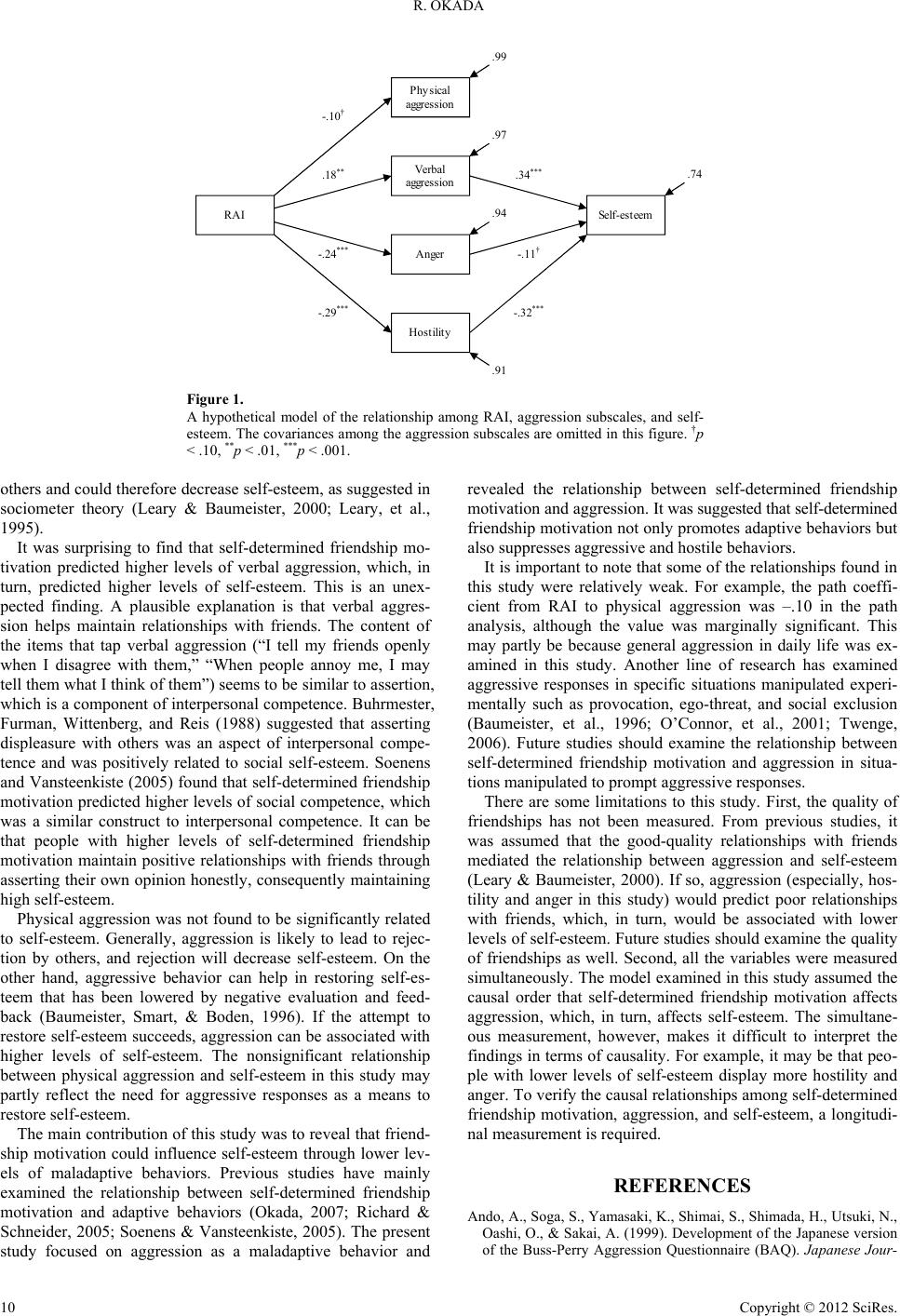 R. OKADA .99 .91 -.32 *** -.11 † .34 *** .97 .18 ** -.24 *** -.29 *** -.10 † .74 .94 RAI Verbal aggression Anger H o stility Self-esteem P h ysical aggression Figure 1. A hypothetical model of the relationship among RAI, aggression subscales, and self- esteem. The covariances among the aggression subscales are omitted in this figure. †p < .10, **p < .01, ***p < .001. others and could therefore decrease self-esteem, as suggested in sociometer theory (Leary & Baumeister, 2000; Leary, et al., 1995). It was surprising to find that self-determined friendship mo- tivation predicted higher levels of verbal aggression, which, in turn, predicted higher levels of self-esteem. This is an unex- pected finding. A plausible explanation is that verbal aggres- sion helps maintain relationships with friends. The content of the items that tap verbal aggression (“I tell my friends openly when I disagree with them,” “When people annoy me, I may tell them what I think of them”) seems to be similar to assertion, which is a component of interpersonal competence. Buhrmester, Furman, Wittenberg, and Reis (1988) suggested that asserting displeasure with others was an aspect of interpersonal compe- tence and was positively related to social self-esteem. Soenens and Vansteenkiste (2005) found that self-determined friendship motivation predicted higher levels of social competence, which was a similar construct to interpersonal competence. It can be that people with higher levels of self-determined friendship motivation maintain positive relationships with friends through asserting their own opinion honestly, consequently maintaining high self-esteem. Physical aggression was not found to be significantly related to self-esteem. Generally, aggression is likely to lead to rejec- tion by others, and rejection will decrease self-esteem. On the other hand, aggressive behavior can help in restoring self-es- teem that has been lowered by negative evaluation and feed- back (Baumeister, Smart, & Boden, 1996). If the attempt to restore self-esteem succeeds, aggression can be associated with higher levels of self-esteem. The nonsignificant relationship between physical aggression and self-esteem in this study may partly reflect the need for aggressive responses as a means to restore self-esteem. The main contribution of this study was to reveal that friend- ship motivation could influence self-esteem through lower lev- els of maladaptive behaviors. Previous studies have mainly examined the relationship between self-determined friendship motivation and adaptive behaviors (Okada, 2007; Richard & Schneider, 2005; Soenens & Vansteenkiste, 2005). The present study focused on aggression as a maladaptive behavior and revealed the relationship between self-determined friendship motivation and aggression. It was suggested that self-determined friendship motivation not only promotes adaptive behaviors but also suppresses aggressive and hostile behaviors. It is important to note that some of the relationships found in this study were relatively weak. For example, the path coeffi- cient from RAI to physical aggression was –.10 in the path analysis, although the value was marginally significant. This may partly be because general aggression in daily life was ex- amined in this study. Another line of research has examined aggressive responses in specific situations manipulated experi- mentally such as provocation, ego-threat, and social exclusion (Baumeister, et al., 1996; O’Connor, et al., 2001; Twenge, 2006). Future studies should examine the relationship between self-determined friendship motivation and aggression in situa- tions manipulated to prompt aggressive responses. There are some limitations to this study. First, the quality of friendships has not been measured. From previous studies, it was assumed that the good-quality relationships with friends mediated the relationship between aggression and self-esteem (Leary & Baumeister, 2000). If so, aggression (especially, hos- tility and anger in this study) would predict poor relationships with friends, which, in turn, would be associated with lower levels of self-esteem. Future studies should examine the quality of friendships as well. Second, all the variables were measured simultaneously. The model examined in this study assumed the causal order that self-determined friendship motivation affects aggression, which, in turn, affects self-esteem. The simultane- ous measurement, however, makes it difficult to interpret the findings in terms of causality. For example, it may be that peo- ple with lower levels of self-esteem display more hostility and anger. To verify the causal relationships among self-determined friendship motivation, aggression, and self-esteem, a longitudi- nal measurement is required. REFERENCES Ando, A., Soga, S., Yamasaki, K., Shimai, S., Shimada, H., Utsuki, N., Oashi, O., & Sakai, A. (1999). Development of the Japanese version of the Buss-Perry Aggression Questionnaire (BAQ). Japanese Jour- Copyright © 2012 SciRes. 10  R. OKADA nal of Psychology, 70, 384-392. doi:10.4992/jjpsy.70.384 Barefoot, J. C., Dahlstrom, W. G., & Williams, R. B. Jr. (1983). Hostil- ity, CHD incidence, and total mortality: A 25-year follow-up study of 255 physicians. P sychosomatic Medicine, 45, 59-63. Baumeister, R. F., Smart, L., & Boden, J. M. (1996). Relation of threatened egotism to violence and aggression: The dark side of high self-esteem. Psychological Review, 103, 5-33. doi:10.1037/0033-295X.103.1.5 Boiché, J. C. S., & Sarrazin, P. G. (2007). Self-determination of con- textual motivation, inter-context dynamics and adolescents’ patterns of sport participation over time. Psychology of Sport and Exercise, 8, 685-703. doi:10.1016/j.psychsport.2006.10.004 Buhrmester, D., Furman, W., Wittenberg, M. T., & Reis, H. T. (1988). Five domains of interpersonal competence in peer relationships. Journal of Personality and Social Psychology, 5 5, 991-1008. doi:10.1037/0022-3514.55.6.991 Buss, A. H., & Perry, M. (1992). The aggression questionnaire. Journal of Personality and Social Ps y c h o l o g y , 63, 452-459. doi:10.1037/0022-3514.63.3.452 Byrne, B. M. (2001). Structural equation modeling with AMOS: Basic concepts, applications and programming. Mahwah, NJ: Erlbaum. Deci, E. L., & Ryan, R. M. (2000). The “what” and “why” of goal pursuits: Human needs and the self-determination of behavior. Psy- chological Inquiry, 11, 227-268. doi:10.1207/S15327965PLI1104_01 Deci, E. L., Ryan, R. M., Gagné, M., Leone, D. R., Usunov, J., & Kor- nazheva, B. P. (2001). Need satisfaction, motivation, and well-being in the work organizations of a former Eastern Bloc country: A cross- cultural study of self-determination. Personality and Social Psy- chology Bulletin, 27, 930-942. doi:10.1177/0146167201278002 Elliot, A. J., Gable, S. L., & Mapes, R. R. (2006). Approach and avoidance motivation in the social domain. Personality and Social Psychology Bulletin, 32, 378-391. doi:10.1177/0146167205282153 Felston, G. & Hill, V. (1999). Aggression Questionnaire hostility scale predicts anger in response to mistreatment. Behaviour Research and Therapy, 37, 87-97. doi:10.1016/S0005-7967(98)00104-1 Gerevich, J., Bácskai, E., & Czobor, P. (2007). The generalizability of the Buss-Perry Aggression Questionnaire. International Journal of Methods in Psychiatric Research , 16, 124-136. doi:10.1002/mpr.221 Grolnick, W. S., & Ryan, R. M. (1987). Autonomy in children’s learn- ing: An experimental and individual difference investigation. Journal of Personality and Social Psychology, 52, 890-898. doi:10.1037/0022-3514.52.5.890 Harmon-Jones, E. (2003). Anger and the behavioral approach system. Personality and Individual Differences, 35, 995-1005. doi:10.1016/S0191-8869(02)00313-6 Harris, J. A. (1997). A further evaluation of the aggression question- naire: Issues of validity and reliability. Behaviour Research Therapy, 35, 1047-1053. doi:10.1016/S0005-7967(97)00064-8 Hartup, W. W., & Stevens, N. (1997). Friendships and adaptation in the life course. Psyc h ological Bulletin, 121, 355-370. doi:10.1037/0033-2909.121.3.355 Hawley, P. H., Little, T. D., & Pasupathi, M. (2002). Winning friends and influencing peers: Strategies of peer influence in late childhood. International Journal of Behavioral Development, 26, 466-474. doi:10.1080/01650250143000427 Jarvinen, D. W., & Nicholls, J. G. (1996). Adolescents’ social goals, beliefs about the causes of social success, and satisfaction in peer re- lations. Developmental Psychology, 32, 435-441. doi:10.1037/0012-1649.32.3.435 Knee, C. R., Lonsbary, C., Canevello, A., & Patrick, H. (2005). Self-determination and conflict in romantic relationships. Journal of Personality and Social P s y chology, 89, 997-1009. doi:10.1037/0022-3514.89.6.997 Leary, M. R., & Baumeister, R. F. (2000). The nature and function of self-esteem: Sociometer theory. In M. P. Zanna (Ed.), Advances in experimental social psychology (Vol. 32, pp. 1-62). San Diego, CA: Academic Press. Leary, M. R., Tambor, E. S., Terdal, S. K., & Downs, D. L. (1995). Self-esteem as an interpersonal monitor: The sociometer hypothesis. Journal of Personality a nd Social Psychology, 68, 518-530. doi:10.1037/0022-3514.68.3.518 Levesque, C., Zuehlke, A. N., Stanek, L. R., & Ryan, R. M. (2004). Autonomy and competence in German and American university stu- dents: A comparative study based on self-determination theory. Journal of Educational Psycholo gy, 96, 68-84. doi:10.1037/0022-0663.96.1.68 Losier, G., & Vallerand, R. J. (1994). The temporal relationship be- tween perceived competence and self-determined motivation. The Journal of Social Psychology, 134, 793-801. doi:10.1080/00224545.1994.9923014 Lucas, R. E., & Dyrenforth, R. S. (2006). Does the existence of social relationships matter for subjective well-being? In K. D. Vohs, & E. J. Finkel (Eds.), Self and relationships: Connecting intrapersonal and interpersonal processes (pp. 254-273). New York, NY: Guilford Press. Matsushima, R., & Shiomi, K. (2003). Developing a scale of self-effi- cacy in personal relationships for adolescents. Psychological Reports, 92, 177-184. Miller, T. Q., Smith, T. W., Turner, C. W., Guijarro, M. L., & Hallet, A. J. (1996). A meta-analytic review of research on hostility and physi- cal health. Psycholo gi c a l Bulletin, 119, 322-348. doi:10.1037/0033-2909.119.2.322 O’Connor, D. B., Archer, J., & Wu, F. W. C. (2001). Measuring ag- gression: Self-reports, partner reports, and responses to provoking scenarios. Aggr es si v e Behavior, 27, 79-101. doi:10.1002/ab.2 Okada, R. (2005). Development of a friendship motivation scale in the framework of the self-determination theory. Japanese Journal of Personality, 14, 101-112. doi:10.2132/personality.14.101 Okada, R. (2006). Effects of autonomous friendship motivation on self-disclosure and adjustment. Japanese Journal of Personality, 15, 52-54. doi:10.2132/personality.15.52 Okada, R. (2007). Motivational analysis of academic help-seeking: Self-determination in adolescents’ friendship. Psychological Reports, 100, 1000-1012. doi:10.2466/pr0.100.3.1000-1012 Patrick, H., Ryan, A. M., & Kaplan, A. (2007). Early adolescents’ perceptions of the classroom social environment, motivational beliefs, and engagement. Journal of Educational P s ycholo gy, 99, 83-98. doi:10.1037/0022-0663.99.1.83 Richard, J. F., & Schneider, B. H. (2005). Assessing friendship motiva- tion during preadolescence and early adolescence. Journal of Early Adolescence, 25, 367-385. doi:10.1177/0272431605276930 Ryan, A. M., & Shim, S. S. (2006). Social achievement goals: The nature and consequences of different orientations toward social com- petence. Personality and Social Psychology Bulletin, 32, 1246-1263. doi:10.1177/0146167206289345 Sénecal, C., Julien, E., & Guay, F. (2003). Role conflict and academic procrastination: A self-determination perspective. European Journal of Social Psychology, 33, 135-145. doi:10.1002/ejsp.144 Shahar, G., Henrich, C. C., Blatt, S. J., & Ryan, R. (2003). Interper- sonal relatedness, self-definition, and their motivational orientation during adolescence: A theoretical and empirical integration. Devel- opmental Psychology, 3 9 , 470-483. doi:10.1037/0012-1649.39.3.470 Soenens, B., & Vansteenkiste, M. (2005). Antecedents and outcomes of self-determination in 3 life domains: The role of parents’ and teach- ers’ autonomy support. Journal of Youth and Adolescence, 34, 589- 604. doi:10.1007/s10964-005-8948-y Twenge, J. M. (2006). When does social rejection lead to aggression? The influences of situations, narcissism, emotion, and replenishing connections. In K. D. Williams, J. P. Forgas, & W. von Hippel (Eds.), The social outcast: Ostracism, social exclusion, rejection, and bully- ing (pp. 201-212). New York, NY: Psychology Press. Yamamoto, M., Matsui, Y., & Yamanari, Y. (1982). The structure of perceived aspects of the self. Japanese Journal of Educational Psy- chology, 30, 64-68. Copyright © 2012 SciRes. 11 |