

Paper Menu >>
Journal Menu >>
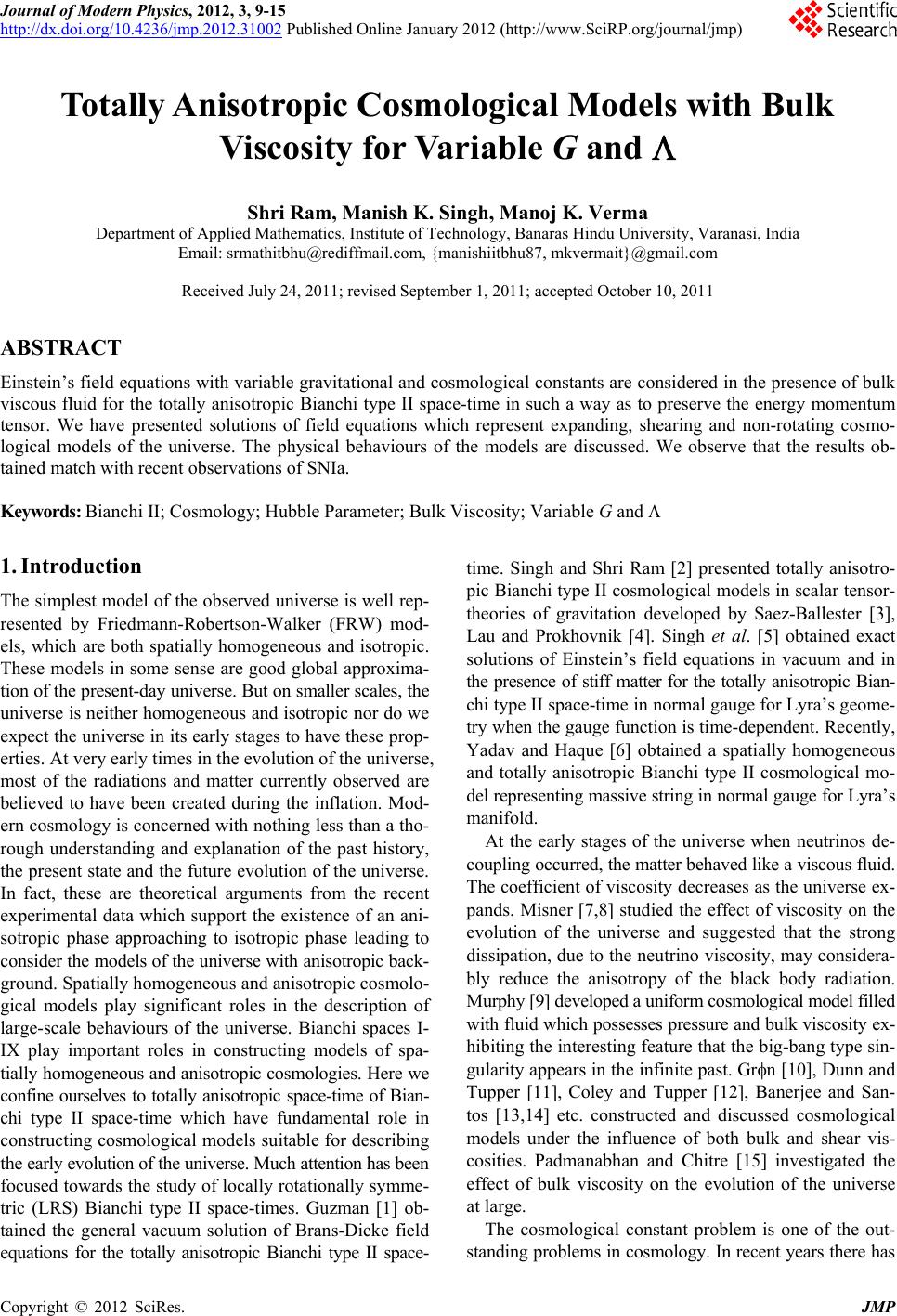 Journal of Modern Physics, 2012, 3, 9-15 http://dx.doi.org/10.4236/jmp.2012.31002 Published Online January 2012 (http://www.SciRP.org/journal/jmp) Totally Anisotropic Cosmological Models with Bulk Viscosity for Variable G and Shri Ram, Manish K. Singh, Manoj K. Verma Department of Applied Mathematics, Institute of Technology, Banaras Hindu University, Varanasi, India Email: [email protected], {manishiitbhu87, mkvermait}@gmail.com Received July 24, 2011; revised September 1, 2011; accepted October 10, 2011 ABSTRACT Einstein’s field equations with variable gravitational and cosmological constants are considered in the presence of bulk viscous fluid for the totally anisotropic Bianchi type II space-time in such a way as to preserve the energy momentum tensor. We have presented solutions of field equations which represent expanding, shearing and non-rotating cosmo- logical models of the universe. The physical behaviours of the models are discussed. We observe that the results ob- tained match with recent observations of SNIa. Keywords: Bianchi II; Cosmology; Hubble Parameter; Bulk Viscosity; Variable G and 1. Introduction The simplest model of the observed universe is well rep- resented by Friedmann-Robertson-Walker (FRW) mod- els, which are both spatially homogeneous and isotropic. These models in some sense are good global approxima- tion of the present-day universe. But on smaller scales, the universe is neither homogeneous and isotropic nor do we expect the universe in its early stages to have these prop- erties. At very early times in the evolution of the universe, most of the radiations and matter currently observed are believed to have been created during the inflation. Mod- ern cosmology is concerned with nothing less than a tho- rough understanding and explanation of the past history, the present state and the future evolution of the universe. In fact, these are theoretical arguments from the recent experimental data which support the existence of an ani- sotropic phase approaching to isotropic phase leading to consider the models of the universe with anisotropic back- ground. Spatially homogeneous and anisotropic cosmolo- gical models play significant roles in the description of large-scale behaviours of the universe. Bianchi spaces I- IX play important roles in constructing models of spa- tially homogeneous and anisotropic cosmologies. Here we confine ourselves to totally anisotropic space-time of Bian- chi type II space-time which have fundamental role in constructing cosmological models suitable for describing the early evolution of the universe. Much attention has been focused towards the study of locally rotationally symme- tric (LRS) Bianchi type II space-times. Guzman [1] ob- tained the general vacuum solution of Brans-Dicke field equations for the totally anisotropic Bianchi type II space- time. Singh and Shri Ram [2] presented totally anisotro- pic Bianchi type II cosmological models in scalar tensor- theories of gravitation developed by Saez-Ballester [3], Lau and Prokhovnik [4]. Singh et al. [5] obtained exact solutions of Einstein’s field equations in vacuum and in the presence of stiff matter for the totally anisotropic Bian- chi type II space-time in normal gauge for Lyra’s geome- try when the gauge function is time-dependent. Recently, Yadav and Haque [6] obtained a spatially homogeneous and totally anisotropic Bianchi type II cosmological mo- del representing massive string in normal gauge for Lyra’s manifold. At the early stages of the universe when neutrinos de- coupling occurred, the matter behaved like a viscous fluid. The coefficient of viscosity decreases as the universe ex- pands. Misner [7,8] studied the effect of viscosity on the evolution of the universe and suggested that the strong dissipation, due to the neutrino viscosity, may considera- bly reduce the anisotropy of the black body radiation. Murphy [9] developed a uniform cosmological model filled with fluid which possesses pressure and bulk viscosity ex- hibiting the interesting feature that the big-bang type sin- gularity appears in the infinite past. Grn [10], Dunn and Tupper [11], Coley and Tupper [12], Banerjee and San- tos [13,14] etc. constructed and discussed cosmological models under the influence of both bulk and shear vis- cosities. Padmanabhan and Chitre [15] investigated the effect of bulk viscosity on the evolution of the universe at large. The cosmological constant problem is one of the out- standing problems in cosmology. In recent years there has C opyright © 2012 SciRes. JMP 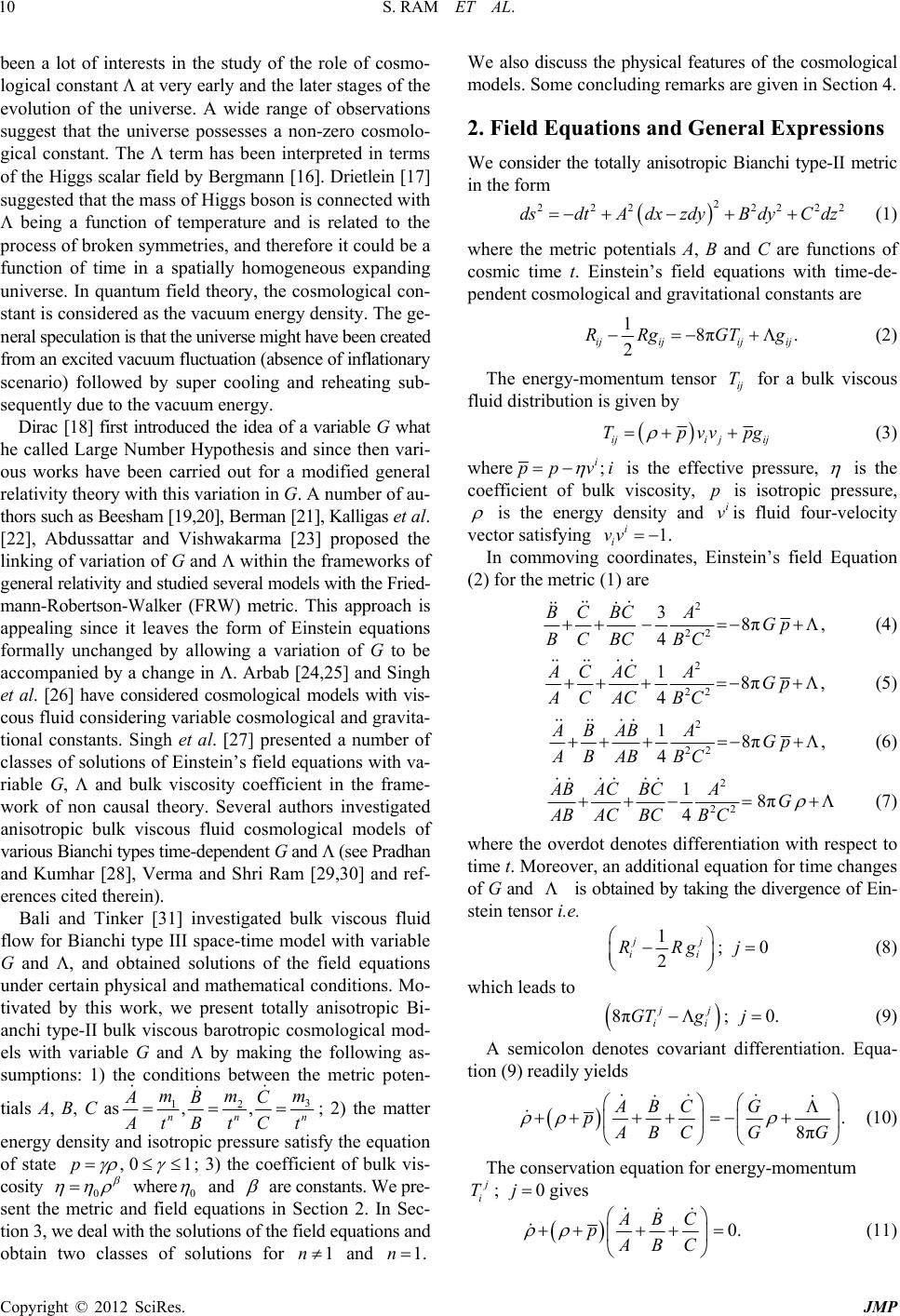 S. RAM ET AL. 10 been a lot of interests in the study of the role of cosmo- logical constant at very early and the later stages of the evolution of the universe. A wide range of observations suggest that the universe possesses a non-zero cosmolo- gical constant. The term has been interpreted in terms of the Higgs scalar field by Bergmann [16]. Drietlein [17] suggested that the mass of Higgs boson is connected with being a function of temperature and is related to the process of broken symmetries, and therefore it could be a function of time in a spatially homogeneous expanding universe. In quantum field theory, the cosmological con- stant is considered as the vacuum energy density. The ge- neral speculation is that the universe might have been created from an excited vacuum fluctuation (absence of inflationary scenario) followed by super cooling and reheating sub- sequently due to the vacuum energy. Dirac [18] first introduced the idea of a variable G what he called Large Number Hypothesis and since then vari- ous works have been carried out for a modified general relativity theory with this variation in G. A number of au- thors such as Beesham [19,20], Berman [21], Kalligas et a l . [22], Abdussattar and Vishwakarma [23] proposed the linking of variation of G and within the frameworks of general relativity and studied several models with the Fried- mann-Robertson-Walker (FRW) metric. This approach is appealing since it leaves the form of Einstein equations formally unchanged by allowing a variation of G to be accompanied by a change in . Arbab [24,25] and Singh et al. [26] have considered cosmological models with vis- cous fluid considering variable cosmological and gravita- tional constants. Singh et al. [27] presented a number of classes of solutions of Einstein’s field equations with va- riable G, and bulk viscosity coefficient in the frame- work of non causal theory. Several authors investigated anisotropic bulk viscous fluid cosmological models of various Bianchi types time-dependent G and (see Pradhan and Kumhar [28], Verma and Shri Ram [29,30] and ref- erences cited therein). Bali and Tinker [31] investigated bulk viscous fluid flow for Bianchi type III space-time model with variable G and , and obtained solutions of the field equations under certain physical and mathematical conditions. Mo- tivated by this work, we present totally anisotropic Bi- anchi type-II bulk viscous barotropic cosmological mod- els with variable G and by making the following as- sumptions: 1) the conditions between the metric poten- tials A, B, C as3 12 ,, nn m mm ABC n A BC tt t ; 2) the matter energy density and isotropic pressure satisfy the equation of state ,0 1p ; 3) the coefficient of bulk vis- cosity 0 where0 and are constants. We pre- sent the metric and field equations in Section 2. In Sec- tion 3, we deal with the solutions of the field equations and obtain two classes of solutions for and 1n1.n We also discuss the physical features of the cosmological models. Some concluding remarks are given in Section 4. 2. Field Equations and General Expressions We consider the totally anisotropic Bianchi type-II metric in the form 2 222 222 dsdtAdxzdyB dyCdz 2 (1) where the metric potentials A, B and C are functions of cosmic time t. Einstein’s field equations with time-de- pendent cosmological and gravitational constants are 18π. 2 ijijij ij RRgGTg (2) The energy-momentum tensor for a bulk viscous fluid distribution is given by ij T iji jij Tpvv pg (3) where ; i pp vi is the effective pressure, is the coefficient of bulk viscosity, is isotropic pressure, p is the energy density and is fluid four-velocity vector satisfying i v 1. i i vv In commoving coordinates, Einstein’s field Equation (2) for the metric (1) are 2 22 38π, 4 BCBC AGp BCBC BC (4) 2 22 18π, 4 AC ACAGp AC ACBC (5) 2 22 18π, 4 ABABAGp A BAB BC (6) 2 22 18π 4 AB AC BCAG A BACBC BC (7) where the overdot denotes differentiation with respect to time t. Moreover, an additional equation for time changes of G and is obtained by taking the divergence of Ein- stein tensor i.e. 1; 2 jj ii RRgj 0 (8) which leads to 8π; jj ii GTgj 0. (9) A semicolon denotes covariant differentiation. Equa- tion (9) readily yields . 8π ABC G p A BCG G 0 (10) The conservation equation for energy-momentum ; j i Tj gives 0. ABC pABC (11) Copyright © 2012 SciRes. JMP 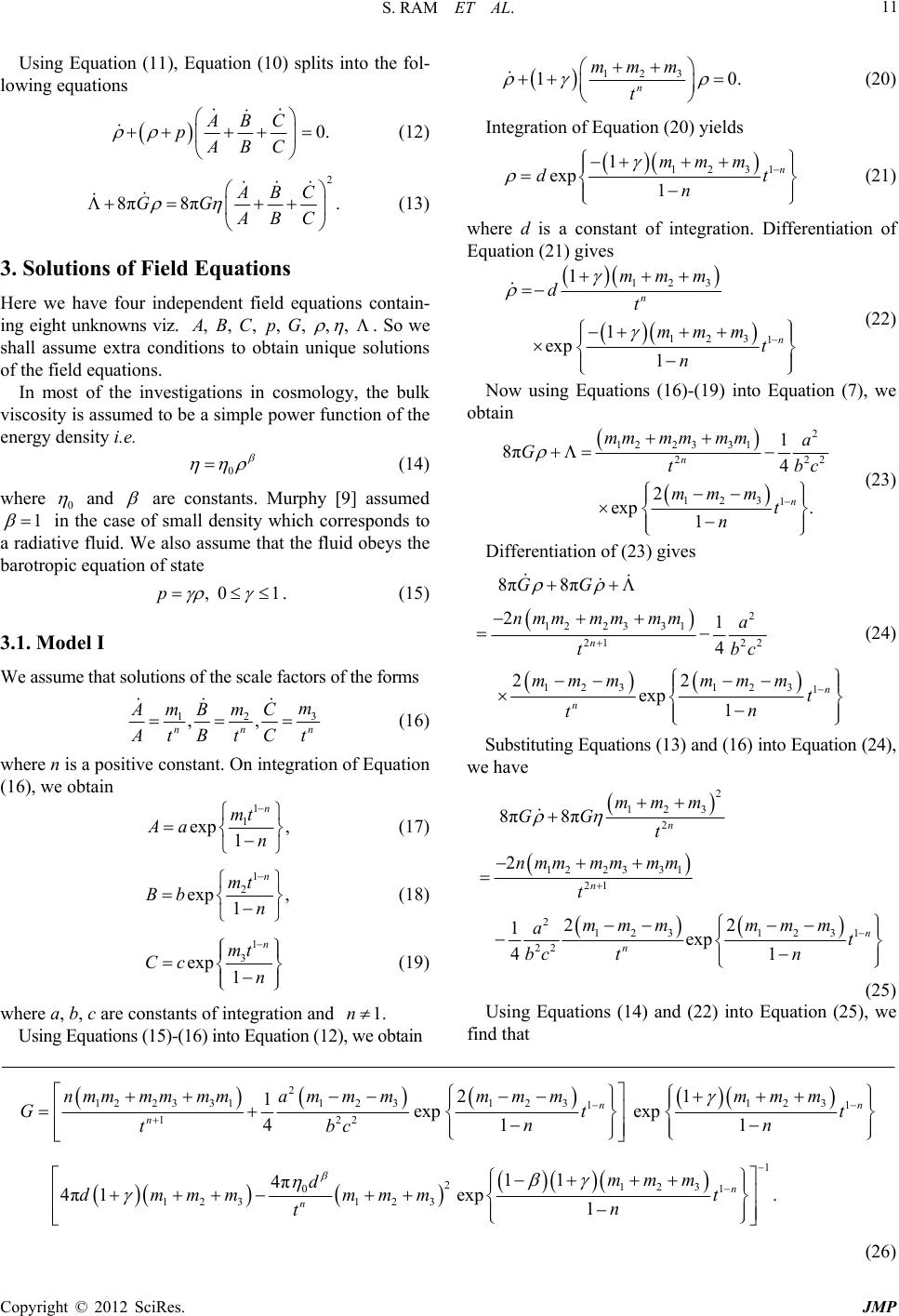 S. RAM ET AL. Copyright © 2012 SciRes. JMP 11 Using Equation (11), Equation (10) splits into the fol- lowing equations 123 10 n mmm t . (20) 0. ABC pABC (12) Integration of Equation (20) yields 123 1 1 exp 1 n mmm dt n (21) 2 8π8π. ABC GG ABC (13) where d is a constant of integration. Differentiation of Equation (21) gives 3. Solutions of Field Equations 123 123 1 1 1 exp 1 n n mmm dt mmm t n (22) Here we have four independent field equations contain- ing eight unknowns viz. ,, ,,,,,ABC pG . So we shall assume extra conditions to obtain unique solutions of the field equations. Now using Equations (16)-(19) into Equation (7), we obtain In most of the investigations in cosmology, the bulk viscosity is assumed to be a simple power function of the energy density i.e. 2 1223 31 22 123 1 1 8π 4 2 exp . 1 n n mmmm mma Gtb mmm t n 0 (14) 2 c (23) where 0 and are constants. Murphy [9] assumed 1 in the case of small density which corresponds to a radiative fluid. We also assume that the fluid obeys the barotropic equation of state Differentiation of (23) gives 2 1223 31 21 22 123 123 1 8π8π 21 4 22 exp 1 n n n GG nmm mmmma tbc mmmmmm t n t (24) ,0 1p . (15) 3.1. Model I We assume that solutions of the scale factors of the forms 3 12 ,, nn m mm ABC ABC tt n t (16) Substituting Equations (13) and (16) into Equation (24), we have where n is a positive constant. On integration of Equation (16), we obtain 2 123 2 1223 31 21 2 123 123 1 22 8π8π 2 22 1exp 41 n n n n mmm GG t nmm mm mm t mmm mmm at n bc t 1 1 exp, 1 n mt Aa n (17) 1 2 exp , 1 n mt Bb n (18) 1 3 exp 1 n mt Cc n (19) (25) Using Equations (14) and (22) into Equation (25), we find that where a, b, c are constants of integration and 1.n Using Equations (15)-(16) into Equation (12), we obtain 2 1223311 231 2 31 23 11 122 1 2123 1 0 123 123 21 1exp exp 41 1 11 4π 4π1exp 1 nn n n n nmm mmmmammmmmmmm m Gt nn tbc mmm d dmmmmmmt n t . t (26) 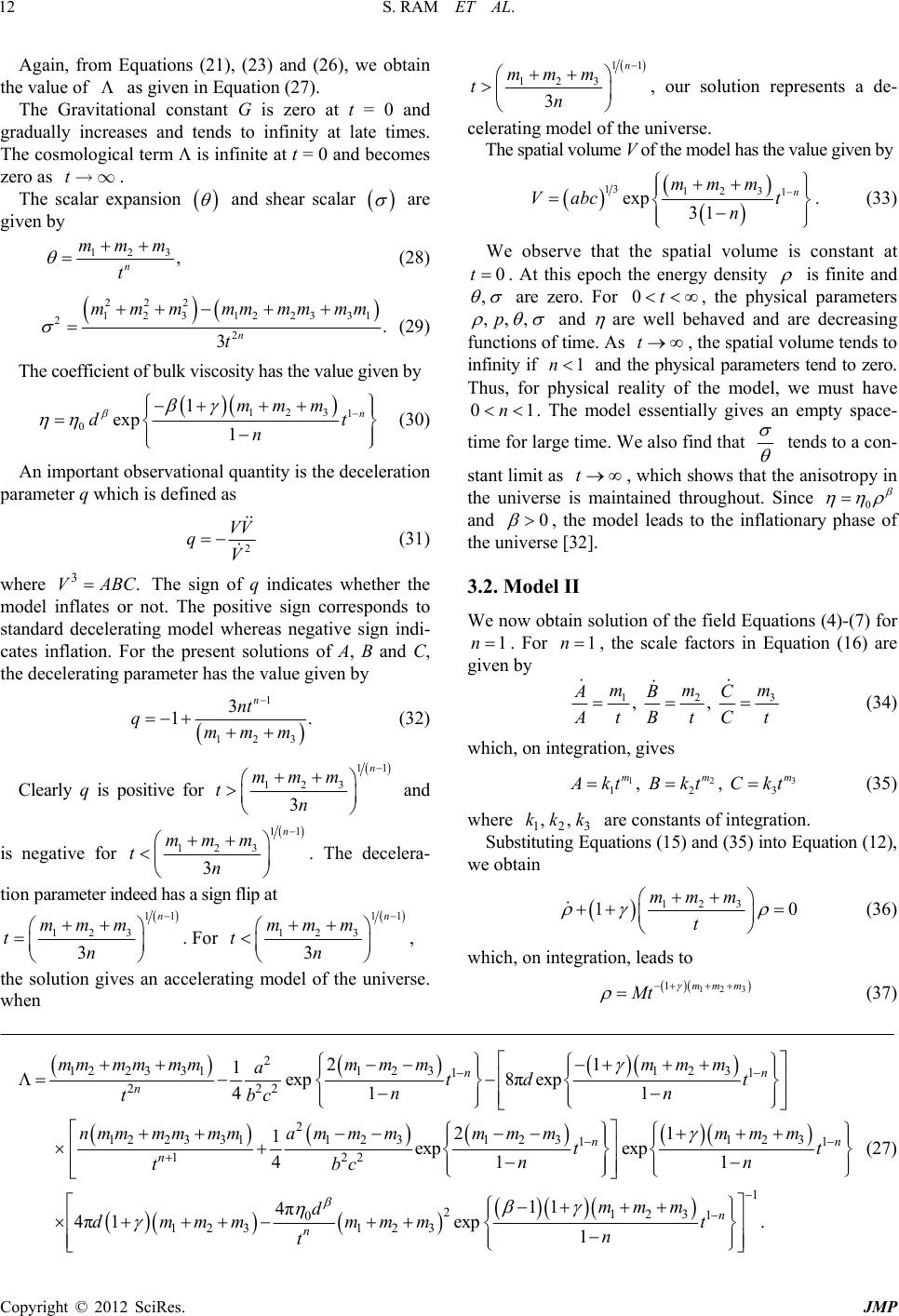 S. RAM ET AL. 12 Again, from Equations (21), (23) and (26), we obtain the value of as given in Equation (27). The Gravitational constant G is zero at t = 0 and gradually increases and tends to infinity at late times. The cosmological term is infinite at t = 0 and becomes zero as . t¥ The scalar expansion and shear scalar are given by 123 , n mmm t (28) 222 123 122331 2 2. 3n mmm mmmmmm t (29) The coefficient of bulk viscosity has the value given by 123 1 0 1 exp 1 n mmm dt n (30) An important observational quantity is the deceleration parameter q which is defined as 2 VV qV (31) where The sign of q indicates whether the model inflates or not. The positive sign corresponds to standard decelerating model whereas negative sign indi- cates inflation. For the present solutions of A, B and C, the decelerating parameter has the value given by 3.VABC 1 123 3 1 n nt qmmm . (32) Clearly q is positive for 11 123 3 n mmm tn and is negative for 11 123 3 n mmm tn . The decelera- tion parameter indeed has a sign flip at 11 123 3 n mmm tn . For 11 123 3 n mmm tn , the solution gives an accelerating model of the universe. when 11 123 3 n mmm tn , our solution represents a de- celerating model of the universe. The spatial volume V of the model has the value given by 13 123 1 exp 31 n mmm Vabc t n . (33) We observe that the spatial volume is constant at 0t . At this epoch the energy density is finite and , are zero. For 0t , the physical parameters ,,p, n and are well behaved and are decreasing functions of time. As , the spatial volume tends to infinity if t 1 and the physical parameters tend to zero. Thus, for physical reality of the model, we must have 0n1 . The model essentially gives an empty space- time for large time. We also find that tends to a con- stant limit as , which shows that the anisotropy in the universe is maintained throughout. Since 0 t and 0 , the model leads to the inflationary phase of the universe [32]. 3.2. Model II We now obtain solution of the field Equations (4)-(7) for 1n . For 1n , the scale factors in Equation (16) are given by 3 12 ,, m mm ABC A tB tC t (34) which, on integration, gives 3 12 12 ,, m mm 3 A ktB ktCkt (35) where are constants of integration. 123 Substituting Equations (15) and (35) into Equation (12), we obtain ,,kkk 123 10 mmm t (36) which, on integration, leads to 12 3 1mmm Mt (37) 2 1223311 231 23 11 222 2 1223311 231 231 23 11 122 21 1exp 8πexp 41 1 21 1exp exp 411 nn n nn n mmmmmmm mmm mm atd t nn tbc nmmmmmmam mmm mmm mm tt nn tbc 1 2123 1 0 123 123 11 4π 4π1exp 1 n n mmm d dmmm mmmt n t . (27) Copyright © 2012 SciRes. JMP 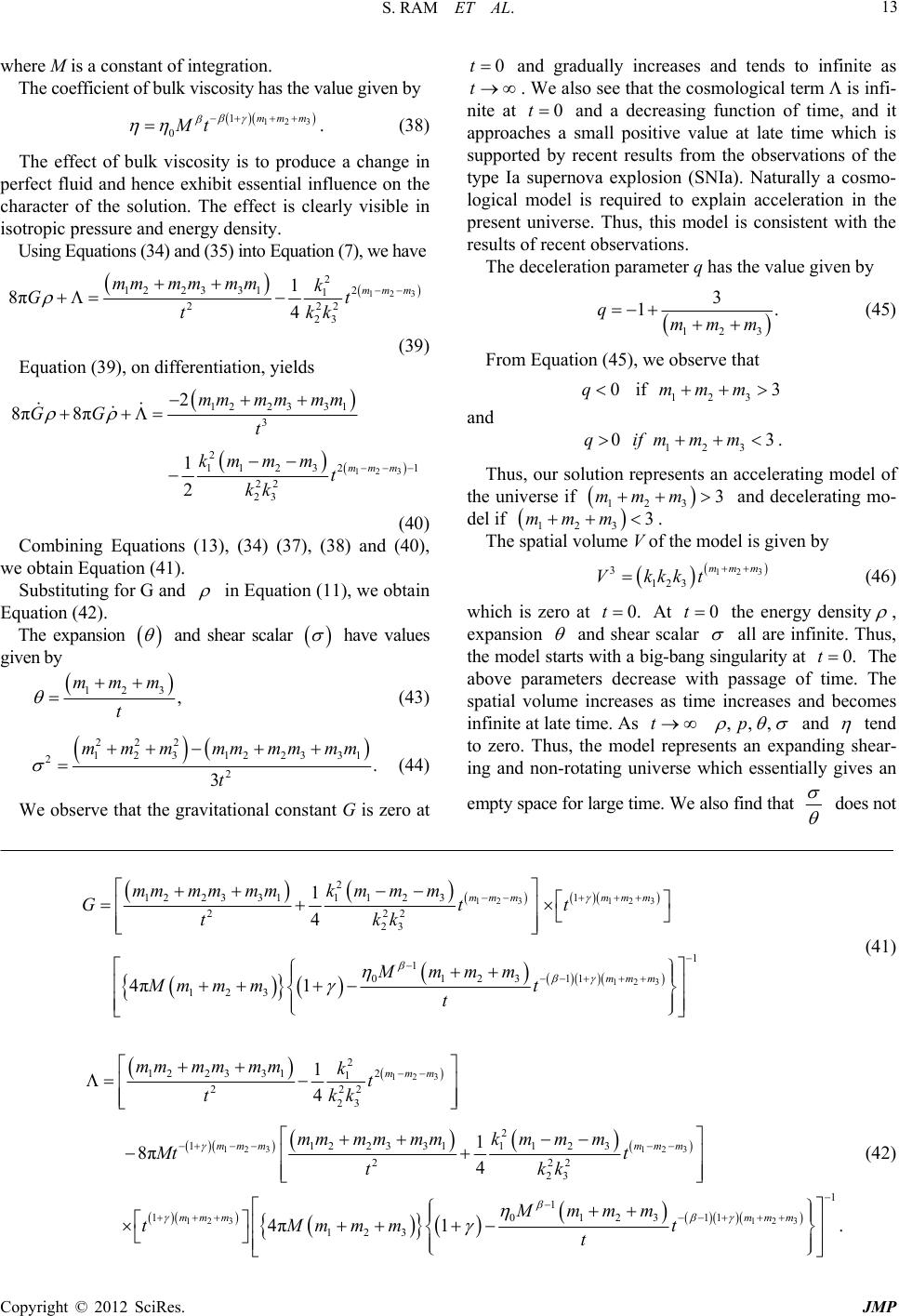 S. RAM ET AL. 13 where M is a constant of integration. The coefficient of bulk viscosity has the value given by 123 1 0 mmm Mt . (38) The effect of bulk viscosity is to produce a change in perfect fluid and hence exhibit essential influence on the character of the solution. The effect is clearly visible in isotropic pressure and energy density. Using Equations (34) and (35) into Equation (7), we have 123 2 2 1223 311 222 23 1 8π 4 mmm mm mm mmk Gt tkk (39) Equation (39), on differentiation, yields 123 1223 31 3 2 2 11 2 3 22 23 2 8π8π 1 2 mmm mmmm mm GG t kmm mt kk 1 (40) Combining Equations (13), (34) (37), (38) and (40), we obtain Equation (41). Substituting for G and in Equation (11), we obtain Equation (42). The expansion and shear scalar have values given by 123 , mmm t (43) 222 123 122331 2 2. 3 mmm mmmmmm t (44) We observe that the gravitational constant G is zero at 0t and gradually increases and tends to infinite as . We also see that the cosmological term is infi- nite at t 0t and a decreasing function of time, and it approaches a small positive value at late time which is supported by recent results from the observations of the type Ia supernova explosion (SNIa). Naturally a cosmo- logical model is required to explain acceleration in the present universe. Thus, this model is consistent with the results of recent observations. The deceleration parameter q has the value given by 123 3 1qmmm . (45) From Equation (45), we observe that 123 0if 3qmmm and 123 03qifmmm. Thus, our solution represents an accelerating model of the universe if 123 3mmm and decelerating mo- del if 3m 123 mm . The spatial volume V of the model is given by 123 3 123 mmm Vkkkt (46) which is zero at 0.t At the energy density0t , expansion and shear scalar all are infinite. Thus, the model starts with a big-bang singularity at 0.t The above parameters decrease with passage of time. The spatial volume increases as time increases and becomes infinite at late time. As t ,,,p and tend to zero. Thus, the model represents an expanding shear- ing and non-rotating universe which essentially gives an empty space for large time. We also find that does not 123 123 123 2 1 1223311 123 222 23 1 1 11 0123 123 1 4 4π1 mmmmmm mmm mmmmmmkmmm Gt tkk Mmmm Mm mmt t t (41) 123 123 123 123 123 2 2 12 23 311 222 23 2 11223 31112 3 222 23 1 111 0123 123 1 4 1 8π 4 4π1 mmm mmmmmm mmmmmm mmmm mmkt tkk mmmmmmkmmm Mt t tkk Mmmm tMmmm t t 1 . (42) Copyright © 2012 SciRes. JMP 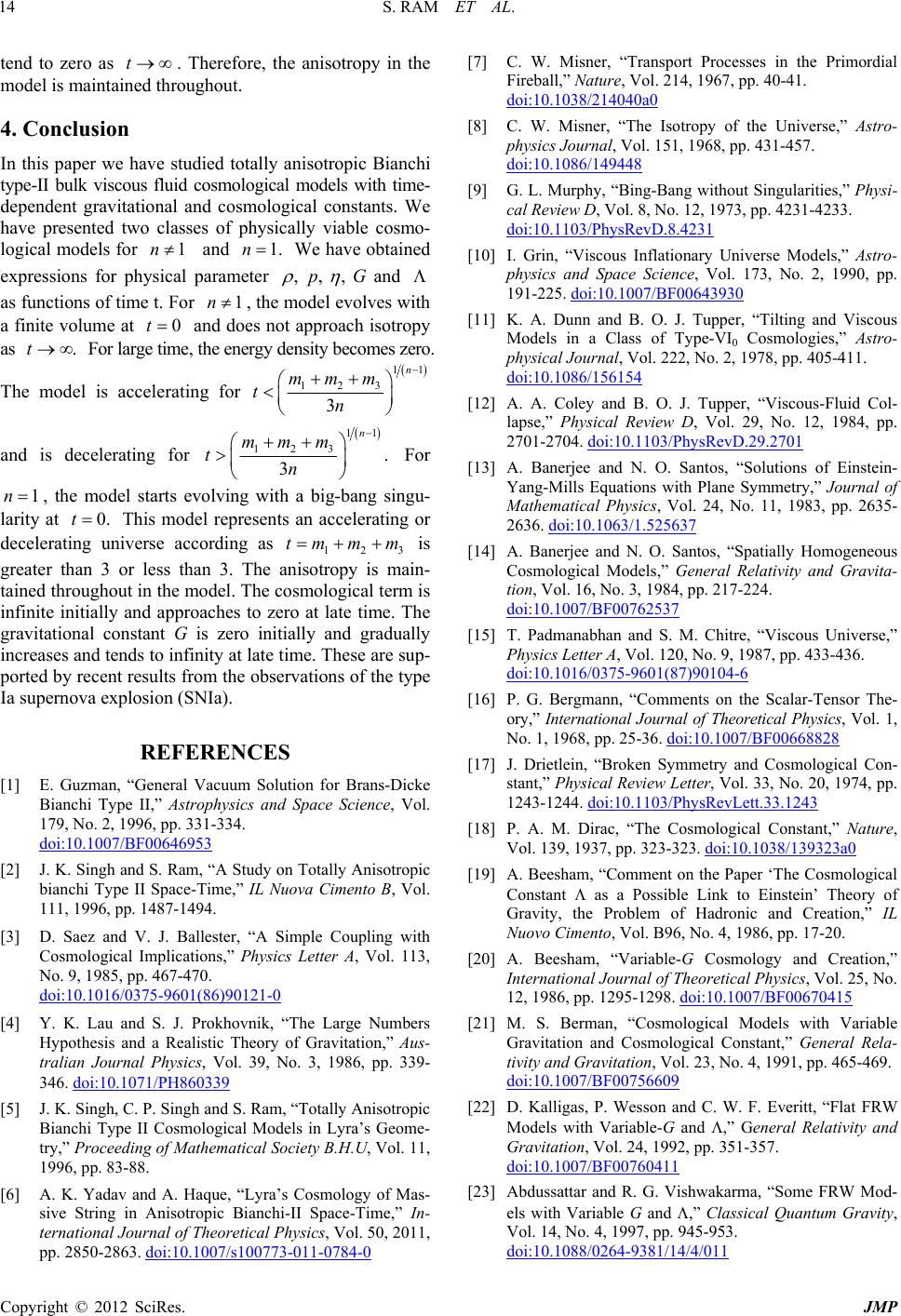 S. RAM ET AL. 14 tend to zero as . Therefore, the anisotropy in the model is maintained throughout. t 4. Conclusion In this paper we have studied totally anisotropic Bianchi type-II bulk viscous fluid cosmological models with time- dependent gravitational and cosmological constants. We have presented two classes of physically viable cosmo- logical models for and We have obtained expressions for physical parameter 1n1.n ,,,p G and as functions of time t. For 1n , the model evolves with a finite volume at and does not approach isotropy as For large time, the energy density becomes zero. The model is accelerating for 0t .t 11n 12 3 mm n 3 m t and is decelerating for 11 123 . 3 n mmm tn For , the model starts evolving with a big-bang singu- larity at This model represents an accelerating or decelerating universe according as is greater than 3 or less than 3. The anisotropy is main- tained throughout in the model. The cosmological term is infinite initially and approaches to zero at late time. The gravitational constant G is zero initially and gradually increases and tends to infinity at late time. These are sup- ported by recent results from the observations of the type Ia supernova explosion (SNIa). 1n 0.t 12 tmmm 3 REFERENCES [1] E. Guzman, “General Vacuum Solution for Brans-Dicke Bianchi Type II,” Astrophysics and Space Science, Vol. 179, No. 2, 1996, pp. 331-334. doi:10.1007/BF00646953 [2] J. K. Singh and S. Ram, “A Study on Totally Anisotropic bianchi Type II Space-Time,” IL Nuova Cimento B, Vol. 111, 1996, pp. 1487-1494. [3] D. Saez and V. J. Ballester, “A Simple Coupling with Cosmological Implications,” Physics Letter A, Vol. 113, No. 9, 1985, pp. 467-470. doi:10.1016/0375-9601(86)90121-0 [4] Y. K. Lau and S. J. Prokhovnik, “The Large Numbers Hypothesis and a Realistic Theory of Gravitation,” Aus- tralian Journal Physics, Vol. 39, No. 3, 1986, pp. 339- 346. doi:10.1071/PH860339 [5] J. K. Singh, C. P. Singh and S. Ram, “Totally Anisotropic Bianchi Type II Cosmological Models in Lyra’s Geome- try,” Proceeding of Mathematical Society B.H.U, Vol. 11, 1996, pp. 83-88. [6] A. K. Yadav and A. Haque, “Lyra’s Cosmology of Mas- sive String in Anisotropic Bianchi-II Space-Time,” In- ternational Journal of Theoretical Physics, Vol. 50, 2011, pp. 2850-2863. doi:10.1007/s100773-011-0784-0 [7] C. W. Misner, “Transport Processes in the Primordial Fireball,” Nature, Vol. 214, 1967, pp. 40-41. doi:10.1038/214040a0 [8] C. W. Misner, “The Isotropy of the Universe,” Astro- physics Journal, Vol. 151, 1968, pp. 431-457. doi:10.1086/149448 [9] G. L. Murphy, “Bing-Bang without Singularities,” Physi- cal Review D, Vol. 8, No. 12, 1973, pp. 4231-4233. doi:10.1103/PhysRevD.8.4231 [10] I. Grin, “Viscous Inflationary Universe Models,” Astro- physics and Space Science, Vol. 173, No. 2, 1990, pp. 191-225. doi:10.1007/BF00643930 [11] K. A. Dunn and B. O. J. Tupper, “Tilting and Viscous Models in a Class of Type-VI0 Cosmologies,” Astro- physical Journal, Vol. 222, No. 2, 1978, pp. 405-411. doi:10.1086/156154 [12] A. A. Coley and B. O. J. Tupper, “Viscous-Fluid Col- lapse,” Physical Review D, Vol. 29, No. 12, 1984, pp. 2701-2704. doi:10.1103/PhysRevD.29.2701 [13] A. Banerjee and N. O. Santos, “Solutions of Einstein- Yang-Mills Equations with Plane Symmetry,” Journal of Mathematical Physics, Vol. 24, No. 11, 1983, pp. 2635- 2636. doi:10.1063/1.525637 [14] A. Banerjee and N. O. Santos, “Spatially Homogeneous Cosmological Models,” General Relativity and Gravita- tion, Vol. 16, No. 3, 1984, pp. 217-224. doi:10.1007/BF00762537 [15] T. Padmanabhan and S. M. Chitre, “Viscous Universe,” Physics Letter A, Vol. 120, No. 9, 1987, pp. 433-436. doi:10.1016/0375-9601(87)90104-6 [16] P. G. Bergmann, “Comments on the Scalar-Tensor The- ory,” International Journal of Theoretical Physics, Vol. 1, No. 1, 1968, pp. 25-36. doi:10.1007/BF00668828 [17] J. Drietlein, “Broken Symmetry and Cosmological Con- stant,” Physical Review Letter, Vol. 33, No. 20, 1974, pp. 1243-1244. doi:10.1103/PhysRevLett.33.1243 [18] P. A. M. Dirac, “The Cosmological Constant,” Nature, Vol. 139, 1937, pp. 323-323. doi:10.1038/139323a0 [19] A. Beesham, “Comment on the Paper ‘The Cosmological Constant as a Possible Link to Einstein’ Theory of Gravity, the Problem of Hadronic and Creation,” IL Nuovo Cimento, Vol. B96, No. 4, 1986, pp. 17-20. [20] A. Beesham, “Variable-G Cosmology and Creation,” International Journal of Theoretical Physics, Vol. 25, No. 12, 1986, pp. 1295-1298. doi:10.1007/BF00670415 [21] M. S. Berman, “Cosmological Models with Variable Gravitation and Cosmological Constant,” General Rela- tivity and Gravitation, Vol. 23, No. 4, 1991, pp. 465-469. doi:10.1007/BF00756609 [22] D. Kalligas, P. Wesson and C. W. F. Everitt, “Flat FRW Models with Variable-G and ,” General Relativity and Gravitation, Vol. 24, 1992, pp. 351-357. doi:10.1007/BF00760411 [23] Abdussattar and R. G. Vishwakarma, “Some FRW Mod- els with Variable G and ,” Classical Quantum Gravity, Vol. 14, No. 4, 1997, pp. 945-953. doi:10.1088/0264-9381/14/4/011 Copyright © 2012 SciRes. JMP  S. RAM ET AL. 15 [24] A. I. Arbab, “Cosmological Models with Variable Cos- mological and Gravitational Constants and Bulk Viscous Fluid,” General Relativity and Gravitation, Vol. 29, No. 1, 1997, pp. 61-74. doi:10.1023/A:1010252130608 [25] A. I. Arbab, “Bianchi Type I Viscous Universe with Vari- able G and ,” General Relativity and Gravitation, Vol. 30, No. 9, 1998, pp. 1401-1405. doi:10.1023/A:1018856625508 [26] T. Singh, A. Beesam and W. S. Mbokazi, “Bulk Viscous Cosmological Models with Variable G and ,” General Relativity and Gravitation, Vol. 30, No. 4, 1991, pp. 573- 581. doi:10.1023/A:1018866107585 [27] C. P. Singh, S. Kumar and A. Pradhan, “Early Viscous Universe with Variable Gravitational and Cosmological Constants,” Classical Quantum Gravity, Vol. 24, No. 2, 2007, pp. 455-474. doi:10.1088/0264-9381/24/2/011 [28] A. Pradhan and S. S. Kumhar, “LRS Bianchi Type II Bulk Viscous Fluid Universe with Decaying Vacuum En- ergy Density ,” International Journal of Theoretical Physics, Vol. 48, No. 5, 2009, pp. 1466-1477. doi:10.1007/s10773-008-9918-4 [29] M. K. Verma and S. Ram, “Bulk Viscous Bianchi Type- III Cosmological Model with Time-Dependent G and ,” International Journal of Theoretical Physics, Vol. 49, No. 4, 2010, pp. 693-700. doi:10.1007/s10773-010-0248-y [30] M. K. Verma and S. Ram, “Spatially Homogeneous Bulk Viscous Fluid Models with Time-Dependent Gravita- tional Constant and Cosmological Term,” Advanced Studies in Theoretical Physics, Vol. 5, No. 8, 2011, pp. 387-398. [31] R. Bali and S. Tinker, “Bianchi Type III Bulk Viscous Barotropic Fluid Cosmological Models with Variable G and ,” Chinese Physics Letter, Vol. 26, No. 2, 2009, pp. 029802-029806. doi:10.1088/0256-307X/26/2/029802 [32] S. Weinberg, “Nonlinear Realizations of Chiral Symme- try,” Physical Review, Vol. 166, No. 5, 1968, pp. 1568- 1577. doi:10.1103/PhysRev.166.1568 Copyright © 2012 SciRes. JMP |