

Paper Menu >>
Journal Menu >>
 Open Journal of Metal, 2011, 1, 17-24 doi:10.4236/ ojmetal.2011.1 2 0 0 3 Published Online December 2011 (http://www.SciRP.org/journal/ojmetal) Copyright © 2011 SciRes. OJMetal A Review of Metallic Fractal Aggregates Rodolfo J. Slobodrian, Claude Rioux, Michel Piché Département de Physique, de Génie physique et D’optique, Université Laval, Québec, Canada E-mail: [email protected] Received September 25, 2011; revised November 2, 2011; accepted November 18, 2011 Abstract Metals are the main components of the Earth’s mass and are characterized by high thermal and electrical conductivity as well as high reflectivity of electromagnetic fields. Finely divided metals are efficient catalysers and this indicates the relevance of surfaces when their ratio to volume becomes large. This is a characteristic of fractal aggregates and their constituent monomers (spheroidal or other) in the micrometer to nanometer scales. Exotic fern shaped aggregates are also produced. All aggregates exhibit large ratios of surface to volume. Condensation of metallic vapours allows to obtain particle sizes much smaller than those obtained via grinding techniques and far superior in purity. Exotic alloys of non miscible metals have been obtained at the micrometer scale. Thermal and laser evaporation methods of metals followed by conden- sation are described. Low gravity aggregation experiments were also carried out on aircraft in parabolic flight. Keywords: Fractals, Monomers, Aggregates, Metals, Alloys 1. Introduction Fractals are ubiquitous in our universe including both inanimate and living matter, at all scales, from subatomic to cosmic dimensions [1]. Physical fractals are deemed to be a fourth state of matter, additional to the usual solid, liquid and gaseous states. Fractal is a word coined by Benoit Mandelbrot as well as the expressions fractal geometry and fractal dimension [2]. The foundations are to be found in the development of the concepts of topo- logical and metric spaces, dimension and measure, laid by 19th and 20th century mathematicians, particularly Cavalieri, Cantor, Lebesgue, Hausdorff, Banach, Borel, Kuratowski and Kolmogorov [3], essential fo r the under- standing of the generalisation leading to non-integer di- mensions (fractal dimensions). In 1982 Mandelbrot de- fined a fractal as a set for which the Hausdorff-Besico- vitch dimension strictly exceeds the topological dimen- sion. This abstract definition was replaced by Mandel- brot in 1986 introducing the concept of self-similarity: Fractal is a shape (set) made by parts similar to the whole in some way [4].This definition implies scale invariance of parts of a set. Physical fractals have a finite range of scale invariance whereas mathematical fractals have in- finite range. Physical fractals are characterized by ran- domness and exhibit frequ ently dendritic structures. 2. Fractal Dimension Integer dimensions are assigned axiomatically: 0 for a point, 1 for a line, 2 for a surface, etc., based on the assumption of continuity. However, for example a subset of the points on a line in correspondence with the rational numbers should reflect a dimension below 1. This is based on the idea of measure of a set with adequate covering units: sticks, plates, cubes or balls, etc. For instance to measure the area of the floor of a room it is possible to use surface elements of variable linear dimension and cover the floor to any given accuracy. The capacity (concept due to Kolmogorov) of the covering element can be expressed as n CK (1) For squares K = 1, for disks K = , n = 2 in both cases. For cubes K =1, n = 3, for spheres (balls) K = 4/3 and n = 3. For the covering of the floor the area A is then given by A=NC (2) If the surface to be measured is not dense the covering elements can be expressed as D C= K (3) where accounting for the non-d ense surface and D< 2 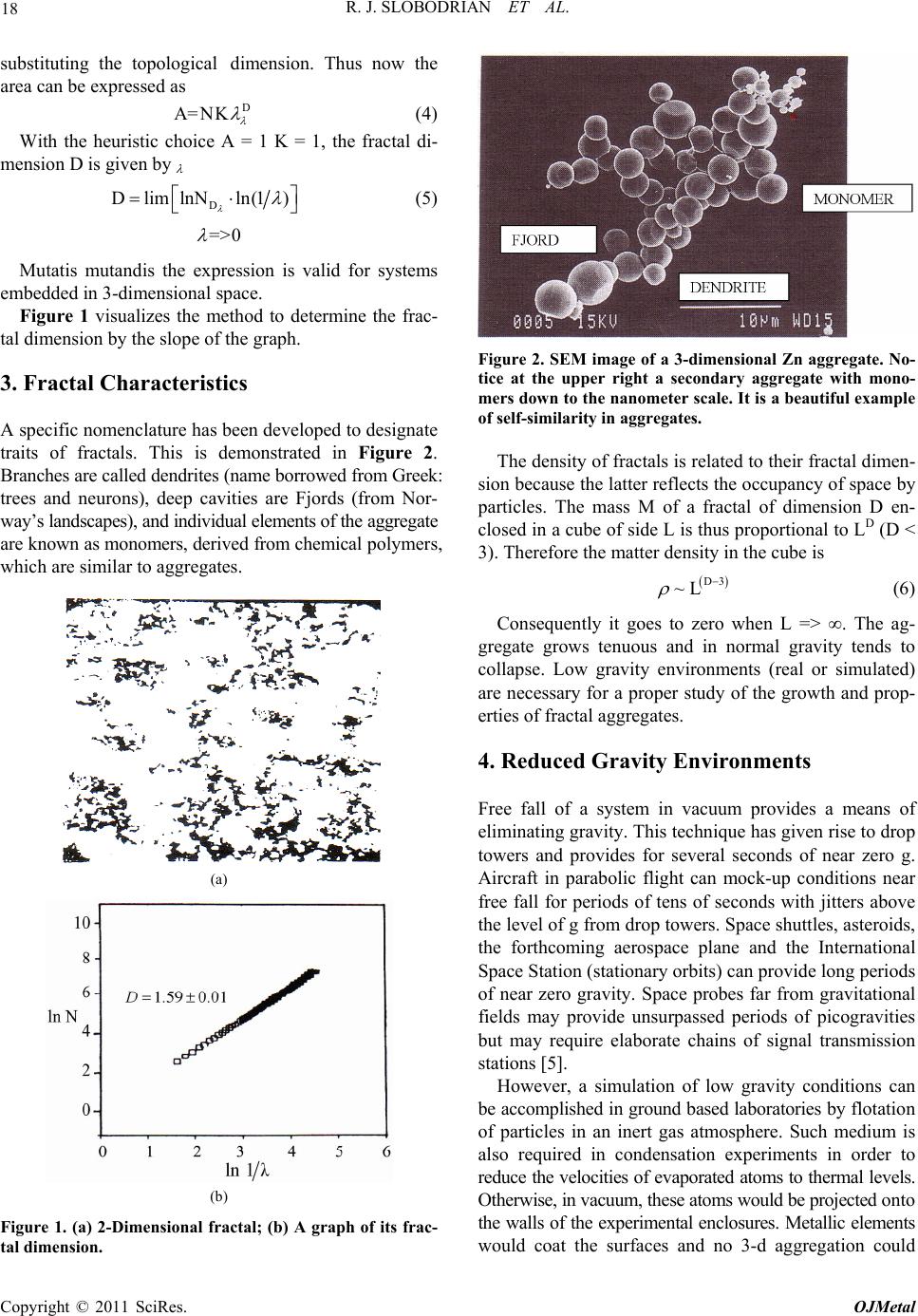 R. J. SLOBODRIAN ET AL. 18 substituting the topological dimension. Thus now the area can be expressed as D A=NK (4) With the heuristic choice A = 1 K = 1, the fractal di- mension D is given by D DlimlnN ln(1) (5) =>0 Mutatis mutandis the expression is valid for systems embedded in 3-dimensional space. Figure 1 visualizes the method to determine the frac- tal dimension by the slo pe of the gra p h. 3. Fractal Characteristics A specific nomenclature has been developed to designate traits of fractals. This is demonstrated in Figure 2. Branches are called dendrites (name borrowed from Greek: trees and neurons), deep cavities are Fjords (from Nor- way’s landscapes), and individual elements of the aggregate are known as monomers, derived from chemical po lyme r s, which are similar to aggregates. (a) (b) Figure 1. (a) 2-Dimensional fractal; (b) A graph of its frac- tal dimension. Figure 2. SEM image of a 3-dimensional Zn aggregate. No- tice at the upper right a secondary aggregate with mono- mers down to the nanometer scale. It is a beautiful example of self-similarity in aggregates. The density of fractals is related to their fractal dimen- sion because the latter reflects the occupancy of space by particles. The mass M of a fractal of dimension D en- closed in a cube of side L is thus propor tional to LD (D < 3). Therefore the matter density in the cube is D3 ~L (6) Consequently it goes to zero when L => . The ag- gregate grows tenuous and in normal gravity tends to collapse. Low gravity environments (real or simulated) are necessary for a proper study of the growth and prop- erties of fractal aggregates. 4. Reduced Gravity Environments Free fall of a system in vacuum provides a means of eliminating gravity. Th is technique has giv en rise to drop towers and provides for several seconds of near zero g. Aircraft in parabolic flight can mock-up conditions near free fall for periods of tens of seconds with jitters above the level of g from drop towers. Space shuttles, asteroids, the forthcoming aerospace plane and the International Space Station (stationary orbits) can provide long periods of near zero gravity. Space probes far from gravitational fields may provide unsurpassed periods of picogravities but may require elaborate chains of signal transmission stations [5] . However, a simulation of low gravity conditions can be accomplished in ground based laboratories by fl ota tion of particles in an inert gas atmosphere. Such medium is also required in condensation experiments in order to reduce the velocities of evaporated atoms to thermal levels. Otherwise, in v a cuum, these atoms would be p rojecte d onto the walls of the experimental enclosures. Metallic elements would coat the surfaces and no 3-d aggregation could Copyright © 2011 SciRes. OJMetal 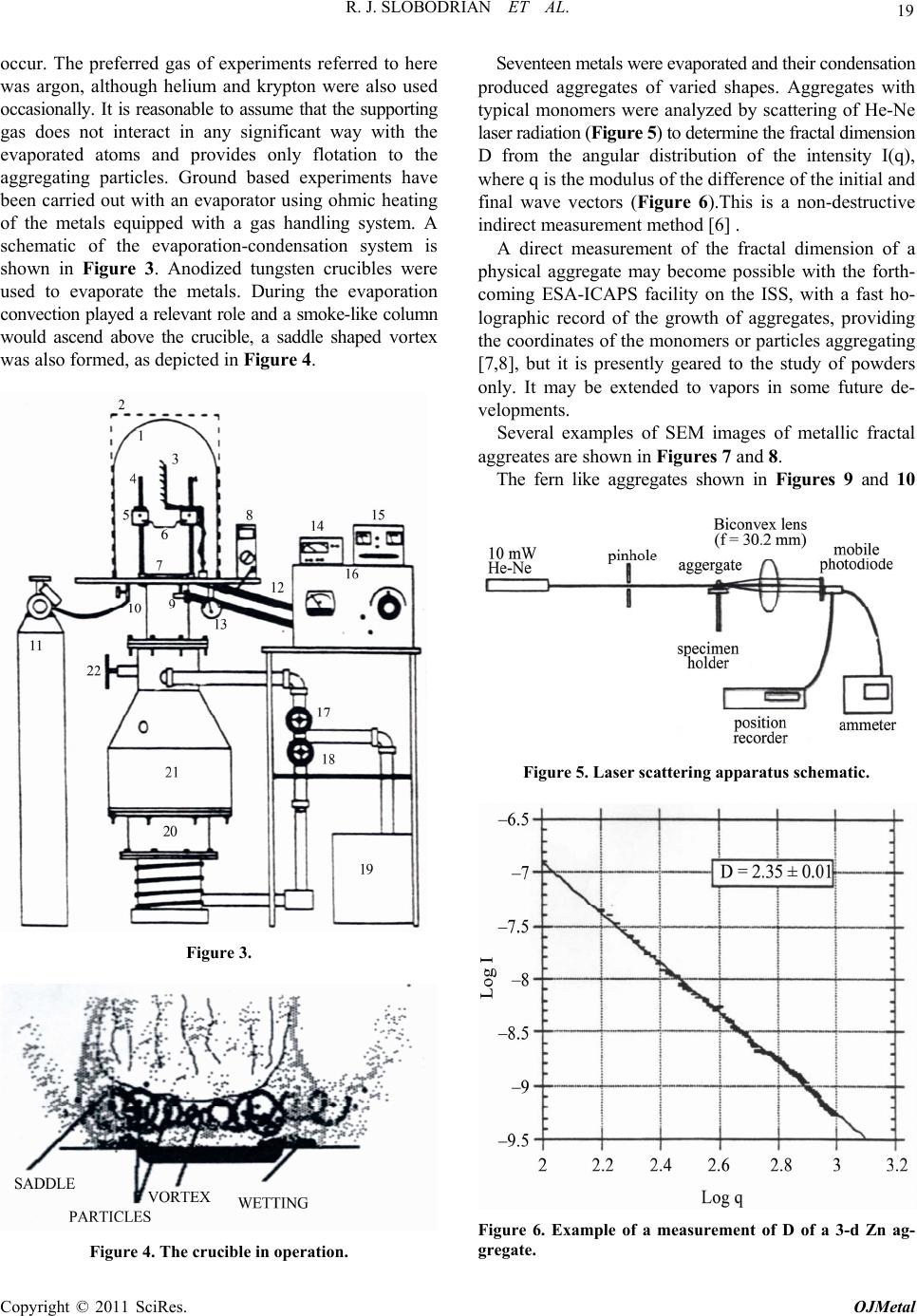 19 R. J. SLOBODRIAN ET AL. occur. The preferred gas of experiments referred to here was argon, although helium and krypton were also used occasionally. It is reasonable to assume that the supporting gas does not interact in any significant way with the evaporated atoms and provides only flotation to the aggregating particles. Ground based experiments have been carried out with an evaporator using ohmic heating of the metals equipped with a gas handling system. A schematic of the evaporation-condensation system is shown in Figure 3. Anodized tungsten crucibles were used to evaporate the metals. During the evaporation convection played a relevant role and a smoke-like column would ascend above the crucible, a saddle shaped vortex was also formed, as depicted in Figure 4. Figure 3. Figure 4. The crucible in operation. Seventeen metals were evaporated and their condensation produced aggregates of varied shapes. Aggregates with typical monomers were analyzed by scattering of He-Ne laser radiation (Figure 5) to determine the fractal dimension D from the angular distribution of the intensity I(q), where q is the modulus of the difference of the initial and final wave vectors (Figure 6).This is a non-destructive indirect measurement method [6] . A direct measurement of the fractal dimension of a physical aggregate may become possible with the forth- coming ESA-ICAPS facility on the ISS, with a fast ho- lographic record of the growth of aggregates, providing the coordinates of the monomers or particles aggregating [7,8], but it is presently geared to the study of powders only. It may be extended to vapors in some future de- velopments. Several examples of SEM images of metallic fractal aggreates are shown in Figures 7 and 8. The fern like aggregates shown in Figures 9 and 10 Figure 5. Laser scattering apparatus sche matic. Figure 6. Example of a measurement of D of a 3-d Zn ag- gregate. Copyright © 2011 SciRes. OJMetal 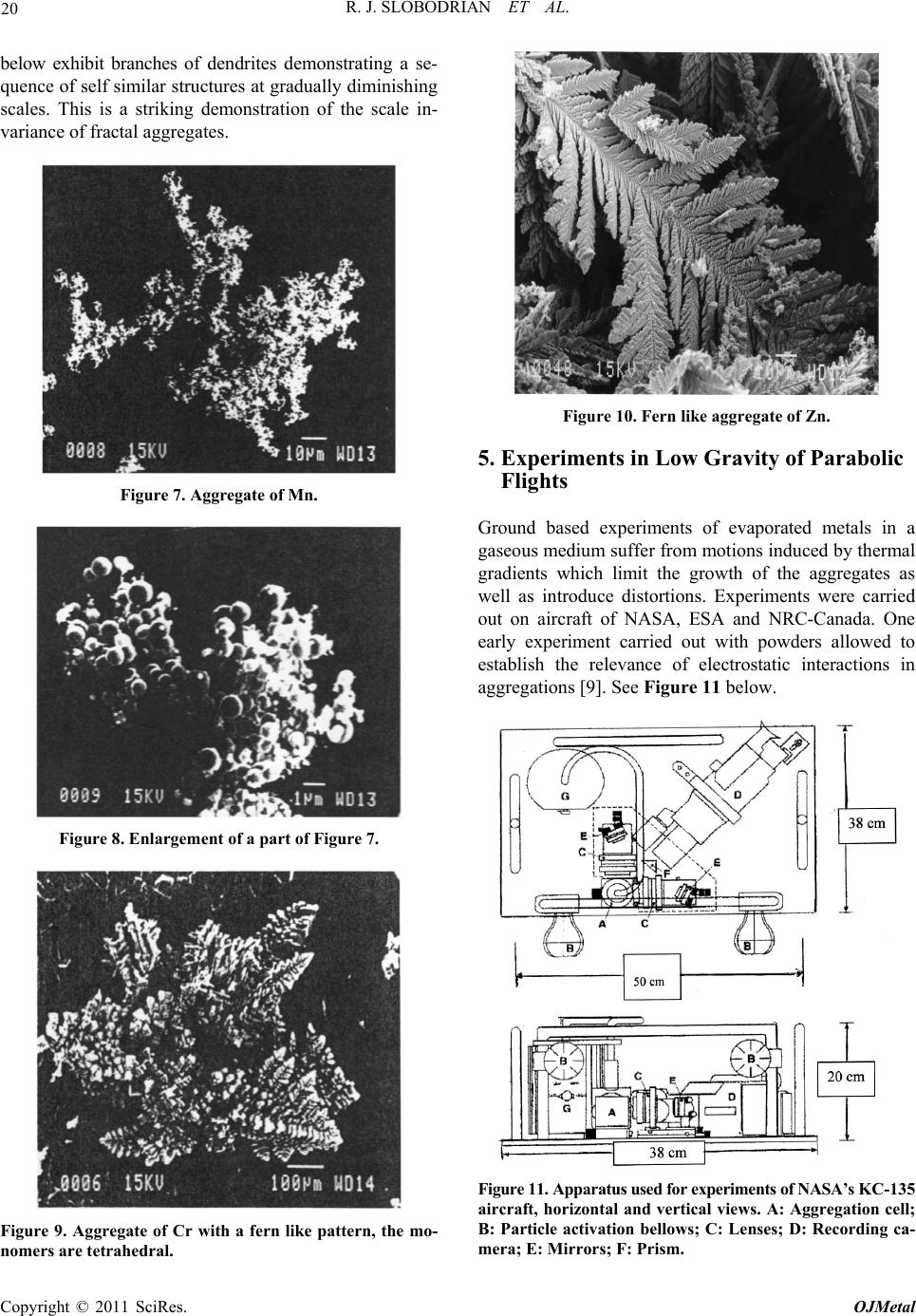 R. J. SLOBODRIAN ET AL. 20 below exhibit branches of dendrites demonstrating a se- quence of self similar structures at gradually diminishing scales. This is a striking demonstration of the scale in- variance of fractal aggregates. Figure 7. Aggregate of Mn. Figure 8. Enlargement of a part of Figure 7. Figure 9. Aggregate of Cr with a fern like pattern, the mo- nomers are tetrahedral. Figure 10. Fern like aggregate of Zn. 5. Experiments in Low Gravity of Parabolic Flights Ground based experiments of evaporated metals in a gaseous medium suffer from motions induced by thermal gradients which limit the growth of the aggregates as well as introduce distortions. Experiments were carried out on aircraft of NASA, ESA and NRC-Canada. One early experiment carried out with powders allowed to establish the relevance of electrostatic interactions in aggregations [9]. See Figure 11 below. Figure 11. Apparatus used for experiments of NASA’s KC-135 aircraft, horizontal and vertical views. A: Aggregation cell; B: Particle activation bellows; C: Lenses; D: Recording ca- mera; E: Mirrors; F: Prism. Copyright © 2011 SciRes. OJMetal 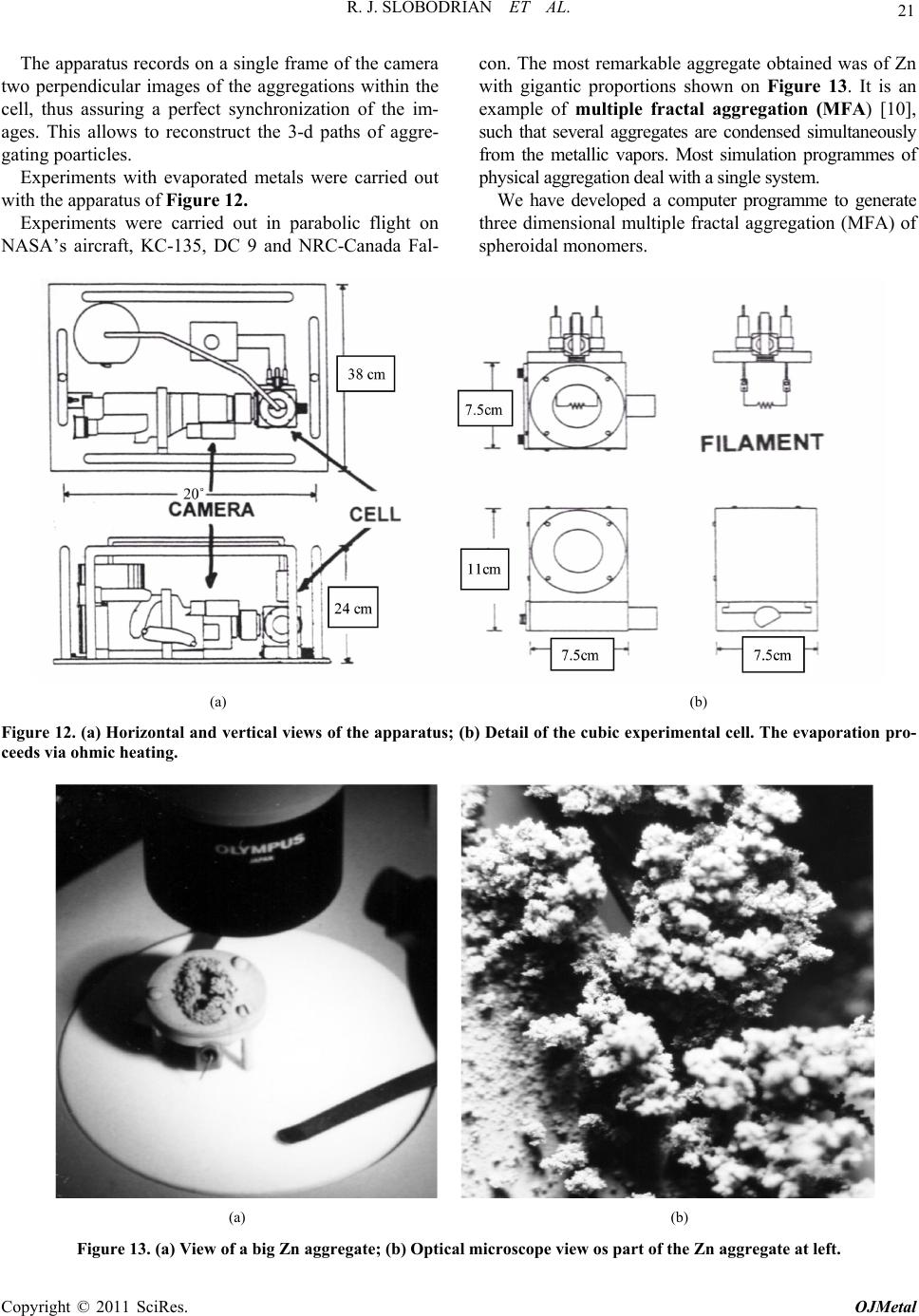 R. J. SLOBODRIAN ET AL. Copyright © 2011 SciRes. OJMetal 21 The apparatus records on a single frame of the camera two perpendicular images of the aggregations within the cell, thus assuring a perfect synchronization of the im- ages. This allows to reconstruct the 3-d paths of aggre- gating poarticles. Experiments with evaporated metals were carried out with the apparatus of Figure 12. Experiments were carried out in parabolic flight on NASA’s aircraft, KC-135, DC 9 and NRC-Canada Fal- con. The most remarkable aggregate obtained was of Zn with gigantic proportions shown on Figure 13. It is an example of multiple fractal aggregation (MFA) [10], such that several aggregates are condensed simultaneously from the metallic vapors. Most simulation programmes of physical aggregation deal with a single system. We have developed a computer programme to generate three dimensional multiple fractal aggregation (MFA) of spheroidal monomers. (a) (b) Figure 12. (a) Horizontal and vertical views of the apparatus; (b) Detail of the cubic experimental cell. The evaporation pro- ceeds via ohmic heating. (a) (b) Figure 13. (a) View of a big Zn aggregate; (b) Optical microscope view os part of the Zn aggregate at left. 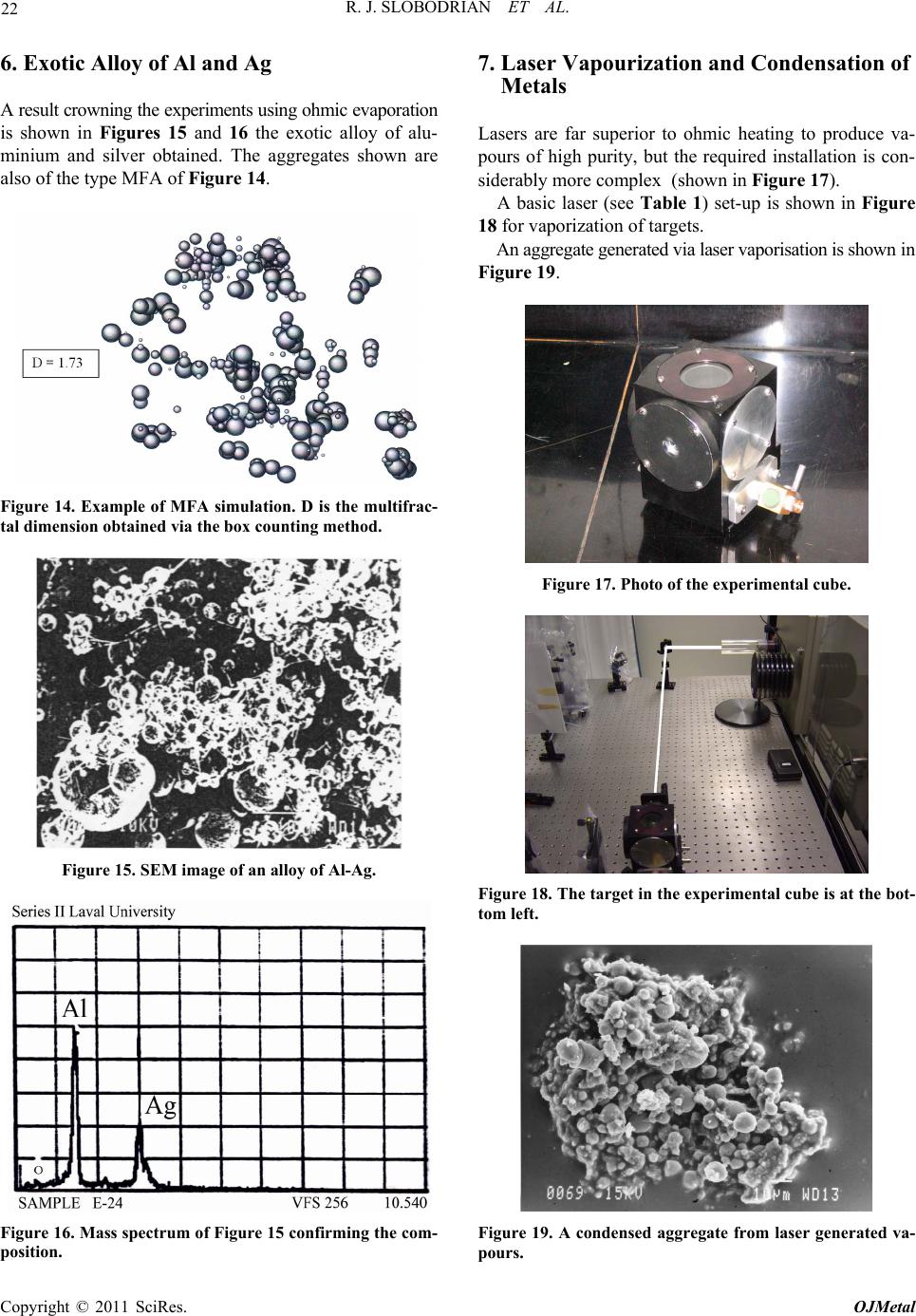 R. J. SLOBODRIAN ET AL. 22 6. Exotic Alloy of Al and Ag A result crowning the experiments using ohmic evaporation is shown in Figures 15 and 16 the exotic alloy of alu- minium and silver obtained. The aggregates shown are also of the type MFA of Figure 14. Figure 14. Example of MFA simulation. D is the multifrac- tal dimension obtained via the box counting method. Figure 15. SEM image of an alloy of Al-Ag. Figure 16. Mass spectrum of Figure 15 confirming the com- position. 7. Laser Vapourization and Condensation of Metals Lasers are far superior to ohmic heating to produce va- pours of high purity, but the required installation is con- siderably more complex (shown in Figure 17). A basic laser (see Table 1) set-up is shown in Figure 18 for vaporization of targets. An aggregate generated via laser vaporisation is shown in Figure 19. Figure 17. Photo of the experimental cube . Figure 18. The target in the experimental cube is at the bot- tom left. Figure 19. A condensed aggregate from laser generated va- pours. Copyright © 2011 SciRes. OJMetal 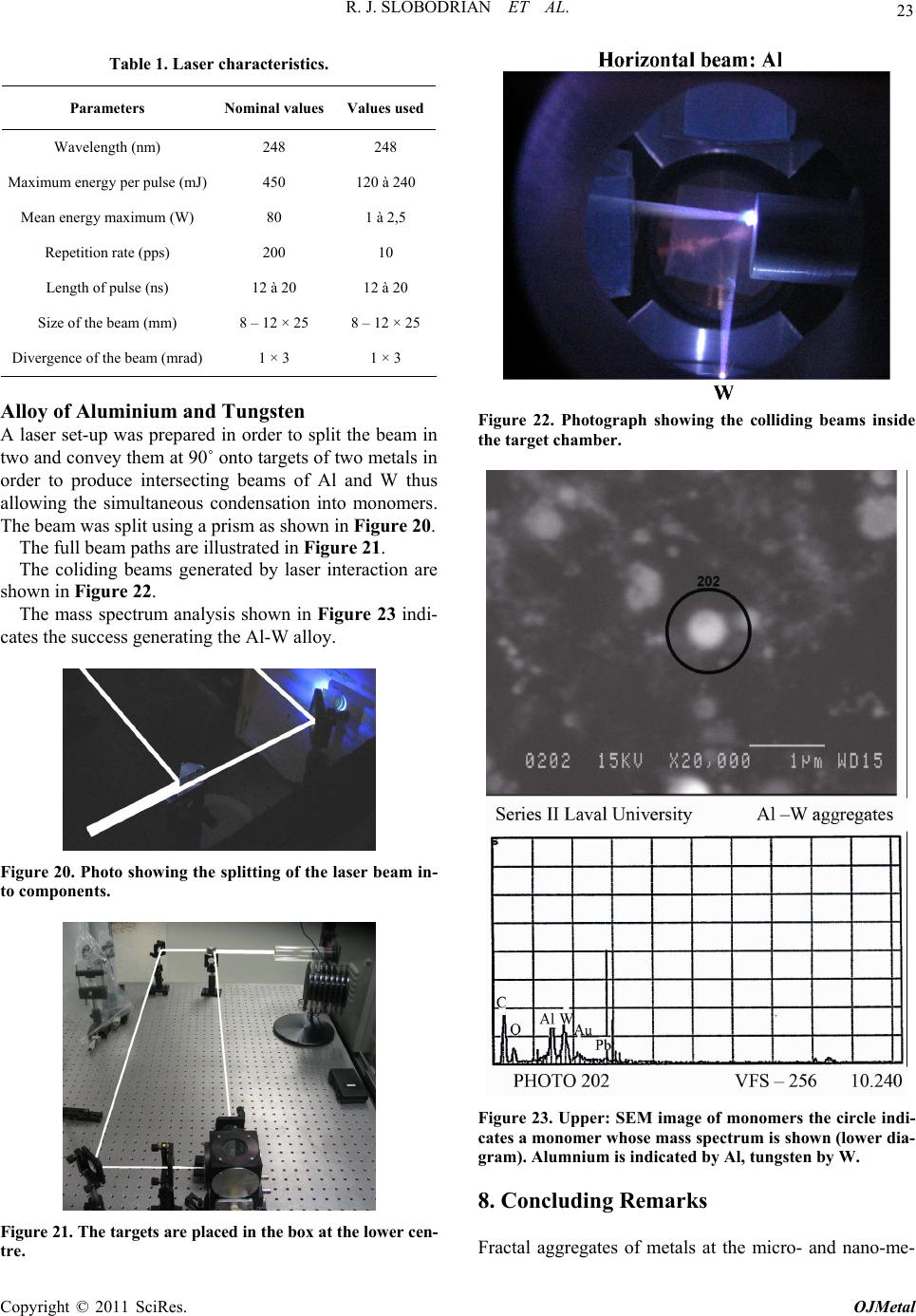 23 R. J. SLOBODRIAN ET AL. Table 1. Laser characteristics. Parameters Nominal values Values used Wavelength (nm) 248 248 Maximum energy per pulse (mJ) 450 120 à 240 Mean energy maximum (W) 80 1 à 2,5 Repetition rate (pps) 200 10 Length of pulse (ns) 12 à 20 12 à 20 Size of the beam (mm) 8 – 12 × 25 8 – 12 × 25 Divergence of the beam (mra d) 1 × 3 1 × 3 Alloy of Aluminium and Tungsten A laser set-up was prepared in order to split the beam in two and convey them at 90˚ onto targets of two metals in order to produce intersecting beams of Al and W thus allowing the simultaneous condensation into monomers. The beam was split using a prism as shown in Figure 20. The full beam paths are illustrated in Figure 21. The coliding beams generated by laser interaction are shown in Figure 22. The mass spectrum analysis shown in Figure 23 indi- cates the success generating the Al-W alloy. Figure 20. Photo showing the splitting of the laser beam in- to components. Figure 21. The targets are placed in the box at the lower cen- tre. Figure 22. Photograph showing the colliding beams inside the target chamber. Figure 23. Upper: SEM image of monomers the circle indi- cates a monomer whose mass spectrum is shown (lower dia- gram). Alumnium is indicated by Al, tungsten by W. 8. Concluding Remarks Fractal aggregates of metals at the micro- and nano-me- Copyright © 2011 SciRes. OJMetal 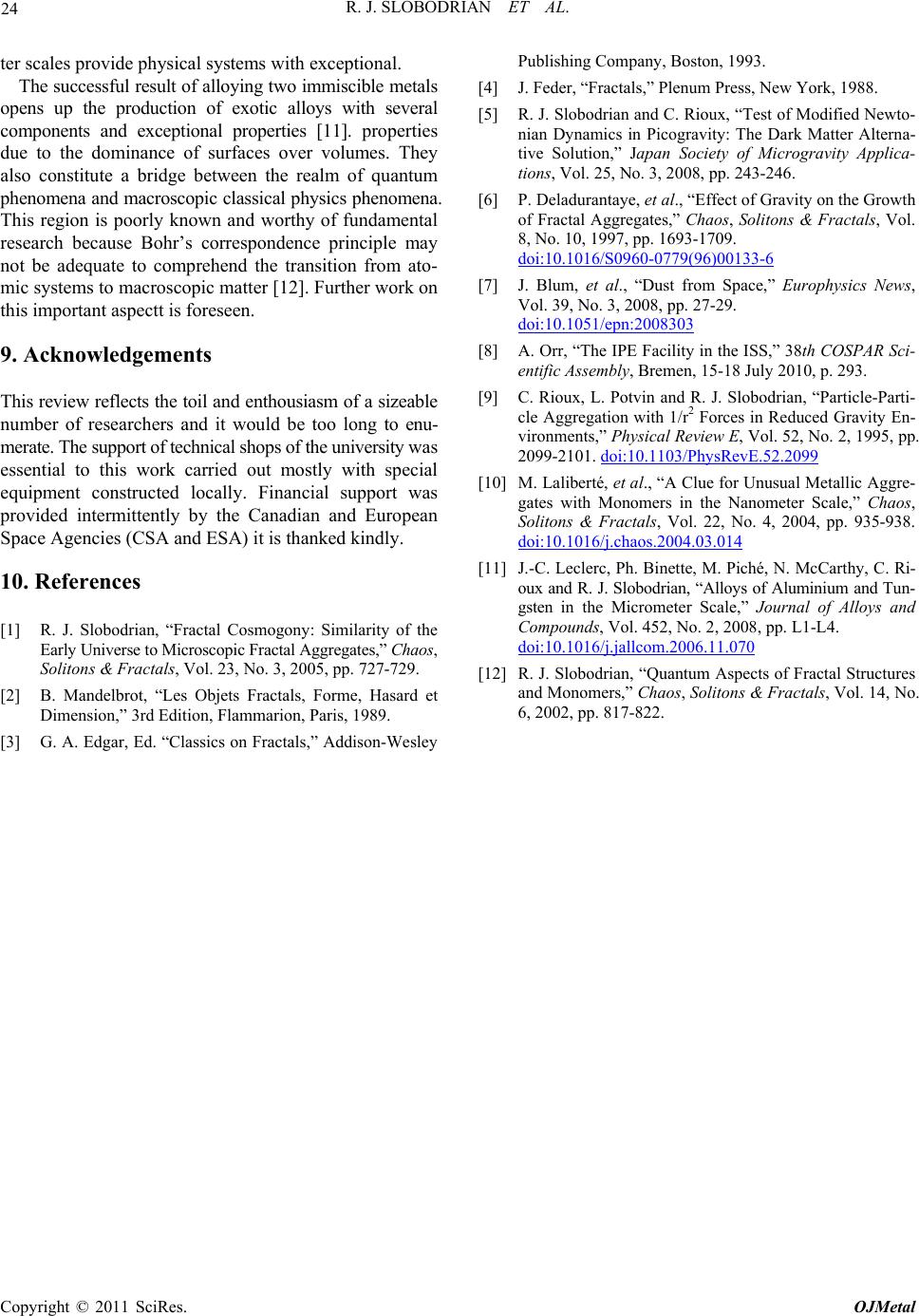 R. J. SLOBODRIAN ET AL. Copyright © 2011 SciRes. OJMetal 24 ter scales provide physical systems with exceptional. The successful result of alloying two immiscible metals opens up the production of exotic alloys with several components and exceptional properties [11]. properties due to the dominance of surfaces over volumes. They also constitute a bridge between the realm of quantum phenomena and macroscopic classical physics phenomena. This region is poorly known and worthy of fundamental research because Bohr’s correspondence principle may not be adequate to comprehend the transition from ato- mic systems to macroscopic matter [12]. Further work on this important aspectt is foreseen. 9. Acknowledgements This review reflects the toil and enthousiasm of a sizeable number of researchers and it would be too long to enu- merate. The support of technical shops of the university was essential to this work carried out mostly with special equipment constructed locally. Financial support was provided intermittently by the Canadian and European Space Agencies (CSA and ESA) it is thanked kindly. 10. References [1] R. J. Slobodrian, “Fractal Cosmogony: Similarity of the Early Universe to Microscopic Fractal Aggregates,” Chaos, Solitons & Fractals, Vol. 23, No. 3, 2005, pp. 727-729. [2] B. Mandelbrot, “Les Objets Fractals, Forme, Hasard et Dimension,” 3rd Edition, Flammarion, Paris, 1989. [3] G. A. Edgar, Ed. “Classics on Fractals, ” Addison-Wesley Publishing Company, Boston, 1993. [4] J. Feder, “Fractals,” Plenum Press, New York, 1988. [5] R. J. Slobodrian and C. Rioux, “Test of Modified Newto- nian Dynamics in Picogravity: The Dark Matter Alterna- tive Solution,” Japan Society of Microgravity Applica- tions, Vol. 25, No. 3, 2008, pp. 243-246. [6] P. Deladurantaye, et al., “Effect of Gravity on the Growth of Fractal Aggregates,” Chaos, Solitons & Fractals, Vol. 8, No. 10, 1997, pp. 1693-1709. doi:10.1016/S0960-0779(96)00133-6 [7] J. Blum, et al., “Dust from Space,” Europhysics News, Vol. 39, No. 3, 2008, pp. 27-29. doi:10.1051/epn:2008303 [8] A. Orr, “The IPE Facility in the ISS,” 38th COSPAR Sci- entific Assembly, Bremen, 15-18 July 2010, p. 293. [9] C. Rioux, L. Potvin and R. J. Slobodrian, “Particle-Parti- cle Aggregation with 1/r2 Forces in Reduced Gravity En- vironments,” Physical Review E, Vol. 52, No. 2, 1995, pp. 2099-2101. doi:10.1103/PhysRevE.52.2099 [10] M. Laliberté, et al., “A Clue for Unusual Metallic Aggre- gates with Monomers in the Nanometer Scale,” Chaos, Solitons & Fractals, Vol. 22, No. 4, 2004, pp. 935-938. doi:10.1016/j.chaos.2004.03.014 [11] J.-C. Leclerc, Ph. Binette, M. Piché, N. McCarthy, C. Ri- oux and R. J. Slobodrian, “Alloy s of Aluminium and Tun- gsten in the Micrometer Scale,” Journal of Alloys and Compounds, Vol. 452, No. 2, 2008, pp. L1-L4. doi:10.1016/j.jallcom.2006.11.070 [12] R. J. Slobodrian, “Quantum Aspects of Fractal Structures and Monomers,” Chaos, Solitons & Fractals, Vol. 14, No. 6, 2002, pp. 817-822. |