

Paper Menu >>
Journal Menu >>
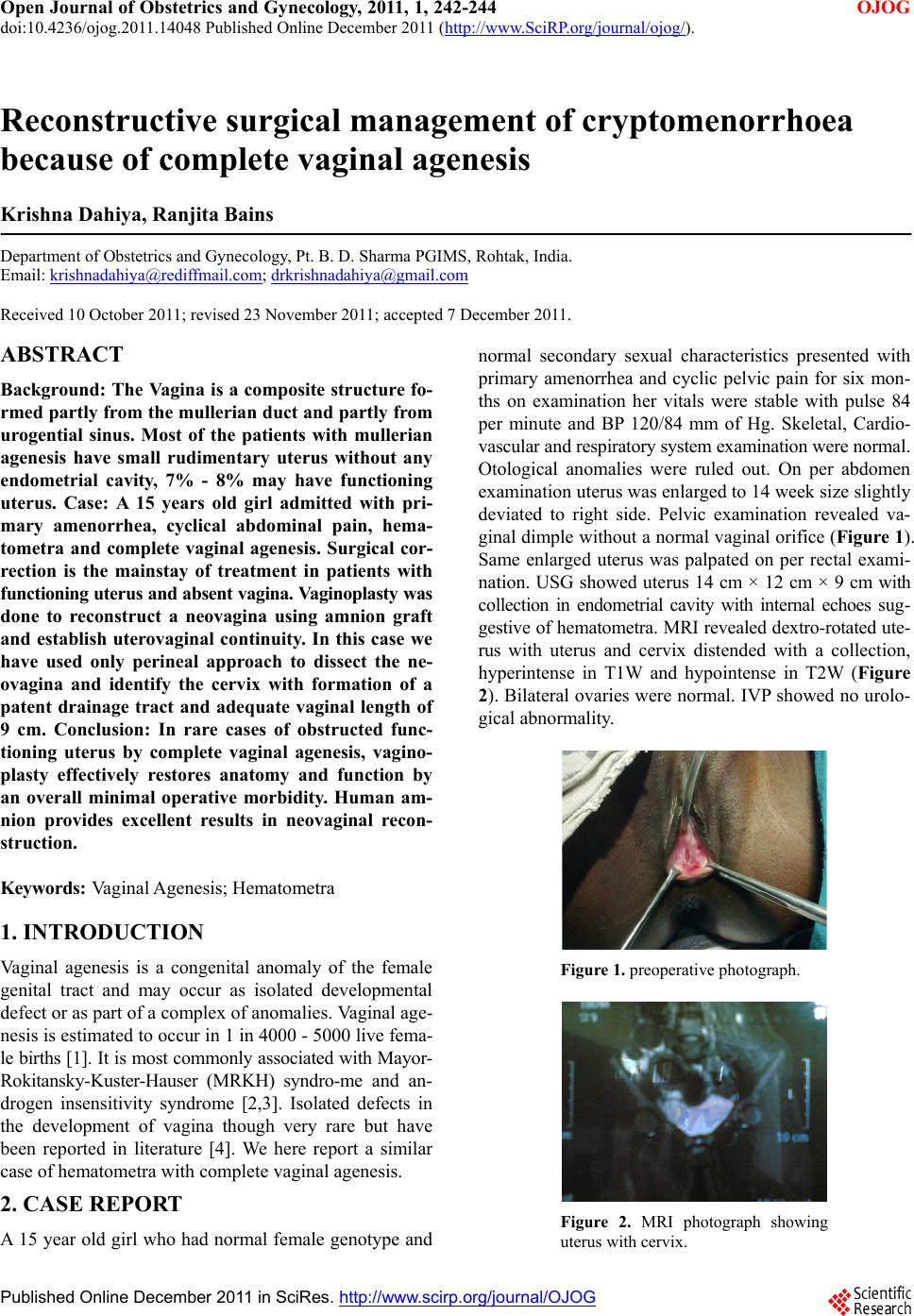 Open Journal of Obstetrics and Gynecology, 2011, 1, 242-244 OJOG doi:10.4236/ojog.2011.14048 Published Online December 2011 (http://www.SciRP.org/journal/ojog/). Published Online December 2011 in SciRes. http://www.scirp.org/journal/OJOG Reconstructive surgical management of cryptomenorrhoea because of complete vaginal agenesis Krishna Dahiya, Ranjita Bains Department of Obstetrics and Gynecology, Pt. B. D. Sharma PGIMS, Rohtak, India. Email: [email protected]; [email protected] Received 10 October 2011; revised 23 November 2011; accepted 7 December 2011. ABSTRACT Background: The Vagina is a composite structure fo- rmed partly from the mullerian duct and partly from urogential sinus. Most of the patients with mullerian agenesis have small rudimentary uterus without any endometrial cavity, 7% - 8% may have functioning uterus. Case: A 15 years old girl admitted with pri- mary amenorrhea, cyclical abdominal pain, hema- tometra and complete vaginal agenesis. Surgical cor- rection is the mainstay of treatment in patients with functioning uterus and absent vagina. Vaginoplasty was done to reconstruct a neovagina using amnion graft and establish uterovaginal continuity. In this case we have used only perineal approach to dissect the ne- ovagina and identify the cervix with formation of a patent drainage tract and adequate vaginal length of 9 cm. Conclusion: In rare cases of obstructed func- tioning uterus by complete vaginal agenesis, vagino- plasty effectively restores anatomy and function by an overall minimal operative morbidity. Human am- nion provides excellent results in neovaginal recon- struction. Keywords: Vaginal Agenesis; Hematometra 1. INTRODUCTION Vaginal agenesis is a congenital anomaly of the female genital tract and may occur as isolated developmental defect or as part of a complex of anomalies. Vaginal age- nesis is estimated to occur in 1 in 4000 - 5000 live fema- le births [1]. It is most commonly as sociated with Mayor- Rokitansky-Kuster-Hauser (MRKH) syndro-me and an- drogen insensitivity syndrome [2,3]. Isolated defects in the development of vagina though very rare but have been reported in literature [4]. We here report a similar case of hematometra with complete vaginal agenesis. 2. CASE REPORT A 15 year old girl who had normal female genotype and normal secondary sexual characteristics presented with primary amenorrhea and cyclic pelvic pain for six mon- ths on examination her vitals were stable with pulse 84 per minute and BP 120/84 mm of Hg. Skeletal, Cardio- vascular and respiratory system examination were normal. Otological anomalies were ruled out. On per abdomen examination uterus was enlarged to 14 week size slightly deviated to right side. Pelvic examination revealed va- ginal dimple without a normal vaginal orifice (Figure 1). Same enlarged uterus was palpated on per rectal exami- nation. USG showed uterus 14 cm × 12 cm × 9 cm with collection in endometrial cavity with internal echoes sug- gestive of hematometra. MRI revealed dextro-rotated ute- rus with uterus and cervix distended with a collection, hyperintense in T1W and hypointense in T2W (Figure 2). Bilateral ovaries were normal. IVP showed no urolo- gical abnormality. Figure 1. preoperative photograph. Figure 2. MRI photograph showing uterus with cervix. 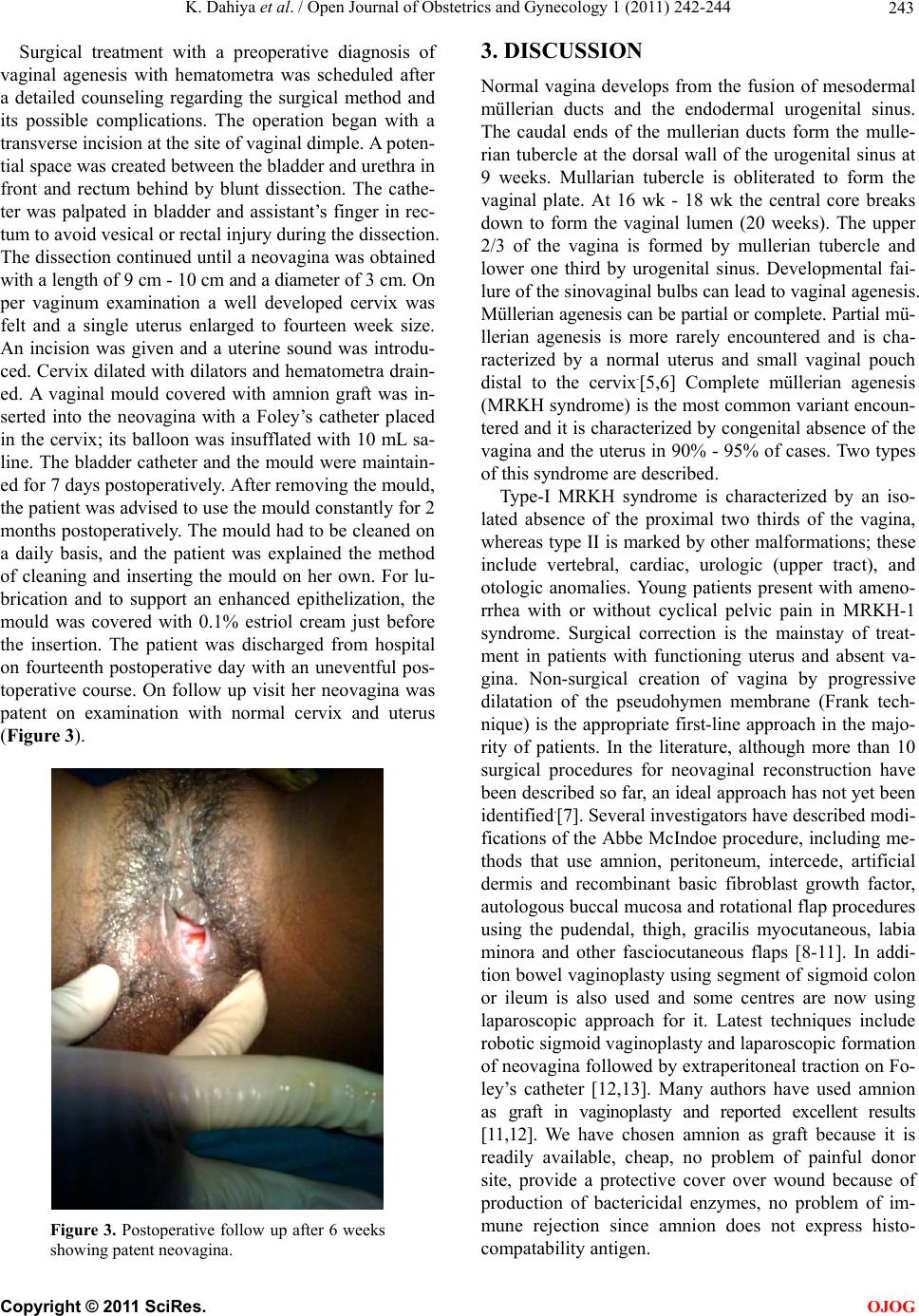 K. Dahiya et al. / Open Journal of Obstetrics and Gynecology 1 (2011) 242-244 243 Surgical treatment with a preoperative diagnosis of vaginal agenesis with hematometra was scheduled after a detailed counseling regarding the surgical method and its possible complications. The operation began with a transverse incision at the site of vaginal dimple. A poten- tial space was created between the bladder and urethra in front and rectum behind by blunt dissection. The cathe- ter was palpated in bladder and assistant’s finger in rec- tum to avoid vesical or rectal injury during the dissection. The dissection continued until a n eovagina was obtained with a length of 9 cm - 10 cm and a diameter of 3 cm. On per vaginum examination a well developed cervix was felt and a single uterus enlarged to fourteen week size. An incision was given and a uterine sound was introdu- ced. Cervix dilated with dilators and h ematometra drain- ed. A vaginal mould covered with amnion graft was in- serted into the neovagina with a Foley’s catheter placed in the cervix; its balloon was insufflated with 10 mL sa- line. The bladder catheter and the mould were maintain- ed for 7 days po stoperativ ely. After removing the mould, the patient was advised to use th e mould constantly for 2 months postoperatively. The mould had to be cleaned on a daily basis, and the patient was explained the method of cleaning and inserting the mould on her own. For lu- brication and to support an enhanced epithelization, the mould was covered with 0.1% estriol cream just before the insertion. The patient was discharged from hospital on fourteenth postoperative day with an uneventful pos- toperative course. On follow up visit her neovagina was patent on examination with normal cervix and uterus (Figure 3). Figure 3. Postoperative follow up after 6 weeks showing patent neovagina. 3. DISCUSSION Normal vagina develops from the fusion of mesodermal müllerian ducts and the endodermal urogenital sinus. The caudal ends of the mullerian ducts form the mulle- rian tubercle at the dorsal wall of the urogenital sinus at 9 weeks. Mullarian tubercle is obliterated to form the vaginal plate. At 16 wk - 18 wk the central core breaks down to form the vaginal lumen (20 weeks). The upper 2/3 of the vagina is formed by mullerian tubercle and lower one third by urogenital sinus. Developmental fai- lure of the sinovaginal bulbs can lead to vaginal agenesis. Müllerian agen esis can be partia l or complete . Partial mü- llerian agenesis is more rarely encountered and is cha- racterized by a normal uterus and small vaginal pouch distal to the cervix.[5,6] Complete müllerian agenesis (MRKH syndrome) is the most common variant encoun- tered and it is characterized by congenital absence of the vagina and the uterus in 90% - 95% of cases. Two types of this syndrome are described. Type-I MRKH syndrome is characterized by an iso- lated absence of the proximal two thirds of the vagina, whereas type II is marked by other malformations; these include vertebral, cardiac, urologic (upper tract), and otologic anomalies. Young patients present with ameno- rrhea with or without cyclical pelvic pain in MRKH-1 syndrome. Surgical correction is the mainstay of treat- ment in patients with functioning uterus and absent va- gina. Non-surgical creation of vagina by progressive dilatation of the pseudohymen membrane (Frank tech- nique) is the appropriate first-line approach in the majo- rity of patients. In the literature, although more than 10 surgical procedures for neovaginal reconstruction have been described so far, an ideal approach has not yet been identified.[7]. Several investigators have described modi- fications of the Abbe McIndoe procedure, including me- thods that use amnion, peritoneum, intercede, artificial dermis and recombinant basic fibroblast growth factor, autologous buccal mucosa and rotational flap procedures using the pudendal, thigh, gracilis myocutaneous, labia minora and other fasciocutaneous flaps [8-11]. In addi- tion bowel vaginoplasty using segment of sigmoid colon or ileum is also used and some centres are now using laparoscopic approach for it. Latest techniques include robotic sigmoid vaginoplasty and laparoscopic formation of neovagina followed by extraperitoneal traction on Fo- ley’s catheter [12,13]. Many authors have used amnion as graft in vaginoplasty and reported excellent results [11,12]. We have chosen amnion as graft because it is readily available, cheap, no problem of painful donor site, provide a protective cover over wound because of production of bactericidal enzymes, no problem of im- mune rejection since amnion does not express histo- compatability antigen. C opyright © 2011 SciRes. OJOG 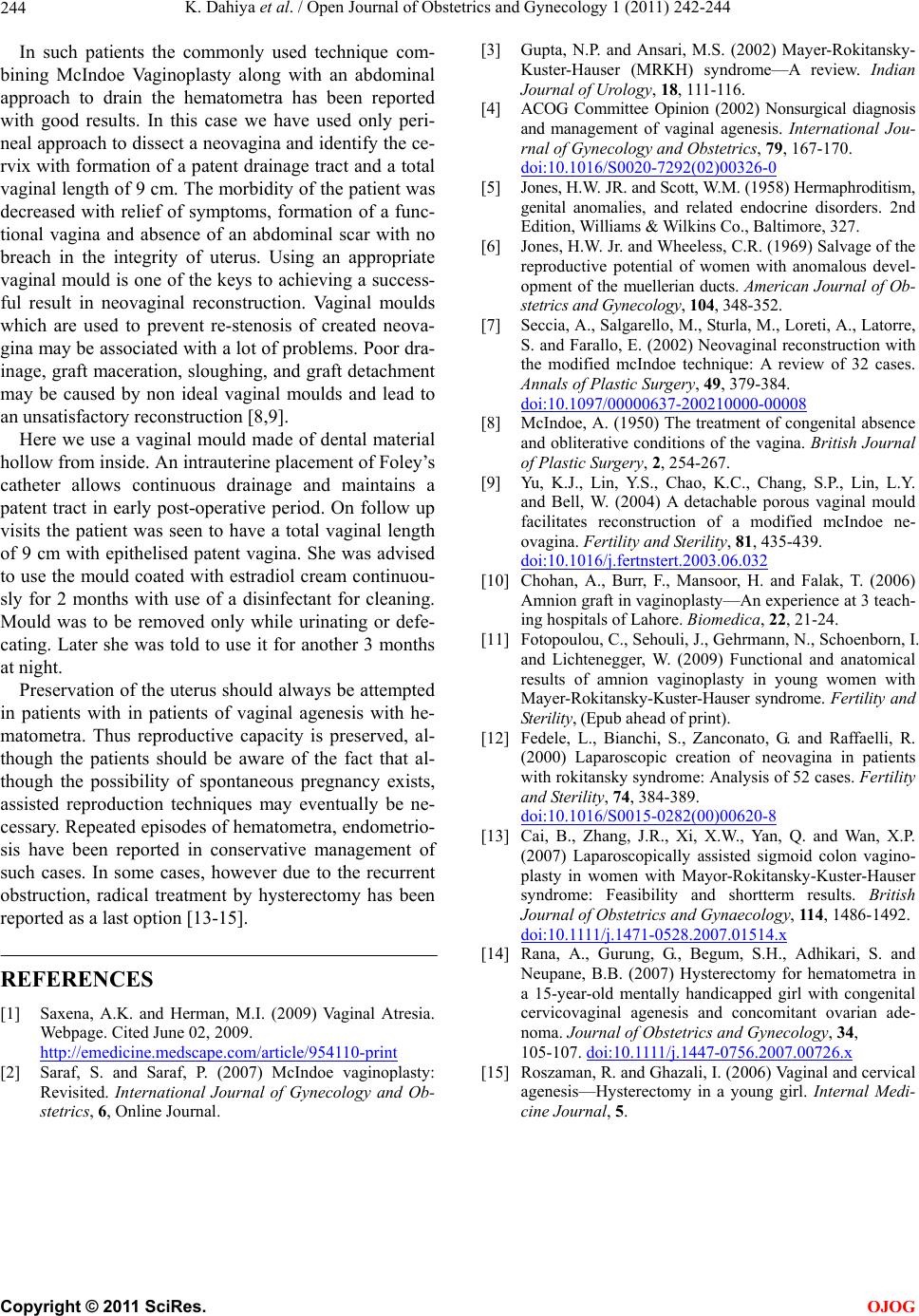 K. Dahiya et al. / Open Journal of Obstetrics and Gynecology 1 (2011) 242-244 Copyright © 2011 SciRes. OJOG 244 [3] Gupta, N.P. and Ansari, M.S. (2002) Mayer-Rokitansky- Kuster-Hauser (MRKH) syndrome—A review. Indian Journal of Urology, 18, 111-116. In such patients the commonly used technique com- bining McIndoe Vaginoplasty along with an abdominal approach to drain the hematometra has been reported with good results. In this case we have used only peri- neal approach to dissect a neovagina and identify the ce- rvix with formation of a patent drainage tract and a total vaginal length of 9 cm. The morbidity of the patient was decreased with relief of symptoms, formation of a func- tional vagina and absence of an abdominal scar with no breach in the integrity of uterus. Using an appropriate vaginal mould is one of the keys to achieving a success- ful result in neovaginal reconstruction. Vaginal moulds which are used to prevent re-stenosis of created neova- gina may be associated with a lot of problems. Poor dra- inage, graft maceratio n, sloughing, and graft detachment may be caused by non ideal vaginal moulds and lead to an unsatisfactory reconstruction [8,9]. [4] ACOG Committee Opinion (2002) Nonsurgical diagnosis and management of vaginal agenesis. International Jou- rnal of Gynecology and Obstetrics, 79, 167-170. doi:10.1016/S0020-7292(02)00326-0 [5] Jones, H.W. JR. and Scott, W.M. (1958) Hermaphroditism, genital anomalies, and related endocrine disorders. 2nd Edition, Williams & Wilkins Co., Baltimore, 327. [6] Jones, H.W. Jr. and Wheeless, C.R. (1969) Salvage of the reproductive potential of women with anomalous devel- opment of the muellerian ducts. American Journal of Ob- stetrics and Gynecology, 104, 348-352. [7] Seccia, A., Salgarello, M., Sturla, M., Loreti, A., Latorre, S. and Farallo, E. (2002) Neovaginal reconstruction with the modified mcIndoe technique: A review of 32 cases. Annals of Plastic Surgery, 49, 379-384. doi:10.1097/00000637-200210000-00008 [8] McIndoe, A. (1950) The treatment of congenital absence and obliterative conditions of the vagina. British Journal of Plastic Surgery, 2, 254-267. Here we use a vaginal mould made of dental material hollow from inside. An intrauterine placement of Foley’s catheter allows continuous drainage and maintains a patent tract in early post-operative period. On follow up visits the patient was seen to have a total vaginal length of 9 cm with epithelised patent vagina. She was advised to use the mould coated with estradiol cream continuou- sly for 2 months with use of a disinfectant for cleaning. Mould was to be removed only while urinating or defe- cating. Later she was told to use it for another 3 months at night. [9] Yu, K.J., Lin, Y.S., Chao, K.C., Chang, S.P., Lin, L.Y. and Bell, W. (2004) A detachable porous vaginal mould facilitates reconstruction of a modified mcIndoe ne- ovagina. Fertility and Sterility, 81, 435-439. doi:10.1016/j.fertnstert.2003.06.032 [10] Chohan, A., Burr, F., Mansoor, H. and Falak, T. (2006) Amnion graft in vaginoplasty—An experience at 3 teach- ing hospitals of Lahore. Biomedica, 22, 21-24. [11] Fotopoulou, C., Sehouli, J., Gehrmann, N., Schoenborn, I. and Lichtenegger, W. (2009) Functional and anatomical results of amnion vaginoplasty in young women with May er-Rokitansky-Kuster-Hauser syndrome. Fertility and Sterility, (Epub ahead of print). Preservation of the uterus should always be attempted in patients with in patients of vaginal agenesis with he- matometra. Thus reproductive capacity is preserved, al- though the patients should be aware of the fact that al- though the possibility of spontaneous pregnancy exists, assisted reproduction techniques may eventually be ne- cessary. Repeated episodes of hematometra, endometrio- sis have been reported in conservative management of such cases. In some cases, however due to the recurrent obstruction, radical treatment by hysterectomy has been reported as a last option [13-15]. [12] Fedele, L., Bianchi, S., Zanconato, G. and Raffaelli, R. (2000) Laparoscopic creation of neovagina in patients with rokitansky syndrome: Analysis of 52 cases. Fertility and Sterility, 74, 384-389. doi:10.1016/S0015-0282(00)00620-8 [13] Cai, B., Zhang, J.R., Xi, X.W., Yan, Q. and Wan, X.P. (2007) Laparoscopically assisted sigmoid colon vagino- plasty in women with Mayor-Rokitansky-Kuster-Hauser syndrome: Feasibility and shortterm results. British Journal of Obstetrics and Gynaecology, 114, 1486-1492. d oi: 10 .1111 /j .1 471 -0528.2007.01514.x [14] Rana, A., Gurung, G., Begum, S.H., Adhikari, S. and Neupane, B.B. (2007) Hysterectomy for hematometra in a 15-year-old mentally handicapped girl with congenital cervicovaginal agenesis and concomitant ovarian ade- noma. Journal of Obstetrics and Gynecology, 34, 105-107. d oi: 10 .1111/ j. 1447-0756.2007.00726.x REFERENCES [1] Saxena, A.K. and Herman, M.I. (2009) Vaginal Atresia. Webpage. Cited June 02, 2009. http://emedicine.medscape.com/article/954110-print [15] Roszaman, R. and Ghazali, I. (2006) Vaginal and cervical agenesis—Hysterectomy in a young girl. Internal Medi- cine Journal, 5. [2] Saraf, S. and Saraf, P. (2007) McIndoe vaginoplasty: Revisited. International Journal of Gynecology and Ob- stetrics, 6, Online Journal. |