

Paper Menu >>
Journal Menu >>
 Advances in Materials Physics and Chemistry, 2011, 1, 91-93 doi:10.4236/ampc.2011.13015 Published Online December 2011 (http://www.SciRP.org/journal/ampc) Copyright © 2011 SciRes. AMPC Column Chromatography: A Facile and Inexpensive Procedure to Purify the Red Dopant DCJ Applied for OLEDs Khadijeh Ghanbari1, Hassan Aghajani1, Maryam Golbabaee1, Elham Naemi Khah1, Seyed Hassan Nabavi2, Ata Koohian1 1Department of Physics, University of Tehran, Tehran, Iran 2Faculty of Physics, Modares University, Tehran, Iran E-mail: [email protected] Received September 17, 2011; revised October 20, 2011; accepted November 3, 2011 Abstract DCJ, one of the DCM derivatives, has been used as a laser dye and a red emitter or a red dopant for OLED devices in recent decade. 4-(dicyanomethylene)-2-methy l-6-(julolidyl-9-enyl)-4H-pyran (DCJ) containing julolidine group has been synthesized for use as a red fluorescent dye molecule in organic light-emitting di- odes (OLEDs). In this paper, we reported a facile, simple and inexpensive procedure of purification of DCJ without necessity of HPLC analysis. The maximum absorption, emission, quantum efficiency are increasing in DCJ with the electron-donating of julolidine group. Keywords: Purification, Column Chromatography, Absorption, Emission, Quantum Efficiency 1. Introduction In recent years, the study of synthesis, structure and chemical properties of organic light emitting diodes (OLED) electronic materials has become one of the foremost topics in chemistry and physics [1-3]. Since the introduction of first multi-layer high efficiency thin-film OLEDs devices by Tang and Van Slyke [4], OLEDs have attracted considerable interests for flat-panel display applications. For the flat panel and full color display, it is necessary to have a set of green, blue and red emitters with sufficiently high luminous efficiency and proper chromaticity. At present time, the OLED materials with blue and green emission have been well developed; however, the red OLED materials require more investigation [5]. In 1989, C. W. Tang in Kodak has improved the efficiency and synthesis of DCM compounds as red dopants [6]. Then Shim et al. deter- mined the julolidyl substituted aniline group in the DCM molecule as DCJ for organic electro-luminescent de- vices. It is wellknown that the pyran containing dyes such as DCM and DCJ (4-(dicyanomethylene)-2-methyl-6- (julolidyl-9-enyl)-4H-pyran) have been widely used as red emitters OLEDs. Maximum emission and absorption wavelength increases with the electron-donating or the electron-withdrawing abilities of different substituents in the aniline as electro-donating group or the pyran as electron-withdrawing group of DCM derivatives [7]. The enhanced electron donating ability of julolidine origi- nated from the increased communications between the lone electron pair on the nitrogen atom and phenyl π system with the help of two six member locking rings [8]. The symmetrical electron acceptor procedure, 4-(dicya- nomethylene)-2,6-dimethyl-4H-pyran, 1, (Scheme 1) was used to prepare DCJ. However, under the normal Knovenagel reaction con- ditions, the bis-condensed byproduct is inevitably in the precursor, which is quite difficult to be separated from the DCJ product and tends to quench the fluorescence of DCJ, 1 [9,10]. Therefore, in this paper to eliminate the bis-con- densed by product, we purpose a simple way for com- plete purification of DCJ dye. Purification was carried out by Column chromatogra- phy instead of HPLC analysis with variety ratio of sol- vents. This method is very simple and needs no expen- sive equipments in comparison with HPLC analysis. 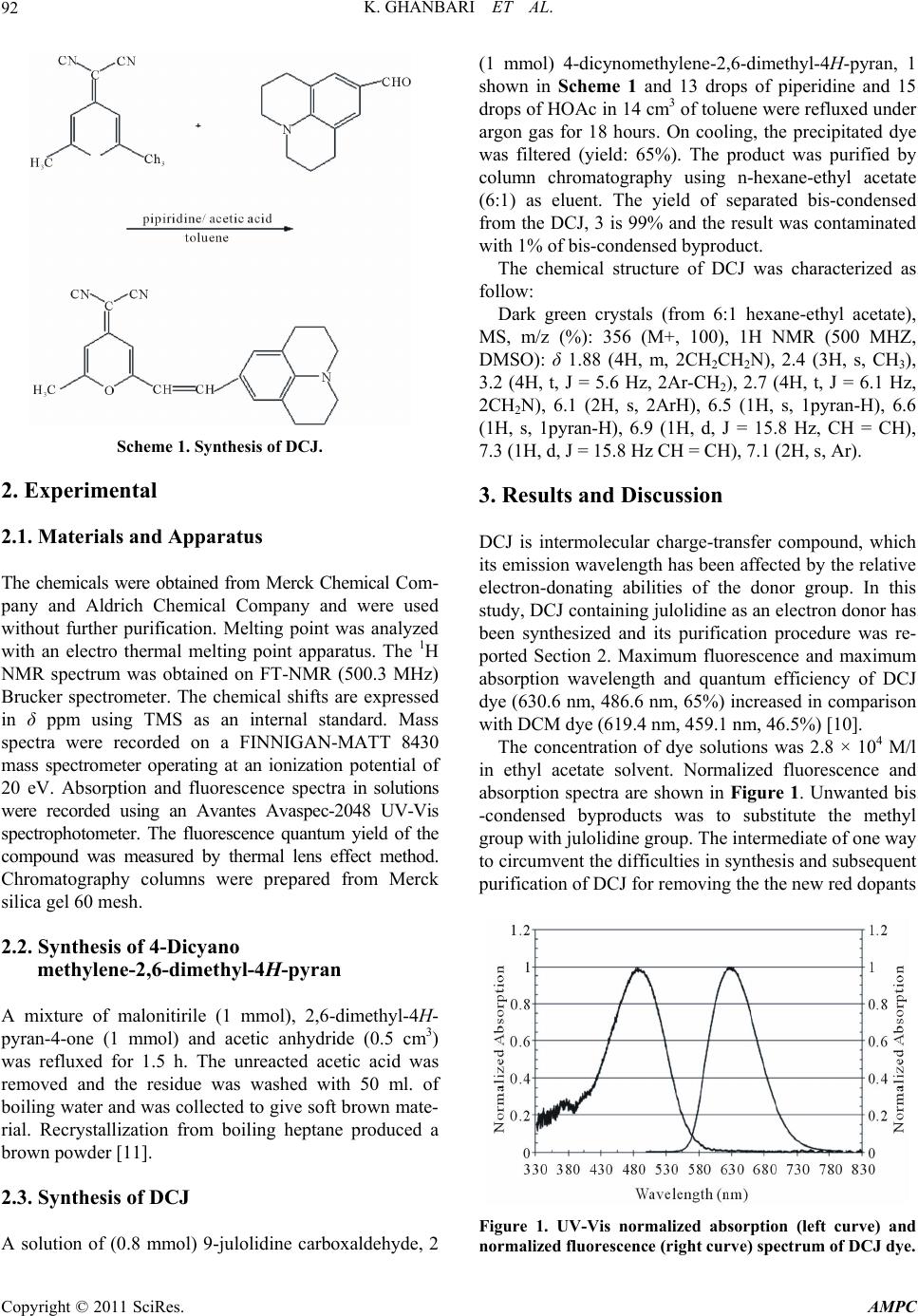 K. GHANBARI ET AL. 92 Scheme 1. Synthesis of DCJ. 2. Experimental 2.1. Materials and Apparatus The chemicals were obtained from Merck Chemical Com- pany and Aldrich Chemical Company and were used without further purification. Melting point was analyzed with an electro thermal melting point apparatus. The 1H NMR spectrum was obtained on FT-NMR (500.3 MHz) Brucker spectrometer. The chemical shifts are expressed in δ ppm using TMS as an internal standard. Mass spectra were recorded on a FINNIGAN-MATT 8430 mass spectrometer operating at an ionization potential of 20 eV. Absorption and fluorescence spectra in solutions were recorded using an Avantes Avaspec-2048 UV-Vis spectrophotometer. The fluorescence quantum yield of the compound was measured by thermal lens effect method. Chromatography columns were prepared from Merck silica gel 60 mesh. 2.2. Synthesis of 4-Dicyano methylene-2,6-dimethyl-4H-pyran A mixture of malonitirile (1 mmol), 2,6-dimethyl-4H- pyran-4-one (1 mmol) and acetic anhydride (0.5 cm3) was refluxed for 1.5 h. The unreacted acetic acid was removed and the residue was washed with 50 ml. of boiling water and was collected to give soft brown mate- rial. Recrystallization from boiling heptane produced a brown powder [11]. 2.3. Synthesis of DCJ A solution of (0.8 mmol) 9-julolidine carboxaldehyde, 2 (1 mmol) 4-dicynomethylene-2,6-dimethyl-4H-pyran, 1 shown in Scheme 1 and 13 drops of piperidine and 15 drops of HOAc in 14 cm3 of toluene were refluxed under argon gas for 18 hours. On cooling, the precipitated dye was filtered (yield: 65%). The product was purified by column chromatography using n-hexane-ethyl acetate (6:1) as eluent. The yield of separated bis-condensed from the DCJ, 3 is 99% and the result was contaminated with 1% of bis-condensed byproduct. The chemical structure of DCJ was characterized as follow: Dark green crystals (from 6:1 hexane-ethyl acetate), MS, m/z (%): 356 (M+, 100), 1H NMR (500 MHZ, DMSO): δ 1.88 (4H, m, 2CH2CH2N), 2.4 (3H, s, CH3), 3.2 (4H, t, J = 5.6 Hz, 2Ar-CH2), 2.7 (4H, t, J = 6.1 Hz, 2CH2N), 6.1 (2H, s, 2ArH), 6.5 (1H, s, 1pyran-H), 6.6 (1H, s, 1pyran-H), 6.9 (1H, d, J = 15.8 Hz, CH = CH), 7.3 (1H, d, J = 15.8 Hz CH = CH), 7.1 (2H, s, Ar). 3. Results and Discussion DCJ is intermolecular charge-transfer compound, which its emission wavelength has been affected by the relative electron-donating abilities of the donor group. In this study, DCJ containing julolidine as an electron donor has been synthesized and its purification procedure was re- ported Section 2. Maximum fluorescence and maximum absorption wavelength and quantum efficiency of DCJ dye (630.6 nm, 486.6 nm, 65%) increased in comparison with DCM dye (619.4 nm, 459.1 nm, 46.5%) [10]. The concentration of dye solutions was 2.8 × 10⁴ M/l in ethyl acetate solvent. Normalized fluorescence and absorption spectra are shown in Figure 1. Unwanted bis -condensed byproducts was to substitute the methyl group with julolidine group. The intermediate of one way to circumvent the difficulties in synthesis and subsequent purification of DCJ for removing the the new red dopants Figure 1. UV-Vis normalized absorption (left curve) and normalized fluorescence (right curve) spectrum of DCJ dye. Copyright © 2011 SciRes. AMPC 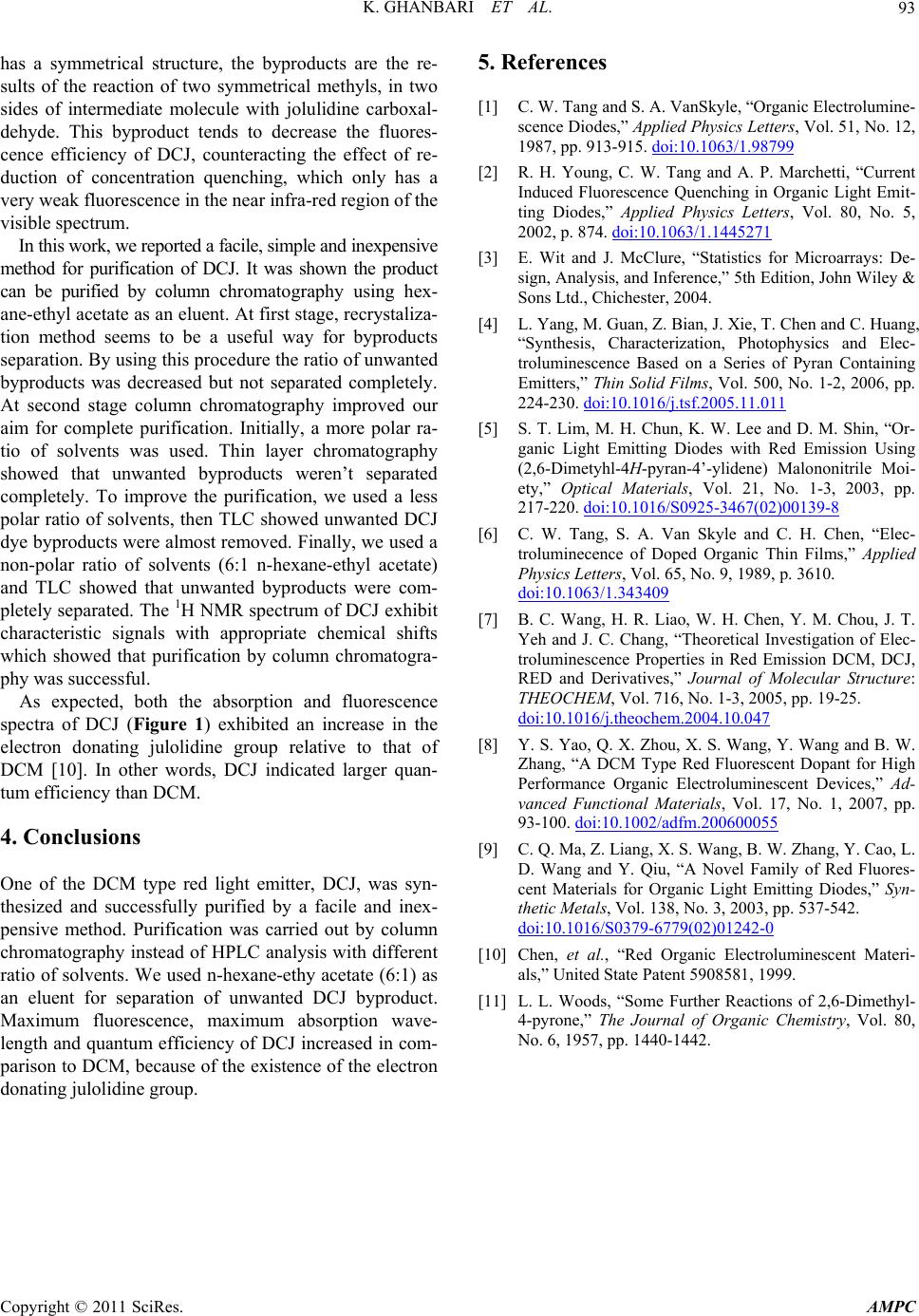 K. GHANBARI ET AL. Copyright © 2011 SciRes. AMPC 93 has a symmetrical structure, the byproducts are the re- sults of the reaction of two symmetrical methyls, in two sides of intermediate molecule with jolulidine carboxal- dehyde. This byproduct tends to decrease the fluores- cence efficiency of DCJ, counteracting the effect of re- duction of concentration quenching, which only has a very weak fluorescence in the near infra-red region of the visible spectrum. In this work, we reported a facile, simple and inexpensive method for purification of DCJ. It was shown the product can be purified by column chromatography using hex- ane-ethyl acetate as an eluent. At first stage, recrystaliza- tion method seems to be a useful way for byproducts separation. By using this procedure the ratio of unwanted byproducts was decreased but not separated completely. At second stage column chromatography improved our aim for complete purification. Initially, a more polar ra- tio of solvents was used. Thin layer chromatography showed that unwanted byproducts weren’t separated completely. To improve the purification, we used a less polar ratio of solvents, then TLC showed unwanted DCJ dye byproducts were almost removed. Finally, we used a non-polar ratio of solvents (6:1 n-hexane-ethyl acetate) and TLC showed that unwanted byproducts were com- pletely separated. The 1H NMR spectrum of DCJ exhibit characteristic signals with appropriate chemical shifts which showed that purification by column chromatogra- phy was successful. As expected, both the absorption and fluorescence spectra of DCJ (Figure 1) exhibited an increase in the electron donating julolidine group relative to that of DCM [10]. In other words, DCJ indicated larger quan- tum efficiency than DCM. 4. Conclusions One of the DCM type red light emitter, DCJ, was syn- thesized and successfully purified by a facile and inex- pensive method. Purification was carried out by column chromatography instead of HPLC analysis with different ratio of solvents. We used n-hexane-ethy acetate (6:1) as an eluent for separation of unwanted DCJ byproduct. Maximum fluorescence, maximum absorption wave- length and quantum efficiency of DCJ increased in com- parison to DCM, because of the existence of the electron donating julolidine group. 5. References [1] C. W. Tang and S. A. VanSkyle, “Organic Electrolumine- scence Diodes,” Applied Physics Letters, Vol. 51, No. 12, 1987, pp. 913-915. doi:10.1063/1.98799 [2] R. H. Young, C. W. Tang and A. P. Marchetti, “Current Induced Fluorescence Quenching in Organic Light Emit- ting Diodes,” Applied Physics Letters, Vol. 80, No. 5, 2002, p. 874. doi:10.1063/1.1445271 [3] E. Wit and J. McClure, “Statistics for Microarrays: De- sign, Analysis, and Inference,” 5th Edition, John Wiley & Sons Ltd., Chichester, 2004. [4] L. Yang, M. Guan, Z. Bian, J. Xie, T. Chen and C. Huang, “Synthesis, Characterization, Photophysics and Elec- troluminescence Based on a Series of Pyran Containing Emitters,” Thin Solid Films, Vol. 500, No. 1-2, 2006, pp. 224-230. doi:10.1016/j.tsf.2005.11.011 [5] S. T. Lim, M. H. Chun, K. W. Lee and D. M. Shin, “Or- ganic Light Emitting Diodes with Red Emission Using (2,6-Dimetyhl-4H-pyran-4’-ylidene) Malononitrile Moi- ety,” Optical Materials, Vol. 21, No. 1-3, 2003, pp. 217-220. doi:10.1016/S0925-3467(02)00139-8 [6] C. W. Tang, S. A. Van Skyle and C. H. Chen, “Elec- troluminecence of Doped Organic Thin Films,” Applied Physics Letters, Vol. 65, No. 9, 1989, p. 3610. doi:10.1063/1.343409 [7] B. C. Wang, H. R. Liao, W. H. Chen, Y. M. Chou, J. T. Yeh and J. C. Chang, “Theoretical Investigation of Elec- troluminescence Properties in Red Emission DCM, DCJ, RED and Derivatives,” Journal of Molecular Structure: THEOCHEM, Vol. 716, No. 1-3, 2005, pp. 19-25. doi:10.1016/j.theochem.2004.10.047 [8] Y. S. Yao, Q. X. Zhou, X. S. Wang, Y. Wang and B. W. Zhang, “A DCM Type Red Fluorescent Dopant for High Performance Organic Electroluminescent Devices,” Ad- vanced Functional Materials, Vol. 17, No. 1, 2007, pp. 93-100. doi:10.1002/adfm.200600055 [9] C. Q. Ma, Z. Liang, X. S. Wang, B. W. Zhang, Y. Cao, L. D. Wang and Y. Qiu, “A Novel Family of Red Fluores- cent Materials for Organic Light Emitting Diodes,” Syn- thetic Metals, Vol. 138, No. 3, 2003, pp. 537-542. doi:10.1016/S0379-6779(02)01242-0 [10] Chen, et al., “Red Organic Electroluminescent Materi- als,” United State Patent 5908581, 1999. [11] L. L. Woods, “Some Further Reactions of 2,6-Dimethyl- 4-pyrone,” The Journal of Organic Chemistry, Vol. 80, No. 6, 1957, pp. 1440-1442. |