

Paper Menu >>
Journal Menu >>
 Open Journal of Obstetrics and Gynecology, 2011, 1, 168-173 OJOG doi:10.4236/ojog.2011.14032 Published Online December 2011 (http://www.SciRP.org/journal/ojog/). Published Online December 2011 in SciRes. http://www.scirp.org/journal/OJOG Does magnesium sulfate increase the incidence of postpartum hemorrhage? A systematic review Laura M. Héman, Pau l J. Q. Van Der Linden Department of Gynaecology and Obstet rics, Deventer Ziekenhuis, Devent er, The Netherlands. Email: [email protected] Received 4 October 2011; revised 22 November 2011; accepted 3 December 2011. ABSTRACT The incidence of Postpartum Hemorrhage (PPH) is increasing in the western world. We hypothesize that magnesium sulfate (MgSO4) could be a contributing factor. MgSO4 might increase the incidence of PPH by induction of vasodilation, tocolytic effects, and effects on the blood like red cell deformity, platelet activity inhibition and a prolonged bleeding time. Based on these effects of MgSO4 a correlation with PPH is suspected. MgSO4 is widely used in the pre- vention of eclampsia. However, the working mecha- nism of this effective drug is largely unknown. We performed a systematic search to find all Random- ized Controlled trials (RCTs) containing MgSO4 in preeclamsia as well as all MgSO4 studies with infor- mation on PPH. Titles, abstracts and references of publications were evaluated for appropriateness and whether they met the inclusion criteria. RCTs about MgSO4 with original data on PPH prevalence were included in our systematic review. We calculated the relative risk of PPH in every study as well as an overall relative risk. Four relevant and valid RCTs were found, totalling 11,621 relevant patients. The relative risk of PPH in women treated with MgSO4 is 0.964 (95% CI 0.886 - 1.050). In this systematic re- view we found no significant increase in PPH in women treated with MgSO4. However, there is still room for discussion due to the heterogeneity in methods (dosage and duration of treatment), results, and tertiary outcomes, as well as the small number of studies found with respect to this important issue. Keywords: Magnesium Sulfate (MgSO4); Postpartum Hemorrhage (PPH) 1. INTRODUCTION In high resource countries we see an increase in Post- partum Hemorrhage (PPH) during the last decade [1,2]. We suspect a correlation with magnesium sulfate (MgSO4) because of three following effects. Firstly, magnesium sulfate is widely used in obstetri- cal care for the prevention of eclampsia during preg- nancy, although the exact pharmacological mechanism of MgSO4 in pr even ting e cla mpsi a i s not kno wn [3 ]. Ce - rebral vasoconstriction has been reported in women with eclampsia [4]. Magnesium sulfate vasodilates intracra- nial vessels distal to the middle cerebral artery and hence may exert a main effect in the prophylaxis and treatment of eclampsia by relieving cerebral ischemia. Further- more, MgSO4 is effective as an antihypertensive drug. This antihypertensive effect is also explained by vaso- dilatation [5 ]. Vasodilatation could induce PPH . Secondly, MgSO4 can be applied as a tocolytic drug. Magnesium maintenance therapy is a type of tocolytic therapy used after an episode of preterm labour in an at- tempt to prevent the onset of further preterm contractions [6]. Therefore, atonia or hypotonia of the uterus could be possible when using magnesium sulfate. Uterus atonia is the most c ommo n cause of postp artum hemorrha ge (PPH) [7]. Thirdly, there are several effects of magnesium sulfate reported on blood. Although results are conflicting, side effects are described. Several authors find a significant increased bleeding time in preeclamptic patients treated with MgSO4, [8-10] while another author did not find a difference in bleeding time in healthy volunteers given MgSO4 [11]. Furthermore, significantly inhib ite d platelet aggre gation [ 10] and an incre ased RBC -defor mability in a 24 ho ur intr ave nou s ma gnes ium t hera py ar e me ntioned [12]. In 1964 authors already had the impression that the observed external blood loss, during and soon after, de- livery was excessive when using MgSO4. However they did not show proof [13]. In the latest Cochrane review conflicting results are reported [14]. When comparing MgSO4 with placebo, no significant difference in PPH is found. However, when comparing MgSO4 with Nimo- dipine (calcium channel blocker), a significant increase in PPH is found. An expla nation for these differences is  L. M. Héman et al. / Open Journal of Obstetrics and Gynecology 1 (2011) 168-173 Copyright © 2011 SciRes. OJOG 169 not given. In su mmary, magne sium sul fate may i nduce va sodil a- tion, tocolytic effects, and effects on blood (i.e. red cell defor mity, inhibited platelet activity and pro longed blee- ding time). If the risk of PPH is increased in women treated with MgSO4 one should be more aware and pre- pared for obstetric blood loss. Therefore, we performed a systematic review of the literature to analyze whether MgSO4 treat me nt increases the risk of PPH. 2. MA TERIALS AND METHODS We created two queries for the database “Pubmed.” The elements of our question are “Magnesium sulphate” and “PPH.” We compiled a query with synonyms. Synonyms were connected with “OR” in the search string while the intervention (MgSO4) and outcome (PPH) were con- nected with “AND.” Using this procedure we found 234 hits. We screened the titles and abstracts and excluded non relevant articles, case reports and articles in other langua ges t han En glish, Ger man and Dutc h. We o nly i n- cluded Randomized Controlled Trials (RCTs) involving MgSO4 treatment which gave original data about PPH. Of the three remaining articles [13,15,16] one met our inclusion criteria and was the refore included in this sys- tematic review [15]. We assumed that in some randomised controlled trials concerning MgSO4 in preeclampsia the incidence of PPH has been examined, but not mentioned in the ab- stract. Therefore, we searched with a nother searc h stri ng for RCTs with MgSO4 in preeclampsia treatment. With this procedure we found 28 hits wherein 7 possible rele- vant trials [15-21]. After reading these articles full text, 2 studies remained [15,17]. On screening references, 3 additional articles were found [22-24] of which one was relevant [22]. Furthermore, we searched in the Cochrane Library for PPH studies as well as solitary MgSO4 studies. We found the three articles we already included [15,17,22] but also two additional relevant articles in which MgSO4 was given for neonatal neuroprotection before preterm birth. [25,26]. However, one [26] gave no clear definition of PPH and was therefore not included after reading full text. So, eventually a total of 4 RCTs were included in our review (see Figure 1 Fl ow char t). Within the patient populations described in these arti- cles [15,17,22,25] we selected the women of whom there was information about PPH, mostly women who were followed and treated during labour. Some authors calculated the relative risk of PPH in women treated with MgSO4 [15,17,25]. For the remain- ing article we calcula ted (usin g the information pr ovided) the relative risk of the incidence of PPH and the 95% confidence interval. Finally, we calculated a relative risk and the 95% con- fidence interval of the combined studies. 3. RESULTS In Table 1 the primary results of the trials are shown. The Magpie trial [22] included by far the most patients (10.141). Heterogeneity between the included studies has been found when comparing the primary outcome measurements i. e . eclampsia, duration of labour, disease progression and neuroprotection of the infant as well as the comparison i.e. placebo or Nimodipine. Information on PPH was given on a total of 11,621 wome n. T he re sults with r espect to the incidence of PPH differ in the various articles (Ta ble 2 ). The researchers of the Magpie trial [22] and Crowther et al. [25] did not found a significant change in the incidence of PPH in women when treated with MgSO4. Belfort et al. [17] however, do find a significant dif- ference. PPH occurs in 2.4% of the women treated with MgSO4 versus 1 .0% of wome n in the contr ol group (RR 2.4695%C I 1.09 - 5.56; p = 0.03.) Witlin et al. [15] report a fourfold greater incidence of PPH in the MgSO4 group, although this finding is not significant. There was a significant difference in the ma- ximum dose of oxytocin used with Magnesium sulphate versus placebo (p = 0.036). The calculated overall relative risk does not show an increase of the risk of PPH when using MgSO4 (RR 0.964 (95%CI 0.886 - 1.050)). 4. DISCUSS I O N In this systematic review we do not find a significant increase in PPH in women treated with MgSO4. Still, there are some interesting remarks to make. Two of four articles in this systematic review report a trend [15] or a significant difference in PPH [17]. However, the data given by the Magpie trial (with no significant difference) overrule all other results because of the large patient population. PPH was one of the many secondary outcome measures of this study. We wonder if we can draw any conclusions yet. Moreover, because the lo- west dose of MgSO4 was used in the two studies which showed no significant increased risk of PPH, including the Magpie stud y. T hey treated with 4 gram loading d ose continued with 1 gram per hour for 24 hours at most. Belfort et al., who do find a significant difference, used the longest durati on of MgS O4 treatment. They treat with a maximum of 24 hours (mean 8.8 hour) during labour and always 24 hours post partum. This could expla in the differences in outcomes, and thus the effects of MgSO4. The dosage of MgSO4 might be crucial in the risk of PPH. It could be possible that the dosage given in the Magpie trial is safe but that there is a threshold to pro- voke PPH. 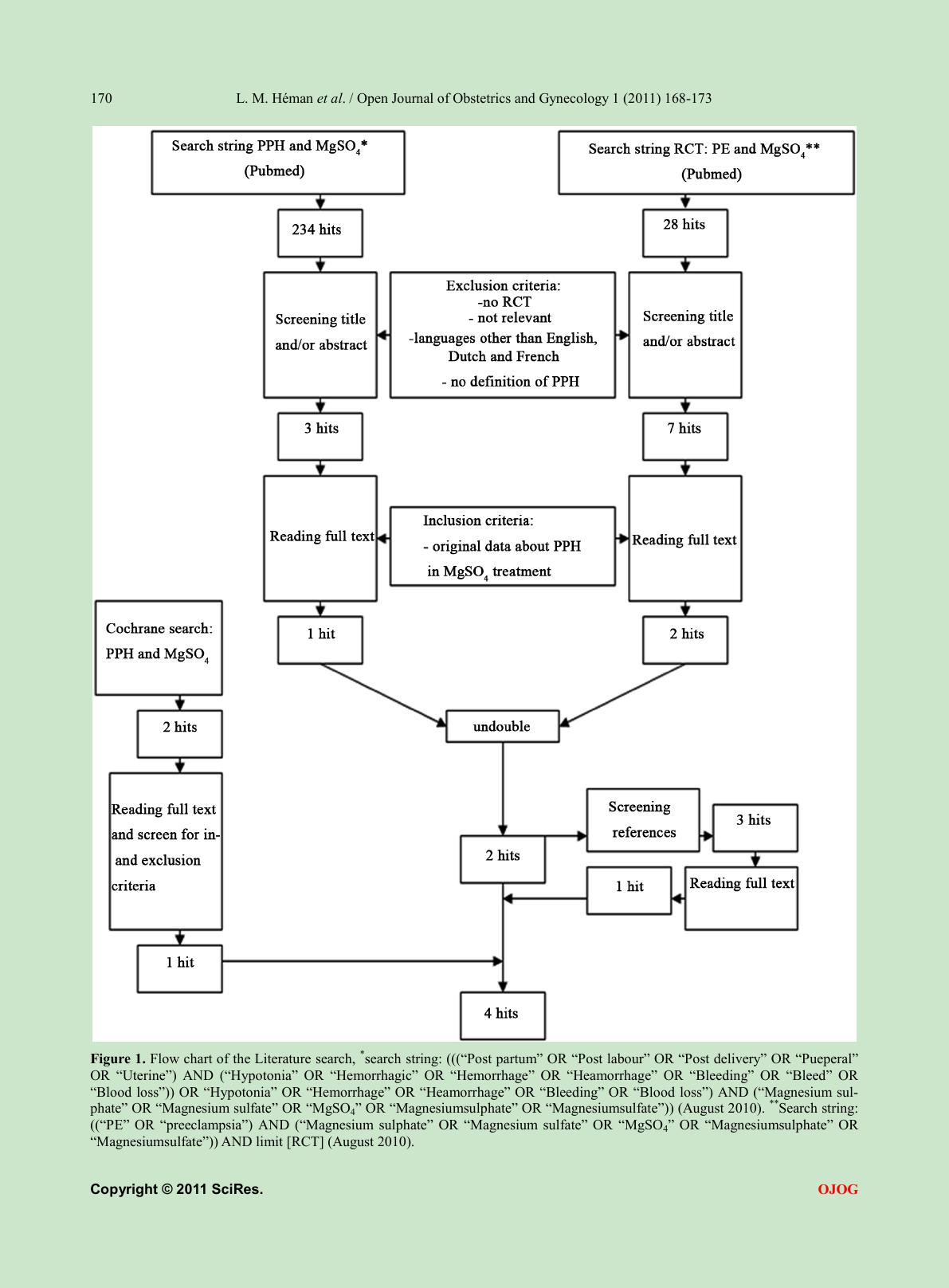 L. M. Héman et al. / Open Journal of Obstetrics and Gynecology 1 (2011) 168-173 Copyright © 2011 Sci Re s. OJOG 170 Fi gure 1 . Flow chart of the Literature search, *search string: (((“Post partum” OR “Po st labour” OR “Po st delivery” OR “Pu eperal” OR “Uterine”) AND (“Hypotonia” OR “Hemorrhagic” OR “Hemorrhage” OR “Heamorrhage” OR “Bleeding” OR “Bleed” OR “Blood loss”)) OR “Hypotonia” OR “Hemorrhage” OR “Heamorrhage” OR “Bleeding” OR “Blood loss”) AND (“Magnesium sul- phat e” OR “Magnesi um sulfate” OR “MgSO4” OR “M agnesiu msulphat e” OR “Magnesi umsulfat e”)) (August 2010). **Search strin g: ((“PE” OR “preeclampsia”) AND (“Magnesium sulphate” OR “Magnesium sulfate” OR “MgSO4” OR “Magnesiumsulphate” OR “Magnesiumsulfate”)) AND limit [RCT] (August 2010). 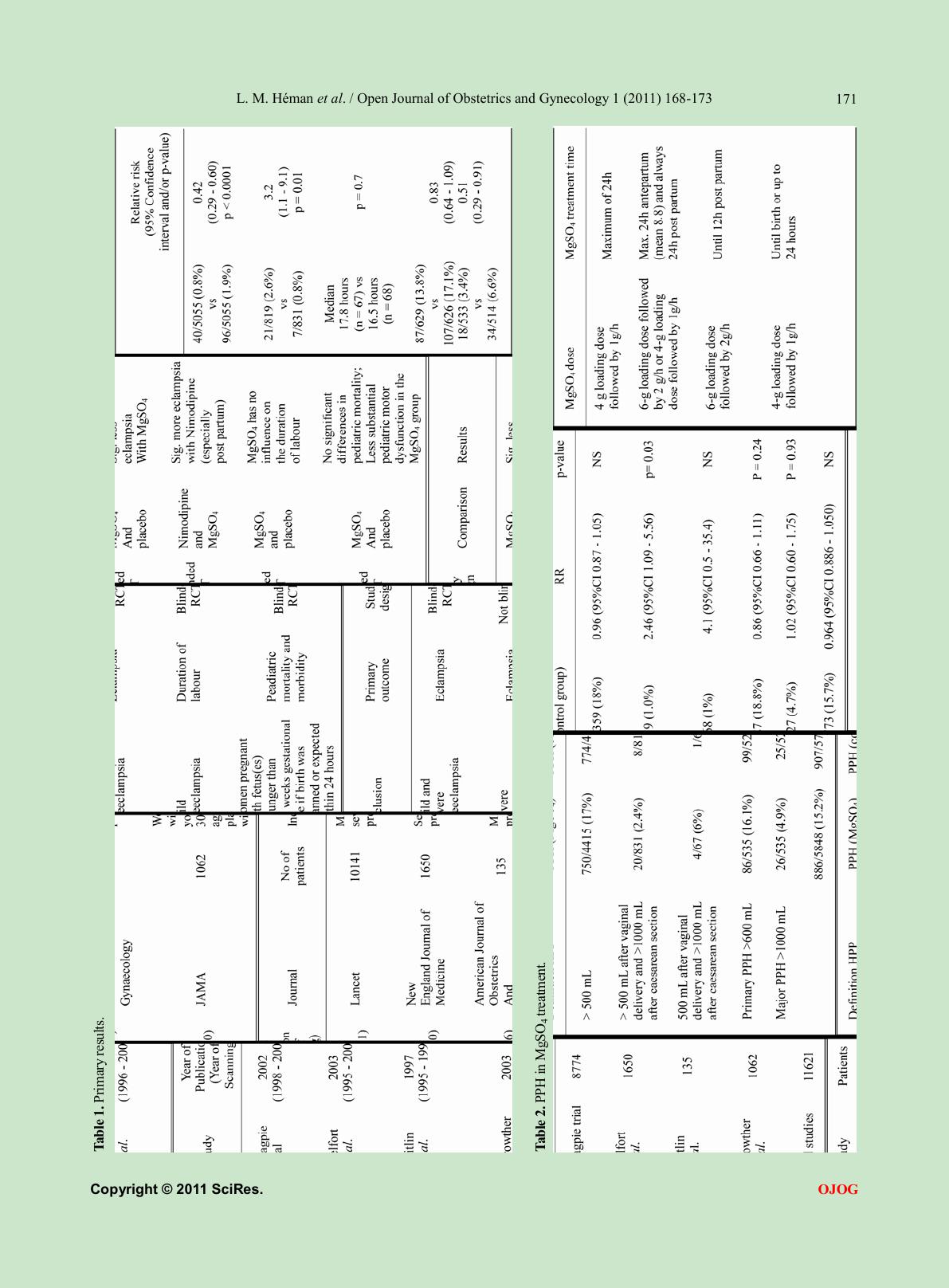 L. M. Héman et al. / Open Journal of Obstetrics and Gynecology 1 (2011) 168-173 Copyright © 2011 SciRes. OJOG 171 Table 2. PPH in MgSO4 treatmen t . Table 1. Primary results.  L. M. Héman et al. / Open Journal of Obstetrics and Gynecology 1 (2011) 168-173 Copyright © 2011 Sci Re s. OJOG 172 Partic u lar l y, Witlin e t a l. report a significantly higher do- sage of ox ytoci n needed in the MgSO4 gro up (p = 0.036). Thi s may s ugge st t hat a po ssib le e ffect of M gS O4 can be a hypotonic uterus. Altho ugh we had to exclude the study of Friedman et al. [21] because the authors did not give numbers about PPH and therefore did not meet our inclusion criteria, there are some remarkable results. The authors examined side effects of MgSO4 compared to phenytoin. They found a significant greater haematocrit fall after delivery when using MgSO4 (7.6% vs. 4.7% (p = 0.0034)), as well as a significant greater blood loss (606 ml vs. 418 ml (p = 0.04)). We do not question the proven and great value of MgSO4 in preventing eclampsia or the indication when to start this treatment. But one can doubt the evidence about side effects. One may suggest that since 2002 MgSO4 treatment possibly becomes more and more common. A false sense of security in preventing eclampsia could enha nce t he u se o f M gS O4 and the duration of treatment. Remarkably, in this systematic review we found only very few articles (4) that studied PPH in combination with MgSO4 treatment, while knowing that MgSO4 is extensively used all over the world and PPH is a dan- gerous and frequent complication of labour [2]. It would be interesti ng to kno w the exact p harmacolo- gical effect of MgSO4. This would help us to understand the function of MgSO4 in preventing eclampsia as well as other possible side effects such as PPH. Theoretically, MgSO4 still could influence the uterus tonus, the bleed- ing time and provoke vasodilatation. To give a definitive answer on our question, ideally a trial with PPH as a primary outcome should be perfo r- med. Secondary, dosage and duration of MgSO4 therapy should be considered, together with interventions to pre vent P PH , i.e. the dosage of oxytocin. With respect to PPH, the decrease in haemoglobin or haematocrit could provide objective results. In women with HELLP syn- drome the risk of PPH in combination with a possible trombopenia should be considered. A limitation of our study is that we mainly systemati- cally searched the Pubmed database. However, a scree- ning in Embase did not show any relevant articles. An- other limitation of our overview could be the heteroge- neity of the articles included. We d ecided to only use an assessment for statistical heterogeneity with population size. One could question if you can compare women with preeclampsia with women with threatened preterm birth who are given MgSO4 as neuroprotection for the foetus. However, we decided that when researching the unknown effect of MgSO4 on PPH the indication for treatment are less relevant. Moreover, this heterogeneity is an argument for more and specific research. In this systematic review, we do not find a significant risk of PPH when treating with MgSO4. MgSO4 has a great, important and proven role in the prevention of ecla mpsia . Ho wever, in our opinion, conse nsus o n the que - stion whether MgSO4 does or does not influence blood loss during delivery is not possible, due to few and non specific studies and the heterogeneity of the relevant studies. REFERENCES [1] Knight, M., Callaghan, W.M., Berg, C., et al. (2009) Trends in postpartum hemorrhage in high resource coun- tries: A review and recommendations from the Interna- tional Postpartum Hemorrhage Collaborative Group. BMC Pre gnanc y and Childbirth, 9, 55. doi:10.1186/1471-2393-9-55 [2] Woisky, M.D., Hermens, R.P.M.G., Middeldorp, J.M., et al. (2010) Haemorrhagia post partum; an implementation study on the evidence-based guidline of the Dutch Soci- ety of Obstetrics and Gynaecology (NVOG) and the MOET (Managing Obstetric Emergencies and Trauma- course) instructions; the Fluxim study. BMC Pregnancy and Childbirth, 10, 5. doi:10.1186/1471-2393-10-5 [3] Euser, A.G. and Cipolla, M.J. (2009) Magnesium sulfate for the t reatmen t o f eclampsi a: A brief revie w. Stroke, 40, 1169-1175. doi:10.1161/STROKEAHA.108.527788 [4] Belfort, M.A. and Moise, K.J. (1992) Effect of magne- sium sulfate on maternal brain blood flow in preeclamp- sia: A randomized, placebo-controlled study. American Journal of Obstetrics & Gynecology, 167, 661-666. [5] Elsharnouby, N.M. and El sh arnouby, M.M. (2006) Mag- nesium sulphate as a technique of hypotensive anesthesia. British Journal of Anaesthesia, 96, 727-731. doi:10.1093/bja/ael085 [6] Han, S., Crowther, C.A. and Moore, V. (2010) Magne- sium maintenance therapy for preventing preterm birth after threatened preterm labour. Cochrane Database of Systematic Reviews, 7. [7] Mousa, H.A. and Alfirevic, Z. (2007) Treatment for pri- mary postpartum haemorrhage. Cochrane Database of Systema tic Reviews, Art. No.: CD003249. doi:10.1002 /14651858.CD003249.pub2 [8] Assaley, J.M., Baron, J.M. and Cibils, L.A. (1998) Ef- fects of magnesium sulfate infusion upon clotting pa- rameters in patients with preeclampsia. Journal of Peri- natal Medicine, 26, 115-119. doi:10.1515/jpme.1998.26.2.115 [9] Fuentes, A., Rojas, A., Porter, K.B., Savliello, G. and O’Brien, W.F. (1995) The effect of magnes ium sulfate o n bleeding time in pregnancy. American Journal of Obstet- rics & Gynecolog y, 173, 1246-1249. doi:10.1016 /0002-9378(95)91363-7 [10] Ravn, H.B., Vissinger, H., Kristensen, S.D., Wennmalm, A., Thygesen, K. and Husted, S.E. (1996) Magnesium inhibits platelet activity—an infusion study in healthy volunteers. Journal of Thrombosis and Haemostasis, 75, 939-944. [11] Falck, G., Lundgaard, H., Jareld, T., et al. (1999) Effect of magnesium infusion on bleeding time in healthy male  L. M. Héman et al. / Open Journal of Obstetrics and Gynecology 1 (2011) 168-173 Copyright © 2011 SciRes. OJOG 173 volunteers. Scandinavian Journal of Clinical & Labora- tory Investigation, 59, 425-430. doi:10.1080 /00365519950185445 [12] Schauf, B., B ecker, S., Abele, H. , Klever, T., Wal lwiener, D. and Aydeniz, B. (2005) Effect of magnesium on red blood cell deformability in pregnancy. Hypertension and Pregnancy, 24, 17-27. doi:10.1081/PRG-45767 [13] Rowland, R.C. and Pritchard, J.A. (1964) The effect of parenteral magnesium sulfate therapy on blood loss at delivery. American Journal of Obstetrics Gynaecology, 89, 261-262. [14] Duley, L., Gülmezoglu, A.M., Henderson-Smart, D.J. and Chou, D. (2010) Magnesium sulphate and other anticon- vulsants for women with pre-eclampsia. Cochrane Da- tabase of Systemat ic Reviews, Art. No.: CD000025. doi:10.1002 /14651858.CD007388.pub2 [15] Witlin, A.G., Friedman, S.A. and Sibai, B.A. (1997) The effect of magnesium sulfate therapy on the duration of labor in women with mild preeclampsia at term: A ran- domized double blind placebo controlled trial. American Journal of Obstetrics Gynaecology, 176, 623-627. doi:10.1016 /S0002-9378(97)70558-1 [16] Livingston, J.C., Livingston, L.W., Ramsey, R., Mabie, B.C. and Sibai, B.M. (2003) Magnesium sulfate in women with mild preeclampsia: A randomized controlled trial. Obstetrics and Gynaecology 101, 217-220. doi:10.1016 /S0029-7844(02)03053-3 [17] Belfort, M.A., Anthony, J., Saade, G.R. and Allen, J.C. (2003) A comparison of magnesium sulphate and ni- modipine for the prevention of eclampsia. New England Journal of Medicine, 348, 304-311. doi:10.1056/NEJMoa021180 [18] Leveno, K.J., Alexander, J.M., McIntire, D.D., Lucas, M.J. (1998) Does magnesium sulphate given for preven- tion of eclampsia affect the outcome of labor? American Journal of Obstetrics Gynaecology, 178, 707-712. doi:10.1016 /S0002-9378(98)70480-6 [19] Lucas, M.J., Leveno, K.J. and Cunningham, F.G. (1995) A comparison of magnesium sulfate with phenytoin for the prevention of eclampsia. New England Journal of Medicine, 333, 201-205. doi:10.1056 /NEJM199507273330401 [20] Atkinson, M.W., Guinn, D., Owen, J. and Hauth, J.C. (1995) Does magnesiu m sulfate affect th e length of labo r induction in women with pregnancy-associated hyper- tension? American Journal of Obstetrics Gynaecology, 173, 1219-1222. doi:10.1016/0002-9378(95)91357-2 [21] Friedman, S.A., Lim, K.H., Baker, C.A. and Repke, J.T. (1993) Phenytoin versus magnesium sulphate in pree- clampsia: A pilot study. American Journal of Perinato- logy, 10, 233-238. [22] The Magpie Trial collaborative group (2002) Do women with pre-eclapsia, and their babies, benefit from magne- sium sulp hate? The Magpie Trial: A randomised placebo controlled trial. Lancet, 359, 1877-1890. doi:10.1016 /S0140-6736(02)08778-0 [23] Coetzee, E.J., Dommisse, J. an d Anthony, J. (1998) A randomised controlled trial of intravenous magnesium sulphate versus placebo in the management of women with severe pre-eclampsia. British Journal of Obstetrics Gynaecology, 105, 300-303. doi:10.1111/j.1471-0528.1998.tb10090.x [24] Moodley, J. and Moodley, V.V. (1994) Prophylactic anti- convulsant therapy in hypertensive crises of pregnan- cy—the need for a large, randomized trial. Hypertension in pregnancy, 13, 245-252. doi:10.3109 /10641959409072226 [25] Crowther, C.A. (2003) Effect of magnesium sulfate gi- ven for neuroprotection before preterm birth. Journal of the American Medical Association, 290, 2669-2676. doi:10.1001/jama.290.20.2669 [26] Marret, S., Marpeau, L., Zupan-Simunek, V., Eurin, D., Lévêque, C., Hellot, M.F. and Bénichou, J. (2007) Mag- nesium sulphate given before very-preterm birth to pro- tect infant brain: The randomised controlled PREMAG trial. British Journal of Obstetrics Gynaecology, 114, 310-318. |