

Paper Menu >>
Journal Menu >>
 International Journal of Organic Chemistry, 2011, 1, 257-261 doi:10.4236/ijoc.2011.14037 Published Online December 2011 (http://www.SciRP.org/journal/ijoc) Copyright © 2011 SciRes. IJOC 257 In Vitr o Antibacterial and Antifungal Activity of Methanol, Chloroform and Aqueous Extracts of Origanum vulgare and Their Comparative Analysis Zaman Ashraf1*, Aun Muhammad2, Muhammad Imran2, Ahmad Hussen Tareq2 1Chemistry Department, Allama Iqbal Open University, Islamabad, Pakistan 2Riphah Institute of Pharmaceutical Sciences, Riphah International University, Islamabad, Pakistan E-mail: *[email protected] Received July 23, 201 1; revised August 28, 2011; accepted September 8, 2011 Abstract The work reports antibacterial and antifungal activity of different solvent extracts of Origanum vulgare. The antimicrobial activity of methanol, chloroform and aqueous extracts were determined against nine different gram negative and gram positive bacterial strains and three fungal stains. The bacterial strains were Bacillus subtilis (ATCC 6633), Staphylococcus aureus (ATCC 29213), Micrococcus luteus (ATCC 9341), Pseudo- monas aeruginosa (ATCC 33347), Escherichia coli (ATCC 25922), Salmonella typhi (ATCC 19430), Shig- ella flexneri (ATCC 25929), Salmonella para typhi A (ATCC 9150) and Proteus mirabilis (ATCC 49565) and fungal strains were Aspergillus flavus, Aspergillus nigar and Aspergillus pterus. Agar well diffusion method was followed in this study. The comparative analysis of antibacterial activity reflects that among these three extracts, chloroform and methanol extracts shows promising result by exhibiting maximum anti- bacterial activity, whereas aqueous extract is not active against most of these strains. The analysis of anti- fungal activity reveals chloroform extract as most efficacious unlike methanol and Aqueous extracts. Keywords: Origanum vulgare, Antibacterial Activity, Antifungal Activity 1. Introduction Medicinal plants deeply connected with our lives espe- cially those who not only hold culinary importance but also possess combative ability against number of mi- crobes. They become cynosure in our homes, commer- cial and research sector. Their natural origin paves expe- dient outcomes, some in form of natural preservatives along with aiding our immune system to fight against pathogenic organisms. World Health Organization (W HO) supported the use of herbal medicines as safe ther- apy for the treatment of different diseases. Medicinal plants would be the paramount basis to find a range of drugs [1]. New drugs must be needed to eliminate the resistant microorganisms because a number of well known antibi- otics cannot fight with resistant strains and become su- perseded [2]. Literature bear witness that this problem has proliferated to whole globe. As, the occurrence of fluoroquinolone resistant gram negative Bacilli colo- nizing community dwelling people with spinal cord dys- function [3], ciprofloxacin-resistant gram negative Ba- cilli association with serious infections in ch ild ren [4] are common examples. The resistant gram negative and gram positive species are associated with increased mor- tality and morbidity, prolonged hospitalization and in- creased costs. Screening of synthetic compounds and plant extracts determining their antibacterial and anti- fungal potential holds immense worth, as they may serve as a solution to eradicate antibiotic resistant microbes. Antibacterial derived from plants are not related with undesired effects as the synthetic drugs and can be suc- cessfully employed to heal many infectious diseases [5]. About 80% populations of the developed countries use herbal medicines. A number of important drugs like qui- nine (antimalarial), vincristine (antitumor drug) and di- gitalis (heart regulator) were extracted from medicinal plants. The utilization of plant extracts and phytochemi- cals with identified biological activity may be of huge significance in therapeutic treatments [6-10]. The plant selected in this study is Origanum vulgare also commonly known as oregano belongs from genus  Z. ASHRAF ET AL. 258 Origanum of lamiaceae family (mint family). This plant is located in hunza valley lies in karakoram ranges. Few of the important medicinal plants of this region are Ar- temisia maritime, Chenopodium ambrosioides, Ephedra gerardianam, Astragalus macropterus, Corydalis Adian- tifolia, Sonchus asper (L)Hill, Hippophae rhamnoides L, Tamarix arceuthoides Bge, Salix acmophylla Boiss, Atriplex crossifolia C.A.Mey, Aquilegia pubiflora Wall. ex Royle, Primula veris L, Lonicera periclymenum L, Galium boreale L, Lactuca decipiens (H. and T) Clark [11]. The plant selected for antibacterial assay may have great potential for industrial applications [12-15]. Oregano has been recognized as one of the most used vegetable all over the world with abundant occurrence in East Europe, in the Middle Asia and South and North America [16,17]. The volatile oil of oregano has been used traditionally for respiratory disorders, indigestion, dental caries, rheumatoid arthritis and urinary tract dis- orders [18]. Carvacrol is a major active component of oregano and has potential uses as a food preservative [19]. Other chemical constituents include limonene, ga- mmacariofilene, rho-cymenene, canfor, linalol, al-pha- pinene and thymol [20]. The present work has been designed to evaluate the potential of methanol, chloroform and aqueous extracts of the Origanum vulgare against nine different gram positive and gram negative pathogenic bacterial strains and three different fungal strains. The results obtained in this bioassay were compared and it was found that chlo- roform extract has high potential against tested bacterial and fungal strains. 2. Experimental The part used are leaves of Origanum vulgare collected from hunza valley in August 2009. The leaves were then dried, homogenized and further subjected for extraction. The hot extraction method was followed to obtain metha- nol, chloroform and aqueous extracts of leaves of the plant. 2.1. Methanol Extract The soxhlet extractor was used to afford different solvent extracts of the Origanum vulgare. The crude methanol extract was achieved by putting 10 g of the dried, ho- mogenized plant in the porous thimble (made of tough filter paper) and 100 ml of the methanol in the bolt head flask of the extraction apparatus. The solvent was then boiled for one hour and methanol was rotary evaporated. The extract was then vacuum dried and yield of the methanol extract was 71.30%. The extract was then stored in refrigerator at 4˚C for further study. 2.2. Chloroform and Aqueous Extracts The same method was adopted for the preparation of chloroform and aqueous extracts. The yield of chloro- form extract was 6.20% and that of aqueous extract was 53.31%. 2.3. Antibacterial Activity The antimicrobial activity of these crude extracts was determined against nine different gram positive and gram negative bacteria. Agar well diffusion assay was used to evaluate the antibacterial activity of these extracts [21]. The selected bacterial strains are Bacillus subtilis (ATCC 6633), Staphylococcus aureus (ATCC 29213), Micro- coccus luteus (ATCC 9341), Pseudomonas aeruginosa (ATCC 33347), Escherichia coli (ATCC 25922), Sal- monella typhi (ATCC 19430), Shigella flexneri (ATCC 25929), Sa lmonella para typhi A (ATCC 9150) and Pro- teus mirabilis (ATCC 49565). Assay was conducted by using the Nutrient Agar. The fresh inoculum of these strains were prepared and diluted with sterilized normal saline. The turbidity of these cul- tures was adjusted by using 0.5 Mc-Farland. A uniform bacterial lawn was developed by sterile cotton swabs. 8 mm sized borer was used to make the wells in the inocu- lated plates. Various dilutions of the dried plant extracts including 1000 ug/ml, 500 ug/ml, 250 ug/ml, 125 ug/ml and 62.5 ug/ml were prepared by using dimethyl sulfox- ide (DMSO) as solvent. 200 ul of test extract and stan- dard were then delivered to each well. DMSO was used as control in this antimicrobial study. Levofloxacin (125 ug/ml) a broad spectrum antibiotic effective against a number of gram positive and gram negative bacterial strains was used as standard. These plates were incubated at 37˚C for 24 hours. Antibacterial activity of the plant extracts was determined by measuring the diameter of zone of inhibition (mm) and presented by subtracting the activity of the control. 2.4. Antibfungal Activity In vitro antifungal activity of the solvent extracts was tested against three fungi; Aspergillus flavus, Aspergillu s nigar and Aspergillus pterus using poison plate method [22]. Potato dextrose agar (PDA) plates were prepared by using pour plate technique for each extract. A 2% con- centration of each extract in DMSO as a solvent was used. A 2% solution of fluconazole was used as standard. A drug free control was included and plates were ob- served for growth after 48 h of static incubation at 30˚C and results are presented in Table 4. All of the plant ex- tracts showed good to excellent antifungal activity. Copyright © 2011 SciRes. IJOC 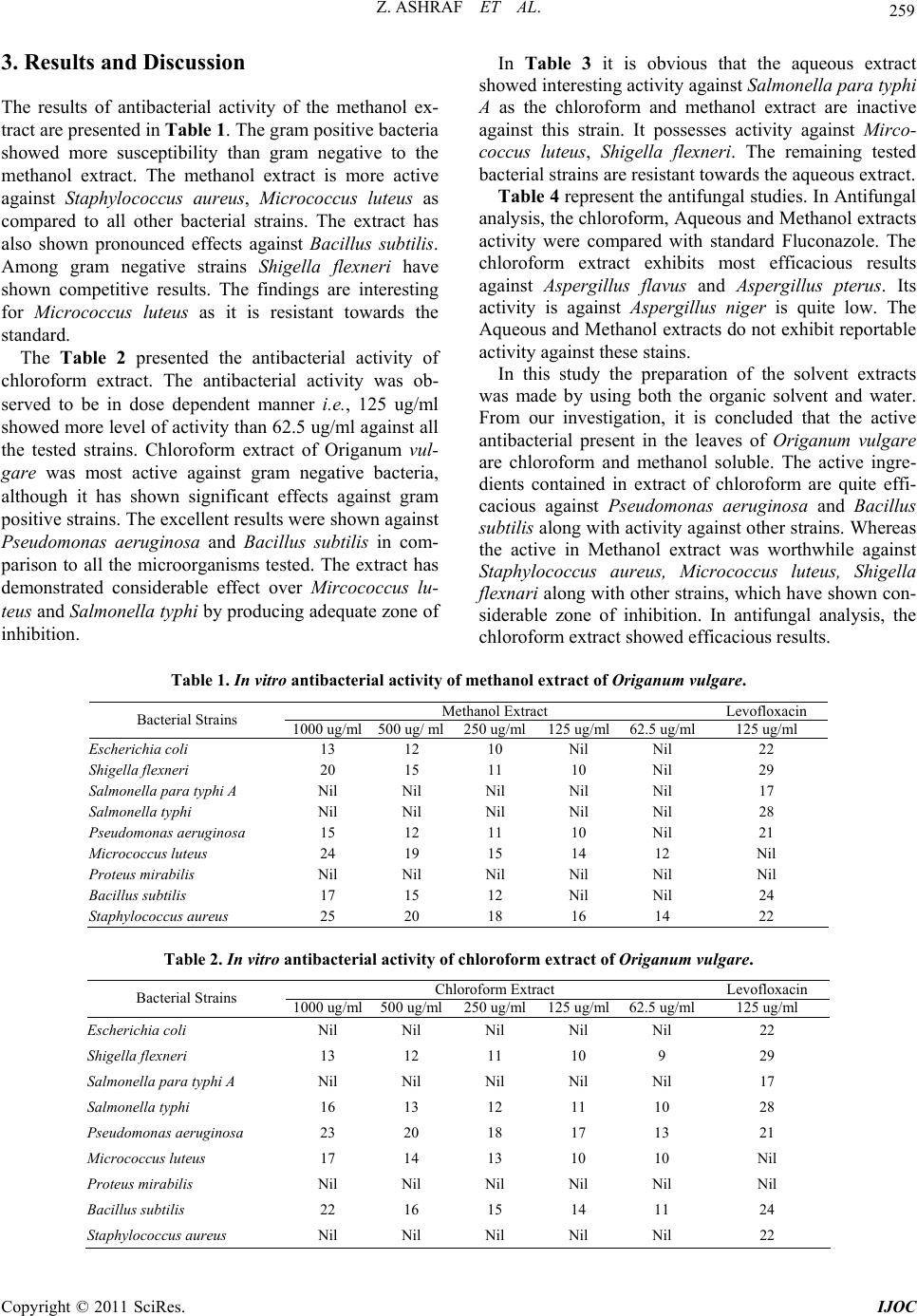 Z. ASHRAF ET AL. Copyright © 2011 SciRes. IJOC 259 3. Results and Discussion The results of antibacterial activity of the methanol ex- tract are presented in Table 1. The gram positive bacteria showed more susceptibility than gram negative to the methanol extract. The methanol extract is more active against Staphylococcus aureus, Micrococcus luteus as compared to all other bacterial strains. The extract has also shown pronounced effects against Bacillus subtilis. Among gram negative strains Shigella flexneri have shown competitive results. The findings are interesting for Micrococcus luteus as it is resistant towards the standard. The Table 2 presented the antibacterial activity of chloroform extract. The antibacterial activity was ob- served to be in dose dependent manner i.e., 125 ug/ml showed more level of activity than 62.5 ug/ml agains t all the tested strains. Chloroform extract of Origanum vul- gare was most active against gram negative bacteria, although it has shown significant effects against gram positive strains. The excellent results were shown ag ainst Pseudomonas aeruginosa and Bacillus subtilis in com- parison to all the microorganisms tested. The extract has demonstrated considerable effect over Mircococcus lu- teus and Salmonella typhi by producing adequate zone of inhibition. In Table 3 it is obvious that the aqueous extract showed interesting activity again st Sa lmon ella para typh i A as the chloroform and methanol extract are inactive against this strain. It possesses activity against Mirco- coccus luteus, Shigella flexneri. The remaining tested bacterial strains are resistant towards the aqueous extract. Table 4 represent the antifungal studies. In Antifun gal analysis, the chloroform, Aqueous and Methanol extracts activity were compared with standard Fluconazole. The chloroform extract exhibits most efficacious results against Aspergillus flavus and Aspergillus pterus. Its activity is against Aspergillus niger is quite low. The Aqueous and Methanol ex tracts do not exhibit reportable activity against these stains. In this study the preparation of the solvent extracts was made by using both the organic solvent and water. From our investigation, it is concluded that the active antibacterial present in the leaves of Origanum vulgare are chloroform and methanol soluble. The active ingre- dients contained in extract of chloroform are quite effi- cacious against Pseudomonas aeruginosa and Bacillus subtilis along with activity against other strains. Whereas the active in Methanol extract was worthwhile against Staphylococcus aureus, Micrococcus luteus, Shigella flexnari along with other strains, which have shown con- siderable zone of inhibition. In antifungal analysis, the chloroform extract showed efficacious results. Table 1. In vitro antibacterial activity of methanol extract of Origanum vulgare. Methanol Extract Levofloxacin Bacterial Strains 1000 ug/ml500 ug/ ml250 ug/ml125 ug/ml62.5 ug/ml 125 ug/ml Escherichia coli 13 12 10 Nil Nil 22 Shigella flexneri 20 15 11 10 Nil 29 Salmonella para typhi A Nil Nil Nil Nil Nil 17 Salmonella typhi Nil Nil Nil Nil Nil 28 Pseudomonas aeruginosa 15 12 11 10 Nil 21 Micrococcus luteus 24 19 15 14 12 Nil Proteus mirabilis Nil Nil Nil Nil Nil Nil Bacillus subtilis 17 15 12 Nil Nil 24 Staphylococcus aureus 25 20 18 16 14 22 Table 2. In vitro antibacterial activity of chloroform extract of Origanum vulgare. Chloroform Extract Levofloxacin Bacterial Strains 1000 ug/ml500 ug/ml250 ug/ml125 ug/ml62.5 ug/ml 125 ug/ml Escherichia coli Nil Nil Nil Nil Nil 22 Shigella flexneri 13 12 11 10 9 29 Salmonella para typhi A Nil Nil Nil Nil Nil 17 Salmonella typhi 16 13 12 11 10 28 Pseudomonas aeruginosa 23 20 18 17 13 21 Micrococcus luteus 17 14 13 10 10 Nil Proteus mirabilis Nil Nil Nil Nil Nil Nil Bacillus subtilis 22 16 15 14 11 24 Staphylococcus aureus Nil Nil Nil Nil Nil 22 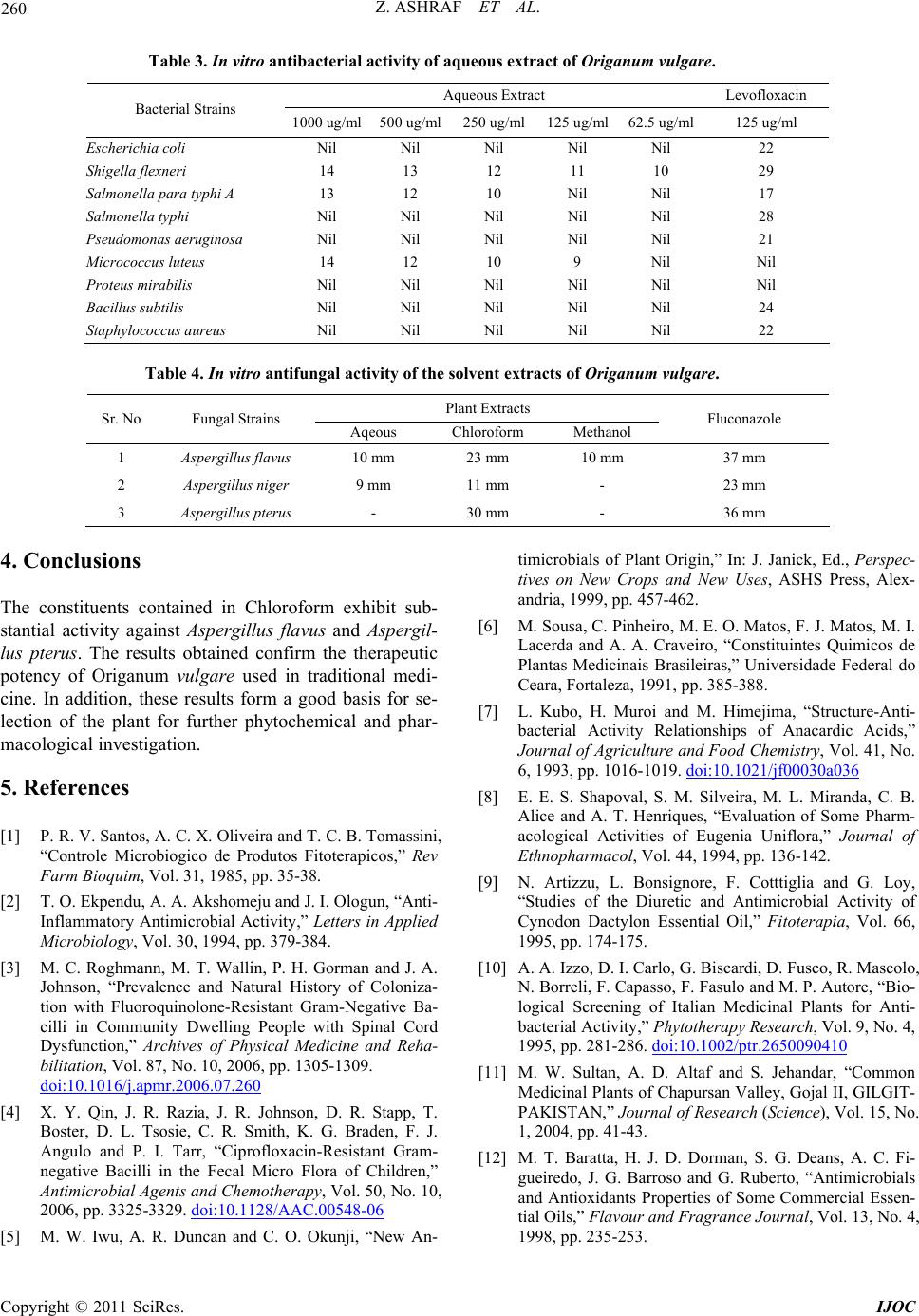 Z. ASHRAF ET AL. 260 Table 3. In vitro antibacterial activity of aqueous extract of Origanum vulgare. Aqueous Extract Levofloxacin Bacterial Strains 1000 ug/ml500 ug/ml250 ug/ml125 ug/ml62.5 ug/ml 125 ug/ml Escherichia coli Nil Nil Nil Nil Nil 22 Shigella flexneri 14 13 12 11 10 29 Salmonella para typhi A 13 12 10 Nil Nil 17 Salmonella typhi Nil Nil Nil Nil Nil 28 Pseudomonas aeruginosa Nil Nil Nil Nil Nil 21 Micrococcus luteus 14 12 10 9 Nil Nil Proteus mirabilis Nil Nil Nil Nil Nil Nil Bacillus subtilis Nil Nil Nil Nil Nil 24 Staphylococcus aureus Nil Nil Nil Nil Nil 22 Table 4. In vitro antifungal activity of the solvent extracts of Origanum vulgare. Plant Extracts Sr. No Fungal Strains Aqeous Chloroform Methanol Fluconazole 1 Aspergillus flavus 10 mm 23 mm 10 mm 37 mm 2 Aspergillus niger 9 mm 11 mm - 23 mm 3 Aspergillus pterus - 30 mm - 36 mm 4. Conclusions The constituents contained in Chloroform exhibit sub- stantial activity against Aspergillus flavus and Aspergil- lus pterus. The results obtained confirm the therapeutic potency of Origanum vulgare used in traditional medi- cine. In addition, these results form a good basis for se- lection of the plant for further phytochemical and phar- macological investig ation. 5. References [1] P. R. V. Santos, A. C. X. Oliveira and T. C. B. Tomassini, “Controle Microbiogico de Produtos Fitoterapicos,” Rev Farm Bioquim, Vol. 31, 1985, pp. 35-38. [2] T. O. Ekpendu, A. A. Akshomeju and J. I. Ologun, “Anti- Inflammatory Antimicrobial Activity,” Letters in Applied Microbiology, Vol. 30, 1994, pp. 379-384. [3] M. C. Roghmann, M. T. Wallin, P. H. Gorman and J. A. Johnson, “Prevalence and Natural History of Coloniza- tion with Fluoroquinolone-Resistant Gram-Negative Ba- cilli in Community Dwelling People with Spinal Cord Dysfunction,” Archives of Physical Medicine and Reha- bilitation, Vol. 87, No. 10, 2006, pp. 1305-1309. doi:10.1016/j.apmr.2006.07.260 [4] X. Y. Qin, J. R. Razia, J. R. Johnson, D. R. Stapp, T. Boster, D. L. Tsosie, C. R. Smith, K. G. Braden, F. J. Angulo and P. I. Tarr, “Ciprofloxacin-Resistant Gram- negative Bacilli in the Fecal Micro Flora of Children,” Antimicrobial Agents and Chemotherapy, Vol. 50, No. 10, 2006, pp. 3325-3329. doi:10.1128/AAC.00548-06 [5] M. W. Iwu, A. R. Duncan and C. O. Okunji, “New An- timicrobials of Plant Origin,” In: J. Janick, Ed., Perspec- tives on New Crops and New Uses, ASHS Press, Alex- andria, 1999, pp. 457-462. [6] M. Sousa, C. Pinheiro, M. E. O. Matos, F. J. Matos, M. I. Lacerda and A. A. Craveiro, “Constituintes Quimicos de Plantas Medicinais Brasileiras,” Universidade Federal do Ceara, Fortaleza, 1991, pp. 385-388. [7] L. Kubo, H. Muroi and M. Himejima, “Structure-Anti- bacterial Activity Relationships of Anacardic Acids,” Journal of Agriculture and Food Chemistry, Vol. 41, No. 6, 1993, pp. 1016-1019. doi:10.1021/jf00030a036 [8] E. E. S. Shapoval, S. M. Silveira, M. L. Miranda, C. B. Alice and A. T. Henriques, “Evaluation of Some Pharm- acological Activities of Eugenia Uniflora,” Journal of Ethnopharmacol, Vol. 44, 1994, pp. 136-142. [9] N. Artizzu, L. Bonsignore, F. Cotttiglia and G. Loy, “Studies of the Diuretic and Antimicrobial Activity of Cynodon Dactylon Essential Oil,” Fitoterapia, Vol. 66, 1995, pp. 174-175. [10] A. A. Izzo, D. I. Carlo, G. Biscardi, D. Fusco, R. Mascolo, N. Borreli, F. Capasso, F. Fasulo and M. P. Autore, “Bio- logical Screening of Italian Medicinal Plants for Anti- bacterial Activity,” Phytoth erapy Re search, Vol. 9, No. 4, 1995, pp. 281-286. doi:10.1002/ptr.2650090410 [11] M. W. Sultan, A. D. Altaf and S. Jehandar, “Common Medicinal Plants of Chapursan Valley, Gojal II, GILGIT- PAKISTAN,” Journal of Research (Science), Vol. 15, No. 1, 2004, pp. 41-43. [12] M. T. Baratta, H. J. D. Dorman, S. G. Deans, A. C. Fi- gueiredo, J. G. Barroso and G. Ruberto, “Antimicrobials and Antioxidants Properties of Some Commercial Essen- tial Oils,” Flavour and Fragrance Journal, Vol. 13, No. 4, 1998, pp. 235-253. Copyright © 2011 SciRes. IJOC  261 Z. ASHRAF ET AL. doi:10.1002/(SICI)1099-1026(1998070)13:4<235::AID-F FJ733>3.0.CO;2-T [13] D. J. Daferera, B. N. Ziogas and M. G. Polissiou, “GC- MS Analysis of Essential Oils from Some Greek Aro- matic Plants and Their Fungi Toxicity on Penicillium Digitatum,” Journal of Agricultural and Food Chemistry, Vol. 48, No. 6, 2000, pp. 2576-2581. doi:10.1021/jf990835x [14] S. G. Deans and K. P. Svoboda, “The Antimicrobial Properties of Marjoram (Origanum majorana L) Volatile Oil,” Flavour and Fragrance Journal, Vol. 5, No. 3, 2001, pp. 187-190. doi:10.1002/ffj.2730050311 [15] M. A. Garcia and J. Sanz, “Analysis of Origanum vulgare Volatile by Direct Thermal Desorption Coupled to Gas Chromatography-Mass Spectrometry,” Journal of Chro- matography A, Vol. 918, No. 1, 2001, pp. 189-194. doi:10.1016/S0021-9673(01)00750-6 [16] S. Kokkini, D. Vokou and R. Karousou, “Morphological and Chemical Variation of Origanum vulgare L. in Greece,” Botanica Chronica, Vol. 10, 1991, pp. 337-346. [17] D. Vokou, S. Kokkini and J. M. Bessiere, “Geographic Variation of Greek Oregano (Origanum vulgare ssp. hir- tum) Essential Oils,” Biochemical Systematics and Ecol- ogy, Vol. 21, No. 2, 1993, pp. 287-295. doi:10.1016/0305-1978(93)90047-U [18] O. N. Ertas, T. Guler, M. Ciftci, B. Darlkilic and U. G. Simsek, “The Effect of an Essential Oil Mix Drive from Oregano, Clove and Anise on Brolier Performance,” In- ternational Journal of Poultry Science, Vol. 4, No. 11, 2005, pp. 879-884. doi:10.3923/ijps.2005.879.884 [19] E. J. Veldhuizen, T. O. Creutzberg, S. A. Burt and H. P. Haagsman, “Low Temperature and Binding to Food Components Inhibit the Antibacterial Activity of Car- vacrol against Listeria monocytogenes in Streak Tartare,” Journal of Food Protection, Vol. 70, No. 9, 2007, pp. 2127-2132. [20] C. C. Arcila-Lozano, G. Loarca-Pina, S. Lecona-Uribe and E. M. Gonzalez, “Oregano Properties, Composition and Biological Activity,” Archivos Latinoamericanos de Nutrición, Vol. 54, No. 1, 2004, pp. 100-111. [21] D. Gatsing, J. A. Mbah, I. H. Garba, P. Tane, P. Djemgou and B. F. Nji-Nkah, “An Antisalmonellal Agent from the Leaves of Glossocalys. Brevipes Benth (Monimiaceae),” Pakistan Journal of Biological Sciences, Vol. 9, No. 1, 2006, pp. 84-87. doi:10.3923/pjbs.2006.84.87 [22] R. V. Shastri and J. S. Varudkar, “Synthesis and Antim- icrobial Activity of 3-Propen-1,2-benzisoxazole Deriva- tives,” Indian Journal of Chemical Sciences, Vol. 48B, 2009, pp. 1156-1160. Copyright © 2011 SciRes. IJOC |