

Paper Menu >>
Journal Menu >>
 International Journal of Organic Chemistry, 2011, 1, 250-256 doi:10.4236/ijoc.2011.14036 Published Online December 2011 (http://www.SciRP.org/journal/ijoc) Copyright © 2011 SciRes. IJOC Vilsmeier Haack Adducts as Effective Reagents for Regioselective Nitration of Aromatic Compounds under Conventional and Non-Conventional Conditions Kamatala Chinna Rajanna*, Mukka Satish Kumar, Purugula Venkanna, Soma Ramgopal, Marri Venkateswarlu Department of Chemistry, Osmania University, Hyderabad, India E-mail: [email protected] Received September 3, 2011; revise October 9, 2011; accepted October 17, 2011 Abstract Nitration of aromatic Compounds is triggered by Vilsmeier-Haack reagent (DMF/POCl3) or (DMF/SOCl2) in the presence of KNO3 or NaNO2 under conventional and non-conventional conditions. The reactions af- forded corresponding Nitro derivatives in very good yield with high regioselectivity. The results obtained in non-conventional methods (Micro wave irradiation, Grinding, Sonication) are comparable with those ob- tained under conventional conditions, but the reaction times of former conditions are substantially shorter than that of the latter. Keywords: Nitration, KNO3 or NaNO2, Vilsmeier-Haack Reagent, Microwave Irradiation (MWI), Grinding, Sonication 1. Introduction Over the years, Nitration of aromatic compounds has been an area of interest to chemists because Nitro arenes are useful intermediates in the synthesis of organometal- lic species and pharmaceutically important compounds [1-3]. Direct method s of Nitration of aromatic compoun- ds involve the use of hazardous acid mixture (HNO3 and H2SO4) that is highly toxic, corrosive, and pollutes to the environment, and metal ion catalysts are generally ex- pensive. In view of this, there has been an upsurge in the design and execution of mild methods of Nitration of aromatic compounds [4-17]. Over the past decade, our group has also been actively involved in designing a va- riety of eco friendly materials using micelle-forming sur- factants as catalysts and unconventional energy sources (such as microwave irradiation and ultrasound) to assist Vilsmeier-Haack (VH) reactions [18-20] and Hunsdiec- ker reactions [21-22] .Dramatic rate accelerations fol- lowed by an increase in the product yield were observed in these reactions in all cases. Organic reactions perform- ed under solvent-free conditions have gained much atten- tion because of their enhanced selectivity, mild reaction conditions, and associated ease of manipulation. The re- cent reviews and publications in this field prove the im- portance of solvent-free organic synthesis [23-28] and highlights that this process is not only simple but also satisfies both economical and environmental demands by replacing the toxic solvents. 2. Results and Discussion The VH reaction [29-32] is widely used for formylation. It can be applied to introduce an acetyl group on activa- ted aromatic or hetero aromatic compounds, many other conversions can be achieved with this technology. It is one of the most versatile reactions in organic synthesis for the conversion of arenes to corresponding bromo derivatives. In general, (DMF/POCl3) or (DMF/SOCl2) are used to generate an iminium salt inter med iate salt can be used in the synthesis of a large number of heterocyclic compounds. The VH reaction is a mild method known for the introduction of a formyl (-CHO) group to various activated aromatic and hetero aromatic compounds. Re- cently our group reported that Vilsmeier-Haack (VH) rea- gents could be effectively used in presence of KBr or NBS for bromination of arenes [20]. Encouraged by this result, we tried to use VH reagent (DMF/SOCl2 and DMF/POCl3) in presence of KNO3 and NaNO2 for ni- tration reactions. Aromatic compounds such as phenols 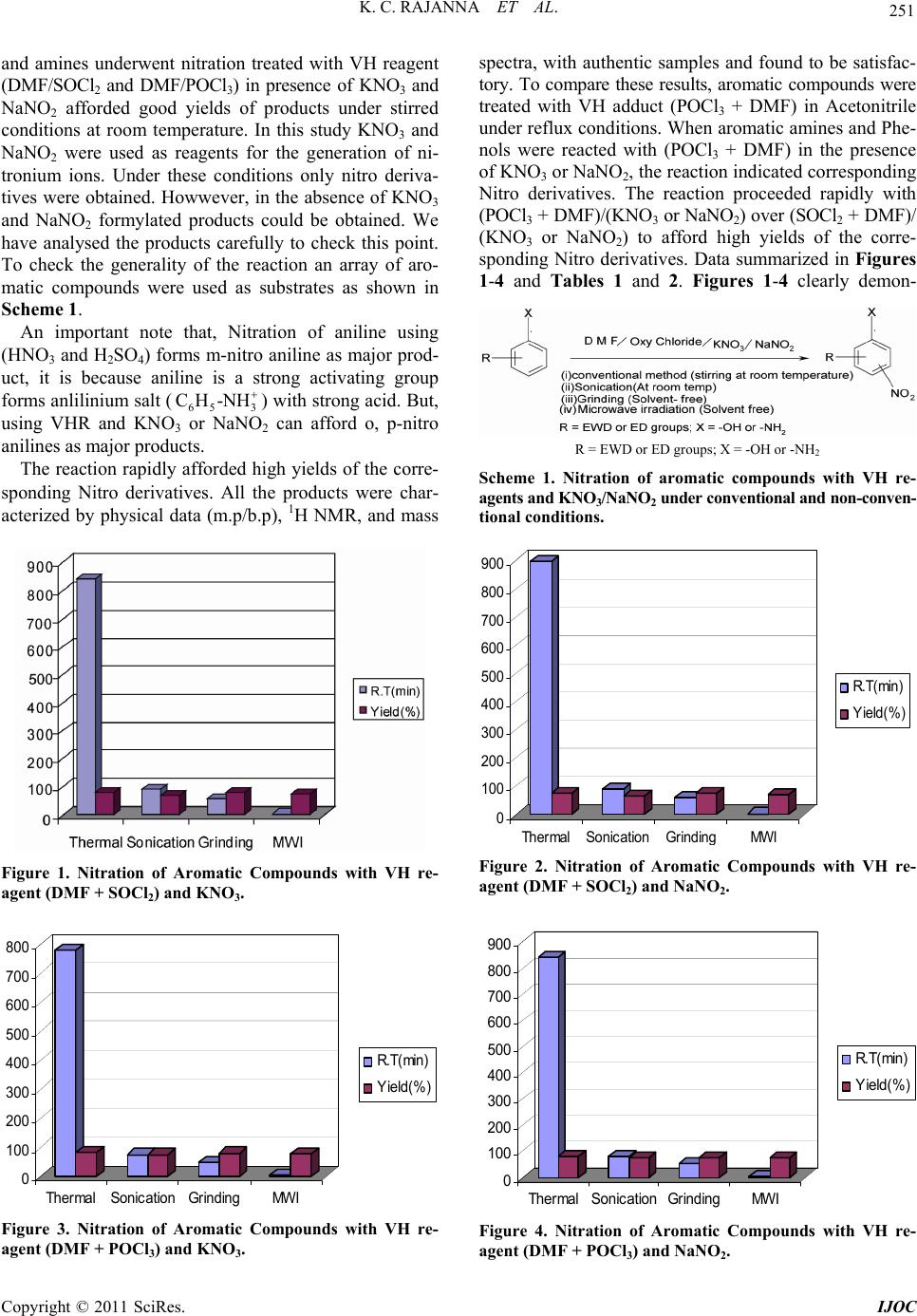 251 K. C. RAJANNA ET AL. and amines underwent nitration treated with VH reagent (DMF/SOCl2 and DMF/POCl3) in presence of KNO3 and NaNO2 afforded good yields of products under stirred conditions at room temperature. In this study KNO3 and NaNO2 were used as reagents for the generation of ni- tronium ions. Under these conditions only nitro deriva- tives were obtained. Howwever, in the absence of KNO3 and NaNO2 formylated products could be obtained. We have analysed the products carefully to check this point. To check the generality of the reaction an array of aro- matic compounds were used as substrates as shown in Scheme 1. An important note that, Nitration of aniline using (HNO3 and H2SO4) forms m-nitro aniline as major prod- uct, it is because aniline is a strong activating group forms anlilinium salt (65 3 ) with strong acid. But, using VHR and KNO3 or NaNO2 can afford o, p-nitro anilines as major products. CH-NH The reaction rapidly afforded high yields of the corre- sponding Nitro derivatives. All the products were char- acterized by physical data (m.p/b.p), 1H NMR, and mass spectra, with authentic samples and found to be satisfac- tory. To compare these results, aromatic compounds were treated with VH adduct (POCl3 + DMF) in Acetonitrile under reflux conditions. When aro matic amines and Phe- nols were reacted with (POCl3 + DMF) in the presence of KNO3 or NaNO2, the reaction indicated corresponding Nitro derivatives. The reaction proceeded rapidly with (POCl3 + DMF)/(KNO3 or NaNO2) over (SOCl2 + DMF)/ (KNO3 or NaNO2) to afford high yields of the corre- sponding Nitro derivatives. Data summarized in Figures 1-4 and Tables 1 and 2. Figures 1-4 clearly demon- R = EWD or E D groups; X = -OH or -NH2 Scheme 1. Nitration of aromatic compounds with VH re- agents and KNO3/NaNO2 under conventional and non-conve n- tional conditions. Figure 1. Nitration of Aromatic Compounds with VH re- agent (DMF + SOCl2) and KNO3. 0 100 200 300 400 500 600 700 800 900 Thermal Sonication Grindin g MWI R.T(min) Yield(%) Figure 2. Nitration of Aromatic Compounds with VH re- agent (DMF + SOCl2) and NaNO2. 0 100 200 300 400 500 600 700 800 ThermalSonication GrindingMWI R.T(min) Yield(%) Figure 3. Nitration of Aromatic Compounds with VH re- agent (DMF + POCl3) and KNO3. 0 100 200 300 400 500 600 700 800 900 ThermalSonication GrindingMWI R.T(mi n) Yield(%) Figure 4. Nitration of Aromatic Compounds with VH re- agent (DMF + POCl3) and NaNO2. Copyright © 2011 SciRes. IJOC 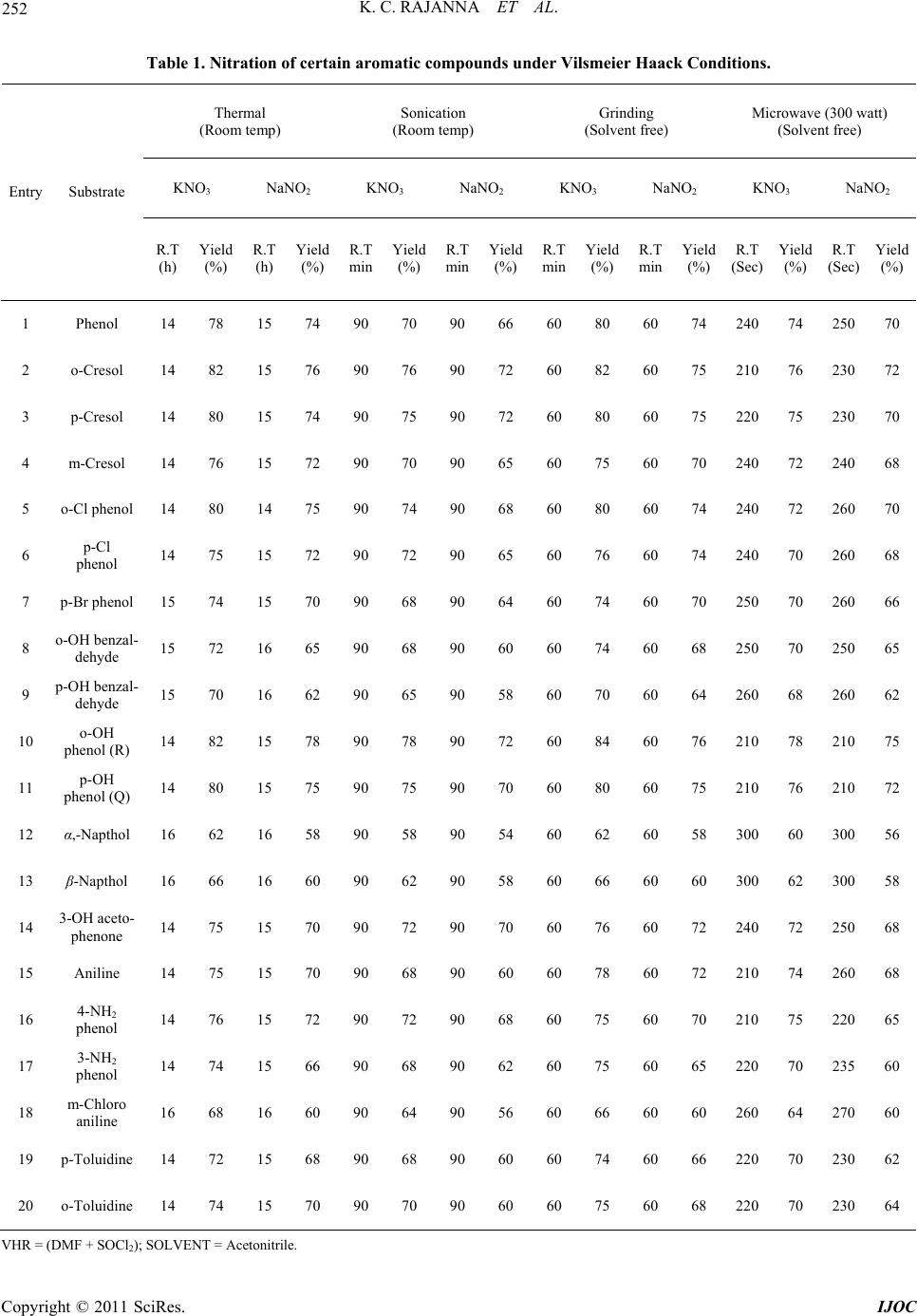 K. C. RAJANNA ET AL. 252 Table 1. Nitration of certain aromatic compounds under Vilsme ier Haac k Conditions. Thermal (Room temp) Sonication (Room temp) Grinding (Solvent free) Microwave (300 watt) (Solvent free) KNO3 NaNO2 KNO3 NaNO2 KNO3 NaNO2 KNO3 NaNO2 Entry Substrate R.T (h) Yield (%) R.T (h) Yield (%) R.T min Yield (%) R.T min Yield (%) R.T min Yield (%) R.T min Yield (%) R.T (Sec) Yield (%) R.T (Sec) Yield (%) 1 Phenol 14 78 15 74 90 70 90 66 60 80 60 74 240 74 250 70 2 o-Cresol 14 82 15 76 90 76 90 72 60 82 60 75 210 76 230 72 3 p-Cresol 14 80 15 74 90 75 90 72 60 80 60 75 220 75 230 70 4 m-Cresol 14 76 15 72 90 70 90 65 60 75 60 70 240 72 240 68 5 o-Cl phenol 14 80 14 75 90 74 90 68 60 80 60 74 240 72 260 70 6 p-Cl phenol 14 75 15 72 90 72 90 65 60 76 60 74 240 70 260 68 7 p-Br phenol 15 74 15 70 90 68 90 64 60 74 60 70 250 70 260 66 8 o-OH benzal- dehyde 15 72 16 65 90 68 90 60 60 74 60 68 250 70 250 65 9 p-OH benzal- dehyde 15 70 16 62 90 65 90 58 60 70 60 64 260 68 260 62 10 o-OH phenol (R) 14 82 15 78 90 78 90 72 60 84 60 76 210 78 210 75 11 p-OH phenol (Q) 14 80 15 75 90 75 90 70 60 80 60 75 210 76 210 72 12 α,-Napthol 16 62 16 58 90 58 90 54 60 62 60 58 300 60 300 56 13 β-Napthol 16 66 16 60 90 62 90 58 60 66 60 60 300 62 300 58 14 3-OH aceto- phenone 14 75 15 70 90 72 90 70 60 76 60 72 240 72 250 68 15 Aniline 14 75 15 70 90 68 90 60 60 78 60 72 210 74 260 68 16 4-NH2 phenol 14 76 15 72 90 72 90 68 60 75 60 70 210 75 220 65 17 3-NH2 phenol 14 74 15 66 90 68 90 62 60 75 60 65 220 70 235 60 18 m-Chloro aniline 16 68 16 60 90 64 90 56 60 66 60 60 260 64 270 60 19 p-Toluidine 14 72 15 68 90 68 90 60 60 74 60 66 220 70 230 62 20 o-Toluidine 14 74 15 70 90 70 90 60 60 75 60 68 220 70 230 64 VHR = (DMF + SOCl2); SOLVENT = Acetonitrile. Copyright © 2011 SciRes. IJOC 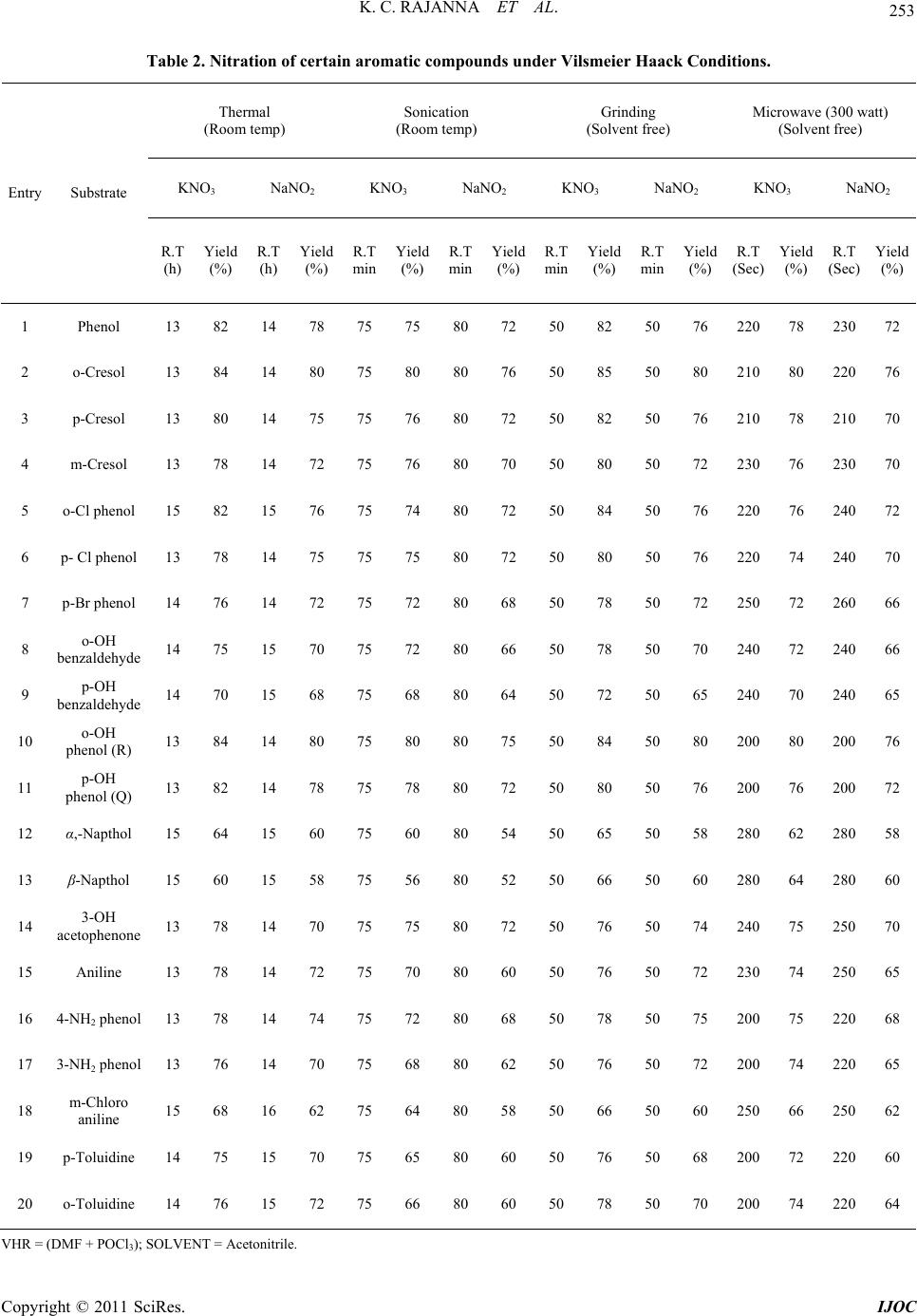 253 K. C. RAJANNA ET AL. Table 2. Nitration of certain aromatic compounds under Vilsme ier Haac k Conditions. Thermal (Room temp) Sonication (Room temp) Grinding (Solvent free) Microwave (300 watt) (Solvent free) KNO3 NaNO2 KNO3 NaNO2 KNO3 NaNO2 KNO3 NaNO2 Entry Substrate R.T (h) Yield (%) R.T (h) Yield (%) R.T min Yield (%) R.T min Yield (%) R.T min Yield (%) R.T min Yield (%) R.T (Sec) Yield (%) R.T (Sec) Yield (%) 1 Phenol 13 82 14 78 75 75 80 72 50 82 50 76 220 78 230 72 2 o-Cresol 13 84 14 80 75 80 80 76 50 85 50 80 210 80 220 76 3 p-Cresol 13 80 14 75 75 76 80 72 50 82 50 76 210 78 210 70 4 m-Cresol 13 78 14 72 75 76 80 70 50 80 50 72 230 76 230 70 5 o-Cl phenol 15 82 15 76 75 74 80 72 50 84 50 76 220 76 240 72 6 p- Cl phenol 13 78 14 75 75 75 80 72 50 80 50 76 220 74 240 70 7 p-Br phenol 14 76 14 72 75 72 80 68 50 78 50 72 250 72 260 66 8 o-OH benzaldehyde 14 75 15 70 75 72 80 66 50 78 50 70 240 72 240 66 9 p-OH benzaldehyde 14 70 15 68 75 68 80 64 50 72 50 65 240 70 240 65 10 o-OH phenol (R) 13 84 14 80 75 80 80 75 50 84 50 80 200 80 200 76 11 p-OH phenol (Q) 13 82 14 78 75 78 80 72 50 80 50 76 200 76 200 72 12 α,-Napthol 15 64 15 60 75 60 80 54 50 65 50 58 280 62 280 58 13 β-Napthol 15 60 15 58 75 56 80 52 50 66 50 60 280 64 280 60 14 3-OH acetophenone 13 78 14 70 75 75 80 72 50 76 50 74 240 75 250 70 15 Aniline 13 78 14 72 75 70 80 60 50 76 50 72 230 74 250 65 16 4-NH2 phenol 13 78 14 74 75 72 80 68 50 78 50 75 200 75 220 68 17 3-NH2 phenol 13 76 14 70 75 68 80 62 50 76 50 72 200 74 220 65 18 m-Chloro aniline 15 68 16 62 75 64 80 58 50 66 50 60 250 66 250 62 19 p-Toluidine 14 75 15 70 75 65 80 60 50 76 50 68 200 72 220 60 20 o-Toluidine 14 76 15 72 75 66 80 60 50 78 50 70 200 74 220 64 VHR = (DMF + POCl3); SOLVENT = Acetonitrile. Copyright © 2011 SciRes. IJOC 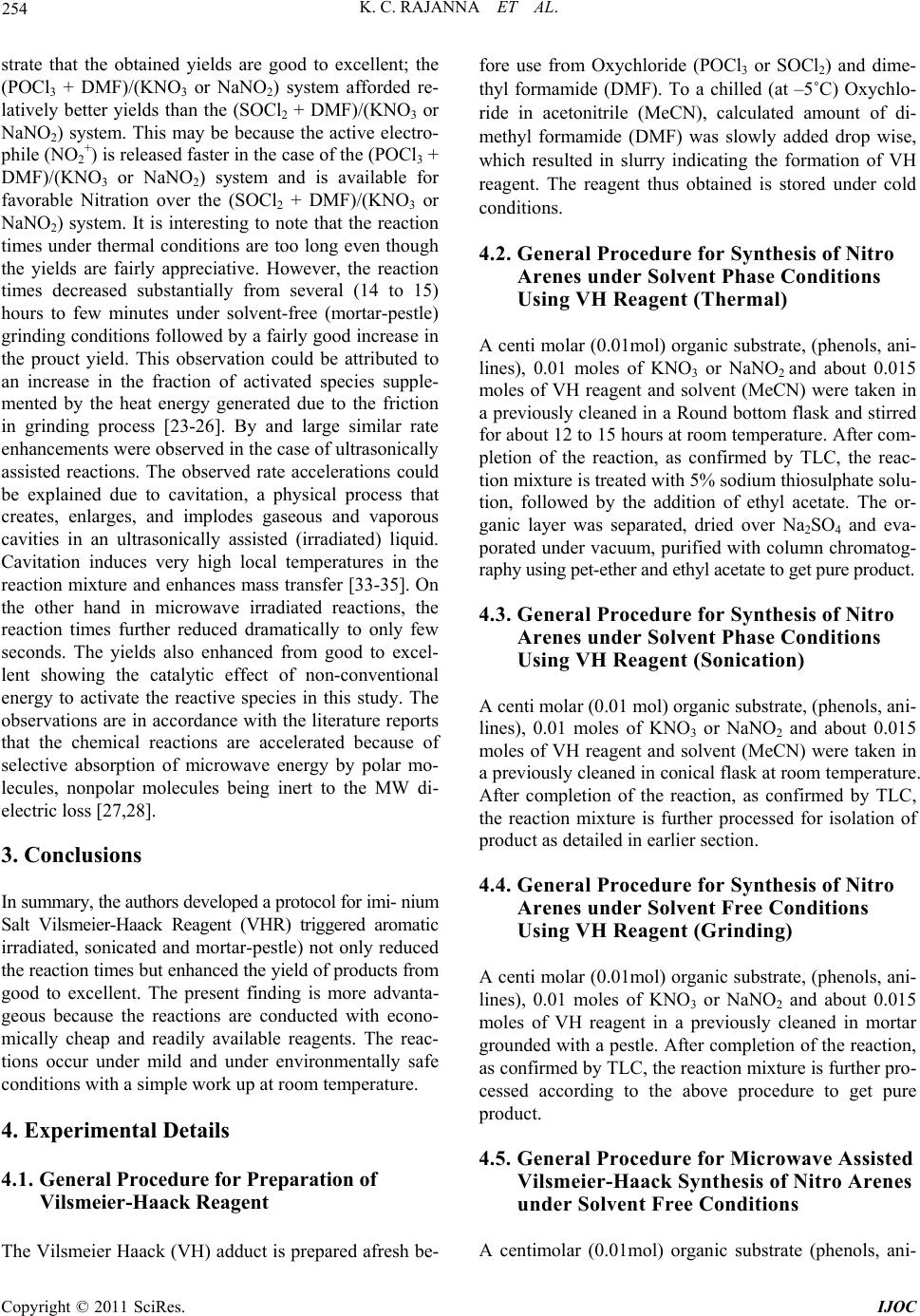 K. C. RAJANNA ET AL. Copyright © 2011 SciRes. IJOC 254 strate that the obtained yields are good to excellent; the (POCl3 + DMF)/(KNO3 or NaNO2) system afforded re- latively better yields than the (SOCl2 + DMF)/(KNO3 or NaNO2) system. This may be because the active electro- phile (NO2+) is re leas ed fa ster in th e cas e of th e (PO Cl 3 + DMF)/(KNO3 or NaNO2) system and is available for favorable Nitration over the (SOCl2 + DMF)/(KNO3 or NaNO2) system. It is interesting to note that the reaction times under thermal conditions are too long even though the yields are fairly appreciative. However, the reaction times decreased substantially from several (14 to 15) hours to few minutes under solvent-free (mortar-pestle) grinding conditions followed by a fairly good increase in the prouct yield. This observation could be attributed to an increase in the fraction of activated species supple- mented by the heat energy generated due to the friction in grinding process [23-26]. By and large similar rate enhancements were observed in the case of ultrasonically assisted reactions. The observed rate accelerations could be explained due to cavitation, a physical process that creates, enlarges, and implodes gaseous and vaporous cavities in an ultrasonically assisted (irradiated) liquid. Cavitation induces very high local temperatures in the reaction mixture and enhances mass transfer [33-35]. On the other hand in microwave irradiated reactions, the reaction times further reduced dramatically to only few seconds. The yields also enhanced from good to excel- lent showing the catalytic effect of non-conventional energy to activate the reactive species in this study. The observations are in accordance with the literature reports that the chemical reactions are accelerated because of selective absorption of microwave energy by polar mo- lecules, nonpolar molecules being inert to the MW di- electric loss [27,28]. 3. Conclusions In summary, the authors developed a protocol for imi- nium Salt Vilsmeier-Haack Reagent (VHR) triggered aromatic irradiated, sonicated and mortar-pestle) not only reduced the reaction times but enhanced the yield of products from good to excellent. The present finding is more advanta- geous because the reactions are conducted with econo- mically cheap and readily available reagents. The reac- tions occur under mild and under environmentally safe conditions with a simple work up at room temperature. 4. Experimental Details 4.1. General Procedure for Preparation of Vilsmeier-Haack Reagent The Vilsmeier Haack (VH) adduct is prepared afresh be- fore use from Oxychloride (POCl3 or SOCl2) and dime- thyl formamide (DMF). To a chilled (at –5˚C) Oxychlo- ride in acetonitrile (MeCN), calculated amount of di- methyl formamide (DMF) was slowly added drop wise, which resulted in slurry indicating the formation of VH reagent. The reagent thus obtained is stored under cold conditions. 4.2. General Procedure for Synthesis of Nitro Arenes under Solvent Phase Conditions Using VH Reagent (Thermal) A centi molar (0.01mol) organic substrate, (phenols, ani- lines), 0.01 moles of KNO3 or NaNO2 and about 0.015 moles of VH reagent and solvent (MeCN) were taken in a previously cleaned in a Round bottom flask and stirred for about 12 to 15 hours at room temperature. After com- pletion of the reaction, as confirmed by TLC, the reac- tion mixture is treated with 5% sodium thiosulphate so lu- tion, followed by the addition of ethyl acetate. The or- ganic layer was separated, dried over Na2SO4 and eva- porated under vacuum, purified with column chromatog- raphy using pet-ether and ethyl acetate t o get pure prod uct. 4.3. General Procedure for Synthesis of Nitro Arenes under Solvent Phase Conditions Using VH Reagent (Sonication) A centi molar (0.01 mol) organic substrate, (phenols, ani- lines), 0.01 moles of KNO3 or NaNO2 and about 0.015 moles of VH reagent and solvent (MeCN) were taken in a previously cleaned in conical flask at room temperature. After completion of the reaction, as confirmed by TLC, the reaction mixture is further processed for isolation of product as detailed in earlier section. 4.4. General Procedure for Synthesis of Nitro Arenes under Solvent Free Conditions Using VH Reagent (Grinding) A centi molar (0.01mol) organic substrate, (phenols, ani- lines), 0.01 moles of KNO3 or NaNO2 and about 0.015 moles of VH reagent in a previously cleaned in mortar grounded with a pestle. After completion of the reaction, as confirmed by TLC, the reaction mixture is further pro- cessed according to the above procedure to get pure product. 4.5. General P rocedur e for Microwav e Assis ted Vilsmeier-Haack Synthesis of Nitro Arenes under Solvent Free Conditions A centimolar (0.01mol) organic substrate (phenols, ani-  255 K. C. RAJANNA ET AL. lines), 0.01 moles of KNO3 or NaNO2 and about 0.015 moles of VH reagent were taken in a previously cleaned 50 ml beaker. About 500 mg of silica gel were added to the contents and mixed thoroughly and placed in micro- wave oven (CEM-908010, bench mate model, 300W laboratory microwave reactor). After completion of the reaction, as checked by TLC, the reaction mixture is treated with 5% sodium thiosulphate solution, followed by the same procedure as detailed above to get pure product. 5. References [1] G. A. Olah, R. Malhotra and S. C. Narang, “Nitration Methods and Mechanisms,” VCH, New York, 1989. [2] J. G. Hoggett, R. B. Monodie, J. R. Penton and K. Scho- field, “Nitration and Aromatic Reactivity,” Cambridge University Press, London, 1971. [3] N. Ono, “The Nitro Group in Organic Synthesis,” Wiley- VCH, New York, 2001. [4] G. K. Surya Prakash and T. Mathew, “Ipso-Nitration of Arenes,” Angewandte Chemie International Edition, Vol. 49, No. 10, 2010, pp. 1726-1728. [5] A. Kogelbauer, D. Va ssena, R. Prins a nd J. N Ar mor, “So- lid Acids as Substitutes for Sulfuric Acid in the Liquid Phase Nitration of Toluene to Nitrotoluene and Dini Tro- toluene,” Catalysis Today, Vol. 55, No. 1-2, 2000, pp. 151-160. [6] J. M. Riego, Z. Sedin, J. M. Zaldivar, N. C. Marzia no and C. Tortato, “Sulfuric Acid on Silica-Gel: An Inexpensive Catalyst for Aromatic Nitration,” Tetrahedron Letters, Vol. 37, 1996, pp. 513-516. doi:10.1016/0040-4039(95)02174-4 [7] X. Peng, H. Suzuki and C. Lu, “Zeolite-Assisted Nitra- tion of Neat Toluene and Chlorobenzene with a Nitrogen Dioxide/Molecular Oxygen System. Remarkable En- hancement of Para-Selectivity,” Tetrahedron Letters, Vol. 42, 2001, pp. 4357-4359. doi:10.1016/S0040-4039(01)00750-X [8] S. P. Dagade, S. B. Waghmode, V. S. Kadam and M. K. Dongare, “Vapor Phase Nitration of Toluene Using Di- lute Nitric Acid and Molecular Modeling Studies over Beta Zeolite,” Applied Catalysis A, Vol. 226, No. 1-2, 2002, pp. 49-61. [9] R. B. Radoslaw and J. S. Andrew, “A Fast and Mild Method for the Nitration of Aromatic Rings,” Tetrahe- dron Letters, Vol. 42, No. 38, 2001, pp. 6767-6769. doi:10.1016/S0040-4039(01)01378-8 [10] N. Iranpoor, H. Firouzabadi, R. Heydari, “Silica-Polyethy- leneglycols/N2O4 Complexes as Heterogeneous Nitrating and Nitrosating Agents,” Phosphorus, Sulfur and Silicon, Vol. 178, No. 5, 2003, pp. 1027-1035. doi:10.1080/10426500307863 [11] J. A. R. Rodrigues, A. P. Oliveira Filho, P. J. S. Moran and R. Custodio, “Regioselectivity of the Nitration of Phenol by Acetyl Nitrate Adsorbed On Silica Gel,” Tet- rahedron, Vol.55, No. 22, 1999, pp. 6733-6738. doi:10.1016/S0040-4020(99)00320-8 [12] J. A. R. Rodrigues, A. P. Oliveira Filho, P. J. S. Moran and R. Custodio, “Regioselectivity of the Mononitration of Alkylbenzenes by Immobilized Acyl Nitrates,” Syn- thetic Communications, Vol. 29, No. 12, 1999, pp. 2169- 2174. doi:10.1080/00397919908086213 [13] L. Delaude, P. Laszlo and K. Smith, “Heightened Selec- tivity in Aromatic Nitrations and Chlorinations by the Use of Solid Supports and Catalysts,” Accounts of Che- mical Re- search, Vol. 26, No. 12, 1993, pp. 607-613. doi:10.1021/ar00036a001 [14] P. Laszlo, “Catalysis of Organic Reactions by Inorganic Solids,” Accounts of Chemical Research, Vol. 19, No. 4, 1986, pp. 121-127. doi:10.1021/ar00124a004 [15] A. R. Hajipour and A. E. Ruoho, “A Fast and Mild Me- thod for Nitration of Aromatic Rings,” Phosphorus, Sul- fur, and Silicon and the Related Elements, Vol. 179, No. 2, 2004, pp. 221-226. doi:10.1080/10426500490274655 [16] J. J. Paul Selvam, V. Suresh, K. Rajesh, S. Ravinder Red- dy and Y. Venkateswarlu, “Highly Efficient Nitration of Phenolic Compounds by Zirconyl Nitrate,” Tetrahedron Letters, Vol. 47, No. 15, 2006, pp. 2507-2509. doi:10.1016/j.tetlet.2006.02.057 [17] H. Firouzabadi, N. Iranpoor and M. A. Zolfigol, “A Re- investigation of Nitration of Phenols with Metal Nitrates under Non-Aqueous and Aprotic Conditions,” Iranian Jour- nal of Chemistry and Chemical Engineering, Vol. 16, No. 2, 1997, pp. 48-58. [18] M. M. Ali, Tasneem, K. C. Rajanna, P. K. Saiprakash, “An Efficient and Facile Synthesis of 2-Chloro-3-formyl- quinolines from Acetanilides in Micellar Media by Vils- meier-Haack Cyclization,” Synlett, Vol. 32, No. 22, 2001, pp. 251-253. [19] Tasneem, “Vilsmeier-Haack Reagent,” Synlett, Vol. 138- 139, No. 1, 2003, pp. 138-139. [20] A. Chakradhar, R. Roopa, K. C. Rajanna and P. K. Saip- rakash, “Vilsmeier-Haack Bromination of Aromatic Com- pounds with KBr and N-Bromosuccinimide Under Sol- vent-Free Conditions,” Synthetic Communications, Vol. 39, No. 10, 2009, pp. 1817-1824. [21] S. Ramgopal, K. Ramesh, N. Maasi Reddy, A. Chakrad- har and K. C. Rajanna, “Metal Nitrate Driven nitro Huns- diecker Reaction with α,β-Unsaturated Carboxylic Acids under Solvent-Free Conditions,” Tetrahedron Letters, Vol. 48, No. 23, 2007, pp. 4043-4045. doi:10.1016/j.tetlet.2007.04.026 [22] K. C. Rajanna, N. Maasi Reddy, M. Rajender Reddy and P. K. Saiprakash, “Micellar Mediated Halodecarboxyla- tion of α,β-Unsaturated Aliphatic and Aromatic Carbox- ylic Acids—A Novel Green Hunsdiecker-Borodin Reac- tion,” Journal of Dispersion Science and Technology, Vol. 28, No. 4, 2007, pp. 613-616. doi:10.1080/01932690701282690 [23] G. R. Desiraju and B. S. Goud, “Reactivity of Solids. Present, Past, and Future,” V. V. Boldyrev, Ed., Black- well Sciences, London, 1995, p. 223. Copyright © 2011 SciRes. IJOC  K. C. RAJANNA ET AL. Copyright © 2011 SciRes. IJOC 256 [24] F. Toda, “Solid State Organic Reactions,” Synlett, No. 5, 1993, pp. 303-312. doi:10.1021/ar00060a003 [25] K. Tanaka and F. Toda, “Solvent-Free Organic Synthe- sis,” Chemical Reviews, Vol. 100, No. 3, 2000, pp. 1025- 1074. [26] J. D. Lou and Z. N. Xu, “Selective Oxidation of Primary Alcohols with Chromium Trioxide under Solvent Free Conditions,” Tetrahedron Letters, Vol. 43, No. 35, 2002, pp. 6095-6097. doi:10.1016/S0040-4039(02)01333-3 [27] R. S. Varma, “Microwaves: Theory and Application in Material Processing IV,” D. E. Clark, W. H. Sutton and D. A. Lewis, Eds., American Ceramic Society, Westerville, Ohio, 1997, p. 357. [28] J. Hamelin, J. P. Bazureau, F. Texier-Boullet and A. Lou- by, “Microwave in Organic Synthesis,” Wiley-VCH, Wein- heim, 2002, p. 253. [29] A. Vilsmeier and A. Haack, “Über die Einwirkung von Halogenphosphor auf Alkyl-formanilide. Eine neue Me- thode zur Darstellung Sekundärer und Tertiärer p-Alky- lamino-benzaldehyde” Berichte der Deutschen Chemis- chen Gesellschaft (A and B Series), Vol. 60, No. 1, 1927, pp. 119-122. doi:10.1002/cber.19270600118 [30] W. Su, Y. Weng, L. Jiang, Y. Yang, L. Zhao, Z. Chen and Z. Li, “Recent Progress in the Use of Vilsmeier-Type Reagents,” Organic Preparations and Procedures Inter- national, Vol. 42, No. 6, 2010, pp. 503-555. doi:10.1080/00304948.2010.513911 [31] I. M. A. Awad, “Studies on the Vilsmeier-Haack Reaction. Part XIII: Novel Heterocyclo-Substituted 4,4’-Bi-pyrazo- lyl Dithiocarbamate Derivatives,” Chemical Technology and Biotechnology, Vol. 56, No. 4, 1992, pp. 339-345. doi:10.1002/jctb.280560403 [32] I. M. A. Awad, “Studies in the Vilsmeier-Haack Reaction, Part VII: Synthesis and Reaction of 3-Methyl-l-phenyl-4- acetyl Hydrazono 2-Pyrazoline-5-one(-5-thione),” Monat- shefte für Chemie, Vol. 121, No. 12, 1990, pp. 1023-1030 [33] T. J. Mason and J. P. Lorimer, “Sono Chemistry Theory, Applications and Uses of Ultrasound in Chemistry,” Ellis Horwood, New York, 1989. [34] T. J. Mason, “Chemistry with Ultrasound,” Critical Re- ports in Applied Chemistry, No. 28, 1990. [35] M. H. Entezari and A. A. Shameli, “Shameli, Phase-Trans- fer Catalysis and Ultrasonic Waves I. Cannizzaro Reac- tion,” Ultrasonics Sonochemistry, Vol. 7, No. 4, 2000, pp. 169-172. doi:10.1016/S1350-4177(00)00037-7 |