

Paper Menu >>
Journal Menu >>
 International Journal of Organic Chemistry, 2011, 1, 215-217 doi:10.4236/ijoc.2011.14031 Published Online December 2011 (http://www.SciRP.org/journal/ijoc) Copyright © 2011 SciRes. IJOC 215 Proposed Extension to the Natta Projection Notation System for Enabling an Indication of Relative Stereochemistry and the Stereochemical St ate Karel D. Klika Department of C hemi st ry , University of Turku, Turku, Finland E-mail: [email protected] Received October 1, 2011; revised November 6, 2011; accepted November 18, 2011 Abstract A system of structure depiction, as an extension of the wedge and hashed wedge bonds (Natta projection), and text notation is herein suggested that embodies more explicit information—or reduced over-statement as circumstances warrant—on the stereochemical nature of the system at hand, in particular, for those cases where only the relative stereochemistry of a compound is known. Keywords: Stereochemistry, Stereochemical Descriptors, Natta Projection, Racemate, Enantiomer The Natta projection system1 for indicating stereochem- istry is familiar to all organic chemists, but surprisingly, there are limitations in the depictions. For example, in Figure 1, the structure presented for 1,2,4-trihydroxy- cyclohexane is very exp licit: it represents the (1R,2S,4R)- enantiomer. If this is the intended information to b e con- veyed, then it is not only appropriate, it is also clearly unambiguous. At the opposite end of the scale, the stru- cture shown in Figure 2 is equally profound in its mean- ing: nothing at all is known regarding the stereochemis- try of 1,2,4-trihydroxycyclo hexane and the state could be one or all or any mixture whatsoever of the eight possi- ble stereoisomers. Figure 1. The structural depiction of (1R,2S,4R)-1,2,4-tri- hydroxycyclohexane. Figure 2. The structural depiction of 1,2,4-trihydroxycy- clohexane without any indication of stereochemistry. Problems arise however, when a known mixture of stereoisomers is present or the relative stereochemistry is known but not the absolute configu ration. How does one then represent the stereochemical state of the system? For example, for a sample of known relative configura- tion but unknown absolute configuration (irrespective of whether one or two stereoisomers were present, pre- sumably in the latter case a pair of enantiomers consti- tuting a racemic sample), then clearly both Figures 1 and 2 do not suffice to accurately convey this information. For Figure 1, because it can be both lacking2 (if two enantiomers were present) and overstating (since the absolute configuration is not known); for Figure 2, be- cause it does not convey all the information that is known. It thus seems curious that there is not a widely used convention in place to conveniently address what is a rather common occurrence. To alleviate this limitation and to enable one to ascertain at a relative glance the stereochemical state in more systems without the need to scour the text for cor roborating or qu alifying info rmation, the following extension to the Natta system is therefore suggested. For systems where something is known about the stereochemistry b ut the information is inco mplete or there is a need amalgamate data, the solid wedge and hashed wedge bonds used to represent forward and backward 2Even if mention of this is made alongside the structural figure, in the figure caption, or in the main body of the text one still has to locate and retrieve it and, regretfully, all too often mention of this important as- p ect may even be neglec t ed altogether. 1Giulio Natta, 1903-1979. 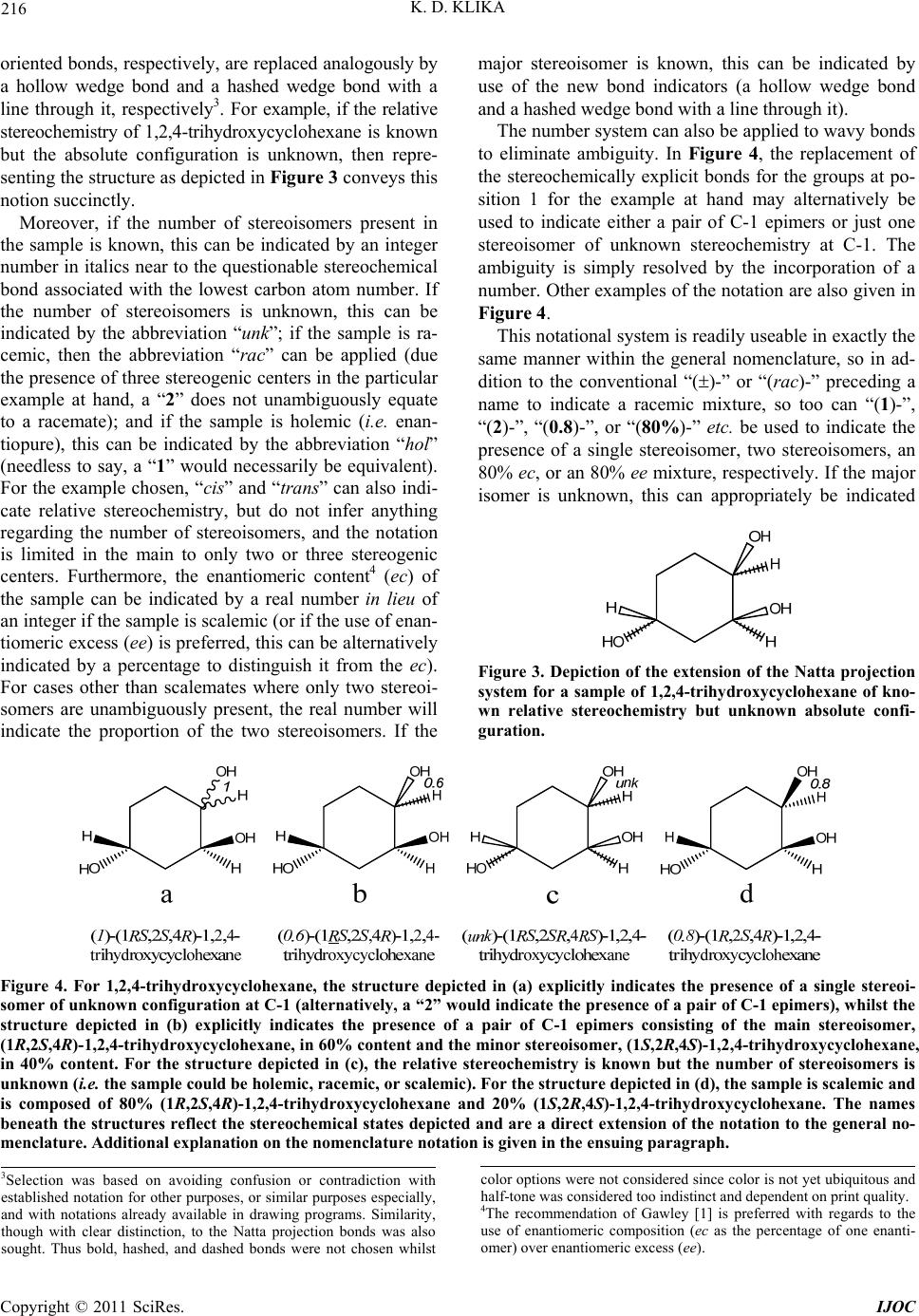 K. D. KLIKA 216 oriented b onds, r espectively, are r eplaced analogously by a hollow wedge bond and a hashed wedge bond with a line through it, respectively3. For example, if the relative stereochemistry of 1,2,4-trihydroxycyc lohexane is known but the absolute configuration is unknown, then repre- senting the structure as depicted in Figure 3 conveys this notion succinctly. Moreover, if the number of stereoisomers present in the sample is known, this can be indicated by an integer number in italics near to the questionable stereochemical bond associated with the lowest carbon atom number. If the number of stereoisomers is unknown, this can be indicated by the abbreviation “unk”; if the sample is ra- cemic, then the abbreviation “rac” can be applied (due the presence of three stereogenic centers in the particular example at hand, a “2” does not unambiguously equate to a racemate); and if the sample is holemic (i.e. enan- tiopure), this can be indicated by the abbreviation “hol” (needless to say, a “1” would necessarily be equivalent). For the example chosen, “cis” and “trans” can also indi- cate relative stereochemistry, but do not infer anything regarding the number of stereoisomers, and the notation is limited in the main to only two or three stereogenic centers. Furthermore, the enantiomeric content4 (ec) of the sample can be indicated by a real number in lieu of an integer if the sample is scalemic (or if the use of enan- tiomeric excess (ee) is preferred, this can be alternatively indicated by a percentage to distinguish it from the ec). For cases other than scalemates where only two stereoi- somers are unambiguously present, the real number will indicate the proportion of the two stereoisomers. If the major stereoisomer is known, this can be indicated by use of the new bond indicators (a hollow wedge bond and a hashed wedge bond with a line through it). The number system can also be applied to wavy bonds to eliminate ambiguity. In Figure 4, the replacement of the stereochemically explicit bonds for the groups at po- sition 1 for the example at hand may alternatively be used to indicate either a pair of C-1 epimers or just one stereoisomer of unknown stereochemistry at C-1. The ambiguity is simply resolved by the incorporation of a number. Other examples of the notation are also given in Figure 4. This notational system is readily useab le in exactly the same manner within the general nomenclature, so in ad- dition to the conventional “()-” or “(ra c)-” preceding a name to indicate a racemic mixture, so too can “(1)-”, “(2)-”, “(0.8)-”, or “(80%)-” etc. be used to indicate the presence of a single stereoisomer, two stereoisomers, an 80% ec, or an 80% ee mixture, respectively. If the major isomer is unknown, this can appropriately be indicated Figure 3. Depiction of the extension of the Natta projection system for a sample of 1,2,4-trihydroxycyclohexane of kno- wn relative stereochemistry but unknown absolute confi- guration. Figure 4. For 1,2,4-trihydroxycyclohexane, the structure depicted in (a) explicitly indicates the presence of a single stereoi- somer of unknown configuration at C-1 (alter natively, a “2” would indicate the presence of a pair of C-1 epimers), whilst the structure depicted in (b) explicitly indicates the presence of a pair of C-1 epimers consisting of the main stereoisomer, (1R,2S,4R)-1,2,4-trihydroxycyclohexane, in 60% content and the minor stereoisomer, (1S,2R,4S)-1,2,4-trihydroxycyclohexane, in 40% content. For the structure depicted in (c), the relative stereochemistry is known but the number of stereoisomers is unknown (i.e. the sample could be holemic, racemic, or scalemic). For the structure depicted in (d), the sample is scalemic and is composed of 80% (1R,2S,4R)-1,2,4-trihydroxycyclohexane and 20% (1S,2R,4S)-1,2,4-trihydroxycyclohexane. The names beneath the structures reflect the stereochemical states depicted and are a direct extension of the notation to the general no- menclature. Additional explanation on the nomenclature notation is given in the ensuing paragraph. color options were not considered since color is not yet ubiquitous and half-tone was considered too in d i stinct and dependent on print quality. 4The recommendation of Gawley [1] is preferred with regards to the use of enantiomeric composition (ec as the percentage of one enanti- omer) over enantiomeric excess (ee). 3Selection was based on avoiding confusion or contradiction with established notation for other purposes, or similar purposes especially, and with notations already available in drawing programs. Similarity, though with clear distinction, to the Natta projection bonds was also sought. Thus bold, hashed, and dashed bonds were not chosen whils t Copyright © 2011 SciRes. IJOC 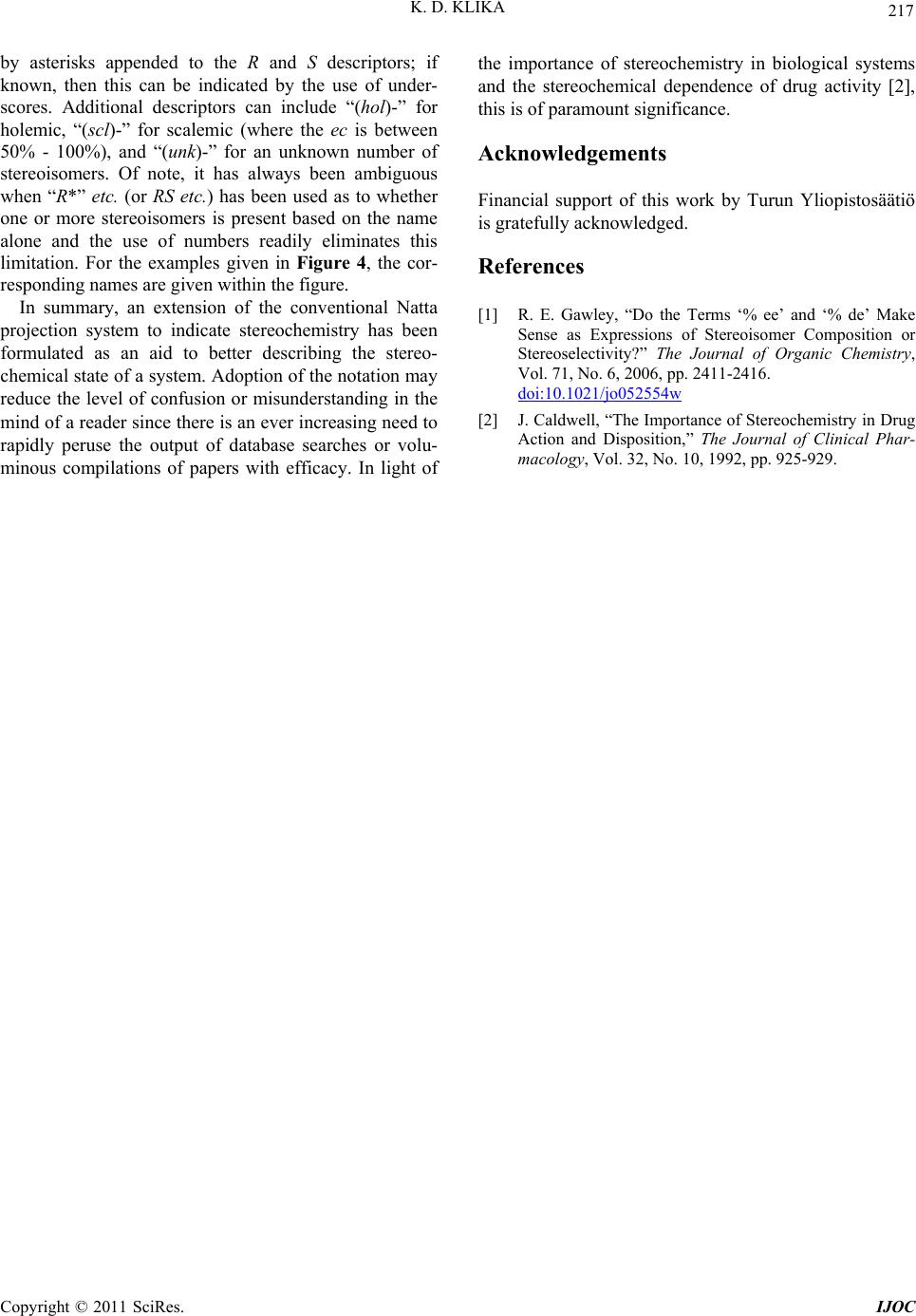 217 K. D. KLIKA by asterisks appended to the R and S descriptors; if known, then this can be indicated by the use of under- scores. Additional descriptors can include “(hol)-” for holemic, “(scl)-” for scalemic (where the ec is between 50% - 100%), and “(unk)-” for an unknown number of stereoisomers. Of note, it has always been ambiguous when “R*” etc. (or RS etc.) has been used as to whether one or more stereoisomers is present based on the name alone and the use of numbers readily eliminates this limitation. For the examples given in Figure 4, the cor- responding names are given within the figure. In summary, an extension of the conventional Natta projection system to indicate stereochemistry has been formulated as an aid to better describing the stereo- chemical state of a system. Adoption of the notation may reduce the level of confusion or misunderstanding in the mind of a reader since there is an ever increasing need to rapidly peruse the output of database searches or volu- minous compilations of papers with efficacy. In light of the importance of stereochemistry in biological systems and the stereochemical dependence of drug activity [2], this is of paramount significance. Acknowledgements Financial support of this work by Turun Yliopistosäätiö is gratefully acknowledged. References [1] R. E. Gawley, “Do the Terms ‘% ee’ and ‘% de’ Make Sense as Expressions of Stereoisomer Composition or Stereoselectivity?” The Journal of Organic Chemistry, Vol. 71, No. 6, 2006, pp. 2411-2416. doi:10.1021/jo052554w [2] J. Caldwell, “The Importance of Stereochemistry in Drug Action and Disposition,” The Journal of Clinical Phar- macology, Vol. 32, No. 10, 1992, pp. 925-929. Copyright © 2011 SciRes. IJOC |