

Paper Menu >>
Journal Menu >>
 International Journal of Organic Chemistry, 2011, 1, 158-161 doi:10.4236/ijoc.2011.14023 Published Online December 2011 (http://www.SciRP.org/journal/ijoc) Copyright © 2011 SciRes. IJOC Photo-Induced Reduction Reaction of Methylene Blue in an Ionic Liquid Jun-ichi Kadokawa, Hironori Izawa, Tomoya Ohta, Satoshi Wakizono, Kazuya Yamamoto Graduate School of Science and Engineering, Kagoshima University, Kagoshima, Japan E-mail: [email protected] Received September 24, 2011; revised October 31, 2011; accepted November 9, 2011 Abstract Reduction of methylene blue (MB) occurred by photo irradiation at 280 - 370 nm wavelengths to a solution of MB in an ionic liquid, 1-butyl-3-methylimidazolium chloride (BMIMCl), which was confirmed by color change and UV-Vis measurement of the solution. Furthermore, the reduced MB was oxidized again by standing the solution under the conditions of light shielding at 50˚C. The fluorescence spectra of the solution excited at 350 nm suggested that the photo-induced reduction probably took place via electron-transfer from BMIMCl to MB. Keywords: Methylene Blue, Ionic Liquid, Reduction, Photo Irradiation 1. Introduction Redox dyes where color depends on oxidation state have been useful in studies in conjugation with electrochemi- cal applications such as a redox indicator [1]. It can be ex- pected that development of new redox system using re- dox dyes leads to further application of the dyes. Methy- lene blue (MB) is one of the representative redox dyes, which possesses good electrochemical properties via its redox reactions [2-6]. Therefore, it has been widely used for basic electrochemical studies and applications, for ex- ample, electrocatalysis, solar cells, and biosensors [2,7,8]. Redox reactions of MB reversibly occurred according to Scheme 1. An oxidized MB exhibits blue color, whereas a reduced MB (leucomethylene blue) has colorless na- ture. On the other hand, ionic liquids, which are low-melt- ing salts and form liquids at the temperature below the boi- ling point of water, have continued to receive a great deal of attention for a wide variety of possible applications, such as the solvent system for a large number of organic and inorganic reactions, gel components, catalysis, sepa- N CH3 H3C N SN CH3 CH3 Cl N CH3 H3C N H SN CH3 CH 3 Oxidized MB ( blue ) Reduced MB ( colo r less ) Scheme 1. Redox reactions of MB. ration, and electrochemical studies [9-17]. The utility of the ionic liquids as media for various photophysical and photochemical studies has also been explored [18-20]. For example, photo-induced electron-transfer reactions in ionic liquids have been reported [21-23]. In this paper, we report photo-induced reduction reaction of MB in an imidazolium-type ionic liquid, 1-butyl-3-methylimidazo- lium chloride (BMIMCl) in the absence of additional reductant. Furthermore, the reduced MB could be oxi- dized again by molecular oxygen under the conditions of light shielding. Previously, redox reactions of some sub- strates by pulse radiolysis in ionic liquids have also been reported [24,25]. 2. Results and Discussion When the photo irradiation at 280 - 370 nm wavelengths to a solution of MB in BMIMCl (0.125 μmol/g) was per- formed at room temperature for 12 h, decolorization of the solution occurred. We assumed that this decolori- zation was owing to the reduction of MB, because it has been well-known that the similar decolorization happens by the general reduction reaction of MB in the presence of some reductants such as glucose. To confirm occur- rence of the reduction of MB in BMIMCl by the photo irradiation, the UV-Vis measurement of the resulting so- lution after the irradiation for 12 h was conducted. In Figure 1, the UV-Vis spectra of the solution of MB in BMIMCl before and after the photo irradiation are shown. 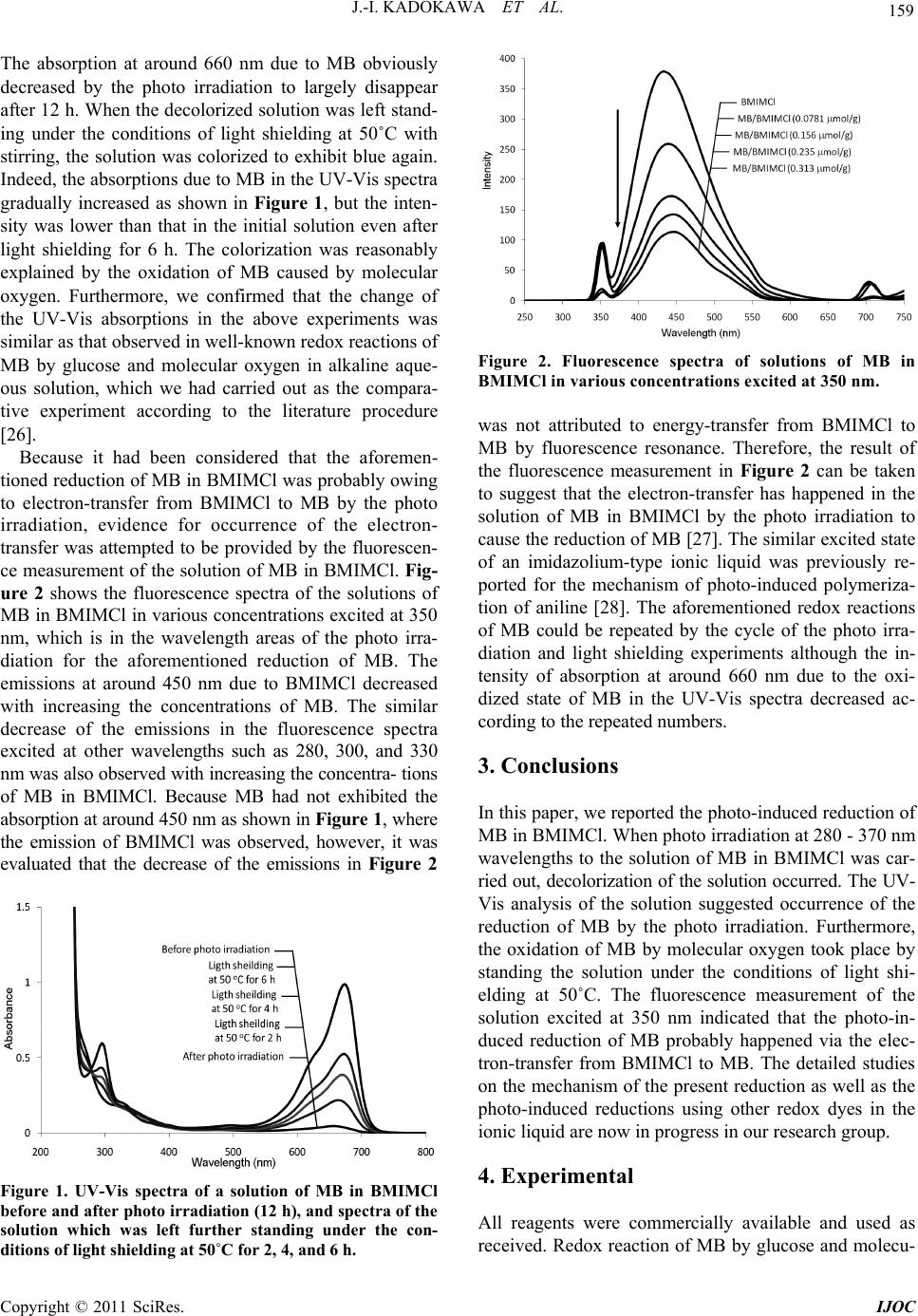 159 J.-I. KADOKAWA ET AL. The absorption at around 660 nm due to MB obviously decreased by the photo irradiation to largely disappear after 12 h. When the decolorized solution was left stand- ing under the conditions of light shielding at 50˚C with stirring, the solution was colorized to exhibit blue again. Indeed, the absorptions due to MB in the UV-Vis spectra gradually increased as shown in Figure 1, but the inten- sity was lower than that in the initial solution even after light shielding for 6 h. The colorization was reasonably explained by the oxidation of MB caused by molecular oxygen. Furthermore, we confirmed that the change of the UV-Vis absorptions in the above experiments was similar as that observed in well-known redox reactions of MB by glucose and molecular oxygen in alkaline aque- ous solution, which we had carried out as the compara- tive experiment according to the literature procedure [26]. Because it had been considered that the aforemen- tioned reduction of MB in BMIMCl was probably owing to electron-transfer from BMIMCl to MB by the photo irradiation, evidence for occurrence of the electron- transfer was attempted to be provided by the fluorescen- ce measurement of the solution of MB in BMIMCl. Fig- ure 2 shows the fluorescence spectra of the solutions of MB in BMIMCl in various concentrations excited at 350 nm, which is in the wavelength areas of the photo irra- diation for the aforementioned reduction of MB. The emissions at around 450 nm due to BMIMCl decreased with increasing the concentrations of MB. The similar decrease of the emissions in the fluorescence spectra excited at other wavelengths such as 280, 300, and 330 nm was also observed with increasing the concentra- tions of MB in BMIMCl. Because MB had not exhibited the absorption at around 450 nm as shown in Figure 1, where the emission of BMIMCl was observed, however, it was evaluated that the decrease of the emissions in Figure 2 Figure 1. UV-Vis spectra of a solution of MB in BMIMCl before and after photo irradiation (12 h), and spectra of the solution which was left further standing under the con- ditions of light shielding at 50˚C for 2, 4, and 6 h. Figure 2. Fluorescence spectra of solutions of MB in BMIMCl in various concentrations excited at 350 nm. was not attributed to energy-transfer from BMIMCl to MB by fluorescence resonance. Therefore, the result of the fluorescence measurement in Figure 2 can be taken to suggest that the electron-transfer has happened in the solution of MB in BMIMCl by the photo irradiation to cause the reduction of MB [27]. The similar excited state of an imidazolium-type ionic liquid was previously re- ported for the mechanism of photo-induced polymeriza- tion of aniline [28]. The aforementioned redox reactions of MB could be repeated by the cycle of the photo irra- diation and light shielding experiments although the in- tensity of absorption at around 660 nm due to the oxi- dized state of MB in the UV-Vis spectra decreased ac- cording to the repeated numbers. 3. Conclusions In this paper, we reported the photo-induced reduction of MB in BMIMCl. When photo irradiation at 280 - 370 nm wavelengths to the solution of MB in BMIMCl was car- ried out, decolorization of the solution occurred. The UV- Vis analysis of the solution suggested occurrence of the reduction of MB by the photo irradiation. Furthermore, the oxidation of MB by molecular oxygen took place by standing the solution under the conditions of light shi- elding at 50˚C. The fluorescence measurement of the solution excited at 350 nm indicated that the photo-in- duced reduction of MB probably happened via the elec- tron-transfer from BMIMCl to MB. The detailed studies on the mechanism of the present reduction as well as the photo-induced reductions using other redox dyes in the ionic liquid are now in progress in our research group. 4. Experimental All reagents were commercially available and used as received. Redox reaction of MB by glucose and molecu- Copyright © 2011 SciRes. IJOC 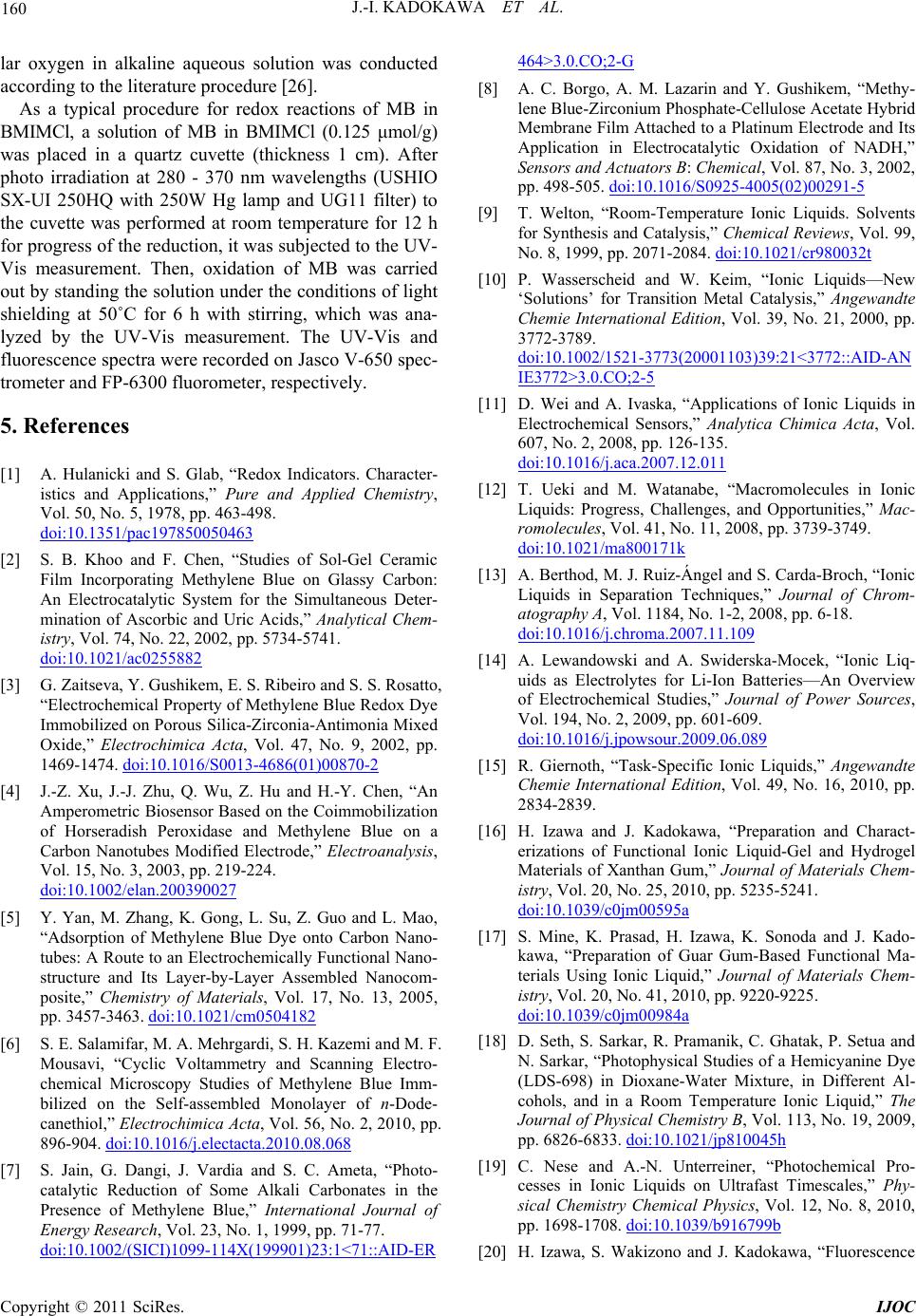 J.-I. KADOKAWA ET AL. 160 lar oxygen in alkaline aqueous solution was conducted according to the literature procedure [26]. As a typical procedure for redox reactions of MB in BMIMCl, a solution of MB in BMIMCl (0.125 μmol/g) was placed in a quartz cuvette (thickness 1 cm). After photo irradiation at 280 - 370 nm wavelengths (USHIO SX-UI 250HQ with 250W Hg lamp and UG11 filter) to the cuvette was performed at room temperature for 12 h for progress of the reduction, it was subjected to the UV- Vis measurement. Then, oxidation of MB was carried out by standing the solution under the conditions of light shielding at 50˚C for 6 h with stirring, which was ana- lyzed by the UV-Vis measurement. The UV-Vis and fluorescence spectra were recorded on Jasco V-650 spec- trometer and FP-6300 fluorometer, respectively. 5. References [1] A. Hulanicki and S. Glab, “Redox Indicators. Character- istics and Applications,” Pure and Applied Chemistry, Vol. 50, No. 5, 1978, pp. 463-498. doi:10.1351/pac197850050463 [2] S. B. Khoo and F. Chen, “Studies of Sol-Gel Ceramic Film Incorporating Methylene Blue on Glassy Carbon: An Electrocatalytic System for the Simultaneous Deter- mination of Ascorbic and Uric Acids,” Analytical Chem- istry, Vol. 74, No. 22, 2002, pp. 5734-5741. doi:10.1021/ac0255882 [3] G. Zaitseva, Y. Gushikem, E. S. Ribeiro and S. S. Rosatto, “Electrochemical Property of Methylene Blue Redox Dye Immobilized on Porous Silica-Zirconia-Antimonia Mixed Oxide,” Electrochimica Acta, Vol. 47, No. 9, 2002, pp. 1469-1474. doi:10.1016/S0013-4686(01)00870-2 [4] J.-Z. Xu, J.-J. Zhu, Q. Wu, Z. Hu and H.-Y. Chen, “An Amperometric Biosensor Based on the Coimmobilization of Horseradish Peroxidase and Methylene Blue on a Carbon Nanotubes Modified Electrode,” Electroanalysis, Vol. 15, No. 3, 2003, pp. 219-224. doi:10.1002/elan.200390027 [5] Y. Yan, M. Zhang, K. Gong, L. Su, Z. Guo and L. Mao, “Adsorption of Methylene Blue Dye onto Carbon Nano- tubes: A Route to an Electrochemically Functional Nano- structure and Its Layer-by-Layer Assembled Nanocom- posite,” Chemistry of Materials, Vol. 17, No. 13, 2005, pp. 3457-3463. doi:10.1021/cm0504182 [6] S. E. Salamifar, M. A. Mehrgardi, S. H. Kazemi and M. F. Mousavi, “Cyclic Voltammetry and Scanning Electro- chemical Microscopy Studies of Methylene Blue Imm- bilized on the Self-assembled Monolayer of n-Dode- canethiol,” Electrochimica Acta, Vol. 56, No. 2, 2010, pp. 896-904. doi:10.1016/j.electacta.2010.08.068 [7] S. Jain, G. Dangi, J. Vardia and S. C. Ameta, “Photo- catalytic Reduction of Some Alkali Carbonates in the Presence of Methylene Blue,” International Journal of Energy Research, Vol. 23, No. 1, 1999, pp. 71-77. doi:10.1002/(SICI)1099-114X(199901)23:1<71::AID-ER 464>3.0.CO;2-G [8] A. C. Borgo, A. M. Lazarin and Y. Gushikem, “Methy- lene Blue-Zirconium Phosphate-Cellulose Acetate Hybrid Membrane Film Attached to a Platinum Electrode and Its Application in Electrocatalytic Oxidation of NADH,” Sensors and Actuators B: Chemical, Vol. 87, No. 3, 2002, pp. 498-505. doi:10.1016/S0925-4005(02)00291-5 [9] T. Welton, “Room-Temperature Ionic Liquids. Solvents for Synthesis and Catalysis,” Chemical Reviews, Vol. 99, No. 8, 1999, pp. 2071-2084. doi:10.1021/cr980032t [10] P. Wasserscheid and W. Keim, “Ionic Liquids—New ‘Solutions’ for Transition Metal Catalysis,” Angewandte Chemie International Edition, Vol. 39, No. 21, 2000, pp. 3772-3789. doi:10.1002/1521-3773(20001103)39:21<3772::AID-AN IE3772>3.0.CO;2-5 [11] D. Wei and A. Ivaska, “Applications of Ionic Liquids in Electrochemical Sensors,” Analytica Chimica Acta, Vol. 607, No. 2, 2008, pp. 126-135. doi:10.1016/j.aca.2007.12.011 [12] T. Ueki and M. Watanabe, “Macromolecules in Ionic Liquids: Progress, Challenges, and Opportunities,” Mac- romolecules, Vol. 41, No. 11, 2008, pp. 3739-3749. doi:10.1021/ma800171k [13] A. Berthod, M. J. Ruiz-Ángel and S. Carda-Broch, “Ionic Liquids in Separation Techniques,” Journal of Chrom- atography A, Vol. 1184, No. 1-2, 2008, pp. 6-18. doi:10.1016/j.chroma.2007.11.109 [14] A. Lewandowski and A. Swiderska-Mocek, “Ionic Liq- uids as Electrolytes for Li-Ion Batteries—An Overview of Electrochemical Studies,” Journal of Power Sources, Vol. 194, No. 2, 2009, pp. 601-609. doi:10.1016/j.jpowsour.2009.06.089 [15] R. Giernoth, “Task-Specific Ionic Liquids,” Angewandte Chemie International Edition, Vol. 49, No. 16, 2010, pp. 2834-2839. [16] H. Izawa and J. Kadokawa, “Preparation and Charact- erizations of Functional Ionic Liquid-Gel and Hydrogel Materials of Xanthan Gum,” Journal of Materials Chem- istry, Vol. 20, No. 25, 2010, pp. 5235-5241. doi:10.1039/c0jm00595a [17] S. Mine, K. Prasad, H. Izawa, K. Sonoda and J. Kado- kawa, “Preparation of Guar Gum-Based Functional Ma- terials Using Ionic Liquid,” Journal of Materials Chem- istry, Vol. 20, No. 41, 2010, pp. 9220-9225. doi:10.1039/c0jm00984a [18] D. Seth, S. Sarkar, R. Pramanik, C. Ghatak, P. Setua and N. Sarkar, “Photophysical Studies of a Hemicyanine Dye (LDS-698) in Dioxane-Water Mixture, in Different Al- cohols, and in a Room Temperature Ionic Liquid,” The Journal of Physical Chemistry B, Vol. 113, No. 19, 2009, pp. 6826-6833. doi:10.1021/jp810045h [19] C. Nese and A.-N. Unterreiner, “Photochemical Pro- cesses in Ionic Liquids on Ultrafast Timescales,” Phy- sical Chemistry Chemical Physics, Vol. 12, No. 8, 2010, pp. 1698-1708. doi:10.1039/b916799b [20] H. Izawa, S. Wakizono and J. Kadokawa, “Fluorescence Copyright © 2011 SciRes. IJOC  J.-I. KADOKAWA ET AL. Copyright © 2011 SciRes. IJOC 161 Resonance-Energy-Transfer in Systems of Rhodamine 6G with Ionic Liquid Showing Emissions by Excitation at Wide Wavelength Areas,” Chemical Communications, Vol. 46, No. 34, 2010, pp. 6359-6361. doi:10.1039/c0cc01066a [21] A. Paul and A. Samanta, “Photoinduced Electron Transfer Reaction in Room Temperature Ionic Liquids: A Com- bined Laser Flash Photolysis and Fluorescence Study,” The Journal of Physical Chemistry B, Vol. 111, No. 8, 2007, pp. 1957-1962. doi:10.1021/jp067481e [22] R. C. Vieira and D. E. Falvey, “Solvent-Mediated Pho- toinduced Electron Transfer in a Pyridinium Ionic Liq- uid,” Journal of the Americal Chemical Society, Vol. 130, No. 5, 2008, pp. 1552-1553. doi:10.1021/ja077797f [23] R. C. Vieira and D. E. Falvey, “Photoinduced Electron- Transfer Reactions in Two Room-Temperature Ionic Liquids: 1-Butyl-3-methylimidazolium Hexafluorophos- phate and 1-Octyl-3-methylimidazolium Hexafluorophos- phate,” The Journal of Physical Chemistry B, Vol. 111, No. 18, 2007, pp. 5023-5029. doi:10.1021/jp0630471 [24] D. Behar, C. Gonzalez and P. Neta, “Reaction Kinetics in Ionic Liquids: Pulse Radiolysis Studies of 1-Butyl-3- methylimidazolium Salts,” The Journal of Physical Che- mistry A, Vol. 105, No. 32, 2001, pp. 7607-7614. doi:10.1021/jp011405o [25] D. Behar, P. Neta and C. Schultheisz, “Reaction Kinetics in Ionic Liquids as Studied by Pulse Radiolysis: Redox Reactions in the Solvents Methyltributylammonium Bis (tri-fluoromethylsulfonyl)imide and N-Butylpyridinium Tetrafluoroborate,” The Journal of Physical Chemistry A, Vol. 106, No. 13, 2002, pp. 3139-3147. doi:10.1021/jp013808u [26] T. Lister, “Classic Chemistry Demonstrations: One Hun- dred Tried and Tested Experiments,” Royal Society of Chemistry, London, 1995. [27] K. V. Rao, K. Jayaramulu, T. K. Maji and S. J. George, “Supramolecular Hydrogels and High-Aspect-Ratio Na- nofibers through Charge-Transfer-Induced Alternate Coa- ssembly,” Angewandte Chemie International Edition, Vol. 49, No. 25, 2010, pp. 4218-4222. doi:10.1002/anie.201000527 [28] Z. Zhou, D. He, Y. Guo, Z. Cui, L. Zeng, G. Li and R. Yang, “Photo-Induced Polymerization in Ionic Liquid Medium: 1. Preparation of Polyaniline Nanoparticles,” Polymer Bulletin, Vol. 62, No. 5, 2009, pp. 573-580. doi:10.1007/s00289-009-0038-y |