

Paper Menu >>
Journal Menu >>
 Journal of Environmental Protection, 2011, 2, 1370-1374 doi:10.4236/jep.2011.210159 Published Online December 2011 (http://www.SciRP.org/journal/jep) Copyright © 2011 SciRes. JEP Preparation and Study of a Composite Flocculant for Papermaking Wastewater Treatment Defang Zeng1,2, Dan Hu1,2, Jie Cheng1,2 1School of Resource and Environmental Engineering, Wuhan University of Technology, Wuhan, China; 2Hubei Key Laboratory of Mineral Resource Processing and Environment, Wuhan, China. E-mail: [email protected] Received September 16th, 2011; revised October 23rd, 2011; accepted November 25th, 2011. ABSTRACT A high flocculation performance composite flocculant was prepared with sodium alginate, polyaluminium ferric chlo- ride and cationic polyacrylamide. And the composite flocculant was used in papermaking wastewater treatment. Results indicated that it achieve the best flocculation performance when the raw material mass ratio was 2:1:1, the dosage of the composite flocculant was 20 mg/L, and the removal efficiency of COD and turbidity with this composite flocculant reached 89.6% and 99.2%, respectively. Keywords: Sodium Alginate, Polyaluminium Ferric Chloride, Cationic Polyacrylamide, Flocculation 1. Introduction Papermaking wastewater contains lignin, cellulose, di- fficult degradation substances and many tiny colloidal materials [1-3]. And flocculation is widely used to pa- permaking wastewater pretreatment or advanced treat- ment [4]. Flocculants are the materials, which are used in fast solid-liquid separations. They act on a molecular level on the surfaces of the particles to reduce repulsive forces and increase attractive forces [5]. Sodium alginate flocculant is widely used in medicine, food, printing, dyeing, papermaking and other industries as its gelling ability, stabilizing properties, and high vis- cosity in aqueous solutions [6-8]. Sodium alginate is a polysaccharide carbohydrate which is a linear polymer consisting of (1-4)-poly-β-D-mannuronic acid and (1-4)- α-L-guluronic acid [9-11]. Sodium alginate can be ex- tracted from the kelp seaweeds and other algae [12]. So- dium alginate is a flocculation reinforcing agent in pa- permaking wastewater treatment and it is acted as a framework material in flocculation. It will accelerate the forming of flocculation particles and shorten the time of flocculation. As an inorganic polymer flocculant, polyaluminium fer- ric chloride is widely used in industrial wastewater be- cause of the bigger flocs, more rapid settling and wide sub- ject range of pH compared with aluminum sulfate and polyaluminium chloride [13]. And cationic polyacryla- mide as a flocculant aid, it could reduce the dosage of flocculants, increase the flocculation rate and improve the stability of flocs in wastewater treatment [14]. Agui- lar et al. used polyacrylamide as flocculant aid to im- prove the process of coagulation-flocculation [15]. On the basis of the advantages of sodium alginate, polyaluminium ferric chloride and cationic polyacryla- mide, we tried to prepare a composite flocculant consist- ing of sodium alginate, polyaluminium ferric chloride and cationic polyacrylamide to treat papermaking waste- water. The main objective of this study was to evaluate the flocculation performance of the composite flocculant. 2. Materials and Methods 2.1. Materials Sodium alginate (SA) was procured from Chemical Re- agent Factory (Shanghai, China). Polyaluminium ferric chloride (PAFC) was purchased from Chemical Co., LTD (Shenyang, China). Cationic Polyacrylamide (CPAM) was obtained from Silver Rings Chemical Co., LTD (Guang- zhou, China). All chemicals were of analytical grade. 2.2. Preparation of the Composite Flocculant SA, PAFC and CPAM were added to the distilled water until dissolution to make a stock solution, respectively. The stock solution of SA, PAFC and CPAM was mixed using a magnetic stirrer (Model 78-1, Jintan splendor equipment manufacture Co., LTD, Jiangsu, China), ad- justing pH, stirring and settling for some period of time 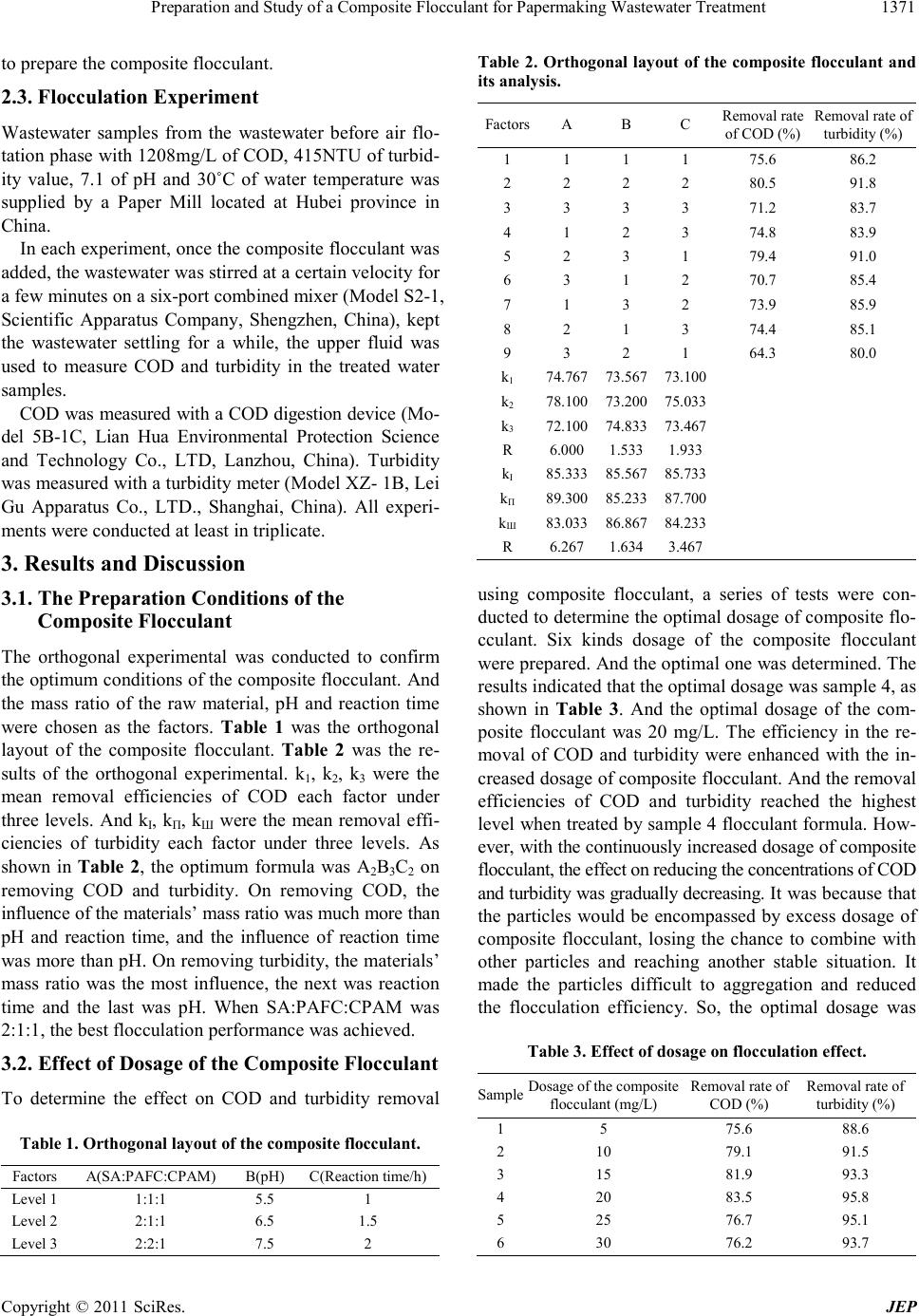 Preparation and Study of a Composite Flocculant for Papermaking Wastewater Treatment1371 to prepare the composite flocculant. 2.3. Flocculation Experiment Wastewater samples from the wastewater before air flo- tation phase with 1208mg/L of COD, 415NTU of turbid- ity value, 7.1 of pH and 30˚C of water temperature was supplied by a Paper Mill located at Hubei province in China. In each experiment, once the composite flocculant was added, the wastewater was stirred at a certain velocity for a few minutes on a six-port combined mixer (Model S2-1, Scientific Apparatus Company, Shengzhen, China), kept the wastewater settling for a while, the upper fluid was used to measure COD and turbidity in the treated water samples. COD was measured with a COD digestion device (Mo- del 5B-1C, Lian Hua Environmental Protection Science and Technology Co., LTD, Lanzhou, China). Turbidity was measured with a turbidity meter (Model XZ- 1B, Lei Gu Apparatus Co., LTD., Shanghai, China). All experi- ments were conducted at least in triplicate. 3. Results and Discussion 3.1. The Preparation Conditions of the Composite Fl occul a nt The orthogonal experimental was conducted to confirm the optimum conditions of the composite flocculant. And the mass ratio of the raw material, pH and reaction time were chosen as the factors. Table 1 was the orthogonal layout of the composite flocculant. Table 2 was the re- sults of the orthogonal experimental. k1, k2, k3 were the mean removal efficiencies of COD each factor under three levels. And kІ, kП, kШ were the mean removal effi- ciencies of turbidity each factor under three levels. As shown in Table 2, the optimum formula was A2B3C2 on removing COD and turbidity. On removing COD, the influence of the materials’ mass ratio was much more than pH and reaction time, and the influence of reaction time was more than pH. On removing turbidity, the materials’ mass ratio was the most influence, the next was reaction time and the last was pH. When SA:PAFC:CPAM was 2:1:1, the best flocculation performance was achieved. 3.2. Effect of Dosage of the Composite Flocculant To determine the effect on COD and turbidity removal Table 1. Orthogonal layout of the composite flocculant. Factors A(SA:PAFC:CPAM) B(pH) C(Reaction time/h) Level 1 1:1:1 5.5 1 Level 2 2:1:1 6.5 1.5 Level 3 2:2:1 7.5 2 Table 2. Orthogonal layout of the composite flocculant and its analysis. FactorsA B C Removal rate of COD (%) Removal rate of turbidity (%) 1 1 1 1 75.6 86.2 2 2 2 2 80.5 91.8 3 3 3 3 71.2 83.7 4 1 2 3 74.8 83.9 5 2 3 1 79.4 91.0 6 3 1 2 70.7 85.4 7 1 3 2 73.9 85.9 8 2 1 3 74.4 85.1 9 3 2 1 64.3 80.0 k1 74.76773.56773.100 k2 78.10073.20075.033 k3 72.10074.83373.467 R 6.0001.5331.933 kІ 85.33385.56785.733 kП 89.30085.23387.700 kШ 83.03386.86784.233 R 6.2671.6343.467 using composite flocculant, a series of tests were con- ducted to determine the optimal dosage of composite flo- cculant. Six kinds dosage of the composite flocculant were prepared. And the optimal one was determined. The results indicated that the optimal dosage was sample 4, as shown in Table 3. And the optimal dosage of the com- posite flocculant was 20 mg/L. The efficiency in the re- moval of COD and turbidity were enhanced with the in- creased dosage of composite flocculant. And the removal efficiencies of COD and turbidity reached the highest level when treated by sample 4 flocculant formula. How- ever, with the continuously increased dosage of composite flocculant, the effect on reducing the concentrations of COD and turbidity was gradually decreasing. It was because that the particles would be encompassed by excess dosage of composite flocculant, losing the chance to combine with other particles and reaching another stable situation. It made the particles difficult to aggregation and reduced the flocculation efficiency. So, the optimal dosage was Table 3. Effect of dos ag e on flocculation effect. Sample Dosage of the composite flocculant (mg/L) Removal rate of COD (%) Removal rate of turbidity (%) 1 5 75.6 88.6 2 10 79.1 91.5 3 15 81.9 93.3 4 20 83.5 95.8 5 25 76.7 95.1 6 30 76.2 93.7 Copyright © 2011 SciRes. JEP 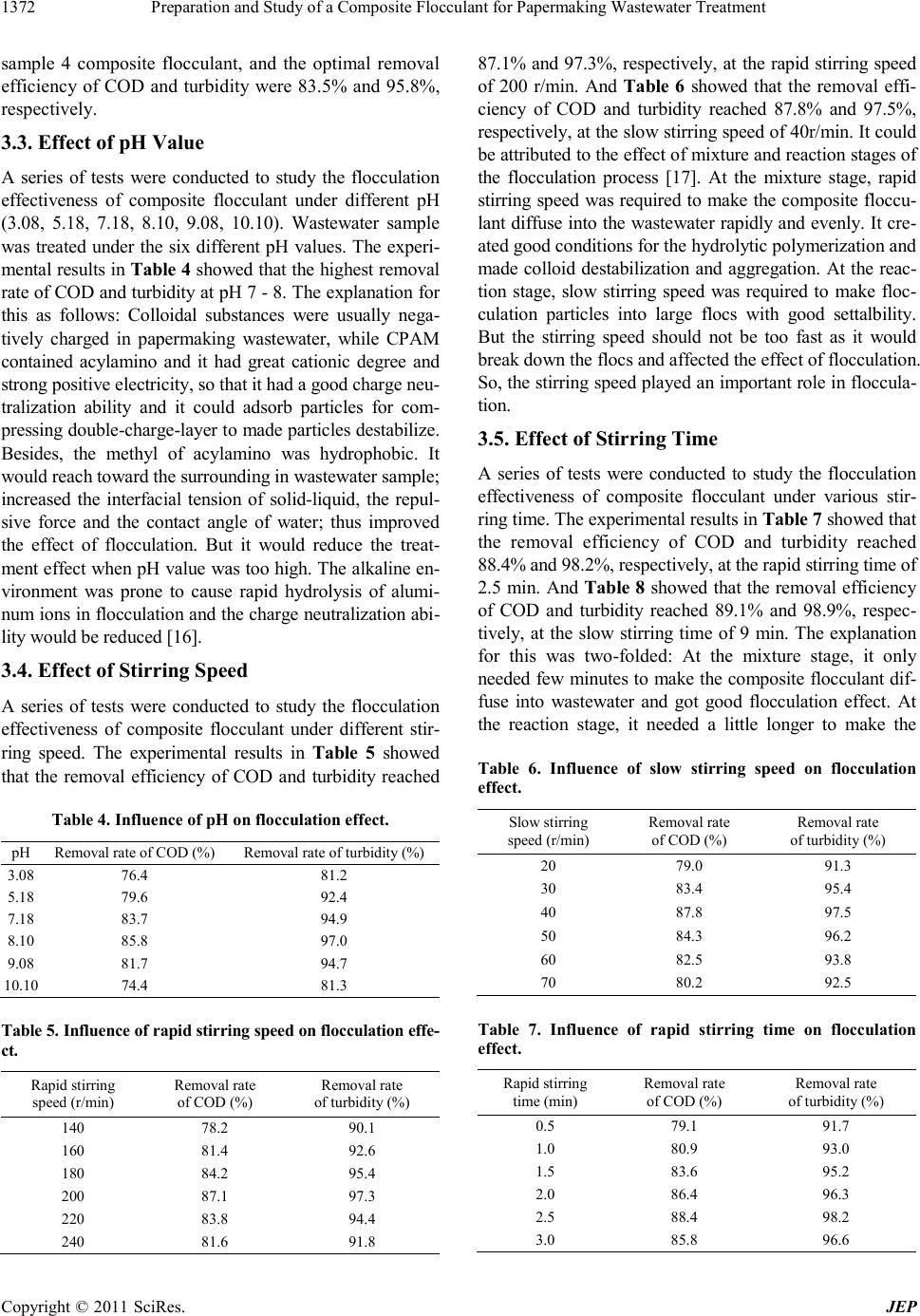 Preparation and Study of a Composite Flocculant for Papermaking Wastewater Treatment 1372 sample 4 composite flocculant, and the optimal removal efficiency of COD and turbidity were 83.5% and 95.8%, respectively. 3.3. Effect of pH Value A series of tests were conducted to study the flocculation effectiveness of composite flocculant under different pH (3.08, 5.18, 7.18, 8.10, 9.08, 10.10). Wastewater sample was treated under the six different pH values. The experi- mental results in Ta ble 4 showed that the highest removal rate of COD and turbidity at pH 7 - 8. The explanation for this as follows: Colloidal substances were usually nega- tively charged in papermaking wastewater, while CPAM contained acylamino and it had great cationic degree and strong positive electricity, so that it had a good charge neu- tralization ability and it could adsorb particles for com- pressing double-charge-layer to made particles destabilize. Besides, the methyl of acylamino was hydrophobic. It would reach toward the surrounding in wastewater sample; increased the interfacial tension of solid-liquid, the repul- sive force and the contact angle of water; thus improved the effect of flocculation. But it would reduce the treat- ment effect when pH value was too high. The alkaline en- vironment was prone to cause rapid hydrolysis of alumi- num ions in flocculation and the charge neutralization abi- lity would be reduced [16]. 3.4. Effect of Stirring Speed A series of tests were conducted to study the flocculation effectiveness of composite flocculant under different stir- ring speed. The experimental results in Table 5 showed that the removal efficiency of COD and turbidity reached Table 4. Influe nce of pH on flocculation effect. pH Removal rate of COD (%) Removal rate of turbidity (%) 3.08 76.4 81.2 5.18 79.6 92.4 7.18 83.7 94.9 8.10 85.8 97.0 9.08 81.7 94.7 10.10 74.4 81.3 Tabl e 5 . Inf l u e nc e of r a pi d s ti r ring sp ee d on f l oc c ul a ti o n ef f e- ct. Rapid stirring speed (r/min) Removal rate of COD (%) Removal rate of turbidity (%) 140 78.2 90.1 160 81.4 92.6 180 84.2 95.4 200 87.1 97.3 220 83.8 94.4 240 81.6 91.8 87.1% and 97.3%, respectively, at the rapid stirring speed of 200 r/min. And Table 6 showed that the removal effi- ciency of COD and turbidity reached 87.8% and 97.5%, respectively, at the slow stirring speed of 40r/min. It could be attributed to the effect of mixture and reaction stages of the flocculation process [17]. At the mixture stage, rapid stirring speed was required to make the composite floccu- lant diffuse into the wastewater rapidly and evenly. It cre- ated good conditions for the hydrolytic polymerization and made colloid destabilization and aggregation. At the reac- tion stage, slow stirring speed was required to make floc- culation particles into large flocs with good settalbility. But the stirring speed should not be too fast as it would break down the flocs and affected the effect of flocculation. So, the stirring speed played an important role in floccula- tion. 3.5. Effect of Stirring Time A series of tests were conducted to study the flocculation effectiveness of composite flocculant under various stir- ring time. The experimental results in Table 7 showed that the removal efficiency of COD and turbidity reached 88.4% and 98.2%, respectively, at the rapid stirring time of 2.5 min. And Table 8 showed that the removal efficiency of COD and turbidity reached 89.1% and 98.9%, respec- tively, at the slow stirring time of 9 min. The explanation for this was two-folded: At the mixture stage, it only needed few minutes to make the composite flocculant dif- fuse into wastewater and got good flocculation effect. At the reaction stage, it needed a little longer to make the Table 6. Influence of slow stirring speed on flocculation effect. Slow stirring speed (r/min) Removal rate of COD (%) Removal rate of turbidity (%) 20 79.0 91.3 30 83.4 95.4 40 87.8 97.5 50 84.3 96.2 60 82.5 93.8 70 80.2 92.5 Table 7. Influence of rapid stirring time on flocculation effect. Rapid stirring time (min) Removal rate of COD (%) Removal rate of turbidity (%) 0.5 79.1 91.7 1.0 80.9 93.0 1.5 83.6 95.2 2.0 86.4 96.3 2.5 88.4 98.2 3.0 85.8 96.6 Copyright © 2011 SciRes. JEP 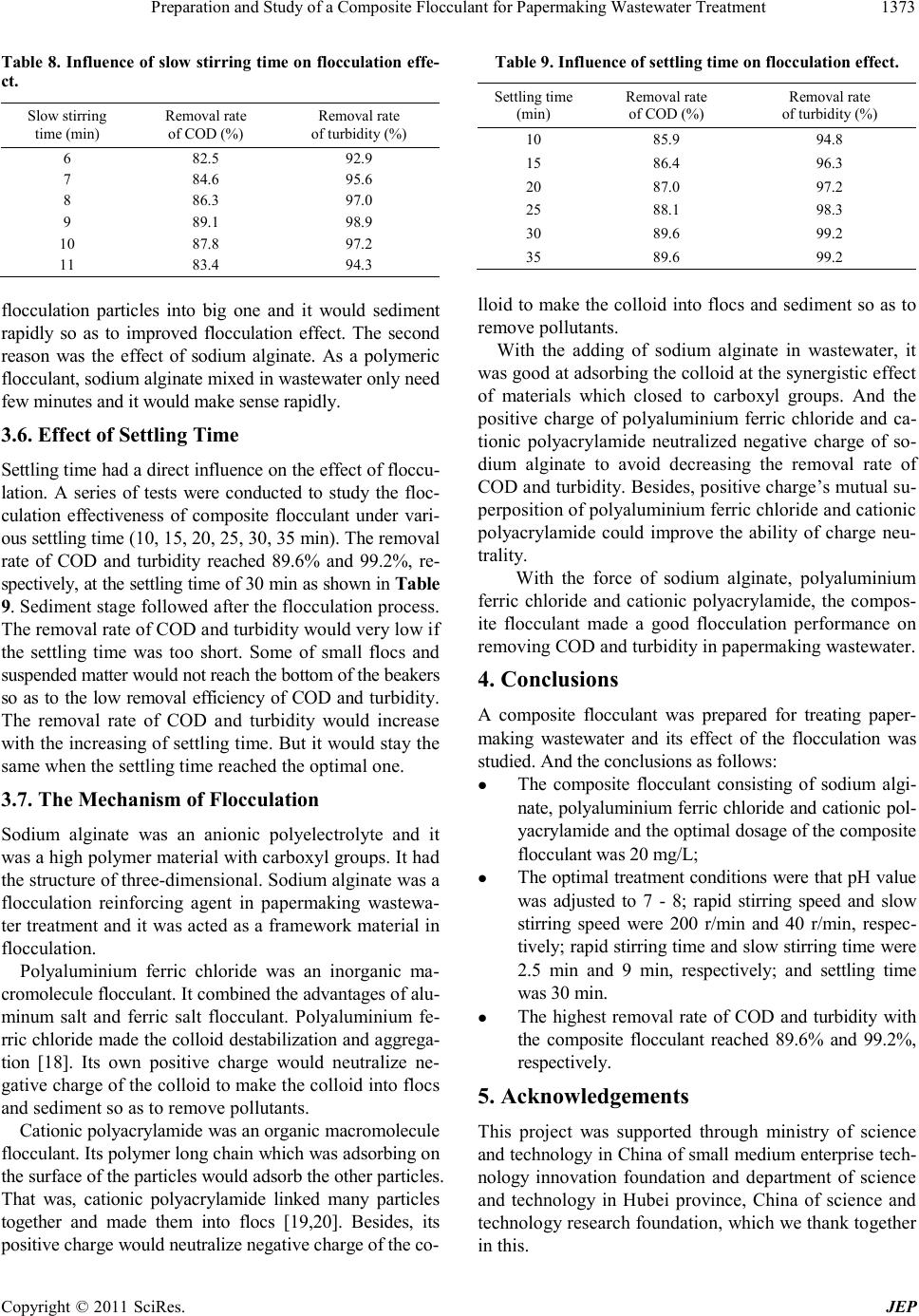 Preparation and Study of a Composite Flocculant for Papermaking Wastewater Treatment1373 Table 8. Influence of slow stirring time on flocculation effe- ct. Slow stirring time (min) Removal rate of COD (%) Removal rate of turbidity (%) 6 82.5 92.9 7 84.6 95.6 8 86.3 97.0 9 89.1 98.9 10 87.8 97.2 11 83.4 94.3 flocculation particles into big one and it would sediment rapidly so as to improved flocculation effect. The second reason was the effect of sodium alginate. As a polymeric flocculant, sodium alginate mixed in wastewater only need few minutes and it would make sense rapidly. 3.6. Effect of Settling Time Settling time had a direct influence on the effect of floccu- lation. A series of tests were conducted to study the floc- culation effectiveness of composite flocculant under vari- ous settling time (10, 15, 20, 25, 30, 35 min). The removal rate of COD and turbidity reached 89.6% and 99.2%, re- spectively, at the settling time of 30 min as shown in Table 9. Sediment stage followed after the flocculation process. The removal rate of COD and turbidity would very low if the settling time was too short. Some of small flocs and suspended matter would not reach the bottom of the beakers so as to the low removal efficiency of COD and turbidity. The removal rate of COD and turbidity would increase with the increasing of settling time. But it would stay the same when the settling time reached the optimal one. 3.7. The Mechanism of Flocculation Sodium alginate was an anionic polyelectrolyte and it was a high polymer material with carboxyl groups. It had the structure of three-dimensional. Sodium alginate was a flocculation reinforcing agent in papermaking wastewa- ter treatment and it was acted as a framework material in flocculation. Polyaluminium ferric chloride was an inorganic ma- cromolecule flocculant. It combined the advantages of alu- minum salt and ferric salt flocculant. Polyaluminium fe- rric chloride made the colloid destabilization and aggrega- tion [18]. Its own positive charge would neutralize ne- gative charge of the colloid to make the colloid into flocs and sediment so as to remove pollutants. Cationic polyacrylamide was an organic macromolecule flocculant. Its polymer long chain which was adsorbing on the surface of the particles would adsorb the other particles. That was, cationic polyacrylamide linked many particles together and made them into flocs [19,20]. Besides, its positive charge would neutralize negative charge of the co- Table 9. Influence of settling time on flocculation effect. Settling time (min) Removal rate of COD (%) Removal rate of turbidity (%) 10 85.9 94.8 15 86.4 96.3 20 87.0 97.2 25 88.1 98.3 30 89.6 99.2 35 89.6 99.2 lloid to make the colloid into flocs and sediment so as to remove pollutants. With the adding of sodium alginate in wastewater, it was good at adsorbing the colloid at the synergistic effect of materials which closed to carboxyl groups. And the positive charge of polyaluminium ferric chloride and ca- tionic polyacrylamide neutralized negative charge of so- dium alginate to avoid decreasing the removal rate of COD and turbidity. Besides, positive charge’s mutual su- perposition of polyaluminium ferric chloride and cationic polyacrylamide could improve the ability of charge neu- trality. With the force of sodium alginate, polyaluminium ferric chloride and cationic polyacrylamide, the compos- ite flocculant made a good flocculation performance on removing COD and turbidity in papermaking wastewater. 4. Conclusions A composite flocculant was prepared for treating paper- making wastewater and its effect of the flocculation was studied. And the conclusions as follows: The composite flocculant consisting of sodium algi- nate, polyaluminium ferric chloride and cationic pol- yacrylamide and the optimal dosage of the composite flocculant was 20 mg/L; The optimal treatment conditions were that pH value was adjusted to 7 - 8; rapid stirring speed and slow stirring speed were 200 r/min and 40 r/min, respec- tively; rapid stirring time and slow stirring time were 2.5 min and 9 min, respectively; and settling time was 30 min. The highest removal rate of COD and turbidity with the composite flocculant reached 89.6% and 99.2%, respectively. 5. Acknowledgements This project was supported through ministry of science and technology in China of small medium enterprise tech- nology innovation foundation and department of science and technology in Hubei province, China of science and technology research foundation, which we thank together in this. Copyright © 2011 SciRes. JEP  Preparation and Study of a Composite Flocculant for Papermaking Wastewater Treatment Copyright © 2011 SciRes. JEP 1374 REFERENCES [1] H. L.Wang, G. S. Liu, P. Li and F. Pan, “The Effect of Bioaugmentation on the Performance of Sequencing Ba- tch Reactor and Sludge Characteristics in the Treatment Process of Papermaking Wastewater,” Bioprocess and Biosystems Engineering, Vol. 29, No. 5-6, 2006, pp. 283- 289. doi:10.1007/s00449-006-0077-9 [2] Y. Matsushita, A. Iwatsuki and S. Yasuda, “Application of Cationic Polymer Prepared from Sulfuric Acid Lignin as a Retention Aid for Usual Rosin Sizes to Neutral Pa- permaking,” The Japan Wood Research Society, Vol. 50, No. 6, 2004, pp. 540-544. do i:10. 1007/ s 10086-003-0602-2 [3] V. C. Srivastava, I. D. Mall and I. M. Mishra, “Treatment of Pulp and Paper Mill Wastewater with Polyaluminium Chloride and Bagasse Fly Ash,” Colloids and Surfaces A: Physicochemical and Engineering Aspects, Vol. 260, No. 1-3, 2005, pp. 17-28. doi:10.1016/j.colsurfa.2005.02.027 [4] X. W. Yang, Y. D. Shen and P. Z. Li, “ Intrinsic Viscos- ity, Surface Activity, and Flocculation of Cationic Poly- acrylamide Modified with Fluorinated Acrylate,” Polymer Bulletin, Vol. 65, No. 2, 2010, pp. 111-122. do i:10. 1007/ s 00289-009-0186-0 [5] B. R. Sharma, N. C. Dhuldhoya and U. C. Merchant, “Flo- cculants—An Ecofriendly Approach,” Journal of Poly- mers and the Environment, Vol. 14, No. 2, 2006, pp. 195- 202. doi:10.1007/s10924-006-0011-x [6] T. A. Becker, D. R. Kipke and T. Brandon, “Calcium Alginate Gel: A Biocompatible and Mechanically Stable Polymer for Endovascular Embolization,” Journal of Bio- medical Materials Research, Vol. 54, No. 1, 2001, pp. 76- 86. doi:10.1002/1097-4636(200101) [7] S. Martins, B. Sarmento, E. B. Souto and D. C. Ferreira, “Insulin-Loaded Alginate Microspheres for Oral Delivery- Effect of Polysaccharide Reinforcement on Physicochemi- cal Properties and Release Profile,” Carbohydrate Poly- mers, Vol. 69, No. 4, 2007, pp. 725-731. doi:10.1016/j.carbpol.2007.02.012 [8] X. J. Huang, Y. Xiao and M. D. Lang, “Micelles/Sodium- Alginate Composite Gel Beads: A New Matrix for Oral Drug Delivery of Indomethacin,” Carbohydrate Polymers, Vol. 87, No. 1, 2012, pp. 790-798. do i :10.1016/ j.carbpol .2011.08. 067 [9] L. H. Fan, X. R. Pan, Y. Zhou, L. Y. Chen, W. G. Xie, Z. H. Long and H. Zheng, “Preparation and Characterization of Crosslinked Carboxymethyl Chitosan-Oxidized So- dium Alginate Hydrogels,” Journal of Applied Polymer Science, Vol. 122, 2011, pp. 2331-2337. doi:10.1002/app.34041 [10] S. R. V. Tomme, G. Storm and W. E. Hennink, “In Situ Gelling Hydrogels for Pharmaceutical and Biomedical Ap- plications,” International Journal of Pharmaceutics, Vol. 355, No. 1, 2008, pp. 1-18. doi:10.1016/j.ijpharm.2008.01.057 [11] H. X. Liu, C. Y. Wang, Q. X. Gao, X. X. Liu and Z. Tong, “Fabrication of novel Core-Shell Hybrid Alginate Hy- drogel Beads,” International Journal of Pharmaceutics, Vol. 351, No. 1, 2008, pp. 104-112. doi:10.1016/j.ijpharm.2007.09.019 [12] A. Shilpa, S. S. Agrawal and A. R. Ray, “Controlled De- livery of Drugs from Alginate Matrix,” Journal of Mac- romolecular Science Part C-Polymer Review, Vol. 43, No. 2, 2003, pp. 187-221. doi:10.1081/MC-120020160 [13] Y. H. Li, X. L. Li and W. H. Li, “Study on Polyalumin- ium Ferric Chloride for Treating Papermaking Wastewa- ter and Regeneration,” North Environment, China, No. 4, 2002, pp. 67-69. [14] S. S. Wong, T. T. Teng, A. L. Ahmad, A. Zuhairi and G. Najafpour, “Treatment of Pulp and Paper Mill Wastewa- ter by Polyacrylamide in Polymer Induced Flocculation,” Journal of Hazardous Materials B, Vol. 135, No. 1-3, 2006, pp. 378-388. doi:10.1016/j.jhazmat.2005.11.076 [15] M. I. Aguilar, J. Sáez, M. Lloréns, A. Soler, J. F. Ortuño, V. Meseguer and A. Fuentes, “Improvement of Coagula- tion-Flocculation Process Using Anionic Polyacrylamide as Coagulant Aid,” Chemosphere, Vol. 58, No. 1, 2005, pp. 47-56. doi:10.1016/j.chemosphere.2004.09.008 [16] N. Carlos, M. S. Luis and F. Elena, “Polyacrylamide In- duced Floccluation of a Cement Ssuspension,” Chemical Engineering Science, Vol. 61, No. 8, 2006, pp. 2522-2532. do i :10.1016/ j.ces.2005.11.013 [17] J. Nan, W. P. He, J. J. Song and G. B. Li, “Characteristics of the Dynamic Distribution of Suspended Particles in the Flocculation Process,” Journal of Zhejiang University Sci- ence A, Vol. 10, No. 9, 2009, pp. 1350-1358. doi:10.1631/jzus.A0820652 [18] M. A. A. Razali, Z. Ahmad, M. S. B. Ahmad and A. Arif- fin, “Treatment of Pulp and Paper Mill Wastewater with Various Molecular Weight of PolyDADMAC Induced Flo- cculation,” Chemical Engineering Journal, Vol. 166, No. 2, 2011, pp. 529-535. doi:10.1016/j.ces.2010.11.011 [19] P. Peng and G. Garnier, “Effect of Cationic Polyacryla- mide Adsorption Kinetics and Lonic Strength on Precipi- tated Calcium Carbonate Flocculation,” Langmuir, Vol. 26, No. 22, 2010, pp. 16949-16957. do i:10. 1021/ la103410j [20] Z. Liang and Y. X. Wang, “Pretreatment of Diosgenin Wastewater Using Polyferric Sulfate and Cationic Polya- crylamide,” Journal of Earth Science, Vol. 21, No. 3, 2010, pp. 340-360. doi:10.1007/s12583-010-0097-x |