

Paper Menu >>
Journal Menu >>
 Materials Sciences and Applicatio ns, 2011, 2, 1702-1707 doi:10.4236/msa.2011.212227 Published Online December 2011 (http://www.SciRP.org/journal/msa) Copyright © 2011 SciRes. MSA Effect of PEDOT:PSS Layer and ITO Ozonization in Arylenevinylene-co-Pyrrolenevinylene (AVPV) Based Solar Cell Devices Ankur Solanki1,2, S. Sundar Kumar Iyer2,3, Ashish Garg1,2 1Department of Materials Science & Engineering, Indian Institute of Technology, Kanpur, India; 2Samtel Center for Display Tech- nologies, Indian Institute of Technology, Kanpur, India; 3Departmental of Electrical Engineering, Indian Institute of Technology, Kanpur, India. E-mail: [email protected] Received September 26th, 2011; revised November 1st, 2011; accepted November 17th, 2011. ABSTRACT Arylenevinylene-co-pyrrolenevinylene (AVPV) is polymer oligomer system derived from arylbridged bispyrroles which has been explored for photovoltaic devices. In this paper, we show the dependence of the photovoltaic device parame- ters on the anode surface treatment in an organic single layer photovoltaic device based on AVPV as an electron donor . Since the total quantum efficien cy includes the charge collection efficien cy at the electrodes, experiments were carried out to vary the anode (ITO) characteristics, achieved by using ITO with or without ozonization and with or without PEDOT:PSS (Polyethylene dioxythiophene:Polystyrene sulphonic acid) layer. Devices fabricated on ITO anode (with- out ozonization and without PEDOT:PSS) exhibited the maximum current density (Jsc = 1.3 µA·cm–2) as compared to those devices where ITO was ozonized as well as had a PEDOT:PSS layer (Jsc = 0.1 µA·cm–2) measured under 1 sun illumination of AM 1.5 through a calibrated solar simulator. Keywords: AVPV, Organic Poly mers, Ozonization, PEDOT:PSS, Organic Solar Cells 1. Introduction Photovoltaic solar cells based on organic compounds are promising candidates for solar energy conversion. They have the potential for cost effectiveness, mechanical flexibility and easy processing [1-3]. However, in order to compete with the inorganic thin film solar cells, power conversion efficiencies of more than 10% must be achieved. While current research efforts have led to the efficiencies above 8% [4] There is a lack of certainty on the maximum achievable efficiencies and concerns on the device reliability and environmental stability of the organic solar cells (OSC) [5,6]. Moreover, for large area solar cell devices, development of materials which are environment friendly and manufacturing processes which are ecologically favourable is required. As reviewed by Gunes et al., [7] a variety of polymers have been used to fabricate the organic solar cells and the results are dependent on the energy band alignment of the polymers with respect to other layers in the device. The internal power conversion efficiency of organic solar cell is mainly a product of five factors viz., 1) absorption efficiency, 2) exciton diffusion efficiency, 3) exciton dissociation efficiency, 4) charge transport efficiency and 5) charge collection efficiency [8,9]. It can be easily es- timated that the polymers having low band gap (<2 eV) absorb the light in the visible range (300 nm - 700 nm) of solar spectrum. Since the first report of low band gap conjugated polymer, polyisothianaphthene (PITN) [10], much work has been carried out to prepare polymers with low band gap energy [11,12]. Low band gap conjugated polymers may have higher conductivity (carrier mobility) and therefore offer potential applications in transistors, transparent conductors, non-linear optical devices and smart windows. In addition, stability of the active layer and rapid deg- radation of properties has been a major concern for OSC devices especially under light illumination and simulta- neous exposure to oxygen or water vapor and an under- standing of these aspects is crucial for fabricating long lasting devices. Degradation of organic solar cells device can occur due to various mechanisms such as diffusion of oxygen and moisture resulting in active layer and elec- trode degradation as reviewed by Jorgensen et al. [13]. 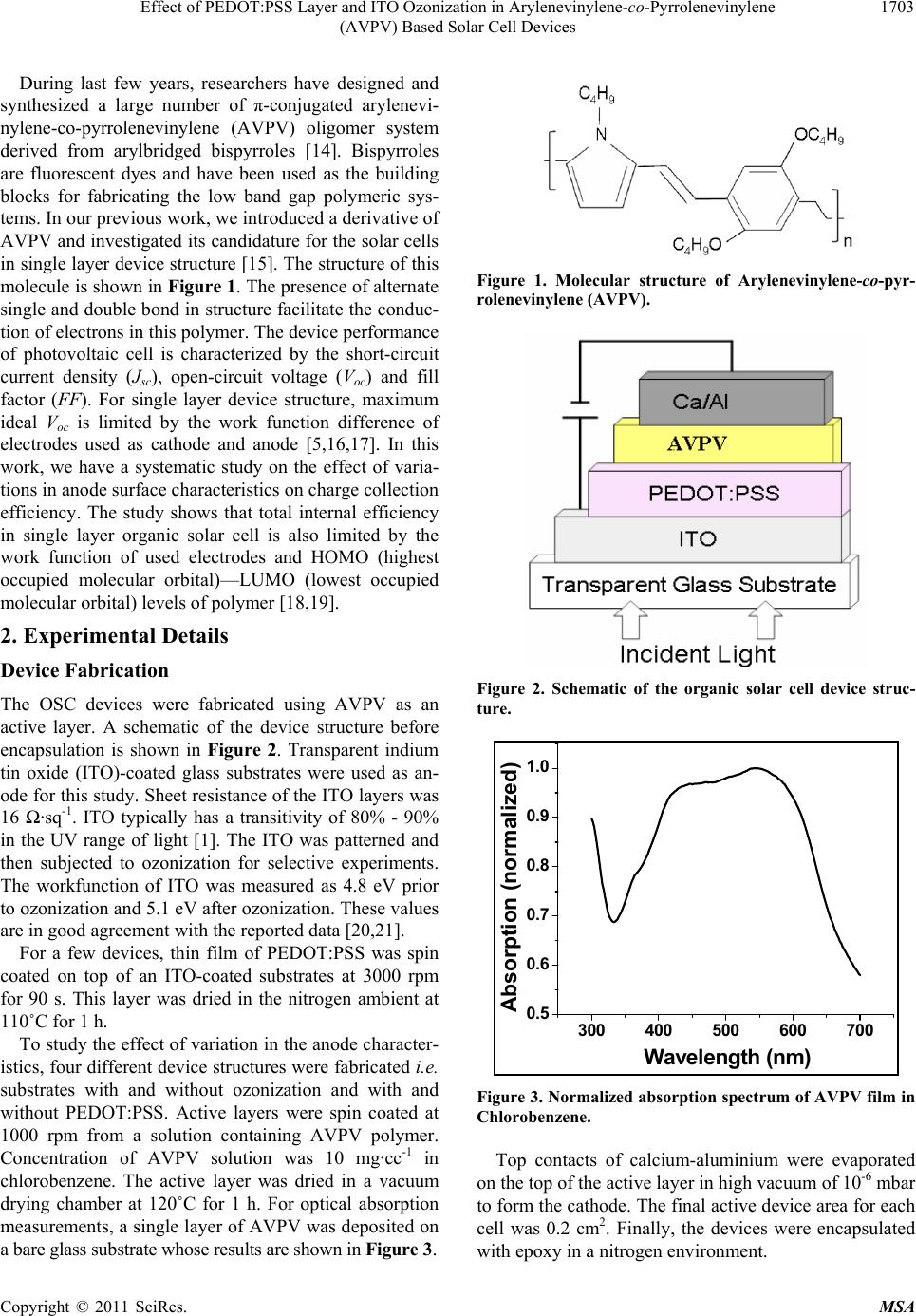 Effect of PEDOT:PSS Layer and ITO Ozonization in Arylenevinylene-co-Pyrrolenevinylene 1703 (AVPV) Based Solar Cell Devices During last few years, researchers have designed and synthesized a large number of π-conjugated arylenevi- nylene-co-pyrrolenevinylene (AVPV) oligomer system derived from arylbridged bispyrroles [14]. Bispyrroles are fluorescent dyes and have been used as the building blocks for fabricating the low band gap polymeric sys- tems. In our previous work, we introduced a derivative of AVPV and investigated its candidature for the solar cells in single layer device structure [15]. The structure of this molecule is shown in Figure 1. The presence of alternate single and double bond in structure facilitate the conduc- tion of electrons in this polymer. The device performance of photovoltaic cell is characterized by the short-circuit current density (Jsc), open-circuit voltage (Voc) and fill factor (FF). For single layer device structure, maximum ideal Voc is limited by the work function difference of electrodes used as cathode and anode [5,16,17]. In this work, we have a systematic study on the effect of varia- tions in anode surface characteristics on charge collection efficiency. The study shows that total internal efficiency in single layer organic solar cell is also limited by the work function of used electrodes and HOMO (highest occupied molecular orbital)—LUMO (lowest occupied molecular orbital) levels of polymer [18,19]. 2. Experimental Details Device Fabrication The OSC devices were fabricated using AVPV as an active layer. A schematic of the device structure before encapsulation is shown in Figure 2. Transparent indium tin oxide (ITO)-coated glass substrates were used as an- ode for this study. Sheet resistance of the ITO layers was 16 Ω·sq-1. ITO typically has a transitivity of 80% - 90% in the UV range of light [1]. The ITO was patterned and then subjected to ozonization for selective experiments. The workfunction of ITO was measured as 4.8 eV prior to ozonization and 5.1 eV after ozonization. These values are in good agreement with the reported data [20,21]. For a few devices, thin film of PEDOT:PSS was spin coated on top of an ITO-coated substrates at 3000 rpm for 90 s. This layer was dried in the nitrogen ambient at 110˚C for 1 h. To study the effect of variation in the anode character- istics, four different device structures were fabricated i.e. substrates with and without ozonization and with and without PEDOT:PSS. Active layers were spin coated at 1000 rpm from a solution containing AVPV polymer. Concentration of AVPV solution was 10 mg·cc-1 in chlorobenzene. The active layer was dried in a vacuum drying chamber at 120˚C for 1 h. For optical absorption measurements, a single layer of AVPV was deposited on a bare glass substrate whose results are shown in Figure 3. Figure 1. Molecular structure of Arylenevinylene-co-pyr- rolenevinyle ne (AVPV). Figure 2. Schematic of the organic solar cell device struc- ture. 300 400 500 600 700 0.5 0.6 0.7 0.8 0.9 1.0 Absorption (normalized) Wavelength (nm) Figure 3. Normalized absorption spectrum of AVPV film in Chlorobenzene. Top contacts of calcium-aluminium were evaporated on the top of the active layer in high vacuum of 10-6 mbar to form the cathode. The final active device area for each cell was 0.2 cm2. Finally, the devices were encapsulated with epoxy in a nitrogen environment. Copyright © 2011 SciRes. MSA 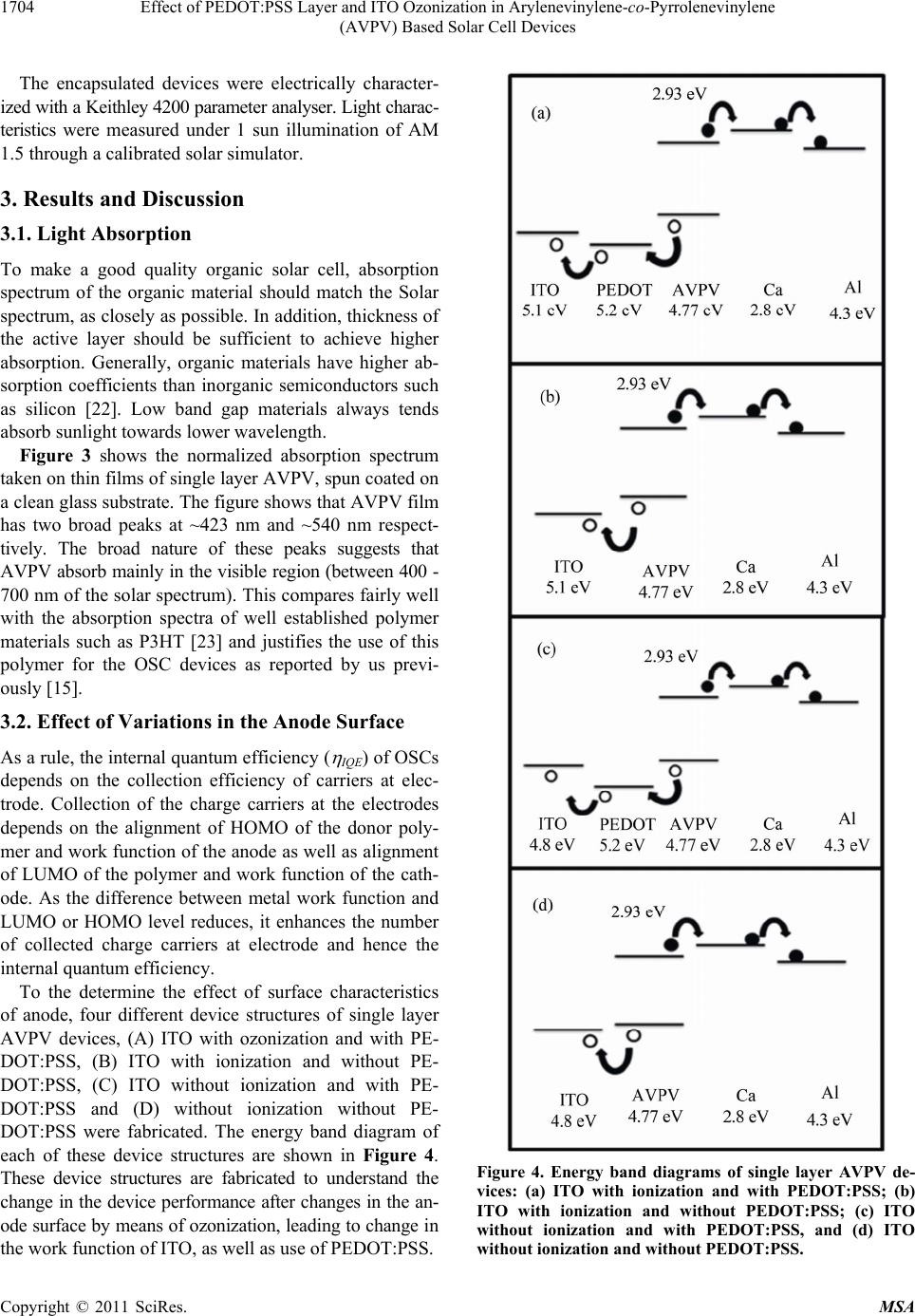 Effect of PEDOT:PSS Layer and ITO Ozonization in Arylenevinylene-co-Pyrrolenevinylene 1704 (AVPV) Based Solar Cell Devices The encapsulated devices were electrically character- ized with a Keithley 4200 parameter analyser. Light charac- teristics were measured under 1 sun illumination of AM 1.5 through a calibrated solar simulator. 3. Results and Discussion 3.1. Light Absorption To make a good quality organic solar cell, absorption spectrum of the organic material should match the Solar spectrum, as closely as possible. In addition, thickness of the active layer should be sufficient to achieve higher absorption. Generally, organic materials have higher ab- sorption coefficients than inorganic semiconductors such as silicon [22]. Low band gap materials always tends absorb sunlight towards lower wavelength. Figure 3 shows the normalized absorption spectrum taken on thin films of single layer AVPV, spun coated on a clean glass substrate. The figure shows that AVPV film has two broad peaks at ~423 nm and ~540 nm respect- tively. The broad nature of these peaks suggests that AVPV absorb mainly in the visible region (between 400 - 700 nm of the solar spectrum). This compares fairly well with the absorption spectra of well established polymer materials such as P3HT [23] and justifies the use of this polymer for the OSC devices as reported by us previ- ously [15]. 3.2. Effect of Variations in the Anode Surface As a rule, the internal quantum efficiency ( IQE) of OSCs depends on the collection efficiency of carriers at elec- trode. Collection of the charge carriers at the electrodes depends on the alignment of HOMO of the donor poly- mer and work function of the anode as well as alignment of LUMO of the polymer and work function of the cath- ode. As the difference between metal work function and LUMO or HOMO level reduces, it enhances the number of collected charge carriers at electrode and hence the internal quantum efficiency. To the determine the effect of surface characteristics of anode, four different device structures of single layer AVPV devices, (A) ITO with ozonization and with PE- DOT:PSS, (B) ITO with ionization and without PE- DOT:PSS, (C) ITO without ionization and with PE- DOT:PSS and (D) without ionization without PE- DOT:PSS were fabricated. The energy band diagram of each of these device structures are shown in Figure 4. These device structures are fabricated to understand the change in the device performance after changes in the an- ode surface by means of ozonization, leading to change in the work function of ITO, as well as use of PEDOT:PSS. Figure 4. Energy band diagrams of single layer AVPV de- vices: (a) ITO with ionization and with PEDOT:PSS; (b) ITO with ionization and without PEDOT:PSS; (c) ITO without ionization and with PEDOT:PSS, and (d) ITO without ionization and without PEDOT:PSS. Copyright © 2011 SciRes. MSA 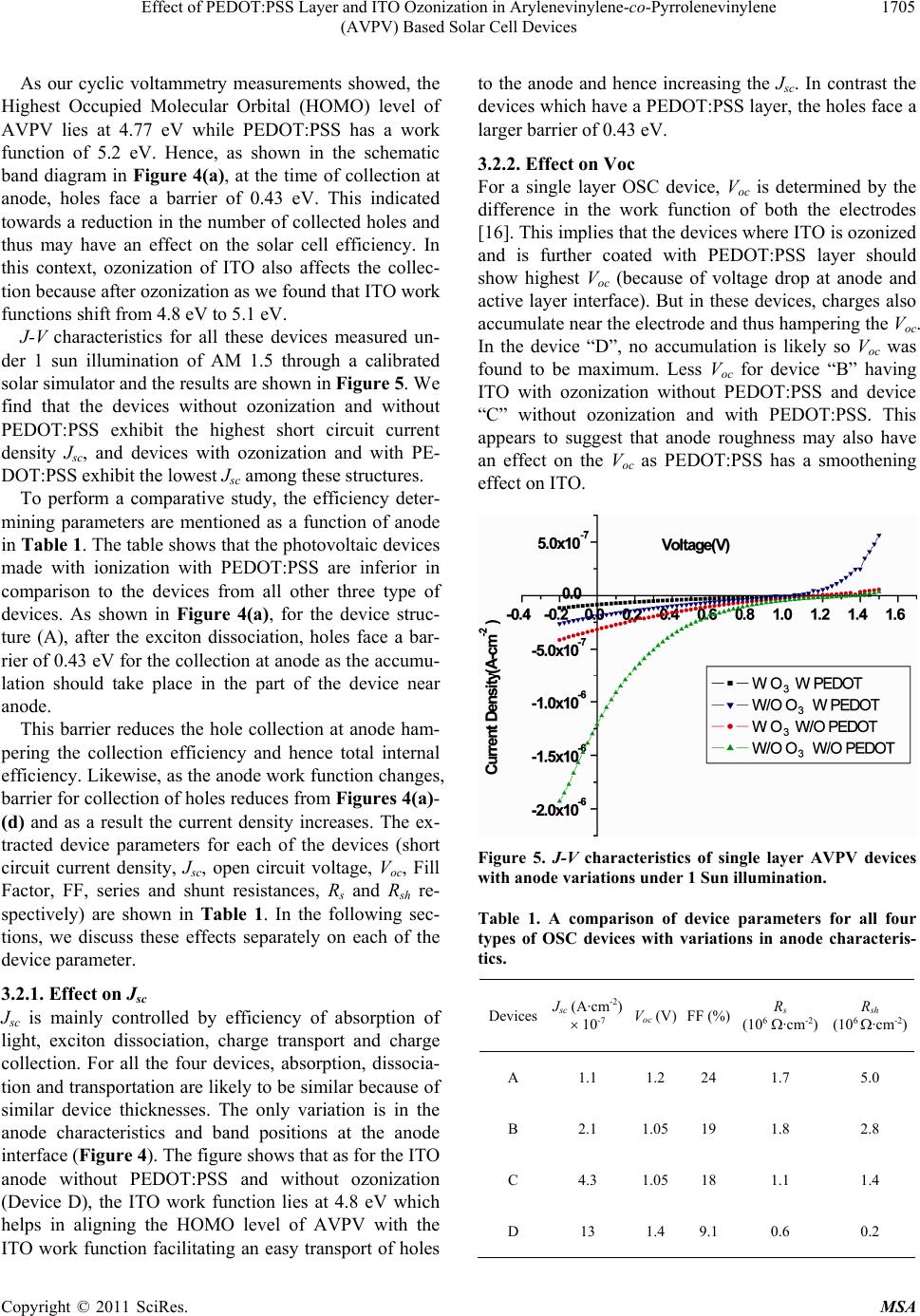 Effect of PEDOT:PSS Layer and ITO Ozonization in Arylenevinylene-co-Pyrrolenevinylene 1705 (AVPV) Based Solar Cell Devices As our cyclic voltammetry measurements showed, the Highest Occupied Molecular Orbital (HOMO) level of AVPV lies at 4.77 eV while PEDOT:PSS has a work function of 5.2 eV. Hence, as shown in the schematic band diagram in Figure 4(a), at the time of collection at anode, holes face a barrier of 0.43 eV. This indicated towards a reduction in the number of collected holes and thus may have an effect on the solar cell efficiency. In this context, ozonization of ITO also affects the collec- tion because after ozonization as we found that ITO work functions shift from 4.8 eV to 5.1 eV. J-V characteristics for all these devices measured un- der 1 sun illumination of AM 1.5 through a calibrated solar simulator and the results are shown in Figure 5. We find that the devices without ozonization and without PEDOT:PSS exhibit the highest short circuit current density Jsc, and devices with ozonization and with PE- DOT:PSS exhibit the lowest Jsc among these structures. To perform a comparative study, the efficiency deter- mining parameters are mentioned as a function of anode in Table 1. The table shows that the photovoltaic devices made with ionization with PEDOT:PSS are inferior in comparison to the devices from all other three type of devices. As shown in Figure 4(a), for the device struc- ture (A), after the exciton dissociation, holes face a bar- rier of 0.43 eV for the collection at anode as the accumu- lation should take place in the part of the device near anode. This barrier reduces the hole collection at anode ham- pering the collection efficiency and hence total internal efficiency. Likewise, as the anode work function changes, barrier for collection of holes reduces from Figures 4(a)- (d) and as a result the current density increases. The ex- tracted device parameters for each of the devices (short circuit current density, Jsc, open circuit voltage, Voc, Fill Factor, FF, series and shunt resistances, Rs and Rsh re- spectively) are shown in Table 1. In the following sec- tions, we discuss these effects separately on each of the device parameter. 3.2.1. Effect on Jsc Jsc is mainly controlled by efficiency of absorption of light, exciton dissociation, charge transport and charge collection. For all the four devices, absorption, dissocia- tion and transportation are likely to be similar because of similar device thicknesses. The only variation is in the anode characteristics and band positions at the anode interface (Figure 4). The figure shows that as for the ITO anode without PEDOT:PSS and without ozonization (Device D), the ITO work function lies at 4.8 eV which helps in aligning the HOMO level of AVPV with the ITO work function facilitating an easy transport of holes to the anode and hence increasing the Jsc. In contrast the devices which have a PEDOT:PSS layer, the holes face a larger barrier of 0.43 eV. 3.2.2. Effect on Voc For a single layer OSC device, Voc is determined by the difference in the work function of both the electrodes [16]. This implies that the devices where ITO is ozonized and is further coated with PEDOT:PSS layer should show highest Voc (because of voltage drop at anode and active layer interface). But in these devices, charges also accumulate near the electrode and thus hampering the Voc. In the device “D”, no accumulation is likely so Voc was found to be maximum. Less Voc for device “B” having ITO with ozonization without PEDOT:PSS and device “C” without ozonization and with PEDOT:PSS. This appears to suggest that anode roughness may also have an effect on the Voc as PEDOT:PSS has a smoothening effect on ITO. Figure 5. J-V characteristics of single layer AVPV devices with anode variations under 1 Sun illumination. Table 1. A comparison of device parameters for all four types of OSC devices with variations in anode characteris- tics. Devices Jsc (A·cm-2) 10-7 Voc (V)FF (%) Rs (106 ·cm-2) Rsh (106 ·cm-2) A 1.1 1.2 24 1.7 5.0 B 2.1 1.0519 1.8 2.8 C 4.3 1.0518 1.1 1.4 D 13 1.4 9.1 0.6 0.2 Copyright © 2011 SciRes. MSA 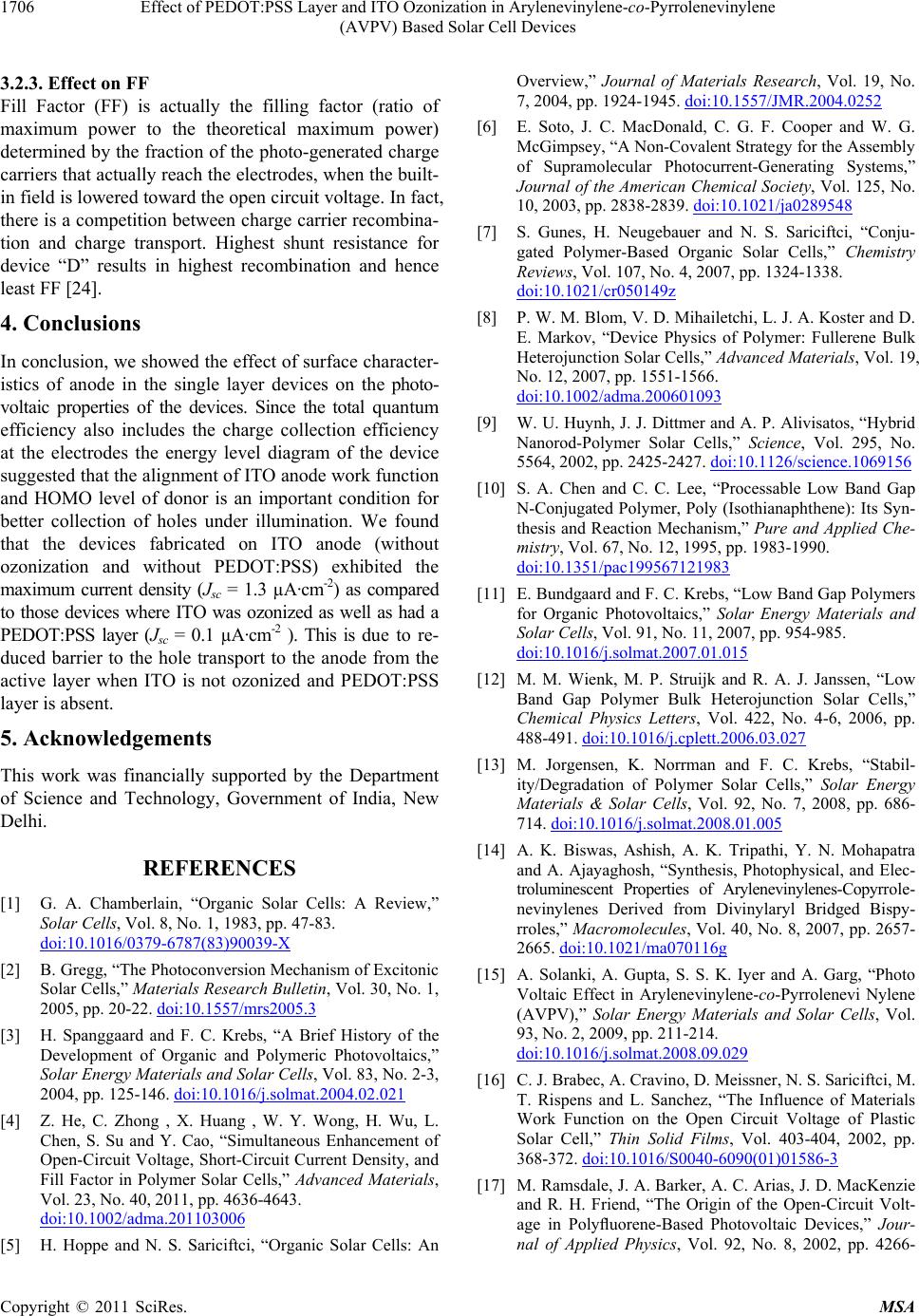 Effect of PEDOT:PSS Layer and ITO Ozonization in Arylenevinylene-co-Pyrrolenevinylene 1706 (AVPV) Based Solar Cell Devices 3.2.3. Effect on FF Fill Factor (FF) is actually the filling factor (ratio of maximum power to the theoretical maximum power) determined by the fraction of the photo-generated charge carriers that actually reach the electrodes, when the built- in field is lowered toward the open circuit voltage. In fact, there is a competition between charge carrier recombina- tion and charge transport. Highest shunt resistance for device “D” results in highest recombination and hence least FF [24]. 4. Conclusions In conclusion, we showed the effect of surface character- istics of anode in the single layer devices on the photo- voltaic properties of the devices. Since the total quantum efficiency also includes the charge collection efficiency at the electrodes the energy level diagram of the device suggested that the alignment of ITO anode work function and HOMO level of donor is an important condition for better collection of holes under illumination. We found that the devices fabricated on ITO anode (without ozonization and without PEDOT:PSS) exhibited the maximum current density (Jsc = 1.3 µA·cm-2) as compared to those devices where ITO was ozonized as well as had a PEDOT:PSS layer (Jsc = 0.1 µA·cm-2 ). This is due to re- duced barrier to the hole transport to the anode from the active layer when ITO is not ozonized and PEDOT:PSS layer is absent. 5. Acknowledgements This work was financially supported by the Department of Science and Technology, Government of India, New Delhi. REFERENCES [1] G. A. Chamberlain, “Organic Solar Cells: A Review,” Solar Cells, Vol. 8, No. 1, 1983, pp. 47-83. doi:10.1016/0379-6787(83)90039-X [2] B. Gregg, “The Photoconversion Mechanism of Excitonic Solar Cells,” Materials Research Bulletin, Vol. 30, No. 1, 2005, pp. 20-22. doi:10.1557/mrs2005.3 [3] H. Spanggaard and F. C. Krebs, “A Brief History of the Development of Organic and Polymeric Photovoltaics,” Solar Energy Materials and Solar Cells, Vol. 83, No. 2-3, 2004, pp. 125-146. doi:10.1016/j.solmat.2004.02.021 [4] Z. He, C. Zhong , X. Huang , W. Y. Wong, H. Wu, L. Chen, S. Su and Y. Cao, “Simultaneous Enhancement of Open-Circuit Voltage, Short-Circuit Current Density, and Fill Factor in Polymer Solar Cells,” Advanced Materials, Vol. 23, No. 40, 2011, pp. 4636-4643. doi:10.1002/adma.201103006 [5] H. Hoppe and N. S. Sariciftci, “Organic Solar Cells: An Overview,” Journal of Materials Research, Vol. 19, No. 7, 2004, pp. 1924-1945. doi:10.1557/JMR.2004.0252 [6] E. Soto, J. C. MacDonald, C. G. F. Cooper and W. G. McGimpsey, “A Non-Covalent Strategy for the Assembly of Supramolecular Photocurrent-Generating Systems,” Journal of the American Chemical Society, Vol. 125, No. 10, 2003, pp. 2838-2839. doi:10.1021/ja0289548 [7] S. Gunes, H. Neugebauer and N. S. Sariciftci, “Conju- gated Polymer-Based Organic Solar Cells,” Chemistry Reviews, Vol. 107, No. 4, 2007, pp. 1324-1338. doi:10.1021/cr050149z [8] P. W. M. Blom, V. D. Mihailetchi, L. J. A. Koster and D. E. Markov, “Device Physics of Polymer: Fullerene Bulk Heterojunction Solar Cells,” Advanced Materials, Vol. 19, No. 12, 2007, pp. 1551-1566. doi:10.1002/adma.200601093 [9] W. U. Huynh, J. J. Dittmer and A. P. Alivisatos, “Hybrid Nanorod-Polymer Solar Cells,” Science, Vol. 295, No. 5564, 2002, pp. 2425-2427. doi:10.1126/science.1069156 [10] S. A. Chen and C. C. Lee, “Processable Low Band Gap N-Conjugated Polymer, Poly (Isothianaphthene): Its Syn- thesis and Reaction Mechanism,” Pure and Applied Che- mistry, Vol. 67, No. 12, 1995, pp. 1983-1990. doi:10.1351/pac199567121983 [11] E. Bundgaard and F. C. Krebs, “Low Band Gap Polymers for Organic Photovoltaics,” Solar Energy Materials and Solar Cells, Vol. 91, No. 11, 2007, pp. 954-985. doi:10.1016/j.solmat.2007.01.015 [12] M. M. Wienk, M. P. Struijk and R. A. J. Janssen, “Low Band Gap Polymer Bulk Heterojunction Solar Cells,” Chemical Physics Letters, Vol. 422, No. 4-6, 2006, pp. 488-491. doi:10.1016/j.cplett.2006.03.027 [13] M. Jorgensen, K. Norrman and F. C. Krebs, “Stabil- ity/Degradation of Polymer Solar Cells,” Solar Energy Materials & Solar Cells, Vol. 92, No. 7, 2008, pp. 686- 714. doi:10.1016/j.solmat.2008.01.005 [14] A. K. Biswas, Ashish, A. K. Tripathi, Y. N. Mohapatra and A. Ajayaghosh, “Synthesis, Photophysical, and Elec- troluminescent Properties of Arylenevinylenes-Copyrrole- nevinylenes Derived from Divinylaryl Bridged Bispy- rroles,” Macromolecules, Vol. 40, No. 8, 2007, pp. 2657- 2665. doi:10.1021/ma070116g [15] A. Solanki, A. Gupta, S. S. K. Iyer and A. Garg, “Photo Voltaic Effect in Arylenevinylene-co-Pyrrolenevi Nylene (AVPV),” Solar Energy Materials and Solar Cells, Vol. 93, No. 2, 2009, pp. 211-214. doi:10.1016/j.solmat.2008.09.029 [16] C. J. Brabec, A. Cravino, D. Meissner, N. S. Sariciftci, M. T. Rispens and L. Sanchez, “The Influence of Materials Work Function on the Open Circuit Voltage of Plastic Solar Cell,” Thin Solid Films, Vol. 403-404, 2002, pp. 368-372. doi:10.1016/S0040-6090(01)01586-3 [17] M. Ramsdale, J. A. Barker, A. C. Arias, J. D. MacKenzie and R. H. Friend, “The Origin of the Open-Circuit Volt- age in Polyfluorene-Based Photovoltaic Devices,” Jour- nal of Applied Physics, Vol. 92, No. 8, 2002, pp. 4266- Copyright © 2011 SciRes. MSA  Effect of PEDOT:PSS Layer and ITO Ozonization in Arylenevinylene-co-Pyrrolenevinylene (AVPV) Based Solar Cell Devices Copyright © 2011 SciRes. MSA 1707 4270. doi:10.1063/1.1506385 [18] A. Geiser, B. Fan, H. Benmansour, F. Castro and J. Heier, “Poly(3-Hexylthi Ophene)/C60 Hetero Junction Solar Cells: Implication of Morphology on Performance and Ambipolar Charge Collection,” Solar Energy Materials and Solar Cells, Vol. 92, No. 4, 2008, pp. 464-473. doi:10.1016/j.solmat.2007.11.001 [19] S. W. Oh, H. W. Rhee, C. Lee and Y. C. Kim, “The Photo-Voltaic Effect of the p-n Heterojunction Organic Photo-Voltaic Device Using a Nano Template Method,” Current Applied Physics, Vol. 5, No. 1, 2005, pp. 55-58. doi:10.1016/j.cap.2003.11.079 [20] N. Srivastava, “Circuit Modeling of P3HT:PCBM Based on Blend Solar Cellsand Experimental Study of Effect of PEDOT:PSS Layer on These Solar Cells,” M.Tech Dis- sertation, Departmental of Electrical Engineering, Indian Institute of Technology, Kanpur, 2008. [21] Z. R. Hong, C. J. Liang and X. Y. Sun, “Characterization of Organic Photovoltaic Devices with Indium-Tin-Oxide Anode Treated by Plasma in Various Gases,” Journal of Applied Physics, Vol. 100, No. 9, 2006, Article ID: 093711. doi:10.1063/1.2372574 [22] B. Gregg, “The Photoconversion Mechanism of Excitonic Solar Cells,” MRS Bulletin, Vol. 30, 2005, pp. 20-22. doi:10.1557/mrs2005.3 [23] V. Shrotriya, J. Ouyang, R. J. Tseng, G. Li and Y. Yang, “Absorption Spectra Modification in Poly(3-Hexylthio- phene):Methanofullerene Blend Thin Films,” Chemical Physics Letters, Vol. 411, No. 1-3, 2005, pp. 138-143. doi:10.1016/j.cplett.2005.06.027 [24] D. Gupta, M. Bag and K. S. Narayan, “Correlating Re- duced Fill Factor in Polymer Solar Cells to Contact Ef- fects,” Applied Physics Letters, Vol. 92, No. 9, 2008, Ar- ticle ID: 093301. |