

Paper Menu >>
Journal Menu >>
 Open Journal of Orthopedics, 2011, 1, 9-13 doi:10.4236/ojo.2011.12003 Published Online December 2011 (http://www.SciRP.org/journal/ojo) Copyright © 2011 SciRes. OJO 1 Pulsed Lavage in Cementless Total Hip Arthroplasty Reduces the Incidence of Brooker Grade 3 and 4 Heterotopic Ossifications* Joris Mellema1, Wierd Zijlstra2, Tom van Raaij2, Basten Have2, Jos van Raay2 1Department of Surgery, Isala klinics, Zwolle, The Netherlands; 2Department of Orthopaedic Surgery, Martini Hospital, Groningen, The Netherlands. E-mail: [email protected] Received October 9th, 2011; revised November 16th, 2011; accepted November 24th, 2011. ABSTRACT Heterotopic ossification (HO) may cause pain, and can lead to loss of hip motion after total hip arthroplasty (THA). There is evidence that pulsed lavage may lower the incidence of HO formation. We assessed the effect of pulsed lavage on the incidence of HO in 87 male patients after THA. All patients received an uncemented THA through a poster- olateral approach. 39 patients were treated with pulsed lavage (index group) and 48 males were treated without pulsed lavage (historical control group, matched on aetiology, gender, surgical approach and type of prosthesis). Both groups followed the same postoperative treatment regimen. HO severity was scored in both groups according to the Brooker classification by three blinded orthopaedic surgeons one year postoperatively. Good inter-observer agreement (Kappa 0.7) for scoring HO was found. The incidence of HO (51%) in the index group did not differ significantly (p = 0.53) from the control group (58%). However, the incidence of clinically relevant HO (Brooker grades 3 and 4) was signifi- cantly lower (p = 0.04) in the index group (3%) as compared to the control group (17%). These results suggest a bene- ficial effect of pulsed lavage on the incidence of severe heterotopic ossification after cementless THA in male patients. Keywords: Heterotopic Ossification, Pulsed Lavage, Total Hip Arthroplasty, Uncemented 1. Introduction Heterotopic ossification (HO) is a well-known co mplica- tion after total hip arthroplasty (THA). The incidence of HO varies from 8% to 90% depending on risk factors and the criteria used [1,2]. A large meta-analysis of 13 ran- domized trials, involving 4129 individuals treated with Non Steroid Anti Inflammatory Drugs (NSA IDs) after major hip surgery, reported an overall HO incidence of 37% [3]. Especially advanced stages of HO, Brooker grades 3 and 4, are clinically relevant because of pain and hip function impairment [4-6]. The exact aetiology of HO remains unclear. Some have suggested that surgical trauma may stimulate pri- mitive mesenchymal cells to differentiate into osteoblastic cells, which form bone [7,8]. Earlier, Lo and Healy [9] found that non-circulating connective tissue cells with fibroblastic features may cause HO. It seems likely that HO is the result of inappropriate differentiation of pluri- potential mesenchymal cells into osteoblastic stem cells. Some risk factors for HO around the hip have been identified; male gender, a lateral surgical approach, un- cemented arthroplasty, HO after contralateral hip arthro- plasty and revision surgery [10,11]. Several studies re- ported beneficial effects of post-operative NSA IDs us- age [12] and local radiation therapy [13] in preventing HO formation. However, NSAIDs often cause gastroin- testinal side effects, and local radiation may generate higher costs, logistic problems, wound healing disorders and introduces the risk of secondary malignnancies. Pulsed lavage around the hip jo int and gluteal muscles may prevent HO formation by washing out the primitive mesenchymal cells. It is inexpensive and has no known side effects. Only one study on the effect of pulsed lav- age has been published and suggested no protective ef- fect on HO formation [1]. In this study, however, all pa- tients received lavage; pulsed or manual with a syringe. Aim of the current study was to determine whether pul sed lavage compared to no lavage resulted in less clinically relevant HO formation after cementless THA in male patients. *Conflict of Interests: None declared  Pulsed Lavage in Cementless Total Hip Arthroplasty Reduces the Incidence of Brooker 10 Grade 3 and 4 Heterotopic Ossifications 2. Materials and Methods Between May 2003 and February 2006, 41 consecutive male patients scheduled for cementless THA were in- cluded prospectively. All patients underwent cementless THA through a posterolateral approach because of pri- mary hypertrophic coxarthrosis, and received pulsed lavage during the procedure. Two patients were lost to follow-up. The index group of 39 patients was matched (on aetiology, gender, surgical approach, type of prosthe- sis and time of follow-up) to a historical control group of 48 patients who received a cementless THA without any form of lavage between March 1993 and December 2001. The local medical ethical committee approved the study design. Informed consent was obtained in all patients. The trial was performed in compliance with the Helsinki Declaration. There were no competing interests. 2.1. Surgical Procedure All patients received a unilateral plasma sprayed porous coated titanium alloy ce mentless total hip pros thesis with a polyethylene liner (Mallory Head®, Biomet, Warsaw, Indiana, USA) through a standard posterolateral ap- proach. No lavage or irrigation was used in the control group. The index group received pulsed lavage with a total of 1 litre saline at 2 time points; 1:50 0 mL after im- plantation of cup and stem with the hip in dislocated po- sition and 2:500 mL after reposition. Pulsed lavage was performed with the OptiLavage system® (Biomet, War- saw, Indiana, USA) in and around the joint and gluteal muscles. After surgery a suction drain was used in all patients routinely. According to protocol no NSAIDs were given postoperatively in both groups. The rehabili- tation programme was similar for both groups, and con- sisted of full weight bearing from the first day after sur- gery. 2.2. Scoring Procedure HO formation was scored using the Brooker classifica- tion on standardized supine anteroposterior pelvic radio- graphs at time of follow-up [14]. Three blinded orthopae- dic surgeons scor ed all radiographs to assess inter-obser- ver variability [5]. Th e mode of the 3 observers was used as definitive Brooker score when disagreement in HO rating oc curred. 2.3. Statistical Analysis Baseline characteristics of both groups are displayed us- ing descriptive statistics. Differences between groups were tested with Student’s T-test or Mann-Whitney U- test in case of non-normal distribution of a parametric variable or non-p arametric var iable. In ter-observ er agree- ment between the 3 observers in scoring of HO formation using the Brooker classification was determined with the kappa statistics. Numbers and percentages of the amount of HO formation in both grou ps we re calculated. Brooker scores were divided into 2 groups; grades 1 and 2 (clini- cally irrelevant) and grades 3 and 4 (clinically relevant) [4-6]. Differences between both groups in Brooker gr ades were tested with the Fischer’s Exact test. All analyses were performed with SPSS version 16.0 for Windows (SPSS inc., Chicago, Illinois). A p value < 0.05 was con- sidered statistically significant. 3. Results Both groups were equal regarding aetiology, gender, sur- gical approach, type of prosthesis, and time of follow-up. The index group was significantly (p = 0.002) older with a mean age of 62 years as compared to the control group mean age of 55 years (Table 1). Good inter-observer agreement (K = 0.7) for scoring HO formation according to the Brooker classification was found (Table 2). Figure 1 shows the distribution of Brooker grades in the index and control group. HO formation was found in 20 out of 39 patients in th e index group, and in 28 out of 48 patients in the control group. Total HO incidence percentage (51% and 58%, respectively) did not differ significantly (p = 0.53) between both groups. However, the index group (1 of 39 patients) had significantly (p = 0.04) less Brooker grades 3 and 4 HO compared to the control group (8 of 48 patients); 3% versus 17%, respec- tively. Table 1. Baseline characteristics for the index and control group. Group Index(N = 39) Control (N = 48) Follow up, months (mean, SD)12 (7) 15 (8) Age, years (mean, SD) 62 (9)ª 55 (10)ª ap = 0.002. Table 2. Inter-observer variability for scoring HO forma- tion (Brooker classification). Observer combination ĸ coefficient O1-O2 0.779 O1-O3 0.654 O2-O3 0.734 Average 0.722 Copyright © 2011 SciRes. OJO 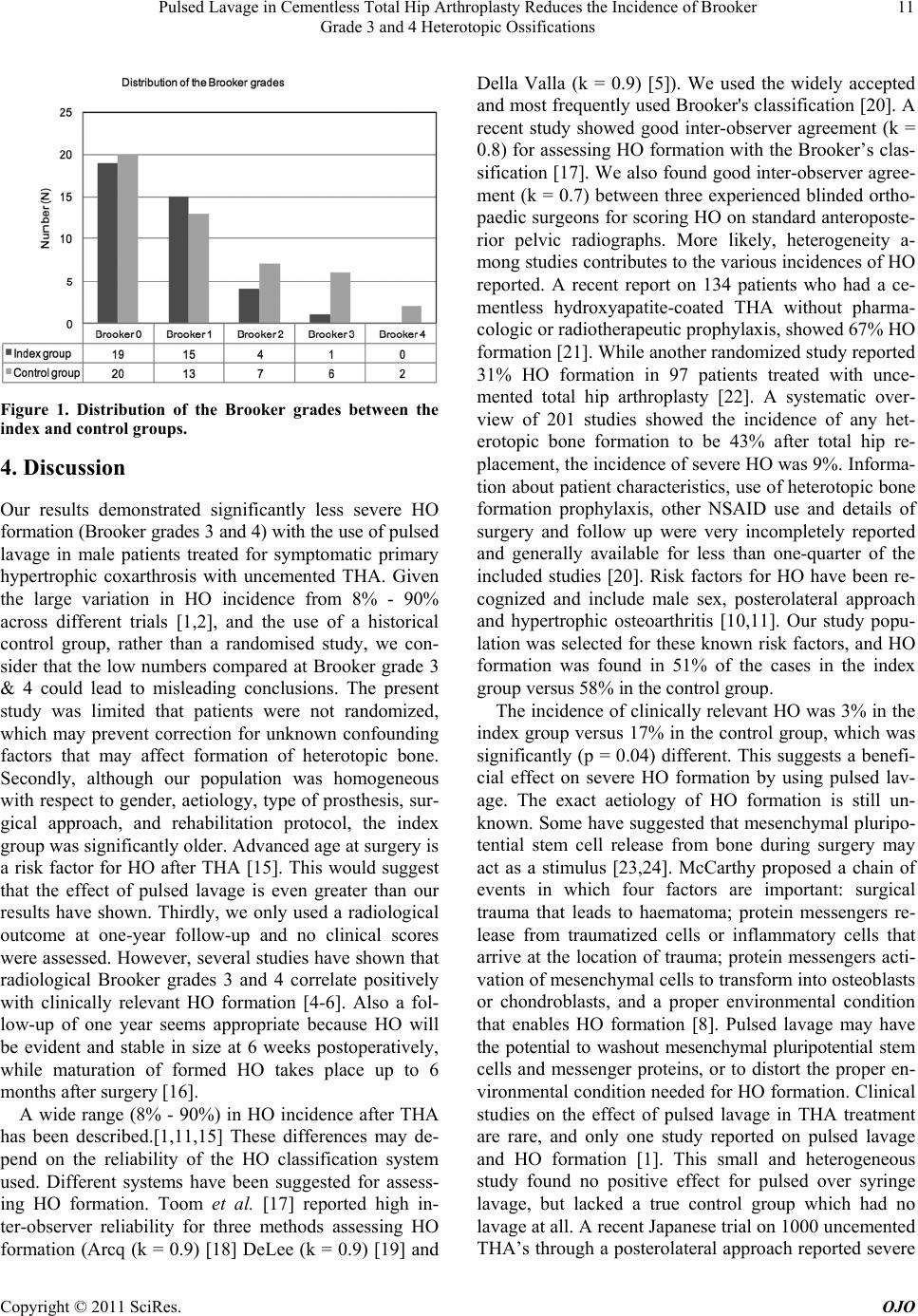 Pulsed Lavage in Cementless Total Hip Arthroplasty Reduces the Incidence of Brooker 11 Grade 3 and 4 Heterotopic Ossifications Figure 1. Distribution of the Brooker grades between the index and control groups. 4. Discussion Our results demonstrated significantly less severe HO formation (Brooker grades 3 and 4) with the use of puls ed lavage in male patients treated for symptomatic primary hypertrophic coxarthrosis with uncemented THA. Given the large variation in HO incidence from 8% - 90% across different trials [1,2], and the use of a historical control group, rather than a randomised study, we con- sider that the low numbers compared at Brooker grade 3 & 4 could lead to misleading conclusions. The present study was limited that patients were not randomized, which may prevent correction for unknown confounding factors that may affect formation of heterotopic bone. Secondly, although our population was homogeneous with respect to gender, aetiolo gy, type of prosthesis, sur- gical approach, and rehabilitation protocol, the index group was significan tly older . Adva nced age at surg ery is a risk factor for HO after THA [15]. This would suggest that the effect of pulsed lavage is even greater than our results have shown. Thirdly, we only used a radiological outcome at one-year follow-up and no clinical scores were assessed. However, several studies have shown that radiological Brooker grades 3 and 4 correlate positively with clinically relevant HO formation [4-6]. Also a fol- low-up of one year seems appropriate because HO will be evident and stable in size at 6 weeks postoperatively, while maturation of formed HO takes place up to 6 months after surgery [16]. A wide range (8% - 90%) in HO incidence after THA has been described.[1,11,15] These differences may de- pend on the reliability of the HO classification system used. Different systems have been suggested for assess- ing HO formation. Toom et al. [17] reported high in- ter-observer reliability for three methods assessing HO formation (Arcq (k = 0.9) [18] DeLee (k = 0.9) [19] and Della Valla (k = 0.9) [5]). We used the widely accepted and most frequently used Brooker's classification [20]. A recent study showed good inter-observer agreement (k = 0.8) for assessing HO formation with the Brooker’s clas- sification [17]. We also found good inter-observer agree- ment (k = 0.7) between three experienced blinded ortho- paedic surgeons for scoring HO on standard anteroposte- rior pelvic radiographs. More likely, heterogeneity a- mong studies contributes to the various incidences of HO reported. A recent report on 134 patients who had a ce- mentless hydroxyapatite-coated THA without pharma- cologic or radiotherapeutic prophylaxis, showed 67% HO formation [21]. While another randomized study reported 31% HO formation in 97 patients treated with unce- mented total hip arthroplasty [22]. A systematic over- view of 201 studies showed the incidence of any het- erotopic bone formation to be 43% after total hip re- placement, the incidence of severe HO was 9%. Informa- tion about patient characteristics, use of heterotopic bone formation prophylaxis, other NSAID use and details of surgery and follow up were very incompletely reported and generally available for less than one-quarter of the included studies [20]. Risk factors for HO have been re- cognized and include male sex, posterolateral approach and hypertrophic osteoarthritis [10,11]. Our study popu- lation was selected for these known risk factors, and HO formation was found in 51% of the cases in the index group versus 58% in the control group. The incidence of clin ically relevant HO was 3% in the index group versus 17% in the control group, which was significantly (p = 0.04) different. This suggests a benefi- cial effect on severe HO formation by using pulsed lav- age. The exact aetiology of HO formation is still un- known. Some have suggested that mesenchymal pluripo- tential stem cell release from bone during surgery may act as a stimulus [23,24]. McCarthy proposed a chain of events in which four factors are important: surgical trauma that leads to haematoma; protein messengers re- lease from traumatized cells or inflammatory cells that arrive at the location of trauma; protein messengers acti- vation of mesenchymal cells to transform into osteob lasts or chondroblasts, and a proper environmental condition that enables HO formation [8]. Pulsed lavage may have the potential to washout mesenchymal pluripotential stem cells and messenger proteins, or to distort the proper en- vironmental condition needed for HO formation. Clinical studies on the effect of pulsed lavage in THA treatment are rare, and only one study reported on pulsed lavage and HO formation [1]. This small and heterogeneous study found no positive effect for pulsed over syringe lavage, but lacked a true control group which had no lavage at all. A recent Japanese trial on 1000 uncemented THA’s through a postero lateral approach reported severe Copyright © 2011 SciRes. OJO  Pulsed Lavage in Cementless Total Hip Arthroplasty Reduces the Incidence of Brooker 12 Grade 3 and 4 Heterotopic Ossifications HO formation in only 1% of the cases. A large portion of patients (40%) received NSAIDs postoperatively, and all wounds were irrigated with 1000 mL of saline [25]. Al- though no pulsatile lavage was used wound lavage may have had an additional beneficial effect, causing the low incidence of HO. 5. Conclusions In conclusion our study showed significantly less Brooker grades 3 and 4 heterotopic ossifications after cementless THA in male patients treated with pulsed lavage. This suggests a positive effect of pulsed lavage on preventing clinically relevant HO formation. Other studies suggested that lavage in general reduces the incidence of HO after THA. Future prospective randomized trials should eluci- date whether pulsed lavage, in addition to syringe lavage and no lavage at all, is superior. 6. Acknowledgements We thank I. van de Akker-Scheek, PhD, for her contribu- tion to the manuscript. REFERENCES [1] R. J. Sneath, F. D. Bindi, J. Davies and E. J. Parnell, “The Effect of Pulsed Irrigation on the Incidence of Het- erotopic Ossification after Total Hip Arthroplasty,” Jour- nal of Arthroplasty, Vol. 16, No. 5, 2001, pp. 547-551. doi:10.1054/arth.2001.23562 [2] A. Toom, T. Haviko and L. Rips, “Heterotopic Ossifica- tion after Total Hip Arthroplasty,” International Ortho- paedics, Vol. 24, No. 6, 2001, pp. 323-326. doi:10.1007/s002640000181 [3] B. C. Neal, A. Rodgers, T. Clark, H. Gray, I. R. Reid, L. Dunn, et al., “A Systematic Survey of 13 Randomized Trials of Non-Steroidal Anti-Inflammatory Drugs for the Prevention of Heterotopic Bone Formation after Major Hip Surgery,” Acta Orthopaedica, Vol. 71, No. 2, 2000, 122-128. doi:10.1080/000164700317413076 [4] A. Buvanendran, J. S. Kroin and R. A. Berger, “Preopera- tive Cyc-Looxygenase-2 Inhibitor Treatment Reduces the Incidence of Hheterotopic Ossification after Hip Arthro- plasty: Six-Month Follow-Up,” Anesthesiology, Vol. 107, No. 2, 2007, 358-359. doi:10.1097/01.anes.0000271873.86164.74 [5] A. G. Della-Valle, P. S. Ruzo, V. Pavone, E. Tolo, D. N. Mintz and E. A. Salvati, “Heterotopic Ossification after Total Hip Arthro-Plasty: A Critical Analysis of the Brooker Classification and Proposal of a Simplified Rat- ing System,” Journal of Arthroplasty, Vol. 17, No. 7, 2002, 870-875. [6] P. Kjaersgaard-Andersen and M. A. Ritter, “Prevention of Formation of Heterotopic Bone after Total Hip Arthro- plasty,” Journal of Bone and Joint Surgery, Vol. 73, No. 6, 1991, 942-947. [7] O. Kolbl, D. Knelles, T. Barthel, U. Kraus, M. Flentje and J. Eulert, “Randomized Trial Comparing Early Postopera- tive Irradiation vs. the Use of Nonsteroidal Antiinflam- matory Drugs for Prevention of Heterotopic Ossification Following Prosthetic Total Hip Replacement,” Interna- tional Journal of Radiation Oncology, Biology and Phys- ics, Vol. 39, No. 5, 1997, pp. 961-966. doi:10.1016/S0360-3016(97)00496-3 [8] E. F. McCarthy and M. Sundaram, “Heterotopic Ossifica- tion: A Review,” Skeletal Radiology, Vol. 34, No. 10, 2005, pp. 609-619. doi:10.1007/s00256-005-0958-z [9] T. C. Lo and W. L. Healy, “Re-Irradiation for Prophylaxis of Heterotopic Ossification after Hip Surgery,” British Journal of Radiology, Vol. 74, No. 882, 2001, pp. 503- 506. [10] B. R. Horwitz, N. L. Rockowitz, S. R. Goll, R. E. Booth, Jr., R. A. Balderston, R. H. Rothman, et al., “A Prospec- tive Randomized Comparison of Two Surgical Ap- proaches to Total Hip Arthroplasty,” Clinical Orthopae- dics and Related Research, Vol. 291, 1993, pp. 154-163. [11] J. G. Nollen and F. Q. van Douveren, “Ectopic Ossifica- tion in Hip Arthroplasty. A Retrospective Study of Pre- disposing Factors in 637 Cases,” Acta Orthopaedica, Vol. 64, No. 2, 1993, pp. 185-187. doi:10.3109/17453679308994567 [12] K. Knahr, M. Salzer, R. Eyb, P. Frank and W. Blauen- steiner, “Heterotopic Ossification with Total Hip Endo- prostheses in Various Models of Thrombosis Prophy- laxis,” Journal of Arthroplasty, Vol. 3, No. 1, 1988, pp. 1-8. doi:10.1016/S0883-5403(88)80047-0 [13] D. C. Ayers, C. M. Evarts and J. R. Parkinson, “The Pre- vention of Heterotopic Ossification in High-Risk Patients by Low-Dose Radiation Therapy after Total Hip Arthro- plasty,” Journal of Bone and Joint Surgery, Vol. 68, No. 9, 1986, pp. 1423-1430. [14] A. F. Brooker, J. W. Bowerman, R. A. Robinson, L. H. Riley Jr., “Ectopic Ossification Following Total Hip Re- placement. Incidence and a Method of Classification,” Journal of Bone and Joint Surgery, Vol. 55, No. 8, 1973, pp. 1629-1632. [15] P. Kjaersgaard-Andersen, J. Sletgard, C. Gjerloff and F. Lund, “Heterotopic Bone Formation after Noncemented Total Hip Arthroplasty. Location of Ectopic Bone and the Influence of Postoperative Antiinflammatory Treatment,” Clinical Orthopaedics and Related Research, Vol. 252, 1990, pp. 156-162. [16] M. A. Ritter and R. B. Vaughan, “Ectopic Ossification after Total Hip Arthroplasty. Predisposing Factors, Fre- quency, and Effect on Results,” Journal of Bone and Joint Surgery, Vol. 59, No. 3, 1977, pp. 345-351. [17] A. Toom, K. Fischer, A. Martson, L. Rips and T. Haviko, “Inter-Observer Reliability in the Assessment of Het- erotopic Ossification: Proposal of a Combined Classifica- tion,” International Orthopaedics, Vol. 29, No. 3, 2005, pp. 156-159. doi:10.1007/s00264-004-0603-9 [18] M. Arcq, “Die Paraartikulären Ossifikationeneine Kom- Copyright © 2011 SciRes. OJO  Pulsed Lavage in Cementless Total Hip Arthroplasty Reduces the Incidence of Brooker Grade 3 and 4 Heterotopic Ossifications Copyright © 2011 SciRes. OJO 13 plikation der Totalhüftendoprothese des Hüftgelenks,” Arch Orthop Unfallchir, Vol. 77, 1973, pp. 108-131. doi:10.1007/BF00416444 [19] J. DeLee, A. Ferrari and J. Charnley, “Ectopic Bone For- mation Following Low Friction Arthroplasty of the Hip,” Clinical Orthopaedics and Related Research, Vol. 121, 1976, pp. 53-59. [20] B. Neal, H. Gray, S. MacMahon and L. Dunn, “Incidence of Heterotopic Bone Formation after Major Hip Surgery,” ANZ Journal of Surgery, Vol. 72, No. 11, 2002, 808-821. doi:10.1046/j.1445-2197.2002.02549.x [21] R. J. Kasetti, A. A. Shetty and C. Rand, “Heterotopic Os- sification after Uncemented Hydroxyapatite-Coated Pri- mary Total Hip Arthroplasty,” Journal of Arthroplasty, Vol. 16, No. 8, 2001, pp. 1038-1042. doi:10.1054/arth.2001.25550 [22] K. R. Rama, P. A. Ve ndittoli, M. Ganapat hi, R. Borgmann , A. Roy and M. Lavigne, “Heterotopic Ossification after Surface Replacement Arthroplasty and Total Hip Arthro- plasty: A Randomized Study,” Journal of Arthroplasty, Vol. 24, No. 2, 2009, pp. 256-262. doi:10.1016/j.arth.2007.12.004 [23] J. E. Puzas, C. M. Evarts and J. S. Brand, “The Stimulus for Bone Formation,” Hip, 1987, pp. 25-38. [24] B. J. Thomas, “Heterotopic Bone Formation after Total Hip Arthroplasty,” Orthopedic Clinics of North America, Vol. 23, No. 2, 1992, pp. 347-358. [25] T. Higo, M. Mawatari, M. Shigematsu and T. Hotokebu- chi, “The Incidence of Heterotopic Ossification after Ce- mentless Total Hip Arthroplasty,” Journal of Arthroplasty, Vol. 21, No. 6, 2006, pp. 852-856. doi:10.1016/j.arth.2005.10.016 |