

Paper Menu >>
Journal Menu >>
 Open Journal of Pediatrics, 2011, 1, 41-44 doi:10.4236/ojped.2011.14012 Published Online December 2011 (http://www.SciRP.org/journal/ojped/ OJPed ) Published Online December 2011 in SciRes. http://www.scirp.org/journal/OJPed Impact of rotavirus vaccine on acute gastroenteritis emergency department visits and hospitalizations in a highly-vaccinated urban cohort Sheila M. Nolan1, Priya Prasad1, Alexander G. Fiks2, Theoklis E. Zaoutis1, Thomas R. TenHave3, Susan E. Coffin1 1Division of Infectious Diseases, The Children’s Hospital of Philadelphia, Philadelphia, USA; 2Department of Pediatrics, The Children’s Hospital of Philadelphia, Philadelphia, USA; 3Department of Biostatistics, School of Medicine, The University of Pennsylvania, Philadelphia, USA. Email: [email protected] Received 7 October 2011; revised 14 November 2011; accepted 22 November 2011. ABSTRACT Background: Rotavirus vaccines (RVV) have signifi- cantly reduced rotavirus disease in children over the past 4 years in the United States. In this study, we describe the impact of RVV in preventing acute gas- troenteritis (AGE) hospital encounters in a highly- vaccinated urban pediatric network during the 2007 and 2008 rotavirus seasons. Methods: We used 5 ur- ban practices from a practice-based network to con- duct a retrospective cohort study comparing the numbers of AGE emergency department (ED) visits and hospitalizations in RVV-immunized (exposed) and non-immunized (unexposed) children during the first 2 full seasons following RVV introduction. We determined incident rate ratios (IRR), using Poisson regression, and vaccine effectiveness for each out- come. Results: The 2007 and 2008 cohorts were ana- lyzed separately. 62% of the 2007 cohort was vacci- nated and 88% of the 2008 cohort. AGE hospitaliza- tions were significantly reduced among RVV-immu- nized children from the 2007 cohort in the 2008 sea- son with vaccine effectiveness of 67%. Sub-analysis of this cohort by age revealed that RVV was most pro- tective against hospitalizations in the youngest age group (IRR = 0.21, 95% CI (0.06, 0.82). A trend to- ward protection against hospitalization was detected for both cohorts in the first season following immu- nization that did not reach a statistically significant level. For AGE ED visits, no significant difference was seen between RVV-immunized and non-immu- nized children in either cohort, although there was a trend toward protection (IRR’s: 0.67 - 0.7). Conclu- sions: RVV was highly effective in preventing AGE hospitalizations for a subset of our cohort in 2008. Given reports of RVV effectiveness, we hypothesize that herd immunity is responsible for the inability to detect a significant difference between RVV-immu- nized and non-immunized children in our highly- vaccinated cohort. Keywords: Rotavirus; Pediatrics; Acute Gast roenteritis 1. INTRODUCTION Prior to the introduction of rotavirus vaccine (RVV) in 2006, rotavirus (RV) was the most common cause of acute gastroent eritis (AGE) among children unde r 5 years of age in the United States [1]. Recent surveillance data and several post-licensure studies have shown sign ificant reductions in RV disease activity and RV-related health- care encounters [2,3]. In this report, we examine the ef- fectiveness of RVV in preventing hospital-related AGE outcomes in a highly vaccinated urban cohort of children enrolled in a pediatric practice-based research network. 2. MATERIALS AND METHODS 2.1. Study Design A retrospective cohort study was performed evaluating the effectiveness of RVV in preventing AGE emergency department (ED) visits and hospitalizations during the first two full RV seasons after RVV introduction. 2.2. Study Setting The CHOP network includes 33 ambulatory pediatric practices, of which 5 are located within 2 miles of CHOP’s main hospital. These practices refer >90% of children to CHOP’ s main hospital for emergency care and hospitalization [4] and use the EpicCare (Verona, WI) electronic health record (EHR). T he CHOP main hos pital  S. M. Nolan et al. / Open Journal of Pediatrics 1 (2011) 41-44 42 is a tertiary care pediatric hospital with over 24,000 in- patient admissions and 70,000 ED visits annually. All CHOP ED visits and hospitalizations are captured in the EHR. 2.3. Study Populations The study population included any child born between February 22, 2006 (RotaTeq® licensure date; RotaTeq® was the only RVV available in the US during the study period) and February 29, 2008, who had at least one visit at one of the 5 selected sites prior to 2 months of age. Children were divided into 2 distinct cohorts: 1) the 2007 cohort included children eligible for AGE outcomes in both the 2007 and 2008 seasons and 2) the 2008 cohort included child ren eligib le for AGE outcomes in the 200 8 season only. 2.4. Exposures and Outcomes The exposure was recei pt of any number of dos es of RVV (1, 2 or 3); unexposed patients received zero RVV doses. The primary outcomes were AGE-related ED visits and hospitalizations, defined as any ED or hospital encounter with a diagnosis code for a diarrheal illness using the AGE ICD-9-CM codes: 001 - 005, 006 - 007, 008 - 008.5, 008.6, 008.61, 008.8, 009 - 009.3, 558.9, 787 - 787.03, 787.91 [5]. Outcomes were not assessed until the child was 6 week s of age (ear liest recommended age for RVV administration). 2.5. Data Collection The EHR was queried to identify total numbers of AGE ED visits and hospitalizations, subject demographics, other immunizations received, complex chronic condi- tions (CCC) [6], and numbers of primary care sick and preventativ e visits. 2.6. Statistical Methods We characterized cohort subjects by all potential risk factors. We compared demographic variables and health- care utilization between RVV-immunized and non-im- munized groups using chi-square analysis for categorical variables a nd s tude nt’s t test f or cont in uous vari a bles. We conducted univa riable analyses using Poisso n regression to determine associations between potential risk factors and outcomes. For the multivariable analysis, we estimated the asso- ciation between RVV exposure and the outcomes for each season using Poisson regression. All potential confound - ers and risk factors with a p value < 0.2 on univariable analysis were included in the multivariable model. We used a stratified analysis to assess effect modification. Vaccine effectiveness (VE) in preventing AGE out- comes was calculated using the formula: VE = (1-Inci- dent Rate Ratio (IRR)) × 100, where IRR is the adjusted ratio for each AGE outcome among vaccinated versus unvaccinated subjects [7]. 3. RESULTS 3.1. Characteristics of the Study Population The study population included 2 cohorts: 3278 children in the 2007 cohort and 2705 children in the 2008 cohort. Among the 2007 cohort, 62% received at least 1 RVV dose and 43% were fully vaccinated with 3 doses. For the 2008 cohort, 88% received at least 1 dose and 63% received 3 doses. Dem ographic characteristics of children in the 2 cohorts were similar except non-vaccinated children in the 2008 co hort were more likely to be black (70.6% vs. 80%, p = 0.003). Non-vaccinated children had lower rates of healthcare utilization than their vaccinated peers; this disparity was more pronounced in the 2008 cohort. In 2007 and 2008, respectively 60% and 44% of RVV-immunized children were up-to-date with recom- mended preventative care visits, whereas 39% and 6% of non-immunized children were up-to-date (p values < 0.0001). 3.2. AGE ED Visits and Hospitalizations For both cohorts, there was a trend toward protection for RVV-immunized children against AGE ED visits and hospitalizations. However, the only statistically signifi- cant protective effect was seen for the 2007 cohort in the 2008 season against hospitalizations (IRR 0.33, 95% CI (0.11, 0.96)) with a VE of 67% (Table 1). Sub-analyses demonstrated that the 3-dose regimen was most protective against AGE hospitalizations in the youngest age group (those 6 weeks of age at entry into the first RV season) for the 2007 cohort in season 2008 (IRR = 0.21, 95% CI (0 .06, 0.82), VE 79%) compared with 1 (IRR = 0.48, 95% CI (0.05, 4.29)) or 2 doses (IRR = 0 .42, 95% CI (0.09 , 1.95)). There was no signifi c ant p r ot ect i ve vaccination effect in the older age groups regardless of RVV dose number for either outcome. 4. DISCUSSION In this cohort study of an urban pediatric healthcare network with high rates of vaccination, we found a sig- nificant reduction in AGE hospitalizations among RVV- immunized children in the 2008 season. We demon- strated by age and dose-stratified analysis that the 3-dose RVV regimen was most effective in preventing AGE hospitalizations among the you ngest ch ildren in the 2007 cohort during the second RV season. For AGE hospitalizations, RVV-immunized children from the 2007 cohort were protected in the 2008 season with VE of 67%. This finding is similar to other cohort studies which demonstrated VE ranging from 59% - C opyright © 2011 SciRes. OJPed 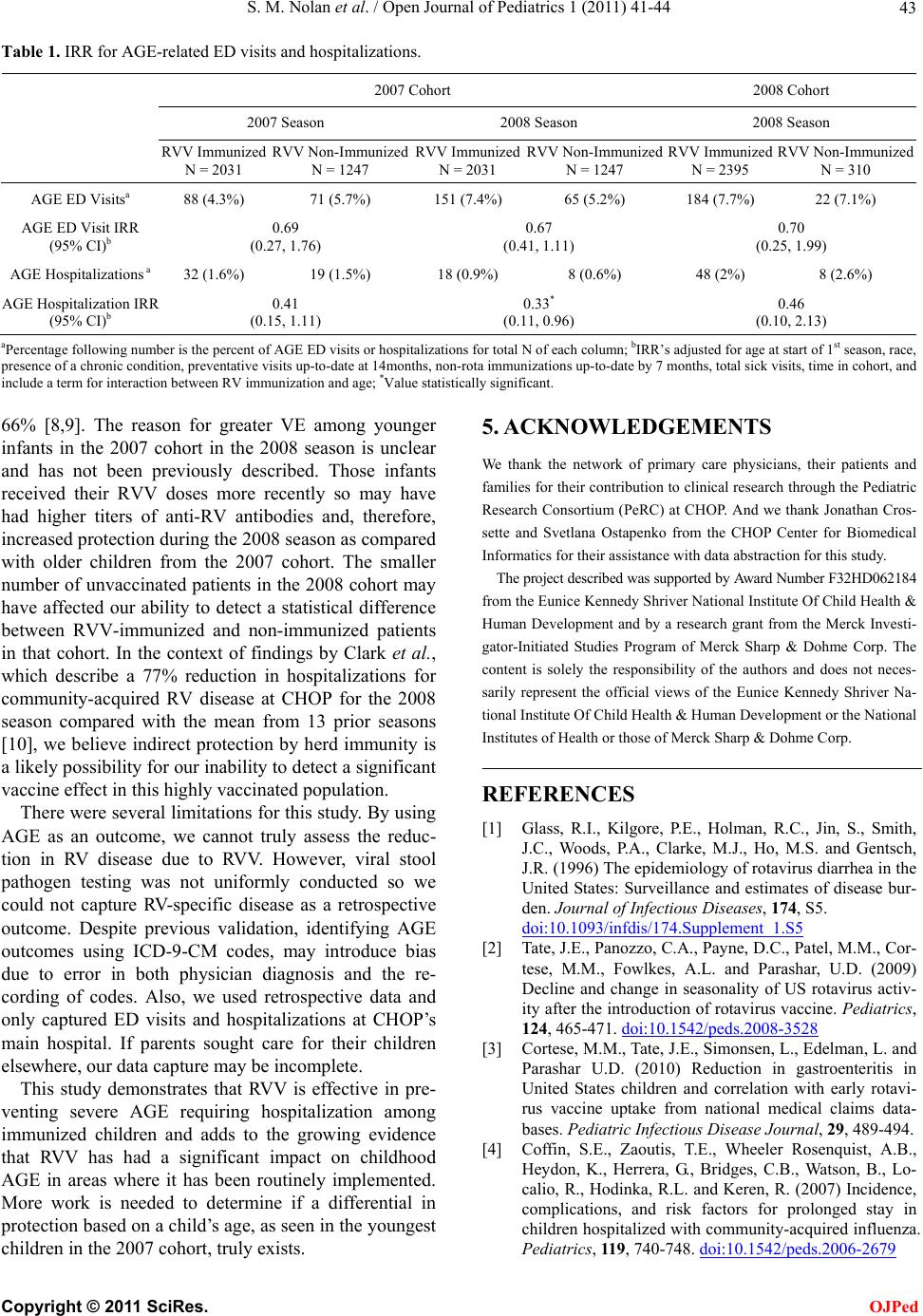 S. M. Nolan et al. / Open Journal of Pediatrics 1 (2011) 41-44 Copyright © 2011 SciRes. 43 Table 1. IRR for AGE-related ED visits and hospitalizations. 2007 Cohort 2008 Cohort 2007 Season 2008 Season 2008 Season RVV Immunized N = 2031 RVV Non-Immunized N = 1247 RVV Immunized N = 2031 RVV Non-Immunized N = 1247 RVV Immunized N = 2395 RVV Non-Immunized N = 310 AGE ED Visitsa 88 (4.3%) 71 (5.7%) 151 (7.4%) 65 (5.2%) 184 (7.7%) 22 (7.1%) AGE ED Visit IRR (95% CI)b 0.69 (0.27, 1.76) 0.67 (0.41, 1.11) 0.70 (0.25, 1.99) AGE Hospitalizations a 32 (1.6%) 19 (1.5%) 18 (0.9%) 8 (0.6%) 48 (2%) 8 (2.6%) AGE Hospitalization IRR (95% CI)b 0.41 (0.15, 1.11) 0.33* (0.11, 0.96) 0.46 (0.10, 2.13) aPercentag e fo llo wing numb er is the p ercent of AGE ED vis it s or hospit ali zati ons for total N of each co lu mn; bIRR’s adjust ed fo r ag e at star t o f 1st s easo n, race, presence of a chronic condition, preventative visits up-to-date at 14months, non-rota immunizations up-to-date by 7 months, total sick visits, time in cohort, and include a term for interaction between RV immunization and age; *Value statistically significant. 5. ACKNOWLEDGEMENTS 66% [8,9]. The reason for greater VE among younger infants in the 2007 cohort in the 2008 season is unclear and has not been previously described. Those infants received their RVV doses more recently so may have had higher titers of anti-RV antibodies and, therefore, increased protection during the 2008 season as compared with older children from the 2007 cohort. The smaller number of unvaccinated patients in the 2008 cohort may have affected our ability to detect a statistical difference between RVV-immunized and non-immunized patients in that cohort. In the context of findings by Clark et al., which describe a 77% reduction in hospitalizations for community-acquired RV disease at CHOP for the 2008 season compared with the mean from 13 prior seasons [10], we believe indirect protection by herd immunity is a likely possibility for our inability to detect a significant vaccine effect in this highly vaccinated population. We thank the network of primary care physicians, their patients and families for their contribution to clinical research through the Pediatric Research Consortium (PeRC) at CHOP. And we thank Jonathan Cros- sette and Svetlana Ostapenko from the CHOP Center for Biomedical Informatics for their assistance with data abstraction for this study. The project described was supported by Award Number F32HD062184 from the Eunice Kennedy Shriver National Institute Of Child Health & Human Development and by a research grant from the Merck Investi- gator-Initiated Studies Program of Merck Sharp & Dohme Corp. The content is solely the responsibility of the authors and does not neces- sarily represent the official views of the Eunice Kennedy Shriver Na- tional Institute Of Child Health & Human Development or the National Institutes of Health or those of Merck Sharp & Dohme Corp. REFERENCES There were several limitations for this study. By using AGE as an outcome, we cannot truly assess the reduc- tion in RV disease due to RVV. However, viral stool pathogen testing was not uniformly conducted so we could not capture RV-specific disease as a retrospective outcome. Despite previous validation, identifying AGE outcomes using ICD-9-CM codes, may introduce bias due to error in both physician diagnosis and the re- cording of codes. Also, we used retrospective data and only captured ED visits and hospitalizations at CHOP’s main hospital. If parents sought care for their children elsewhere, our data capture may be incomplete. [1] Glass, R.I., Kilgore, P.E., Holman, R.C., Jin, S., Smith, J.C., Woods, P.A., Clarke, M.J., Ho, M.S. and Gentsch, J.R. (1996) The epidemiology of rotavirus diarrhea in the United States: Surveillance and estimates of disease bur- den. Journal of Infectious Diseases, 174, S5. doi:10.1093/infdis/174.Supplement_1.S5 [2] Tate, J.E., Panozzo, C.A., Payne, D.C., Patel, M.M., Cor- tese, M.M., Fowlkes, A.L. and Parashar, U.D. (2009) Decline and change in seasonality of US rotavirus activ- ity after the introduction of rotavirus vaccine. Pediatrics, 124, 465-471. doi:10.1542/peds.2008-3528 [3] Cortese, M.M., Tate, J.E., Simonsen, L., Edelman, L. and Parashar U.D. (2010) Reduction in gastroenteritis in United States children and correlation with early rotavi- rus vaccine uptake from national medical claims data- bases. Pediatric Infectious Disease Journal, 29, 489-494. This study demonstrates that RVV is effective in pre- venting severe AGE requiring hospitalization among immunized children and adds to the growing evidence that RVV has had a significant impact on childhood AGE in areas where it has been routinely implemented. More work is needed to determine if a differential in protection based on a child’s age, as seen in the youngest children in the 2007 cohort, truly exists. [4] Coffin, S.E., Zaoutis, T.E., Wheeler Rosenquist, A.B., Heydon, K., Herrera, G., Bridges, C.B., Watson, B., Lo- calio, R., Hodinka, R.L. and Keren, R. (2007) Incidence, complications, and risk factors for prolonged stay in children hospitalized with community-acquired influenza. Pediatrics, 11 9, 740-748. doi:10.1542/peds.2006-2679 OJPed  S. M. Nolan et al. / Open Journal of Pediatrics 1 (2011) 41-44 44 [5] Hsu, V.P., Staat, M.A., Roberts, N., Thieman, C., Bern- stein, D.I., Bresee, J., Glass, R.I. and Parashar, U.D. (2005) Uses of active surveillance to validate interna- tional classification code estimates of rotavirus hospi- talizations in children. Pediatrics, 11 5, 78-82. [6] Feudtner, C., Christakis, D.A. and Connell, F.A. (2000) Pediatric deaths attributable to complex chronic condi- tions: A population-based study of Washington state, 1980-1997. Pediatrics, 106, 205-209. [7] Ewell, M. (1996) Comparing methods for calculating confidence intervals for vaccine efficacy. Statistics in Medicine, 15, 2379-2392. doi:10.1002/(SICI)1097-0258(19961115)15:21<2379::AI D-SIM457>3.0.CO;2-L [8] Wang, F.T., Mast, T.C., Glass, R.J., Loughlin, J. and Seeger, J.D. (2010) Effectiveness of the pentavalent rota- virus vaccine in preventing gastroenteritis in the United States. Pediatrics, 125, e208-e213. doi:10.1542/peds.2009-1246 [9] Field, E.J., Vally, H., Grimwood, K. and Lambert, S.B. (2010) Pentavalent rotavirus vaccine and prevention of gastroenteritis hospitalizations in Australia. Pediatrics, 126, 506-512. doi:10.1542/peds.2010-0443 [10] Clark, H.F., Lawley, D., Mallette, L.A., DiNubile, M.J. and Hodinka, R.L. (2009) Decline in cases of rotavirus gastroenteritis presenting to the children’s hospital of philadelphia after introduction of pentavalent rotavirus vaccine. Clinical and Vaccine Immunology, 16, 382-386. doi:10.1128/CVI.00382-08 C opyright © 2011 SciRes. OJPed |