

Paper Menu >>
Journal Menu >>
 Vol.2, No.3, 190-196 (2010) Natural Science http://dx.doi.org/10.4236/ns.2010.23029 Copyright © 2010 SciRes. OPEN ACCESS Solid polymeric electrolyte of poly(ethylene)oxide-50% epoxidized natural rubber-lithium triflate (PEO-ENR50-LiCF3SO3) Siti Aminah bt. Mohd Noor1, Azizan Ahmad1, Mohd. Yusri bin Abd. Rahman2*, Ibrahim Abu Talib 3 1School of Chemical Science and Food Technology, Faculty of Science and Technology, National University of Malaysia, Selangor, Malaysia; [email protected], [email protected] 2College of Engineering, Universiti Tenaga Nasional, Selangor, Malaysia; yusri@uni te n.ed u.my 3School of Applied Physics, Faculty of Science and Technology, National University of Malaysia, Selangor, Malaysia; Received 19 November 2009; revised 28 December 2009; accepted 25 January 2010. ABSTRACT A solid polymer electrolyte (SPE) films consist- ing of polyethylene oxide (PEO), 50% epoxi- dized natural rubber (ENR50) and LiCF3SO3 with various compositions of PEO-ENR50 and vari- ous weight percentage of LiCF3SO3 were pre- pared by solution casting technique. The poly- mer electrolyte films were characterized using DSC, XRD and AC impedance spectroscopy. The SPE with the PEO-ENR50 composition of 70-30 shows the highest conductivity of 4.2 × 10⁻⁵ Scm-1 at the 15 wt.% of LiCF3SO3 compared with the other composition of PEO/ENR50. This composition was then chosen to investigate the effect of LiCF3SO3 on the thermal property, structure and conductivity of the electrolyte. The highest room temperature conductivity of 1.4 × 10⁻⁴ Scm-1 was achieved at 20 wt.% of LiCF3SO3. The conductivity result is supported by the DSC and XRD analysis which showed the semi- crystalline nature of PEO turning to amor- phous state due to the increase in LiCF3SO3 content. Keywords: A. Polymers; C. Differential Scanning Calorimetry (DSC); C. X-Ray Diffraction; D. Electrical Conductivity; D. Electrical Properties 1. INTRODUCTION Main application of polymer electrolytes lies in electro- chemical device such as display, sensor, electrochemical window, super-capacitor, rechargeable battery and photo- electrochemical cell. However, the main attention of many solid state researchers is the development of sec- ondary lithium batteries [1-4]. Ionic conducting polymer electrolytes were first suggested by Fenton et al. in 1973 [5], who reported that PEO-salt complexes are capable of exhibiting ionic conductivity and subsequently substan- tial activities were directed towards the development of a wide variety of solid polymer electrolytes using different combinations of polymer and salt. The most reported and extensively studied polymer host for solid polymer elec- trolyte is PEO [6-12]. This is due to a high electrochemi- cal stability of PEO in comparison with other polyethers, copolymers or PEO branched polymers [9]. Besides, PEO has a good solubility for many salts such as LiTFSI, Li2SO4, NH4ClO4 and LiCF3SO3. Even though PEO has a good electrochemical stability, PEO exists in semi-crys- talline state at room temperature and does not have an excellent contact with the electrodes. Solid polymer electrolytes (SPE) for lithium batter- ies have many advantages over its counterpart liquid electrolyte, such as mechanical stability and processing flexibility. However, the conductivity at room tem- perature is usually too low to be utilized in ionic device. There are various techniques that can be employed to enhance the conductivity of SPE at room temperature. The recent technique developed for solid polymer elec- trolytes is the dispersion of nanosize inorganic ceramic filler particles such as Al2O3, SiO2, TiO2, SnO2, ZnO and ZrO in the electrolyte systems [6-10]. Propylene carbonate (PC), ethylene carbonate (EC) and dibutyl phthalate (DBP) are also used as plasticizers for con- ventional polymer electrolyte systems [11-13]. An al- ternative to ceramic fillers or plasticizers is to employ a complexing polymer such as modified natural rubber. This is due to their distinctive characteristics such as low glass transition temperature, soft elastomeric char- acteristic at room temperature, good elasticity and ad- hesion that makes them a suitable candidate as a filler for polymeric electrolyte systems [1,11,12]. Figure 1 shows the structure of ENR50 dimmer. 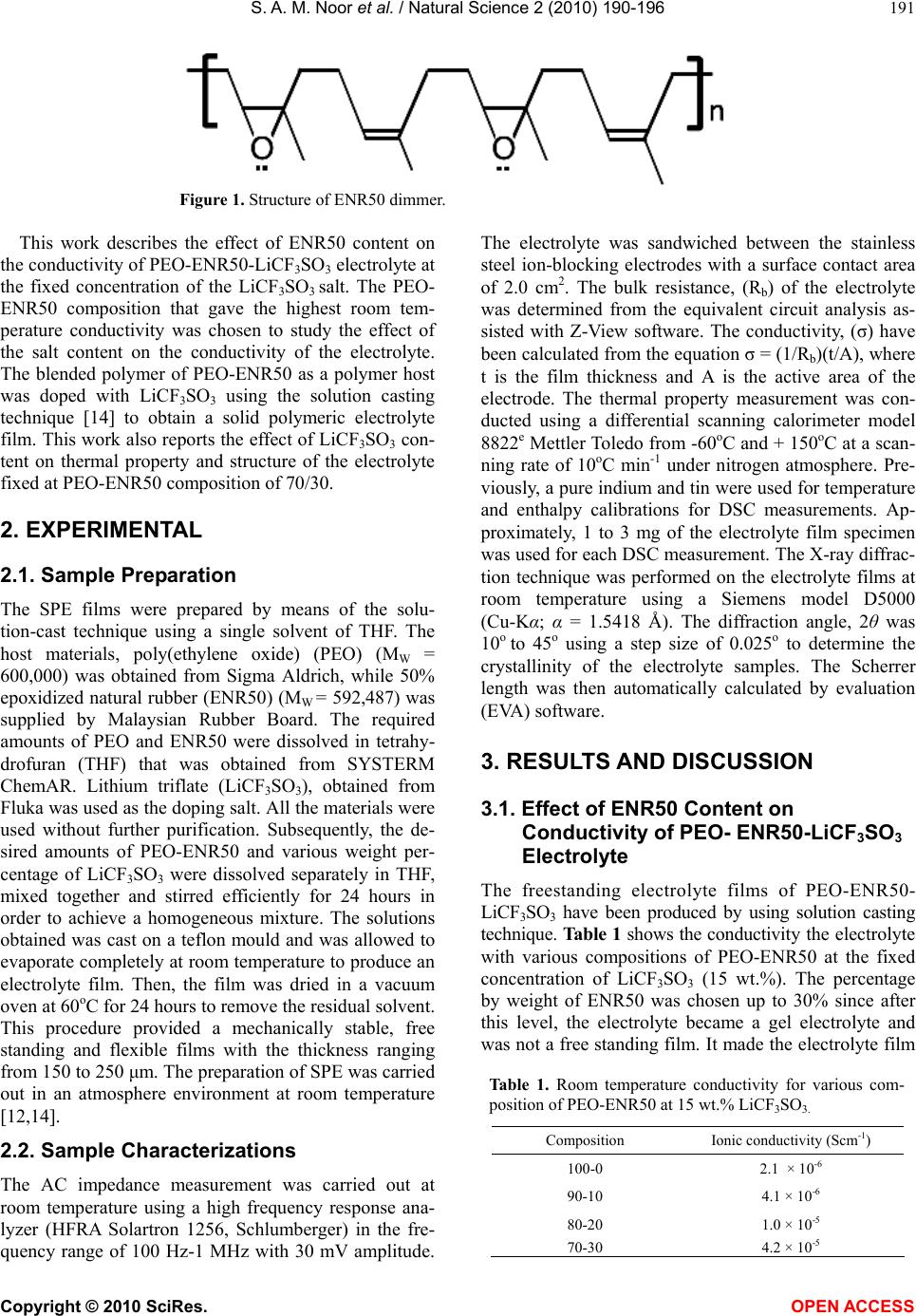 S. A. M. Noor et al. / Natural Science 2 (2010) 190-196 Copyright © 2010 SciRes. OPEN ACCESS 191 Figure 1. Structure of ENR50 dimmer. This work describes the effect of ENR50 content on the conductivity of PEO-ENR50-LiCF3SO 3 electrolyte at the fixed concentration of the LiCF3SO3 salt. The PEO- ENR50 composition that gave the highest room tem- perature conductivity was chosen to study the effect of the salt content on the conductivity of the electrolyte. The blended polymer of PEO-ENR50 as a polymer host was doped with LiCF3SO3 using the solution casting technique [14] to obtain a solid polymeric electrolyte film. This work also reports the effect of LiCF3SO3 con- tent on thermal property and structure of the electrolyte fixed at PEO-ENR50 composition of 70/30. 2. EXPERIMENTAL 2.1. Sample Preparation The SPE films were prepared by means of the solu- tion-cast technique using a single solvent of THF. The host materials, poly(ethylene oxide) (PEO) (MW = 600,000) was obtained from Sigma Aldrich, while 50% epoxidized natural rubber (ENR50) (MW = 592,487) was supplied by Malaysian Rubber Board. The required amounts of PEO and ENR50 were dissolved in tetrahy- drofuran (THF) that was obtained from SYSTERM ChemAR. Lithium triflate (LiCF3SO3), obtained from Fluka was used as the doping salt. All the materials were used without further purification. Subsequently, the de- sired amounts of PEO-ENR50 and various weight per- centage of LiCF3SO3 were dissolved separately in THF, mixed together and stirred efficiently for 24 hours in order to achieve a homogeneous mixture. The solutions obtained was cast on a teflon mould and was allowed to evaporate completely at room temperature to produce an electrolyte film. Then, the film was dried in a vacuum oven at 60oC for 24 hours to remove the residual solvent. This procedure provided a mechanically stable, free standing and flexible films with the thickness ranging from 150 to 250 μm. The preparation of SPE was carried out in an atmosphere environment at room temperature [12,14]. 2.2. Sample Characterizations The AC impedance measurement was carried out at room temperature using a high frequency response ana- lyzer (HFRA Solartron 1256, Schlumberger) in the fre- quency range of 100 Hz-1 MHz with 30 mV amplitude. The electrolyte was sandwiched between the stainless steel ion-blocking electrodes with a surface contact area of 2.0 cm2. The bulk resistance, (Rb) of the electrolyte was determined from the equivalent circuit analysis as- sisted with Z-View software. The conductivity, (σ) have been calculated from the equation σ = (1/Rb)(t/A), where t is the film thickness and A is the active area of the electrode. The thermal property measurement was con- ducted using a differential scanning calorimeter model 8822e Mettler Toledo from -60oC and + 150oC at a scan- ning rate of 10oC min-1 under nitrogen atmosphere. Pre- viously, a pure indium and tin were used for temperature and enthalpy calibrations for DSC measurements. Ap- proximately, 1 to 3 mg of the electrolyte film specimen was used for each DSC measurement. The X-ray diffrac- tion technique was performed on the electrolyte films at room temperature using a Siemens model D5000 (Cu-Kα; α = 1.5418 Å). The diffraction angle, 2θ was 10o to 45o using a step size of 0.025o to determine the crystallinity of the electrolyte samples. The Scherrer length was then automatically calculated by evaluation (EVA) software. 3. RESULTS AND DISCUSSION 3.1. Effect of ENR50 Content on Conductivity of PEO- ENR50-LiCF3SO3 Electrolyte The freestanding electrolyte films of PEO-ENR50- LiCF3SO3 have been produced by using solution casting technique. Table 1 shows the conductivity the electrolyte with various compositions of PEO-ENR50 at the fixed concentration of LiCF3SO3 (15 wt.%). The percentage by weight of ENR50 was chosen up to 30% since after this level, the electrolyte became a gel electrolyte and was not a free standing film. It made the electrolyte film Table 1. Room temperature conductivity for various com- position of PEO-ENR50 at 15 wt.% LiCF3SO3. Composition Ionic conductivity (Scm-1) 100-0 2.1 × 10⁻⁶ 90-10 4.1 × 10⁻⁶ 80-20 1.0 × 10⁻⁵ 70-30 4.2 × 10⁻⁵ 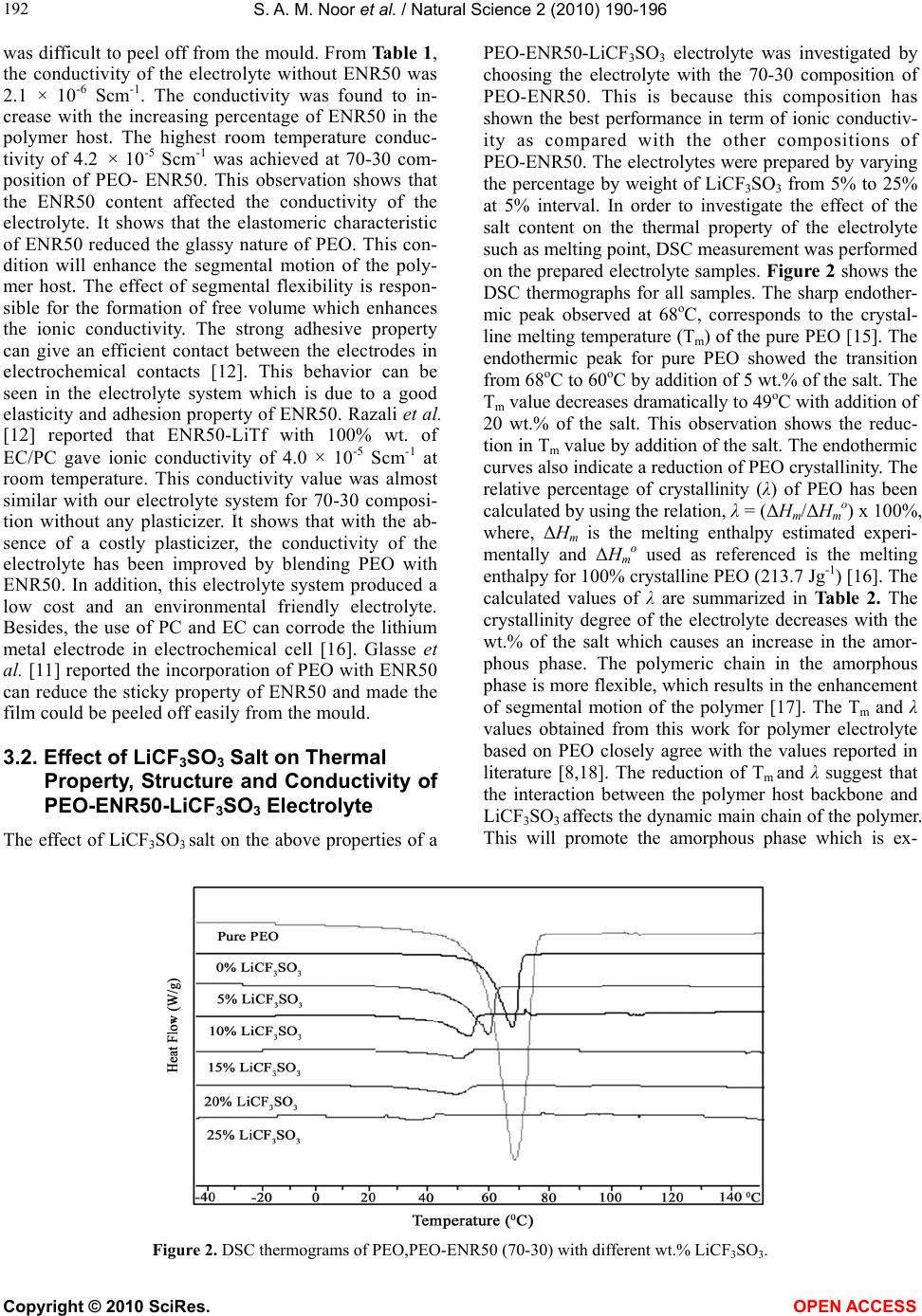 S. A. M. Noor et al. / Natural Science 2 (2010) 190-196 Copyright © 2010 SciRes. OPEN ACCESS 192 was difficult to peel off from the mould. From Table 1, the conductivity of the electrolyte without ENR50 was 2.1 × 10⁻⁶ Scm-1. The conductivity was found to in- crease with the increasing percentage of ENR50 in the polymer host. The highest room temperature conduc- tivity of 4.2 × 10⁻⁵ Scm-1 was achieved at 70-30 com- position of PEO- ENR50. This observation shows that the ENR50 content affected the conductivity of the electrolyte. It shows that the elastomeric characteristic of ENR50 reduced the glassy nature of PEO. This con- dition will enhance the segmental motion of the poly- mer host. The effect of segmental flexibility is respon- sible for the formation of free volume which enhances the ionic conductivity. The strong adhesive property can give an efficient contact between the electrodes in electrochemical contacts [12]. This behavior can be seen in the electrolyte system which is due to a good elasticity and adhesion property of ENR50. Razali et al. [12] reported that ENR50-LiTf with 100% wt. of EC/PC gave ionic conductivity of 4.0 × 10⁻⁵ Scm-1 at room temperature. This conductivity value was almost similar with our electrolyte system for 70-30 composi- tion without any plasticizer. It shows that with the ab- sence of a costly plasticizer, the conductivity of the electrolyte has been improved by blending PEO with ENR50. In addition, this electrolyte system produced a low cost and an environmental friendly electrolyte. Besides, the use of PC and EC can corrode the lithium metal electrode in electrochemical cell [16]. Glasse et al. [11] reported the incorporation of PEO with ENR50 can reduce the sticky property of ENR50 and made the film could be peeled off easily from the mould. 3.2. Effect of LiCF3SO3 Salt on Thermal Property, Structure and Conductivity of PEO-ENR50-LiCF3SO3 Electrolyte The effect of LiCF3SO3 salt on the above properties of a PEO-ENR50-LiCF3SO3 electrolyte was investigated by choosing the electrolyte with the 70-30 composition of PEO-ENR50. This is because this composition has shown the best performance in term of ionic conductiv- ity as compared with the other compositions of PEO-ENR50. The electrolytes were prepared by varying the percentage by weight of LiCF3SO3 from 5% to 25% at 5% interval. In order to investigate the effect of the salt content on the thermal property of the electrolyte such as melting point, DSC measurement was performed on the prepared electrolyte samples. Figure 2 shows the DSC thermographs for all samples. The sharp endother- mic peak observed at 68oC, corresponds to the crystal- line melting temperature (Tm) of the pure PEO [15]. The endothermic peak for pure PEO showed the transition from 68oC to 60oC by addition of 5 wt.% of the salt. The Tm value decreases dramatically to 49oC with addition of 20 wt.% of the salt. This observation shows the reduc- tion in Tm value by addition of the salt. The endothermic curves also indicate a reduction of PEO crystallinity. The relative percentage of crystallinity (λ) of PEO has been calculated by using the relation, λ = (ΔHm/ΔHm o) x 100%, where, ΔHm is the melting enthalpy estimated experi- mentally and ΔHm o used as referenced is the melting enthalpy for 100% crystalline PEO (213.7 Jg-1) [16]. The calculated values of λ are summarized in Table 2. The crystallinity degree of the electrolyte decreases with the wt.% of the salt which causes an increase in the amor- phous phase. The polymeric chain in the amorphous phase is more flexible, which results in the enhancement of segmental motion of the polymer [17]. The Tm and λ values obtained from this work for polymer electrolyte based on PEO closely agree with the values reported in literature [8,18]. The reduction of Tm and λ suggest that the interaction between the polymer host backbone and LiCF3SO3 affects the dynamic main chain of the polymer. This will promote the amorphous phase which is ex- Figure 2. DSC thermograms of PEO,PEO-ENR50 (70-30) with different wt.% LiCF3SO3. 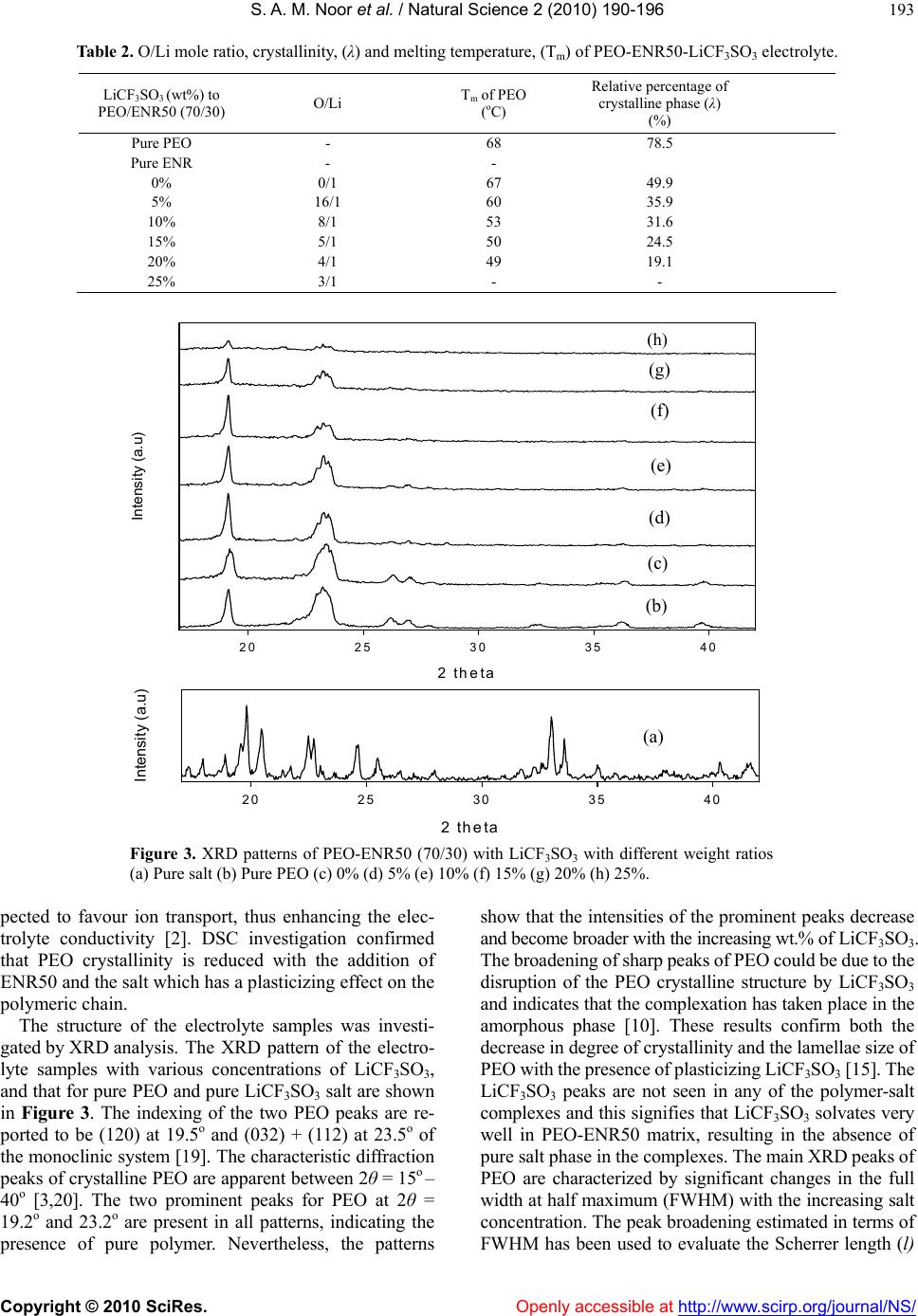 S. A. M. Noor et al. / Natural Science 2 (2010) 190-196 Copyright © 2010 SciRes. Openly accessible at http://www.scirp.org/journal/NS/ 193 Table 2. O/Li mole ratio, crystallinity, (λ) and melting temperature, (Tm) of PEO-ENR50-LiCF3SO3 electrolyte. LiCF3SO3 (wt%) to PEO/ENR50 (70/30) O/Li Tm of PEO (oC) Relative percentage of crystalline phase (λ) (%) Pure PEO - 68 78.5 Pure ENR - - 0% 0/1 67 49.9 5% 16/1 60 35.9 10% 8/1 53 31.6 15% 5/1 50 24.5 20% 4/1 49 19.1 25% 3/1 - - 2 theta 20 25 30 35 40 Intensity (a.u) 2 theta 20 2530 35 40 Intensity (a.u) (b) (e) (d) (c) (g) (f) (h) (a) Figure 3. XRD patterns of PEO-ENR50 (70/30) with LiCF3SO3 with different weight ratios (a) Pure salt (b) Pure PEO (c) 0% (d) 5% (e) 10% (f) 15% (g) 20% (h) 25%. pected to favour ion transport, thus enhancing the elec- trolyte conductivity [2]. DSC investigation confirmed that PEO crystallinity is reduced with the addition of ENR50 and the salt which has a plasticizing effect on the polymeric chain. The structure of the electrolyte samples was investi- gated by XRD analysis. The XRD pattern of the electro- lyte samples with various concentrations of LiCF3SO3, and that for pure PEO and pure LiCF3SO3 salt are shown in Figure 3. The indexing of the two PEO peaks are re- ported to be (120) at 19.5o and (032) + (112) at 23.5o of the monoclinic system [19]. The characteristic diffraction peaks of crystalline PEO are apparent between 2θ = 15o – 40o [3,20]. The two prominent peaks for PEO at 2θ = 19.2o and 23.2o are present in all patterns, indicating the presence of pure polymer. Nevertheless, the patterns show that the intensities of the prominent peaks decrease and become broader with the increasing wt.% of LiCF3SO3. The broadening of sharp peaks of PEO could be due to the disruption of the PEO crystalline structure by LiCF3SO3 and indicates that the complexation has taken place in the amorphous phase [10]. These results confirm both the decrease in degree of crystallinity and the lamellae size of PEO with the presence of plasticizing LiCF3SO3 [15]. The LiCF3SO3 peaks are not seen in any of the polymer-salt complexes and this signifies that LiCF3SO3 solvates very well in PEO-ENR50 matrix, resulting in the absence of pure salt phase in the complexes. The main XRD peaks of PEO are characterized by significant changes in the full width at half maximum (FWHM) with the increasing salt concentration. The peak broadening estimated in terms of FWHM has been used to evaluate the Scherrer length (l) 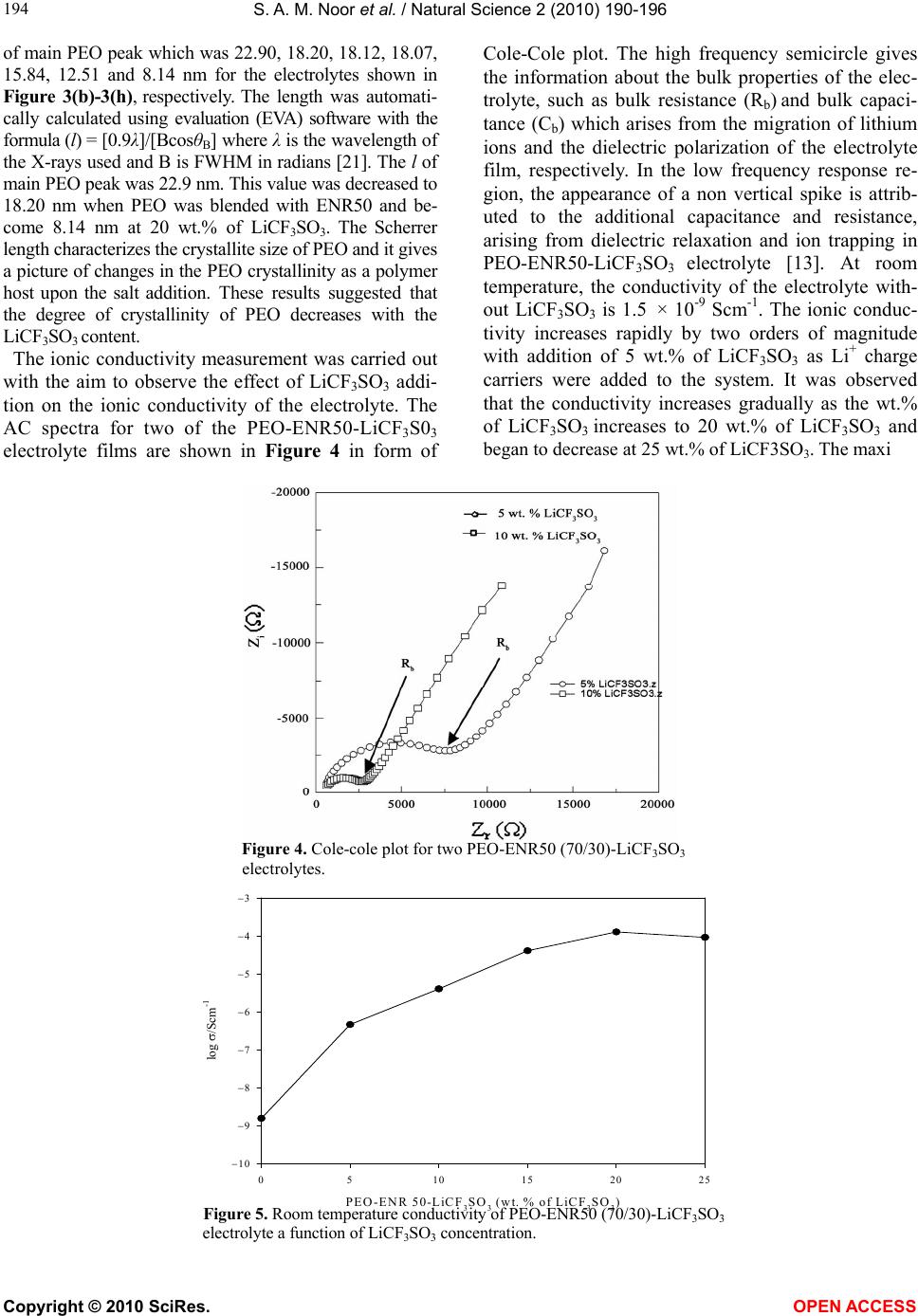 S. A. M. Noor et al. / Natural Science 2 (2010) 190-196 Copyright © 2010 SciRes. OPEN ACCESS 194 of main PEO peak which was 22.90, 18.20, 18.12, 18.07, 15.84, 12.51 and 8.14 nm for the electrolytes shown in Figure 3(b)-3(h), respectively. The length was automati- cally calculated using evaluation (EVA) software with the formula (l) = [0.9λ]/[BcosθB] where λ is the wavelength of the X-rays used and B is FWHM in radians [21]. The l of main PEO peak was 22.9 nm. This value was decreased to 18.20 nm when PEO was blended with ENR50 and be- come 8.14 nm at 20 wt.% of LiCF3SO3. The Scherrer length characterizes the crystallite size of PEO and it gives a picture of changes in the PEO crystallinity as a polymer host upon the salt addition. These results suggested that the degree of crystallinity of PEO decreases with the LiCF3SO3 content. The ionic conductivity measurement was carried out with the aim to observe the effect of LiCF3SO3 addi- tion on the ionic conductivity of the electrolyte. The AC spectra for two of the PEO-ENR50-LiCF3S03 electrolyte films are shown in Figure 4 in form of Cole-Cole plot. The high frequency semicircle gives the information about the bulk properties of the elec- trolyte, such as bulk resistance (Rb) and bulk capaci- tance (Cb) which arises from the migration of lithium ions and the dielectric polarization of the electrolyte film, respectively. In the low frequency response re- gion, the appearance of a non vertical spike is attrib- uted to the additional capacitance and resistance, arising from dielectric relaxation and ion trapping in PEO-ENR50-LiCF3SO3 electrolyte [13]. At room temperature, the conductivity of the electrolyte with- out LiCF3SO3 is 1.5 × 10⁻⁹ Scm-1. The ionic conduc- tivity increases rapidly by two orders of magnitude with addition of 5 wt.% of LiCF3SO3 as Li+ charge carriers were added to the system. It was observed that the conductivity increases gradually as the wt.% of LiCF3SO3 increases to 20 wt.% of LiCF3SO3 and began to decrease at 25 wt.% of LiCF3SO3. The maxi Figure 4. Cole-cole plot for two PEO-ENR50 (70/30)-LiCF3SO3 electrolytes. PEO-ENR 50-LiCF3SO3 (wt. % of LiCF3SO3) log /Scm-1 Figure 5. Room temperature conductivity of PEO-ENR50 (70/30)-LiCF3SO3 electrolyte a function of LiCF3SO3 concentration. 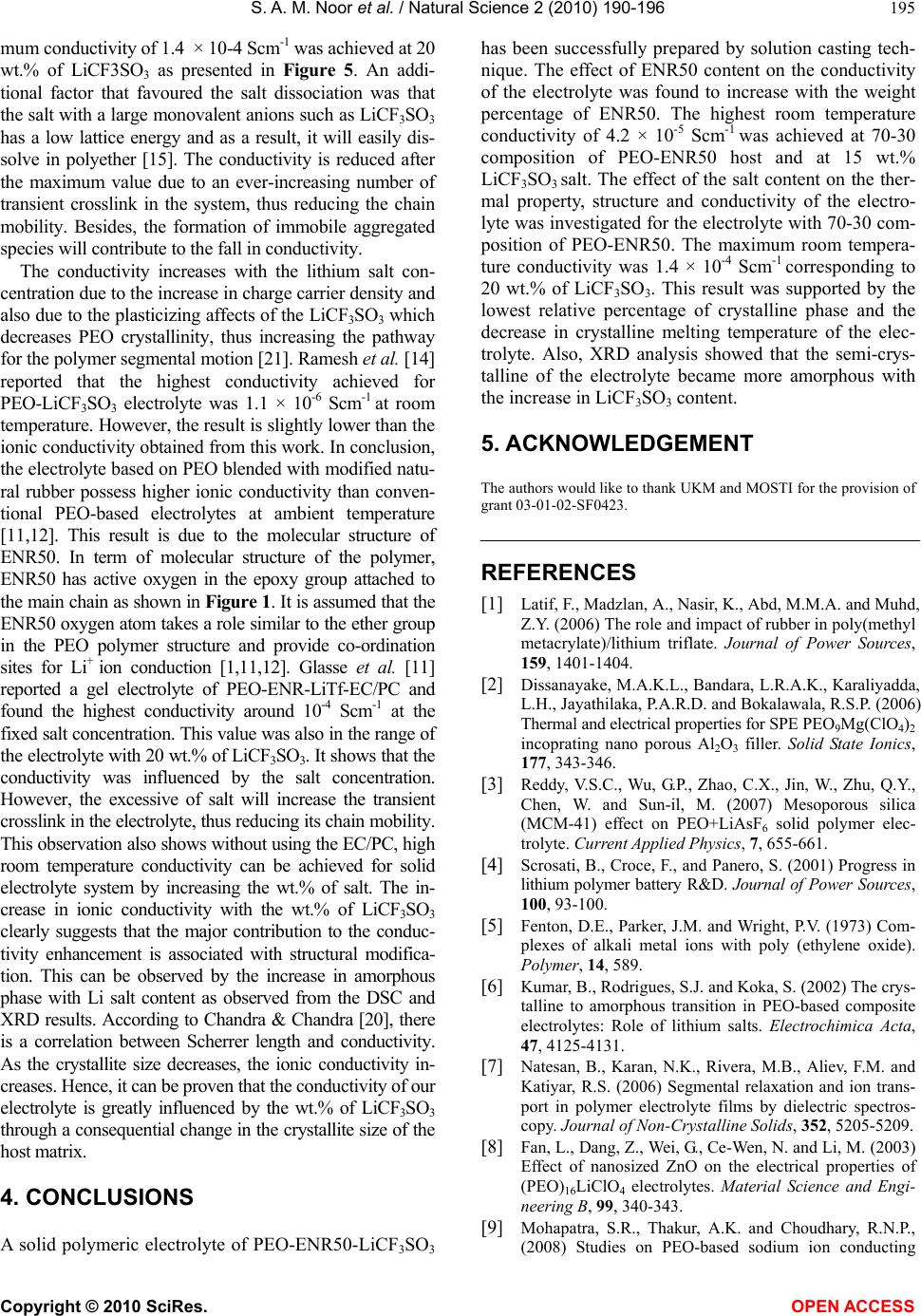 S. A. M. Noor et al. / Natural Science 2 (2010) 190-196 Copyright © 2010 SciRes. OPEN ACCESS 195 mum conductivity of 1.4 × 10⁻⁴ Scm-1 was achieved at 20 wt.% of LiCF3SO3 as presented in Figure 5. An addi- tional factor that favoured the salt dissociation was that the salt with a large monovalent anions such as LiCF3SO3 has a low lattice energy and as a result, it will easily dis- solve in polyether [15]. The conductivity is reduced after the maximum value due to an ever-increasing number of transient crosslink in the system, thus reducing the chain mobility. Besides, the formation of immobile aggregated species will contribute to the fall in conductivity. The conductivity increases with the lithium salt con- centration due to the increase in charge carrier density and also due to the plasticizing affects of the LiCF3SO3 which decreases PEO crystallinity, thus increasing the pathway for the polymer segmental motion [21]. Ramesh et al. [14] reported that the highest conductivity achieved for PEO-LiCF3SO3 electrolyte was 1.1 × 10⁻⁶ Scm-1 at room temperature. However, the result is slightly lower than the ionic conductivity obtained from this work. In conclusion, the electrolyte based on PEO blended with modified natu- ral rubber possess higher ionic conductivity than conven- tional PEO-based electrolytes at ambient temperature [11,12]. This result is due to the molecular structure of ENR50. In term of molecular structure of the polymer, ENR50 has active oxygen in the epoxy group attached to the main chain as shown in Figure 1. It is assumed that the ENR50 oxygen atom takes a role similar to the ether group in the PEO polymer structure and provide co-ordination sites for Li+ ion conduction [1,11,12]. Glasse et al. [11] reported a gel electrolyte of PEO-ENR-LiTf-EC/PC and found the highest conductivity around 10-4 Scm-1 at the fixed salt concentration. This value was also in the range of the electrolyte with 20 wt.% of LiCF3SO3. It shows that the conductivity was influenced by the salt concentration. However, the excessive of salt will increase the transient crosslink in the electrolyte, thus reducing its chain mobility. This observation also shows without using the EC/PC, high room temperature conductivity can be achieved for solid electrolyte system by increasing the wt.% of salt. The in- crease in ionic conductivity with the wt.% of LiCF3SO3 clearly suggests that the major contribution to the conduc- tivity enhancement is associated with structural modifica- tion. This can be observed by the increase in amorphous phase with Li salt content as observed from the DSC and XRD results. According to Chandra & Chandra [20], there is a correlation between Scherrer length and conductivity. As the crystallite size decreases, the ionic conductivity in- creases. Hence, it can be proven that the conductivity of our electrolyte is greatly influenced by the wt.% of LiCF3SO3 through a consequential change in the crystallite size of the host matrix. 4. CONCLUSIONS A solid polymeric electrolyte of PEO-ENR50-LiCF3SO 3 has been successfully prepared by solution casting tech- nique. The effect of ENR50 content on the conductivity of the electrolyte was found to increase with the weight percentage of ENR50. The highest room temperature conductivity of 4.2 × 10⁻⁵ Scm-1 was achieved at 70-30 composition of PEO-ENR50 host and at 15 wt.% LiCF3SO3 salt. The effect of the salt content on the ther- mal property, structure and conductivity of the electro- lyte was investigated for the electrolyte with 70-30 com- position of PEO-ENR50. The maximum room tempera- ture conductivity was 1.4 × 10⁻⁴ Scm-1 corresponding to 20 wt.% of LiCF3SO3. This result was supported by the lowest relative percentage of crystalline phase and the decrease in crystalline melting temperature of the elec- trolyte. Also, XRD analysis showed that the semi-crys- talline of the electrolyte became more amorphous with the increase in LiCF3SO3 content. 5. ACKNOWLEDGEMENT The authors would like to thank UKM and MOSTI for the provision of grant 03-01-02-SF0423. REFERENCES [1] Latif, F., Madzlan, A., Nasir, K., Abd, M.M.A. and Muhd, Z.Y. (2006) The role and impact of rubber in poly(methyl metacrylate)/lithium triflate. Journal of Power Sources, 159, 1401-1404. [2] Dissanayake, M.A.K.L., Bandara, L.R.A.K., Karaliyadda, L.H., Jayathilaka, P.A.R.D. and Bokalawala, R.S.P. (2006) Thermal and electrical properties for SPE PEO9Mg(ClO4)2 incoprating nano porous Al2O3 filler. Solid State Ionics, 177, 343-346. [3] Reddy, V.S.C., Wu, G.P., Zhao, C.X., Jin, W., Zhu, Q.Y., Chen, W. and Sun-il, M. (2007) Mesoporous silica (MCM-41) effect on PEO+LiAsF6 solid polymer elec- trolyte. Current Applied Physics, 7, 655-661. [4] Scrosati, B., Croce, F., and Panero, S. (2001) Progress in lithium polymer battery R&D. Journal of Power Sources, 100, 93-100. [5] Fenton, D.E., Parker, J.M. and Wright, P.V. (1973) Com- plexes of alkali metal ions with poly (ethylene oxide). Polymer, 14, 589. [6] Kumar, B., Rodrigues, S.J. and Koka, S. (2002) The crys- talline to amorphous transition in PEO-based composite electrolytes: Role of lithium salts. Electrochimica Acta, 47, 4125-4131. [7] Natesan, B., Karan, N.K., Rivera, M.B., Aliev, F.M. and Katiyar, R.S. (2006) Segmental relaxation and ion trans- port in polymer electrolyte films by dielectric spectros- copy. Journal of Non-Crystalline Solids, 352, 5205-5209. [8] Fan, L., Dang, Z., Wei, G., Ce-Wen, N. and Li, M. (2003) Effect of nanosized ZnO on the electrical properties of (PEO)16LiClO4 electrolytes. Material Science and Engi- neering B, 99, 340-343. [9] Mohapatra, S.R., Thakur, A.K. and Choudhary, R.N.P., (2008) Studies on PEO-based sodium ion conducting 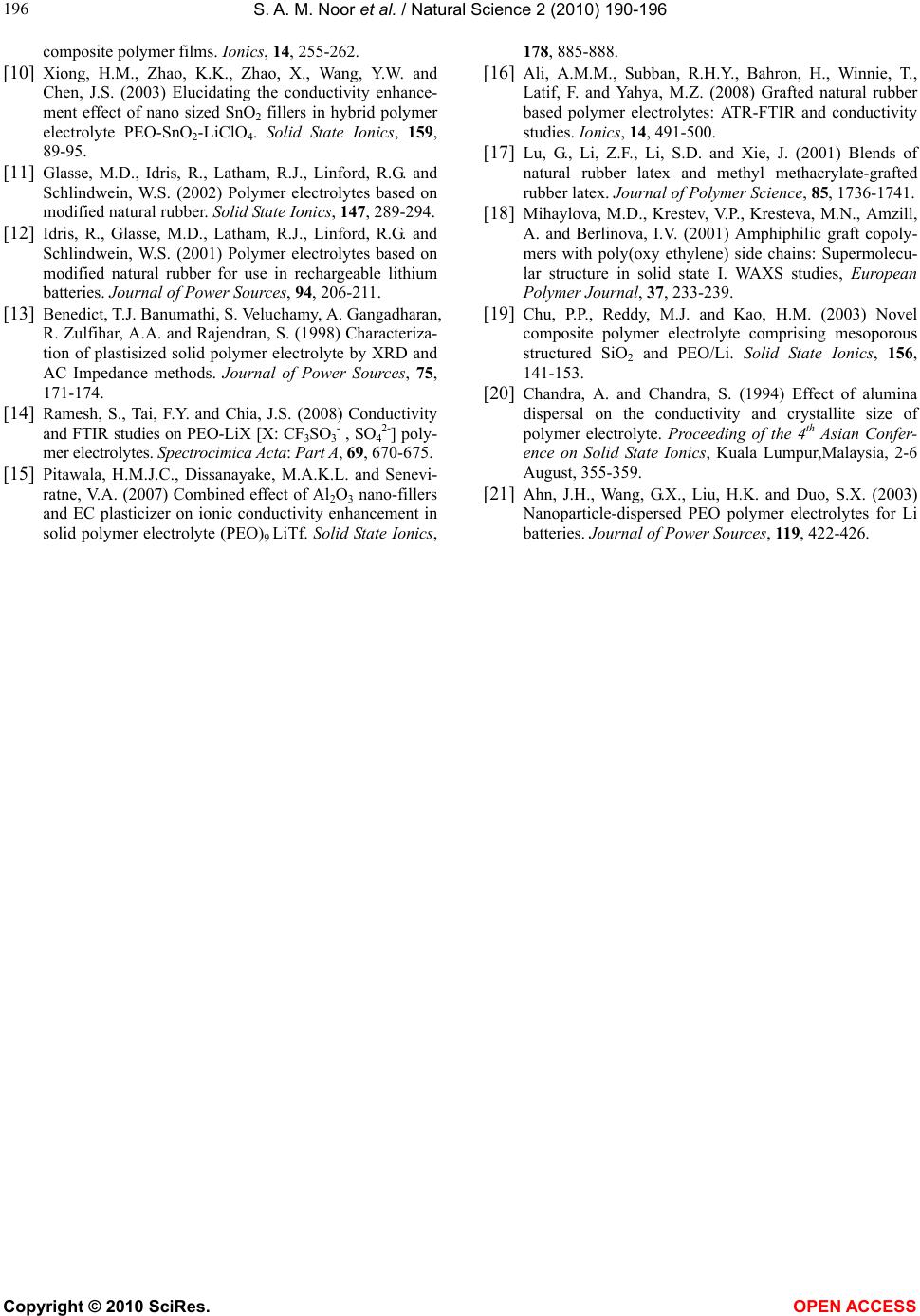 S. A. M. Noor et al. / Natural Science 2 (2010) 190-196 Copyright © 2010 SciRes. OPEN ACCESS 196 composite polymer films. Ionics, 14, 255-262. [10] Xiong, H.M., Zhao, K.K., Zhao, X., Wang, Y.W. and Chen, J.S. (2003) Elucidating the conductivity enhance- ment effect of nano sized SnO2 fillers in hybrid polymer electrolyte PEO-SnO2-LiClO4. Solid State Ionics, 159, 89-95. [11] Glasse, M.D., Idris, R., Latham, R.J., Linford, R.G. and Schlindwein, W.S. (2002) Polymer electrolytes based on modified natural rubber. Solid State Ionics, 147, 289-294. [12] Idris, R., Glasse, M.D., Latham, R.J., Linford, R.G. and Schlindwein, W.S. (2001) Polymer electrolytes based on modified natural rubber for use in rechargeable lithium batteries. Journal of Power Sources, 94, 206-211. [13] Benedict, T.J. Banumathi, S. Veluchamy, A. Gangadharan, R. Zulfihar, A.A. and Rajendran, S. (1998) Characteriza- tion of plastisized solid polymer electrolyte by XRD and AC Impedance methods. Journal of Power Sources, 75, 171-174. [14] Ramesh, S., Tai, F.Y. and Chia, J.S. (2008) Conductivity and FTIR studies on PEO-LiX [X: CF3SO3- , SO42-] poly- mer electrolytes. Spectrocimica Acta: Part A, 69, 670-675. [15] Pitawala, H.M.J.C., Dissanayake, M.A.K.L. and Senevi- ratne, V.A. (2007) Combined effect of Al2O3 nano-fillers and EC plasticizer on ionic conductivity enhancement in solid polymer electrolyte (PEO)9 LiTf. Solid State Ionics, 178, 885-888. [16] Ali, A.M.M., Subban, R.H.Y., Bahron, H., Winnie, T., Latif, F. and Yahya, M.Z. (2008) Grafted natural rubber based polymer electrolytes: ATR-FTIR and conductivity studies. Ionics, 14, 491-500. [17] Lu, G., Li, Z.F., Li, S.D. and Xie, J. (2001) Blends of natural rubber latex and methyl methacrylate-grafted rubber latex. Journal of Polymer Science, 85, 1736-1741. [18] Mihaylova, M.D., Krestev, V.P., Kresteva, M.N., Amzill, A. and Berlinova, I.V. (2001) Amphiphilic graft copoly- mers with poly(oxy ethylene) side chains: Supermolecu- lar structure in solid state I. WAXS studies, European Polymer Journal, 37, 233-239. [19] Chu, P.P., Reddy, M.J. and Kao, H.M. (2003) Novel composite polymer electrolyte comprising mesoporous structured SiO2 and PEO/Li. Solid State Ionics, 156, 141-153. [20] Chandra, A. and Chandra, S. (1994) Effect of alumina dispersal on the conductivity and crystallite size of polymer electrolyte. Proceeding of the 4th Asian Confer- ence on Solid State Ionics, Kuala Lumpur,Malaysia, 2-6 August, 355-359. [21] Ahn, J.H., Wang, G.X., Liu, H.K. and Duo, S.X. (2003) Nanoparticle-dispersed PEO polymer electrolytes for Li batteries. Journal of Power Sources, 119, 422-426. |