

Paper Menu >>
Journal Menu >>
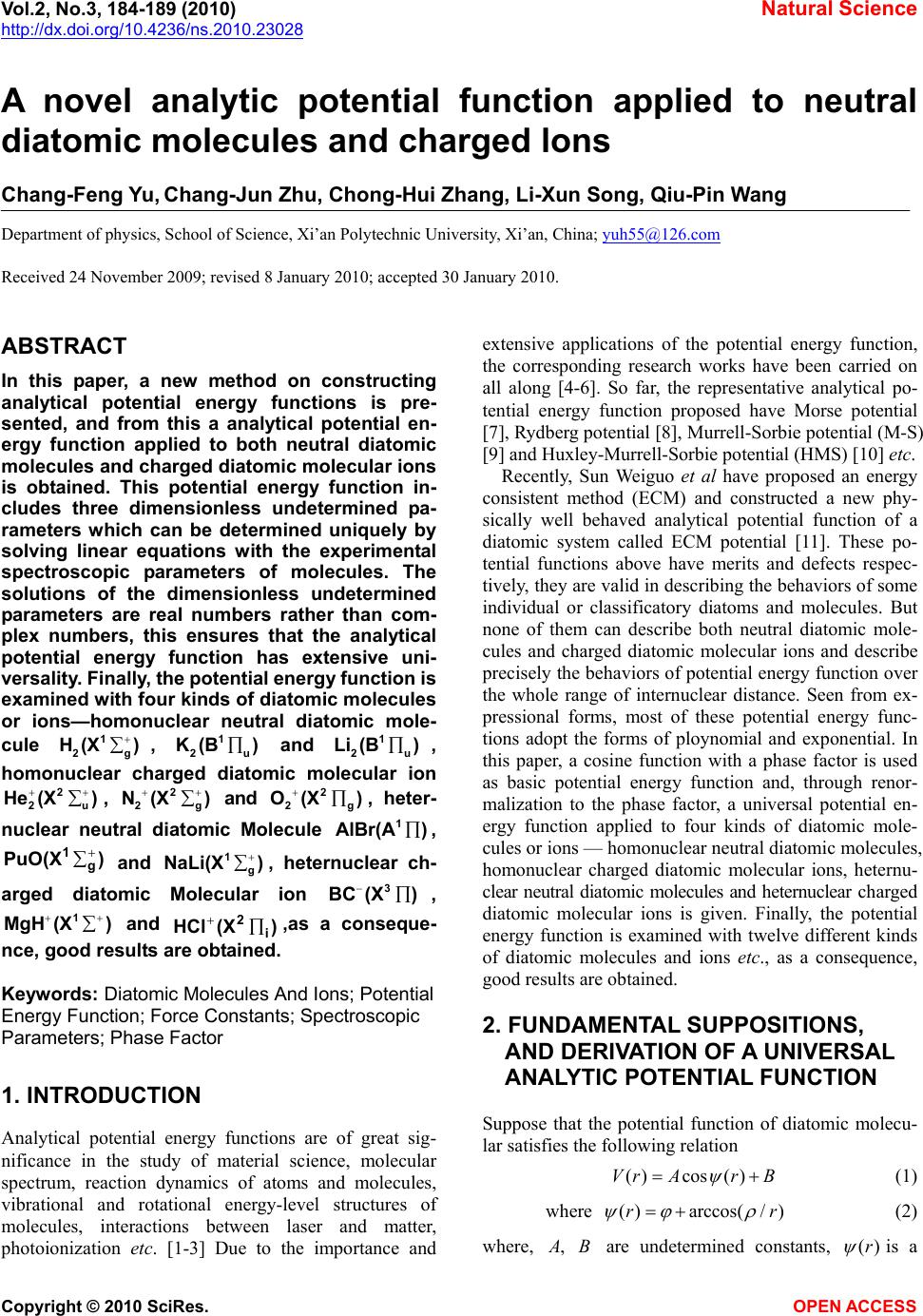 Vol.2, No.3, 184-189 (2010) Natural Science http://dx.doi.org/10.4236/ns.2010.23028 Copyright © 2010 SciRes. OPEN ACCESS A novel analytic potential function applied to neutral diatomic molecules and charged lons Chang-Feng Yu, Chang-Jun Zhu, Chong-Hui Zhang, Li-Xun Song, Qiu-Pin Wang Department of physics, School of Science, Xi’an Polytechnic University, Xi’an, China; [email protected] Received 24 November 2009; revised 8 January 2010; accepted 30 January 2010. ABSTRACT In this paper, a new method on constructing analytical potential energy functions is pre- sented, and from this a analytical potential en- ergy function applied to both neutral diatomic molecules and charged diatomic molecular ions is obtained. This potential energy function in- cludes three dimensionless undetermined pa- rameters which can be determined uniquely by solving linear equations with the experimental spectroscopic parameters of molecules. The solutions of the dimensionless undetermined parameters are real numbers rather than com- plex numbers, this ensures that the analytical potential energy function has extensive uni- versality. Finally, the potential energy function is examined with four kinds of diatomic molecules or ions—homonuclear neutral diatomic mole- cule 1 2g H(X) , 1 2u K(B) and 1 2u Li (B), homonuclear charged diatomic molecular ion 2 2u He(X) , 2 2g N(X ) and 2 2g O(X) , heter- nuclear neutral diatomic Molecule 1 AlBr(A) , )PuO(X g 1 and 1 g NaLi ( X ) , heternuclear ch- arged diatomic Molecular ion 3 BC (X), 1 MgH(X) and )(XHCl i 2 ,as a conseque- nce, good results are obtained. Keywords: Diatomic Molecules And Ions; Potential Energy Function; Force Constants; Spectroscopic Parameters; Phase Factor 1. INTRODUCTION Analytical potential energy functions are of great sig- nificance in the study of material science, molecular spectrum, reaction dynamics of atoms and molecules, vibrational and rotational energy-level structures of molecules, interactions between laser and matter, photoionization etc. [1-3] Due to the importance and extensive applications of the potential energy function, the corresponding research works have been carried on all along [4-6]. So far, the representative analytical po- tential energy function proposed have Morse potential [7], Rydberg potential [8], Murrell-Sorbie potential (M-S) [9] and Huxley-Murrell-Sorbie potential (HMS) [10] etc. Recently, Sun Weiguo et al have proposed an energy consistent method (ECM) and constructed a new phy- sically well behaved analytical potential function of a diatomic system called ECM potential [11]. These po- tential functions above have merits and defects respec- tively, they are valid in describing the behaviors of some individual or classificatory diatoms and molecules. But none of them can describe both neutral diatomic mole- cules and charged diatomic molecular ions and describe precisely the behaviors of potential energy function over the whole range of internuclear distance. Seen from ex- pressional forms, most of these potential energy func- tions adopt the forms of ploynomial and exponential. In this paper, a cosine function with a phase factor is used as basic potential energy function and, through renor- malization to the phase factor, a universal potential en- ergy function applied to four kinds of diatomic mole- cules or ions — homonuclear neutral diatomic molecules, homonuclear charged diatomic molecular ions, heternu- clear neutral diatomic molecules and heternuclear charged diatomic molecular ions is given. Finally, the potential energy function is examined with twelve different kinds of diatomic molecules and ions etc., as a consequence, good results are obtained. 2. FUNDAMENTAL SUPPOSITIONS, AND DERIVATION OF A UNIVERSAL ANALYTIC POTENTIAL FUNCTION Suppose that the potential function of diatomic molecu- lar satisfies the following relation ()cos ()VrAr B (1) where ()arccos(/ )rr (2) where, BA, are undetermined constants, )(r is a 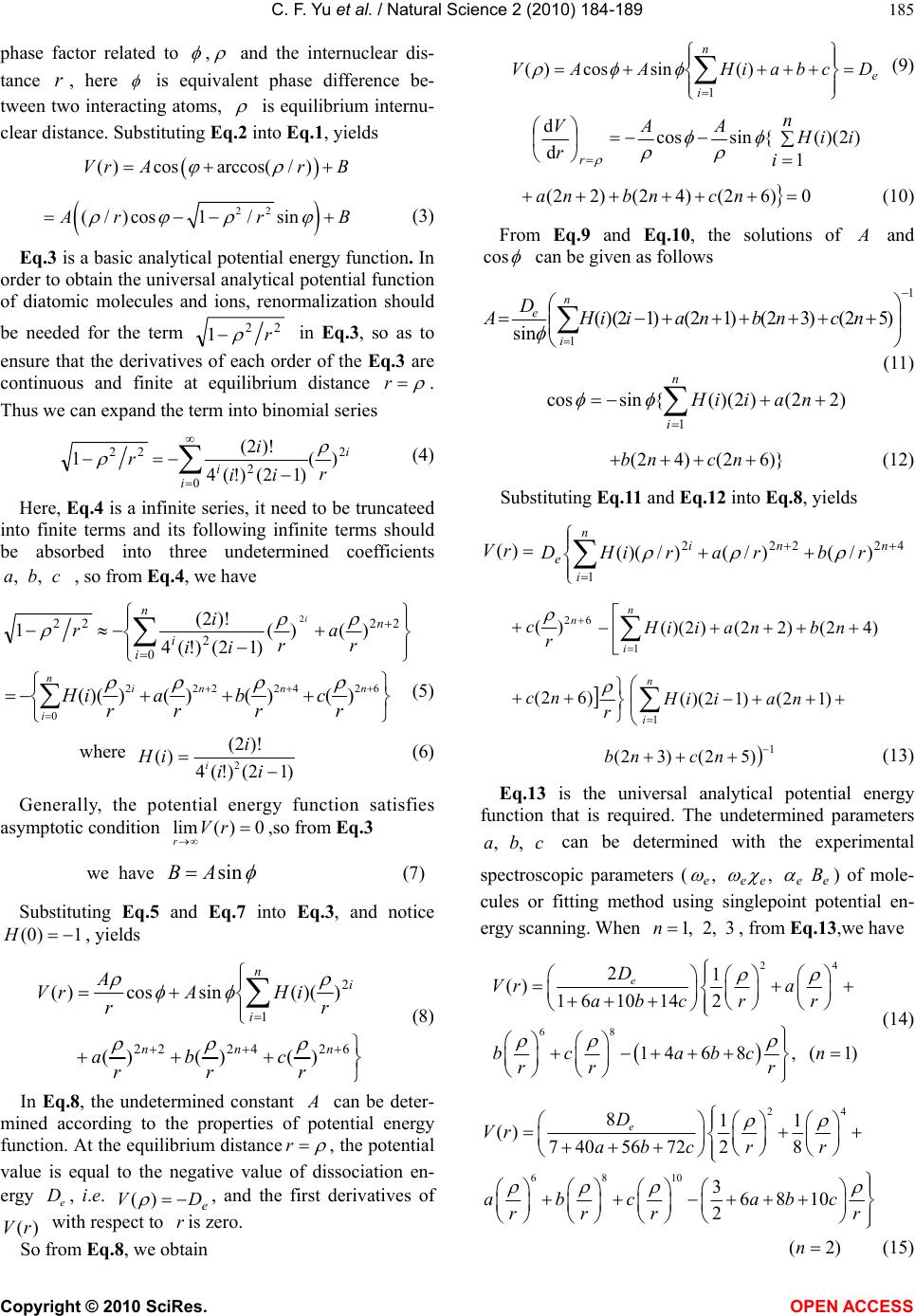 C. F. Yu et al. / Natural Science 2 (2010) 184-189 Copyright © 2010 SciRes. OPEN ACCESS 185 phase factor related to , and the internuclear dis- tance r , here is equivalent phase difference be- tween two interacting atoms, is equilibrium internu- clear distance. Substituting Eq.2 into Eq.1 , yields ( )cosarccos(/)Vr ArB 22 (/)cos1/ sin A rrB (3) Eq.3 is a basic analytical potential energy function. In order to obtain the universal analytical potential function of diatomic molecules and ions, renormalization should be needed for the term 22 1r in Eq.3, so as to ensure that the derivatives of each order of the Eq.3 are continuous and finite at equilibrium distance r . Thus we can expand the term into binomial series i i ir ii i r2 0 2 22 )( )12()!(4 )!2( 1 (4) Here, Eq.4 is a infinite series, it need to be truncateed into finite terms and its following infinite terms should be absorbed into three undetermined coefficients ,,abc , so from Eq.4, we have n i n ir a r ii i ri 0 22 2 22 )()( )12()!(4 )!2( 12 n i nnni r c r b r a r iH 0 6242222 )()()())(( (5) where )12()!(4 )!2( )( 2 ii i iH i (6) Generally, the potential energy function satisfies asymptotic condition lim()0 rVr ,so from Eq.3 we have sinAB (7) Substituting Eq.5 and Eq.7 into Eq.3, and notice 1)0( H, yields 624222 1 2 )()()( ))((sincos)( nnn n i i r c r b r a r iHA r A rV (8) In Eq.8, the undetermined constant A can be deter- mined according to the properties of potential energy function. At the equilibrium distance r , the potential value is equal to the negative value of dissociation en- ergy e D, i.e. e D V )( , and the first derivatives of ) ( r V with respect to r is zero. So from Eq.8, we obtain e n i DcbaiHAAV 1 )(sincos)( (9) n i iiH AA r V r1 )2)(({sincos d d 0)62()42()22( ncnbna (10) From Eq.9 and Eq.1 0, the solutions of A and cos can be given as follows 1 1 )52()32()12()12)(( sin n i encnbnaiiH D A (11) )22()2()({sincos 1 naiiH n i )}62()42( ncnb (12) Substituting Eq.11 and Eq.12 into Eq.8, yields )(rV 4222 1 2)/()/()/)(( nn n i i erbrariHD 62 )( n r c n i nbnaiiH 1 )42()22()2)(( r nc )62( n i naiiH 1 )12()12)(( 1 )52()32( ncnb (13) Eq.13 is the universal analytical potential energy function that is required. The undetermined parameters cba ,, can be determined with the experimental spectroscopic parameters (eeeee B ,,) of mole- cules or fitting method using singlepoint potential en- ergy scanning. When 3,2,1n, from Eq.13,we have 24 68 21 () 16 10142 1468,(1) e D Vr a abc rr bc abcn rr r (14) 24 6810 811 () 74056 7228 36810 2 e D Vr abc rr abcabc rrr r (2)n (15) 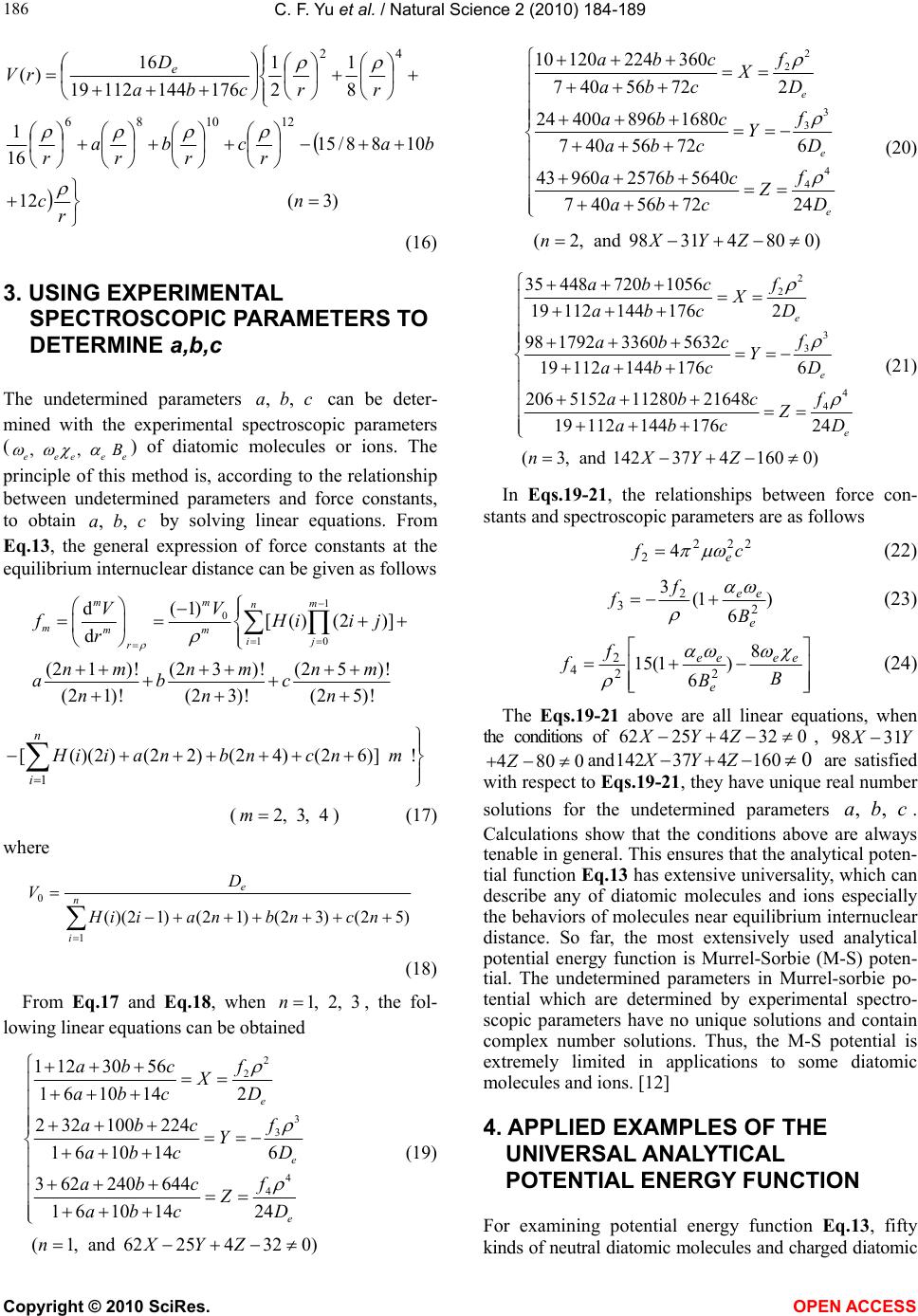 C. F. Yu et al. / Natural Science 2 (2010) 184-189 Copyright © 2010 SciRes. OPEN ACCESS 186 )3(12 1088/15 16 1 8 1 2 1 17614411219 16 )( 121086 42 n r c ba r c r b r a r rrcba D rV e (16) 3. USING EXPERIMENTAL SPECTROSCOPIC PARAMETERS TO DETERMINE a,b,c The undetermined parameters ,,abc can be deter- mined with the experimental spectroscopic parameters (eeeee B ,, ) of diatomic molecules or ions. The principle of this method is, according to the relationship between undetermined parameters and force constants, to obtain cba ,, by solving linear equations. From Eq.13, the general expression of force constants at the equilibrium internuclear distance can be given as follows 1 0 10 (1) d[() (2)] d (21)!(2 3)!(2 5)! (2 1)!(23)!(25)! m mm n mmm ij r V V f Hiij r nmn mn m ab c nnn !])62()42()22()2)(([ 1 mncnbnaiiH n i (4,3,2m) (17) where n i e ncnbnaiiH D V 1 0 )52()32()12()12)(( (18) From Eq.17 and Eq.18, when 3,2,1n, the fol- lowing linear equations can be obtained 2 2 3 3 4 4 1123056 1610 142 2 32100224 1610146 362240 644 1 6101424 (1,and 62254320) e e e f abc X abc D f abc Y abc D f abc Z abc D nXYZ (19) 2 2 3 3 4 4 10 120224360 74056 722 24 4008961680 74056 726 43 96025765640 74056 7224 (2,and 98314800) e e e f abc X abc D f ab c Y abc D f abc Z abc D nXYZ (20) 2 2 3 3 4 4 35 4487201056 19 1121441762 98 179233605632 191121441766 206 51521128021648 19 11214417624 (3,and1423741600) e e e f ab c X abc D f abc Y abc D f abc Z abc D nXYZ (21) In Eqs.19-21, the relationships between force con- stants and spectroscopic parameters are as follows 222 24cf e (22) ) 6 1( 3 2 2 3 e ee B f f (23) B B f fee e ee 8 ) 6 1(15 22 2 4 (24) The Eqs.19-21 above are all linear equations, when the conditions of 03242562 ZYX , 98 31 X Y 4800Z and 160437142 ZYX 0 are satisfied with respect to Eqs.19-21 , they have unique real number solutions for the undetermined parameters cba,, . Calculations show that the conditions above are always tenable in general. This ensures that the analytical poten- tial function Eq. 13 has extensive universality, which can describe any of diatomic molecules and ions especially the behaviors of molecules near equilibrium internuclear distance. So far, the most extensively used analytical potential energy function is Murrel-Sorbie (M-S) poten- tial. The undetermined parameters in Murrel-sorbie po- tential which are determined by experimental spectro- scopic parameters have no unique solutions and contain complex number solutions. Thus, the M-S potential is extremely limited in applications to some diatomic molecules and ions. [12] 4. APPLIED EXAMPLES OF THE UNIVERSAL ANALYTICAL POTENTIAL ENERGY FUNCTION For examining potential energy function Eq.13, fifty kinds of neutral diatomic molecules and charged diatomic 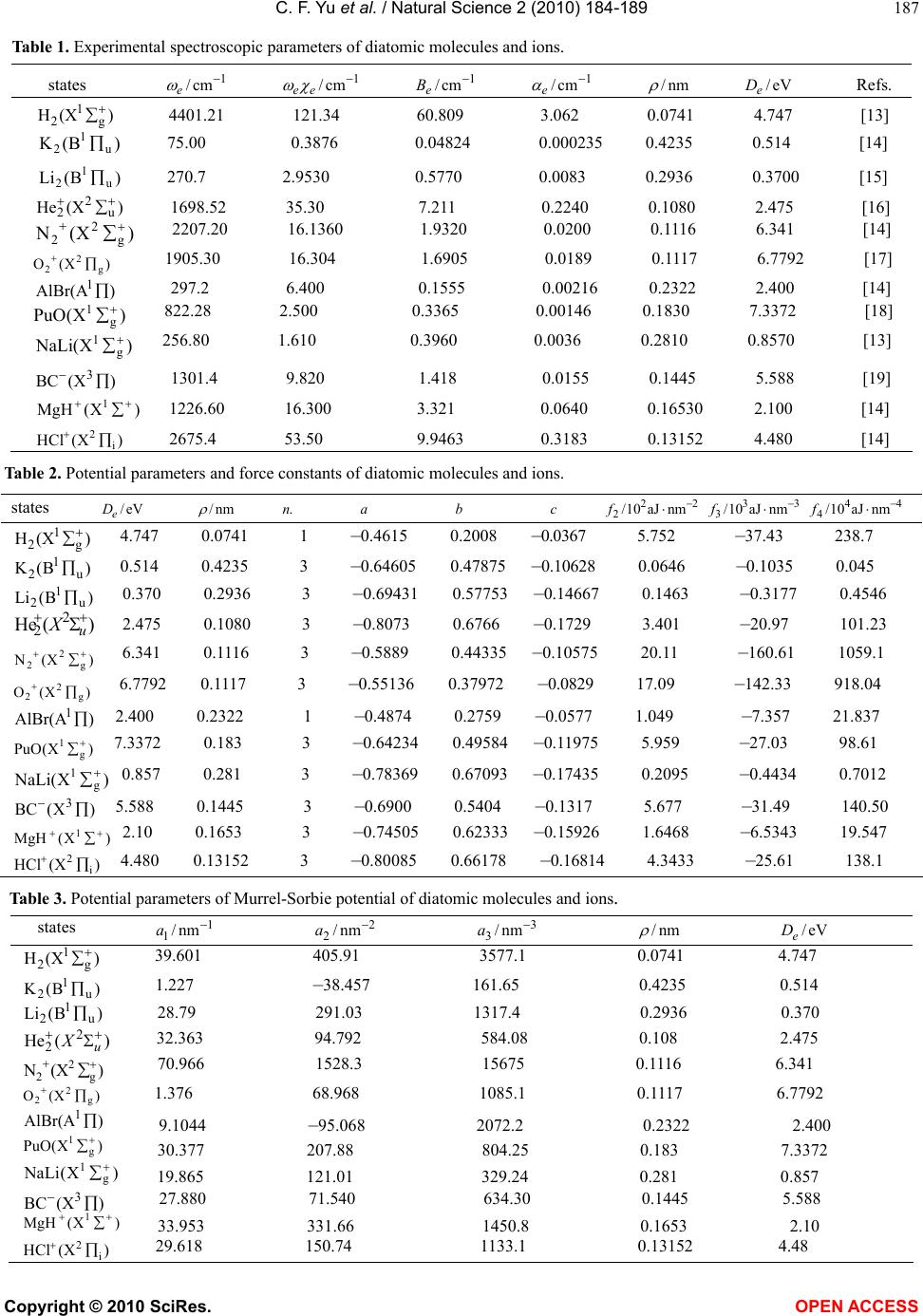 C. F. Yu et al. / Natural Science 2 (2010) 184-189 Copyright © 2010 SciRes. OPEN ACCESS 187 Table 1. Experimental spectroscopic parameters of diatomic molecules and ions. states eV/nm/cm/cm/cm/cm/ 1111 eeeeeeDB Refs. )(XH g 1 2 4401.21 121.34 60.809 3.062 0.0741 4.747 [13] )B(K u 1 2 75.00 0.3876 0.04824 0.000235 0.4235 0.514 [14] )B(Li u 1 2 270.7 2.9530 0.5770 0.0083 0.2936 0.3700 [15] )(XHe u 2 2 1698.52 35.30 7.211 0.2240 0.1080 2.475 [16] )X(Ng 2 2 2207.20 16.1360 1.9320 0.0200 0.1116 6.341 [14] )X(O g 2 2 1905.30 16.304 1.6905 0.0189 0.1117 6.7792 [17] )AlBr(A1 297.2 6.400 0.1555 0.00216 0.2322 2.400 [14] )X(PuO g 1 822.28 2.500 0.3365 0.00146 0.1830 7.3372 [18] )X(NaLi g 1 256.80 1.610 0.3960 0.0036 0.2810 0.8570 [13] )(XBC 3 1301.4 9.820 1.418 0.0155 0.1445 5.588 [19] )X(MgH 1 1226.60 16.300 3.321 0.0640 0.16530 2.100 [14] )X(HCli 2 2675.4 53.50 9.9463 0.3183 0.13152 4.480 [14] Table 2. Potential parameters and force constants of diatomic molecules and ions. states 44 4 33 3 22 2nmaJ10/nmaJ10/nmaJ10/.nm/eV/ fffcbanDe )(XH g 1 2 4.747 0.0741 1 –0.4615 0.2008 –0.0367 5.752 –37.43 238.7 )B(K u 1 2 0.514 0.4235 3 –0.64605 0.47875 –0.10628 0.0646 –0.1035 0.045 )B(Li u 1 2 0.370 0.2936 3 –0.69431 0.57753 –0.14667 0.1463 –0.3177 0.4546 )(He 2 2 u X 2.475 0.1080 3 –0.8073 0.6766 –0.1729 3.401 –20.97 101.23 )X(N g 2 2 6.341 0.1116 3 –0.5889 0.44335 –0.10575 20.11 –160.61 1059.1 )X(O g 2 2 6.7792 0.1117 3 –0.55136 0.37972 –0.0829 17.09 –142.33 918.04 )AlBr(A1 2.400 0.2322 1 –0.4874 0.2759 –0.0577 1.049 –7.357 21.837 )X(PuO g 1 7.3372 0.183 3 –0.64234 0.49584 –0.11975 5.959 –27.03 98.61 )X(NaLi g 1 0.857 0.281 3 –0.78369 0.67093 –0.17435 0.2095 –0.4434 0.7012 )X(BC 3 5.588 0.1445 3 –0.6900 0.5404 –0.1317 5.677 –31.49 140.50 )X(MgH1 2.10 0.1653 3 –0.74505 0.62333 –0.15926 1.6468 –6.5343 19.547 )X(HCli 2 4.480 0.13152 3 –0.80085 0.66178 –0.16814 4.3433 –25.61 138.1 Table 3. Potential parameters of Murrel-Sorbie potential of diatomic molecules and ions. states eV/nm/nm/nm/nm/ 3 3 2 2 1 1e Daaa )(XHg 1 2 39.601 405.91 3577.1 0.0741 4.747 )B(Ku 1 2 1.227 –38.457 161.65 0.4235 0.514 )B(Li u 1 2 28.79 291.03 1317.4 0.2936 0.370 )(He2 2u X 32.363 94.792 584.08 0.108 2.475 )X(N g 2 2 70.966 1528.3 15675 0.1116 6.341 )X(Og 2 2 1.376 68.968 1085.1 0.1117 6.7792 )AlBr(A1 9.1044 –95.068 2072.2 0.2322 2.400 )X(PuO g 1 30.377 207.88 804.25 0.183 7.3372 )X(NaLi g 1 19.865 121.01 329.24 0.281 0.857 ) ( XBC 3 27.880 71.540 634.30 0.1445 5.588 )X(MgH1 33.953 331.66 1450.8 0.1653 2.10 )X(HCl i 2 29.618 150.74 1133.1 0.13152 4.48 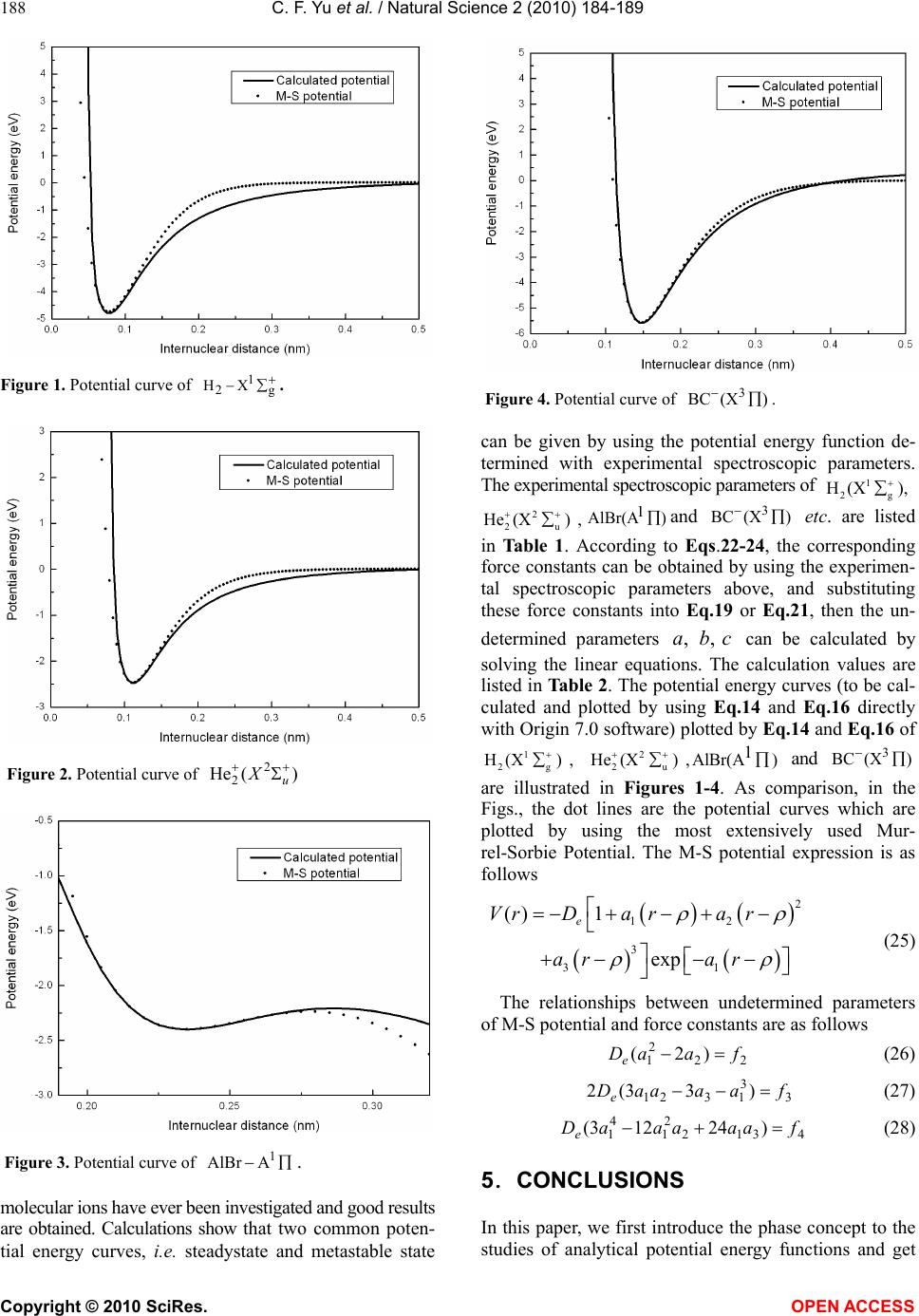 C. F. Yu et al. / Natural Science 2 (2010) 184-189 Copyright © 2010 SciRes. OPEN ACCESS 188 Figure 1. Potential curve of g 1 2XH. Figure 2. Potential curve of )(He 2 2 u X Figure 3. Potential curve of 1 AAlBr . molecular ions have ever been investigated and good results are obtained. Calculations show that two common poten- tial energy curves, i.e. steadystate and metastable state Figure 4. Potential curve of )(XBC 3 . can be given by using the potential energy function de- termined with experimental spectroscopic parameters. The experimental spectroscopic parameters of 1 2g H(X ), 2 2u He(X) , ) 1 AlBr(A and )(XBC 3 etc. are listed in Table 1. According to Eqs.22-24, the corresponding force constants can be obtained by using the experimen- tal spectroscopic parameters above, and substituting these force constants into Eq.19 or Eq.2 1, then the un- determined parameters ,, ba c can be calculated by solving the linear equations. The calculation values are listed in Table 2. The potential energy curves (to be cal- culated and plotted by using Eq.14 and Eq.16 directly with Origin 7.0 software) plotted by Eq.14 and Eq.16 of 1 2g H(X ), 2 2u 1 He(X), AlBr(A) and )(XBC 3 are illustrated in Figures 1-4. As comparison, in the Figs., the dot lines are the potential curves which are plotted by using the most extensively used Mur- rel-Sorbie Potential. The M-S potential expression is as follows 2 12 3 31 () 1 exp e VrDa rar ar ar (25) The relationships between undetermined parameters of M-S potential and force constants are as follows 22 2 1)2( faaDe (26) 3 3 1321 )33(2faaaaDe (27) 4312 2 1 4 1)24123(faaaaaDe (28) 5.CONCLUSIONS In this paper, we first introduce the phase concept to the studies of analytical potential energy functions and get 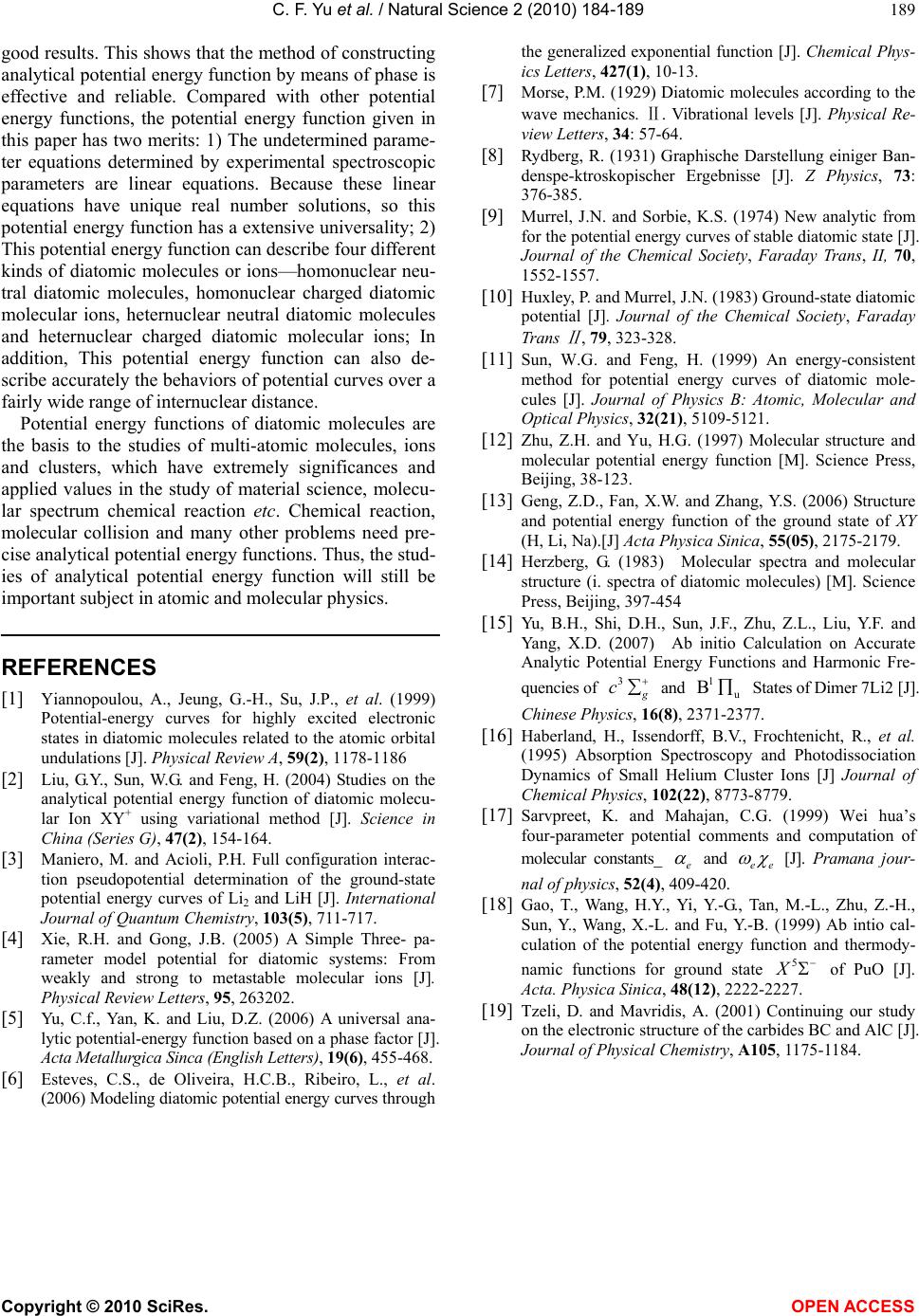 C. F. Yu et al. / Natural Science 2 (2010) 184-189 Copyright © 2010 SciRes. OPEN ACCESS 189 good results. This shows that the method of constructing analytical potential energy function by means of phase is effective and reliable. Compared with other potential energy functions, the potential energy function given in this paper has two merits: 1) The undetermined parame- ter equations determined by experimental spectroscopic parameters are linear equations. Because these linear equations have unique real number solutions, so this potential energy function has a extensive universality; 2) This potential energy function can describe four different kinds of diatomic molecules or ions—homonuclear neu- tral diatomic molecules, homonuclear charged diatomic molecular ions, heternuclear neutral diatomic molecules and heternuclear charged diatomic molecular ions; In addition, This potential energy function can also de- scribe accurately the behaviors of potential curves over a fairly wide range of internuclear distance. Potential energy functions of diatomic molecules are the basis to the studies of multi-atomic molecules, ions and clusters, which have extremely significances and applied values in the study of material science, molecu- lar spectrum chemical reaction etc. Chemical reaction, molecular collision and many other problems need pre- cise analytical potential energy functions. Thus, the stud- ies of analytical potential energy function will still be important subject in atomic and molecular physics. REFERENCES [1] Yiannopoulou, A., Jeung, G.-H., Su, J.P., et al. (1999) Potential-energy curves for highly excited electronic states in diatomic molecules related to the atomic orbital undulations [J]. Physical Review A, 59(2), 1178-1186 [2] Liu, G.Y., Sun, W.G. and Feng, H. (2004) Studies on the analytical potential energy function of diatomic molecu- lar Ion XY+ using variational method [J]. Science in China (Series G), 47(2), 154-164. [3] Maniero, M. and Acioli, P.H. Full configuration interac- tion pseudopotential determination of the ground-state potential energy curves of Li2 and LiH [J]. International Journal of Quantum Chemistry, 103(5), 711-717. [4] Xie, R.H. and Gong, J.B. (2005) A Simple Three- pa- rameter model potential for diatomic systems: From weakly and strong to metastable molecular ions [J]. Physical Review Letters, 95, 263202. [5] Yu, C.f., Yan, K. and Liu, D.Z. (2006) A universal ana- lytic potential-energy function based on a phase factor [J]. Acta Metallurgica Sinca (English Letters), 19(6), 455-468. [6] Esteves, C.S., de Oliveira, H.C.B., Ribeiro, L., et al. (2006) Modeling diatomic potential energy curves through the generalized exponential function [J]. Chemical Phys- ics Letters, 427(1), 10-13. [7] Morse, P.M. (1929) Diatomic molecules according to the wave mechanics. Ⅱ. Vibrational levels [J]. Physical Re- view Letters, 34: 57-64. [8] Rydberg, R. (1931) Graphische Darstellung einiger Ban- denspe-ktroskopischer Ergebnisse [J]. Z Physics, 73: 376-385. [9] Murrel, J.N. and Sorbie, K.S. (1974) New analytic from for the potential energy curves of stable diatomic state [J]. Journal of the Chemical Society, Faraday Trans, II, 70, 1552-1557. [10] Huxley, P. and Murrel, J.N. (1983) Ground-state diatomic potential [J]. Journal of the Chemical Society, Faraday Trans Ⅱ , 79, 323-328. [11] Sun, W.G. and Feng, H. (1999) An energy-consistent method for potential energy curves of diatomic mole- cules [J]. Journal of Physics B: Atomic, Molecular and Optical Physics, 32(21), 5109-5121. [12] Zhu, Z.H. and Yu, H.G. (1997) Molecular structure and molecular potential energy function [M]. Science Press, Beijing, 38-123. [13] Geng, Z.D., Fan, X.W. and Zhang, Y.S. (2006) Structure and potential energy function of the ground state of XY (H, Li, Na).[J] Acta Physica Sinica, 55(05), 2175-2179. [14] Herzberg, G. (1983) Molecular spectra and molecular structure (i. spectra of diatomic molecules) [M]. Science Press, Beijing, 397-454 [15] Yu, B.H., Shi, D.H., Sun, J.F., Zhu, Z.L., Liu, Y.F. and Yang, X.D. (2007) Ab initio Calculation on Accurate Analytic Potential Energy Functions and Harmonic Fre- quencies of 3 g c and 1 u B States of Dimer 7Li2 [J]. Chinese Physics, 16(8), 2371-2377. [16] Haberland, H., Issendorff, B.V., Frochtenicht, R., et al. (1995) Absorption Spectroscopy and Photodissociation Dynamics of Small Helium Cluster Ions [J] Journal of Chemical Physics, 102(22), 8773-8779. [17] Sarvpreet, K. and Mahajan, C.G. (1999) Wei hua’s four-parameter potential comments and computation of molecular constants_ e and ee [J]. Pramana jour- nal of physics, 52(4), 409-420. [18] Gao, T., Wang, H.Y., Yi, Y.-G., Tan, M.-L., Zhu, Z.-H., Sun, Y., Wang, X.-L. and Fu, Y.-B. (1999) Ab intio cal- culation of the potential energy function and thermody- namic functions for ground state 5 X of PuO [J]. Acta. Physica Sinica, 48(12), 2222-2227. [19] Tzeli, D. and Mavridis, A. (2001) Continuing our study on the electronic structure of the carbides BC and AlC [J]. Journal of Physical Chemistry, A105, 1175-1184. |