

Paper Menu >>
Journal Menu >>
 Vol.2, No.3, 155-159 (2010) Natural Science http://dx.doi.org/10.4236/ns.2010.23025 Copyright © 2010 SciRes. OPEN ACCESS Seismo-Microplasticity phenomenon in the rocks* Eduard Innokentevich Mashinskii Institute of Petroleum Geology and Geophysics, Siberian Branch of the RAS, Novosibirsk, Russia; [email protected] Received 26 November 2009; revised 8 January 2010; accepted 30 January 2010. ABSTRACT The seismic records of borehole-to-borehole me- asurements on frequency of 200 Hz in the mi- crostrain range have been analysed. Microplas- ticity manifestations caused by seismic wave are detected on seismic records. It is the lad- der-like stepwise change in amplitude course in some parts of the seismic trace. The step dura- tion (time plateau) presents the amplitude- dependent time delay that shifts the arrival time and protracts pulse front. The microplastic process occurs owing to the anomalous re- alignment of the internal stresses on the micro- structural defects in “elastic” domain. Result is the useful contribution for improvement of the theory of wave attenuation in the rocks. It can also be used in solving the applied problems in material science, seismic prospecting, diagnos- tics etc. Keywords: Anelasticity; Deformation And Time Delay; Anelastic Seismic Parameters; Amplitude Dependence Of Wave Velocity And Attenuation 1. INTRODUCTION Perfection of the wave attenuation mechanisms is up to now one of main tasks in Earth’s sciences. For under- standing attenuation mechanisms, the new knowledge is necessary about the rock anelasticity. Viscoelastic model of standard linear solid well describes the dispersion and relaxation but insufficiently correctly explains, for ex- ample, the amplitude-dependent effects. So, there are some contradictions relative to character of amplitude dependences of wave velocity and attenuation. There are data about decrease of wave velocity and increase in attenuation with increasing amplitude [1-4]. However, there are also facts when increase in the strain amplitude leads on the contrary to the increase in wave velocity and decrease in attenuation [5-9]. Detection of the quasi-static rock microplasticity has strengthened supposition about some unknown factor in charge of the amplitude dependence of seismic parame- ters [10-12]. It is necessary to mark that in Earth’s sci- ences the microplastic anelasticity is not yet the gener- ally accepted fact as against solid-state physics. In con- trast to the viscoelasticity, microplasticity appears only when stress reaches critical value. The microplastic strain can increase and decrease, appear and vanish during increasing stress. The amplitude-dependent effects in rocks and quartz crystals were interpreted as indirect attributes of microplasticity that is possible even on the small strain amplitudes [13,14]. Assumption about mi- croplasticity processes during seismic wave propagation was also made in works [15-16]. The direct testimony of seismic microplasticity was received in borehole-to-borehole measurements during the amplitude effect study [17]. This paper describes mi- croplasticity manifestations detected on the seismic traces in result of the detailed analysis of the field materials. 2. EXPERIMENTS AND DATA ANALYSIS The propagation of seismic pulse with diverse amplitudes in the area between two boreholes was studied. The ex- periments were performed in the Bystrovka research area. The measuring instruments were mounted in two bore- holes 110 mm in diameter and 12 m depth spaced 7 m. A source was located in one of the boreholes and a receiver, in the other. The source in borehole 1 and receiver in borehole 2 were successively installed at depth of 2, 6, and 10 m. Detailed description is in the work [17]. The upper part of the section is comparatively homogeneous and is composed of loams as far as a depth of a few tens of meters. Rock is partially water-saturated as far as 8.5 m with compressional wave velocity Vp = 240 – 300 m/sec. After the depth – 9 m the wave travels in completely wa- ter-saturated loams with Vp = 1500 m/sec. The measurements were made in accordance with the following procedure. The source and the receiver were successively located at depths of 2, 6, and 10 m in the diverse combinations. Such source-receiver configura- tion enables to study the pulse propagation in the differ- ent direction. Basic seismic records were made on the location of source–receiver in the lateral (horizontal) *This work was performed with the support of the Russian Fund of Fun- damental Researches, grant N 05-09-00405. 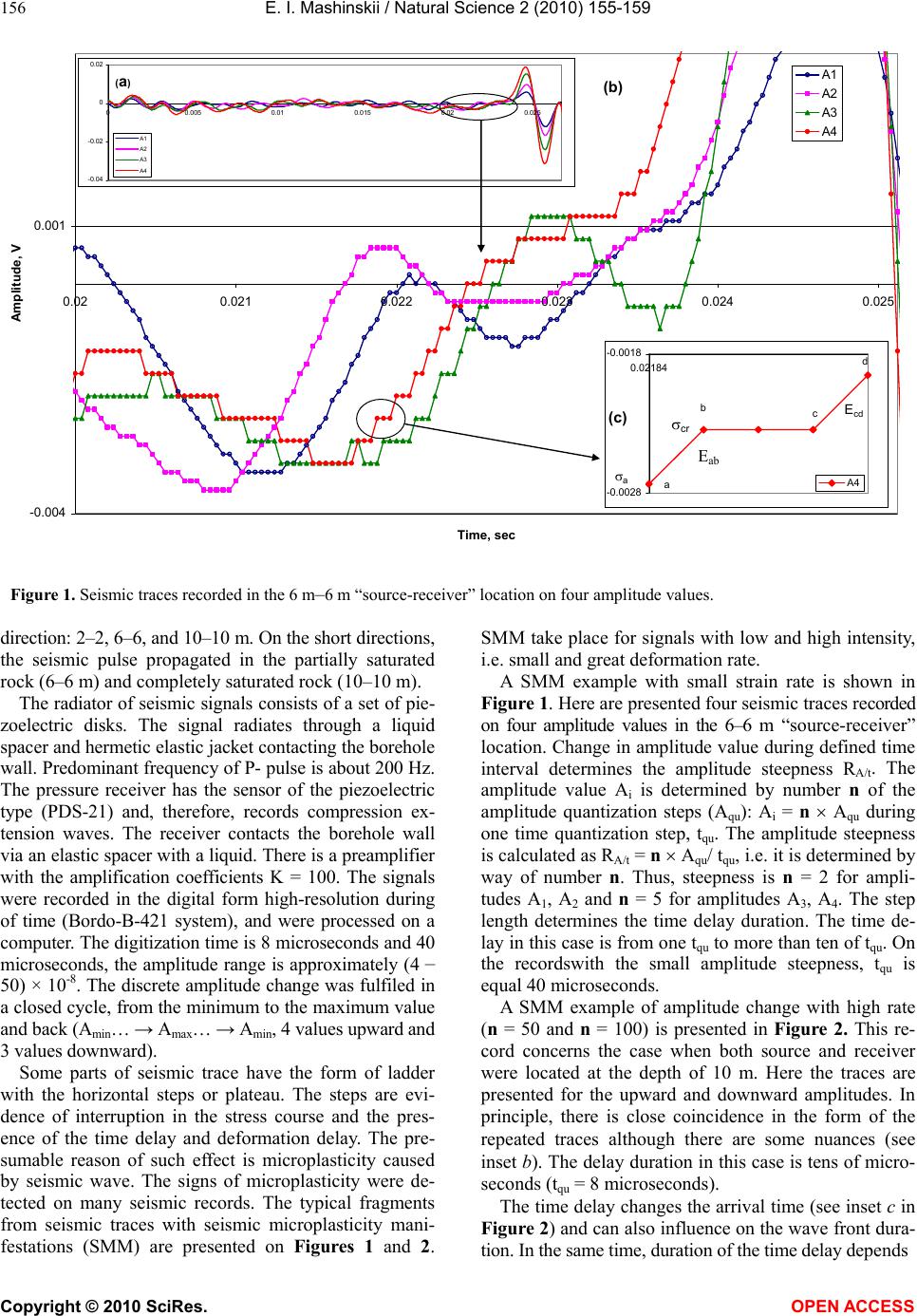 E. I. Mashinskii / Natural Science 2 (2010) 155-159 Copyright © 2010 SciRes. OPEN ACCESS 156 -0.004 0.001 0.020.021 0.022 0.023 0.024 0.025 Time, sec Amplitude, V A1 A2 A3 A4 -0.04 -0.02 0 0.02 00.005 0.01 0.015 0.02 0.025 A1 A2 A3 A4 ( a ) -0.0028 -0.0018 0.02184 A4 (c) a bc a cr E a d E cd (b) Figure 1. Seismic traces recorded in the 6 m–6 m “source-receiver” location on four amplitude values. direction: 2–2, 6–6, and 10–10 m. On the short directions, the seismic pulse propagated in the partially saturated rock (6–6 m) and completely saturated rock (10–10 m). The radiator of seismic signals consists of a set of pie- zoelectric disks. The signal radiates through a liquid spacer and hermetic elastic jacket contacting the borehole wall. Predominant frequency of P- pulse is about 200 Hz. The pressure receiver has the sensor of the piezoelectric type (PDS-21) and, therefore, records compression ex- tension waves. The receiver contacts the borehole wall via an elastic spacer with a liquid. There is a preamplifier with the amplification coefficients K = 100. The signals were recorded in the digital form high-resolution during of time (Bordo-B-421 system), and were processed on a computer. The digitization time is 8 microseconds and 40 microseconds, the amplitude range is approximately (4 – 50) × 10-8. The discrete amplitude change was fulfiled in a closed cycle, from the minimum to the maximum value and back (Amin… → Amax… → Amin, 4 values upward and 3 values downward). Some parts of seismic trace have the form of ladder with the horizontal steps or plateau. The steps are evi- dence of interruption in the stress course and the pres- ence of the time delay and deformation delay. The pre- sumable reason of such effect is microplasticity caused by seismic wave. The signs of microplasticity were de- tected on many seismic records. The typical fragments from seismic traces with seismic microplasticity mani- festations (SMM) are presented on Figures 1 and 2. SMM take place for signals with low and high intensity, i.e. small and great deformation rate. A SMM example with small strain rate is shown in Figure 1. Here are presented four seismic traces recorded on four amplitude values in the 6–6 m “source-receiver” location. Change in amplitude value during defined time interval determines the amplitude steepness RA/t. The amplitude value Ai is determined by number n of the amplitude quantization steps (Aqu): Ai = n Aqu during one time quantization step, tqu. The amplitude steepness is calculated as RA/t = n Aqu/ tqu, i.e. it is determined by way of number n. Thus, steepness is n = 2 for ampli- tudes A1, A2 and n = 5 for amplitudes A3, A4. The step length determines the time delay duration. The time de- lay in this case is from one tqu to more than ten of tqu. On the recordswith the small amplitude steepness, tqu is equal 40 microseconds. A SMM example of amplitude change with high rate (n = 50 and n = 100) is presented in Figure 2. This re- cord concerns the case when both source and receiver were located at the depth of 10 m. Here the traces are presented for the upward and downward amplitudes. In principle, there is close coincidence in the form of the repeated traces although there are some nuances (see inset b). The delay duration in this case is tens of micro- seconds (tqu = 8 microseconds). The time delay changes the arrival time (see inset c in Figure 2) and can also influence on the wave front dura- tion. In the same time, duration of the time delay depends Eab 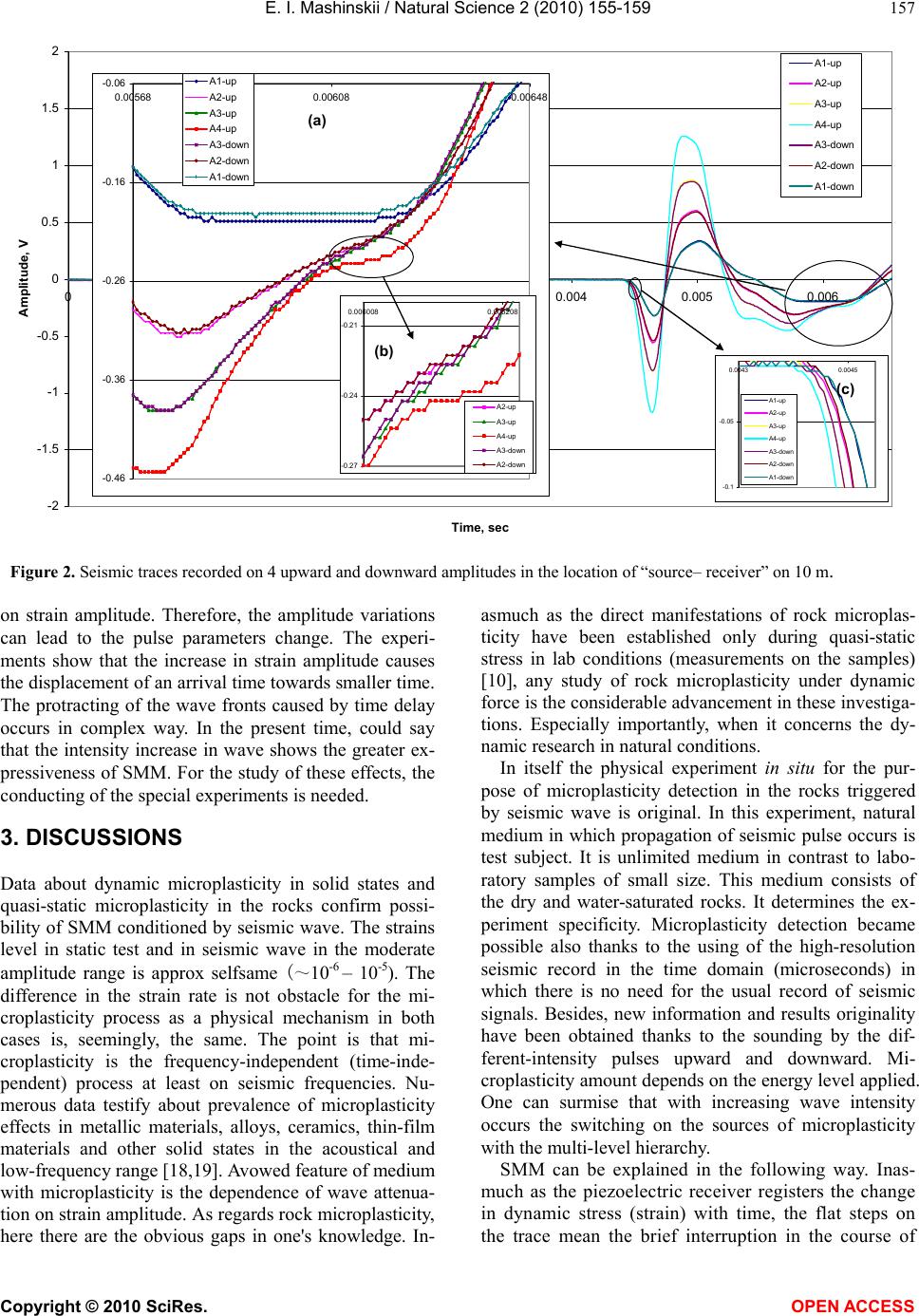 E. I. Mashinskii / Natural Science 2 (2010) 155-159 Copyright © 2010 SciRes. OPEN ACCESS 157 -2 -1.5 -1 -0.5 0 0.5 1 1.5 2 00.001 0.002 0.003 0.004 0.005 0.006 Time, sec Amplitude, V A1-up A2-up A3-up A4-up A3-down A2-down A1-down -0.46 -0.36 -0.26 -0.16 -0.06 0.00568 0.00608 0.00648 A1-up A2-up A3-up A4-up A3-down A2-down A1-down (a) -0.27 -0.24 -0.21 0.006008 0.006208 A2-up A3-up A4-up A3-down A2-down (b) -0.1 -0.05 0.0043 0.0045 A1-up A2-up A3-up A4-up A3-down A2-down A1-down (c) Figure 2. Seismic traces recorded on 4 upward and downward amplitudes in the location of “source– receiver” on 10 m. on strain amplitude. Therefore, the amplitude variations can lead to the pulse parameters change. The experi- ments show that the increase in strain amplitude causes the displacement of an arrival time towards smaller time. The protracting of the wave fronts caused by time delay occurs in complex way. In the present time, could say that the intensity increase in wave shows the greater ex- pressiveness of SMM. For the study of these effects, the conducting of the special experiments is needed. 3. DISCUSSIONS Data about dynamic microplasticity in solid states and quasi-static microplasticity in the rocks confirm possi- bility of SMM conditioned by seismic wave. The strains level in static test and in seismic wave in the moderate amplitude range is approx selfsame (~10-6 – 10-5). The difference in the strain rate is not obstacle for the mi- croplasticity process as a physical mechanism in both cases is, seemingly, the same. The point is that mi- croplasticity is the frequency-independent (time-inde- pendent) process at least on seismic frequencies. Nu- merous data testify about prevalence of microplasticity effects in metallic materials, alloys, ceramics, thin-film materials and other solid states in the acoustical and low-frequency range [18,19]. Avowed feature of medium with microplasticity is the dependence of wave attenua- tion on strain amplitude. As regards rock microplasticity, here there are the obvious gaps in one's knowledge. In- asmuch as the direct manifestations of rock microplas- ticity have been established only during quasi-static stress in lab conditions (measurements on the samples) [10], any study of rock microplasticity under dynamic force is the considerable advancement in these investiga- tions. Especially importantly, when it concerns the dy- namic research in natural conditions. In itself the physical experiment in situ for the pur- pose of microplasticity detection in the rocks triggered by seismic wave is original. In this experiment, natural medium in which propagation of seismic pulse occurs is test subject. It is unlimited medium in contrast to labo- ratory samples of small size. This medium consists of the dry and water-saturated rocks. It determines the ex- periment specificity. Microplasticity detection became possible also thanks to the using of the high-resolution seismic record in the time domain (microseconds) in which there is no need for the usual record of seismic signals. Besides, new information and results originality have been obtained thanks to the sounding by the dif- ferent-intensity pulses upward and downward. Mi- croplasticity amount depends on the energy level applied. One can surmise that with increasing wave intensity occurs the switching on the sources of microplasticity with the multi-level hierarchy. SMM can be explained in the following way. Inas- much as the piezoelectric receiver registers the change in dynamic stress (strain) with time, the flat steps on the trace mean the brief interruption in the course of  158 E. I. Mashinskii / Natural Science 2 (2010) 155-159 Copyright © 2010 SciRes. OPEN ACCESS stress. Such stress stop supposes similar stop on the stress-strain curve that can occur owing to the mi- croplasticity process. Total strain = e + µ + v-e in the small-strain range consists mainly of elastic and microplastic component (e + µ), as viscoelastic com- ponent v-e is comparatively small [10,11]. During loading (or unloading), both components have own contribution to the total strain. The stop in the course of stress occurs when the stress reaches some critical value σcr (for example, in the point b see inset (b) in Figure 1). At that moment, the redistribution of con- tribution between components occurs thus that contri- bution of the microplastic component become pre- dominant. In the extreme case, the strain increment occurs only thanks to microplasticity as the increment due to the elastic deformation does not occur at all [10]. Therefore, the yield process is also possible. The re- grouping in components occurs thus that effective modulus Eab and accordingly the stress and strain re- main invariable during interval b – c. It is possible ow- ing to the distinctive feature of rock microplasticity that can both increase and decrease or even vanish during stress. In the point c after delay, the stress recom- mences own course with the same modulus. There is the hierarchical set of the diverse critical stresses that switch on the microplasticity sources when amplitude increases (decreases). Thus, seismic wave switches on the process of the anomalous redistribution of stresses and strains and respectively adequate to it process of the structural realignment in the rock. It takes a definite time that leads to deformation delay. In order to ex- clude the instrumental factor in appraisal of SMM, the amplitude error of analog-digital converter is checked. Testing of this device shows that the own error in pla- teau duration does not exceed 2 microseconds in the broad range of the amplitude steepness. Similar deformation stops caused by microplasticity were detected in C60 single crystals [20]. It is shown that magnetic field manipulations lead to a change in the strain rate, the decrease in the rate being accompanied by a brief interruption of deformation. The deformation delay (incubation period) was observed also in the high-temperature superconductors, possessing by mi- croplasticity [21]. Delay appearance is bound with pres- ence of opposite internal stresses for decrease of which time is required. The wave attenuation mechanism in the rock with microplasticity (referring to the experiments [10]) is theoretically substantiated also in work [22]. As regards the mechanism of wave attenuation, the combi- nation of known mechanisms is possible, for instance, as the hybrid relaxation-hysteresis mechanism [12]. It must not be ruled out also the acoustoplastic effect in the rocks as in metals and alloys [23]. The instance of stress jumps marked on seismic record evokes the great cau- tion in interpretation of this effect, and therefore for the time being, we do not examine this question. 4. CONCLUSIONS The result of this work is the new knowledge about na- ture of propagation of the mechanical oscillations in the Earth. The unnoticed heretofore presence in seismic re- cord of microplasticity manifestations was detected thanks to the high-resolution signals measurements. The quasi-static microplasticity of the rocks, dynamic mi- croplasticity of many solid states denoted the prospect of our search. The dynamic microplasticity in the rocks definitely is bound with critical amplitudes but its de- pendence on strain rate is not yet established. One may surmise data about rock microplasticity will enlarge the comprehension of some known effects that had not for- merly of the satisfactory physical explanation. We see it now in the delay effect of the arrival time and the pulse shortening-widening. As stated above, the nature of microplasticity in the rocks can coincide with known mechanisms in the solid states (for instance, dislocation microplasticity) or to be quite other (quasi-microplasticity). In the last case in spite of the difference in mechanism, the microplasticity manifestations can be the same as in usual solid states. This question requires subsequent clarification. Microplas- ticity affects the little-known anelastic processes of the small-amplitude wave propagation. The new knowledge about nonlinear-anelastic processes during wave propa- gation will help in discovery of new diagnostic indica- tions permissive to increase the efficiency of seismic method for search of oil-gas deposits. 5. ACKNOWLEDGMENT The author thanks G.V. Egorov for the help in the experimental work. REFERENCES [1] Mavko, G.M. (1979) Friction attenuation: An inherent amplitude dependence. Journal of Geophysical Research, 84(9), 4769-4775. [2] Winkler, K.W., Nur, A. and Gladwin, M. (1998) Friction and seismic attenuation in rock. Nature, 274, 528-531, 1979. [3] Tutuncu, A.N., Podio, A.L. and M.M. (1994) Sharma An experimental investigation of factors influencing co- mpressional- and shear-wave velocities and attenuations in tight gas sandstones. Geophysics, 59(1), 77-86. [4] Ostrovsky, L.A. and Johnson, P.A. (2001) Dynamic nonlinear elasticity in geomaterials. La Rivista del Nuovo Cimento, 24(4), 7. [5] Johnston, D.H. and Toksoz, M.N. (1980) Thermal cracking and amplitude dependent attenuation. Journal of  E. I. Mashinskii / Natural Science 2 (2010) 155-159 159 Copyright © 2010 SciRes. OPEN ACCESS Geophysical Research, 85, 937-942. [6] Mashinskii, E.I., Koksharov, V.Z. and Nefedkin, Y.A. (1999) Amplitude-dependent effects in the range of small seismic strains. Geologiya i Geofizika, 40, 611-618. [7] Mashinskii, E.I. (2004) The variants of the strain- amplitude dependence of elastic wave velocities in the rocks under pressure. Journal of Geophysics and Engineering, 1, 295-306. [8] Mashinskii, E.I. (2007a) Effect of strain amplitude on the relaxation spectra of attenuation in the dry and saturated sandstone under pressure. Journal of Geophysics and Engineering, 4, 194-203. [9] Zaitsev, V.Y., Nazarov, V.E. and Talanov, V.I. (1999) Experimental study of the self-action of seismoacoustic waves. Acoustic Physics, 45(6), 720-726. [10] Mashinsky, E.I. (1994) Quasi-micro-plasticity processes and nonlinear seismicity. Physics of the Solid Earth, 30, 97-102. [11] Mashinskii, E.I. (2005b) Non-linear stress-strain relation in sedimentary rocks and its effect on seismic wave velocity. Geophysica, 41(1,2), 3-17. [12] Mashinskii, E.I. (2006) Nonlinear amplitude-frequency characteristics of attenuation in rock under pressure. Journal of Geophysics and Engineering, 3, 291-306. [13] Mashinskii, E.I. (2005a) Experimental study of the amplitude effect on wave velocity and attenuation in consolidated rocks under confining pressure. Journal of Geophysics and Engineering, 2, 199-212. [14] Mashinskii, E.I. (2008) Amplitude-frequency depende- ncies of wave attenuation in single-crystal quartz: Exp- erimental study. Journal of Geophysical Research, 113, B11304. [15] Xu, H., Day, S.M. and Minster, J.-B.H. Model for nonlinear wave propagation derived from rock hysteresis measurements. Journal of Geophysical Research, 103(B12), 29,915-29,929. [16] Braccini, S., et al. (2000) The maraging-steel blades of the Virgo super attenuator. Measurement Science and Technology, 11, 467-476. [17] Mashinskii, E.I. (2007) Amplitude-dependent effects of Longitudinal Seismic Wave Propagation in the Interhole Space. Izvestya, Physics of the Solid Earth, 43(8), 683-690. [18] Nishino, Y. and Asano, S. (1996) Amplitude-dependent internal friction and microplasticity in thin-film materials. Journal de Physique IV, 6, 783-786. [19] Golovin, I.S., Sinning, H.-R., Goken, J. and Riehemann, W. (2004) Fatigue-related damping in some cellular metallic materials. Materials Science and Engineering, A370, 537-541. [20] Smirnov, B.I., Shpeizman, V.V., Peschanskaya, N.N. and Nikolaev, R.K. (2002) Effect of magnetic field on microplastic strain rate for C60 single crystals. Physics of the Solid State, 44(10), 2009-2012. [21] Davies, P.W. and Wilshire, B. (1971) On internal stress measurement and the mechanism of high temperature creep. Scripta Metallurgica, 5(6), 475-478. [22] Yarushina, V.M. and Podladchikov, Y.Y. (2008) Micriscale yielding as mechanism for low-frequency imtrinsic seismic wave attenuation. 70th EAGE Conference & Exhibition, Rome, Italy, 9-12 June. [23] Sapozhnikov, K.V., Vetrov, V.V., Pulnev, S.A. and Kustov, S.B. (1996) Acousto-pseudoelastic effect and internal friction during stress-induced martensitic transformations in Cu-Al-Ni single crystals. Scripta Materialia, 34(10), 1543. |