

Paper Menu >>
Journal Menu >>
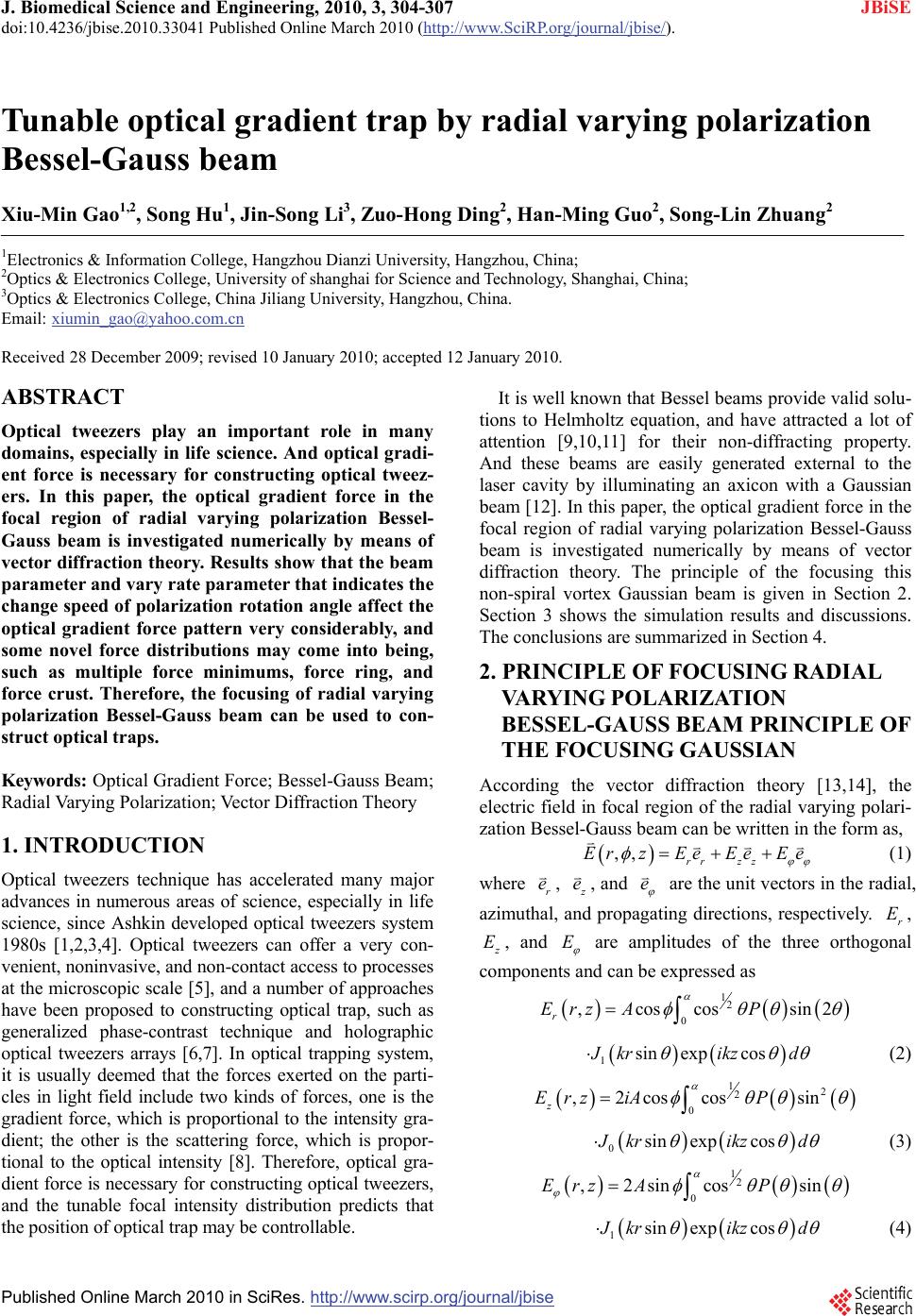 J. Biomedical Science and Engineering, 2010, 3, 304-307 doi:10.4236/jbise.2010.33041 Published Online March 2010 (http://www.SciRP.org/journal/jbise/ JBiSE ). Published Online March 2010 in SciRes. http://www.scirp.org/journal/jbise Tunable optical gradient trap by radial varying polarization Bessel-Gauss beam Xiu-Min Gao1,2, Song Hu1, Jin-Song Li3, Zuo-Hong Ding2, Han-Ming Guo2, Song-Lin Zhuang2 1Electronics & Information College, Hangzhou Dianzi University, Hangzhou, China; 2Optics & Electronics College, University of shanghai for Science and Technology, Shanghai, China; 3Optics & Electronics College, China Jiliang University, Hangzhou, China. Email: [email protected] Received 28 December 2009; revised 10 January 2010; accepted 12 January 2010. ABSTRACT Optical tweezers play an important role in many domains, especially in life science. And optical gradi- ent force is necessary for constructing optical tweez- ers. In this paper, the optical gradient force in the focal region of radial varying polarization Bessel- Gauss beam is investigated numerically by means of vector diffraction theory. Results show that the beam parameter and vary rate parameter that indicates the change speed of polarization rotation angle affect the optical gradient force pattern very considerably, and some novel force distributions may come into being, such as multiple force minimums, force ring, and force crust. Therefore, the focusing of radial varying polarization Bessel-Gauss beam can be used to con- struct optical traps. Keywords: Optical Gradient Force; Bessel-Gauss Beam; Radial Varying Polarization; Vector Diffraction Theory 1. INTRODUCTION Optical tweezers technique has accelerated many major advances in numerous areas of science, especially in life science, since Ashkin developed optical tweezers system 1980s [1,2,3,4]. Optical tweezers can offer a very con- venient, noninvasive, and non-contact access to processes at the microscopic scale [5], and a number of approaches have been proposed to constructing optical trap, such as generalized phase-contrast technique and holographic optical tweezers arrays [6,7]. In optical trapping system, it is usually deemed that the forces exerted on the parti- cles in light field include two kinds of forces, one is the gradient force, which is proportional to the intensity gra- dient; the other is the scattering force, which is propor- tional to the optical intensity [8]. Therefore, optical gra- dient force is necessary for constructing optical tweezers, and the tunable focal intensity distribution predicts that the position of optical trap may be controllable. It is well known that Bessel beams provide valid solu- tions to Helmholtz equation, and have attracted a lot of attention [9,10,11] for their non-diffracting property. And these beams are easily generated external to the laser cavity by illuminating an axicon with a Gaussian beam [12]. In this paper, the optical gradient force in the focal region of radial varying polarization Bessel-Gauss beam is investigated numerically by means of vector diffraction theory. The principle of the focusing this non-spiral vortex Gaussian beam is given in Section 2. Section 3 shows the simulation results and discussions. The conclusions are summarized in Section 4. 2. PRINCIPLE OF FOCUSING RADIAL VARYING POLARIZATION BESSEL-GAUSS BEAM PRINCIPLE OF THE FOCUSING GAUSSIAN According the vector diffraction theory [13,14], the electric field in focal region of the radial varying polari- zation Bessel-Gauss beam can be written in the form as, ,, rr zz ErzEe Ee Ee (1) where r e , z e , and e are the unit vectors in the radial, azimuthal, and propagating directions, respectively. , r E z E, and E are amplitudes of the three orthogonal components and can be expressed as 12 0 ,coscos sin2 r Erz AP 1sin expcos J krikz d (2) 12 2 0 ,2coscos sin z Erz iAP 0sin expcos J krikz d (3) 12 0 ,2 sincossinErz AP 1sin expcos J krikz d (4) 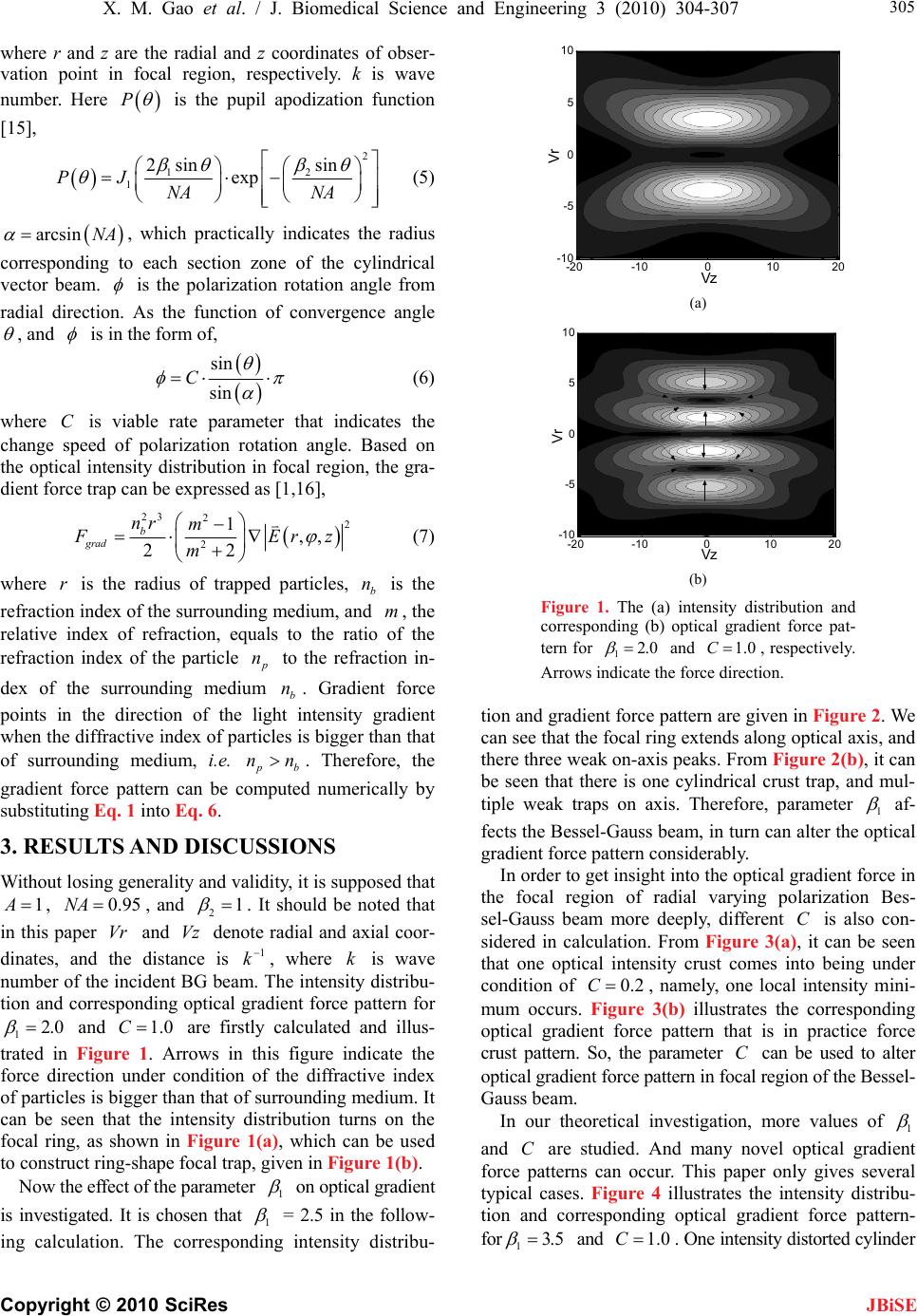 X. M. Gao et al. / J. Biomedical Science and Engineering 3 (2010) 304-307 Copyright © 2010 SciRes 305 JBiSE where r and z are the radial and z coordinates of obser- vation point in focal region, respectively. k is wave number. Here P is the pupil apodization function [15], 2 12 1 2sin sin expPJ NA NA (5) arcsin NA , which practically indicates the radius corresponding to each section zone of the cylindrical vector beam. is the polarization rotation angle from radial direction. As the function of convergence angle , and is in the form of, sin sin C (6) where is viable rate parameter that indicates the change speed of polarization rotation angle. Based on the optical intensity distribution in focal region, the gra- dient force trap can be expressed as [1,16], C 23 22 2 1,, 22 b grad nr m F Er z m (7) where is the radius of trapped particles, is the refraction index of the surrounding medium, and , the relative index of refraction, equals to the ratio of the refraction index of the particle rb n m p n to the refraction in- dex of the surrounding medium . Gradient force points in the direction of the light intensity gradient when the diffractive index of particles is bigger than that of surrounding medium, i.e. b n p b nn. Therefore, the gradient force pattern can be computed numerically by substituting Eq. 1 into Eq. 6. 3. RESULTS AND DISCUSSIONS Without losing generality and validity, it is supposed that 1 A , , and 0.95NA 21 k . It should be noted that in this paper and Vz denote radial and axial coor- dinates, and the distance is , where is wave number of the incident BG beam. The intensity distribu- tion and corresponding optical gradient force pattern for Vr 0 1k 12. and are firstly calculated and illus- trated in Figure 1. Arrows in this figure indicate the force direction under condition of the diffractive index of particles is bigger than that of surrounding medium. It can be seen that the intensity distribution turns on the focal ring, as shown in Figure 1(a), which can be used to construct ring-shape focal trap, given in Figure 1(b). 1.0C Now the effect of the parameter 1 on optical gradient is investigated. It is chosen that 1 = 2.5 in the follow- ing calculation. The corresponding intensity distribu- -20 -10 010 20 -10 -5 0 5 10 Vr Vz (a) Vz -20 -10 010 20 -10 -5 0 5 10 Vr Vz (b) Figure 1. The (a) intensity distribution and corresponding (b) optical gradient force pat- tern for 12.0 and , respectively. Arrows indicate the force direction. 1.0C tion and gradient force pattern are given in Figure 2. We can see that the focal ring extends along optical axis, and there three weak on-axis peaks. From Figure 2(b), it can be seen that there is one cylindrical crust trap, and mul- tiple weak traps on axis. Therefore, parameter 1 af- fects the Bessel-Gauss beam, in turn can alter the optical gradient force pattern considerably. In order to get insight into the optical gradient force in the focal region of radial varying polarization Bes- sel-Gauss beam more deeply, different is also con- sidered in calculation. From Figure 3(a), it can be seen that one optical intensity crust comes into being under condition of C 0.2C , namely, one local intensity mini- mum occurs. Figure 3(b) illustrates the corresponding optical gradient force pattern that is in practice force crust pattern. So, the parameter can be used to alter optical gradient force pattern in focal region of the Bessel- Gauss beam. C In our theoretical investigation, more values of 1 and are studied. And many novel optical gradient force patterns can occur. This paper only gives several typical cases. Figure 4 illustrates the intensity distribu- tion and corresponding optical gradient force pattern- for C 13.5 and 1.0C . One intensity distorted cylinder 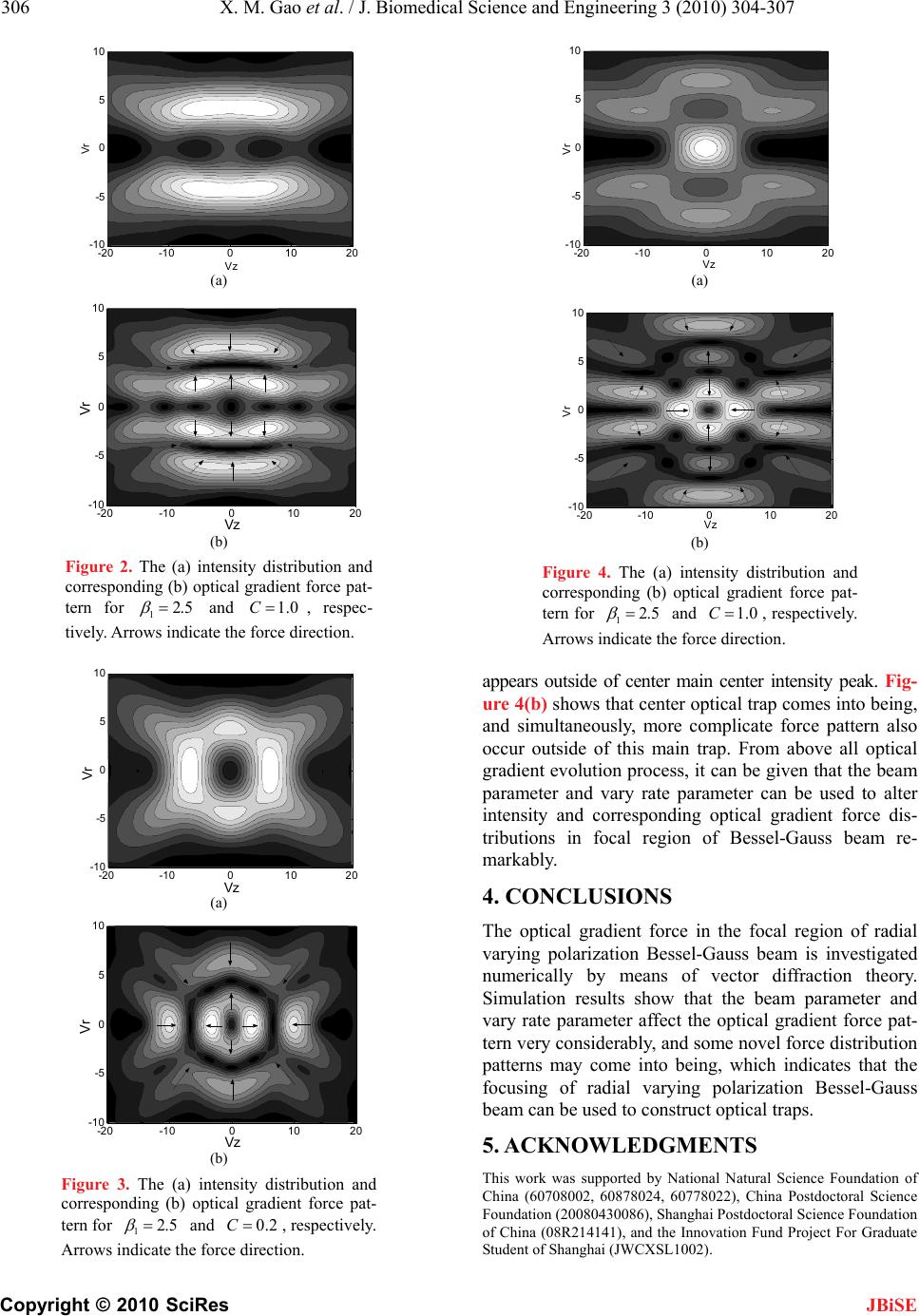 306 X. M. Gao et al. / J. Biomedical Science and Engineering 3 (2010) 304-307 Copyright © 2010 SciRes JBiSE -20 -1001020 -10 -5 0 5 10 V z Vr (a) Vz -20 -10010 20 -10 -5 0 5 10 Vr Vz (b) Figure 2. The (a) intensity distribution and corresponding (b) optical gradient force pat- tern for 12.5 and , respec- tively. Arrows indicate the force direction. 1.0C -20 -1001020 -10 -5 0 5 10 Vr Vz (a) Vz -20 -1001020 -1 0 -5 0 5 10 Vr Vz (b) Figure 3. The (a) intensity distribution and corresponding (b) optical gradient force pat- tern for 12.5 and 0.2C , respectively. Arrows indicate the force direction. -20 -1001020 -10 -5 0 5 10 Vz Vr (a) -20 -1001020 -1 0 -5 0 5 10 Vz Vr (b) Figure 4. The (a) intensity distribution and corresponding (b) optical gradient force pat- tern for 12.5 and , respectively. Arrows indicate the force direction. 1.0C appears outside of center main center intensity peak. Fig- ure 4(b) shows that center optical trap comes into being, and simultaneously, more complicate force pattern also occur outside of this main trap. From above all optical gradient evolution process, it can be given that the beam parameter and vary rate parameter can be used to alter intensity and corresponding optical gradient force dis- tributions in focal region of Bessel-Gauss beam re- markably. 4. CONCLUSIONS The optical gradient force in the focal region of radial varying polarization Bessel-Gauss beam is investigated numerically by means of vector diffraction theory. Simulation results show that the beam parameter and vary rate parameter affect the optical gradient force pat- tern very considerably, and some novel force distribution patterns may come into being, which indicates that the focusing of radial varying polarization Bessel-Gauss beam can be used to construct optical traps. 5. ACKNOWLEDGMENTS This work was supported by National Natural Science Foundation of China (60708002, 60878024, 60778022), China Postdoctoral Science Foundation (20080430086), Shanghai Postdoctoral Science Foundation of China (08R214141), and the Innovation Fund Project For Graduate Student of Shanghai (JWCXSL1002). 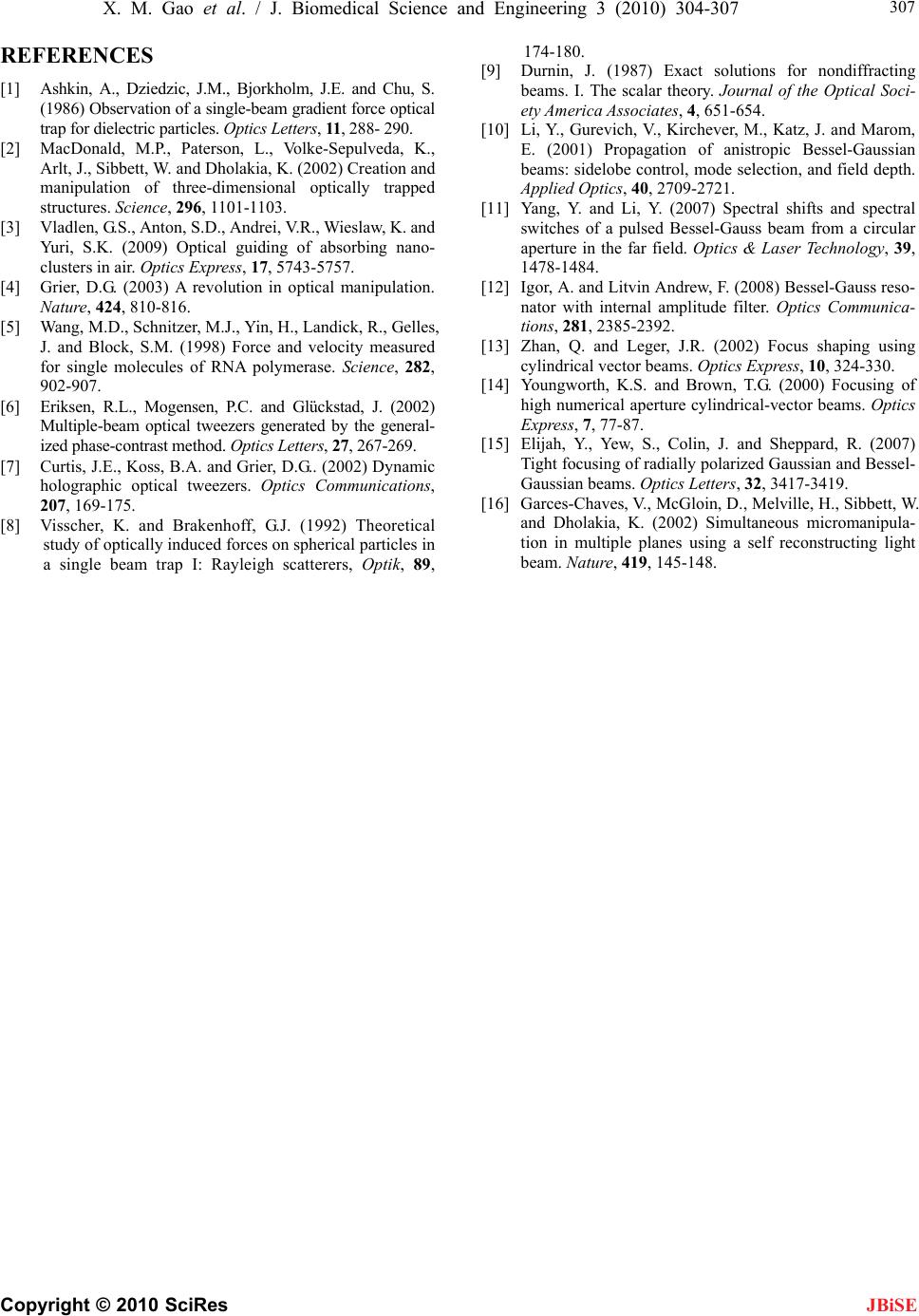 X. M. Gao et al. / J. Biomedical Science and Engineering 3 (2010) 304-307 Copyright © 2010 SciRes 307 JBiSE REFERENCES [1] Ashkin, A., Dziedzic, J.M., Bjorkholm, J.E. and Chu, S. (1986) Observation of a single-beam gradient force optical trap for dielectric particles. Optics Letters, 11, 288- 290. [2] MacDonald, M.P., Paterson, L., Volke-Sepulveda, K., Arlt, J., Sibbett, W. and Dholakia, K. (2002) Creation and manipulation of three-dimensional optically trapped structures. Science, 296, 1101-1103. [3] Vladlen, G.S., Anton, S.D., Andrei, V.R., Wieslaw, K. and Yuri, S.K. (2009) Optical guiding of absorbing nano- clusters in air. Optics Express, 17, 5743-5757. [4] Grier, D.G. (2003) A revolution in optical manipulation. Nature, 424, 810-816. [5] Wang, M.D., Schnitzer, M.J., Yin, H., Landick, R., Gelles, J. and Block, S.M. (1998) Force and velocity measured for single molecules of RNA polymerase. Science, 282, 902-907. [6] Eriksen, R.L., Mogensen, P.C. and Glückstad, J. (2002) Multiple-beam optical tweezers generated by the general- ized phase-contrast method. Optics Letters, 27, 267-269. [7] Curtis, J.E., Koss, B.A. and Grier, D.G.. (2002) Dynamic holographic optical tweezers. Optics Communications, 207, 169-175. [8] Visscher, K. and Brakenhoff, G.J. (1992) Theoretical study of optically induced forces on spherical particles in a single beam trap I: Rayleigh scatterers, Optik, 89, 174-180. [9] Durnin, J. (1987) Exact solutions for nondiffracting beams. I. The scalar theory. Journal of the Optical Soci- ety America Associates, 4, 651-654. [10] Li, Y., Gurevich, V., Kirchever, M., Katz, J. and Marom, E. (2001) Propagation of anistropic Bessel-Gaussian beams: sidelobe control, mode selection, and field depth. Applied Optics, 40, 2709-2721. [11] Yang, Y. and Li, Y. (2007) Spectral shifts and spectral switches of a pulsed Bessel-Gauss beam from a circular aperture in the far field. Optics & Laser Technology, 39, 1478-1484. [12] Igor, A. and Litvin Andrew, F. (2008) Bessel-Gauss reso- nator with internal amplitude filter. Optics Communica- tions, 281, 2385-2392. [13] Zhan, Q. and Leger, J.R. (2002) Focus shaping using cylindrical vector beams. Optics Express, 10, 324-330. [14] Youngworth, K.S. and Brown, T.G. (2000) Focusing of high numerical aperture cylindrical-vector beams. Optics Express, 7, 77-87. [15] Elijah, Y., Yew, S., Colin, J. and Sheppard, R. (2007) Tight focusing of radially polarized Gaussian and Bessel- Gaussian beams. Optics Letters, 32, 3417-3419. [16] Garces-Chaves, V., McGloin, D., Melville, H., Sibbett, W. and Dholakia, K. (2002) Simultaneous micromanipula- tion in multiple planes using a self reconstructing light beam. Nature, 419, 145-148. |