

Paper Menu >>
Journal Menu >>
 Vol.2, No.2, 115-119 (2010) Natural Science http://dx.doi.org/10.4236/ns.2010.22019 Copyright © 2010 SciRes. OPEN ACCESS Optimization of clear liquid fermentation condition for ethanol production from Canna edulis Kerl Ying Shen, Qing-li Tang, Tian-Xiang Wu* College of Life Sciences,Guizhou University, Guiyang, China; [email protected] Received 27 October 2009; revised 24 November 2009, accepted 15 December 2009. ABSTRACT In this paper, clear liquid fermentation condition for ethanol production from Canna edulis Kerl with orthogonal design was studied. We have studied five factors that influenced clear liquid fermentation condition for ethanol production from Canna edulis Kerl by the single-factor test. The five factors were α-amylase amount, glu- coamylase amount, pH, nitrogen and auxiliary materials amount. Selected the best amounts of α-amylase, glucoamylase, pH, nitrogen source and auxiliary materials by means of the singe- factors test. And then, we used the Orthogonal test to optimize the fermentation process. The study showed that the best fermentation condi- tions were α-amylase amount 7 u/g C.eduli, glu- coamylase amount 145u/g C. edulis, pH 4.4 and the amount of urea 0.08%, 1% of rice bran as auxiliary materials. The rate of alcohol which was produced by the best fermentation conditions is 21.5% that increased by 1.3% than the rate of alcohol by the single-factor test. Keywords: Alcohol; Canna edulis Kerl ; Clear Liquid Fermentation; Orthogonal Design 1. INTRODUCTION Canna edulis Ker1 belongs to Canna ceae and Canna L, in chinese herbs it was called jiang-yu or jiao-ou. At the first of 20th century, it was planted widely at slope and hills in Sichuan, Guizhou and Yunan because of its ex- cellent feature. The content of starch in rhizomes of Canna edulis Ker1 is very abundant. The content of starch is about 40%–60% [8-13]. So Canna edulis Ker1 has great development potential in supply of starch. The planting of Canna edulis Ker1 can increase earning for montanic people. At the same time it has con- tinuable-development significance in regulating agricul tural configuration and developing rural economics. But the starch of Canna edulis Ker1 is made into noodle largely only now, so its value is low. The molecular structure and physical and chemical properties of the starch of Canna edulis Ker1 were studied largely. Now, many scholars are investigating other purposes of the starch of Canna edulis Ker1 . For exemple, the starch of Canna edulis Kerl has achieved a breakthrough in alco- holic fermentation. The solid-state fermentation, clear liquid fermentation of Canna edulis Kerl and the com- prehensive utilization of fermentation residue have been researched largely in laboratory [1,7-11]. On this basis, we have got the best clear liquid fermentation process from Canna edulis Kerl with the single-factor test. Then we improve the utilization rate of Canna edulis Kerl raw after optimizing the technics of clear liquid fermentation condition for ethanol production from Canna edulis Kerl [8,12,15,16]. 2. MATERIALS AND METHODS 2.1. Experimental Material Canna edulis Ker1: Collected from Xingyi Guizhou, the content of Starch is 60.1%, the content of moisture is 14.8%; Thermal Resistance α-amylase: wuxi xing-da Bio- Engineering Co., Ltd., enzyme activity: 20000u/mL; New liquid glucoamylase: wuxi xing-da Bio- Engineering Co., Ltd., enzyme activity 100000u/Ml. 2.2. Methods 2.2.1. The Preparation of Clear Liquid Culture Medium Firstly, mixed the powder of Canna edulis Kerl with water in a certain proportion, joined in α-amylase, then heated them to 85~90℃ rapidly, keep them together 30~60min. When the time was over, cooled them to 60℃, adjusted pH 4.2. A certain proportion moderate glucoamylase was joined into the mixture solution, a few minites later, the Solid-state glycation Saccharification dregs and clear liquid can be gained by centrifugal tech- nology, then put the clear liquid into the autoclave whose 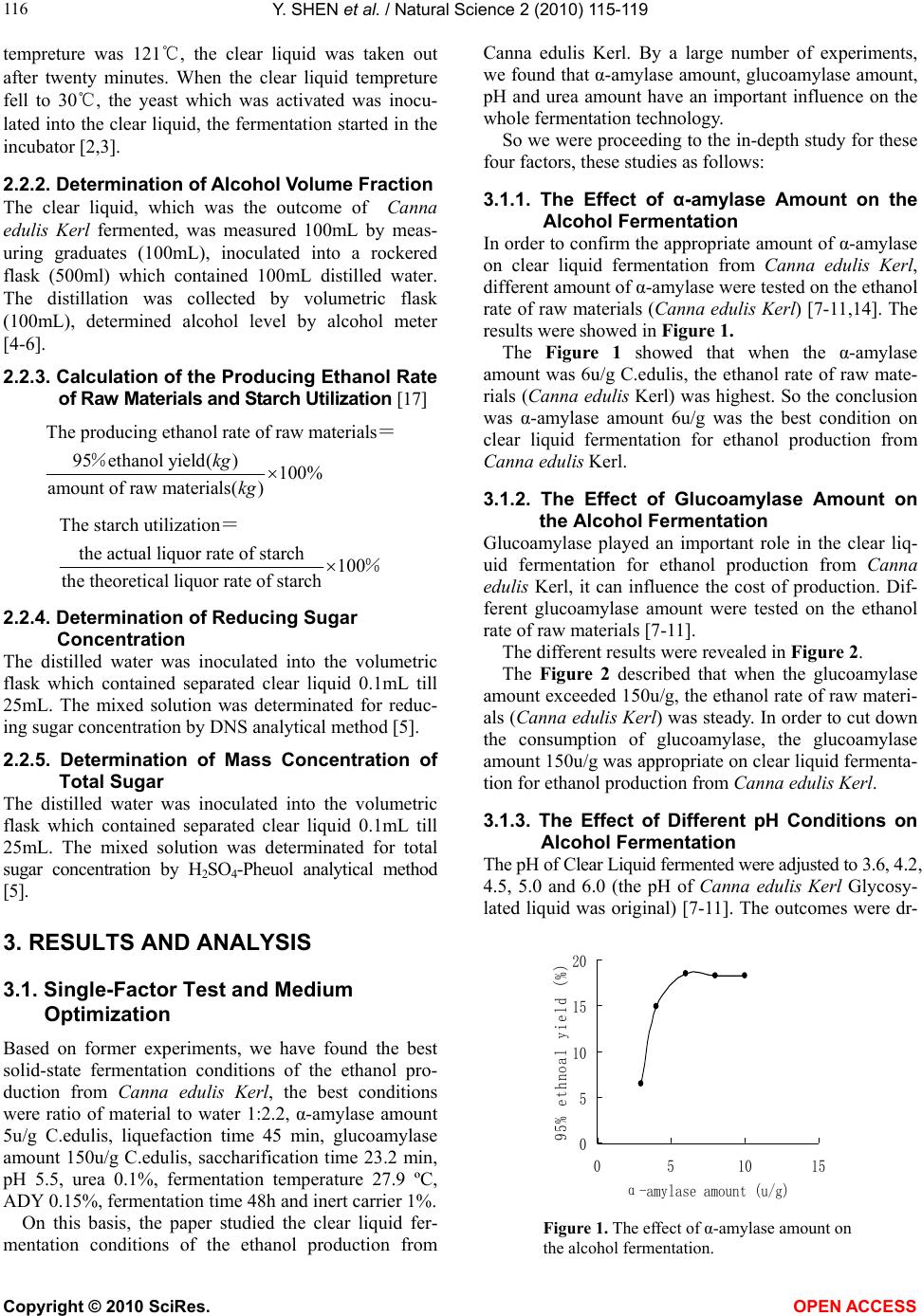 Y. SHEN et al. / Natural Science 2 (2010) 115-119 Copyright © 2010 SciRes. OPEN ACCESS 116 tempreture was 121℃, the clear liquid was taken out after twenty minutes. When the clear liquid tempreture fell to 30℃, the yeast which was activated was inocu- lated into the clear liquid, the fermentation started in the incubator [2,3]. 2.2.2. Determination of Alcohol Volume Fraction The clear liquid, which was the outcome of Canna edulis Kerl fermented, was measured 100mL by meas- uring graduates (100mL), inoculated into a rockered flask (500ml) which contained 100mL distilled water. The distillation was collected by volumetric flask (100mL), determined alcohol level by alcohol meter [4-6]. 2.2.3. Calculation of the Producing Ethanol Rate of Raw Materials and Starch Utilization [17] The producing ethanol rate of raw materials 95ethanol yield()100% amount of raw materials() kg kg = % The starch utilization the actual liquor rate of starch100 the theoretical liquor rate of starch = % 2.2.4. Determination of Reducing Sugar Concentration The distilled water was inoculated into the volumetric flask which contained separated clear liquid 0.1mL till 25mL. The mixed solution was determinated for reduc- ing sugar concentration by DNS analytical method [5]. 2.2.5. Determination of Mass Concentration of Total Sugar The distilled water was inoculated into the volumetric flask which contained separated clear liquid 0.1mL till 25mL. The mixed solution was determinated for total sugar concentration by H2SO4-Pheuol analytical method [5]. 3. RESULTS AND ANALYSIS 3.1. Single-Factor Test and Medium Optimization Based on former experiments, we have found the best solid-state fermentation conditions of the ethanol pro- duction from Canna edulis Kerl, the best conditions were ratio of material to water 1:2.2, α-amylase amount 5u/g C.edulis, liquefaction time 45 min, glucoamylase amount 150u/g C.edulis, saccharification time 23.2 min, pH 5.5, urea 0.1%, fermentation temperature 27.9 ºC, ADY 0.15%, fermentation time 48h and inert carrier 1%. On this basis, the paper studied the clear liquid fer- mentation conditions of the ethanol production from Canna edulis Kerl. By a large number of experiments, we found that α-amylase amount, glucoamylase amount, pH and urea amount have an important influence on the whole fermentation technology. So we were proceeding to the in-depth study for these four factors, these studies as follows: 3.1.1. The Effect of α-amylase Amount on the Alcohol Fermentation In order to confirm the appropriate amount of α-amylase on clear liquid fermentation from Canna edulis Kerl, different amount of α-amylase were tested on the ethanol rate of raw materials (Canna edulis Kerl) [7-11,14]. The results were showed in Figure 1. The Figure 1 showed that when the α-amylase amount was 6u/g C.edulis, the ethanol rate of raw mate- rials (Canna edulis Kerl) was highest. So the conclusion was α-amylase amount 6u/g was the best condition on clear liquid fermentation for ethanol production from Canna edulis Kerl. 3.1.2. The Effect of Glucoamylase Amount on the Alcohol Fermentation Glucoamylase played an important role in the clear liq- uid fermentation for ethanol production from Canna edulis Kerl, it can influence the cost of production. Dif- ferent glucoamylase amount were tested on the ethanol rate of raw materials [7-11]. The different results were revealed in Figure 2. The Figure 2 described that when the glucoamylase amount exceeded 150u/g, the ethanol rate of raw materi- als (Canna edulis Kerl) was steady. In order to cut down the consumption of glucoamylase, the glucoamylase amount 150u/g was appropriate on clear liquid fermenta- tion for ethanol production from Canna edulis Kerl. 3.1.3. The Effect of Different pH Conditions on Alcohol Fermentation The pH of Clear Liquid fermented were adjusted to 3.6, 4.2, 4.5, 5.0 and 6.0 (the pH of Canna edulis Kerl Glycosy- lated liquid was original) [7-11]. The outcomes were dr- 0 5 10 15 20 0510 15 α-amylase amount (u/g) 95% ethnoal yield (%) Figure 1. The effect of α-amylase amount on the alcohol fermentation. 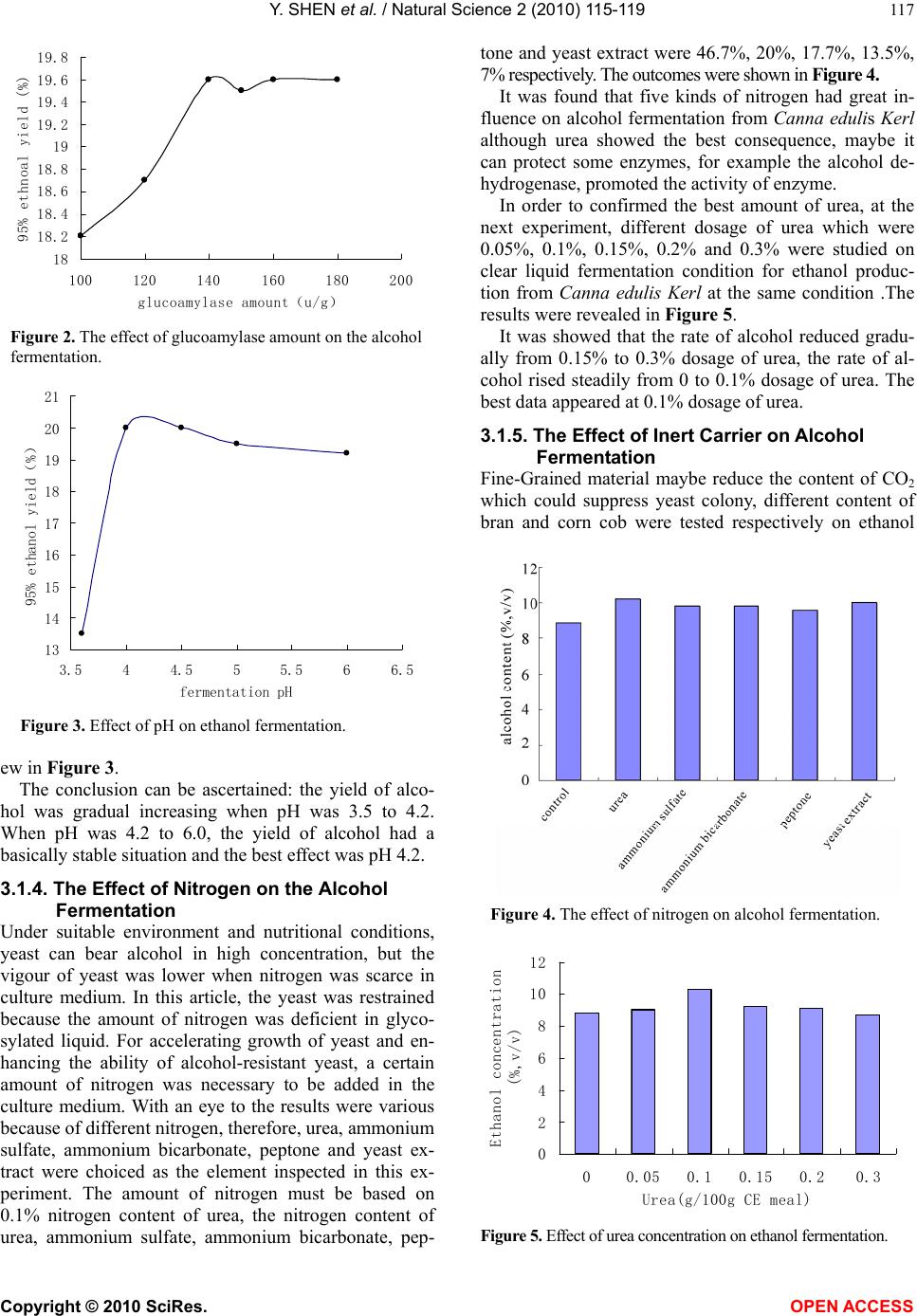 Y. SHEN et al. / Natural Science 2 (2010) 115-119 Copyright © 2010 SciRes. OPEN ACCESS 117 18 18.2 18.4 18.6 18.8 19 19.2 19.4 19.6 19.8 100 120 140160 180 200 glucoamylase amount(u/g) 95% ethnoal yield (%) Figure 2. The effect of glucoamylase amount on the alcohol fermentation. 13 14 15 16 17 18 19 20 21 3.5 4 4.5 55.5 6 6.5 fermentation pH 95% ethanol yield(%) Figure 3. Effect of pH on ethanol fermentation. ew in Figure 3. The conclusion can be ascertained: the yield of alco- hol was gradual increasing when pH was 3.5 to 4.2. When pH was 4.2 to 6.0, the yield of alcohol had a basically stable situation and the best effect was pH 4.2. 3.1.4. The Effect of Nitrogen on the Alcohol Fermentation Under suitable environment and nutritional conditions, yeast can bear alcohol in high concentration, but the vigour of yeast was lower when nitrogen was scarce in culture medium. In this article, the yeast was restrained because the amount of nitrogen was deficient in glyco- sylated liquid. For accelerating growth of yeast and en- hancing the ability of alcohol-resistant yeast, a certain amount of nitrogen was necessary to be added in the culture medium. With an eye to the results were various because of different nitrogen, therefore, urea, ammonium sulfate, ammonium bicarbonate, peptone and yeast ex- tract were choiced as the element inspected in this ex- periment. The amount of nitrogen must be based on 0.1% nitrogen content of urea, the nitrogen content of urea, ammonium sulfate, ammonium bicarbonate, pep- tone and yeast extract were 46.7%, 20%, 17.7%, 13.5%, 7% respectively. The outcomes were shown in Figure 4. It was found that five kinds of nitrogen had great in- fluence on alcohol fermentation from Canna edulis Kerl although urea showed the best consequence, maybe it can protect some enzymes, for example the alcohol de- hydrogenase, promoted the activity of enzyme. In order to confirmed the best amount of urea, at the next experiment, different dosage of urea which were 0.05%, 0.1%, 0.15%, 0.2% and 0.3% were studied on clear liquid fermentation condition for ethanol produc- tion from Canna edulis Kerl at the same condition .The results were revealed in Figure 5. It was showed that the rate of alcohol reduced gradu- ally from 0.15% to 0.3% dosage of urea, the rate of al- cohol rised steadily from 0 to 0.1% dosage of urea. The best data appeared at 0.1% dosage of urea. 3.1.5. The Effect of Inert Carrier on Alcohol Fermentation Fine-Grained material maybe reduce the content of CO2 which could suppress yeast colony, different content of bran and corn cob were tested respectively on ethanol Figure 4. The effect of nitrogen on alcohol fermentation. 0 2 4 6 8 10 12 00.05 0.1 0.15 0.20.3 Urea(g/100g CE meal) Ethanol concentration (%,v/v) Figure 5. Effect of urea concentration on ethanol fermentation. 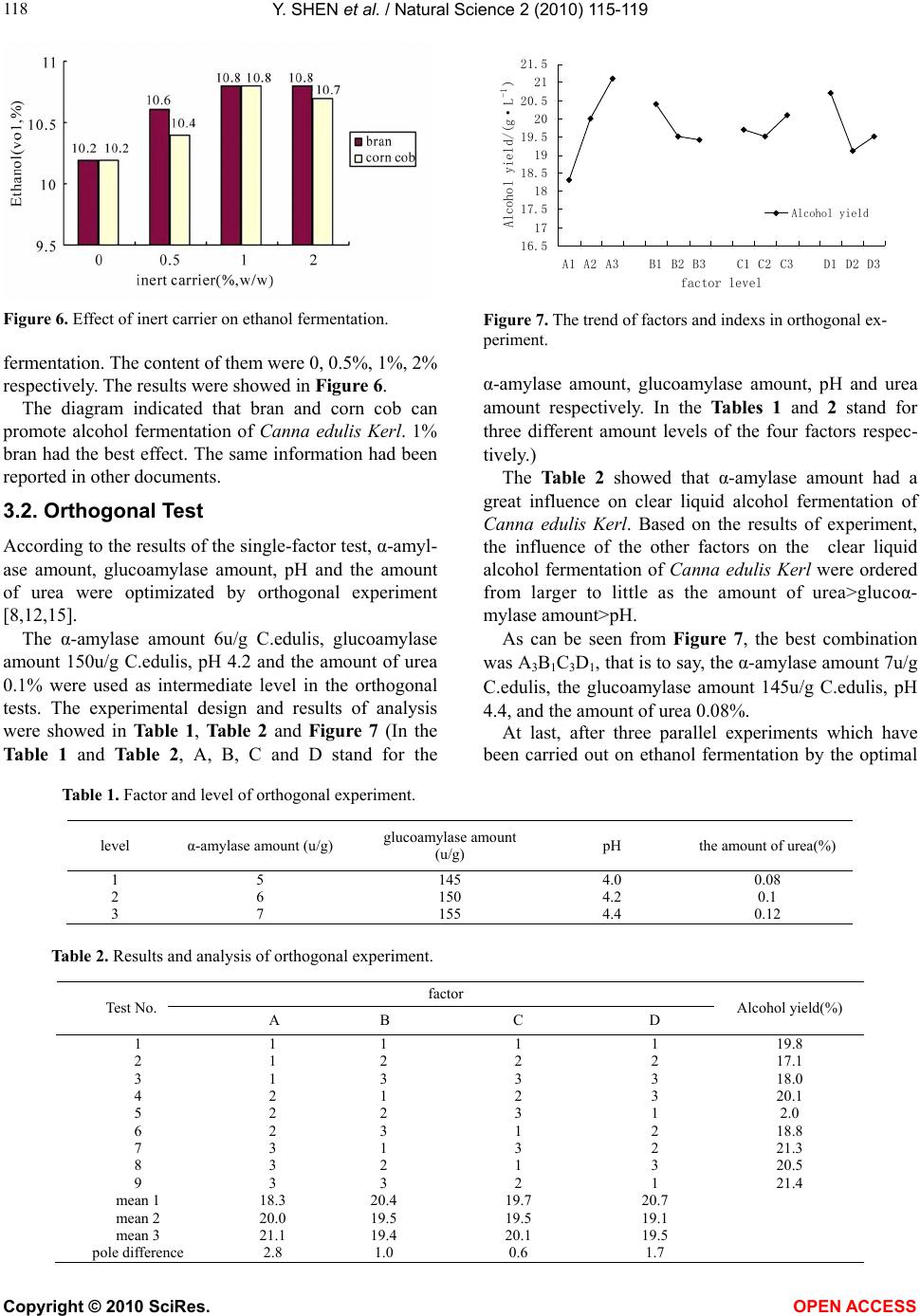 Y. SHEN et al. / Natural Science 2 (2010) 115-119 Copyright © 2010 SciRes. OPEN ACCESS 118 Figure 6. Effect of inert carrier on ethanol fermentation. fermentation. The content of them were 0, 0.5%, 1%, 2% respectively. The results were showed in Figure 6. The diagram indicated that bran and corn cob can promote alcohol fermentation of Canna edulis Kerl. 1% bran had the best effect. The same information had been reported in other documents. 3.2. Orthogonal Test According to the results of the single-factor test, α-amyl- ase amount, glucoamylase amount, pH and the amount of urea were optimizated by orthogonal experiment [8,12,15]. The α-amylase amount 6u/g C.edulis, glucoamylase amount 150u/g C.edulis, pH 4.2 and the amount of urea 0.1% were used as intermediate level in the orthogonal tests. The experimental design and results of analysis were showed in Table 1, Table 2 and Figure 7 (In the Table 1 and Table 2, A, B, C and D stand for the 16.5 17 17.5 18 18.5 19 19.5 20 20.5 21 21.5 A1 A2 A3B1 B2 B3C1 C2 C3D1 D2 D3 factor level Alcohol yield/(g·L -1 ) Alcohol yield Figure 7. The trend of factors and indexs in orthogonal ex- periment. α-amylase amount, glucoamylase amount, pH and urea amount respectively. In the Tables 1 and 2 stand for three different amount levels of the four factors respec- tively.) The Table 2 showed that α-amylase amount had a great influence on clear liquid alcohol fermentation of Canna edulis Kerl. Based on the results of experiment, the influence of the other factors on the clear liquid alcohol fermentation of Canna edulis Kerl were ordered from larger to little as the amount of urea>glucoα- mylase amount>pH. As can be seen from Figure 7, the best combination was A3B1C3D1, that is to say, the α-amylase amount 7u/g C.edulis, the glucoamylase amount 145u/g C.edulis, pH 4.4, and the amount of urea 0.08%. At last, after three parallel experiments which have been carried out on ethanol fermentation by the optimal Table 1. Factor and level of orthogonal experiment. level α-amylase amount (u/g) glucoamylase amount (u/g) pH the amount of urea(%) 1 5 145 4.0 0.08 2 6 150 4.2 0.1 3 7 155 4.4 0.12 Table 2. Results and analysis of orthogonal experiment. factor Test No. A B C D Alcohol yield(%) 1 1 1 1 1 19.8 2 1 2 2 2 17.1 3 1 3 3 3 18.0 4 2 1 2 3 20.1 5 2 2 3 1 2.0 6 2 3 1 2 18.8 7 3 1 3 2 21.3 8 3 2 1 3 20.5 9 3 3 2 1 21.4 mean 1 18.3 20.4 19.7 20.7 mean 2 20.0 19.5 19.5 19.1 mean 3 21.1 19.4 20.1 19.5 pole difference 2.8 1.0 0.6 1.7  Y. SHEN et al. / Natural Science 2 (2010) 115-119 Copyright © 2010 SciRes. OPEN ACCESS 119 technological conditions, we found the production rate of alcohol were 21.7%, 21.4%, 21.5% respectively, and the average was 21.5%. 4. CONCLUSIONS 1) Canna edulis Kerl is a non-alimentarn crop. The ad- vantages of fuel ethanol produced by Canna edulis Kerl were raising the utilization rate of resources, reducing the pollution of the environment, lower manufacturing Cost and higher productivity. The fuel ethanol produced from Canna edulis Kerl can not only solve the problem of food security, but also promote the development of fuel alcohol industry in china. 2) We have known that α-amylase amount, glucoa- mylase amount, pH, nitrogen and auxiliary materials can influence clear liquid fermentation for ethanol produc- tion from Canna edulis Kerl. Then optimizing four fac- tors by the orthogonal test .The best process conditions areα-amylase amount 7u/g C.edulis, glucoamylase amount 145u/g C.edulis, pH 4.4, the amount of urea 0.08% and 1% of rice bran. The production rate of alco- hol was 21.5% which increased by 1.3% than the pro- duction rate of alcohol by the single-factor test. 3) We are researching the best conditions of clear liq- uid fermentation for ethanol production from Canna edulis Kerl. These investigations laid a good foundation for reducing the cost of alcohol production, comprehen- sive utilization of Resources and efficient, saving, unde- filed technics of alcohol production. So clear liquid fer- mentation for ethanol Production from Canna edulis Kerl was an epoch-making event in the realm of indus- trial alcohol. REFERENCES [1] Zhu, Z.H. and Wu, T.X. (2005) Studies on characters and industral applications of Canna edulis Kerl starchy mate- ria1 [J]. Chinese Journal of Bioprocess Engineering, 3(4), 66-70. [2] Fang, S.Q., Zhao, Y.f., Niu, Q.C. et a1. (2005) Study on the technology of alcohol production by wheat flour clear liquid [J]. Liquor-Making Science & Technology, 5, 64-65. [3] Liu, L.F. and Ma. X.J. (2004) Study on alcoholic fer- mentation from wheat hourin clarifying solution [J]. Chinese Journal of henan institute of education (Natural Science Edition), 13(4), 57-58. [4] Wang, F.R. (1980) Analysis of industrial fermentation [M]. Beijing;China Light Industryb Press, 25-27. [5] Wang, F.R. (2006) Bio-engineering analysis and detec- tion [M]. Beijing: China Light Industryb Press, 140-163. [6] Zhang, K.C. (2004) Alcohol and tequila-technology [M]. Beijing; China Light Industryb Press. [7] Wu, T.X., Ding, C.Y., Yang, H.l. et a1. (2003) Study on teclmology of the semi-solid state pulp fermentation of Canna edulis Eerl for ethanol [J]. Liquor Making, 30(2), 71-73. [8] Fang, Y., Wang, P.H., Xie, S.Q. et a1. (2004) Technique of scarifying and fermenting process of canna starch [J]. Southwest China Journal of Agricultural Sciences, 17(2), 231-234. [9] Wu, T.X., Zhang, K.C., Liu, C.Z. et a1. (2005) Study on the property of canna edulis ker & its application in etha- nol fermentation [J]. Liquor-Making Science & Tech- nology, 10, 40-42. [10] Wu, T.X., Ding, C.Y., Yang, H.L. et a1. (2002) The fea- sibility study on the solid state fermentation and the de- velopment of alcoholic industry [J]. Food and Fermenta- tion Industries, 28(12), 67-70. [11] Chen, Y.F., Fang, H.Y., Wang, Z.G. et a1. (2002) Study on flask ethanol fermentation conditions of Canna edulis Kerl [J]. Liquor Making, 29(6), 63-65. [12] Ying, B., Qu, J.Q. and Lin, X.M. (2005) Principles of microbial technology development [M]. Chemical Indus- try Press, (3), 99-109. [13] Thitipraphunkul, K., Uttapap, D., Piyachomkwan, K. and Takeda, Y.A. (2003) Comparative study of edible canna (Canna edulis) starch from diferent cultivars Part I, Chemical composition and physicochemical properties [J]. Carbohydrate Polymers, 53, 3l7-324. [14] Shigechi, H., Fujita, Y., Koh, J., Ueda, M., Fukuda, H. and Kondo, A. (2004) Energy-saving direct ethanol pro- duction from low-temperature-cooked corn starch using a cell-surface engineered yeast strain co-displaying glu- coamylase α-amylase [J]. Biochem EngJ, 18, 149-153. [15] Bandaru, V.V.R., Somalanka, S.R., Menduc, D.R., Madicherla, N.R. and Chityala, A. (2006) Optimization of fermentation conditions for the production of ethanol from sago starch by co-immobilized amyloglucosidase and cells of Zymomonas mobilis using response surface methodology [J]. Enzyme Microb Technol, 38, 209-14. [16] Yan, L, and Shuzo, T. (2006) Ethanol fermentation from biomass resources: current state and prospects [J]. Appl Microbiol Biotechnol, 69, 627-642. [17] Zhu, Z.H., Zhang, H.Y. and Wu, T.X. (2007) Response surface methodology to optimize ethanol fermentation from Canna edulis Ker [J]. Liquor-Making Science &Technology, 8, 29-32. |