

Paper Menu >>
Journal Menu >>
 Vol.2, No.2, 79-84 (2010) Natural Science http://dx.doi.org/10.4236/ns.2010.22012 Copyright © 2010 SciRes. OPEN ACCESS Hydroxypropylmethylcellulose gel application delays Der p 1 diffusion in vitro B. Diethart1, J. C. Emberlin2, R. A. Lewis3 1School of Human and Health Sciences, Swansea University, Swansea, United Kingdom; [email protected] 2National Pollen and Aerobiology Research Unit, University of Worcester, Worcester, United Kingdom 3Worcestershire Royal Hospital, Worcester, United Kingdom Received 16 November 2009; revised 10 December 2009; accepted 30 December 2009. ABSTRACT Background: A special hydroxypropylmethyl- cellulose powder (Nasaleze®) has been used for the alleviation of nasal symptoms of allergic rhinitis since 1994. The efficacy of the product has been recently proven but the mechanism of action was still largely unknown. The aim of the study was to investigate the hypothesis that the gel formed after moisture absorption in the nose might act as mechanical barrier that prevents allergen diffusion towards the nasal epithelium. Methods: The diffusion of Der p 1 through HPMC and agar gels was measured in vitro after 15, 30, 60, 180 and 360 minutes using ELISA. Agar blocks were used to simulate the nasal mucosa. Control samples without gel layer were obtained. Results: The control samples with no applied gel barrier absorbed 72.2 % of the Der p 1 solution after 15 minutes and 100 % after 60 minutes. In comparison, the HPMC and agar gel layers both significantly delayed Der p 1 diffu- sion. After 15 minutes 0.76 % had diffused through the HPMC gel layer compared to 28.1 % which diffused through the agar layer. After 360 minutes, 14.1 % of the baseline Der p 1 crossed the HPMC gel layer while 100 % had diffused through the agar layer. Conclusions: HPMC gel significantly reduces Der p 1 diffusion in vitro compared to no barrier and an agar gel layer. This is likely to be due to the small mesh size of the polymer network of HPMC and could have important implications for a preventative treat- ment of allergic rhinitis. Keywords: Allergic Rhinitis; Der p 1; Diffusion Barrier; Hydroxypropylmethylcellulose 1. INTRODUCTION Allergic rhinitis (AR) is a global health problem which affects up to 25 % of the adult population in industrial- ised countries and more than 40 % of children [1,2]. The rising prevalence of allergic rhinitis imposes a huge burden on the economy due to costs of treatment and loss of work productivity. Recent estimates of annual costs range from $2 to 5 billion in the U.S. alone [3-5]. The pathology of AR is associated with a severe im- pairment of the quality of life for those who suffer from it [6,7]. A reduction of quality-of-life impairment can be achieved by appropriate treatment of allergic rhinitis [7,8]. Modern medications such as antihistamines or corticosteroids can do a lot to help to alleviate symptoms and restore a normal lifestyle but many of them have unwanted adverse effects or are limited in their applica- tion [1,3,4]. Many people distrust these conventional medicines and therefore prefer to use complementary and alternative treatments. However, the therapeutic efficacy of many of these treatments is not supported by evidence and they might not be devoid of side effects [3,9]. A recent approach is offered by the use of an inert hy- droxypropylmethylcellulose (HPMC) powder (Nasaleze ®) for allergy prevention and alleviation in the nose. Although the product has been registered as a class 1 medical device with the MHRA since 1991 and is sold over the counter in more than 50 countries worldwide, little work has been done on the effect of the powder on nasal symptoms. However, the efficacy of HPMC in decreasing symptoms of allergic rhinitis caused by grass pollen and house dust mite allergens was recently proven [10-12]. The investigators observed an improvement of symptoms when using HPMC for treatment of SAR and PAR. Nasal peak inspiratory flow (PIF) and peak expi- ratory flow (PEF) increased compared to placebo and some symptoms of allergic rhinitis including sneezing, itching and runny nose were alleviated significantly. Also the need to use rescue medication was found to be reduced. Considerable variance was observed in the re- sults and some participants did not show any improve- ment. This was partly attributed to the application device which is suspected not to deliver constant doses [12,13]. 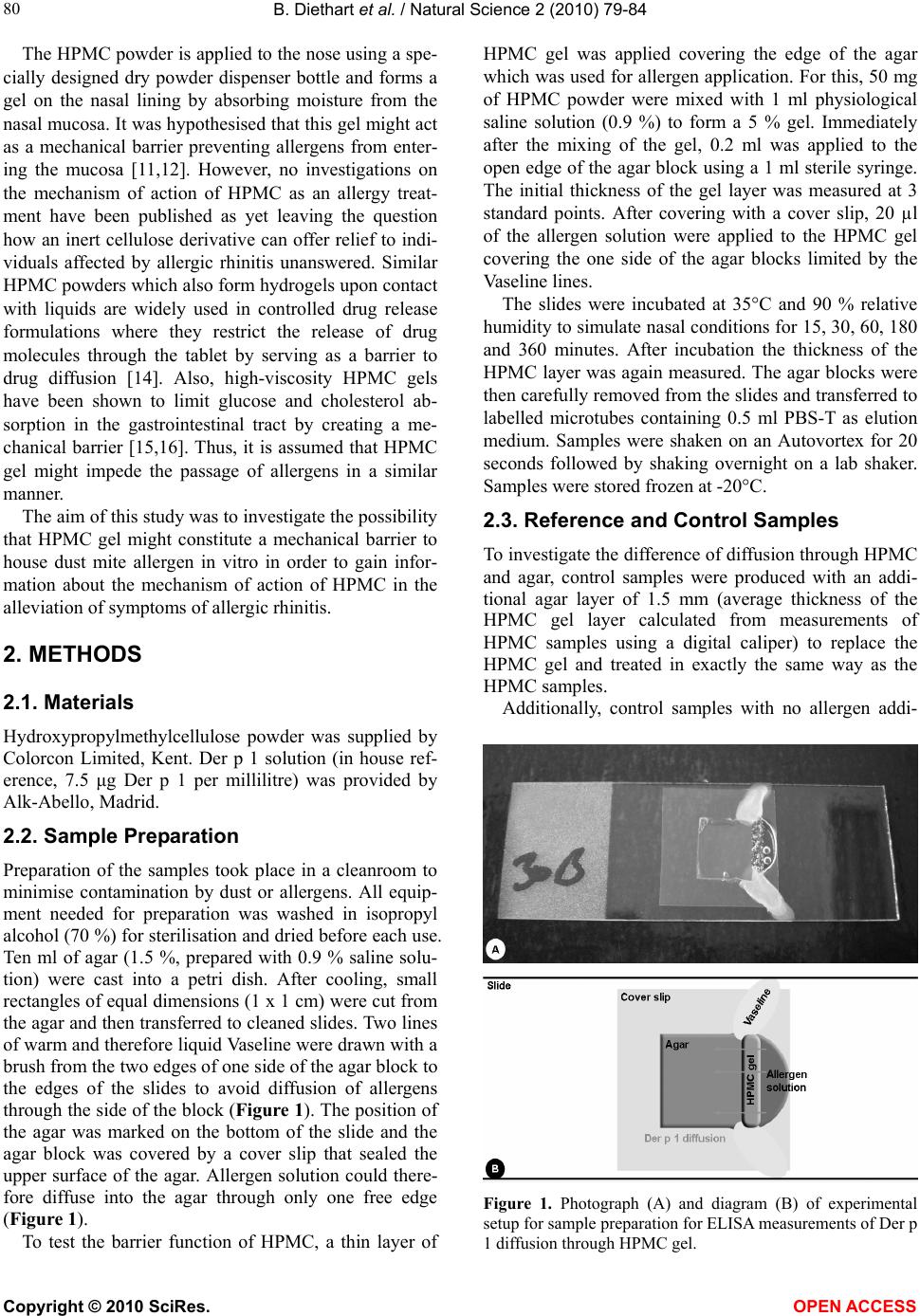 B. Diethart et al. / Natural Science 2 (2010) 79-84 Copyright © 2010 SciRes. OPEN ACCESS 80 The HPMC powder is applied to the nose using a spe- cially designed dry powder dispenser bottle and forms a gel on the nasal lining by absorbing moisture from the nasal mucosa. It was hypothesised that this gel might act as a mechanical barrier preventing allergens from enter- ing the mucosa [11,12]. However, no investigations on the mechanism of action of HPMC as an allergy treat- ment have been published as yet leaving the question how an inert cellulose derivative can offer relief to indi- viduals affected by allergic rhinitis unanswered. Similar HPMC powders which also form hydrogels upon contact with liquids are widely used in controlled drug release formulations where they restrict the release of drug molecules through the tablet by serving as a barrier to drug diffusion [14]. Also, high-viscosity HPMC gels have been shown to limit glucose and cholesterol ab- sorption in the gastrointestinal tract by creating a me- chanical barrier [15,16]. Thus, it is assumed that HPMC gel might impede the passage of allergens in a similar manner. The aim of this study was to investigate the possibility that HPMC gel might constitute a mechanical barrier to house dust mite allergen in vitro in order to gain infor- mation about the mechanism of action of HPMC in the alleviation of symptoms of allergic rhinitis. 2. METHODS 2.1. Materials Hydroxypropylmethylcellulose powder was supplied by Colorcon Limited, Kent. Der p 1 solution (in house ref- erence, 7.5 μg Der p 1 per millilitre) was provided by Alk-Abello, Madrid. 2.2. Sample Preparation Preparation of the samples took place in a cleanroom to minimise contamination by dust or allergens. All equip- ment needed for preparation was washed in isopropyl alcohol (70 %) for sterilisation and dried before each use. Ten ml of agar (1.5 %, prepared with 0.9 % saline solu- tion) were cast into a petri dish. After cooling, small rectangles of equal dimensions (1 x 1 cm) were cut from the agar and then transferred to cleaned slides. Two lines of warm and therefore liquid Vaseline were drawn with a brush from the two edges of one side of the agar block to the edges of the slides to avoid diffusion of allergens through the side of the block (Figure 1). The position of the agar was marked on the bottom of the slide and the agar block was covered by a cover slip that sealed the upper surface of the agar. Allergen solution could there- fore diffuse into the agar through only one free edge (Figure 1). To test the barrier function of HPMC, a thin layer of HPMC gel was applied covering the edge of the agar which was used for allergen application. For this, 50 mg of HPMC powder were mixed with 1 ml physiological saline solution (0.9 %) to form a 5 % gel. Immediately after the mixing of the gel, 0.2 ml was applied to the open edge of the agar block using a 1 ml sterile syringe. The initial thickness of the gel layer was measured at 3 standard points. After covering with a cover slip, 20 µl of the allergen solution were applied to the HPMC gel covering the one side of the agar blocks limited by the Vaseline lines. The slides were incubated at 35°C and 90 % relative humidity to simulate nasal conditions for 15, 30, 60, 180 and 360 minutes. After incubation the thickness of the HPMC layer was again measured. The agar blocks were then carefully removed from the slides and transferred to labelled microtubes containing 0.5 ml PBS-T as elution medium. Samples were shaken on an Autovortex for 20 seconds followed by shaking overnight on a lab shaker. Samples were stored frozen at -20°C. 2.3. Reference and Control Samples To investigate the difference of diffusion through HPMC and agar, control samples were produced with an addi- tional agar layer of 1.5 mm (average thickness of the HPMC gel layer calculated from measurements of HPMC samples using a digital caliper) to replace the HPMC gel and treated in exactly the same way as the HPMC samples. Additionally, control samples with no allergen addi- Figure 1. Photograph (A) and diagram (B) of experimental setup for sample preparation for ELISA measurements of Der p 1 diffusion through HPMC gel. 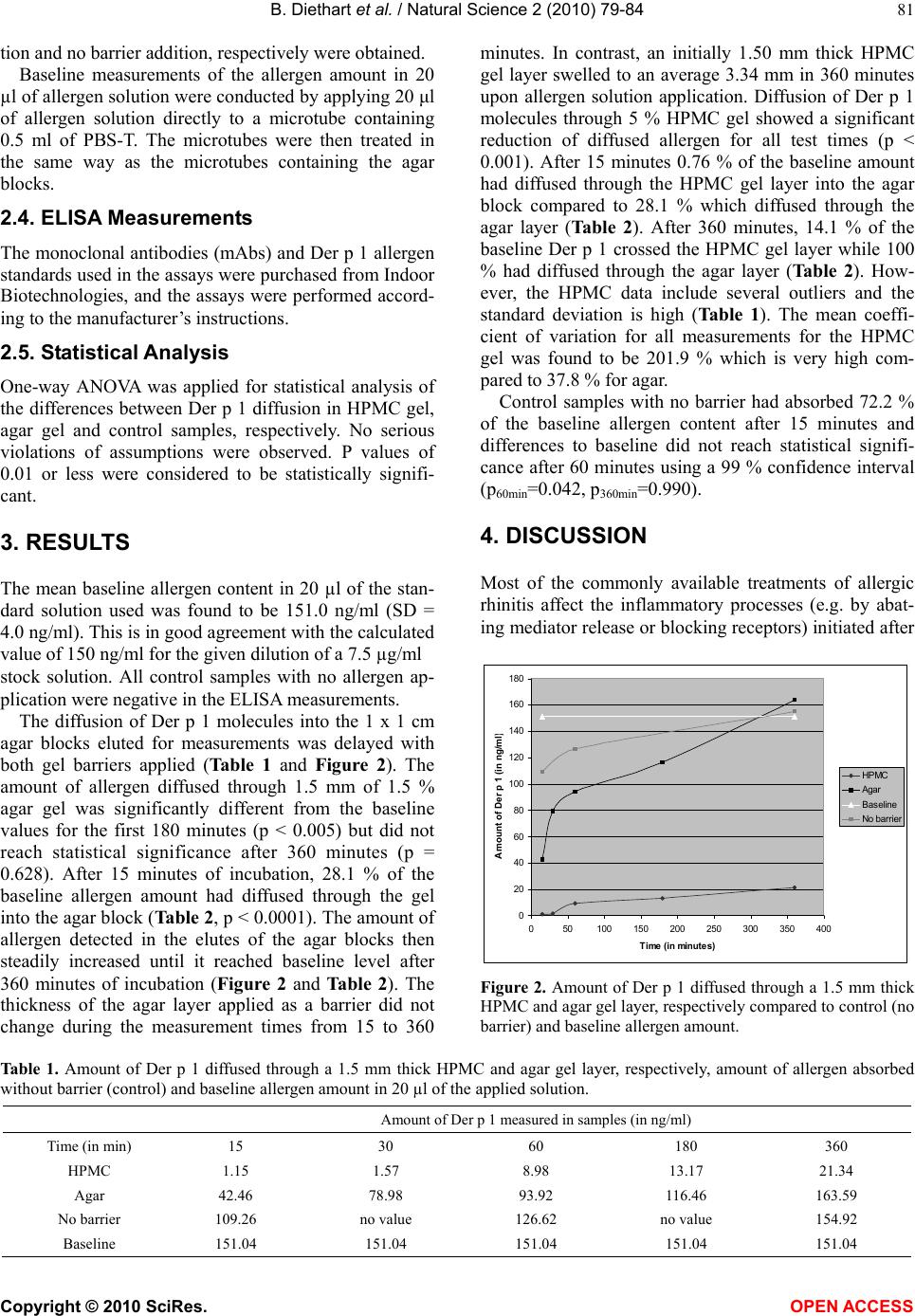 B. Diethart et al. / Natural Science 2 (2010) 79-84 Copyright © 2010 SciRes. OPEN ACCESS 81 tion and no barrier addition, respectively were obtained. Baseline measurements of the allergen amount in 20 µl of allergen solution were conducted by applying 20 μl of allergen solution directly to a microtube containing 0.5 ml of PBS-T. The microtubes were then treated in the same way as the microtubes containing the agar blocks. 2.4. ELISA Measurements The monoclonal antibodies (mAbs) and Der p 1 allergen standards used in the assays were purchased from Indoor Biotechnologies, and the assays were performed accord- ing to the manufacturer’s instructions. 2.5. Statistical Analysis One-way ANOVA was applied for statistical analysis of the differences between Der p 1 diffusion in HPMC gel, agar gel and control samples, respectively. No serious violations of assumptions were observed. P values of 0.01 or less were considered to be statistically signifi- cant. 3. RESULTS The mean baseline allergen content in 20 µl of the stan- dard solution used was found to be 151.0 ng/ml (SD = 4.0 ng/ml). This is in good agreement with the calculated value of 150 ng/ml for the given dilution of a 7.5 µg/ml stock solution. All control samples with no allergen ap- plication were negative in the ELISA measurements. The diffusion of Der p 1 molecules into the 1 x 1 cm agar blocks eluted for measurements was delayed with both gel barriers applied (Table 1 and Figure 2). The amount of allergen diffused through 1.5 mm of 1.5 % agar gel was significantly different from the baseline values for the first 180 minutes (p < 0.005) but did not reach statistical significance after 360 minutes (p = 0.628). After 15 minutes of incubation, 28.1 % of the baseline allergen amount had diffused through the gel into the agar block (Table 2, p < 0.0001). The amount of allergen detected in the elutes of the agar blocks then steadily increased until it reached baseline level after 360 minutes of incubation (Figure 2 and Table 2). The thickness of the agar layer applied as a barrier did not change during the measurement times from 15 to 360 minutes. In contrast, an initially 1.50 mm thick HPMC gel layer swelled to an average 3.34 mm in 360 minutes upon allergen solution application. Diffusion of Der p 1 molecules through 5 % HPMC gel showed a significant reduction of diffused allergen for all test times (p < 0.001). After 15 minutes 0.76 % of the baseline amount had diffused through the HPMC gel layer into the agar block compared to 28.1 % which diffused through the agar layer (Table 2). After 360 minutes, 14.1 % of the baseline Der p 1 crossed the HPMC gel layer while 100 % had diffused through the agar layer (Table 2). How- ever, the HPMC data include several outliers and the standard deviation is high (Table 1). The mean coeffi- cient of variation for all measurements for the HPMC gel was found to be 201.9 % which is very high com- pared to 37.8 % for agar. Control samples with no barrier had absorbed 72.2 % of the baseline allergen content after 15 minutes and differences to baseline did not reach statistical signifi- cance after 60 minutes using a 99 % confidence interval (p60min=0.042, p360min=0.990). 4. DISCUSSION Most of the commonly available treatments of allergic rhinitis affect the inflammatory processes (e.g. by abat- ing mediator release or blocking receptors) initiated after 0 20 40 60 80 100 120 140 160 180 050100 150 200 250 300 350 400 Time (in minutes) Amount of Der p 1 (in ng/ml ) HPMC Agar Base line No barrier Figure 2. Amount of Der p 1 diffused through a 1.5 mm thick HPMC and agar gel layer, respectively compared to control (no barrier) and baseline allergen amount. Table 1. Amount of Der p 1 diffused through a 1.5 mm thick HPMC and agar gel layer, respectively, amount of allergen absorbed without barrier (control) and baseline allergen amount in 20 µl of the applied solution. Amount of Der p 1 measured in samples (in ng/ml) Time (in min) 15 30 60 180 360 HPMC 1.15 1.57 8.98 13.17 21.34 Agar 42.46 78.98 93.92 116.46 163.59 No barrier 109.26 no value 126.62 no value 154.92 Baseline 151.04 151.04 151.04 151.04 151.04 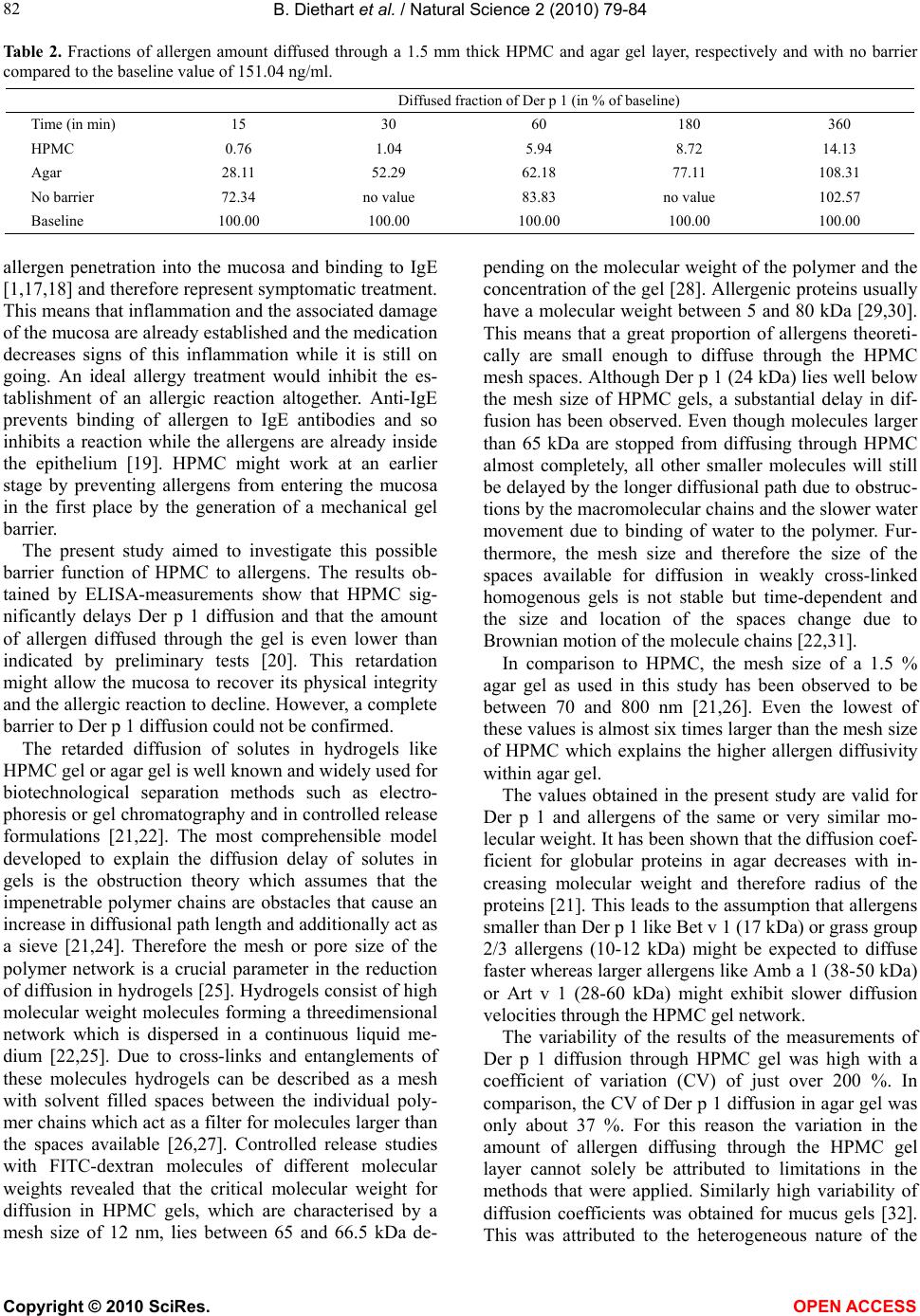 B. Diethart et al. / Natural Science 2 (2010) 79-84 Copyright © 2010 SciRes. OPEN ACCESS 82 Table 2. Fractions of allergen amount diffused through a 1.5 mm thick HPMC and agar gel layer, respectively and with no barrier compared to the baseline value of 151.04 ng/ml. Diffused fraction of Der p 1 (in % of baseline) Time (in min) 15 30 60 180 360 HPMC 0.76 1.04 5.94 8.72 14.13 Agar 28.11 52.29 62.18 77.11 108.31 No barrier 72.34 no value 83.83 no value 102.57 Baseline 100.00 100.00 100.00 100.00 100.00 allergen penetration into the mucosa and binding to IgE [1,17,18] and therefore represent symptomatic treatment. This means that inflammation and the associated damage of the mucosa are already established and the medication decreases signs of this inflammation while it is still on going. An ideal allergy treatment would inhibit the es- tablishment of an allergic reaction altogether. Anti-IgE prevents binding of allergen to IgE antibodies and so inhibits a reaction while the allergens are already inside the epithelium [19]. HPMC might work at an earlier stage by preventing allergens from entering the mucosa in the first place by the generation of a mechanical gel barrier. The present study aimed to investigate this possible barrier function of HPMC to allergens. The results ob- tained by ELISA-measurements show that HPMC sig- nificantly delays Der p 1 diffusion and that the amount of allergen diffused through the gel is even lower than indicated by preliminary tests [20]. This retardation might allow the mucosa to recover its physical integrity and the allergic reaction to decline. However, a complete barrier to Der p 1 diffusion could not be confirmed. The retarded diffusion of solutes in hydrogels like HPMC gel or agar gel is well known and widely used for biotechnological separation methods such as electro- phoresis or gel chromatography and in controlled release formulations [21,22]. The most comprehensible model developed to explain the diffusion delay of solutes in gels is the obstruction theory which assumes that the impenetrable polymer chains are obstacles that cause an increase in diffusional path length and additionally act as a sieve [21,24]. Therefore the mesh or pore size of the polymer network is a crucial parameter in the reduction of diffusion in hydrogels [25]. Hydrogels consist of high molecular weight molecules forming a threedimensional network which is dispersed in a continuous liquid me- dium [22,25]. Due to cross-links and entanglements of these molecules hydrogels can be described as a mesh with solvent filled spaces between the individual poly- mer chains which act as a filter for molecules larger than the spaces available [26,27]. Controlled release studies with FITC-dextran molecules of different molecular weights revealed that the critical molecular weight for diffusion in HPMC gels, which are characterised by a mesh size of 12 nm, lies between 65 and 66.5 kDa de- pending on the molecular weight of the polymer and the concentration of the gel [28]. Allergenic proteins usually have a molecular weight between 5 and 80 kDa [29,30]. This means that a great proportion of allergens theoreti- cally are small enough to diffuse through the HPMC mesh spaces. Although Der p 1 (24 kDa) lies well below the mesh size of HPMC gels, a substantial delay in dif- fusion has been observed. Even though molecules larger than 65 kDa are stopped from diffusing through HPMC almost completely, all other smaller molecules will still be delayed by the longer diffusional path due to obstruc- tions by the macromolecular chains and the slower water movement due to binding of water to the polymer. Fur- thermore, the mesh size and therefore the size of the spaces available for diffusion in weakly cross-linked homogenous gels is not stable but time-dependent and the size and location of the spaces change due to Brownian motion of the molecule chains [22,31]. In comparison to HPMC, the mesh size of a 1.5 % agar gel as used in this study has been observed to be between 70 and 800 nm [21,26]. Even the lowest of these values is almost six times larger than the mesh size of HPMC which explains the higher allergen diffusivity within agar gel. The values obtained in the present study are valid for Der p 1 and allergens of the same or very similar mo- lecular weight. It has been shown that the diffusion coef- ficient for globular proteins in agar decreases with in- creasing molecular weight and therefore radius of the proteins [21]. This leads to the assumption that allergens smaller than Der p 1 like Bet v 1 (17 kDa) or grass group 2/3 allergens (10-12 kDa) might be expected to diffuse faster whereas larger allergens like Amb a 1 (38-50 kDa) or Art v 1 (28-60 kDa) might exhibit slower diffusion velocities through the HPMC gel network. The variability of the results of the measurements of Der p 1 diffusion through HPMC gel was high with a coefficient of variation (CV) of just over 200 %. In comparison, the CV of Der p 1 diffusion in agar gel was only about 37 %. For this reason the variation in the amount of allergen diffusing through the HPMC gel layer cannot solely be attributed to limitations in the methods that were applied. Similarly high variability of diffusion coefficients was obtained for mucus gels [32]. This was attributed to the heterogeneous nature of the  B. Diethart et al. / Natural Science 2 (2010) 79-84 Copyright © 2010 SciRes. OPEN ACCESS 83 mucous gel producing uneven penetration profiles. Re- lease from HPMC matrices for controlled drug release was found to be sensitive to alterations in the chemical composition and the polymer gel conformation and sub- stantial batch-to-batch variations in release and swelling could be observed for a single type of HPMC [33,34]. The authors suspect that this might be due to aggregate formation in the gel causing transient cross-linking that could perturb diffusion in some places throughout the gel which cannot be predicted. Due to its importance in controlled drug release, the effect of HPMC as a diffusion barrier for drugs has been studied extensively. However, no investigations of aller- gen diffusion in HPMC have been found in the accessi- ble literature. It was confirmed in this study that HPMC gel delays Der p 1 diffusion in vitro. Other allergens need to be tested to extend the evidence for the efficacy of the product. Also many other factors will influence the efficiency of the product in vivo. For practicality reasons, the gel layer used in the experiments is thicker than the gel layer that can be expected to be established within the nasal cavity. Diffusion velocity is a crucial parameter needed to make assumption for in vivo condi- tions and should therefore be addressed in future re- search. A complete diffusion barrier is essential for the retardation of drug release [14] and similarly optimal coverage of the nasal mucosa is important since uncov- ered areas may allow free allergen entry and the provo- cation of an allergic response. Sub-optimum coverage is likely to reduce the efficiency of the product. The provi- sion of a suitable powder delivery device therefore poses an important challenge for the maximisation of the effi- cacy of HPMC in the alleviation of allergic rhinitis. In conclusion, a diffusion delay of Der p 1 in HPMC gel has been confirmed in vitro. This means that even though HPMC gel does not constitute an impermeable barrier to allergens, the significant delay of allergen en- try into the mucosa could be beneficial to hay fever suf- ferers through the reduction of allergen exposure. This fairly novel way of treatment reduces the allergen load itself and not the symptoms caused after allergen entry into the mucosa. Thus, with the appropriate delivery device, HPMC could be a valuable, drug-free alternative for the treatment of allergic rhinitis. The efficacy of HPMC in hay fever treatment has been recently proven [10-12]. However, the research presented in this paper is the first to address the mechanism of action of HPMC in the alleviation of allergic rhinitis. This knowledge will allow improvements on the product to be made in order to increase its benefit to hay fever sufferers. 5. ACKNOWLEDGEMENTS This study was sponsored by the University of Worcester, UK and Kisska International Ltd. REFERENCES [1] Greiner, A.N. and Meltzer, E.O. (2006) Pharmacologic rationale for treating allergic and nonallergic rhinitis. Journal of Allergy and Clinical Immunology, 118, 985-96. [2] Bachau, V. and Durham, S.R. (2004) Prevalence and rate of diagnosis of allergic rhinitis in Europe. European Res- piratory Journal, 24, 758-64. [3] Bousquet, J., Khaltaev, N., Cruz, A.A., Denburg, J., Fokkens, W.J., Togias, A.G., Zuberbier,T., Baena-Cag- nani, C.E., Canonica, G.W., van Weel, C. and Agache, I. (2008) Allergic rhinitis and its impact on asthma (ARIA) 2008. Allergy, 63(Suppl.86), S8-S160. [4] Carr, W.W., Nelson, M.R. and Hadley, J.A. (2008) Man- aging rhinitis: strategies for improved patient outcomes. Allergy and Asthma Proceedings, 29, 349-57. [5] Simoens, S. and Laekeman, G. (2009) Pharmacotherapy of allergic rhinitis: a pharmaco-economic approach. Al- lergy, 64, 85-95. [6] Stuck, B.A., Czajkowski, J., Hagner, A.-E., Klimek, L., Verse, T., Hoermann, K. and Maurer, J.T. (2004) Changes in daytime sleepiness, quality of life and objective sleep patterns in seasonal allergic rhinitis: a controlled clinical trial. Journal of Allergy and Clinical Immunology, 113, 663-8. [7] Meltzer, E.O. (2001) Quality of life in adults and chil- dren with allergic rhinitis. Journal of Allergy and Clini- cal Immunology, 108, S45-S53. [8] Leynaert, B., Neukirch, C., Liard, R., Bousquet, J. and Neukirch, F. (2000) Quality of life in allergic rhinitis and asthma. A population-based study of young adults. American Journal of Respiratory and Critical Care Medicine, 162, 1391-6. [9] Passalacqua, G., Bousquet, P.J., Carlsen, K.-H., Kemp, J., Lockey, R.F., Niggemann, B., Pawankar, R., Price, D. and Bousquet, J. (2006) ARIA update: I - Systematic re- view of complementary and alternative medicine for rhinitis and asthma. Journal of Allergy and Clinical Im- munology, 117, 1054-62. [10] Emberlin, J.C. and Lewis, R.A. (2006) A double-blind placebo-controlled crossover trial of inert cellulose pow- der by nasal provocation with grass pollen to assess the efficacy of the product in controlling the symptoms of hayfever. EAACI, Vienna, Austria. [11] Emberlin, J.C. and Lewis, R.A. (2006) A double blind, placebo controlled trial of inert cellulose powder for the relief of symptoms of hay fever in adults. Current Medi- cal Research and Opinion, 22(2), 275-85. [12] Emberlin, J.C. and Lewis, R.A. (2007) A double blind, placebo-controlled cross over trial of cellulose powder by nasal provocation with Der p 1 and Der f 1. Current Medical Research and Opinion, 23(10), 2423-31. [13] Josling, P. and Steadman, S. (2003) Use of cellulose powder for the treatment of seasonal allergic rhinitis. Advances in Therapy, 20(4), 213-9. [14] Cheong, L.W.S., Heng, P.W.S. and Wong, L.F. (1992) Relationship between polymer viscosity and drug release from a matrix system. Pharmaceutical Research, 9(11), 1510-4. [15] Maki, K.C., Carson, M.L., Miller, M.P., Turowski, M., Bell, M., Wilder, D. and Reeves, M.S. (2007) High vis-  B. Diethart et al. / Natural Science 2 (2010) 79-84 Copyright © 2010 SciRes. OPEN ACCESS 84 cosity hydroxypropylmethylcellulose blunts postprandial glucose and insulin responses. Diabetes Care, 30, 1039- 43. [16] Reppas, C., Swidan, S.Z., Tobey, S.W., Turowski, M. and Dressman, J.B. (2009) Hydroxypropylmethylcellulose significantly lowers blood cholesterol in mildly hyper- cholesterolemic human subjects. European Journal of Clinical Nutrition, 63, 71-7. [17] Bousquet, J., Van Cauwenberge, P., Khaltaev, N. and ARIA (2001) Allergic rhinitis and its impact on asthma. Journal of Allergy and Clinical Immunology, 108, S147-S336. [18] Quraishi, S.A., Davies, M.J. and Craig, T.J. (2004) In- flammatory responses in allergic rhinitis: traditional ap- proaches and novel treatment strategies. The Journal of the American Osteopathic Association, 104(5), S7-S15. [19] Verbruggen, K., Van Cauwenberge, P. and Bachert, C. (2009) Anti-IgE for the treatment of allergic rhinitis - and eventually nasal polyps? International Archives of Al- lergy and Immunology, 148, 87-98. [20] Diethart, B., Emberlin, J.C. and Lewis, R.A. (2008) Hy- droxypropylmethylcellulose gel delays house dust mite allergen (Der p 1) diffusion in vitro. Allergy, 63(Suppl. 88), 551. [21] Pluen, A., Netti, P.A., Jain, R.K. and Berk, D.A. (1999) Diffusion of macromolecules in agarose gels: comparison of linear and globular configurations. Biophysical Jour- nal, 77, 542-52. [22] Amsden, B. (1998) Solute diffusion in hydrogels. Mechansims and models. Macromolecules, 31, 8382-95. [23] Lauffer, M.A. (1961) Theory of diffusion in gels. Bio- physical Journal, 1, 205-13. [24] Ferrero, C., Massuelle, D., Jeannerat, D. and Doelker, E. (2008) Towards elucidation of the drug release mecha- nism from compressed hydrophilic matrices made of cellulose ethers. I. Pulse-field-gradient spin-echo NMR study of sodium salicylate diffusivity in swollen hy- drogels with respect to polymer matrix physical structure. Journal of Controlled Release, 128, 71-9. [25] Baumgartner, S., Lahajnar, G., Sepe, A. and Kristl, J. (2002) Investigation of the state and dynamics of water in hydrogels of cellulose ethers by 1H NMR spectros- copy. American Association of Pharmaceutical Scientists - PharmSciTech, 3(4), 1-8. [26] Fatin-Rouge, N., Starchev, K. and Buffle, J. (2004) Size effects on diffusion processes within agarose gels. Bio- physical Journal, 86, 2710-9. [27] Griess, G.A., Guiseley, K.B. and Serwer, P. (1993) The relationship of agarose gel structure to the sieving of spheres during agarose gel electrophoresis. Biophysical Journal, 65, 138-48. [28] Xu, G. and Groves, M.J. (2001) Effect of FITC-dextran molecular weight on its release from floating cetyl alco- hol and HPMC tablets. Journal of Pharmacy and Phar- macology, 53, 49-56. [29] Puc, M. (2003) Characterisation of pollen allergens. An- nals of Agricultural and Environmental Medicine, 10, 143-9. [30] Grote, M., Swoboda, I., Valenta, R. and Reichelt, R. (2005) Group 13 allergens as environmental and immu- nological markers for grass pollen allergy: studies by immunogold field emission scanning and transmission electron microscopy. International Archives of Allergy and Immunology, 136, 303-10. [31] Grassi, M. and Grassi, G. (2005) Mathematical modelling and controlled drug delivery: matrix systems. Current Drug Delivery, 2, 97-116. [32] Khanvilkar, K., Donovan, M.D. and Flanagan, D.R. (2001) Drug transfer through mucus. Advanced Drug Delivery Reviews, 48, 173-93. [33] Viriden, A., Wittgren, B., Andersson, T. and Larsson, A. (2009) The effect of chemical heterogeneity of HPMC on polymer release from matrix tablets. European Journal of Pharmaceutical Sciences, 36(4-5), 392-400. [34] Viriden, A., Wittgren, B. and Larsson, A. (2009) Investi- gation of critical polymer properties for polymer release and swelling of HPMC matrix tablets. European Journal of Pharmaceutical Sciences, 36(2-3), 297-309. |