

Paper Menu >>
Journal Menu >>
 Vol.2, No.2, 157-161 (2010) doi:10.4236/health.2010.22023 SciRes Copyright © 2010 Openly accessible at http://www.scirp.org/journal/HEALTH/ Health Is overweight or obesity a perioperative risk factor in total hip replacement? Mushtaq AlAssaf1, Michael Kolbeck2, Wolfgang Hönle1, Alexander Schuh2 1Department of Orthopaedic Surgery, Neumarkt Clinic, Neumarkt, Germany 2Research Unit Orthopaedics and General Surgery, Neumarkt Clinic, Neumarkt,Germany; [email protected] Received 20 October 2009; revised 31 December 2009; accepted 3 January 2010. ABSTRACT Introduction: A large proportion of patients who undergo total hip replacement (THR) are obese. Aim of the present study is to investigate the influence of Body Mass Index (BMI) on compli- cations following THR in a single surgeon in the short term follow-up. Material and method: This study was based on the retrospective review of charts and BMIs from 171 patients who had undergone THR between April 2005 and March 2006 at our hospital. All operations were per- formed by a single surgeon. All patients were followed up 6 weeks after operation. Results: 27 / 171 patients (15.8%) were found to have com- plications. Systemic minor complications in- cluded arrythmia in 1 case, urinary tract infec- tion in two cases, ileus in two cases, renal in- sufficiency in 3 cases, confusion in 2 cases and anaemia in 14 cases (8.2%) requiring blood tr- ansfusion. There was one case of pulmonary embolism as a major systemic complication. Local minor complications included one single dislocation and 1 superficial wound infection. Body mass index ranged from 20.8 to 46.7 with a mean of 28.6. Hospital length of stay ranged from 10 to 42 days with a mean of 13. The leng- th of operation time between obese and non- obese patients varied significantly in our study. There was no increased risk for complications and length of hospital stay. Discussion: We can conclude that there are no economic or medical reasons for excluding obese patients from THR as there is no increased risk for complications and length of hospital stay. Keywords: Total Hip Replacement, Complication, Obesity, BMI, Bleeding 1. INTRODUCTION A large proportion of patients who undergo total hip re- placement (THR) are obese 17,18. There has been mu- ch concern that obesity is associated with anaesthetic and operative complications after THR. Obese patients have a higher risk of adverse cardiovascular and respi- ratory events and obesity is an independent risk factor for the development of type II diabetes mellitus, a condi- tion that carries an increased risk of post-operative mor- bidity. Other studies have demonstrated an increased risk of venous thromboembolic disease following joint re- placement surgery in the obese. There is a strong asso- ciation between obesity and prolonged wound drainage post-operatively which, in turn, is associated with a higher rate of wound infection and blood loss 1,4,20. Namba et al. 15 concluded that obese patients have a 4.2 times higher risk of post-operative infection follow- ing THR. Furthermore, obesity has a bearing on health economics, with obese patients having an increased length of hospital stay compared with the general popu- lation 3,12. Recently a weak correlation BMI and the complication rate in THR has been published by Patel A et al. 17. He stated that orthopaedic surgeons should be aware of the slightly higher risk in THR in such patients. On the other hand several authors found no increased post-operative complications rate in obese patients un- dergoing THR 2,9,11,19. Aim of this study was to in- vestigate the influence of BMI on complications follow- ing THR in a single surgeon. 2. MATERIAL AND METHOD This study was based on the retrospective review of charts and BMIs from 171 patients who had undergone THR between April 2005 and March 2006 at our hospi- tal. All operations were performed by a single surgeon (WH). Prior to surgery weight and height of the patients were recorded by nursing staff. BMI was calculated as the body weight in kilograms divided by the height in metres squared. Co-morbid conditions were also re- corded. Any complications reported by the patient or the medical staff were recorded. Complications were group- 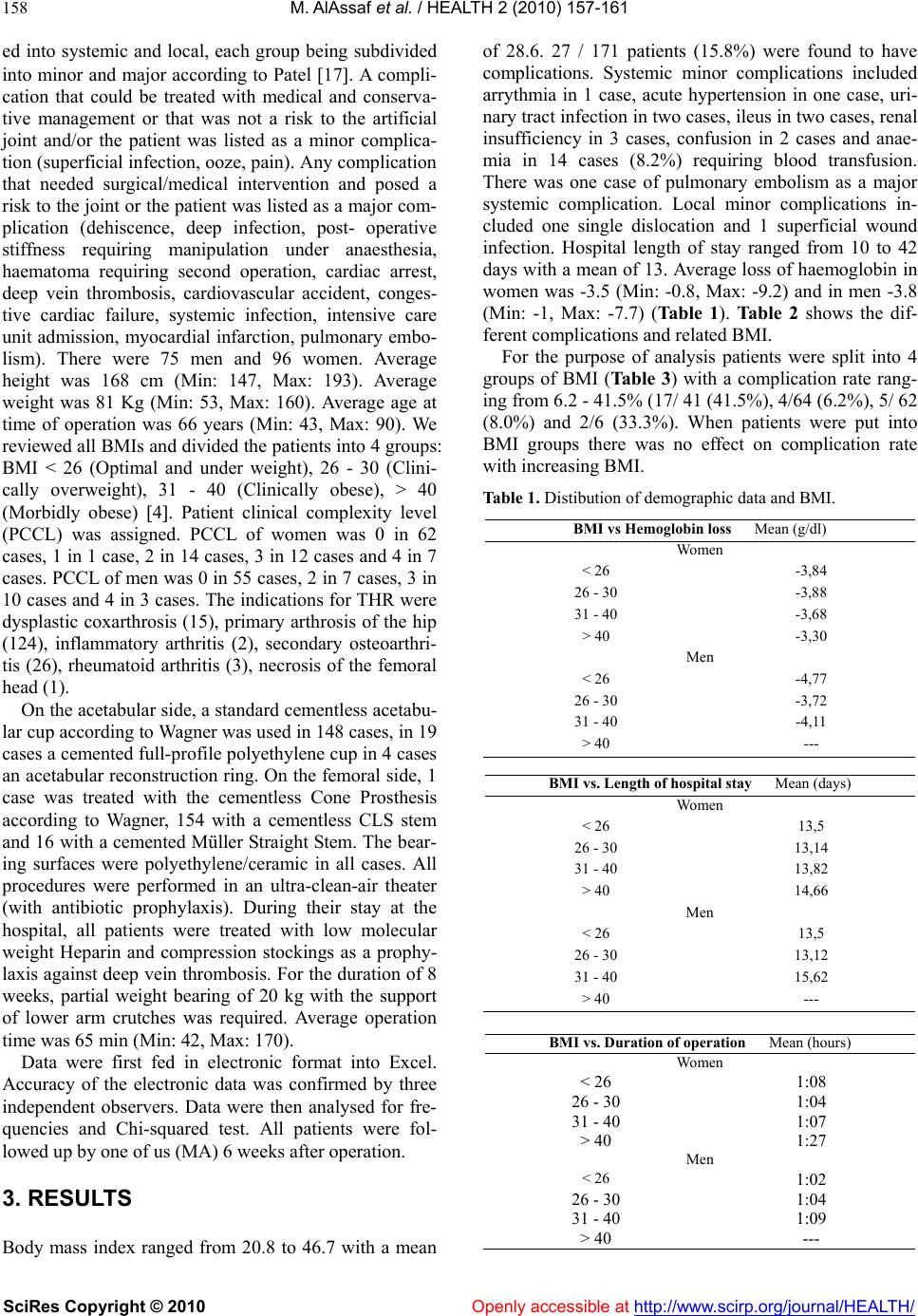 M. AlAssaf et al. / HEALTH 2 (2010) 157-161 SciRes Copyright © 2010 Openly accessible at http://www.scirp.org/journal/HEALTH/ 158 ed into systemic and local, each group being subdivided into minor and major according to Patel 17. A compli- cation that could be treated with medical and conserva- tive management or that was not a risk to the artificial joint and/or the patient was listed as a minor complica- tion (superficial infection, ooze, pain). Any complication that needed surgical/medical intervention and posed a risk to the joint or the patient was listed as a major com- plication (dehiscence, deep infection, post- operative stiffness requiring manipulation under anaesthesia, haematoma requiring second operation, cardiac arrest, deep vein thrombosis, cardiovascular accident, conges- tive cardiac failure, systemic infection, intensive care unit admission, myocardial infarction, pulmonary embo- lism). There were 75 men and 96 women. Average height was 168 cm (Min: 147, Max: 193). Average weight was 81 Kg (Min: 53, Max: 160). Average age at time of operation was 66 years (Min: 43, Max: 90). We reviewed all BMIs and divided the patients into 4 groups: BMI < 26 (Optimal and under weight), 26 - 30 (Clini- cally overweight), 31 - 40 (Clinically obese), > 40 (Morbidly obese) 4. Patient clinical complexity level (PCCL) was assigned. PCCL of women was 0 in 62 cases, 1 in 1 case, 2 in 14 cases, 3 in 12 cases and 4 in 7 cases. PCCL of men was 0 in 55 cases, 2 in 7 cases, 3 in 10 cases and 4 in 3 cases. The indications for THR were dysplastic coxarthrosis (15), primary arthrosis of the hip (124), inflammatory arthritis (2), secondary osteoarthri- tis (26), rheumatoid arthritis (3), necrosis of the femoral head (1). On the acetabular side, a standard cementless acetabu- lar cup according to Wagner was used in 148 cases, in 19 cases a cemented full-profile polyethylene cup in 4 cases an acetabular reconstruction ring. On the femoral side, 1 case was treated with the cementless Cone Prosthesis according to Wagner, 154 with a cementless CLS stem and 16 with a cemented Müller Straight Stem. The bear- ing surfaces were polyethylene/ceramic in all cases. All procedures were performed in an ultra-clean-air theater (with antibiotic prophylaxis). During their stay at the hospital, all patients were treated with low molecular weight Heparin and compression stockings as a prophy- laxis against deep vein thrombosis. For the duration of 8 weeks, partial weight bearing of 20 kg with the support of lower arm crutches was required. Average operation time was 65 min (Min: 42, Max: 170). Data were first fed in electronic format into Excel. Accuracy of the electronic data was confirmed by three independent observers. Data were then analysed for fre- quencies and Chi-squared test. All patients were fol- lowed up by one of us (MA) 6 weeks after operation. 3. RESULTS Body mass index ranged from 20.8 to 46.7 with a mean of 28.6. 27 / 171 patients (15.8%) were found to have complications. Systemic minor complications included arrythmia in 1 case, acute hypertension in one case, uri- nary tract infection in two cases, ileus in two cases, renal insufficiency in 3 cases, confusion in 2 cases and anae- mia in 14 cases (8.2%) requiring blood transfusion. There was one case of pulmonary embolism as a major systemic complication. Local minor complications in- cluded one single dislocation and 1 superficial wound infection. Hospital length of stay ranged from 10 to 42 days with a mean of 13. Average loss of haemoglobin in women was -3.5 (Min: -0.8, Max: -9.2) and in men -3.8 (Min: -1, Max: -7.7) (Table 1). Table 2 shows the dif- ferent complications and related BMI. For the purpose of analysis patients were split into 4 groups of BMI (Table 3) with a complication rate rang- ing from 6.2 - 41.5% (17/ 41 (41.5%), 4/64 (6.2%), 5/ 62 (8.0%) and 2/6 (33.3%). When patients were put into BMI groups there was no effect on complication rate with increasing BMI. Table 1. Distibution of demographic data and BMI. BMI vs Hemoglobin loss Mean (g/dl) Women < 26 -3,84 26 - 30 -3,88 31 - 40 -3,68 > 40 -3,30 Men < 26 -4,77 26 - 30 -3,72 31 - 40 -4,11 > 40 --- BMI vs. Length of hospital stay Mean (days) Women < 26 13,5 26 - 30 13,14 31 - 40 13,82 > 40 14,66 Men < 26 13,5 26 - 30 13,12 31 - 40 15,62 > 40 --- BMI vs. Duration of operation Mean (hours) Women < 26 1:08 26 - 30 1:04 31 - 40 1:07 > 40 1:27 Men < 26 1:02 26 - 30 1:04 31 - 40 1:09 > 40 --- 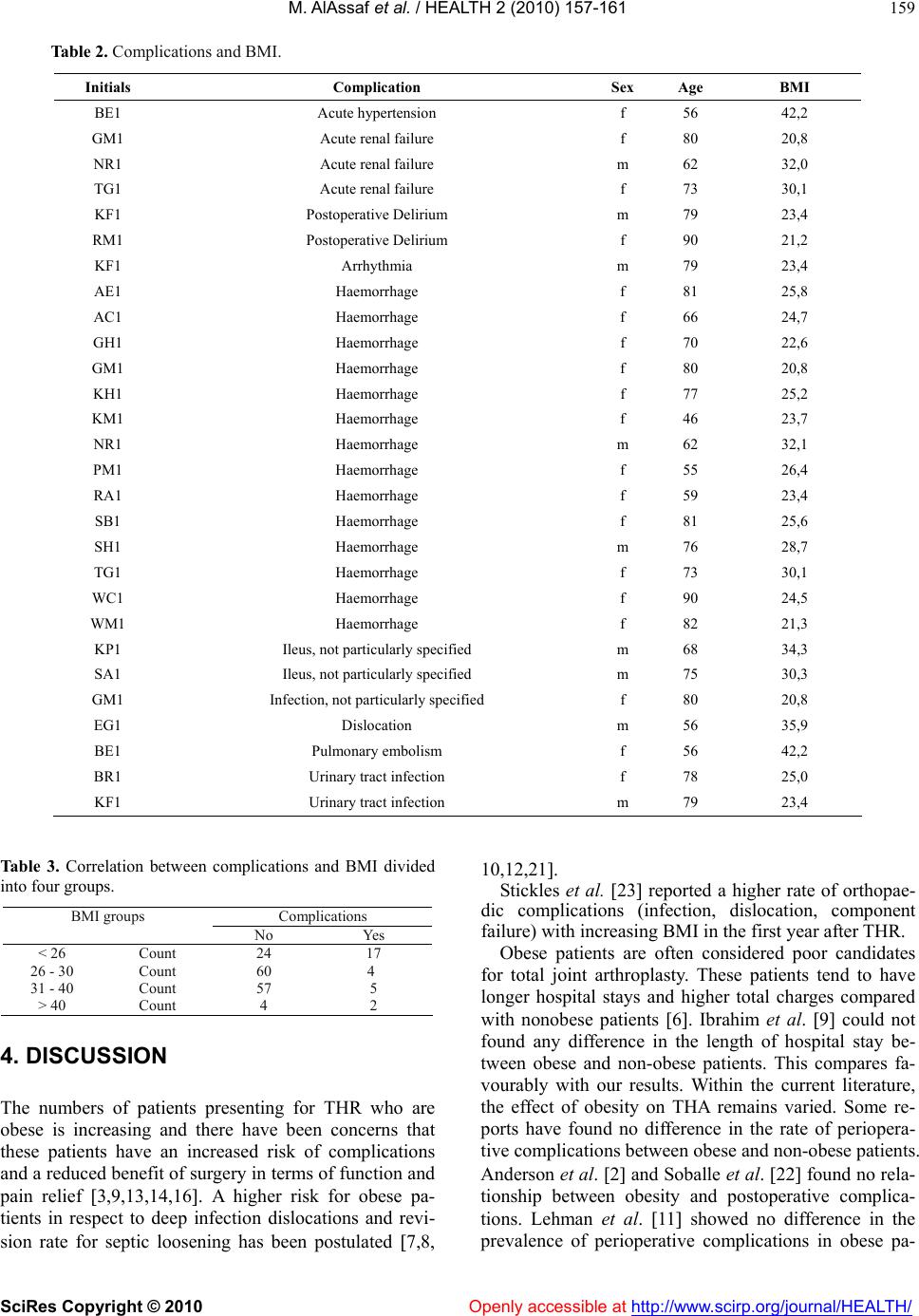 M. AlAssaf et al. / HEALTH 2 (2010) 157-161 SciRes Copyright © 2010 http://www.scirp.org/journal/HEALTH/Openly accessible at 159 Table 2. Complications and BMI. Initials Complication Sex Age BMI BE1 Acute hypertension f 56 42,2 GM1 Acute renal failure f 80 20,8 NR1 Acute renal failure m 62 32,0 TG1 Acute renal failure f 73 30,1 KF1 Postoperative Delirium m 79 23,4 RM1 Postoperative Delirium f 90 21,2 KF1 Arrhythmia m 79 23,4 AE1 Haemorrhage f 81 25,8 AC1 Haemorrhage f 66 24,7 GH1 Haemorrhage f 70 22,6 GM1 Haemorrhage f 80 20,8 KH1 Haemorrhage f 77 25,2 KM1 Haemorrhage f 46 23,7 NR1 Haemorrhage m 62 32,1 PM1 Haemorrhage f 55 26,4 RA1 Haemorrhage f 59 23,4 SB1 Haemorrhage f 81 25,6 SH1 Haemorrhage m 76 28,7 TG1 Haemorrhage f 73 30,1 WC1 Haemorrhage f 90 24,5 WM1 Haemorrhage f 82 21,3 KP1 Ileus, not particularly specified m 68 34,3 SA1 Ileus, not particularly specified m 75 30,3 GM1 Infection, not particularly specified f 80 20,8 EG1 Dislocation m 56 35,9 BE1 Pulmonary embolism f 56 42,2 BR1 Urinary tract infection f 78 25,0 KF1 Urinary tract infection m 79 23,4 Table 3. Correlation between complications and BMI divided into four groups. Complications BMI groups No Yes < 26 Count 24 17 26 - 30 Count 60 4 31 - 40 Count 57 5 > 40 Count 4 2 4. DISCUSSION The numbers of patients presenting for THR who are obese is increasing and there have been concerns that these patients have an increased risk of complications and a reduced benefit of surgery in terms of function and pain relief 3,9,13,14,16. A higher risk for obese pa- tients in respect to deep infection dislocations and revi- sion rate for septic loosening has been postulated 7,8, 10,12,21. Stickles et al. 23 reported a higher rate of orthopae- dic complications (infection, dislocation, component failure) with increasing BMI in the first year after THR. Obese patients are often considered poor candidates for total joint arthroplasty. These patients tend to have longer hospital stays and higher total charges compared with nonobese patients 6. Ibrahim et al. 9 could not found any difference in the length of hospital stay be- tween obese and non-obese patients. This compares fa- vourably with our results. Within the current literature, the effect of obesity on THA remains varied. Some re- ports have found no difference in the rate of periopera- tive complications between obese and non-obese patients. Anderson et al. 2 and Soballe et al. 22 found no rela- tionship between obesity and postoperative complica- tions. Lehman et al. 11 showed no difference in the prevalence of perioperative complications in obese pa-  M. AlAssaf et al. / HEALTH 2 (2010) 157-161 SciRes Copyright © 2010 Openly accessible at http://www.scirp.org/journal/HEALTH/ 160 tients with similar gains in pain relief and functional abilities as non-obese patients. Chan and Villar 5 showed no difference in the quality of life in the short term following THA between obese and non-obese pa- tients. With our study results we can follow Andrew et al. 3 and Ibrahim et al. 9 that there is no association be- tween obesity and the risk of revision surgery or other complications. Especially we could not found any in- creased risk for hematoma, dislocation rate and infection rate and the rate of blood transfusion in the short term follow up. Certainly a limitation of this study is the short period of follow-up. This limitation is of particular importance to the rate of revision surgery. A major advantage of our study is a consecutive patient series who were operated by the same orthopaedic surgeon. Patel et al. 17 came to the same conclusion in a patient cohort who was op- erated by seven different orthopaedic surgeons. Interest- ingly Bowditch et al. 4 found a higher rate of blood loss in obese patients. A lack of this study is the small number of 80 Patients operated by four surgeons. To be able to compare different studies we suggest a larger series of patients operated by the same orthopaedic sur- geon and the use of the same classification system for obesity. We believe that the lack of consensus regarding the impact of obesity on THR may be explained in part by the different definitions of obesity which have been used 3. The aim of our study was to investigate the influence of BMI on early complications in THR. The length of operation between obese and non-obese pa- tients varied significantly in our study. Nevertheless we can conclude that there are no economic or medical rea- sons for excluding obese patients from THR, especially as there is no increased risk for complications and length of hospital stay. We fully agree with Andrew et al. 3 who postulated that patients should still be encouraged to reduce their weight prior to surgery but it seems un- acceptable for patients to be denied treatment in the form of hip replacement solely on the basis of their BMI. REFERENCES [1] Aderinto, J. and Brenkel, I.J. (2004) Pre-operative pre- dictors of the requirement for blood transfusion follow- ing total hip replacement. J Bone Joint Surg Br, 86-Br, 970–3. [2] Anderson, L., Kammerer, W.S. and Greer, R.B. III (1979) Risk factor assessment in 101 total hip arthroplasties. Clin Orthop, 141, 50–54. [3] Andrew, J.G., Palan, J., Kurup, H.V., Gibson, P., Murray, D.W. and Beard, D.J. (2008) Obesity in total hip re- placement. J Bone Joint Surg Br, 90-Br, 424–9. [4] Bowditch, M.G. and Villar, R.N. (1999) Do obese pa- tients bleed more? A prospective study of blood loss at total hip replacement. Ann R Coll Surg Engl, 81, 198 –200. [5] Chan, C.L.H. and Villar, R.N. (1996) Obesity and quality of life after primary hip arthroplasty. J Bone Jt Surg Br, 78-Br, 78–81. [6] Epstein, A.M., Read, L. and Hoefer, M. (1987) The rela- tion of body weight to length of stay and charges for hospital services for patients undergoing elective surgery: a study of two procedures. Am J Public Health, 77, 993– 997. [7] Giurea, A, Zehetgruber, H., Funovics, P., Grampp, S., Karamat, L. and Gottsauner-Wolf, F. (2001) Risk factors for dislocation of a cementless total hip endoprosthe- sis—a statistical analysis. Z Orthop Ihre Grenzgeb, 139, 194–9. [8] Haverkamp, D., de Man, F.H., de Jong, P.T., van Stralen, R.A. and Marti, R.K. (2008) Is the long-term outcome of cemented THA jeopardized by patients being overweight? Clin Orthop Relat Res, 466, 1162–8. [9] Ibrahim, T., Hobson, S., Beiri, A. and Esler, C.N. (2005) No influence of body mass index on early outcome fol- lowing total hip arthroplasty. Int Orthop., 29, 359–61. [10] Jibodh, S.R., Gurkan, I. and Wenz, J.F. (2004) In-hospital outcome and resource use in hip arthroplasty: influence of body mass. Orthopedics, 27, 594–601. [11] Lehman, D.E., Capello, W.N., Feinberg, J.R. (1994) Total hip arthroplasty without cement in obese patients. A minimum two year clinical and radiographic follow-up study. J Bone Jt Surg Am, 76-Am, 854–862. [12] Lübbeke, A., Stern, R., Garavaglia, G., Zurcher, L. and Hoffmeyer, P. (2007) Differences in outcomes of obese women and men undergoing primary total hip arthro- plasty. Arthritis Rheum., 57, 327–34. [13] Marker, D.R., Seyler, T.M., Jinnah, R.H., Delanois, R.E., Ulrich, S.D. and Mont, M.A. (2007) Femoral neck frac- tures after metal-on-metal total hip resurfacing: a pro- spective cohort study. J Arthroplasty, 22(7 Suppl 3), 66 –71. [14] Moran, M., Walmsley, P., Gray, A. and Brenkel, I.J. (2005) Does body mass index affect the early outcome of primary total hip arthroplasty? J Arthroplasty, 20, 866–9. [15] Namba, R.S., Paxton, L., Fithian, D.C. and Stone, M.L. (2005) Obesity and perioperative morbidity in total hip and total knee arthroplasty patients. J Arthroplasty, 20, 46–50. [16] Parvizi, J., Mui, A., Purtill, J.J., Sharkey, P.F., Hozack, W.J. and Rothman, R.H. (2007) Total joint arthroplasty: When do fatal or near-fatal complications occur? J Bone Joint Surg Am, 89-Am, 27–32. [17] Patel, A.D. and Albrizio, M. (2007) Relationship of body mass index to early complications in hip replacement surgery : study performed at Hinchingbrooke Hospital, Orthopaedic Directorate, Huntingdon, Cambridgeshire. Int Orthop., 31, 439–43. [18] Patel, V.P., Walsh, M., Sehgal, B., Preston, C., DeWal, H., Di Cesare, P.E. (2007) Factors associated with prolonged wound drainage after primary total hip and knee arthro- plasty. J Bone Joint Surg Am, 89-Am, 33–8. [19] Perka, C., Labs, K., Muschik, M. and Buttgereit, F. (2000) The influence of obesity on perioperative morbidity and mortality in revision total hip arthroplasty. Arch Orthop Trauma Surg., 120, 267–271. [20] Pola, E., Papaleo, P., Santoliquido, A., Gasparini, G., Aulisa, L. and De Santis, E. (2004) Clinical factors asso-  M. AlAssaf et al. / HEALTH 2 (2010) 157-161 SciRes Copyright © 2010 http://www.scirp.org/journal/HEALTH/Openly accessible at 161 ciated with an increased risk of perioperative blood transfusion in nonanemic patients undergoing total hip arthroplasty. J Bone Joint Surg Am., 86-Am, 57–61. [21] Sadr Azodi, O., Adami, J., Lindström, D., Eriksson, K.O., Wladis, A. and Bellocco, R. (2008) High body mass in- dex is associated with increased risk of implant disloca- tion following primary total hip replacement: 2,106 pa- tients followed for up to 8 years. Acta Orthop., 79, 41–7. [22] Soballe, K., Christensen, F. and Luxhoj, T. (1987) Hip replacements in obese patients. Acta Orthop Scand., 58, 223–225. [23] Stickles, B., Phillips, L., Brox, W.T., Owens, B. and Lanzer, W.L. (2001) Defining the relationship between obesity and total joint arthroplasty. Obes Res., 9, 219–23. |