

Paper Menu >>
Journal Menu >>
 Vol.2, No.1, 33-40 (2010) Natural Science http://dx.doi.org/10.4236/ns.2010.21005 Copyright © 2010 SciRes. OPEN ACCESS Toxicity evaluation of produced formation waters after filtration treatment Loredana Manfra, Chiara Maggi, Jessica Bianchi, Michela Mannozzi, Olga Faraponova, Livia Mariani, Fulvio Onorati, Andrea Tornambè, Claudia Virno Lamberti, Erika Magaletti ISPRA, Advanced Institute for Environmental Protection and Research, Rome, Italy; [email protected] Received 19 June 2009; revised 24 July 2009; accepted 28 July 2009. ABSTRACT During the last years many authors have char- acterized the produced formation waters (PFWs) with respect to chemical compounds and toxic- ity. Most of data are related to PFWs collected on offshore platform after treatment process. The available results showed that the particulate phase had an influence on PFW toxicity. As- suming the toxicity of PFWs treated on platform, the aim of this paper is to study the toxicity of these PFWs after a further filtration treatment carried out in laboratory. For this purpose PFWs were sampled from three natural gas platforms located in the Adriatic Sea (Italy) below treat- ment system. The eco-toxicological bioassays have been conducted on test-organisms be- longing to different trophic levels such as bac- teria, algae, crustaceans and fishes. The PFWs resulted toxic according to an overall assess- ment obtained through the bioassays. Further- more, it has been possible to identify the spe- cies that were more sensitive to the tested PFWs, namely Tigriopus fulvus, Dicentrarchus labrax and Vibrio fischeri. Besides, a chemical char- acterization was reported related to the con- taminants present in the PFWs to go with eco-toxicological assessment. Barium, zinc and manganese showed the most concentrations among the metals and the lower molecular weight components were common among the organic compounds. Some differences among PFWs were observed both for toxicity and chemical composition. The highest toxicity was recorded in PFWs (PFW1 and PFW2) containing the highest concentrations of some metals (Ba, Mn and Zn) and/or BTEX. Keywords: Adriatic Sea (Italy); Offshore Platforms; Natural Gas Production Fields; Produced Formation Waters; Toxicity Assessment; Bacterium (Vibrio Fischeri); Algae (Dunaliella Tertiolecta and Phaeodactylum Tricornutum); Crustaceans (Artemia Franciscana and Tigriopus Fulvus); Fish (Dicentrarchus Labrax); Chemical Characterization 1. INTRODUCTION Produced formation water (PFW) is water naturally pre- sent in sedimentary formations from which oil and gas are mined. It is piped to the surface during the produc- tion process and may be discharged into the sea when the rejection is not possible. Before discharge, PFWs are treated directly on platform to reduce oil and solid sus- pended content [1]. In spite of this treatment, PFWs still include oil and particles. In Italy, like in other Countries, the legislation binds to control the oil content in the PFW when they are dis- charged into the sea [2]; for this reason, the PFW char- acterization has been limited for several years to meas- urement of “oil in water”, which means analysis of non polar aliphatic hydrocarbons. However, PFW contains a variety of compounds such as metals (i.e. barium, copper, zinc, and iron), volatile aromatic compounds (benzene, toluene, ethylbenzene, xylenes, called BTEX), semi- volatile compounds (naphthalene, phenanthrene, diben- zothiophene and their C1-C3 alkyl homologues), phenols alkylated up to C7, organic acids (C1-C6 compounds) and some additives of possible employment (i.e. diethylene glycol, called DEG) [3]. For this reason, during the last years many authors have characterized PFWs with respect to these com- pounds (metals, aromatic and aliphatic hydrocarbons, phenols and additives) and to the toxicity of PFWs. The most data-gathering is related to PFWs collected on platform after treatment process and untreated in laboratory later on [4-8]. Few data are referred to PFWs collected on oil platforms below treatment sys- tem and filtered in laboratory subsequently [3,9]. There are scattered data about PFWs originated from Italian offshore gas installations (Adriatic Sea): some 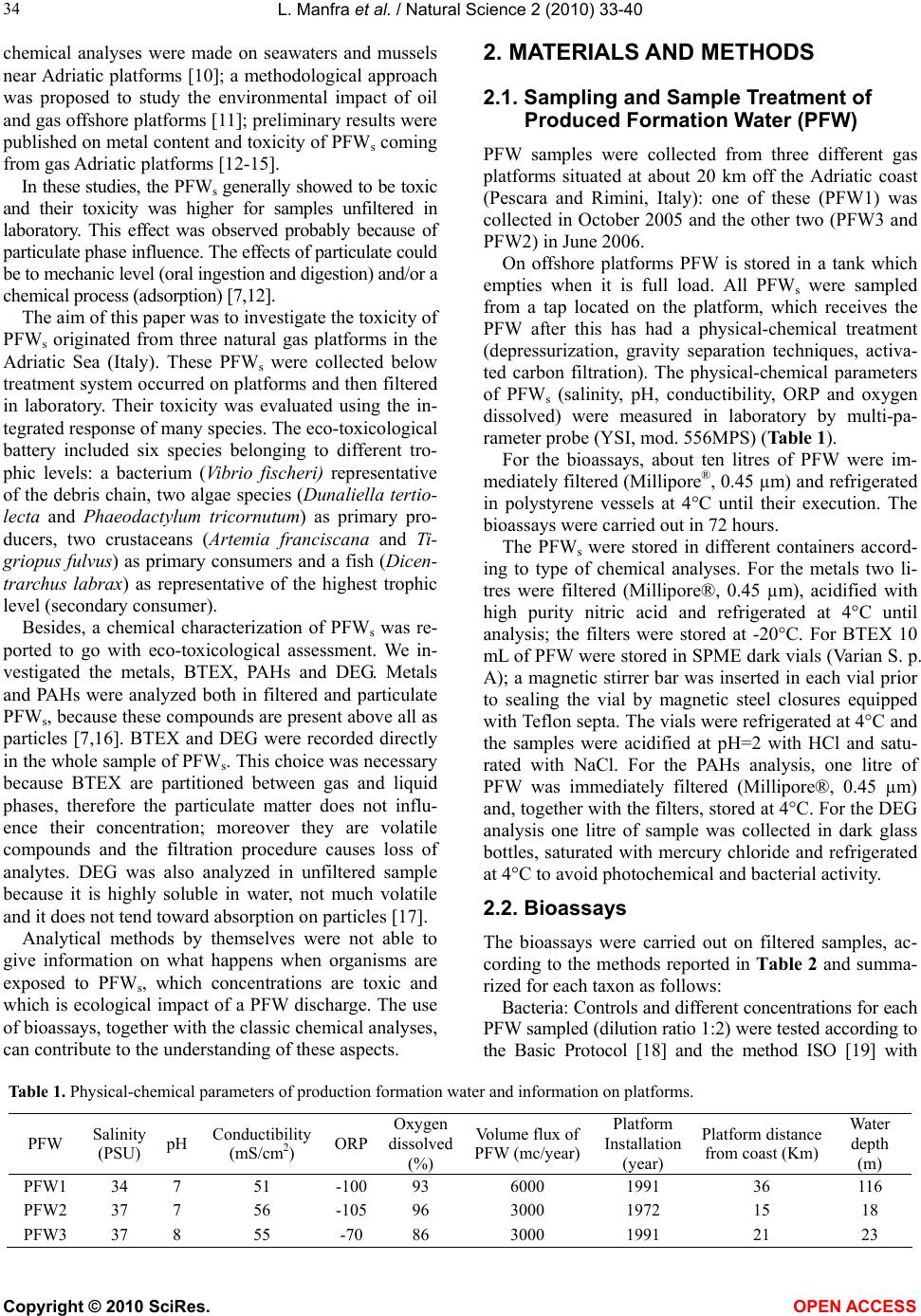 L. Manfra et al. / Natural Science 2 (2010) 33-40 Copyright © 2010 SciRes. OPEN ACCESS 34 chemical analyses were made on seawaters and mussels near Adriatic platforms [10]; a methodological approach was proposed to study the environmental impact of oil and gas offshore platforms [11]; preliminary results were published on metal content and toxicity of PFWs coming from gas Adriatic platforms [12-15]. In these studies, the PFWs generally showed to be toxic and their toxicity was higher for samples unfiltered in laboratory. This effect was observed probably because of particulate phase influence. The effects of particulate could be to mechanic level (oral ingestion and digestion) and/or a chemical process (adsorption) [7,12]. The aim of this paper was to investigate the toxicity of PFWs originated from three natural gas platforms in the Adriatic Sea (Italy). These PFWs were collected below treatment system occurred on platforms and then filtered in laboratory. Their toxicity was evaluated using the in- tegrated response of many species. The eco-toxicological battery included six species belonging to different tro- phic levels: a bacterium (Vibrio fischeri) representative of the debris chain, two algae species (Dunaliella tertio- lecta and Phaeodactylum tricornutum) as primary pro- ducers, two crustaceans (Artemia franciscana and Ti- griopus fulvus) as primary consumers and a fish (Dicen- trarchus labrax) as representative of the highest trophic level (secondary consumer). Besides, a chemical characterization of PFWs was re- ported to go with eco-toxicological assessment. We in- vestigated the metals, BTEX, PAHs and DEG. Metals and PAHs were analyzed both in filtered and particulate PFWs, because these compounds are present above all as particles [7,16]. BTEX and DEG were recorded directly in the whole sample of PFWs. This choice was necessary because BTEX are partitioned between gas and liquid phases, therefore the particulate matter does not influ- ence their concentration; moreover they are volatile compounds and the filtration procedure causes loss of analytes. DEG was also analyzed in unfiltered sample because it is highly soluble in water, not much volatile and it does not tend toward absorption on particles [17]. Analytical methods by themselves were not able to give information on what happens when organisms are exposed to PFWs, which concentrations are toxic and which is ecological impact of a PFW discharge. The use of bioassays, together with the classic chemical analyses, can contribute to the understanding of these aspects. 2. MATERIALS AND METHODS 2.1. Sampling and Sample Treatment of Produced Formation Water (PFW) PFW samples were collected from three different gas platforms situated at about 20 km off the Adriatic coast (Pescara and Rimini, Italy): one of these (PFW1) was collected in October 2005 and the other two (PFW3 and PFW2) in June 2006. On offshore platforms PFW is stored in a tank which empties when it is full load. All PFWs were sampled from a tap located on the platform, which receives the PFW after this has had a physical-chemical treatment (depressurization, gravity separation techniques, activa- ted carbon filtration). The physical-chemical parameters of PFWs (salinity, pH, conductibility, ORP and oxygen dissolved) were measured in laboratory by multi-pa- rameter probe (YSI, mod. 556MPS) (Table 1). For the bioassays, about ten litres of PFW were im- mediately filtered (Millipore®, 0.45 µm) and refrigerated in polystyrene vessels at 4°C until their execution. The bioassays were carried out in 72 hours. The PFWs were stored in different containers accord- ing to type of chemical analyses. For the metals two li- tres were filtered (Millipore®, 0.45 µm), acidified with high purity nitric acid and refrigerated at 4°C until analysis; the filters were stored at -20°C. For BTEX 10 mL of PFW were stored in SPME dark vials (Varian S. p. A); a magnetic stirrer bar was inserted in each vial prior to sealing the vial by magnetic steel closures equipped with Teflon septa. The vials were refrigerated at 4°C and the samples were acidified at pH=2 with HCl and satu- rated with NaCl. For the PAHs analysis, one litre of PFW was immediately filtered (Millipore®, 0.45 µm) and, together with the filters, stored at 4°C. For the DEG analysis one litre of sample was collected in dark glass bottles, saturated with mercury chloride and refrigerated at 4°C to avoid photochemical and bacterial activity. 2.2. Bioassays The bioassays were carried out on filtered samples, ac- cording to the methods reported in Table 2 and summa- rized for each taxon as follows: Bacteria: Controls and different concentrations for each PFW sampled (dilution ratio 1:2) were tested according to the Basic Protocol [18] and the method ISO [19] with Table 1. Physical-chemical parameters of production formation water and information on platforms. PFW Salinity (PSU) pH Conductibility (mS/cm2) ORP Oxygen dissolved (%) Volume flux of PFW (mc/year) Platform Installation (year) Platform distance from coast (Km) Water depth (m) PFW1 34 7 51 -10093 6000 1991 36 116 PFW2 37 7 56 -10596 3000 1972 15 18 PFW3 37 8 55 -7086 3000 1991 21 23  L. Manfra et al. / Natural Science 2 (2010) 33-40 Copyright © 2010 SciRes. OPEN ACCESS 35 35 bacteria coming from freeze-dried SDI. PFW salinity was not adjusted prior to testing. The Software Microtox Om- niTM v. 1.16 was utilized to calculate the EC50 and EC20 values (effect concentration of 50% and 20% respectively) and the Dunnett test was used to calculate the NOEC value (no observed effect concentration). Algae: One control and some concentrations for each PFW sampled were tested according to the ISO method [20] with Phaeodactylum tricornutum strain 1090-1° and Dunaliella tertiolecta strain 13.86, ob- tained from the Plant Physiology Institute of Gottingen University (Germany). Algal growth medium was prepared with artificial seawater [20]; for D. tertio- lecta nutrients, according to the IRSA-CNR method [21] and vitamins according to the ISO method [20] were added. The algal inoculum had an initial density of 10000 cells mL-1 ± 10% for P. tricornutum and 2000 cells mL-1± 10% for D. tertiolecta. Regression analysis technique was performed for the determination of EC50 and EC20; the Dunnett test was used to calculate the NOEC value. Crustaceans: A control and some concentrations for each PFW sampled were tested with nauplii of Artemia franciscana , according to the APAT IRSA-CNR method [22], and with nauplii of Tigriopus fulvus, according to the ISO/FDIS method [23] as modified by Faraponova et al. [24,25]. Reference cysts of A. franciscana were obtained from the Quality Assurance Research Divi- sion U. S. Environmental Protection Agency (Cincin- nati OH 45268, USA) or from the Laboratory for Bio- logical Research in Aquatic Pollution, University of Ghent (Belgium). The eggs of A. franciscana were hatched in synthetic seawater and the nauplii were used within 48 hours of hatching [22]. Synchronized nauplii (24-48h) of T. fulvus were collected from a culture of two hundred females taken from a mass laboratory culture originated from the Italian coast (Calafuria, Livorno) and supplied with an algal mix- ture (Tetroselmis suecica and Isochrysis galbana, ratio 1:2). Probit analysis was performed for the determina- tion of EC50 and EC15, the Dunnett test was used to calculate the NOEC value. Fish: One control and some concentrations for each PFW sampled were tested with juveniles of Dicen- trarchus labrax (80 days old, length of 3.74±0.28 cm and weight of 0.48±0.08 g), according to the EPA [26] and OECD [27] methods. Organisms were supplied by the hatchery production plant ASA (Rome), stabled in synthetic seawater with salinity of 20±1 PSU for 15 days and fed with granulated food until 24 hours before the test. Probit analysis was performed for the determination of EC50 and EC15, the Dunnett test was used to calculate the NOEC value. The results were compared to a toxicity scale reported in Table 3. On the basis of this toxicity scale, the samples were classified as follows: 1) toxic 10≤ EC50<100, 20≤ EC20<50, effect percentage ≥50; 2) weakly toxic EC50>100, EC20>50, 20≤effect percentage<50; 3) no toxic EC50 no calculable, EC20>100, effect percentage 20. 2.3. Analysis of Metals Determination of iron (Fe), copper (Cu), zinc (Zn), lead (Pb), chromium (Cr), manganese (Mn), nickel (Ni), bar- ium (Ba), arsenic (As), cadmium (Cd) and mercury (Hg) was carried on both filtered and particulate samples. The filtered sample was directly analyzed. The metal disso- lution of particulate fraction collected on the filters was conducted using microwave-assisted digestion (Mile- stone MLS Ethos TC) with 3 mL of HNO3 and 9 mL of HCl. The metal concentrations were determined by a graphite furnace atomic absorption with Zeeman back- ground correction technique (SpectrAA-220Z, Varian) and by coupled emission plasma ICP-OES (Liberty AX, Varian). For Hg analysis a Direct Mercury Analyzer (DMA-80, FKV) instrument was used (EPA Method [28]). All samples were run in triplicate. The quantifica- tion limits (LOQ) were: 0.0005 mg/l for Hg and Cd, 0.01 mg/L for the other metals. 2.4. Analysis of Organic Compounds BTEX: The analyses were extracted and pre-concen- trated by means Solid Phase Micro Extraction (SPME) using a stable flex fiber of divinilbenzene-carboxen- poly-dimethylsiloxane (film thickness: 55/30 µm) (Su- pelco®) by head space sampling. The analytical deter- minations of BTEX were carried out in unfiltered sam- ples using a modified EPA method [29]. A gas chroma- tography coupled with mass spectrometry (GC HP 5790 Agilent Technologies® and MS 5973 Network Agilent Technologies®) were used. The method detection limits were 1 µg/L for benzene and 0.1 µg/L for toluene, ethyl benzene and xylenes. PAHs: The analyses were investigated in filtered sam- ples and on the particulate matter retained by the filter (Millipore®, 0.45 µm). The analyses were extracted by the filtered samples by means Solid Phase Extraction technique. The treatment of filters was carried out by ultrasonic extraction for 20 minutes with 10 mL of di- chloromethane. Then, both the extraction phases were evaporated at 1-2 mL with a gentle nitrogen flow. Af- terward, 1 mL of toluene was added and the residual dichloromethane was completely removed. All solvents were capillary GC grade supplied by Sigma-Aldrich. The analyses of PAHs were carried out in gas chroma- tography coupled with mass spectrometry (GC HP 5790® and MS 5973 Network Agilent Technologies). The LOQ was 1 µg/L for each analysis. DEG: An extraction procedure of DEG was carried out with 2 mL SPE cartridges packed with 200 mg of EN V+stationary phase (International Sorbent Technology, 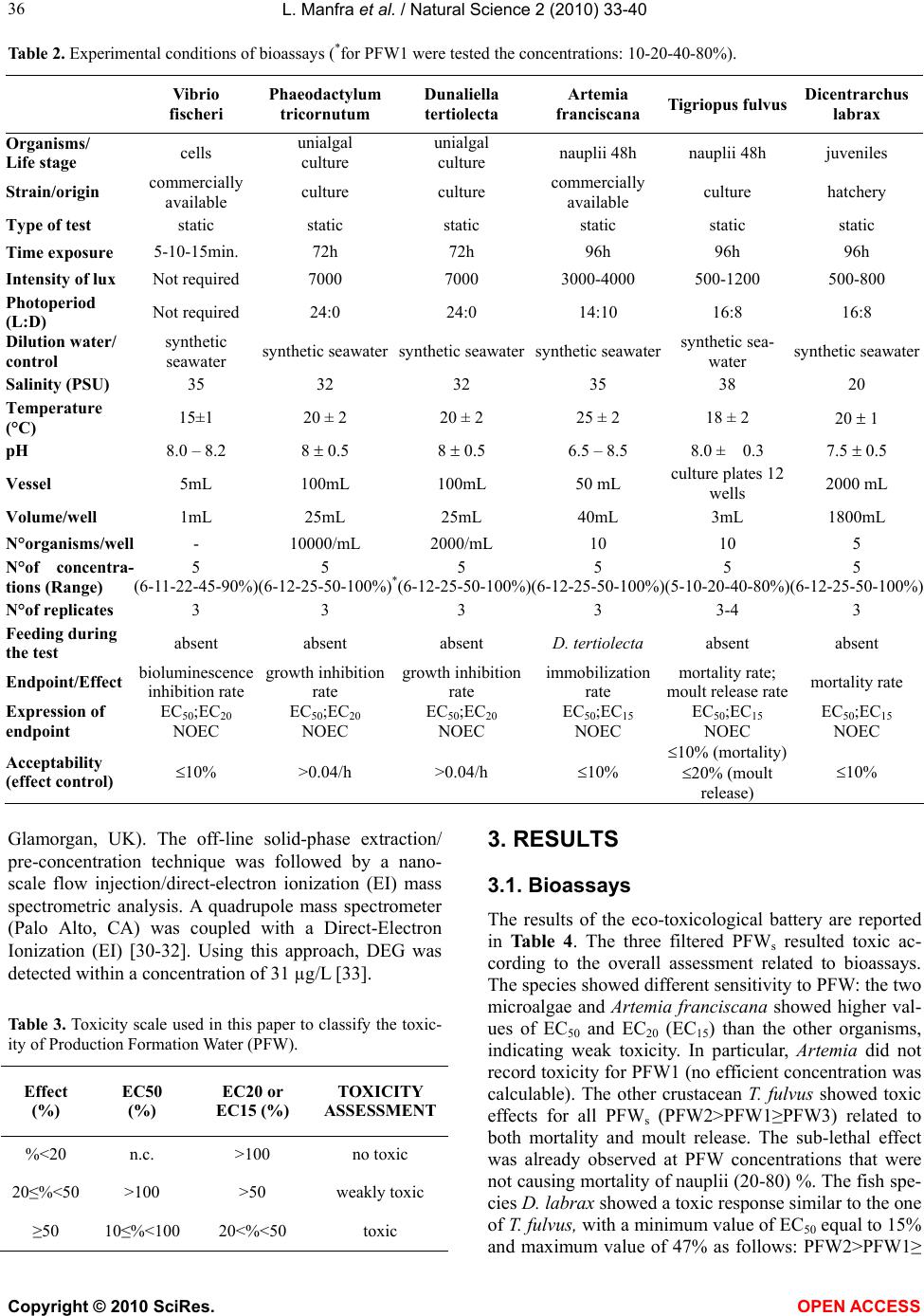 L. Manfra et al. / Natural Science 2 (2010) 33-40 Copyright © 2010 SciRes. OPEN ACCESS 36 Table 2. Experimental conditions of bioassays (*for PFW1 were tested the concentrations: 10-20-40-80%). Vibrio fischeri Phaeodactylum tricornutum Dunaliella tertiolecta Artemia franciscana Tigriopus fulvus Dicentrarchus labrax Organisms/ Life stage cells unialgal culture unialgal culture nauplii 48h nauplii 48h juveniles Strain/origin commercially available culture culture commercially available culture hatchery Type of test static static static static static static Time exposure 5-10-15min. 72h 72h 96h 96h 96h Intensity of lux Not required 7000 7000 3000-4000 500-1200 500-800 Photoperiod (L:D) Not required 24:0 24:0 14:10 16:8 16:8 Dilution water/ control synthetic seawater synthetic seawatersynthetic seawatersynthetic seawatersynthetic sea- water synthetic seawater Salinity (PSU) 35 32 32 35 38 20 Temperature (°C) 15±1 20 ± 2 20 ± 2 25 ± 2 18 ± 2 20 1 pH 8.0 – 8.2 8 0.5 8 0.5 6.5 – 8.5 8.0 ± 0.3 7.5 0.5 Vessel 5mL 100mL 100mL 50 mL culture plates 12 wells 2000 mL Volume/well 1mL 25mL 25mL 40mL 3mL 1800mL N°organisms/well - 10000/mL 2000/mL 10 10 5 N°of concentra- tions (Range) 5 (6-11-22-45-90%) 5 (6-12-25-50-100%) 5 *(6-12-25-50-100%) 5 (6-12-25-50-100%) 5 (5-10-20-40-80%) 5 (6-12-25-50-100%) N°of replicates 3 3 3 3 3-4 3 Feeding during the test absent absent absent D. tertiolecta absent absent Endpoint/Effect bioluminescence inhibition rate growth inhibition rate growth inhibition rate immobilization rate mortality rate; moult release rate mortality rate Expression of endpoint EC50;EC20 NOEC EC50;EC20 NOEC EC50;EC20 NOEC EC50;EC15 NOEC EC50;EC15 NOEC EC50;EC15 NOEC Acceptability (effect control) 10% >0.04/h >0.04/h 10% 10% (mortality) 20% (moult release) 10% Glamorgan, UK). The off-line solid-phase extraction/ pre-concentratio n technique was followed by a nano- scale flow injection/direct-electron ionization (EI) mass spectrometric analysis. A quadrupole mass spectrometer (Palo Alto, CA) was coupled with a Direct-Electron Ionization (EI) [30-32]. Using this approach, DEG was detected within a concentration of 31 µg/L [33]. Table 3. Toxicity scale used in this paper to classify the toxic- ity of Production Formation Water (PFW). Effect (%) EC50 (%) EC20 or EC15 (%) TOXICITY ASSESSMENT %<20 n.c. >100 no toxic 20≤%<50 >100 >50 weakly toxic ≥50 10≤%<100 20<%<50 toxic 3. RESULTS 3.1. Bioassays The results of the eco-toxicological battery are reported in Table 4. The three filtered PFWs resulted toxic ac- cording to the overall assessment related to bioassays. The species showed different sensitivity to PFW: the two microalgae and Artemia franciscana showed higher val- ues of EC50 and EC20 (EC15) than the other organisms, indicating weak toxicity. In particular, Artemia did not record toxicity for PFW1 (no efficient concentration was calculable). The other crustacean T. fulvus showed toxic effects for all PFWs (PFW2>PFW1≥PFW3) related to both mortality and moult release. The sub-lethal effect was already observed at PFW concentrations that were not causing mortality of nauplii (20-80) %. The fish spe- cies D. labrax showed a toxic response similar to the one of T. fulvus, with a minimum value of EC50 equal to 15% and maximum value of 47% as follows: PFW2>PFW1≥  L. Manfra et al. / Natural Science 2 (2010) 33-40 Copyright © 2010 SciRes. OPEN ACCESS 37 37 PFW3. The bacterium V. fischeri recorded lower toxicity than T. fulvus and D. labrax but yet a toxic effect was observed for all PFWs (PFW1>PFW3≥PFW2). 3.2. Analysis of Metals In filtered sample, Ba, Mn and Zn showed detectable concentrations. There were not significant differences between PFW2 and PFW3 exclusive of Ba and Mn. These two metals showed higher concentrations of one order in PFW2 than PFW3. In particulate sample, all metals were detectable except Pb and Hg. Ni, Cd and As registered detectable concentrations only in PFW3. Ba, Zn and Fe showed highest concentrations and some sig- nificant differences among the PFWs analyzed. Ba con- centration was higher of one order in PFW1 and PFW2 than PFW3; Zn was higher of two orders in PFW2 and PFW3 than PFW1; Fe was higher of one order in PFW3 than PFW1 and PFW2. 3.3. Analysis of Organic Compounds As reported in introduction section, BTEX and DEG were analysed on unfiltered PFWs. The analyses of the three platforms pointed out that the volatile organic compounds (BTEX) were detected at very high concen- trations by the following ranking: PFW1 (1281.8 μg/L) >PFW3 (66.5 μg/L)>PFW2 (48.0 μg/L) (Table 6), showing for PFW1 values almost twenty times higher than ones of PFW2 and PFW3. The DEG showed con- centrations ranging from 2400 to 13000 μg/L by the fol- lowing ranking of the fields: PFW3>PFW2>PFW1 (Ta- ble 6). PAHs were investigated both in filtered and par- ticulate sample but they were lower than LOQ (1 μg/L) in filtered PFWs. In particulate sample PAHs showed the trend as follows: PFW1 (150.0 μg/L)>PFW3 (126.0 μg/L)>PFW2 (100.0 μg/L), with values about of the same magnitude order. The congeners with two and three rings recorded the following concentrations: 87 μg/L in PFW1 compared to 150 μg/L of the total PAHs content; 54 μg/L in PFW2 compared to 100 μg/L of total PAHs concentration, and 66 μg/L in PFW3 compared to 126 μg/L of total PAHs. The detected concentrations were of the same order of magnitude for all three PFW investigated. 4. DISCUSSIONS The bioassays showed that the PFWs were toxic even if filtered. EC50 values ranged between the minimum of 14.8 % and values higher than 100 %. Some of the sam- ples did record no toxicity at the EC50 level observed Table 4. Bioassay results related to three Italian Production Formation Waters and toxicity evaluation according to toxicity scale (n.c. not calculable; n.d. not determined). Species (time of exposure, end point) % PFW1 PFW2 PFW3 PFW1 PFW2 PFW3 EC50 67 (59-75)> 90 > 90 EC20 20(18-23) 29(27-31)28(25-31) Vibrio fischeri (15 min. bioluminescence) NOEC - - - toxic toxic toxic EC50 > 80 > 100 > 100 EC20 > 80 52 (46-58) 68 (24-111) Phaeodactylum tricornutum (72h growth) NOEC 40 25 25 weakly toxic weakly toxic weakly toxic EC50 > 80 n.d. n.d EC20 > 80 n.d n.d Dunaliella tertiolecta (72h growth) NOEC 40 n.d n.d weakly toxic n. d n. d. EC50 > 100 > 100 > 100 EC15 > 100 86 (55-259) 77 (42-462) Artemia franciscana (96h immobilization) NOEC n.c. 50 25 no toxic weakly toxic weakly toxic EC50 29 15 44 EC15 19 8 29 Tigriopus fulvus (96h mortality) NOEC 10 5 20 toxic toxic toxic EC50 23 25 77 EC15 n.c. n.c. n.c. Tigriopus fulvus (96h moult release) NOEC 10 5 10 toxic toxic toxic EC50 32 (27-39) 15 (n.c) 47 (n.c) EC15 23 (15-28) 11 (n.c) 15 (n.c) Dicentrarchus labrax (96h mortality) NOEC 13 6 6 toxic toxic toxic 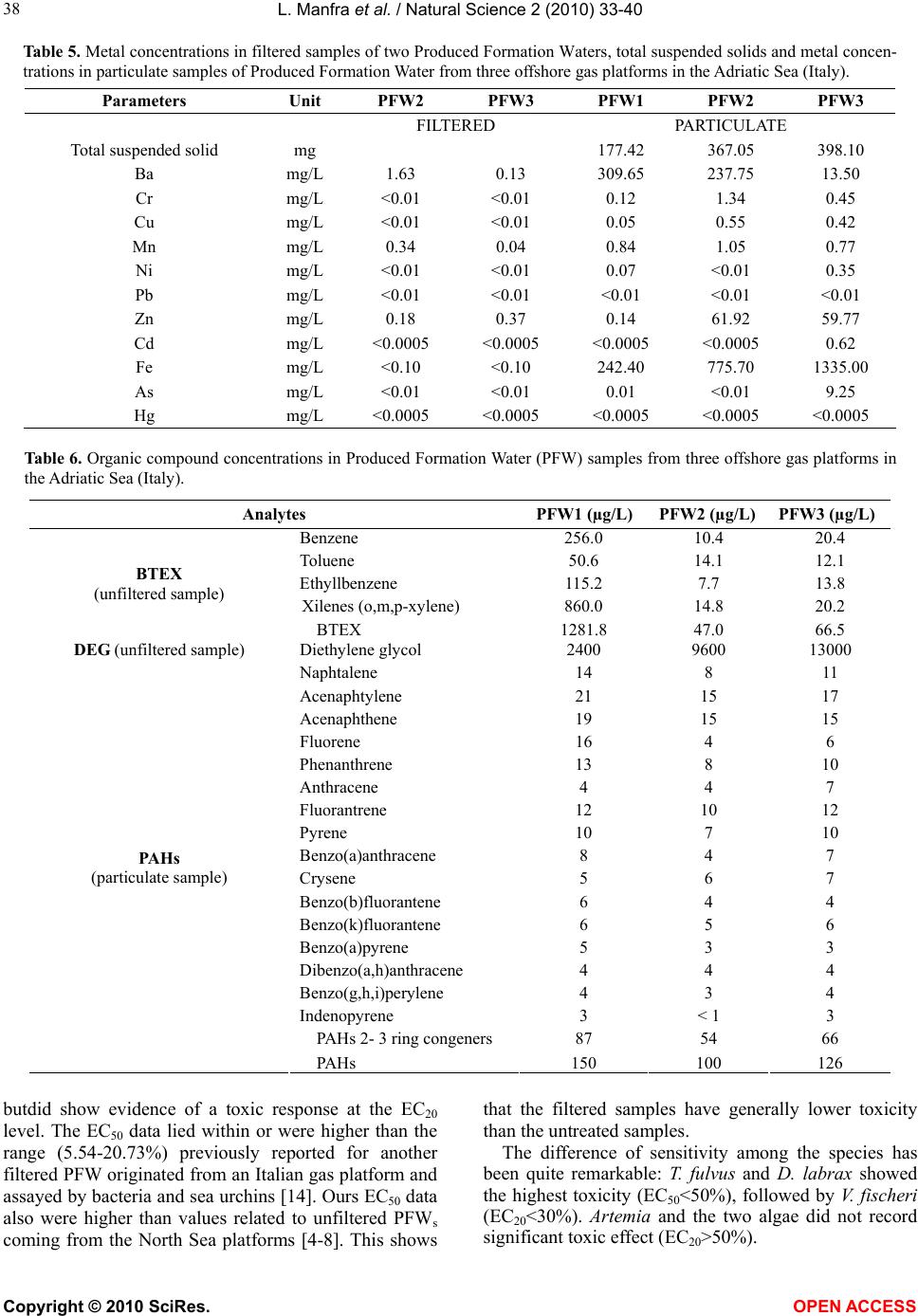 L. Manfra et al. / Natural Science 2 (2010) 33-40 Copyright © 2010 SciRes. OPEN ACCESS 38 Table 5. Metal concentrations in filtered samples of two Produced Formation Waters, total suspended solids and metal concen- trations in particulate samples of Produced Formation Water from three offshore gas platforms in the Adriatic Sea (Italy). Parameters Unit PFW2 PFW3 PFW1 PFW2 PFW3 FILTERED PARTICULATE Total suspended solid mg 177.42 367.05 398.10 Ba mg/L 1.63 0.13 309.65 237.75 13.50 Cr mg/L <0.01 <0.01 0.12 1.34 0.45 Cu mg/L <0.01 <0.01 0.05 0.55 0.42 Mn mg/L 0.34 0.04 0.84 1.05 0.77 Ni mg/L <0.01 <0.01 0.07 <0.01 0.35 Pb mg/L <0.01 <0.01 <0.01 <0.01 <0.01 Zn mg/L 0.18 0.37 0.14 61.92 59.77 Cd mg/L <0.0005 <0.0005 <0.0005 <0.0005 0.62 Fe mg/L <0.10 <0.10 242.40 775.70 1335.00 As mg/L <0.01 <0.01 0.01 <0.01 9.25 Hg mg/L <0.0005 <0.0005 <0.0005 <0.0005 <0.0005 Table 6. Organic compound concentrations in Produced Formation Water (PFW) samples from three offshore gas platforms in the Adriatic Sea (Italy). Analytes PFW1 (µg/L)PFW2 (µg/L) PFW3 (µg/L) Benzene 256.0 10.4 20.4 Toluene 50.6 14.1 12.1 Ethyllbenzene 115.2 7.7 13.8 Xilenes (o,m,p-xylene) 860.0 14.8 20.2 BTEX (unfiltered sample) BTEX 1281.8 47.0 66.5 DEG (unfiltered sample) Diethylene glycol 2400 9600 13000 Naphtalene 14 8 11 Acenaphtylene 21 15 17 Acenaphthene 19 15 15 Fluorene 16 4 6 Phenanthrene 13 8 10 Anthracene 4 4 7 Fluorantrene 12 10 12 Pyrene 10 7 10 Benzo(a)anthracene 8 4 7 Crysene 5 6 7 Benzo(b)fluorantene 6 4 4 Benzo(k)fluorantene 6 5 6 Benzo(a)pyrene 5 3 3 Dibenzo(a,h)anthracene 4 4 4 Benzo(g,h,i)perylene 4 3 4 Indenopyrene 3 < 1 3 PAHs 2 - 3 ring congeners 87 54 66 PAHs (particulate sample) PAHs 150 100 126 butdid show evidence of a toxic response at the EC20 level. The EC50 data lied within or were higher than the range (5.54-20.73%) previously reported for another filtered PFW originated from an Italian gas platform and assayed by bacteria and sea urchins [14]. Ours EC50 data also were higher than values related to unfiltered PFWs coming from the North Sea platforms [4-8]. This shows that the filtered samples have generally lower toxicity than the untreated samples. The difference of sensitivity among the species has been quite remarkable: T. fulvus and D. labrax showed the highest toxicity (EC50<50%), followed by V. fischeri (EC20<30%). Artemia and the two algae did not record significant toxic effect (EC20>50%). 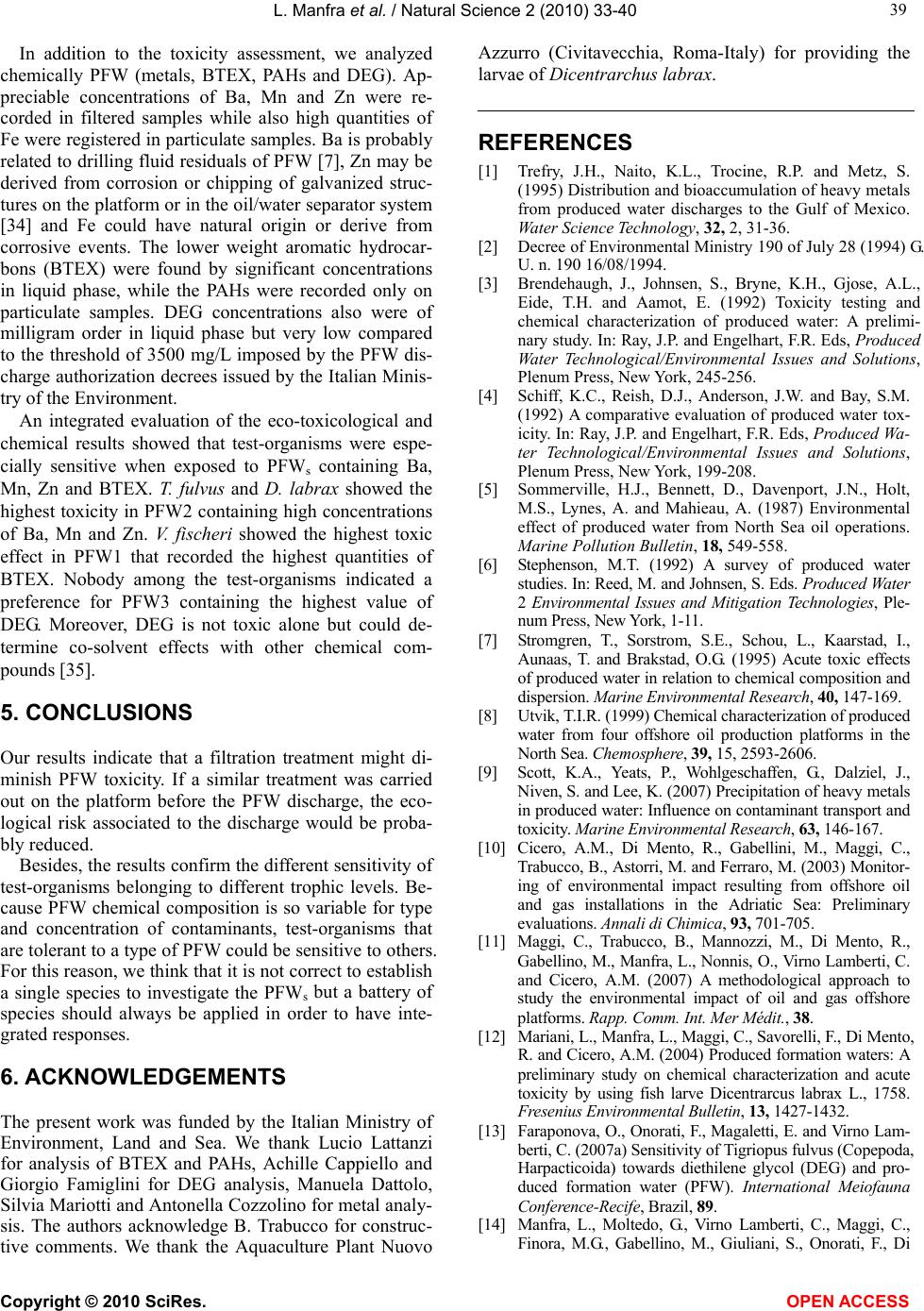 L. Manfra et al. / Natural Science 2 (2010) 33-40 Copyright © 2010 SciRes. OPEN ACCESS 39 39 In addition to the toxicity assessment, we analyzed chemically PFW (metals, BTEX, PAHs and DEG). Ap- preciable concentrations of Ba, Mn and Zn were re- corded in filtered samples while also high quantities of Fe were registered in particulate samples. Ba is probably related to drilling fluid residuals of PFW [7], Zn may be derived from corrosion or chipping of galvanized struc- tures on the platform or in the oil/water separator system [34] and Fe could have natural origin or derive from corrosive events. The lower weight aromatic hydrocar- bons (BTEX) were found by significant concentrations in liquid phase, while the PAHs were recorded only on particulate samples. DEG concentrations also were of milligram order in liquid phase but very low compared to the threshold of 3500 mg/L imposed by the PFW dis- charge authorization decrees issued by the Italian Minis- try of the Environment. An integrated evaluation of the eco-toxicological and chemical results showed that test-organisms were espe- cially sensitive when exposed to PFWs containing Ba, Mn, Zn and BTEX. T. fulvus and D. labrax showed the highest toxicity in PFW2 containing high concentrations of Ba, Mn and Zn. V. fischeri showed the highest toxic effect in PFW1 that recorded the highest quantities of BTEX. Nobody among the test-organisms indicated a preference for PFW3 containing the highest value of DEG. Moreover, DEG is not toxic alone but could de- termine co-solvent effects with other chemical com- pounds [35]. 5. CONCLUSIONS Our results indicate that a filtration treatment might di- minish PFW toxicity. If a similar treatment was carried out on the platform before the PFW discharge, the eco- logical risk associated to the discharge would be proba- bly reduced. Besides, the results confirm the different sensitivity of test-organisms belonging to different trophic levels. Be- cause PFW chemical composition is so variable for type and concentration of contaminants, test-organisms that are tolerant to a type of PFW could be sensitive to others. For this reason, we think that it is not correct to establish a single species to investigate the PFWs but a battery of species should always be applied in order to have inte- grated responses. 6. ACKNOWLEDGEMENTS The present work was funded by the Italian Ministry of Environment, Land and Sea. We thank Lucio Lattanzi for analysis of BTEX and PAHs, Achille Cappiello and Giorgio Famiglini for DEG analysis, Manuela Dattolo, Silvia Mariotti and Antonella Cozzolino for metal analy- sis. The authors acknowledge B. Trabucco for construc- tive comments. We thank the Aquaculture Plant Nuovo Azzurro (Civitavecchia, Roma-Italy) for providing the larvae of Dicentrarchus labrax. REFERENCES [1] Trefry, J.H., Naito, K.L., Trocine, R.P. and Metz, S. (1995) Distribution and bioaccumulation of heavy metals from produced water discharges to the Gulf of Mexico. Water Science Technology, 32, 2, 31-36. [2] Decree of Environmental Ministry 190 of July 28 (1994) G. U. n. 190 16/08/1994. [3] Brendehaugh, J., Johnsen, S., Bryne, K.H., Gjose, A.L., Eide, T.H. and Aamot, E. (1992) Toxicity testing and chemical characterization of produced water: A prelimi- nary study. In: Ray, J.P. and Engelhart, F.R. Eds, Produced Water Technological/Environmental Issues and Solutions, Plenum Press, New York, 245-256. [4] Schiff, K.C., Reish, D.J., Anderson, J.W. and Bay, S.M. (1992) A comparative evaluation of produced water tox- icity. In: Ray, J.P. and Engelhart, F.R. Eds, Produced Wa- ter Technological/Environmental Issues and Solutions, Plenum Press, New York, 199-208. [5] Sommerville, H.J., Bennett, D., Davenport, J.N., Holt, M.S., Lynes, A. and Mahieau, A. (1987) Environmental effect of produced water from North Sea oil operations. Marine Pollution Bulletin, 18, 549-558. [6] Stephenson, M.T. (1992) A survey of produced water studies. In: Reed, M. and Johnsen, S. Eds. Produced Water 2 Environmental Issues and Mitigation Technologies, Ple- num Press, New York, 1-11. [7] Stromgren, T., Sorstrom, S.E., Schou, L., Kaarstad, I., Aunaas, T. and Brakstad, O.G. (1995) Acute toxic effects of produced water in relation to chemical composition and dispersion. Marine Environmental Research, 40, 147-169. [8] Utvik, T.I.R. (1999) Chemical characterization of produced water from four offshore oil production platforms in the North Sea. Chemosphere, 39, 15, 2593-2606. [9] Scott, K.A., Yeats, P., Wohlgeschaffen, G., Dalziel, J., Niven, S. and Lee, K. (2007) Precipitation of heavy metals in produced water: Influence on contaminant transport and toxicity. Marine Environmental Research, 63, 146-167. [10] Cicero, A.M., Di Mento, R., Gabellini, M., Maggi, C., Trabucco, B., Astorri, M. and Ferraro, M. (2003) Monitor- ing of environmental impact resulting from offshore oil and gas installations in the Adriatic Sea: Preliminary evaluations. Annali di Chimica, 93, 701-705. [11] Maggi, C., Trabucco, B., Mannozzi, M., Di Mento, R., Gabellino, M., Manfra, L., Nonnis, O., Virno Lamberti, C. and Cicero, A.M. (2007) A methodological approach to study the environmental impact of oil and gas offshore platforms. Rapp. Comm. Int. Mer Médit., 38. [12] Mariani, L., Manfra, L., Maggi, C., Savorelli, F., Di Mento, R. and Cicero, A.M. (2004) Produced formation waters: A preliminary study on chemical characterization and acute toxicity by using fish larve Dicentrarcus labrax L., 1758. Fresenius Environmental Bulletin, 13, 1427-1432. [13] Faraponova, O., Onorati, F., Magaletti, E. and Virno Lam- berti, C. (2007a) Sensitivity of Tigriopus fulvus (Copepoda, Harpacticoida) towards diethilene glycol (DEG) and pro- duced formation water (PFW). International Meiofauna Conference-Recife, Brazil, 89. [14] Manfra, L., Moltedo, G., Virno Lamberti, C., Maggi, C., Finora, M.G., Gabellino, M., Giuliani, S., Onorati, F., Di  L. Manfra et al. / Natural Science 2 (2010) 33-40 Copyright © 2010 SciRes. OPEN ACCESS 40 Mento, R. and Cicero A.M. (2007) Metal content and tox- icity of produced formation water (PFW): Study of the possible effects of the discharge on marine environment. Archives of Environmental Contamination and Toxicology, 53, 183-190. [15] Manfra, L., De Nicola, E., Maggi, C., Zambianchi, E., Caramello, D., Toscano, A., Cianelli, D. and Cicero, A.M. Submitted Exposure of rotifers, crustaceans and sea ur- chins to produced formation water and seawaters collected in a gas platform area. Journal of the Marine Biological Association. [16] Prego, R., Cottè, M.H., Cobelo Garcìa, A. and Martin, J.M. (2006) Trace metals in the water column of the Vigo Ria: Offshore exchange in mid-winter conditions. Estuarine Costal and Shelf Science, 68, 289-296. [17] Weyerhaeuser (2005) Material safety data sheet MSDS WC 379-01 Rev. 8/26/2005, 1-7. [18] Azur Environmental (1995) Microtox® acute toxicity basic test procedures, 63. [19] ISO (2004) Water quality: Determination of the inhibitory effect of water samples on the light emission of Vibrio fischeri (luminescent bacteria test)-Part 3: Method using freeze-dried bacteria. ISO/CD, 11348-3. [20] ISO (2006) Water quality: Marine algal growth inhibition test with Skeletonema costatum and Phaeodactylum tri- cornutum. Reference number ISO 10253:2006, 12. [21] IRSA (1978) Metodologia di saggio algale per lo studio di acque marine. Quaderni dell'Istituto di Ricerca sulle Acque, IRSA-CNR, Milano, 39. [22] APAT-IRSA-CNR (2003) Metodo 8060. Metodo di valu- tazione della tossicità acuta con Artemia sp. In: APAT- IRSA-CNR, Metodi analitici per le acque, Manuali e Linee Guida 29/2003, Volume Terzo, 1043-1049. [23] ISO/FDIS (1998) Water quality: Determination of acute lethal toxicity to marine copepods (Copepoda, Crustacea). ISO/FDIS, 16, 14669. [24] Faraponova, O., De Pascale, D., Onorati, F. and Finoia, M.G. (2005) Tigriopus fulvus (Copepoda, Harpacticoda) as a target species in biological assays. Meiofauna Marina, 14, 91-95. [25] Faraponova, O., Virno Lamberti, C. and Onorati, F. (2007b) Study intensification of Tigriopus fulvus (Copepoda, Har- pacticoida) as a target species in bioassays. International Meiofauna Conference-ecife, Brazil, 90. [26] EPA (1993) Methods for measuring the acute toxicity of effluents and receiving waters to freshwaters and marine organisms. EPA/600/4-90/027F, Environmental Protection Agency, Cincinnati, Ohio, 71-91. [27] OECD (1992) Guideline for testing of chemicals n° 203. Fish, Acute Toxicity Test, 1-9. [28] EPA (1998) Mercury in solids and solutions by thermal decomposition, amalgamation, and atomic absorption spectrophotometry Method 7473. Environmental Protec- tion Agency, Cincinnati, Ohio. [29] EPA (1996) Volatile organic compounds by gas chroma- tography/mass spectrometry (GC/MS) Method 8260B (Revision 2). Environmental Protection Agency, Cincinnati, Ohio. [30] Cappiello, A., Famiglini, G., Mangani, F. and Palma, P. (2001) New trends in the application of electron ionization to liquid chromatography-mass spectrometry interfacing. Mass Spectrom. Rev., 20, 88-104. [31] Cappiello, A., Famiglini, G., Mangani, F. and Palma, P. (2002) A simple approach for coupling liquid chromatog- raphy and electron ionization mass spectrometry. J. Am. Soc. Mass. Spectrom., 13, 265-273. [32] Cappiello, A., Famiglini, G. and Palma, P. (2003) Elec- tron ionization for LC/MS. Analytical Chemistry, 75, 497A-503A. [33] Cappiello, A., Famiglini, G., Palma, P., Pierini, E., Trufelli, H., Maggi, C., Manfra, L. and Mannozzi, M. (2007) Ap- plication of nano-FIA-Direct-EI-MS to determine diethyl- ene glycol in produced formation water discharges and seawater samples. Chemosphere, 69, 554-560. [34] Neff, J.M., Sauer, T.C. and Maciolek, N. (1992) Composi- tion, fate and effects of produced water discharges to nearshore marine waters. In: Ray J.P. and Engelhart F.R. Eds, Produced Water Technological/Environmental Issues and Solutions, Plenum Press, New York, 371-385. [35] Sorensen, J.A., Gallagher, J.R., Hawthorne, S.B. and Au- lich, T.R. (2000) Gas Industry Groundwater Research Program, Final Report for U.S. Department of Energy Na- tional Energy Technology Laboratory Cooperative Agreement No. DE-FC26-98FT40321; Energy & Envi- ronmental Research Center Publication 2004-EERC- 07-01, Grand Forks, ND. |